
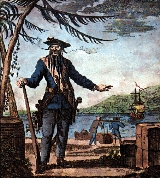
Edward Teach better known as
Blackbeard, was a notorious English
piratePiracy is an act of robbery or criminal violence at sea. The term can include acts committed on land, in the air, or in other major bodies of water or on a shore. It does not normally include crimes committed against persons traveling on the same vessel as the perpetrator...
who operated around the West Indies and the eastern coast of the
American coloniesThe start of the European colonization of the Americas is typically dated to 1492. The first Europeans to reach the Americas were the Vikings during the 11th century, who established several colonies in Greenland and one short-lived settlement in present day Newfoundland...
.
Although little is known about his early life, he was probably born in
BristolBristol is a city, unitary authority area and ceremonial county in South West England, with an estimated population of 433,100 for the unitary authority in 2009, and a surrounding Larger Urban Zone with an estimated 1,070,000 residents in 2007...
, England. He may have been a sailor on
privateerA privateer is a private person or ship authorized by a government by letters of marque to attack foreign shipping during wartime. Privateering was a way of mobilizing armed ships and sailors without having to spend public money or commit naval officers...
ships during
Queen Anne's WarQueen Anne's War , as the North American theater of the War of the Spanish Succession was known in the British colonies, was the second in a series of French and Indian Wars fought between France and England, later Great Britain, in North America for control of the continent. The War of the...
before settling on the
CaribbeanThe Caribbean is a crescent-shaped group of islands more than 2,000 miles long separating the Gulf of Mexico and the Caribbean Sea, to the west and south, from the Atlantic Ocean, to the east and north...
island of
New ProvidenceNew Providence is the most populous island in the Bahamas, containing more than 70% of the total population. It also houses the national capital city, Nassau.The island was originally under Spanish control following Christopher Columbus' discovery of the New World, but the Spanish government showed...
, a base for Captain
Benjamin HornigoldCaptain Benjamin Hornigold was an 18th-century English pirate. His career lasted from 1715 to 1718, after which he turned pirate hunter and pursued his former allies on behalf of the Governor of the Bahamas...
, whose crew Teach joined sometime around 1716. Hornigold placed him in command of a sloop he had captured, and the two engaged in numerous acts of piracy. Their numbers were boosted by the addition to their fleet of two more ships, one of which was commanded by
Stede BonnetStede Bonnet was an early 18th-century Barbadian pirate, sometimes called "the gentleman pirate" because he was a moderately wealthy landowner before turning to a life of crime. Bonnet was born into a wealthy English family on the island of Barbados, and inherited the family estate after his...
, but toward the end of 1717 Hornigold retired from piracy, taking two vessels with him.
Teach captured a French merchant vessel, renamed her
Queen Anne's RevengeQueen Anne's Revenge was the name of English pirate Blackbeard's flagship, used by him for less than a year, but an effective tool in his prize taking....
, and equipped her with 40 guns. He became a renowned pirate, his
cognomenThe cognomen nōmen "name") was the third name of a citizen of Ancient Rome, under Roman naming conventions. The cognomen started as a nickname, but lost that purpose when it became hereditary. Hereditary cognomina were used to augment the second name in order to identify a particular branch within...
derived from his thick black beard and fearsome appearance; he was reported to have tied lit fuses under his hat to frighten his enemies. He formed an alliance of pirates and blockaded the port of
Charleston, South CarolinaCharleston is the second largest city in the U.S. state of South Carolina. It was made the county seat of Charleston County in 1901 when Charleston County was founded. The city's original name was Charles Towne in 1670, and it moved to its present location from a location on the west bank of the...
. After successfully ransoming its inhabitants, he ran
Queen Anne's Revenge aground on a sandbar near Beaufort, North Carolina. He parted company with Bonnet, settling in
Bath TownBath is a town in Beaufort County, North Carolina, United States. The population was 268 at the 2008 census. Incorporated in 1705, Bath was North Carolina's first port of entry. Bath is North Carolina's oldest town, celebrating its 300th anniversary in 2005...
, where he accepted a royal pardon. But he was soon back at sea and attracted the attention of
Alexander SpotswoodAlexander Spotswood was a Lieutenant-Colonel in the British Army and a noted Lieutenant Governor of Virginia. He is noted in Virginia and American history for a number of his projects as Governor, including his exploring beyond the Blue Ridge Mountains, his establishing what was perhaps the first...
, the
Governor of VirginiaThe governor of Virginia serves as the chief executive of the Commonwealth of Virginia for a four-year term. The position is currently held by Republican Bob McDonnell, who was inaugurated on January 16, 2010, as the 71st governor of Virginia....
. Spotswood arranged for a party of soldiers and sailors to try to capture the pirate, which they did on 22 November 1718. During a ferocious battle, Teach and several of his crew were killed by a small force of sailors led by Lieutenant
Robert MaynardCaptain Robert Maynard RN was a lieutenant and later captain in the Royal Navy, First Lieutenant of HMS Pearl, most famous for defeating the infamous English pirate Blackbeard in battle.- Naval commands and battles :...
.
A shrewd and calculating leader, Teach spurned the use of force, relying instead on his fearsome image to elicit the response he desired from those he robbed. Contrary to the modern-day picture of the traditional tyrannical pirate, he commanded his vessels with the permission of their crews and there is no known account of his ever having harmed or murdered those he held captive. He was romanticised after his death and became the inspiration for a number of pirate-themed works of fiction across a range of genres.
Early life
Little is known about Blackbeard's early life. It is commonly believed that at the time of his death he was between 35 and 40 years old and thus born in about 1680. In contemporary records his name is most often given as Blackbeard, Edward Thatch, or Edward Teach and it is the last that today is most often used. However, several spellings of his surname exist—Thatch, Thach, Thache, Thack, Tack, Thatche and Theach. One early source claims that his surname was Drummond, but the lack of any supporting documentation makes this unlikely. Pirates habitually used fictitious surnames while engaged in the business of piracy, so as not to tarnish the family name, and this makes it unlikely that Teach's real name will ever be known.
The 17th-century rise of Britain's American colonies and the rapid 18th-century expansion of the
Atlantic slave tradeThe Atlantic slave trade, also known as the trans-atlantic slave trade, refers to the trade in slaves that took place across the Atlantic ocean from the sixteenth through to the nineteenth centuries...
had made
BristolBristol is a city, unitary authority area and ceremonial county in South West England, with an estimated population of 433,100 for the unitary authority in 2009, and a surrounding Larger Urban Zone with an estimated 1,070,000 residents in 2007...
an important international sea port, and Teach was most likely raised in what was the second-largest city in England. He could almost certainly read and write; he communicated with merchants and when killed had in his possession a letter addressed to him by the Chief Justice and Secretary of the
Province of CarolinaThe Province of Carolina, originally chartered in 1629, was an English and later British colony of North America. Because the original Heath charter was unrealized and was ruled invalid, a new charter was issued to a group of eight English noblemen, the Lords Proprietors, in 1663...
, Tobias Knight. The author Robert Lee speculated that Teach may therefore have been born into a respectable, wealthy family. He may have arrived in the Caribbean in the last years of the 17th century, on a merchant vessel (possibly a
slave shipSlave ships were large cargo ships specially converted for the purpose of transporting slaves, especially newly purchased African slaves to Americas....
). The 18th-century author Charles Johnson claimed that Teach was for some time a sailor operating from
JamaicaJamaica is an island nation of the Greater Antilles, in length, up to in width and 10,990 square kilometres in area. It is situated in the Caribbean Sea, about south of Cuba, and west of Hispaniola, the island harbouring the nation-states Haiti and the Dominican Republic...
on privateer ships during
Queen Anne's WarQueen Anne's War , as the North American theater of the War of the Spanish Succession was known in the British colonies, was the second in a series of French and Indian Wars fought between France and England, later Great Britain, in North America for control of the continent. The War of the...
, and that "he had often distinguished himself for his uncommon boldness and personal courage". At what point during the war Teach joined the fighting is, in keeping with the record of most of his life before he became a pirate, unknown.
New Providence
With its history of colonialism, trade and piracy, the West Indies was the setting for many 17th and 18th-century maritime incidents. The privateer-turned-pirate
Henry JenningsHenry Jennings was an 18th century British privateer who served primarily during the War of Spanish Succession and later served as leader of the pirate haven of New Providence....
and his followers decided, early in the 18th century, to use the then uninhabited island of
New ProvidenceNew Providence is the most populous island in the Bahamas, containing more than 70% of the total population. It also houses the national capital city, Nassau.The island was originally under Spanish control following Christopher Columbus' discovery of the New World, but the Spanish government showed...
as a base for their operations; it was within easy reach of the Florida Strait and its busy shipping lanes, which were filled with European vessels crossing the Atlantic. New Providence's harbour could easily accommodate hundreds of ships, and was too shallow for the
Royal NavyThe Royal Navy is the naval warfare service branch of the British Armed Forces. Founded in the 16th century, it is the oldest service branch and is known as the Senior Service...
's larger vessels to navigate. The island then was not the popular tourist destination it later became; the author George Woodbury described it as "no city of homes; it was a place of temporary sojourn and refreshment for a literally floating population," continuing, "The only permanent residents were the piratical camp followers, the traders, and the hangers-on; all others were transient." Law and order were unheard of; in New Providence, pirates found a welcome respite.
Teach was one of those who came to enjoy the island's benefits. Probably shortly after the signing of the
Treaty of UtrechtThe Treaty of Utrecht, which established the Peace of Utrecht, comprises a series of individual peace treaties, rather than a single document, signed by the belligerents in the War of Spanish Succession, in the Dutch city of Utrecht in March and April 1713...
, he moved there from
JamaicaJamaica is an island nation of the Greater Antilles, in length, up to in width and 10,990 square kilometres in area. It is situated in the Caribbean Sea, about south of Cuba, and west of Hispaniola, the island harbouring the nation-states Haiti and the Dominican Republic...
, and with most
privateerA privateer is a private person or ship authorized by a government by letters of marque to attack foreign shipping during wartime. Privateering was a way of mobilizing armed ships and sailors without having to spend public money or commit naval officers...
s once involved in the war, became involved in piracy. Possibly about 1716, he joined the crew of Captain
Benjamin HornigoldCaptain Benjamin Hornigold was an 18th-century English pirate. His career lasted from 1715 to 1718, after which he turned pirate hunter and pursued his former allies on behalf of the Governor of the Bahamas...
, a renowned pirate who operated from New Providence's safe waters. In 1716 Hornigold placed Teach in charge of a
sloopA sloop is a sail boat with a fore-and-aft rig and a single mast farther forward than the mast of a cutter....
he had taken as a prize. In early 1717, Hornigold and Teach, each captaining a sloop, set out for the mainland. They captured a boat carrying 120 barrels of flour out of
HavanaHavana is the capital city, province, major port, and leading commercial centre of Cuba. The city proper has a population of 2.1 million inhabitants, and it spans a total of — making it the largest city in the Caribbean region, and the most populous...
, and shortly thereafter took 100 barrels of wine from a sloop out of
BermudaBermuda is a British overseas territory in the North Atlantic Ocean. Located off the east coast of the United States, its nearest landmass is Cape Hatteras, North Carolina, about to the west-northwest. It is about south of Halifax, Nova Scotia, Canada, and northeast of Miami, Florida...
. A few days later they stopped a vessel sailing from
MadeiraMadeira is a Portuguese archipelago that lies between and , just under 400 km north of Tenerife, Canary Islands, in the north Atlantic Ocean and an outermost region of the European Union...
to
Charleston, South CarolinaCharleston is the second largest city in the U.S. state of South Carolina. It was made the county seat of Charleston County in 1901 when Charleston County was founded. The city's original name was Charles Towne in 1670, and it moved to its present location from a location on the west bank of the...
. Teach and his quartermaster, William Howard, may at this time have struggled to control their crews. By then they had probably developed a taste for
Madeira wineMadeira is a fortified Portuguese wine made in the Madeira Islands. Some wines produced in small quantities in California and Texas are also referred to as "Madeira", or "Madera", although those wines do not conform to the EU PDO regulations...
, and on 29 September near
Cape CharlesCape Charles is a town in Northampton County, Virginia, United States. The population was 1,134 at the 2000 census.-Geography:Cape Charles is located at ....
all they took from the
Betty of Virginia was her cargo of Madeira, before they
scuttledScuttling is the act of deliberately sinking a ship by allowing water to flow into the hull.This can be achieved in several ways—valves or hatches can be opened to the sea, or holes may be ripped into the hull with brute force or with explosives...
her with the remaining cargo.
It was during this cruise with Hornigold that the earliest known report of Teach was made, in which he is recorded as a pirate in his own right, in command of a large crew. In a report made by a Captain Mathew Munthe on an anti-piracy patrol for North Carolina, "Thatch" was described as operating "a sloop 6 gunns [sic] and about 70 men". In September Teach and Hornigold encountered
Stede BonnetStede Bonnet was an early 18th-century Barbadian pirate, sometimes called "the gentleman pirate" because he was a moderately wealthy landowner before turning to a life of crime. Bonnet was born into a wealthy English family on the island of Barbados, and inherited the family estate after his...
, a landowner and military officer from a wealthy family who had turned to piracy earlier that year. Bonnet's crew of about 70 were reportedly dissatisfied with his command, so with Bonnet's permission, Teach took control of his ship
Revenge. The pirates' flotilla now consisted of three ships; Teach on
Revenge, Teach's old sloop and Hornigold's
Ranger. By October, another vessel had been captured and added to the small fleet. The sloops
Robert of Philadelphia and
Good Intent of
Dublin were stopped on 22 October 1717, and their cargo holds emptied.
As a former British privateer, Hornigold attacked only his old enemies, but for his crew, the sight of British vessels filled with valuable cargo passing by unharmed became too much, and at some point toward the end of 1717 he was demoted. Whether Teach had any involvement in this decision is unknown, but Hornigold quickly retired from piracy. He took
Ranger and one of the sloops, leaving Teach with
Revenge and the remaining sloop. The two never met again, and with many other occupants of New Providence, Hornigold accepted the King's pardon from
Woodes RogersWoodes Rogers was an English sea captain, privateer, and, later, the first Royal Governor of the Bahamas. He is known as the captain of the vessel that rescued the marooned Alexander Selkirk, whose plight is generally believed to have inspired Daniel Defoe's Robinson Crusoe.Rogers came from an...
in June the following year.
Blackbeard
On 28 November Teach's two ships attacked a French merchant vessel off the coast of
Saint VincentSaint Vincent is a volcanic island in the Caribbean. It is the largest island of the chain called Saint Vincent and the Grenadines. It is located in the Caribbean Sea, between Saint Lucia and Grenada. It is composed of partially submerged volcanic mountains...
. They each fired a
broadsideA broadside is the side of a ship; the battery of cannon on one side of a warship; or their simultaneous fire in naval warfare.-Age of Sail:...
across its bulwarks, killing several of its crew, and forcing its captain to surrender. The ship was
La Concorde of
Saint-MaloSaint-Malo is a walled port city in Brittany in northwestern France on the English Channel. It is a sub-prefecture of the Ille-et-Vilaine.-Demographics:The population can increase to up to 200,000 in the summer tourist season...
, a large French guineaman carrying a cargo of slaves. Teach and his crews sailed the vessel south along
Saint Vincent and the GrenadinesSaint Vincent and the Grenadines is an island country in the Lesser Antilles chain, namely in the southern portion of the Windward Islands, which lie at the southern end of the eastern border of the Caribbean Sea where the latter meets the Atlantic Ocean....
to
BequiaBequia is the largest island in the Grenadines. It is part of the country of Saint Vincent and the Grenadines, and is approximately 15 km from the nation's capital, Kingstown.-Geography:The island capital is Port Elizabeth...
, where they disembarked her crew and cargo, and converted the ship for their own use. The crew of
La Concorde were given the smaller of Teach's two
sloopA sloop is a sail boat with a fore-and-aft rig and a single mast farther forward than the mast of a cutter....
s, which they renamed
Mauvaise Rencontre (Bad Meeting), and sailed for Martinique. Teach may have recruited some of their slaves, but the remainder were left on the island and were later recaptured by the returning crew of
Mauvaise Rencontre.
Teach immediately renamed
La Concorde as
Queen Anne's RevengeQueen Anne's Revenge was the name of English pirate Blackbeard's flagship, used by him for less than a year, but an effective tool in his prize taking....
and equipped her with 40 guns. In late November, near Saint Vincent, he attacked the
Great Allen. After a lengthy engagement, he forced the large and well-armed merchant ship to surrender. He ordered her to move closer to the shore, disembarked her crew and emptied her cargo holds, and then burned and sank the vessel. The incident was chronicled in the
Boston News Letter, which called Teach the commander of a "French ship of 32 Guns, a Briganteen of 10 guns and a Sloop of 12 guns." When or where Teach collected the ten gun
BriganteenIn sailing, a brigantine or hermaphrodite brig is a vessel with two masts, only the forward of which is square rigged.-Origins of the term:...
is unknown, but by that time he may have been in command of at least 150 men split between three vessels.
On 5 December 1717 Teach stopped the merchant sloop
Margaret off the coast of Crab Island, near
AnguillaAnguilla is a British overseas territory and overseas territory of the European Union in the Caribbean. It is one of the most northerly of the Leeward Islands in the Lesser Antilles, lying east of Puerto Rico and the Virgin Islands and directly north of Saint Martin...
. Her captain, Henry Bostock, and crew, remained Teach's prisoners for about eight hours, and were forced to watch as their sloop was ransacked. Bostock, who had been held aboard
Queen Anne's Revenge, was returned unharmed to
Margaret and was allowed to leave with his crew. He returned to his base of operations on Saint Christopher Island and reported the matter to Governor Walter Hamilton, who requested that he sign an
affidavitAn affidavit is a written sworn statement of fact voluntarily made by an affiant or deponent under an oath or affirmation administered by a person authorized to do so by law. Such statement is witnessed as to the authenticity of the affiant's signature by a taker of oaths, such as a notary public...
about the encounter. Bostock's deposition details Teach's command of two vessels: a sloop and a large French guineaman, Dutch-built, with 36 cannon and a crew of 300 men. The captain believed that the larger ship carried valuable gold dust, silver plate, and "a very fine cup" supposedly taken from the commander of
Great Allen. Teach's crew had apparently informed Bostock that they had destroyed several other vessels, and that they intended to sail to
HispaniolaHispaniola is a major island in the Caribbean, containing the two sovereign states of the Dominican Republic and Haiti. The island is located between the islands of Cuba to the west and Puerto Rico to the east, within the hurricane belt...
and lie in wait for an expected Spanish armada, supposedly laden with money to pay the garrisons. Bostock also claimed that Teach had questioned him about the movements of local ships, but also that he had seemed unsurprised when Bostock told him of an expected royal pardon from London for all pirates.
Bostock's deposition describes Teach as a "tall spare man with a very black beard which he wore very long". It is the first recorded account of Teach's appearance and is the source of his cognomen, Blackbeard. Later descriptions mention that his thick black beard was braided into pigtails, sometimes tied in with small coloured ribbons. Johnson (1724) described him as "such a figure that imagination cannot form an idea of a fury from hell to look more frightful." Whether Johnson's description was entirely truthful or embellished is unclear, but it seems likely that Teach understood the value of appearances; better to strike fear into the heart of one's enemies, than rely on bluster alone. Teach was tall, with broad shoulders. He wore knee-length boots and dark clothing, topped with a wide hat and sometimes a long coat of brightly-coloured silk or velvet. Johnson also described Teach in times of battle as wearing "a sling over his shoulders, with three brace of pistols, hanging in holsters like bandoliers; and stuck lighted matches under his hat", the latter apparently to emphasise the fearsome appearance he wished to present to his enemies. Despite his ferocious reputation though, there are no verified accounts of his ever having murdered or harmed those he held captive. Teach may have used other aliases; on 30 November, the
Monserrat Merchant encountered two ships and a sloop, commanded by a Captain Kentish and Captain Edwards (the latter a known alias of Stede Bonnet).
Enlargement of Teach's fleet
Teach's movements between late 1717 and early 1718 are not known. He and Bonnet were probably responsible for an attack off
Sint Eustatius in December 1717. Henry Bostock claimed to have heard the pirates say they would head toward the Spanish-controlled
Samaná BaySamaná Bay is a bay in the eastern Dominican Republic. The Yuna River flows into the Samaná Bay, and it is located south of the town and peninsula of Samaná....
in
HispaniolaHispaniola is a major island in the Caribbean, containing the two sovereign states of the Dominican Republic and Haiti. The island is located between the islands of Cuba to the west and Puerto Rico to the east, within the hurricane belt...
, but a cursory search revealed no pirate activity. Captain Hume of
HMS ScarboroughTen ships of the Royal Navy have borne the name HMS Scarborough, after the town of Scarborough:*HMS Scarborough was a 10-gun ketch launched in 1691 and captured by the French in 1693....
reported on 6 February that a "Pyrate Ship of 36 Guns and 250 men, and a Sloop of 10 Guns and 100 men were Said to be Cruizing amongst the Leeward Islands". Hume reinforced his crew with
musketA musket is a muzzle-loaded, smooth bore long gun, fired from the shoulder. Muskets were designed for use by infantry. A soldier armed with a musket had the designation musketman or musketeer....
-armed soldiers and joined up with
HMS SeafordFour ships of the Royal Navy have borne the name HMS Seaford, after the coastal town of Seaford, now in East Sussex. A fifth was planned, but was not completed for the navy:...
to track the two ships, to no avail, though they discerned that the two ships had sunk a French vessel off
St Christopher IslandSaint Kitts Saint Kitts Saint Kitts (also known more formally as Saint Christopher Island (Saint-Christophe in French) is an island in the West Indies. The west side of the island borders the Caribbean Sea, and the eastern coast faces the Atlantic Ocean...
, and reported also that they had last been seen "gone down the North side of Hispaniola". Although no confirmation exists that these two ships were controlled by Teach and Bonnet, author Angus Konstam believes it very likely they were.
In March 1718, while taking on water at Turneffe Island east of
BelizeBelize is a constitutional monarchy and the northernmost country in Central America. Belize has a diverse society, comprising many cultures and languages. Even though Kriol and Spanish are spoken among the population, Belize is the only country in Central America where English is the official...
, both ships spotted a sloop from Jamaica,
Adventure, making for the harbour. She was quickly stopped and her captain, David Harriot, invited to join the pirates. Harriot and his crew accepted the invitation, and Teach sent over a crew to run
Adventure. They sailed for the Bay of Honduras, where they added another ship and four sloops to their flotilla. On 9 April Teach's enlarged fleet of ships looted and burnt
Protestant Caesar. His fleet then sailed to
Grand CaymanGrand Cayman is the largest of the three Cayman Islands and the location of the nation's capital, George Town. In relation to the other two Cayman Islands, it is approximately 75 miles southwest of Little Cayman and 90 miles southwest of Cayman Brac.-Geography:Grand Cayman encompasses 76% of...
where they captured a "small turtler". Teach probably sailed toward
HavanaHavana is the capital city, province, major port, and leading commercial centre of Cuba. The city proper has a population of 2.1 million inhabitants, and it spans a total of — making it the largest city in the Caribbean region, and the most populous...
, where he may have captured a small Spanish vessel that had left the Cuban port. They then sailed to the wrecks of the 1715 Spanish fleet, off the western coast of
FloridaFlorida is a state in the southeastern United States, located on the nation's Atlantic and Gulf coasts. It is bordered to the west by the Gulf of Mexico, to the north by Alabama and Georgia and to the east by the Atlantic Ocean. With a population of 18,801,310 as measured by the 2010 census, it...
. There Teach disembarked the crew of the captured Spanish sloop, before proceeding north to the port of
Charleston, South CarolinaCharleston is the second largest city in the U.S. state of South Carolina. It was made the county seat of Charleston County in 1901 when Charleston County was founded. The city's original name was Charles Towne in 1670, and it moved to its present location from a location on the west bank of the...
, attacking three vessels along the way.
Blockade of Charleston
By May 1718 Teach had awarded himself the rank of
CommodoreCommodore is a military rank used in many navies that is superior to a navy captain, but below a rear admiral. Non-English-speaking nations often use the rank of flotilla admiral or counter admiral as an equivalent .It is often regarded as a one-star rank with a NATO code of OF-6, but is not always...
and was at the height of his power. Late that month his flotilla blockaded the port of
CharlestonCharleston is the second largest city in the U.S. state of South Carolina. It was made the county seat of Charleston County in 1901 when Charleston County was founded. The city's original name was Charles Towne in 1670, and it moved to its present location from a location on the west bank of the...
(then known as Charles Town) in
South CarolinaSouth Carolina is a state in the Deep South of the United States that borders Georgia to the south, North Carolina to the north, and the Atlantic Ocean to the east. Originally part of the Province of Carolina, the Province of South Carolina was one of the 13 colonies that declared independence...
. All vessels entering or leaving the port were stopped, and as the town had no
guard shipA guard ship is a warship stationed at some port or harbour to act as a guard, and in former times in the Royal Navy to receive the men impressed for service...
, its
pilot boatA Pilot Boat is a type of boat used to transport pilots between land and the inbound or outbound ships that they are piloting.-History:The origins of the word pilot probably disseminates from the Latin word pilota, a variation of pedota, the plural of pēdón which translates as oar...
was the first to be captured. Over the next five or six days about nine vessels were stopped and ransacked as they attempted to sail past
Charleston BarCharleston Bar is a series of submerged shoals lying about eight miles southeast of Charleston, South Carolina, United States.-See also:* Battle of Sullivan's Island...
, where Teach's fleet was anchored. One such ship, headed for London with a group of prominent Charleston citizens which included Samuel Wragg (a member of the Council of the Province of Carolina), was the
Crowley. Her passengers were questioned about the vessels still in port and then locked below decks for about half a day. Teach informed the prisoners that his fleet required medical supplies from the colonial government of South Carolina, and that if none were forthcoming, all prisoners would be executed, their heads sent to the Governor and all captured ships burnt.
Wragg agreed to Teach's demands, and a Mr Marks and two pirates were given two days to collect the drugs. Teach moved his fleet, and the captured ships, to within about five or six
leaguesA league is a unit of length . It was long common in Europe and Latin America, but it is no longer an official unit in any nation. The league originally referred to the distance a person or a horse could walk in an hour...
from land. Three days later a messenger, sent by Marks, returned to the fleet; Marks's boat had capsized and delayed their arrival in Charleston. Teach granted a reprieve of two days, but still the party did not return. He then called a meeting of his fellow sailors and moved eight ships into the harbour, causing panic within the town. When Marks finally returned to the fleet, he explained what had happened. On his arrival he had presented the pirates' demands to the Governor and the drugs had been quickly gathered, but the two pirates sent to escort him had proved difficult to find; they had been busy drinking with friends and were finally discovered, drunk.
Teach kept to his side of the bargain and released the captured ships and his prisoners—albeit relieved of their valuables, including the fine clothing some had worn.
Beaufort Inlet
Whilst at Charleston, Teach learned that
Woodes RogersWoodes Rogers was an English sea captain, privateer, and, later, the first Royal Governor of the Bahamas. He is known as the captain of the vessel that rescued the marooned Alexander Selkirk, whose plight is generally believed to have inspired Daniel Defoe's Robinson Crusoe.Rogers came from an...
had left England with several men-of-war, with orders to purge the West Indies of pirates. Teach's flotilla sailed northward along the Atlantic coast and into Topsail Inlet (commonly known as Beaufort Inlet), off the coast of North Carolina. There they intended to
careenCareening a sailing vessel is the practice of beaching it at high tide. This is usually done in order to expose one side or another of the ship's hull for maintenance and repairs below the water line when the tide goes out....
their ships to scrape their hulls, but
Queen Anne's Revenge ran aground on a sandbar, cracking her main-mast and severely damaging many of her timbers. Teach ordered several sloops to throw ropes across the flagship in an attempt to free her. A sloop commanded by
Israel HandsIsrael Hands was an 18th century pirate, also known as Basilica Hands. Hands is best known for being second in command to Edward Teach, better known as Blackbeard...
of
Adventure also ran aground, and both vessels appeared to be damaged beyond repair, leaving only
Revenge and the captured Spanish sloop.
Teach had at some stage learnt of the offer of a royal pardon and probably confided in Bonnet his willingness to accept it. The pardon was open to all pirates who surrendered on or before 5 September 1718, but contained a caveat stipulating that immunity was offered only against crimes committed before 5 January. Although in theory this left Bonnet and Teach at risk of being hanged for their actions at Charleston Bar, most authorities could waive such conditions. Teach thought that Governor
Charles EdenCharles Eden was the second Governor of the separate Colony of North Carolina.-Public service:Eden was appointed Governor of North Carolina on 13 July 1713. He is best known for his actions to end piracy in the area...
was a man he could trust, but to make sure, he waited to see what would happen to another captain. Bonnet left immediately on a small sailing boat for
Bath TownBath is a town in Beaufort County, North Carolina, United States. The population was 268 at the 2008 census. Incorporated in 1705, Bath was North Carolina's first port of entry. Bath is North Carolina's oldest town, celebrating its 300th anniversary in 2005...
, where he surrendered to Governor Eden, and received his pardon. He then travelled back to Beaufort Inlet to collect the
Revenge and the remainder of his crew, intending to sail to Saint Thomas Island to receive a commission. Unfortunately for him, Teach had stripped the vessel of its valuables and provisions, and had marooned its crew; Bonnet set out for revenge, but was unable to find him. He and his crew returned to piracy and were captured on 27 September 1718 at the mouth of the
Cape Fear RiverThe Cape Fear River is a long blackwater river in east central North Carolina in the United States. It flows into the Atlantic Ocean near Cape Fear, from which it takes its name. The overall water quality of the river is continuously measured and monitored by and conducted by the , , and the...
. All but four were tried and hanged in Charleston.
The author Robert Lee surmised that Teach and Hands intentionally ran the ships aground to reduce the fleet's crew complement, increasing their share of the spoils. During the trial of Bonnet's crew,
Revenges
boatswainA boatswain , bo's'n, bos'n, or bosun is an unlicensed member of the deck department of a merchant ship. The boatswain supervises the other unlicensed members of the ship's deck department, and typically is not a watchstander, except on vessels with small crews...
Ignatius Pell testified that "the ship was run ashore and lost, which Thatch [Teach] caused to be done." Lee considers it plausible that Teach let Bonnet in on his plan to accept a pardon from Governor Eden. He suggested that Bonnet do the same, and as war between the
Quadruple Alliance of 1718The term "Quadruple Alliance" refers to several historical military alliances; none of which remain in effect.# The Quadruple Alliance of August 1673 was an alliance between the Holy Roman Empire, the Kingdom of Spain, Charles IV, Duke of Lorraine, and the United Provinces of the Netherlands, in...
and
SpainSpain , officially the Kingdom of Spain languages]] under the European Charter for Regional or Minority Languages. In each of these, Spain's official name is as follows:;;;;;;), is a country and member state of the European Union located in southwestern Europe on the Iberian Peninsula...
was threatening, to consider taking a privateer's commission from England. Lee suggests that Teach also offered Bonnet the return of his ship
Revenge. Konstam (2007) proposes a similar idea, explaining that Teach began to see
Queen Anne's Revenge as something of a liability; while a pirate fleet was anchored, news of this was sent to neighbouring towns and colonies, and any vessels nearby would delay sailing. It was prudent therefore for Teach not to linger for too long, although wrecking the ship was a somewhat extreme measure.
Pardon
Before sailing northward on his remaining sloop to
Ocracoke InletOcracoke Inlet is an estuary located in the Outer Banks, North Carolina, United States that separates Ocracoke Island and Portsmouth Island. It connects the Atlantic Ocean to the Pamlico Sound. It is the southern terminus of the Cape Hatteras National Seashore. It is the northern terminus of the...
, Teach marooned about 25 men on a small sandy island about a league from the mainland. He may have done this to stifle any protest they made, if they guessed their captain's plans. Bonnet rescued them two days later. Teach continued on to Bath, where in June 1718—only days after Bonnet had departed with his pardon—he and his much-reduced crew received their pardon from Governor Eden.
He settled in Bath, on the eastern side of Bath Creek at Plum Point, near Eden's home. During July and August he travelled between his base in the town and his sloop off Ocracoke. Johnson's account states that he married the daughter of a local plantation owner, although there is no supporting evidence for this. Eden gave Teach permission to sail to St Thomas to seek a commission as a privateer (a useful way of removing bored and troublesome pirates from the small settlement), and Teach was given official title to his remaining sloop, which he renamed
Adventure. By the end of August he had returned to piracy, and in the same month the Governor of Pennsylvania issued a warrant for his arrest, but by then Teach was probably operating in
Delaware BayDelaware Bay is a major estuary outlet of the Delaware River on the Northeast seaboard of the United States whose fresh water mixes for many miles with the waters of the Atlantic Ocean. It is in area. The bay is bordered by the State of New Jersey and the State of Delaware...
, some distance away. He took two French ships leaving the Caribbean, moved one crew across to the other, and sailed the remaining ship back to Ocracoke. In September he told Eden that he had found the French ship at sea, deserted. A
Vice Admiralty CourtVice admiralty courts were juryless courts located in British colonies that were granted jurisdiction over local legal matters related to maritime activities, such as disputes between merchants and seamen. Judges were given 5% of confiscated cargo, if they found a smuggling defendant guilty...
was quickly convened, presided over by Tobias Knight and the Collector of Customs. The ship was judged as a derelict found at sea, and of its cargo 20
hogsheadA hogshead is a large cask of liquid . More specifically, it refers to a specified volume, measured in either Imperial units or U.S. customary units, primarily applied to alcoholic beverages such as wine, ale, or cider....
s of sugar were awarded to Knight and sixty to Eden; Teach and his crew were given what remained in the vessel's hold.
Ocracoke Inlet was Teach's favourite anchorage. It was a perfect vantage point from which to view ships travelling between the various settlements of northeast Carolina, and it was from there that Teach first spotted the approaching ship of
Charles VaneCharles Vane was an English pirate who preyed upon English and French shipping. His pirate career lasted from 1716 - 1719. His flagship was a brigantine named the Ranger....
, another English pirate. Several months earlier Vane had rejected the pardon brought by Woodes Rogers and escaped the men-of-war the English captain brought with him to
NassauNassau is the capital, largest city, and commercial centre of the Commonwealth of the Bahamas. The city has a population of 248,948 , 70 percent of the entire population of The Bahamas...
. He had also been pursued by Teach's old commander, Benjamin Hornigold, who was by then a pirate hunter. Teach and Vane spent several nights on the southern tip of Ocracoke Island, accompanied by such notorious figures as Israel Hands, Robert Deal and
Calico JackJohn Rackham , commonly known as Calico Jack, was an English pirate captain operating in the Bahamas during the early 18th century...
.
Alexander Spotswood
As it spread throughout the neighbouring colonies, the news of Teach and Vane's impromptu party worried the Governor of Pennsylvania enough to send out two sloops to capture the pirates. They were unsuccessful, but
Governor of VirginiaThe governor of Virginia serves as the chief executive of the Commonwealth of Virginia for a four-year term. The position is currently held by Republican Bob McDonnell, who was inaugurated on January 16, 2010, as the 71st governor of Virginia....
Alexander SpotswoodAlexander Spotswood was a Lieutenant-Colonel in the British Army and a noted Lieutenant Governor of Virginia. He is noted in Virginia and American history for a number of his projects as Governor, including his exploring beyond the Blue Ridge Mountains, his establishing what was perhaps the first...
was also concerned that the supposedly retired freebooter and his crew were living in nearby North Carolina. Some of Teach's former crew had already moved into several Virginian seaport towns, prompting Spotswood to issue a proclamation on 10 July, requiring all former pirates to make themselves known to the authorities, to give up their arms and to not travel in groups larger than three. As head of a
Crown colonyA Crown colony, also known in the 17th century as royal colony, was a type of colonial administration of the English and later British Empire....
, Spotswood viewed the
proprietary colonyA proprietary colony was a colony in which one or more individuals, usually land owners, remaining subject to their parent state's sanctions, retained rights that are today regarded as the privilege of the state, and in all cases eventually became so....
of North Carolina with contempt; he had little faith in the ability of the Carolinians to control the pirates, who he suspected would be back to their old ways, disrupting Virginian commerce, as soon as their money ran out.
Spotswood learnt that William Howard, the former quartermaster of
Queen Anne's Revenge, was in the area, and believing that he might know of Teach's whereabouts had the pirate and his two slaves arrested. Spotswood had no legal authority to have pirates tried, and as a result, Howard's attorney, John Holloway, brought charges against Captain Brand of
HMS LymeAt least four vessels of the British Royal Navy have been named HMS Lyme:* Lyme , 52-gun third-rate. Renamed Montagu in 1660.* Lyme , 20-gun sixth-rate.* Lyme , 24-gun sixth-rate.* Lyme , 28-gun sixth-rate....
, where Howard was imprisoned. He also sued on Howard's behalf for damages of £500, claiming wrongful arrest.
Spotswood's council claimed that Teach's presence was a crisis and that under a statute of
William IIIWilliam III & II was a sovereign Prince of Orange of the House of Orange-Nassau by birth. From 1672 he governed as Stadtholder William III of Orange over Holland, Zeeland, Utrecht, Guelders, and Overijssel of the Dutch Republic. From 1689 he reigned as William III over England and Ireland...
, the governor was entitled to try Howard without a jury. The charges referred to several acts of piracy supposedly committed after the pardon's cut-off date, in "a sloop belonging to ye subjects of the King of Spain", but ignored the fact that they took place outside Spotswood's jurisdiction and in a vessel then legally owned. Another charge cited two attacks, one of which was the capture of a slave ship off Charleston Bar, from which one of Howard's slaves was presumed to have come. Howard was sent to await trial before a Court of Vice-Admiralty, on the charge of piracy, but Brand and his colleague, Captain Gordon (of
HMS PearlHMS Pearl may refer to:, a fourth-rate of 42 guns launched in 1708; a detachment of its crew under Lieutenant Robert Maynard killed Blackbeard in 1718; broken up in 1722, a fourth-rate of 42 guns launched in 1726 and sold in 1744, a fifth-rate of 44 guns launched in 1744 and sold in 1759, a...
) refused to serve with Holloway present. Incensed, Holloway had no option but to stand down, and was replaced by the
Attorney General of VirginiaThe Attorney General of Virginia is an executive office in the Government of Virginia. Attorneys General are elected for a four-year term in the year following a presidential election . There are no term limits restricting the number of terms someone can serve as Attorney General...
, John Clayton, who Spotswood described as "an honester man [than Holloway]". Howard was found guilty and sentenced to be hanged, but was saved by a commission from London, which directed Spotswood to pardon all acts of piracy committed by surrendering pirates before 23 July 1718.
Meanwhile, Spotswood had obtained from Howard valuable information on Teach's whereabouts, and he planned to send his forces across the border into North Carolina to capture him. He gained the support of two men keen to discredit North Carolina's Governor—Edward Moseley and Colonel Maurice Moore. He also wrote to the Lords of Trade, suggesting that the Crown might benefit financially from Teach's capture. Spotswood personally financed the operation, possibly believing that Teach had fabulous treasures hidden away. He ordered Captains Gordon and Brand of HMS
Pearl and HMS
Lyme to travel overland to Bath.
Lieutenant Robert MaynardCaptain Robert Maynard RN was a lieutenant and later captain in the Royal Navy, First Lieutenant of HMS Pearl, most famous for defeating the infamous English pirate Blackbeard in battle.- Naval commands and battles :...
of HMS
Pearl was given command of two commandeered sloops, to approach the town from the sea. An extra incentive for Teach's capture was the offer of a reward from the Assembly of Virginia, over and above any that might be received from the Crown.
Maynard took command of the two armed sloops on 17 November. He was given 57 men—33 from HMS
Pearl and 24 from HMS
Lyme. Maynard and the detachment from HMS
Pearl took the larger of the two vessels and named her
Jane; the rest took
Ranger, commanded by one of Maynard's officers, a Mister Hyde. Some from the two ships' civilian crews remained aboard. They sailed from
KecoughtanKecoughtan in Virginia was originally named Kikotan , the name of the Algonquian Native Americans living there when the English colonists arrived in the Hampton Roads area in 1607....
, along the
James RiverThe James River is a river in the U.S. state of Virginia. It is long, extending to if one includes the Jackson River, the longer of its two source tributaries. The James River drains a catchment comprising . The watershed includes about 4% open water and an area with a population of 2.5 million...
, on 17 November. The two sloops moved slowly, giving Brand's force time to reach Bath. Brand set out for North Carolina six days later, arriving within three miles of Bath on 23 November. Included in Brand's force were a number of North Carolinians, including Colonel Moore and Captain Jeremiah Vail, sent to put down any local objection to the presence of foreign soldiers. Moore went into the town to see if Teach was there, reporting back that he was not, but that the pirate was expected at "every minute." Brand then went to Governor Eden's home and informed him of his purpose. The next day, Brand sent two canoes down
Pamlico RiverThe Pamlico River is a tidal river that flows into Pamlico Sound, in North Carolina in the United States of America. It is formed by the confluence of the Tar River and Tranters Creek....
to Ocracoke Inlet, to see if Teach could be seen. They returned two days later and reported on what eventually transpired.
Last battle
Maynard found the pirates anchored on the inner side of Ocracoke Island, on the evening of 21 November. He had ascertained their position from ships he had stopped along his journey, but unfamiliar with the local channels and shoals he decided to wait until the following morning to make his attack. He stopped all traffic from entering the inlet—preventing any warning of his presence—and posted a lookout on both sloops to ensure that Teach could not escape to sea. On the other side of the island, Teach was busy entertaining guests and had not set a lookout. With Israel Hands ashore in Bath with about 24 of
Adventures sailors, he also had a much-reduced crew. Johnson (1724) reported that the pirate had "no more than twenty-five men on board" and that he "gave out to all the vessels that he spoke with that he had forty". "Thirteen white and six Negroes", was the number later reported by Brand to the Admiralty.
At daybreak, preceded by a small boat taking soundings, Maynard's two sloops entered the channel. The small craft was quickly spotted by
Adventure and fired at as soon as it was within range of her guns. While the boat made a quick retreat to the
Jane, Teach cut the
Adventures anchor cable. His crew hoisted the sails and the
Adventure manoeuvred to point her starboard guns toward Maynard's sloops, which were slowly closing the gap. Hyde moved
Ranger to the port side of
Jane and the
Union flagThe Union Flag, also known as the Union Jack, is the flag of the United Kingdom. It retains an official or semi-official status in some Commonwealth Realms; for example, it is known as the Royal Union Flag in Canada. It is also used as an official flag in some of the smaller British overseas...
was unfurled on each ship.
Adventure then turned toward the beach of Ocracoke Island, heading for a narrow channel. What happened next is uncertain. Johnson claimed that there was an exchange of small-arms fire following which
Adventure ran aground on a sandbar, while Maynard anchored and then lightened his ship to pass over the obstacle. Another version claimed that
Jane and
Ranger ran aground, although Maynard made no mention of this in his log.
What is certain though is that
Adventure turned her guns on the two ships and fired. The broadside was devastating; in an instant, Maynard had lost as much as a third of his forces. About 20 on
Jane were either wounded or killed and 9 on
Ranger. Hyde was dead and his second and third officers either dead or seriously injured. His sloop was so badly damaged that it played no further role in the attack. Again, contemporary accounts of what happened next are confused, but small-arms fire from
Jane may have cut
Adventures jib sheet, causing her to lose control and run onto the sandbar. In the aftermath of Teach's overwhelming attack,
Jane and
Ranger may also have been grounded; the battle thenceforth would have become a race to see who could float their ship first.
The lieutenant had kept many of his men below deck and in anticipation of being boarded told them to prepare for close fighting. Teach watched as the gap between the vessels closed, and ordered his men to be ready. The two vessels contacted one another as the
Adventures grappling hooks hit their target and several grenades, made from powder and shot-filled bottles and ignited by fuses, broke across the sloop's deck. As the smoke cleared, Teach led his men aboard, buoyant at the sight of Maynard's apparently empty ship, his men firing at the small group formed by the lieutenant and his men at the
sternThe stern is the rear or aft-most part of a ship or boat, technically defined as the area built up over the sternpost, extending upwards from the counter rail to the taffrail. The stern lies opposite of the bow, the foremost part of a ship. Originally, the term only referred to the aft port section...
.
The rest of Maynard's men then burst from the hold, shouting and firing. The plan to surprise Teach and his crew worked; the pirates were apparently taken aback at the assault. Teach rallied his men and the two groups fought across the deck, which was already slick with blood from those killed or injured by Teach's broadside. Maynard and Teach fired their
flintlockFlintlock is the general term for any firearm based on the flintlock mechanism. The term may also apply to the mechanism itself. Introduced at the beginning of the 17th century, the flintlock rapidly replaced earlier firearm-ignition technologies, such as the doglock, matchlock and wheellock...
s at each other, then threw them away. Teach drew his cutlass and managed to break Maynard's sword. Against superior training and a slight advantage in numbers, the pirates were pushed back toward the bow, allowing the
Janes crew to surround Maynard and Teach, who was by then completely isolated. As Maynard drew back to fire once again, Teach moved in to attack him, but was slashed across the neck by one of Maynard's men. Badly wounded, he was then attacked and killed by several more of Maynard's crew. The remaining pirates quickly surrendered. Those left on the
Adventure were captured by the
Rangers crew, including one who planned to set fire to the powder room and blow up the ship. Varying accounts exist of the battle's list of casualties; Maynard reported that 8 of his men and 12 pirates were killed. Brand reported that 10 pirates and 11 of Maynard's men were killed. Spotswood claimed ten pirates and ten of the King's men dead.
Maynard later examined Teach's body, noting that it had been shot no fewer than five times and cut about twenty. He also found several items of correspondence, including a letter to the pirate from Tobias Knight. Teach's corpse was thrown into the inlet while his head was suspended from the
bowspritThe bowsprit of a sailing vessel is a pole extending forward from the vessel's prow. It provides an anchor point for the forestay, allowing the fore-mast to be stepped farther forward on the hull.-Origin:...
of Maynard's sloop (so the reward could be collected).
Legacy
Lieutenant Maynard remained at Ocracoke for several more days, making repairs and burying the dead. Teach's loot—sugar, cocoa,
indigoIndigo dye is an organic compound with a distinctive blue color . Historically, indigo was a natural dye extracted from plants, and this process was important economically because blue dyes were once rare. Nearly all indigo dye produced today — several thousand tons each year — is synthetic...
and cotton—found "in pirate sloops and ashore in a tent where the sloops lay", was sold at auction along with sugar and cotton found in Tobias Knight's barn, for £2,238. Governor Spotswood used a portion of this to pay for the entire operation. The prize money for capturing Teach was to have been about £400, but it was split between the crews of HMS
Lyme and HMS
Pearl. As Captain Brand and his troops had not been the ones fighting for their lives, Maynard thought this extremely unfair. He lost much of any support he may have had though when it was discovered that he and his crew had helped themselves to about £90 of Teach's booty. The two companies did not receive their prize money for another four years, and despite his bravery Maynard was not promoted; instead, he faded into obscurity.
The remainder of Teach's crew and former associates were found by Brand, in Bath, and were transported to
Williamsburg, VirginiaWilliamsburg is an independent city located on the Virginia Peninsula in the Hampton Roads metropolitan area of Virginia, USA. As of the 2010 Census, the city had an estimated population of 14,068. It is bordered by James City County and York County, and is an independent city...
, where they were jailed on charges of piracy. Several were black, prompting Spotswood to ask his council what could be done about "the Circumstances of these Negroes to exempt them from undergoing the same Tryal as other pirates." Regardless, the men were tried with their comrades in Williamsburg's Capitol building, under admiralty law, on 12 March 1719. No records of the day's proceedings remain, but 14 of the 16 accused were found guilty. Of the remaining two, one proved that he had partaken of the fight out of necessity, having been on Teach's ship only as a guest at a drinking party the night before, and not as a pirate. The other, Israel Hands, was not present at the fight. He claimed that during a drinking session Teach had shot him in the knee, and that he was still covered by the royal pardon. The remaining pirates were hanged, then left to rot in
gibbetA gibbet is a gallows-type structure from which the dead bodies of executed criminals were hung on public display to deter other existing or potential criminals. In earlier times, up to the late 17th century, live gibbeting also took place, in which the criminal was placed alive in a metal cage...
s along Williamsburg's Capitol Landing Road (known for some time after as "Gallows Road").
Governor Eden was certainly embarrassed by Spotswood's invasion of North Carolina, while Spotswood disavowed himself of any part of the seizure. He defended his actions, writing to
Lord CarteretJohn Carteret, 2nd Earl Granville, 7th Seigneur of Sark, KG, PC , commonly known by his earlier title as Lord Carteret, was a British statesman and Lord President of the Council from 1751 to 1763.-Family:...
, a shareholder of the Province of Carolina, that he might benefit from the sale of the seized property and reminding the Earl of the number of Virginians who had died to protect his interests. He argued for the secrecy of the operation by suggesting that Eden "could contribute nothing to the Success of the Design", and told Eden that his authority to capture the pirates came from the king. Eden was heavily criticised for his involvement with Teach and was accused of being his accomplice. By criticising Eden, Spotswood intended to bolster the legitimacy of his invasion. Lee (1974) concludes that although Spotswood may have thought that the ends justified the means, he had no legal authority to invade North Carolina, to capture the pirates and to seize and auction their goods. Eden doubtless shared the same view. As Spotswood had also accused Tobias Knight of being in league with Teach, on 4 April 1719, Eden had Knight brought in for questioning. Israel Hands had, weeks earlier, testified that Knight had been on board the
Adventure in August 1718, shortly after Teach had brought a French ship to North Carolina as a prize. Four pirates had testified that with Teach, they had visited Knight's home to give him presents. This testimony and the letter found on Teach's body by Maynard appeared compelling, but Knight conducted his defence with competence. Despite being very sick and close to death, he questioned the reliability of Spotswood's witnesses. He claimed that Israel Hands had talked under duress, and that under North Carolinian law, the other witness, an African, was unable to testify. The sugar, he argued, was stored at his house legally, and Teach had visited him only on business, in his official capacity. The board found Knight innocent of all charges. He died later that year.
Eden was annoyed that the accusations against Knight arose during a trial in which he played no part. The goods which Brand seized were officially North Carolinian property and Eden considered him a thief. The argument raged back and forth between the colonies until Eden's death on 17 March 1722. His will named one of Spotswood's opponents, John Holloway, a beneficiary. In the same year, Spotswood, who for years had fought his enemies in the
House of BurgessesThe House of Burgesses was the first assembly of elected representatives of English colonists in North America. The House was established by the Virginia Company, who created the body as part of an effort to encourage English craftsmen to settle in North America...
and the Council, was replaced by
Hugh DrysdaleColonel Hugh Drysdale was a British governor of colonial Virginia. More officially, his title was Lieutenant Governor and Commander in Chief of the Colony and Dominion of Virginia...
, once
Robert WalpoleRobert Walpole, 1st Earl of Orford, KG, KB, PC , known before 1742 as Sir Robert Walpole, was a British statesman who is generally regarded as having been the first Prime Minister of Great Britain....
was convinced to act.
Modern view
Official views on pirates were sometimes quite different from those held by contemporary authors, who often described their subjects as despicable rogues of the sea. Privateers who became pirates were generally considered by the English government to be reserve naval forces, and were sometimes given active encouragement; as far back as 1545
Francis DrakeSir Francis Drake, Vice Admiral was an English sea captain, privateer, navigator, slaver, and politician of the Elizabethan era. Elizabeth I of England awarded Drake a knighthood in 1581. He was second-in-command of the English fleet against the Spanish Armada in 1588. He also carried out the...
was knighted by
Queen ElizabethElizabeth I was queen regnant of England and Ireland from 17 November 1558 until her death. Sometimes called The Virgin Queen, Gloriana, or Good Queen Bess, Elizabeth was the fifth and last monarch of the Tudor dynasty...
, when he returned to England from a round-the-world expedition with plunder worth an estimated £1,500,000. Royal pardons were regularly issued, usually when England was on the verge of war, and the public's opinion of pirates was often favourable, some considering them akin to patrons. Economist
Peter LeesonPeter T. Leeson is BB&T Professor for the Study of Capitalism at the Mercatus Center, George Mason University He authored The Invisible Hook: The Hidden Economics of Pirates, a book in which he uses rational choice theory to examine the economic conditions and incentives that influenced pirate...
believes that pirates were generally shrewd businessmen, far removed from the modern, romanticised view of them as murderous tyrants. After Woodes Rogers' 1718 landing at New Providence and his ending of the pirate republic however, piracy in the West Indies fell into terminal decline. With no easily accessible outlet to fence their stolen goods, pirates were reduced to a subsistence livelihood, and following almost a century of naval warfare between the British, French and Spanish—during which sailors could find easy employment—lone privateers found themselves outnumbered by the powerful ships employed by the
British EmpireThe British Empire comprised the dominions, colonies, protectorates, mandates and other territories ruled or administered by the United Kingdom. It originated with the overseas colonies and trading posts established by England in the late 16th and early 17th centuries. At its height, it was the...
to defend its merchant fleets. The popularity of the slave trade helped bring to an end the frontier condition of the West Indies and in these circumstances, piracy was no longer able flourish as it once did.
Since the end of this so-called
golden age of piracyThe Golden Age of Piracy is a common designation given to one or more outbursts of piracy in maritime history of the early modern period. In its broadest accepted definition, the Golden Age of Piracy spans from the 1650s to the 1730s and covers three separate outbursts of piracy:the buccaneering...
, Teach and his exploits have become the stuff of lore, inspiring books, films and even amusement park rides. Much of what is known about him can be sourced to Charles Johnson's
A General Historie of the Robberies and Murders of the Most Notorious Pyrates, published in Britain in 1724. A recognised authority on the pirates of his time, Johnson's descriptions of such figures as
Anne BonnyAnne Bonny was an Irish woman who became a famous female pirate, operating in the Caribbean. What little is known of her life comes largely from A General History of the Pyrates.-Historical record:...
and
Mary ReadMary Read was an English pirate. She is chiefly remembered as one of only two women known to have been convicted of piracy during the early 18th century, at the height of the Golden Age of Piracy....
were for years required reading for those interested in the subject. Readers were titillated by his stories and a second edition was quickly published, though author Angus Konstam suspects that Johnson's entry on Blackbeard was "coloured a little to make a more sensational story."
A General Historie is though generally considered to be a reliable source. Johnson may have been an assumed alias. As Johnson's accounts have been corroborated in personal and official dispatches, Lee (1974) considers that whoever he was, he had some access to official correspondence. Konstam speculates further, suggesting that Johnson may have been the English playwright
Charles JohnsonCharles Johnson was an English playwright, tavern keeper, and enemy of Alexander Pope's. He was a dedicated Whig who allied himself with the Duke of Marlborough, Colley Cibber, and those who rose in opposition to Queen Anne's Tory ministry of 1710 - 1714.Johnson claimed to be trained in the law,...
, the British publisher
Charles RivingtonCharles Rivington , British publisher, eldest son of Thurston Rivington, was born at Chesterfield, Derbyshire, in 1688....
, or the writer
Daniel DefoeDaniel Defoe , born Daniel Foe, was an English trader, writer, journalist, and pamphleteer, who gained fame for his novel Robinson Crusoe. Defoe is notable for being one of the earliest proponents of the novel, as he helped to popularise the form in Britain and along with others such as Richardson,...
. In his 1951 work
The Great Days of Piracy, author George Woodbury wrote that Johnson is "obviously a pseudonym", continuing "one cannot help suspecting that he may have been a pirate himself."
Despite his infamy, Teach was not the most successful of pirates.
Henry EveryHenry Every, also Avery or Avary, , sometimes given as John Avery, was an English pirate who operated in the Atlantic and Indian Oceans in the mid-1690s. He likely used several aliases throughout his career, including Benjamin Bridgeman, and was known as Long Ben to his crewmen and associates...
retired a rich man, and
Bartholomew RobertsBartholomew Roberts , born John Roberts, was a Welsh pirate who raided ships off America and West Africa between 1719 and 1722. He was the most successful pirate of the Golden Age of Piracy. He is estimated to have captured over 470 vessels...
took an estimated five times the amount Teach stole. Treasure hunters have long busied themselves searching for any trace of his rumoured hoard of gold and silver, but nothing found in the numerous sites explored along the east coast of the US has ever been connected to him. Some tales suggest that pirates often killed a prisoner on the spot where they buried their loot, and Teach is no exception in these stories, but that no finds have come to light is not exceptional; buried pirate treasure is often considered a modern myth for which almost no supporting evidence exists. The available records include nothing to suggest that the burial of treasure was a common practice, except in the imaginations of the writers of fictional accounts such as
Treasure IslandTreasure Island is an adventure novel by Scottish author Robert Louis Stevenson, narrating a tale of "pirates and buried gold". First published as a book on May 23, 1883, it was originally serialized in the children's magazine Young Folks between 1881–82 under the title Treasure Island; or, the...
. Such hoards would necessitate a wealthy owner, and their supposed existence ignores the command structure of a pirate vessel, in which the crew often served by free suffrage. The only pirate ever known to bury treasure was
William KiddWilliam "Captain" Kidd was a Scottish sailor remembered for his trial and execution for piracy after returning from a voyage to the Indian Ocean. Some modern historians deem his piratical reputation unjust, as there is evidence that Kidd acted only as a privateer...
; the only treasure so far recovered from Teach's exploits is that taken from the wreckage of the
Queen Anne's Revenge, which was found and excavated in 1997. As of 2007 more than 15,000 objects have been rescued and preserved, some of which are on display at the
North Carolina Maritime MuseumThe North Carolina Maritime Museum is a divisional museum of the North Carolina Museum of History. There are several branches of the Maritime Museum located in Beaufort, Southport and Roanoke Island.-North Carolina Maritime Museum at Beaufort:...
.
Various
superstitiousCredulity is a state of willingness to believe in one or many people or things in the absence of reasonable proof or knowledge.Credulity is not simply belief in something that may be false. The subject of the belief may even be correct, but a credulous person will believe it without good...
tales exist of Teach's ghost. Unexplained lights at sea are often referred to as "Teach's light", and some recitals claim that the notorious pirate now roams the afterlife searching for his head, for fear that his friends, and the Devil, will not recognise him. A North Carolinian tale holds that Teach's skull was used as the basis for a silver drinking chalice; a local judge even claimed to have drunk from it one night in the 1930s. The name of Blackbeard has been attached to many local attractions, such as Charleston's Blackbeard's Cove. His name and persona have also featured heavily in literature. He is the main subject of Matilda Douglas's fictional 1835 work
Blackbeard: A page from the colonial history of Philadelphia.
Gregory KeyesGregory Keyes is an American writer of science fiction and fantasy who has written both original and media-related novels under both the names "J. Gregory Keyes" and "Greg Keyes". He is famous for his quartet The Age of Unreason, a steampunk/alchemical story starring Benjamin Franklin and Isaac...
' fictional
The Age of UnreasonThe Age of Unreason is a series of four novels written by Gregory Keyes:* Newton's Cannon , ISBN 1-56865-829-X* A Calculus of Angels , ISBN 0-7394-0260-9* Empire of Unreason , ISBN 0-345-40609-5...
has him appearing as the governor of a colony, and
Tim PowersTimothy Thomas "Tim" Powers is an American science fiction and fantasy author. Powers has won the World Fantasy Award twice for his critically acclaimed novels Last Call and Declare...
' 1988 novel
On Stranger TidesOn Stranger Tides is a 1987 historical fantasy novel written by Tim Powers. It was nominated for the World Fantasy Award for Best Novel, and placed second in the annual Locus poll for best fantasy novel....
tells of his forming an alliance of pirates. Film renditions of his life include
Blackbeard the PirateBlackbeard the Pirate is a 1952 Technicolor adventure film made by RKO. The film was directed by Raoul Walsh and produced by Edmund Grainger from a screenplay by Alan Le May based on the story by DeVallon Scott.-Plot:...
(1952),
Blackbeard's GhostBlackbeard's Ghost is a 1968 live-action fantasy comedy Disney film starring Peter Ustinov, Dean Jones, and Suzanne Pleshette, directed by Robert Stevenson. It is based upon the novel of the same name by Ben Stahl and was shot in Walt Disney Studios. The Disney Channel aired this film until the...
(1968),
Blackbeard: Terror at Sea (2005), and the 2006
Hallmark ChannelThe Hallmark Channel is a cable television network that broadcasts across the United States. Their programming includes a mix of television movies/miniseries, syndicated series, and lifestyle shows that are appropriate for the whole family...
miniseries
BlackbeardBlackbeard is an adventure–drama miniseries based on the pirate Blackbeard. It premiered on Hallmark Channel on June 17, 2006. The Kevin Connor film was shot on location in Thailand, the town of New Providence built on a coconut plantation...
. Parallels have also been drawn between Johnson's Blackbeard and the character of
Captain Jack SparrowJack Sparrow is a fictional character and the central protagonist in the Pirates of the Caribbean film series created by screenwriters Ted Elliott and Terry Rossio, portrayed by Johnny Depp. He is first introduced in the film Pirates of the Caribbean: The Curse of the Black Pearl...
in the 2003 adventure film,
Pirates of the Caribbean: The Curse of the Black PearlPirates of the Caribbean: The Curse of the Black Pearl is a 2003 adventure fantasy film based on the Pirates of the Caribbean ride at Disney theme parks. It was directed by Gore Verbinski and produced by Jerry Bruckheimer...
.
External links