
Home      Discussion      Topics      Dictionary      Almanac
Signup       Login
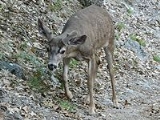
Black-tailed Deer

Black-tailed Deer

Overview
Two forms of black-tailed deer or blacktail deer occupying coastal temperate rainforest on North America's Pacific coast are subspecies
Subspecies
Subspecies in biological classification, is either a taxonomic rank subordinate to species, ora taxonomic unit in that rank . A subspecies cannot be recognized in isolation: a species will either be recognized as having no subspecies at all or two or more, never just one...

 of the mule deer
Mule Deer
The mule deer is a deer indigenous to western North America. The Mule Deer gets its name from its large mule-like ears. There are believed to be several subspecies, including the black-tailed deer...

. They have sometimes been treated as a species, but virtually all recent authorities maintain they are subspecies. The Columbian black-tailed deer (Odocoileus hemionus columbianus) is found in western North America
North America
North America is a continent wholly within the Northern Hemisphere and almost wholly within the Western Hemisphere. It is also considered a northern subcontinent of the Americas...

, from Northern California
Northern California
Northern California is the northern portion of the U.S. state of California. The San Francisco Bay Area , and Sacramento as well as its metropolitan area are the main population centers...

 into the Pacific Northwest
Pacific Northwest
The Pacific Northwest is a region in northwestern North America, bounded by the Pacific Ocean to the west and, loosely, by the Rocky Mountains on the east. Definitions of the region vary and there is no commonly agreed upon boundary, even among Pacific Northwesterners. A common concept of the...

 and coastal British Columbia. The Sitka black-tailed deer (Odocoileus hemionus sitkensis) is found coastally in British Columbia
British Columbia
British Columbia is the westernmost of Canada's provinces and is known for its natural beauty, as reflected in its Latin motto, Splendor sine occasu . Its name was chosen by Queen Victoria in 1858...

, Southeast Alaska and Southcentral Alaska (as far as Kodiak Island
Kodiak Island
Kodiak Island is a large island on the south coast of the U.S. state of Alaska, separated from the Alaska mainland by the Shelikof Strait. The largest island in the Kodiak Archipelago, Kodiak Island is the second largest island in the United States and the 80th largest island in the world, with an...

).
Discussion
Ask a question about 'Black-tailed Deer'
Start a new discussion about 'Black-tailed Deer'
Answer questions from other users
Full Discussion Forum
 
Unanswered Questions
Recent Discussions
Encyclopedia
Two forms of black-tailed deer or blacktail deer occupying coastal temperate rainforest on North America's Pacific coast are subspecies
Subspecies
Subspecies in biological classification, is either a taxonomic rank subordinate to species, ora taxonomic unit in that rank . A subspecies cannot be recognized in isolation: a species will either be recognized as having no subspecies at all or two or more, never just one...

 of the mule deer
Mule Deer
The mule deer is a deer indigenous to western North America. The Mule Deer gets its name from its large mule-like ears. There are believed to be several subspecies, including the black-tailed deer...

. They have sometimes been treated as a species, but virtually all recent authorities maintain they are subspecies. The Columbian black-tailed deer (Odocoileus hemionus columbianus) is found in western North America
North America
North America is a continent wholly within the Northern Hemisphere and almost wholly within the Western Hemisphere. It is also considered a northern subcontinent of the Americas...

, from Northern California
Northern California
Northern California is the northern portion of the U.S. state of California. The San Francisco Bay Area , and Sacramento as well as its metropolitan area are the main population centers...

 into the Pacific Northwest
Pacific Northwest
The Pacific Northwest is a region in northwestern North America, bounded by the Pacific Ocean to the west and, loosely, by the Rocky Mountains on the east. Definitions of the region vary and there is no commonly agreed upon boundary, even among Pacific Northwesterners. A common concept of the...

 and coastal British Columbia. The Sitka black-tailed deer (Odocoileus hemionus sitkensis) is found coastally in British Columbia
British Columbia
British Columbia is the westernmost of Canada's provinces and is known for its natural beauty, as reflected in its Latin motto, Splendor sine occasu . Its name was chosen by Queen Victoria in 1858...

, Southeast Alaska and Southcentral Alaska (as far as Kodiak Island
Kodiak Island
Kodiak Island is a large island on the south coast of the U.S. state of Alaska, separated from the Alaska mainland by the Shelikof Strait. The largest island in the Kodiak Archipelago, Kodiak Island is the second largest island in the United States and the 80th largest island in the world, with an...

).

Range


Black-tailed deer once lived at least as far east as Wyoming. In Francis Parkman
Francis Parkman
Francis Parkman was an American historian, best known as author of The Oregon Trail: Sketches of Prairie and Rocky-Mountain Life and his monumental seven-volume France and England in North America. These works are still valued as history and especially as literature, although the biases of his...

's The Oregon Trail, an eyewitness account of his 1846 trek across the early West, while within a two-days ride from Fort Laramie, Parkman writes of shooting what he believes to be an elk
Elk
The Elk is the large deer, also called Cervus canadensis or wapiti, of North America and eastern Asia.Elk may also refer to:Other antlered mammals:...

, only to discover that he has killed a Black-tailed Deer.

The Black-tailed deer is currently common in northern California, western Oregon, Washington, in coastal and interior British Columbia
British Columbia
British Columbia is the westernmost of Canada's provinces and is known for its natural beauty, as reflected in its Latin motto, Splendor sine occasu . Its name was chosen by Queen Victoria in 1858...

, and north into the Alaskan panhandle. It is a popular game animal.

Taxonomy


Though it has been argued that the black-tailed deer is a species, virtually all recent authorities maintain it as a subspecies of the mule deer
Mule Deer
The mule deer is a deer indigenous to western North America. The Mule Deer gets its name from its large mule-like ears. There are believed to be several subspecies, including the black-tailed deer...

 (Odocoileus hemionus). Strictly speaking the black-tailed deer group consists of two subspecies, as it also includes O. h. sitkensis (Sitka black-tailed deer
Sitka Deer
The Sitka deer or Sitka black-tailed deer , is a subspecies of mule deer , and similar to another subspecies the black-tailed deer . Their name originates from Sitka, Alaska. Weighing in on average between , Sitka deer are characteristically smaller than other types of black-tailed deer...

). The black-tailed deer group and the mule deer group (sensu stricto) hybridize, and it appears the mule deer evolved
Evolution
Evolution is any change across successive generations in the heritable characteristics of biological populations. Evolutionary processes give rise to diversity at every level of biological organisation, including species, individual organisms and molecules such as DNA and proteins.Life on Earth...

 from the black-tailed deer. Despite this, the mtDNA of the white-tailed deer
White-tailed Deer
The white-tailed deer , also known as the Virginia deer or simply as the whitetail, is a medium-sized deer native to the United States , Canada, Mexico, Central America, and South America as far south as Peru...

 and mule deer is similar, but differs from that of the black-tailed deer. This may be the result of introgression
Introgression
Introgression, also known as introgressive hybridization, in genetics is the movement of a gene from one species into the gene pool of another by the repeated backcrossing of an interspecific hybrid with one of its parent species...

, although hybrids between the mule deer and white-tailed deer are rare in the wild (apparently more common locally in west Texas
Texas
Texas is the second largest U.S. state by both area and population, and the largest state by area in the contiguous United States.The name, based on the Caddo word "Tejas" meaning "friends" or "allies", was applied by the Spanish to the Caddo themselves and to the region of their settlement in...

), and the hybrid survival rate
Survival rate
In biostatistics, survival rate is a part of survival analysis, indicating the percentage of people in a study or treatment group who are alive for a given period of time after diagnosis...

 is low even in captivity.

Ecology


This species thrives on the edge of the forest, as the dark forest lacks the underbrush and grasslands that the deer prefers as food, and completely open areas lack the hiding spots and the cover it prefers for harsh weather. One of the plants that black-tailed deer browse is western poison oak, despite its allergen content. This deer often is most active at dawn and dusk, and is frequently involved in collisions with automobiles.

Controversy over habitat management


In Southeast Alaska, the Sitka black-tailed deer is the primary prey of Alexander Archipelago wolf
Alexander Archipelago Wolf
The Alexander Archipelago Wolf , also known as the Archipelago Wolf and the Islands Wolf, is a subspecies of the gray wolf, Canis lupus, and primarily resides in the areas in and around the Alexander Archipelago. This region composes a part of the Tongass National Forest, where this species makes...

 (Canis lupus ligoni), which is endemic to the region and rare. In the mid-1990s the United States Fish & Wildlife Service evaluated a petition to list this wolf species as threatened, and decided in August 1997 that a listing was not warranted, largely on the basis of provisions the Forest Service had included to protect the viability of the wolf species in its Forest Plan for the Tongass National Forest
Tongass National Forest
The Tongass National Forest in southeastern Alaska is the largest national forest in the United States at 17 million acres . Most of its area is part of the temperate rain forest WWF ecoregion, itself part of the larger Pacific temperate rain forest WWF ecoregion, and is remote enough to be home...

, adopted three months earlier. The Tongass NF is important in wolf conservation because it includes about 80% of the region's land area. The protections for the wolf included a standard and guideline intended to retain, in the face of losses logging, enough habitat carrying capacity for deer in winter to assure the viability of the Alexander Archipelago wolf and an adequate supply of deer for hunters. The need carrying capacity was originally specified as 13 deer per square mile, but was corrected in 2000 to 18. Use of a deer model is specified for determining carrying capacity, and is the only tool available for the purpose.

However, the Forest Service's implementation of the deer provision in the Tongass wolf standard and guideline has been controversial for many years, and led to a lawsuit by Greenpeace and Cascadia Wildlands in 2008, over four logging projects. Issues raised included these two. It was alleged that the dataset
Data set
A data set is a collection of data, usually presented in tabular form. Each column represents a particular variable. Each row corresponds to a given member of the data set in question. Its values for each of the variables, such as height and weight of an object or values of random numbers. Each...

 the Forest Service was using in the deer model was known through the agency's own study, done in 2000, to generally overestimate the carrying capacity for deer. The study showed that the data set, called Vol-Strata, is uncorrelated to habitat quality, which generally causes the carrying capacity for deer to be overestimated and logging impacts to be underestimated, Also, a conversion factor, known as the "deer multiplier" (used in calculating carrying capacity) was incorrectly applied, causing — by itself – a 30% overestimation of carrying capacity and corresponding underestimation of impacts. The combined effect of the two errors is variable because Vol-Strata is uncorrelated to habitat quality. It is, for the Traitors Cove Timber Sales project the plaintiffs said in 2011 oral arguments before the 9th Circuit Court of Appeals, the difference between a claimed 21 deer per square mile in the project EIS, and 9.5 deer per square mile (about half of the Forest Plan's requirement) according to unpublished corrections made by the agency in 2008.

A ruling was issued in favor of plaintiffs on August 2, 2011 by the 9th Circuit, remanding the four timber sale decisions and giving guidance for what is necessary during renanalysis of impacts to deer. The ruling says in part:
"We do not think that USFS has adequately explained its decision to approve the four logging projects in the Tongass. ... USFS has failed to explain how it ended up with a table that identifies 100 deer per square mile as a maximum carrying capacity, but allows 130 deer per square mile as a potential carrying capacity. 'The agency is obligated to articulate a rational connection between the facts found and the choices made,' which the agency has not done here. Pac. Coast Fed’n of Fisherman’s Ass’ns v. U.S. Bureau of Reclamation, 426 F.3d 1082, 1091 (9th Cir. 2005)..."

"We have similar questions about USFS’s use of VolStrata data, which identifies total timber volume and not forest structure, to approve the projects, where forest structure—and not total timber volume—is relevant to the habitability of a piece of land. USFS itself has recognized the limitations in the VolStrata data. ... Because we must remand to the agency to re-examine its Deer Model, we need not decide whether the use of the VolStrata data was arbitrary and capricious. We anticipate that, in reviewing the proposed projects, USFS will use the best available data ..."


In a statement to the press, a spokesman for the plaintiffs said that the errors in this lawsuit apply to every significant Tongass timber sale decision between 1996 and 2008, before the Forest Service corrected errors in the deer model when the agency issued its revised Tongass Forest Plan in 2008. But he said that despite those corrections the agency still fails to address cumulative impacts to deer, especially on Prince of Wales Island, as is being challenged in the Logjam timber sale lawsuit, by ignoring substantial logging on non-federal lands.

External links