

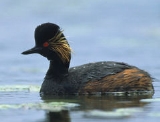
Black-necked Grebe

Encyclopedia
The Black-necked Grebe, Podiceps nigricollis, known in North America as the Eared Grebe, is a member of the grebe
family
of water birds. It occurs on every continent except Australia
and Antarctica.
The two common names for this species both refer to features visible when the bird is in its breeding plumage; in such plumage, it has an all-black neck and a spray of golden plumes on each side of its head. The name "Eared Grebe" was in usage nearly a century before the name "Black-necked Grebe". The latter was first used in 1912 by Ernst Hartert, in an effort to bring the common name of the species in line with its scientific name. The genus name of this species—Podiceps—comes from two Latin words: podicis, meaning "vent" or "anus" and pes meaning "foot". This is a reference to the attachment point of the bird's legs—at the extreme back end of its body. The specific epithet nigricollis is Latin for "black-necked": niger means "black" and collis means "neck".
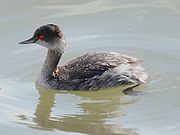 The Black-necked Grebe is 28 – long. The adult is unmistakable in summer with a black head and neck and yellow ear tufts. In winter, this small grebe is white with a poorly defined black cap, which distinguishes it from the crisper-looking Slavonian Grebe
(Horned Grebe in America).
In courtship the male gives a mellow poo-ee-chk call to the female.
This species breeds in vegetated areas of freshwater lakes across Europe
, Asia
, Africa
, northern South America
and the southwest and western United States. The North America
n subspecies
, P. n. californicus is known as the Eared Grebe (or "eared diver"). These birds migrate
in winter, mostly to the Pacific Coast
where they range south to El Salvador
on a regular basis; vagrants may occur as far as Costa Rica
.
Black-necked Grebes of the nominate subspecies P. n. nigricollis in the cooler temperate regions of the Old World
also winter further south, with many Europe
an birds moving to the Mediterranean area.
The isolated southern African race, P. n. gurneyi is sedentary. It was named by South African ornithologist and author Austin Roberts
in honour of the English
bankers and amateur ornithologists John Henry Gurney
and John Henry Gurney Jr..
Sadly the large breeding population in County Roscommon
, Ireland discovered about 1915 fell victim to a drainage scheme in the late 1930s; at its peak there were an estimated 250 pairs.
as well as small crustaceans, aquatic insect
s and larva
e.
It prefers to escape danger by diving rather than flying, although it can easily rise from the water.
Like all grebes, the Black-necked Grebe nests on the water's edge, since its legs are set very far back and it cannot walk well. Usually two egg
s are laid, and the striped young are sometimes carried on the adult's back.
Interestingly, the eared grebe is essentially flightless for most of the year (9 to 10 months), and serves as an example of one of the most inefficient flier among avifauna. Generally, this bird avoids flying at all costs and reserves long distance flight exclusively for migration. However, when migrating, it will travel as much as 6000 kilometres (3,728.2 mi) to reach prosperous areas which are exploited by few other species.
Grebe
A grebe is a member of the Podicipediformes order, a widely distributed order of freshwater diving birds, some of which visit the sea when migrating and in winter...
family
Family (biology)
In biological classification, family is* a taxonomic rank. Other well-known ranks are life, domain, kingdom, phylum, class, order, genus, and species, with family fitting between order and genus. As for the other well-known ranks, there is the option of an immediately lower rank, indicated by the...
of water birds. It occurs on every continent except Australia
Australia
Australia , officially the Commonwealth of Australia, is a country in the Southern Hemisphere comprising the mainland of the Australian continent, the island of Tasmania, and numerous smaller islands in the Indian and Pacific Oceans. It is the world's sixth-largest country by total area...
and Antarctica.
Taxonomy
There are three subspecies:- P. n. nigricollis is found from western Europe to western Asia (wintering to the south and west), in central and eastern Asia, and in eastern Africa
- P. n. gurneyi is found in southern Africa
- P. n. californicus is found from southwestern Canada through the western U.S. It winters as far south as Guatemala.
The two common names for this species both refer to features visible when the bird is in its breeding plumage; in such plumage, it has an all-black neck and a spray of golden plumes on each side of its head. The name "Eared Grebe" was in usage nearly a century before the name "Black-necked Grebe". The latter was first used in 1912 by Ernst Hartert, in an effort to bring the common name of the species in line with its scientific name. The genus name of this species—Podiceps—comes from two Latin words: podicis, meaning "vent" or "anus" and pes meaning "foot". This is a reference to the attachment point of the bird's legs—at the extreme back end of its body. The specific epithet nigricollis is Latin for "black-necked": niger means "black" and collis means "neck".
Description and range
Slavonian Grebe
The Horned Grebe or Slavonian Grebe, Podiceps auritus, is a member of the grebe family of water birds. The Slavonian Grebe is an excellent swimmer and diver, and pursues its fish prey underwater...
(Horned Grebe in America).
In courtship the male gives a mellow poo-ee-chk call to the female.
This species breeds in vegetated areas of freshwater lakes across Europe
Europe
Europe is, by convention, one of the world's seven continents. Comprising the westernmost peninsula of Eurasia, Europe is generally 'divided' from Asia to its east by the watershed divides of the Ural and Caucasus Mountains, the Ural River, the Caspian and Black Seas, and the waterways connecting...
, Asia
Asia
Asia is the world's largest and most populous continent, located primarily in the eastern and northern hemispheres. It covers 8.7% of the Earth's total surface area and with approximately 3.879 billion people, it hosts 60% of the world's current human population...
, Africa
Africa
Africa is the world's second largest and second most populous continent, after Asia. At about 30.2 million km² including adjacent islands, it covers 6% of the Earth's total surface area and 20.4% of the total land area...
, northern South America
South America
South America is a continent situated in the Western Hemisphere, mostly in the Southern Hemisphere, with a relatively small portion in the Northern Hemisphere. The continent is also considered a subcontinent of the Americas. It is bordered on the west by the Pacific Ocean and on the north and east...
and the southwest and western United States. The North America
North America
North America is a continent wholly within the Northern Hemisphere and almost wholly within the Western Hemisphere. It is also considered a northern subcontinent of the Americas...
n subspecies
Subspecies
Subspecies in biological classification, is either a taxonomic rank subordinate to species, ora taxonomic unit in that rank . A subspecies cannot be recognized in isolation: a species will either be recognized as having no subspecies at all or two or more, never just one...
, P. n. californicus is known as the Eared Grebe (or "eared diver"). These birds migrate
Bird migration
Bird migration is the regular seasonal journey undertaken by many species of birds. Bird movements include those made in response to changes in food availability, habitat or weather. Sometimes, journeys are not termed "true migration" because they are irregular or in only one direction...
in winter, mostly to the Pacific Coast
Pacific Coast
A country's Pacific coast is the part of its coast bordering the Pacific Ocean.-The Americas:Countries on the western side of the Americas have a Pacific coast as their western border.* Geography of Canada* Geography of Chile* Geography of Colombia...
where they range south to El Salvador
El Salvador
El Salvador or simply Salvador is the smallest and the most densely populated country in Central America. The country's capital city and largest city is San Salvador; Santa Ana and San Miguel are also important cultural and commercial centers in the country and in all of Central America...
on a regular basis; vagrants may occur as far as Costa Rica
Costa Rica
Costa Rica , officially the Republic of Costa Rica is a multilingual, multiethnic and multicultural country in Central America, bordered by Nicaragua to the north, Panama to the southeast, the Pacific Ocean to the west and the Caribbean Sea to the east....
.
Black-necked Grebes of the nominate subspecies P. n. nigricollis in the cooler temperate regions of the Old World
Old World
The Old World consists of those parts of the world known to classical antiquity and the European Middle Ages. It is used in the context of, and contrast with, the "New World" ....
also winter further south, with many Europe
Europe
Europe is, by convention, one of the world's seven continents. Comprising the westernmost peninsula of Eurasia, Europe is generally 'divided' from Asia to its east by the watershed divides of the Ural and Caucasus Mountains, the Ural River, the Caspian and Black Seas, and the waterways connecting...
an birds moving to the Mediterranean area.
The isolated southern African race, P. n. gurneyi is sedentary. It was named by South African ornithologist and author Austin Roberts
Austin Roberts
Austin Roberts was a South African zoologist. He is best known for his Birds of South Africa, first published in 1940. He also studied the mammalian fauna of the region: his work The mammals of South Africa was published posthumously in 1951...
in honour of the English
England
England is a country that is part of the United Kingdom. It shares land borders with Scotland to the north and Wales to the west; the Irish Sea is to the north west, the Celtic Sea to the south west, with the North Sea to the east and the English Channel to the south separating it from continental...
bankers and amateur ornithologists John Henry Gurney
John Henry Gurney
John Henry Gurney was an English banker, amateur ornithologist, and Liberal Party politician.-Life:Gurney was the only son of Joseph John Gurney of Earlham Hall, Norwich, Norfolk. At the age of ten he was sent to a private tutor at Leytonstone near the Epping Forest, where he met Henry Doubleday,...
and John Henry Gurney Jr..
Sadly the large breeding population in County Roscommon
County Roscommon
County Roscommon is a county in Ireland. It is located in the West Region and is also part of the province of Connacht. It is named after the town of Roscommon. Roscommon County Council is the local authority for the county...
, Ireland discovered about 1915 fell victim to a drainage scheme in the late 1930s; at its peak there were an estimated 250 pairs.
Behaviour
The Black-necked Grebe is an excellent swimmer and diver, and pursues its prey underwater, eating mostly fishFish
Fish are a paraphyletic group of organisms that consist of all gill-bearing aquatic vertebrate animals that lack limbs with digits. Included in this definition are the living hagfish, lampreys, and cartilaginous and bony fish, as well as various extinct related groups...
as well as small crustaceans, aquatic insect
Insect
Insects are a class of living creatures within the arthropods that have a chitinous exoskeleton, a three-part body , three pairs of jointed legs, compound eyes, and two antennae...
s and larva
Larva
A larva is a distinct juvenile form many animals undergo before metamorphosis into adults. Animals with indirect development such as insects, amphibians, or cnidarians typically have a larval phase of their life cycle...
e.
It prefers to escape danger by diving rather than flying, although it can easily rise from the water.
Like all grebes, the Black-necked Grebe nests on the water's edge, since its legs are set very far back and it cannot walk well. Usually two egg
Egg (biology)
An egg is an organic vessel in which an embryo first begins to develop. In most birds, reptiles, insects, molluscs, fish, and monotremes, an egg is the zygote, resulting from fertilization of the ovum, which is expelled from the body and permitted to develop outside the body until the developing...
s are laid, and the striped young are sometimes carried on the adult's back.
Interestingly, the eared grebe is essentially flightless for most of the year (9 to 10 months), and serves as an example of one of the most inefficient flier among avifauna. Generally, this bird avoids flying at all costs and reserves long distance flight exclusively for migration. However, when migrating, it will travel as much as 6000 kilometres (3,728.2 mi) to reach prosperous areas which are exploited by few other species.
External links
- BTO BirdFacts - Black-necked Grebe
- Eared Grebe – Cornell Lab of Ornithology
- Eared Grebe – eNature.com
- Eared Grebe Information and Photos – South Dakota Birds
- Eared Grebe – USGS Patuxent Bird Identification InfoCenter
- Watch more black-necked grebe (Podiceps nigricollis) video clips from the BBC archive on Wildlife Finder