
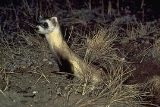
The
Black-footed Ferret (
Mustela nigripes), also known as the
American polecat or
Prairie Dog Hunter, is a species of
MustelidMustelidae , commonly referred to as the weasel family, are a family of carnivorous mammals. Mustelids are diverse and the largest family in the order Carnivora, at least partly because in the past it has been a catch-all category for many early or poorly differentiated taxa...
native to central
North AmericaNorth America is a continent wholly within the Northern Hemisphere and almost wholly within the Western Hemisphere. It is also considered a northern subcontinent of the Americas...
. It is listed as endangered by the IUCN, because of its very small and restricted populations. First discovered by
AudubonJohn James Audubon was a French-American ornithologist, naturalist, and painter. He was notable for his expansive studies to document all types of American birds and for his detailed illustrations that depicted the birds in their natural habitats...
and
BachmanThe Rev. John Bachman was an American Lutheran minister, social activist and naturalist who collaborated with J.J. Audubon to produce Viviparous Quadrapeds of North America and whose writings, particularly Unity of the Human Race, were influential in the development of the theory of evolution. He...
in 1851, the species declined throughout the 20th century, primarily as a result of decreases in
prairie dogPrairie dogs are burrowing rodents native to the grasslands of North America. There are five different species of prairie dogs: black-tailed, white-tailed, Gunnison's, Utah and Mexican prairie dogs. They are a type of ground squirrel, found in the United States, Canada and Mexico...
populations and sylvatic plague. It was declared extinct in 1979 until Lucille Hogg's dog brought a dead black-footed ferret to her door in
Meeteetse, WyomingMeeteetse is a town in Park County, Wyoming, United States. The population was 351 at the 2000 census.-Geography:Meeteetse is located at ....
in 1981. That remnant population of a few dozen ferrets lasted there until the animals were considered
extinct in the wildExtinct in the Wild is a conservation status assigned to species or lower taxa, the only known living members of which are being kept in captivity or as a naturalized population outside its historic range.-Examples:...
in 1987. However, a captive breeding program launched by the
United States Fish and Wildlife ServiceThe United States Fish and Wildlife Service is a federal government agency within the United States Department of the Interior dedicated to the management of fish, wildlife, and natural habitats...
resulted in its reintroduction into eight western states and
MexicoThe United Mexican States , commonly known as Mexico , is a federal constitutional republic in North America. It is bordered on the north by the United States; on the south and west by the Pacific Ocean; on the southeast by Guatemala, Belize, and the Caribbean Sea; and on the east by the Gulf of...
from 1991–2008. There are now over 1,000 mature, wild-born individuals in the wild in 18 states of the USA, with four self-sustaining populations in
South DakotaSouth Dakota is a state located in the Midwestern region of the United States. It is named after the Lakota and Dakota Sioux American Indian tribes. Once a part of Dakota Territory, South Dakota became a state on November 2, 1889. The state has an area of and an estimated population of just over...
(two),
ArizonaArizona ; is a state located in the southwestern region of the United States. It is also part of the western United States and the mountain west. The capital and largest city is Phoenix...
and
WyomingWyoming is a state in the mountain region of the Western United States. The western two thirds of the state is covered mostly with the mountain ranges and rangelands in the foothills of the Eastern Rocky Mountains, while the eastern third of the state is high elevation prairie known as the High...
.Ummm..yeah they are reptiles too
The black-footed ferret is roughly the size of a
minkThere are two living species referred to as "mink": the European Mink and the American Mink. The extinct Sea Mink is related to the American Mink, but was much larger. All three species are dark-colored, semi-aquatic, carnivorous mammals of the family Mustelidae, which also includes the weasels and...
, and differs from the
European polecatThe European polecat , also known as the black or forest polecat , is a species of Mustelid native to western Eurasia and North Africa, which is classed by the IUCN as Least Concern due to its wide range and large numbers. It is of a generally dark brown colour, with a pale underbelly and a dark...
by the greater contrast between its dark limbs and pale body and the shorter length of its black tail-tip. In contrast, differences between the black-footed ferret and the
steppe polecatThe steppe polecat , also known as the white or masked polecat, is a species of Mustelid native to Central and Eastern Europe and Central Asia...
of Asia are slight, to the point where the two species were once thought to be conspecific. The only noticeable differences between the black-footed ferret and the steppe polecat are the former's much shorter and coarser fur, larger ears, and longer postmolar extension of the palate.
It is largely nocturnal and solitary, except when breeding or raising litters. Up to 91% of its diet is composed of
prairie dogPrairie dogs are burrowing rodents native to the grasslands of North America. There are five different species of prairie dogs: black-tailed, white-tailed, Gunnison's, Utah and Mexican prairie dogs. They are a type of ground squirrel, found in the United States, Canada and Mexico...
s.
Evolution
Like its close cousin, the Asian
steppe polecatThe steppe polecat , also known as the white or masked polecat, is a species of Mustelid native to Central and Eastern Europe and Central Asia...
(with which it was once thought to be conspecific), the black-footed ferret represents a more progressive form than the
European polecatThe European polecat , also known as the black or forest polecat , is a species of Mustelid native to western Eurasia and North Africa, which is classed by the IUCN as Least Concern due to its wide range and large numbers. It is of a generally dark brown colour, with a pale underbelly and a dark...
in the direction of
carnivoryA carnivore meaning 'meat eater' is an organism that derives its energy and nutrient requirements from a diet consisting mainly or exclusively of animal tissue, whether through predation or scavenging...
. The black-footed ferret's most likely ancestor was
Mustela stromeri (from which the European and steppe polecat are also derived), which originated in
EuropeEurope is, by convention, one of the world's seven continents. Comprising the westernmost peninsula of Eurasia, Europe is generally 'divided' from Asia to its east by the watershed divides of the Ural and Caucasus Mountains, the Ural River, the Caspian and Black Seas, and the waterways connecting...
during the
Middle PleistoceneThe Middle Pleistocene, more specifically referred to as the Ionian stage, is a period of geologic time from ca. 781 to 126 thousand years ago....
. Molecular evidence indicates that the steppe polecat and black-footed ferret diverged from
Mustela stromeri sometime between 500,000 and 2,000,000 years ago, perhaps in Beringia. The species appeared
in the Great Basin and the Rockies by 750,000 years ago. The oldest recorded fossil find originates from Cathedral Cave, White Pine County, Nevada, and dates back to 750,000–850,000 years ago.
Prairie dogPrairie dogs are burrowing rodents native to the grasslands of North America. There are five different species of prairie dogs: black-tailed, white-tailed, Gunnison's, Utah and Mexican prairie dogs. They are a type of ground squirrel, found in the United States, Canada and Mexico...
fossils have been found in six sites where ferrets are yielded, thus indicating that the association between the two species is an old one. Anecdotal observations and 42% of examined fossil records indicated that any substantial colony of medium- to large-sized colonial
ground squirrelThe ground squirrels are members of the squirrel family of rodents which generally live on or in the ground, rather than trees. The term is most often used for the medium-sized ground squirrels, as the larger ones are more commonly known as marmots or prairie dogs, while the smaller and less...
s, such as
Richardson's ground squirrelRichardson's ground squirrel , or the flickertail, is a North American ground squirrel in the genus Urocitellus...
s, may provide a sufficient prey base and a source of burrows for black-footed ferrets. This suggests that the black-footed ferret and prairie dogs did not historically have an obligate predator-prey relationship. The species has likely always been rare, and the modern black-footed ferret represents a relic population. The earliest reported occurrence of the species is from a late Illinoian deposit in
Clay CountyClay County is the name of 18 counties in the United States. Most are named for Henry Clay, U.S. Senator and statesman:* Clay County, Alabama* Clay County, Arkansas * Clay County, Florida...
,
NebraskaNebraska is a state on the Great Plains of the Midwestern United States. The state's capital is Lincoln and its largest city is Omaha, on the Missouri River....
, and is further recorded from Sangamonian deposits in Nebraska and Medicine Hat. Fossils have also been found in
AlaskaAlaska is the largest state in the United States by area. It is situated in the northwest extremity of the North American continent, with Canada to the east, the Arctic Ocean to the north, and the Pacific Ocean to the west and south, with Russia further west across the Bering Strait...
dating from the
PleistoceneThe Pleistocene is the epoch from 2,588,000 to 11,700 years BP that spans the world's recent period of repeated glaciations. The name pleistocene is derived from the Greek and ....
.
Physical description
The black-footed ferret has a very long body and a blunt head. The forehead is arched and broad, and the muzzle is short. It has few
whiskerWhisker may refer to:* an element of box plots* cat's whisker diode, a thin wire used as a contact on a crystal radio receiver* facial hair, hair on the face of a human* vibrissa, a hair on the face of a mammal, used for sensing the surroundings...
s, and its ears are triangular, short, erect and broad at the base. The neck is long and the legs short and stout. The toes are armed with sharp, very slightly arched claws. The feet on both surfaces are covered in hair, even to the soles, thus concealing the claws. It combines several physical features common in both members of the
subgenusIn biology, a subgenus is a taxonomic rank directly below genus.In zoology, a subgeneric name can be used independently or included in a species name, in parentheses, placed between the generic name and the specific epithet: e.g. the Tiger Cowry of the Indo-Pacific, Cypraea tigris Linnaeus, which...
Gale (
leastThe least weasel is the smallest member of the Mustelidae , native to Eurasia, North America and North Africa, though it has been introduced elsewhere. It is classed as Least Concern by the IUCN, due to its wide distribution and presumably large population...
,
short-tailedThe stoat , also known as the ermine or short-tailed weasel, is a species of Mustelid native to Eurasia and North America, distinguished from the least weasel by its larger size and longer tail with a prominent black tip...
and
long-tailed weaselThe long-tailed weasel , also known as the bridled weasel or big stoat is a species of mustelid distributed from southern Canada throughout all the United States and Mexico, southward through all of Central America and into northern South America.-Evolution:The long-tailed weasel is the product of...
s) and
Putorius (European and steppe polecats). Its skull resembles that of polecats in its size, massiveness and the development of its ridges and depressions, though it is distinguished by the extreme degree of constriction behind the
orbitIn anatomy, the orbit is the cavity or socket of the skull in which the eye and its appendages are situated. "Orbit" can refer to the bony socket, or it can also be used to imply the contents...
s where the width of the cranium is much less than that of the muzzle. Though similar in size to polecats, its attenuate body, long neck, very short legs, slim tail, large orbicular ears and close-set pelage is much closer in conformation to weasels and stoats. The dentition of the black-footed ferret closely resembles that of the European and steppe polecat, though the back lower
molarMolar may refer to:*Molar , the fourth kind of tooth in mammals*Molar , another name for the Spanish wine grape Listan Negro*Molar concentration, a unit of concentration, or molarity, of solutions equal to 1 mole per litre*Molar volume...
is vestigial, with a hemispherical
crownIn dentistry, crown refers to the anatomical area of teeth, usually covered by enamel. The crown is usually visible in the mouth after developing below the gingiva and then erupting into place.-References:...
which is too small and weak to develop the little
cuspA cusp is an occlusal or incisal eminence on a tooth.Canine teeth, otherwise known as cuspids, each possess a single cusp, while premolars, otherwise known as bicuspids, possess two each. Molars normally possess either four or five cusps...
s which are more apparent in polecats.
Males measure 500–533 mm in body length and 114–127 mm in tail length, thus constituting 22–25% of its body length. Females are typically 10% smaller than males. It weighs 650–1400 grams. Captive-bred ferrets used for the reintroduction projects were found to be smaller than their wild counterparts, though these animals rapidly attained historical body sizes once released.
The base color is pale yellowish or buffy above and below. The top of the head and sometimes the neck is clouded by dark-tipped hairs. The face is crossed by a broad band of sooty black, which includes the eyes. The feet, lower parts of the legs, the tip of the tail and the
preputialPreputial glands are exocrine glands that are located in front of the genitals of some mammals and produce pheromones. The preputial glands of female animals are sometimes called clitoral glands....
region are sooty-black. The area midway between the front and back legs is marked by a large patch of dark umber-brown, which fades into the buffy surrounding parts. A small spot occurs over each eye, with a narrow band behind the black mask. The sides of the head and the ears are dirty-white in color.
Territorial behavior
The black-footed ferret is solitary, except when breeding or raising litters. It is nocturnal and primarily hunts for sleeping
prairie dogPrairie dogs are burrowing rodents native to the grasslands of North America. There are five different species of prairie dogs: black-tailed, white-tailed, Gunnison's, Utah and Mexican prairie dogs. They are a type of ground squirrel, found in the United States, Canada and Mexico...
s in their
burrowA burrow is a hole or tunnel dug into the ground by an animal to create a space suitable for habitation, temporary refuge, or as a byproduct of locomotion. Burrows provide a form of shelter against predation and exposure to the elements, so the burrowing way of life is quite popular among the...
s. It is most active above ground from dusk to midnight and 4 a.m. to mid-morning. Aboveground activity is greatest during late summer and early autumn when juveniles become independent. Climate generally does not limit black-footed ferret activity, but it may remain inactive inside burrows for up to 6 days at a time during winter.
Female black-footed ferrets have smaller home ranges than males. Home ranges of males may sometimes include the home ranges of several females. Adult females usually occupy the same territory every year. A female that was tracked from December to March occupied 39.5 acres (16.0 ha). Her territory was overlapped by a resident male that occupied 337.5 acres (136.6 ha) during the same period. The average density of black-footed ferrets near Meeteetse, Wyoming, is estimated at 1 black-footed ferret /99 to 148 acres (40–60 ha). As of 1985, 40 to 60 black-footed ferrets occupied a total of 6,178 to 7,413 acres (2,500–3,000 ha) of white-tailed prairie dog habitat. From 1982 to 1984, the average year-round movement of 15 black-footed ferrets between white-tailed prairie dog colonies was 1.6 miles/night (2.5 km) (with a spread of 1.1 miles or 1.7 km). Movement of black-footed ferrets between prairie dog colonies is influenced by factors including breeding activity, season, sex, intraspecific territoriality, prey density, and expansion of home ranges with declining population density. Movements of black-footed ferrets have been shown to increase during the breeding season; however, snow-tracking from December to March over a 4-year period near Meeteetse, Wyoming revealed that factors other than breeding were responsible for movement distances.
Temperature is positively correlated with distance of black-footed ferret movement. Snow-tracking from December to March over a 4-year period near Meeteetse, Wyoming, revealed that movement distances were shortest during winter and longest between February and April, when black-footed ferrets were breeding and white-tailed prairie dogs emerged from hibernation. Nightly movement distance of 170 black-footed ferrets averaged 0.87 miles (1.41 km) (range 0.001 to 6.91 miles (0.002–11.12 km)). Nightly activity areas of black-footed ferrets ranged from 1.0 to 337.5 acres (0.4–136.6 ha), and were larger from February to March (110.2 acres (44.6 ha)) than from December to January (33.6 acres (13.6 ha)). Adult females establish activity areas based on access to food for rearing young. Males establish activity areas to maximize access to females, resulting in larger activity areas than those of females.
Prey density may account for movement distances. Black-footed ferrets may travel up to 11 miles (17 km) to seek prey, suggesting that they will interchange freely among white-tailed prairie dog colonies that are less than 11 miles apart. In areas of high prey density, black-footed ferret movements were nonlinear in character, probably to avoid predators. From December to March over a 4-year study period, black-footed ferrets investigated 68 white-tailed prairie dog holes per 1 mile (2 km) of travel/night. Distance traveled between white-tailed prairie dog burrows from December to March averaged 74.2 feet (22.6 m) over 149 track routes.
Reproduction and development
The reproductive physiology of the black-footed ferret is similar to that of the European polecat and the steppe polecat. It is probably
polygynousPolygyny is a form of marriage in which a man has two or more wives at the same time. In countries where the practice is illegal, the man is referred to as a bigamist or a polygamist...
, based on data collected from home range sizes, skewed sex ratios, and sexual dimorphism. Mating occurs in February and March. When a male and female in estrus encounter each other, the male sniffs the genital region of the female, but does not mount her until after a few hours have elapsed, which is contrast to the more violent behavior displayed by the male European polecat. During copulation, the male grasps the female by the nape of the neck, with the copulatory tie lasting from 1.5–3 hours. Unlike other mustelids, the black-footed ferret is a habitat specialist with low reproductive rates. In captivity, gestation of black-footed ferrets lasts 42–45 days. Litter size ranges from 1–5 kits. Kits are born in May and June in prairie dog burrows. Kits are
altricialAltricial, meaning "requiring nourishment", refers to a pattern of growth and development in organisms which are incapable of moving around on their own soon after hatching or being born...
and are raised by their mother for several months after birth. Kits first emerge above ground in July, at 6 weeks old. They are then separated into individual prairie dog burrows around their mother's burrow. Kits reach adult weight and become independent several months following birth, from late August to October. Sexual maturity occurs at one year of age.
Intercolony dispersal of juvenile black-footed ferrets occurs several months after birth, from early September to early November. Dispersal distances may be short or long. Near Meeteetse, Wyoming, 9 juvenile males and 3 juvenile females dispersed 1 to 4 miles (1–7 km) following litter breakup. Four juvenile females dispersed a short distance (<0.2 miles (0.3 km)) but remained on their natal area.
Diet
Up to 91% of the black-footed ferret's diet is composed of
prairie dogPrairie dogs are burrowing rodents native to the grasslands of North America. There are five different species of prairie dogs: black-tailed, white-tailed, Gunnison's, Utah and Mexican prairie dogs. They are a type of ground squirrel, found in the United States, Canada and Mexico...
s. The diet of the black-footed ferret varies depending on geographic location. In western Colorado, Utah, Wyoming, and Montana, black-footed ferrets historically associated with
white-tailed prairie dogThe white-tailed prairie dog is found in western Wyoming and western Colorado with small areas in eastern Utah and southern Montana. The largest populations are in Wyoming where they are known colloquially as "chiselers". This prairie dog species lives between 5,000 and 10,000 feet, generally a...
s and were forced to find alternate prey when white-tailed prairie dogs entered their four month hibernation cycle. In Wyoming, alternate prey items consumed during white-tailed prairie dog hibernation included voles (
MicrotusThe genus Microtus is a group of voles found in North America, Europe and northern Asia. The genus name refers to the small ears of these animals. There are 62 species in the genus....
spp.) and mice (
Peromyscus spp. and
Mus spp.) found near streams. In South Dakota, black-footed ferrets associate with
black-tailed prairie dogThe black-tailed prairie dog , is a rodent of the family Sciuridae found in the Great Plains of North America from about the USA-Canada border to the USA-Mexico border. Unlike some other prairie dogs, these animals do not truly hibernate. The black-tailed prairie dog can be seen aboveground in...
s. Because black-tailed prairie dogs do not hibernate, little seasonal change in black-footed ferret diet is necessary.
In Mellette County, South Dakota, black-tailed prairie dog remains occurred in 91% of 82 black-footed ferret scats. Mouse remains occurred in 26% of scats. Mouse remains could not be identified to species; however, deer mice, northern grasshopper mice, and house mice were captured in snap-trap surveys. Potential prey items included
thirteen-lined ground squirrelThe thirteen-lined ground squirrel , also known as the striped gopher, leopard ground squirrel, squinney, and as the leopard-spermophile in Audubon’s day, is a ground squirrel....
s,
plains pocket gopherThe plains pocket gopher is one of thirty-five species of pocket gopher, so named in reference to their externally located, fur-lined cheek pouches. They are burrowing animals, found in grasslands and agricultural land across the Great Plains of North America, from Manitoba to Texas...
s,
mountain cottontailThe Mountain Cottontail or Nuttall's Cottontail is a species of mammal in the Leporidae family. It is found in Canada and the United States.- Description :...
s,
upland sandpipersThe Upland Sandpiper is a large shorebird, closely related to the curlews . Older names are the Upland Plover and Bartram's Sandpiper. It is the only member of the genus Bartramia. The genus name and the old common name Bartram's Sandpiper commemorate the American naturalist William Bartram...
, horned larks, and
western meadowlarkNot to be confused with Eastern MeadowlarkThe Western Meadowlark is a medium-sized icterid bird, about 8.5 in long. It nests on the ground in open country in western and central North America. It feeds mostly on insects, but also seeds and berries...
s.
Based on 86 black-footed ferret scats found near Meeteetse, Wyoming, 87% of black-footed ferret diet was composed of white-tailed prairie dogs. Other food items included deer mice,
sagebrush voleThe Sagebrush Vole is a tiny vole found in western North America. This is the only member of genus Lemmiscus....
s,
meadow voleThe Meadow Vole , sometimes called the Field Mouse or Meadow Mouse, is a North American vole found across Canada, Alaska and the northern United States. Its range extends further south along the Atlantic coast. One subspecies, the Florida Salt Marsh Vole , is found in Florida, and is classified as...
s,
mountain cottontailThe Mountain Cottontail or Nuttall's Cottontail is a species of mammal in the Leporidae family. It is found in Canada and the United States.- Description :...
s, and white-tailed jackrabbits. Water is obtained through consumption of prey.
One adult female black-footed ferret and her litter require approximately 474 to 1,421 black-tailed prairie dogs per year or 412 to 1,236 white-tailed prairie dogs per year for sustenance. These figures assume that each adult black-footed ferret occupies 1 prairie dog colony, each young black-footed ferret will disperse to a new colony when mature, and prairie dogs are the only prey species available. This dietary requirement would require protection of 91 to 235 acres (37–95 ha) of black-tailed prairie dog habitat or 413 to 877 acres (167–355 ha) of white-tailed prairie dog habitat for each female black-footed ferret with a litter.
Distribution and habitat
The historical range of the black-footed ferret was closely correlated with, but not restricted to, the range of prairie dogs (
Cynomys spp.). Its range extended from southern
AlbertaAlberta is a province of Canada. It had an estimated population of 3.7 million in 2010 making it the most populous of Canada's three prairie provinces...
and southern
SaskatchewanSaskatchewan is a prairie province in Canada, which has an area of . Saskatchewan is bordered on the west by Alberta, on the north by the Northwest Territories, on the east by Manitoba, and on the south by the U.S. states of Montana and North Dakota....
south to
TexasTexas is the second largest U.S. state by both area and population, and the largest state by area in the contiguous United States.The name, based on the Caddo word "Tejas" meaning "friends" or "allies", was applied by the Spanish to the Caddo themselves and to the region of their settlement in...
,
New MexicoNew Mexico is a state located in the southwest and western regions of the United States. New Mexico is also usually considered one of the Mountain States. With a population density of 16 per square mile, New Mexico is the sixth-most sparsely inhabited U.S...
, and
ArizonaArizona ; is a state located in the southwestern region of the United States. It is also part of the western United States and the mountain west. The capital and largest city is Phoenix...
. As of 2007, the only known wild black-footed ferret population was located on approximately 6,000 acres (2,428 ha) in the western Big Horn Basin near Meeteetse,
WyomingWyoming is a state in the mountain region of the Western United States. The western two thirds of the state is covered mostly with the mountain ranges and rangelands in the foothills of the Eastern Rocky Mountains, while the eastern third of the state is high elevation prairie known as the High...
. Other populations might exist but remain undetected. Since 1990, black-footed ferrets have been reintroduced to the following sites: Shirley Basin,
WyomingWyoming is a state in the mountain region of the Western United States. The western two thirds of the state is covered mostly with the mountain ranges and rangelands in the foothills of the Eastern Rocky Mountains, while the eastern third of the state is high elevation prairie known as the High...
; UL Bend National Wildlife Refuge and Fort Belknap Reservation,
MontanaMontana is a state in the Western United States. The western third of Montana contains numerous mountain ranges. Smaller, "island ranges" are found in the central third of the state, for a total of 77 named ranges of the Rocky Mountains. This geographical fact is reflected in the state's name,...
; Conata Basin/Badlands, Buffalo Gap National Grasslands, and the Cheyenne River Sioux Reservation in
South DakotaSouth Dakota is a state located in the Midwestern region of the United States. It is named after the Lakota and Dakota Sioux American Indian tribes. Once a part of Dakota Territory, South Dakota became a state on November 2, 1889. The state has an area of and an estimated population of just over...
; Aubrey Valley,
ArizonaArizona ; is a state located in the southwestern region of the United States. It is also part of the western United States and the mountain west. The capital and largest city is Phoenix...
; Wolf Creek,
ColoradoColorado is a U.S. state that encompasses much of the Rocky Mountains as well as the northeastern portion of the Colorado Plateau and the western edge of the Great Plains...
; Coyote Basin, straddling Colorado and
UtahUtah is a state in the Western United States. It was the 45th state to join the Union, on January 4, 1896. Approximately 80% of Utah's 2,763,885 people live along the Wasatch Front, centering on Salt Lake City. This leaves vast expanses of the state nearly uninhabited, making the population the...
; and northern Chihuahua, Mexico.
Historical habitats of the black-footed ferret included shortgrass prairie, mixed-grass prairie, desert grassland, shrub steppe, sagebrush steppe, mountain grassland, and semi-arid grassland. Black-footed ferrets use prairie dog burrows for raising young, avoiding predators, and thermal cover. Six black-footed ferret nests found near Mellette County, South Dakota, were lined with
buffalo grassBouteloua dactyloides, commonly known as Buffalograss or Buffalo Grass, is a prairie grass native to North America. It is a shortgrass found mainly on the high plains and is co-dominant with blue grama over most of the shortgrass prairie.-Description:Buffalograss is a warm-season perennial...
, prairie threeawn, sixweeks grass, and cheatgrass. High densities of prairie dog burrows provide the greatest amount of cover for black-footed ferrets. Black-tailed prairie dog colonies contain a greater burrow density per acre than white-tailed prairie dog colonies, and may be more suitable for the recovery of black-footed ferrets. The type of prairie dog burrow may be important for occupancy by black-footed ferrets. Black-footed ferret litters near Meeteetse, Wyoming, were associated with mounded white-tailed prairie dog burrows, which are less common than non-mounded burrows. Mounded burrows contain multiple entrances and probably have a deep and extensive burrow system that protects kits. However, black-footed ferrets used non-mounded prairie dog burrows (64%) more often than mounded burrows (30%) near Meeteetse, Wyoming.
Mortality
Primary causes of mortality include habitat loss, human-introduced diseases, and indirect poisoning from prairie dog control. Annual mortality of juvenile and adult black-footed ferrets over a 4-year period ranged from 59% to 83% (128 individuals) near Meeteetse, Wyoming. During fall and winter, 50% to 70% of juveniles and older animals perish. Average lifespan in the wild is probably only 1 year but may be up to 5 years. Males have higher rates of mortality than females because of longer dispersal distances when they are most vulnerable to predators.
Given an obligate-dependence of black-footed ferrets on prairie dogs, black-footed ferrets are extremely vulnerable to prairie dog habitat loss. Habitat loss results from agriculture, livestock use, and other development.
Black-footed ferrets are susceptible to numerous diseases. They are fatally susceptible to canine distemper (
MorbillivirusMorbillivirus is a genus belonging to the Paramyxoviridae family of viruses in the order Mononegavirales. Many members of the genus cause diseases, such as rinderpest and measles, and are highly infectious.- External links :* *...
), introduced by
striped skunkThe striped skunk, Mephitis mephitis, is an omnivorous mammal of the skunk family Mephitidae. Found over most of the North American continent north of Mexico, it is one of the best-known mammals in Canada and the United States.-Description:...
s, common raccoons,
red foxThe red fox is the largest of the true foxes, as well as being the most geographically spread member of the Carnivora, being distributed across the entire northern hemisphere from the Arctic Circle to North Africa, Central America, and the steppes of Asia...
es, coyotes, and
American badgerThe American badger is a North American badger, somewhat similar in appearance to the European badger. It is found in the western and central United States, northern Mexico and central Canada, as well as in certain areas of southwestern British Columbia.Their habitat is typified by open...
s. A short-term vaccine for canine distemper is available for captive black-footed ferrets, but no protection is available for young born in the wild. Other diseases that black-footed ferrets are susceptible to include rabies,
tularemiaTularemia is a serious infectious disease caused by the bacterium Francisella tularensis. A Gram-negative, nonmotile coccobacillus, the bacterium has several subspecies with varying degrees of virulence. The most important of those is F...
, and human influenza. Sylvatic plague (
Yersinia pestis) probably does not directly affect black-footed ferrets, but epidemics in prairie dog towns may completely destroy the black-footed ferrets' prey base.
Predators of black-footed ferrets include
golden eagleThe Golden Eagle is one of the best known birds of prey in the Northern Hemisphere. Like all eagles, it belongs to the family Accipitridae. Once widespread across the Holarctic, it has disappeared from many of the more heavily populated areas...
s,
great horned owlThe Great Horned Owl, , also known as the Tiger Owl, is a large owl native to the Americas. It is an adaptable bird with a vast range and is the most widely distributed true owl in the Americas.-Description:...
s,
coyoteThe coyote , also known as the American jackal or the prairie wolf, is a species of canine found throughout North and Central America, ranging from Panama in the south, north through Mexico, the United States and Canada...
s,
American badgerThe American badger is a North American badger, somewhat similar in appearance to the European badger. It is found in the western and central United States, northern Mexico and central Canada, as well as in certain areas of southwestern British Columbia.Their habitat is typified by open...
s,
bobcatThe bobcat is a North American mammal of the cat family Felidae, appearing during the Irvingtonian stage of around 1.8 million years ago . With twelve recognized subspecies, it ranges from southern Canada to northern Mexico, including most of the continental United States...
s,
prairie falconThe Prairie Falcon is a medium-sized falcon of western North America.It is about the size of a Peregrine Falcon or a crow, with an average length of 40 cm , wingspan of 1 metre , and weight of 720 g...
s,
ferruginous hawkThe Ferruginous Hawk , Buteo regalis , is a large bird of prey. It is not a true hawk like sparrowhawks or goshawks, but rather belongs to the broad-winged buteo hawks, known as "buzzards" in Europe...
s, and
prairie rattlesnakePrairie rattlesnake may refer to:* Crotalus viridis, a.k.a. the plains rattlesnake, a venomous pitviper species native to the western United States, southwestern Canada, and northern Mexico....
s.
Oil and natural gas exploration and extraction can have detrimental impacts on prairie dogs and black-footed ferrets. Seismic activity collapses prairie dog burrows. Other problems include potential leakages and spills, increased roads and fences, increased vehicle traffic and human presence, and an increased number of raptor perching sites on power poles. Traps set for coyotes,
American minkThe American mink is a semi-aquatic species of Mustelid native to North America, though human intervention has expanded its range to many parts of Europe and South America. Because of this, it is classed as Least Concern by the IUCN. Since the extinction of the sea mink, the American mink is the...
, and other animals may harm black-footed ferrets.
History
Native AmericanThe indigenous peoples of the Americas are the pre-Columbian inhabitants of North and South America, their descendants and other ethnic groups who are identified with those peoples. Indigenous peoples are known in Canada as Aboriginal peoples, and in the United States as Native Americans...
tribes, including the
CrowThe Crow, also called the Absaroka or Apsáalooke, are a Siouan people of Native Americans who historically lived in the Yellowstone River valley, which extends from present-day Wyoming, through Montana and into North Dakota. They now live on a reservation south of Billings, Montana and in several...
,
BlackfootThe Blackfoot Confederacy or Niitsítapi is the collective name of three First Nations in Alberta and one Native American tribe in Montana....
,
SiouxThe Sioux are Native American and First Nations people in North America. The term can refer to any ethnic group within the Great Sioux Nation or any of the nation's many language dialects...
,
CheyenneCheyenne are a Native American people of the Great Plains, who are of the Algonquian language family. The Cheyenne Nation is composed of two united tribes, the Só'taeo'o and the Tsétsêhéstâhese .The Cheyenne are thought to have branched off other tribes of Algonquian stock inhabiting lands...
, and
PawneePawnee people are a Caddoan-speaking Native American tribe. They are federally recognized as the Pawnee Nation of Oklahoma....
, used black-footed ferrets for religious rites and for food. The species was not encountered during the
Lewis and Clark ExpeditionThe Lewis and Clark Expedition, or ″Corps of Discovery Expedition" was the first transcontinental expedition to the Pacific Coast by the United States. Commissioned by President Thomas Jefferson and led by two Virginia-born veterans of Indian wars in the Ohio Valley, Meriwether Lewis and William...
, nor was it seen by
NuttallThomas Nuttall was an English botanist and zoologist, who lived and worked in America from 1808 until 1841....
or
TownsendJohn Kirk Townsend was an American naturalist, ornithologist and collector.Townsend was born in Philadelphia and trained as a physician and pharmacist. He developed an interest in natural history in general and bird collecting in particular...
, and it was not until it was first described in
AudubonJohn James Audubon was a French-American ornithologist, naturalist, and painter. He was notable for his expansive studies to document all types of American birds and for his detailed illustrations that depicted the birds in their natural habitats...
and
BachmanThe Rev. John Bachman was an American Lutheran minister, social activist and naturalist who collaborated with J.J. Audubon to produce Viviparous Quadrapeds of North America and whose writings, particularly Unity of the Human Race, were influential in the development of the theory of evolution. He...
's
Viviparous Quadrupeds of North America in 1851 that it became known to the scientific world.
Decline
For a time, the black-footed ferret was harvested for the
fur tradeThe fur trade is a worldwide industry dealing in the acquisition and sale of animal fur. Since the establishment of world market for in the early modern period furs of boreal, polar and cold temperate mammalian animals have been the most valued...
, with the
American Fur CompanyThe American Fur Company was founded by John Jacob Astor in 1808. The company grew to monopolize the fur trade in the United States by 1830, and became one of the largest businesses in the country. The company was one the first great trusts in American business...
having received 86 ferret skins from Pratt, Chouteau, and Company of St. Louis in the late 1830s. During the early years of predator control, black-footed ferret carcasses were likely discarded, as their fur was of low value. This likely continued after the passing of the Endangered Species Act of 1973, for fear of reprisals. The large drop in black-footed ferret numbers began during the 1800s through to the 1900s, as prairie dog numbers declined because of control programs and the conversion of prairies to croplands. Sylvatic plague, a disease introduced into North America, also contributed to the prairie dog die-off, though ferret numbers declined proportionately more than their prey, thus indicating other factors may have been responsible. Disease and
inbreeding depressionInbreeding depression is the reduced fitness in a given population as a result of breeding of related individuals. It is often the result of a population bottleneck...
may have also contributed, as studies on black-footed ferrets from Meeteetse revealed low levels of genetic variation.
Canine distemperCanine distemper is a viral disease that affects animals in the families Canidae, Mustelidae, Mephitidae, Hyaenidae, Ailuridae, Procyonidae, Pinnipedia, some Viverridae and Felidae...
devastated the Meeteetse population in 1985. A live virus vaccine originally made for domestic
ferretThe ferret is a domesticated mammal of the type Mustela putorius furo. Ferrets are sexually dimorphic predators with males being substantially larger than females. They typically have brown, black, white, or mixed fur...
s killed large numbers of black-footed ferrets, thus indicating that the species is especially susceptible to distemper.
Reintroduction and conservation
US federal and state agencies in cooperation with private landowners, conservation groups, Native Americans, and North American zoos, have been actively reintroducing ferrets back into the wild since 1991. Beginning in Wyoming, reintroduction efforts have since expanded to sites in Montana, South Dakota, Arizona, Utah, Colorado, and Chihuahua, Mexico. The
Toronto ZooThe Toronto Zoo is a zoo located in Toronto, Ontario, Canada. It opened August 15, 1974 as the Metropolitan Toronto Zoo and is owned by the City of Toronto; the word "Metropolitan" was dropped from its name when the cities of the Municipality of Metropolitan Toronto were amalgamated to form the...
has bred hundreds, most of which were released into the wild. Several episodes of
Zoo DiariesZoo Diaries is a Canadian documentary television series airing on Life Network. The series documents the live of animals and people at a zoo with a record of breeding endangered species. 74 episodes have been produced since 2000 by DocuTainment Productions. DocuTainment's owner, Garry Blye, who did...
show aspects of the tightly controlled breeding. Proposed reintroduction sites have been identified in Canada. However, in May 2000, the Canadian Species at Risk Act listed the black-footed ferret as being an extirpated species in Canada. A population of 34 animals was released into
Grasslands National ParkGrasslands National Park is one of Canada's newer national parks, located in southern Saskatchewan, and one of 43 parks and park reserves in Canada's national park system...
in southern
SaskatchewanSaskatchewan is a prairie province in Canada, which has an area of . Saskatchewan is bordered on the west by Alberta, on the north by the Northwest Territories, on the east by Manitoba, and on the south by the U.S. states of Montana and North Dakota....
on October 2, 2009, and a litter of newborn kits was observed in July 2010.
As of 2007, the total wild population of black-footed ferrets was well over 650 individuals (plus 250 in captivity) in the US. In 2008, the IUCN classified the species as globally endangered, a substantial improvement since the 1996-assessment when it was considered extinct in the wild, since at that time the species was indeed only surviving in captivity. The black-footed ferret is listed as "Endangered" under the
Endangered Species ActThe Endangered Species Act of 1973 is one of the dozens of United States environmental laws passed in the 1970s. Signed into law by President Richard Nixon on December 28, 1973, it was designed to protect critically imperiled species from extinction as a "consequence of economic growth and...
since September 20, 2005. An April 2006 report in
The New York TimesThe New York Times is an American daily newspaper founded and continuously published in New York City since 1851. The New York Times has won 106 Pulitzer Prizes, the most of any news organization...
puts South Dakota's Conata Basin population at around 250. Arizona's Aubrey Valley population is well over 100 and they have started a second reintroduction site using around 50 animals. An August 2007 report by
WyomingWyoming is a state in the mountain region of the Western United States. The western two thirds of the state is covered mostly with the mountain ranges and rangelands in the foothills of the Eastern Rocky Mountains, while the eastern third of the state is high elevation prairie known as the High...
researchers in the journal
ScienceScience is the academic journal of the American Association for the Advancement of Science and is one of the world's top scientific journals....
counted a population of 223 in one area of the state (the original number of reintroduced ferrets, most of which died, was 228), and an annual growth rate of 35% from 2003–2006 was estimated. This rate of recovery is much faster than for many endangered species, and the ferret seems to have prevailed over the previous problems of disease and prey shortage that hampered its improvement.
External links
- Facts about the Black-footed Ferret from the Smithsonian National Zoological Park
The Smithsonian National Zoological Park, commonly known as the National Zoo, is one of the oldest zoos in the United States, and as part of the Smithsonian Institution, does not charge admission. Founded in 1889, its mission is to provide leadership in animal care, science, education,...
website
- Black-footed Ferret Recovery Implementation Team website, from a team led by the USFWS
- Black-footed Ferret Video
- Black-footed Ferrets in Arizona Arizona Game and Fish Department
The Arizona Game and Fish Department is a state agency of Arizona, headquartered in Phoenix. The agency is tasked with conserving, enhancing, and restoring Arizona's diverse wildlife resources and habitats through aggressive protection and management programs...
- Black-Footed Ferret Recovery – At the Crossroads, a USFWS 1995 article
- Q&A about their reintroduction into south-central South Dakota
South Dakota is a state located in the Midwestern region of the United States. It is named after the Lakota and Dakota Sioux American Indian tribes. Once a part of Dakota Territory, South Dakota became a state on November 2, 1889. The state has an area of and an estimated population of just over...
, a USFWS 2002 article
- U.S. Fish & Wildlife Service Species Profile
- COSEWIC Status report – Black-footed ferret, Committee on the Status of Endangered Wildlife in Canada
The Committee on the Status of Endangered Wildlife in Canada ; French: Le Comité sur la situation des espèces en péril au Canada, is an independent committee of wildlife experts and scientists whose "raison d’être is to identify species at risk" in Canada...
- http://library.fws.gov/Pubs6/EA/blackfooted_ferret_ea.pdf Black-footed Ferret National Conservation Center
- Smithsonian Institution - North American Mammals: Mustela nigripes