
The
Black-bellied Whistling Duck (
Dendrocygna autumnalis), formerly also called
Black-bellied Tree Duck, is a whistling duck that breeds from the southernmost
United StatesThe United States of America is a federal constitutional republic comprising fifty states and a federal district...
and tropical
CentralCentral America is the central geographic region of the Americas. It is the southernmost, isthmian portion of the North American continent, which connects with South America on the southeast. When considered part of the unified continental model, it is considered a subcontinent...
to south-central
South AmericaSouth America is a continent situated in the Western Hemisphere, mostly in the Southern Hemisphere, with a relatively small portion in the Northern Hemisphere. The continent is also considered a subcontinent of the Americas. It is bordered on the west by the Pacific Ocean and on the north and east...
. In the USA, it can be found year-round in parts of southeast
TexasTexas is the second largest U.S. state by both area and population, and the largest state by area in the contiguous United States.The name, based on the Caddo word "Tejas" meaning "friends" or "allies", was applied by the Spanish to the Caddo themselves and to the region of their settlement in...
, and seasonally in southeast
ArizonaArizona ; is a state located in the southwestern region of the United States. It is also part of the western United States and the mountain west. The capital and largest city is Phoenix...
, and
LouisianaLouisiana is a state located in the southern region of the United States of America. Its capital is Baton Rouge and largest city is New Orleans. Louisiana is the only state in the U.S. with political subdivisions termed parishes, which are local governments equivalent to counties...
's Gulf Coast. It is a rare breeder in such disparate locations as
FloridaFlorida is a state in the southeastern United States, located on the nation's Atlantic and Gulf coasts. It is bordered to the west by the Gulf of Mexico, to the north by Alabama and Georgia and to the east by the Atlantic Ocean. With a population of 18,801,310 as measured by the 2010 census, it...
,
ArkansasArkansas is a state located in the southern region of the United States. Its name is an Algonquian name of the Quapaw Indians. Arkansas shares borders with six states , and its eastern border is largely defined by the Mississippi River...
,
GeorgiaGeorgia is a state located in the southeastern United States. It was established in 1732, the last of the original Thirteen Colonies. The state is named after King George II of Great Britain. Georgia was the fourth state to ratify the United States Constitution, on January 2, 1788...
and
South CarolinaSouth Carolina is a state in the Deep South of the United States that borders Georgia to the south, North Carolina to the north, and the Atlantic Ocean to the east. Originally part of the Province of Carolina, the Province of South Carolina was one of the 13 colonies that declared independence...
.
It is widely known as
pijije (also
pixixi or
pichichi),
chiriría or
sirirí in
Latin AmericaLatin America is a region of the Americas where Romance languages – particularly Spanish and Portuguese, and variably French – are primarily spoken. Latin America has an area of approximately 21,069,500 km² , almost 3.9% of the Earth's surface or 14.1% of its land surface area...
, though this can also refer to other whistling-ducks and a qualifyer such as
ala blanca or
aliblanco ("white-winged") is usually added to signify this species. In
MexicoThe United Mexican States , commonly known as Mexico , is a federal constitutional republic in North America. It is bordered on the north by the United States; on the south and west by the Pacific Ocean; on the southeast by Guatemala, Belize, and the Caribbean Sea; and on the east by the Gulf of...
, it is also called
pato maízal ("cornfield duck") due to its habit of visiting
such fieldsMaize known in many English-speaking countries as corn or mielie/mealie, is a grain domesticated by indigenous peoples in Mesoamerica in prehistoric times. The leafy stalk produces ears which contain seeds called kernels. Though technically a grain, maize kernels are used in cooking as a vegetable...
after harvest. And since it is one of only two whistling-duck species native to
North AmericaNorth America is a continent wholly within the Northern Hemisphere and almost wholly within the Western Hemisphere. It is also considered a northern subcontinent of the Americas...
, it is occasionally just known as the "whistling duck" in the southern USA.
The Black-bellied Whistling Duck is an unusual species among North American
waterfowlWaterfowl are certain wildfowl of the order Anseriformes, especially members of the family Anatidae, which includes ducks, geese, and swans....
. With its long legs, peculiar appearance and odd habits, it was described by one early American ornithologist as "most un-duck-like". Its numbers are increasing in North America.
Description
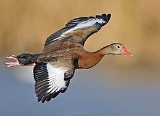
The Black-bellied Whistling Duck is 19-21 in (48–53 cm) long. It has a long red bill, long head and longish legs, pale grey head and mostly grey-brown
plumagePlumage refers both to the layer of feathers that cover a bird and the pattern, colour, and arrangement of those feathers. The pattern and colours of plumage vary between species and subspecies and can also vary between different age classes, sexes, and season. Within species there can also be a...
. The belly and tail are black, and the body plumage, back of the neck and cap are a rich chestnut brown. The face and upper neck are grey, and they sport a thin but distinct white eye-ring. The extensive white in the wings is obvious in flight, less so on the ground; it is formed by the secondary remiges while the primaries are black; the wing-coverts are brown. Males and females look alike; juveniles are similar but have a grey bill and less contrasting belly.
Due to its unique appearance, this species is almost unmistakable. With an upright stance, long pink legs, and long neck, adult Black-bellied Whistling Ducks are unlikely to be confused with any other bird within their range. The wing bar is in fact unique among living whistling ducks. But when on the ground, it may be hard to discern or look like the light flanks present in many of these
waterfowlWaterfowl are certain wildfowl of the order Anseriformes, especially members of the family Anatidae, which includes ducks, geese, and swans....
. The Fulvous Whistling-duck (
D. bicolor) is the only sympatric whistling duck that shows such a whitish flank stripe however, and it differs from the Black-bellied by having dark wings and a lighter belly rather than the other way around. Juvenile
D. autumnalis are quite similar to young of the White-faced Whistling-duck (
D. viduata), which have a darker bill and no white wing patch; even when sitting they never seem to show white along the sides, as their thin white
verticalIn astronomy, geography, geometry and related sciences and contexts, a direction passing by a given point is said to be vertical if it is locally aligned with the gradient of the gravity field, i.e., with the direction of the gravitational force at that point...
barring on the black flanks is very indistinct.
As the name implies, these are noisy birds with a clear whistling
waa-chooo call.
Subspecies
There are two
subspeciesSubspecies in biological classification, is either a taxonomic rank subordinate to species, ora taxonomic unit in that rank . A subspecies cannot be recognized in isolation: a species will either be recognized as having no subspecies at all or two or more, never just one...
, which intergrade in
PanamaPanama , officially the Republic of Panama , is the southernmost country of Central America. Situated on the isthmus connecting North and South America, it is bordered by Costa Rica to the northwest, Colombia to the southeast, the Caribbean Sea to the north and the Pacific Ocean to the south. The...
:
- Northern Black-bellied Whistling Duck, Dendrocygna autumnalis autumnalis – Southern USA to Panama
- Larger, with a brown breast and upper back
- Southern Black-bellied Whistling Duck, Dendrocygna autumnalis discolor – Panama to Paraguay
Paraguay , officially the Republic of Paraguay , is a landlocked country in South America. It is bordered by Argentina to the south and southwest, Brazil to the east and northeast, and Bolivia to the northwest. Paraguay lies on both banks of the Paraguay River, which runs through the center of the...
and adjacent regions
- Smaller, with grey breast and upper back
Ecology
The Black-bellied Whistling Duck is a common but wary species. It is highly gregarious, forming large flocks when not breeding, and is largely resident apart from local movements. It usually nests in hollow trees. The habitat is quiet shallow freshwater
pondA pond is a body of standing water, either natural or man-made, that is usually smaller than a lake. A wide variety of man-made bodies of water are classified as ponds, including water gardens, water features and koi ponds; all designed for aesthetic ornamentation as landscape or architectural...
s,
lakeA lake is a body of relatively still fresh or salt water of considerable size, localized in a basin, that is surrounded by land. Lakes are inland and not part of the ocean and therefore are distinct from lagoons, and are larger and deeper than ponds. Lakes can be contrasted with rivers or streams,...
s, and
marshIn geography, a marsh, or morass, is a type of wetland that is subject to frequent or continuous flood. Typically the water is shallow and features grasses, rushes, reeds, typhas, sedges, other herbaceous plants, and moss....
es, cultivated land or reservoirs with plentiful vegetation, where this
duckDuck is the common name for a large number of species in the Anatidae family of birds, which also includes swans and geese. The ducks are divided among several subfamilies in the Anatidae family; they do not represent a monophyletic group but a form taxon, since swans and geese are not considered...
feeds mainly at night on seeds and other plant food. Tree-lined bodies of water are of particular value and as the old common name suggests, they are quite fond of perching in trees. This species can also be seen "loafing" (doing nothing in particular except hanging around and socializing) in flocks on
golf courseA golf course comprises a series of holes, each consisting of a teeing ground, fairway, rough and other hazards, and a green with a flagstick and cup, all designed for the game of golf. A standard round of golf consists of playing 18 holes, thus most golf courses have this number of holes...
s and other grassy areas near suitable waterways.
Diet
Feeding often occurs nocturnally, but they can be encountered eating at any hour of the day. Black-bellied Whistling Ducks ingest a wide variety of plant material, but also consume
arthropodAn arthropod is an invertebrate animal having an exoskeleton , a segmented body, and jointed appendages. Arthropods are members of the phylum Arthropoda , and include the insects, arachnids, crustaceans, and others...
s and aquatic
invertebrateAn invertebrate is an animal without a backbone. The group includes 97% of all animal species – all animals except those in the chordate subphylum Vertebrata .Invertebrates form a paraphyletic group...
s when available. They often feed on submerged vegetation by wading through shallow water. As its
MexicanThe United Mexican States , commonly known as Mexico , is a federal constitutional republic in North America. It is bordered on the north by the United States; on the south and west by the Pacific Ocean; on the southeast by Guatemala, Belize, and the Caribbean Sea; and on the east by the Gulf of...
name implies, it is commonly seen gleaning recently-harvested fields for leftover seed and invertebrates brought up by the harvesters disturbing the soil.
Movements
The Black-bellied Whistling Duck is mainly non-migratory. Birds in the extreme northern portions of their range (
ArizonaArizona ; is a state located in the southwestern region of the United States. It is also part of the western United States and the mountain west. The capital and largest city is Phoenix...
,
LouisianaLouisiana is a state located in the southern region of the United States of America. Its capital is Baton Rouge and largest city is New Orleans. Louisiana is the only state in the U.S. with political subdivisions termed parishes, which are local governments equivalent to counties...
, and parts of
TexasTexas is the second largest U.S. state by both area and population, and the largest state by area in the contiguous United States.The name, based on the Caddo word "Tejas" meaning "friends" or "allies", was applied by the Spanish to the Caddo themselves and to the region of their settlement in...
) move south in winter. At the heart of their range, there is a tendency to travel in flocks over the winter months, though this behavior is not a true long-range migration but rather local dispersal.
Reproduction
The Black-bellied Whistling Duck is quite unique among ducks in their strong monogamous pair-bond. Its pairs often stay together for many years, a trait more often associated with geese and
swanSwans, genus Cygnus, are birds of the family Anatidae, which also includes geese and ducks. Swans are grouped with the closely related geese in the subfamily Anserinae where they form the tribe Cygnini. Sometimes, they are considered a distinct subfamily, Cygninae...
s. Both parents share all tasks associated with the raising of young, from
incubationIncubation refers to the process by which certain oviparous animals hatch their eggs, and to the development of the embryo within the egg. The most vital factor of incubation is the constant temperature required for its development over a specific period. Especially in domestic fowl, the act of...
to the rearing of ducklings. The ducks, primarily cavity nesters, prefer the confines of a hollow tree, but will nest on the ground when necessary. They also make use of chimneys, abandoned buildings, or
nest boxA nest box, also spelled nestbox is a man-made box provided for animals to nest in. Nest boxes are most frequently utilized for wild and domesticated birds, in which case they are also called birdhouses, but some mammalian species may also use them. Birdhouses are the most common types of nest...
es, the latter having been increasingly provided to them over recent decades, especially in southeast Texas and Mexico. Ducklings leap from nest cavities within two days of hatching, can feed themselves immediately, and stay with the parents for up to eight weeks.
Status and conservation
This species is not considered to be of conservation concern by the IUCN and the
National Audubon SocietyThe National Audubon Society is an American non-profit environmental organization dedicated to conservation. Incorporated in 1905, Audubon is one of the oldest of such organizations in the world and uses science, education and grassroots advocacy to advance its conservation mission...
; its global population is estimated at 1,550,000 birds. Black-bellied Whistling-duck populations are currently stable or increasing. It has expanded its range significantly in the latter half of the 20th century, and has benefited in recent years from the placement of nest boxes across key portions of the north of its range.
Breeding Bird SurveyA breeding bird survey monitors the status and trends of bird populations. Data from the survey are an important source for the range maps found in field guides. The North American Breeding Bird Survey is a joint project of the United States Geological Survey and the Canadian Wildlife Service...
and
Christmas Bird CountThe Christmas Bird Count is a census of birds in the Western Hemisphere, performed annually in the early Northern-hemisphere winter by volunteer birders...
data both confirm that populations of this species have increased significantly over the past 30 years.
The existence of healthy coastal
wetlandA wetland is an area of land whose soil is saturated with water either permanently or seasonally. Wetlands are categorised by their characteristic vegetation, which is adapted to these unique soil conditions....
s greatly benefits Black-bellied Whistling Ducks. In past years, over-hunting was a serious concern, largely due to the species' relatively docile nature. Current populations, however, seem to be secure enough to sustain hunting at the present levels, which are lower than in the past and mostly aimed at preventing large numbers of these birds gathering on fields where they may harm crops.
External links