


Birthmark

Encyclopedia
A birthmark is a benign
irregularity on the skin
which is present at birth or appears shortly after birth, usually in the first month. They can occur anywhere on the skin. Birthmarks are caused by overgrowth of blood vessel
s, melanocyte
s, smooth muscle
, fat
, fibroblast
s, or keratinocyte
s.
Dermatologists divide birthmarks into two types. Pigmented birthmarks caused by excess skin pigment cells include mole
s, café-au-lait spots, and Mongolian spots. Vascular birthmarks (also called red birthmarks) are caused by increased blood vessels and include macular stains (salmon patches), hemangioma
s, and Port-wine stain
s. A little over 1 in 10 babies have a vascular
birthmark present by age 1. Several birthmark types are part of the group of skin lesion
s known as nevi
or naevi, which means "birthmarks" in Latin
.
The exact cause of most birthmarks is unknown, but vascular birthmarks are not hereditary. They are thought to occur as a result of a localized imbalance in factors controlling the development and migration of skin cells.
is a type of melanocytic nevus
(or mole) found in infant
s at birth
. Occurring in about 1% of infants in the United States
, it is located in the area of the head
and neck
15% of the time, but may occur anywhere on the body. It may appear as light brown in fair-skinned people, to almost black in darker-skinned people. Coming in a variety of sizes and appearances, they may be irregular in shape and flat, or raised and lumpy in appearance and feel.
.
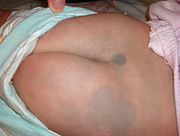 A Mongolian blue spot is a benign
flat congenital
birthmark with wavy borders and irregular shape, most common among East Asia
ns and Turks
(excluding Turkish people
), and named after Mongolians. It is also extremely prevalent among East Africa
ns and Native Americans
. Authentic Mongolian blue spots disappear within the first four years of life. The most common color is blue, although they can be blue-gray, blue-black or even deep brown.
The Mongolian spot is a congenital
developmental condition exclusively involving the skin
. The blue colour is caused by melanocyte
s, melanin
-containing cells, that are deep under the skin. Usually, as multiple spots or one large patch, it covers one or more of the lumbosacral area (lower back
), the buttocks, flank
s, and shoulder
s. It results from the entrapment of melanocytes in the dermis
during their migration from the neural crest
to the epidermis during embryo
nic development.
Among those who are not aware of the background of the Mongolian spots, it may sometimes be mistaken for a bruise indicative of child abuse.
self-involuting
tumor
(swelling or growth) of endothelial
cells, the cells that line blood vessel
s. It usually appears during the first weeks of life and resolves by age 10. In infancy, it is the most common tumor.
 Port-wine stains are present at birth and range from a pale pink in color, to a deep wine-red. Irregular in appearance, they are usually quite large, and caused by a deficiency or absence in the nerve supply to blood vessels. This causes the blood vessels to dilate, and blood to pool or collect in the affected area. Over time, port-wine stains may become thick or develop small ridges or bumps, and do not fade with age. Such birthmarks may have emotional or social repercussions.
Port-wine stains occur in 0.3% of the population, equally among males and females. They frequently express unilaterally, i.e., on only one side, not crossing the midline of the body. Often on the face, marks on the upper eyelid or forehead may be indicative of a condition called Sturge-Weber syndrome
. Additionally, port-wine stains in these locations may be associated with glaucoma
and seizure
s.
reasons. Treatments include administering oral or injected steroid
s, dermatological lasers
to reduce size and/or color, or dermatologic surgery.
es" because, according to folklore
, they are caused by unsatisfied wishes of the mother during pregnancy
. For example, if a pregnant woman does not satisfy a sudden wish or craving for strawberries
, it's said that the infant might bear a strawberry mark.
In Dutch, birthmarks are called moedervlekken, in Danish modermærke and in German Muttermal (mother-spots) because it was thought that an infant inherited the marks solely from the mother. The Hungarian word for any flat mole (as opposed to only congenital birthmarks), anyajegy, is also derived from this belief.
Some myths associated with birthmarks are that they are caused when an expectant mother sees something strange, or experiences a great deal of fear. See Maternal impression
for more information.
In Iranian folklore, a birth mark appears when the pregnant mother touches a part of her body during a solar eclipse.
In American folklore, birth marks sometimes mark the site of traumatic injuries in a past life.
Benignity
Benignity [from Latin benignus , from bonus + genus ] is a medical term used to describe a condition that is harmless...
irregularity on the skin
Human skin
The human skin is the outer covering of the body. In humans, it is the largest organ of the integumentary system. The skin has multiple layers of ectodermal tissue and guards the underlying muscles, bones, ligaments and internal organs. Human skin is similar to that of most other mammals,...
which is present at birth or appears shortly after birth, usually in the first month. They can occur anywhere on the skin. Birthmarks are caused by overgrowth of blood vessel
Blood vessel
The blood vessels are the part of the circulatory system that transports blood throughout the body. There are three major types of blood vessels: the arteries, which carry the blood away from the heart; the capillaries, which enable the actual exchange of water and chemicals between the blood and...
s, melanocyte
Melanocyte
-External links: - "Eye: fovea, RPE" - "Integument: pigmented skin"...
s, smooth muscle
Smooth muscle
Smooth muscle is an involuntary non-striated muscle. It is divided into two sub-groups; the single-unit and multiunit smooth muscle. Within single-unit smooth muscle tissues, the autonomic nervous system innervates a single cell within a sheet or bundle and the action potential is propagated by...
, fat
Fat
Fats consist of a wide group of compounds that are generally soluble in organic solvents and generally insoluble in water. Chemically, fats are triglycerides, triesters of glycerol and any of several fatty acids. Fats may be either solid or liquid at room temperature, depending on their structure...
, fibroblast
Fibroblast
A fibroblast is a type of cell that synthesizes the extracellular matrix and collagen, the structural framework for animal tissues, and plays a critical role in wound healing...
s, or keratinocyte
Keratinocyte
Keratinocytes are the predominant cell type in the epidermis, the outermost layer of the human skin, constituting 95% of the cells found there. Those keratinocytes found in the basal layer of the skin are sometimes referred to as "basal cells" or "basal keratinocytes"...
s.
Dermatologists divide birthmarks into two types. Pigmented birthmarks caused by excess skin pigment cells include mole
Melanocytic nevus
A melanocytic nevus is a type of lesion that contains nevus cells .Some sources equate the term mole with "melanocytic nevus". Other sources reserve the term "mole" for other purposes....
s, café-au-lait spots, and Mongolian spots. Vascular birthmarks (also called red birthmarks) are caused by increased blood vessels and include macular stains (salmon patches), hemangioma
Hemangioma
A hemangioma of infancy is a benign self-involuting tumor of endothelial cells, the cells that line blood vessels. It usually appears during the first weeks of life and sometimes resolves by age 10. In more severe case hemangioma may have permanency, if not treated by a physician...
s, and Port-wine stain
Port-wine stain
A port-wine stain or naevus flammeus is a vascular anomaly consisting of superficial and deep dilated capillaries in the skin which produce a reddish to purplish discoloration of the skin. They are so called for their colour, resembling that of port wine...
s. A little over 1 in 10 babies have a vascular
Vascular
Vascular in zoology and medicine means "related to blood vessels", which are part of the circulatory system. An organ or tissue that is vascularized is heavily endowed with blood vessels and thus richly supplied with blood....
birthmark present by age 1. Several birthmark types are part of the group of skin lesion
Lesion
A lesion is any abnormality in the tissue of an organism , usually caused by disease or trauma. Lesion is derived from the Latin word laesio which means injury.- Types :...
s known as nevi
Nevus
Nevus is the medical term for sharply-circumscribed and chronic lesions of the skin. These lesions are commonly named birthmarks and moles. Nevi are benign by definition...
or naevi, which means "birthmarks" in Latin
Latin
Latin is an Italic language originally spoken in Latium and Ancient Rome. It, along with most European languages, is a descendant of the ancient Proto-Indo-European language. Although it is considered a dead language, a number of scholars and members of the Christian clergy speak it fluently, and...
.
The exact cause of most birthmarks is unknown, but vascular birthmarks are not hereditary. They are thought to occur as a result of a localized imbalance in factors controlling the development and migration of skin cells.
Mole (Congenital melanocytic nevus)
Congenital melanocytic nevusCongenital melanocytic nevus
The congenital melanocytic nevus is a type of melanocytic nevus found in infants at birth. This type of birthmark occurs in about 1% of infants in the United States; it is located in the area of the head and neck 15% of the time....
is a type of melanocytic nevus
Melanocytic nevus
A melanocytic nevus is a type of lesion that contains nevus cells .Some sources equate the term mole with "melanocytic nevus". Other sources reserve the term "mole" for other purposes....
(or mole) found in infant
Infant
A newborn or baby is the very young offspring of a human or other mammal. A newborn is an infant who is within hours, days, or up to a few weeks from birth. In medical contexts, newborn or neonate refers to an infant in the first 28 days after birth...
s at birth
Birth
Birth is the act or process of bearing or bringing forth offspring. The offspring is brought forth from the mother. The time of human birth is defined as the time at which the fetus comes out of the mother's womb into the world...
. Occurring in about 1% of infants in the United States
United States
The United States of America is a federal constitutional republic comprising fifty states and a federal district...
, it is located in the area of the head
Human head
In human anatomy, the head is the upper portion of the human body. It supports the face and is maintained by the skull, which itself encloses the brain.-Cultural importance:...
and neck
Neck
The neck is the part of the body, on many terrestrial or secondarily aquatic vertebrates, that distinguishes the head from the torso or trunk. The adjective signifying "of the neck" is cervical .-Boner anatomy: The cervical spine:The cervical portion of the human spine comprises seven boney...
15% of the time, but may occur anywhere on the body. It may appear as light brown in fair-skinned people, to almost black in darker-skinned people. Coming in a variety of sizes and appearances, they may be irregular in shape and flat, or raised and lumpy in appearance and feel.
Café au lait spot
Café au lait spot macules may occur anywhere on the body. They are most commonly oval in shape and light brown, or milk coffee, in color. These birthmarks may be present at birth, or appear in early childhood, and do not fade with age. One or two on an individual is common; however, four or more may be an indicator of neurofibromatosisNeurofibromatosis
Neurofibromatosis is a genetically-inherited disorder in which the nerve tissue grows tumors that may be benign or may cause serious damage by compressing nerves and other tissues...
.
Mongolian spot (Dermal melanocytosis)
Benign
A benign tumor is a tumor that lacks the ability to metastasize. Common examples of benign tumors include moles and uterine fibroids.The term "benign" implies a mild and nonprogressive disease. Indeed, many kinds of benign tumors are harmless to human health...
flat congenital
Congenital disorder
A congenital disorder, or congenital disease, is a condition existing at birth and often before birth, or that develops during the first month of life , regardless of causation...
birthmark with wavy borders and irregular shape, most common among East Asia
East Asia
East Asia or Eastern Asia is a subregion of Asia that can be defined in either geographical or cultural terms...
ns and Turks
Turkic peoples
The Turkic peoples are peoples residing in northern, central and western Asia, southern Siberia and northwestern China and parts of eastern Europe. They speak languages belonging to the Turkic language family. They share, to varying degrees, certain cultural traits and historical backgrounds...
(excluding Turkish people
Turkish people
Turkish people, also known as the "Turks" , are an ethnic group primarily living in Turkey and in the former lands of the Ottoman Empire where Turkish minorities had been established in Bulgaria, Cyprus, Bosnia and Herzegovina, Georgia, Greece, Kosovo, Macedonia, and Romania...
), and named after Mongolians. It is also extremely prevalent among East Africa
East Africa
East Africa or Eastern Africa is the easterly region of the African continent, variably defined by geography or geopolitics. In the UN scheme of geographic regions, 19 territories constitute Eastern Africa:...
ns and Native Americans
Indigenous peoples of the Americas
The indigenous peoples of the Americas are the pre-Columbian inhabitants of North and South America, their descendants and other ethnic groups who are identified with those peoples. Indigenous peoples are known in Canada as Aboriginal peoples, and in the United States as Native Americans...
. Authentic Mongolian blue spots disappear within the first four years of life. The most common color is blue, although they can be blue-gray, blue-black or even deep brown.
The Mongolian spot is a congenital
Congenital disorder
A congenital disorder, or congenital disease, is a condition existing at birth and often before birth, or that develops during the first month of life , regardless of causation...
developmental condition exclusively involving the skin
Skin
-Dermis:The dermis is the layer of skin beneath the epidermis that consists of connective tissue and cushions the body from stress and strain. The dermis is tightly connected to the epidermis by a basement membrane. It also harbors many Mechanoreceptors that provide the sense of touch and heat...
. The blue colour is caused by melanocyte
Melanocyte
-External links: - "Eye: fovea, RPE" - "Integument: pigmented skin"...
s, melanin
Melanin
Melanin is a pigment that is ubiquitous in nature, being found in most organisms . In animals melanin pigments are derivatives of the amino acid tyrosine. The most common form of biological melanin is eumelanin, a brown-black polymer of dihydroxyindole carboxylic acids, and their reduced forms...
-containing cells, that are deep under the skin. Usually, as multiple spots or one large patch, it covers one or more of the lumbosacral area (lower back
Human back
The human back is the large posterior area of the human body, rising from the top of the buttocks to the back of the neck and the shoulders. It is the surface opposite to the chest, its height being defined by the vertebral column and its breadth being supported by the ribcage and shoulders...
), the buttocks, flank
Flank
Flank may refer to:* Flank, the side of either a horse or a military unit*Flanking maneuver in military tactics* Flank , the waveform edge formed when a signal goes high or low...
s, and shoulder
Shoulder
The human shoulder is made up of three bones: the clavicle , the scapula , and the humerus as well as associated muscles, ligaments and tendons. The articulations between the bones of the shoulder make up the shoulder joints. The major joint of the shoulder is the glenohumeral joint, which...
s. It results from the entrapment of melanocytes in the dermis
Dermis
The dermis is a layer of skin between the epidermis and subcutaneous tissues, and is composed of two layers, the papillary and reticular dermis...
during their migration from the neural crest
Neural crest
Neural crest cells are a transient, multipotent, migratory cell population unique to vertebrates that gives rise to a diverse cell lineage including melanocytes, craniofacial cartilage and bone, smooth muscle, peripheral and enteric neurons and glia....
to the epidermis during embryo
Embryo
An embryo is a multicellular diploid eukaryote in its earliest stage of development, from the time of first cell division until birth, hatching, or germination...
nic development.
Among those who are not aware of the background of the Mongolian spots, it may sometimes be mistaken for a bruise indicative of child abuse.
Stork bite (Nevus flammeus nuchae)
Colloquially called a "stork bite", "angel's kiss" or "salmon patch", telangiectatic nevus appears as a pink or tanned, flat, irregularly-shaped mark on the knee, back of the neck, and/or the forehead, eyelids and, sometimes, the top lip. The skin is not thickened and feels no different from anywhere else on the body; the only difference remaining in appearance. Nearly half of all babies have such a birthmark.Strawberry mark (Hemangioma)
A hemangioma of infancy (strawberry mark) is a benignBenign
A benign tumor is a tumor that lacks the ability to metastasize. Common examples of benign tumors include moles and uterine fibroids.The term "benign" implies a mild and nonprogressive disease. Indeed, many kinds of benign tumors are harmless to human health...
self-involuting
Involution (medicine)
-Thymus:The thymus continues to grow between birth and puberty and then begins to atrophy, a process directed by the high levels of circulating sex hormones. Proportional to thymic size, thymic activity is most active before puberty. Upon atrophy, the size and activity are dramatically reduced,...
tumor
Tumor
A tumor or tumour is commonly used as a synonym for a neoplasm that appears enlarged in size. Tumor is not synonymous with cancer...
(swelling or growth) of endothelial
Endothelium
The endothelium is the thin layer of cells that lines the interior surface of blood vessels, forming an interface between circulating blood in the lumen and the rest of the vessel wall. These cells are called endothelial cells. Endothelial cells line the entire circulatory system, from the heart...
cells, the cells that line blood vessel
Blood vessel
The blood vessels are the part of the circulatory system that transports blood throughout the body. There are three major types of blood vessels: the arteries, which carry the blood away from the heart; the capillaries, which enable the actual exchange of water and chemicals between the blood and...
s. It usually appears during the first weeks of life and resolves by age 10. In infancy, it is the most common tumor.
Port-wine stain (Nevus flammeus)
Port-wine stains occur in 0.3% of the population, equally among males and females. They frequently express unilaterally, i.e., on only one side, not crossing the midline of the body. Often on the face, marks on the upper eyelid or forehead may be indicative of a condition called Sturge-Weber syndrome
Sturge-Weber syndrome
Sturge–Weber syndrome, sometimes referred to as encephalotrigeminal angiomatosis, is a rare congenital neurological and skin disorder. It is one of the phakomatoses and is often associated with port-wine stains of the face, glaucoma, seizures, mental retardation, and ipsilateral leptomeningeal...
. Additionally, port-wine stains in these locations may be associated with glaucoma
Glaucoma
Glaucoma is an eye disorder in which the optic nerve suffers damage, permanently damaging vision in the affected eye and progressing to complete blindness if untreated. It is often, but not always, associated with increased pressure of the fluid in the eye...
and seizure
Seizure
An epileptic seizure, occasionally referred to as a fit, is defined as a transient symptom of "abnormal excessive or synchronous neuronal activity in the brain". The outward effect can be as dramatic as a wild thrashing movement or as mild as a brief loss of awareness...
s.
Treatment
Most birthmarks are harmless and do not require treatment. Pigmented marks can resolve on their own over time in some cases. Vascular birthmarks may require reduction or removal for cosmeticCosmesis
Cosmesis is the preservation, restoration, or bestowing of bodily beauty. In the medical context, it usually refers to the surgical correction of a disfiguring defect, or the cosmetic improvements made by a surgeon following incisions...
reasons. Treatments include administering oral or injected steroid
Steroid
A steroid is a type of organic compound that contains a characteristic arrangement of four cycloalkane rings that are joined to each other. Examples of steroids include the dietary fat cholesterol, the sex hormones estradiol and testosterone, and the anti-inflammatory drug dexamethasone.The core...
s, dermatological lasers
Laser medicine
Laser medicine is the use of various types of lasers in medical diagnosis, treatment, or therapy. Types of lasers used in medicine include in principle any laser design, especially:* CO2 lasers* diode lasers* dye lasers* excimer lasers* fiber lasers...
to reduce size and/or color, or dermatologic surgery.
Folklore
Birthmarks are called voglie in Italian, antojos in Spanish, and wiham in Arabic; all of which translate to "wishWish
A wish is a hope or desire for something. Fictionally, wishes can be used as plot devices. In folklore, opportunities for "making a wish" or for wishes to "come true" or "be granted" are themes that are sometimes used.-In literature:...
es" because, according to folklore
Folklore
Folklore consists of legends, music, oral history, proverbs, jokes, popular beliefs, fairy tales and customs that are the traditions of a culture, subculture, or group. It is also the set of practices through which those expressive genres are shared. The study of folklore is sometimes called...
, they are caused by unsatisfied wishes of the mother during pregnancy
Pregnancy
Pregnancy refers to the fertilization and development of one or more offspring, known as a fetus or embryo, in a woman's uterus. In a pregnancy, there can be multiple gestations, as in the case of twins or triplets...
. For example, if a pregnant woman does not satisfy a sudden wish or craving for strawberries
Strawberry
Fragaria is a genus of flowering plants in the rose family, Rosaceae, commonly known as strawberries for their edible fruits. Although it is commonly thought that strawberries get their name from straw being used as a mulch in cultivating the plants, the etymology of the word is uncertain. There...
, it's said that the infant might bear a strawberry mark.
In Dutch, birthmarks are called moedervlekken, in Danish modermærke and in German Muttermal (mother-spots) because it was thought that an infant inherited the marks solely from the mother. The Hungarian word for any flat mole (as opposed to only congenital birthmarks), anyajegy, is also derived from this belief.
Some myths associated with birthmarks are that they are caused when an expectant mother sees something strange, or experiences a great deal of fear. See Maternal impression
Maternal impression
The conception of a maternal impression rests on the belief that a powerful mental influence working on the mother's mind may produce an impression, either general or definite, on the child she is carrying...
for more information.
In Iranian folklore, a birth mark appears when the pregnant mother touches a part of her body during a solar eclipse.
In American folklore, birth marks sometimes mark the site of traumatic injuries in a past life.
External links
- Birthmarks via the Cleveland ClinicCleveland ClinicThe Cleveland Clinic is a multispecialty academic medical center located in Cleveland, Ohio, United States. The Cleveland Clinic is currently regarded as one of the top 4 hospitals in the United States as rated by U.S. News & World Report...
- Vascular Birthmark Foundation
- Birthmarks via MedlinePlusMedlinePlusMedlinePlus is a free Web site that provides consumer health information for patients, families, and Health care providers. The site brings together information from the United States National Library of Medicine, the National Institutes of Health , other U.S. government agencies, and...