

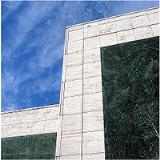
Birmingham Museum of Art

Encyclopedia
Founded in 1951, the Birmingham Museum of Art in Birmingham, Alabama
today has one of the finest collections in the Southeast US, with more than 24,000 paintings, sculptures, prints, drawings, and decorative arts representing a numerous diverse cultures, including Asia
n, Europe
an, American
, Africa
n, Pre-Columbian
, and Native American
. Among other highlights, the Museum’s collection of Asian art is considered the finest and most comprehensive in the Southeast, and its Vietnamese ceramics one of the finest in the U.S. The Museum also is home to a remarkable Kress Collection of Renaissance
and Baroque
paintings, sculpture, and decorative arts from the late 13th century to c.1750, and the 18th-century European decorative arts include superior examples of English ceramics and French furniture.
The Birmingham Museum of Art is owned by the City of Birmingham and encompasses 3.9 acres (15,782.8 m²) in the heart of the city’s cultural district. Erected in 1959, the present building was designed by architects Warren, Knight and Davis, and a major renovation and expansion by Edward Larrabee Barnes
of New York was completed in 1993. The facility encompasses 180000 square feet (16,722.5 m²), including an outdoor sculpture garden.
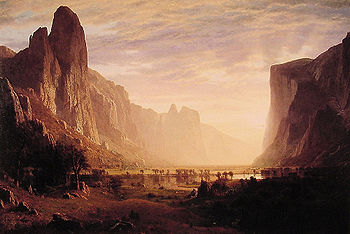
and dates from the 12th century to the present. The collection features fine examples of figure sculpture, masks, ritual objects, furniture and household and utilitarian objects, textiles, ceramics and metal arts, with an Egypt
ian false door, Yoruba
mask, Benin
bronze hip pendant, divination portrait of a king from Dahomey
.
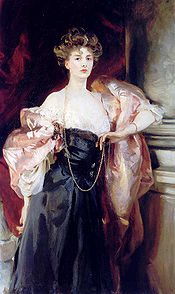 Spanning the late 18th through mid-20th century, the Museum’s collection of American painting, sculpture, works on paper, and decorative arts features paintings by Gilbert Stuart
, Childe Hassam
, and Georgia O'Keeffe
; sculptures by Hiram Powers
and Frederic Remington
; and important decorative pieces by Tiffany
Studios and Frank Lloyd Wright
. Considered one of the three most important American landscape paintings, the Museum’s Looking Down Yosemite Valley, California (1865) by Bierstadt
was recently chosen by The National Endowment for the Humanities
as one of 40 American masterpieces that best depict the people, places, and events that have shaped our country and tell America’s story.
, Korea
, Japan
, India
, and Southeast Asia
, featuring the finest collection of Vietnam
ese ceramics in the U.S., as well as outstanding examples of Buddhist and Hindu
art, lacquer ware, ceramics, paintings, prints, and sculpture. Highlights include a rare Ming dynasty
temple wall and Tang dynasty
tomb figures from China; Jomon period pottery from Japan; and contemporary works such as The Grand Residence, considered by Chinese painter Wu Guanzhong
among his most important works. Also, on long-term loan from The Smithsonian Institution
is the Vetlesen Jade Collection of 16th- to 19th-century pieces, one of the most important jade collections in the U.S. The Museum has the only gallery for Korean art in the Southeast.
, Andy Warhol
, Bill Viola
, Lynda Benglis
, Kerry James Marshall
, Callum Innes
, Grace Hartigan
, Larry Rivers
, Louise Nevelson, Frank Fleming and Philip Guston
, as well as works by a younger generation who are defining the new century.
will feature works by Bill Traylor
, Thornton Dial
, Alabama’s outstanding quilters, and other self-taught artists.
and Baroque
paintings, sculpture and decorative arts dating from the late 13th century to c.1750, with works by Pietro Perugino
, Antonio Canaletto, and Paris Bordone
. Other strengths include 17th-century Dutch paintings by Jacob van Ruisdael, Ferdinand Bol
, and Balthasar van der Ast
; British 18th-century painting, with portraits by Thomas Gainsborough
and Thomas Lawrence
; and 18th- and 19th-century French paintings by Francois-Hubert Drouais
, Jean-Baptiste Oudry
, Mary Cassatt
, Gustave Courbet
, and Jean-Baptiste-Camille Corot
.
to present day. Notable holdings include the only public collection of late 19th-century European cast iron
items in the U.S. and the Eugenia Woodward Hitt Collection of 18th-century French art, including furniture of the Louis XIV, XV, and XVI periods, mounted porcelain, gilt bronzes, paintings, and works on paper from the Regénce
to the period following the French Revolution
. The Dwight and Lucille Beeson Wedgwood Collection is the finest outside England
, comprising more than 1,400 objects illustrating the entire production of the Wedgwood
factory from its early years through the 19th century.
arts. The galleries are organized into four cultural groupings according to region: Eastern Woodlands, Plains
, Northwest Coast, and Southwest
. Highlights of the collection include a large grouping of fine Navajo
blankets and rugs, an extensive collection of Northwest coast art, and important historic and contemporary Pueblo
ceramics. There also are excellent examples of Plains
beadwork and stunning shaman headdresses.
, and the Northern Andes. Highlights from Meso-America include Zapotec
ceramics, objects related to the ballgame, Maya
figure sculpture, ceramics and jewelry, Aztec
stone sculpture, and West Mexican figural tomb sculpture. Cultures of ancient Costa Rica
, Guatemala
, and Panama
are well represented: works include gold jewelry, metates, censors, volcanic stone figure sculpture, and ceramics. Northern Andean objects include Sican
ceremonial gold vessels and tumi, ceramics from the Moche
, Chimu, Chancay
, and Vicus
cultures, Incan keros and mummy masks, and Peru
vian textiles.
, Jacques Lipchitz
and Auguste Rodin
as well as three site-specific artworks commissioned by the Museum: Lithos II (1993) by Elyn Zimmerman, a water wall and pool of textured granite blocks set into the curving east wall of the garden, Blue Pools Courtyard (1993) by artist Valerie Jaudon, featuring inlaid tile pools, plantings, and brick and bluestone pavers and Sol LeWitt
’s Bands of Color in Various Directions, commissioned in 2001 in celebration of the Museum’s 50th anniversary.
and his manufactures, along with the Beeson rare book holdings, make this the U.S. center for the study of Wedgwood. Among these holdings are letters from John Flaxman
and Benjamin West
, and Sir William Hamilton’s Collection of Engravings from Antique Vases, known as the Hamilton Folios, the first European color-plate books.
. Over the next two decades the club continued to add to the collection and raise support in the press and in City Hall for the concept of a new building.
, Old master print
s, costumes, glass, and oil paintings. In 1952 the Samuel H. Kress
Foundation presented 29 paintings from the Italian Renaissance
as a long-term loan to the new museum, forming the core of the collection of European paintings. A large bequest in 1954 made possible a new museum building. Land was purchased the following year and a design commission for a new museum building was given to the office of Warren Knight & Davis. The "Oscar Wells Memorial Building" opened to the public on May 3, 1959. In the following years the Kress Foundation made two important gifts to the museum: the trusteeship of a collection of Renaissance furniture and decorative objects in 1959, and the deed to the Italian paintings already on loan, along with eight additional works from the same period. The following year, the American Cast Iron Pipe Company
loaned its Lamprecht Collection of German cast-iron objects (the largest in the world).
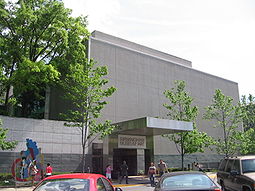 A level of upper floor galleries was added to the building's west wing in 1965, and the following year, the Clarence B. Hanson, Jr. Library was opened on the building's first floor. In 1967 a new east wing was completed. Additional land was purchased in 1969, and in 1974 another addition included a three-story rebuilding of the east wing. Further reworking of the east wing added a conservation lab, loading dock, and a second public entrance to the building in 1979, and the following year, gallery space was expanded by 28,000 square feet (2,600 m²). In 1986 another expansion project was planned and architect Edward Larrabee Barnes
, in conjunction with local architect KPS Group, Inc., was selected to oversee the design, which included provision for a new outdoor sculpture garden and 50,000 square feet (5,000 m²) of exhibition space bringing the total to 180,000 square feet (15,400 m²).
Birmingham, Alabama
Birmingham is the largest city in Alabama. The city is the county seat of Jefferson County. According to the 2010 United States Census, Birmingham had a population of 212,237. The Birmingham-Hoover Metropolitan Area, in estimate by the U.S...
today has one of the finest collections in the Southeast US, with more than 24,000 paintings, sculptures, prints, drawings, and decorative arts representing a numerous diverse cultures, including Asia
Asia
Asia is the world's largest and most populous continent, located primarily in the eastern and northern hemispheres. It covers 8.7% of the Earth's total surface area and with approximately 3.879 billion people, it hosts 60% of the world's current human population...
n, Europe
Europe
Europe is, by convention, one of the world's seven continents. Comprising the westernmost peninsula of Eurasia, Europe is generally 'divided' from Asia to its east by the watershed divides of the Ural and Caucasus Mountains, the Ural River, the Caspian and Black Seas, and the waterways connecting...
an, American
Americas
The Americas, or America , are lands in the Western hemisphere, also known as the New World. In English, the plural form the Americas is often used to refer to the landmasses of North America and South America with their associated islands and regions, while the singular form America is primarily...
, Africa
Africa
Africa is the world's second largest and second most populous continent, after Asia. At about 30.2 million km² including adjacent islands, it covers 6% of the Earth's total surface area and 20.4% of the total land area...
n, Pre-Columbian
Pre-Columbian
The pre-Columbian era incorporates all period subdivisions in the history and prehistory of the Americas before the appearance of significant European influences on the American continents, spanning the time of the original settlement in the Upper Paleolithic period to European colonization during...
, and Native American
Indigenous peoples of the Americas
The indigenous peoples of the Americas are the pre-Columbian inhabitants of North and South America, their descendants and other ethnic groups who are identified with those peoples. Indigenous peoples are known in Canada as Aboriginal peoples, and in the United States as Native Americans...
. Among other highlights, the Museum’s collection of Asian art is considered the finest and most comprehensive in the Southeast, and its Vietnamese ceramics one of the finest in the U.S. The Museum also is home to a remarkable Kress Collection of Renaissance
Renaissance
The Renaissance was a cultural movement that spanned roughly the 14th to the 17th century, beginning in Italy in the Late Middle Ages and later spreading to the rest of Europe. The term is also used more loosely to refer to the historical era, but since the changes of the Renaissance were not...
and Baroque
Baroque
The Baroque is a period and the style that used exaggerated motion and clear, easily interpreted detail to produce drama, tension, exuberance, and grandeur in sculpture, painting, literature, dance, and music...
paintings, sculpture, and decorative arts from the late 13th century to c.1750, and the 18th-century European decorative arts include superior examples of English ceramics and French furniture.
The Birmingham Museum of Art is owned by the City of Birmingham and encompasses 3.9 acres (15,782.8 m²) in the heart of the city’s cultural district. Erected in 1959, the present building was designed by architects Warren, Knight and Davis, and a major renovation and expansion by Edward Larrabee Barnes
Edward Larrabee Barnes
Edward Larrabee Barnes was a American architect.Barnes was born in Chicago, Illinois into a family he described as "incense-swinging High Episcopalians", consisting of Cecil Barnes, a lawyer, and Margaret Helen Ayer, recipient of a Pulitzer Prize for the novel Year of Grace...
of New York was completed in 1993. The facility encompasses 180000 square feet (16,722.5 m²), including an outdoor sculpture garden.
Highlights of the Permanent Collection
African Art
The Museum’s growing collection of nearly 2,000 objects is derived from the major culture groups of sub-Saharan AfricaSub-Saharan Africa
Sub-Saharan Africa as a geographical term refers to the area of the African continent which lies south of the Sahara. A political definition of Sub-Saharan Africa, instead, covers all African countries which are fully or partially located south of the Sahara...
and dates from the 12th century to the present. The collection features fine examples of figure sculpture, masks, ritual objects, furniture and household and utilitarian objects, textiles, ceramics and metal arts, with an Egypt
Egypt
Egypt , officially the Arab Republic of Egypt, Arabic: , is a country mainly in North Africa, with the Sinai Peninsula forming a land bridge in Southwest Asia. Egypt is thus a transcontinental country, and a major power in Africa, the Mediterranean Basin, the Middle East and the Muslim world...
ian false door, Yoruba
Yoruba traditional art
The Yoruba of South Western Africa , have a very rich and vibrant artisan community, creating traditional and contemporary art...
mask, Benin
Benin
Benin , officially the Republic of Benin, is a country in West Africa. It borders Togo to the west, Nigeria to the east and Burkina Faso and Niger to the north. Its small southern coastline on the Bight of Benin is where a majority of the population is located...
bronze hip pendant, divination portrait of a king from Dahomey
Dahomey
Dahomey was a country in west Africa in what is now the Republic of Benin. The Kingdom of Dahomey was a powerful west African state that was founded in the seventeenth century and survived until 1894. From 1894 until 1960 Dahomey was a part of French West Africa. The independent Republic of Dahomey...
.
American Art
Gilbert Stuart
Gilbert Charles Stuart was an American painter from Rhode Island.Gilbert Stuart is widely considered to be one of America's foremost portraitists...
, Childe Hassam
Childe Hassam
Frederick Childe Hassam was a prolific American Impressionist painter, noted for his urban and coastal scenes. Along with Mary Cassatt and John Henry Twachtman, Hassam was instrumental in promulgating Impressionism to American collectors, dealers, and museums...
, and Georgia O'Keeffe
Georgia O'Keeffe
Georgia Totto O'Keeffe was an American artist.Born near Sun Prairie, Wisconsin, O'Keeffe first came to the attention of the New York art community in 1916, several decades before women had gained access to art training in America’s colleges and universities, and before any of its women artists...
; sculptures by Hiram Powers
Hiram Powers
Hiram Powers was an American neoclassical sculptor.-Biography:The son of a farmer, Powers was born in Woodstock, Vermont, on the July 29, 1805. In 1818 his father moved to Ohio, about six miles from Cincinnati, where the son attended school for about a year, staying meanwhile with his brother, a...
and Frederic Remington
Frederic Remington
Frederic Sackrider Remington was an American painter, illustrator, sculptor, and writer who specialized in depictions of the Old American West, specifically concentrating on the last quarter of the 19th century American West and images of cowboys, American Indians, and the U. S...
; and important decorative pieces by Tiffany
Louis Comfort Tiffany
Louis Comfort Tiffany was an American artist and designer who worked in the decorative arts and is best known for his work in stained glass. He is the American artist most associated with the Art Nouveau and Aesthetic movements...
Studios and Frank Lloyd Wright
Frank Lloyd Wright
Frank Lloyd Wright was an American architect, interior designer, writer and educator, who designed more than 1,000 structures and completed 500 works. Wright believed in designing structures which were in harmony with humanity and its environment, a philosophy he called organic architecture...
. Considered one of the three most important American landscape paintings, the Museum’s Looking Down Yosemite Valley, California (1865) by Bierstadt
Albert Bierstadt
Albert Bierstadt was a German-American painter best known for his lavish, sweeping landscapes of the American West. In obtaining the subject matter for these works, Bierstadt joined several journeys of the Westward Expansion...
was recently chosen by The National Endowment for the Humanities
National Endowment for the Humanities
The National Endowment for the Humanities is an independent federal agency of the United States established by the National Foundation on the Arts and the Humanities Act of 1965 dedicated to supporting research, education, preservation, and public programs in the humanities. The NEH is located at...
as one of 40 American masterpieces that best depict the people, places, and events that have shaped our country and tell America’s story.
Art of Alabama
Since its doors opened to the public in 1951, the Birmingham Museum of Art has collected and exhibited the art of Alabama. Among the earliest works to enter the collection were paintings by significant Alabama artists including the miniaturist Hannah Elliott and the landscapist Carrie Hill. Throughout its history, the Museum has continued its commitment to the arts of Alabama. In 1995, it organized Made in Alabama, a groundbreaking survey of artistic production in the state during the nineteenth century. In addition to collecting the works of academically trained native artists, the Museum has built an impressive collection of folk art, including painting, sculpture, quilts, and pottery. Thanks to the generosity of Robert and Helen Cargo, the Museum possesses one of the largest and most comprehensive collections of Southern quilts in the country. Similarly, several major private collectors are helping the Museum build the most significant repository of Alabama pottery in the State.Asian Art
The Museum’s Asian art collection started with a gift of Chinese textiles in 1951 and today, with more than 4,000 objects, is the largest and most comprehensive in the Southeast. The collection hails from ChinaChina
Chinese civilization may refer to:* China for more general discussion of the country.* Chinese culture* Greater China, the transnational community of ethnic Chinese.* History of China* Sinosphere, the area historically affected by Chinese culture...
, Korea
Korea
Korea ) is an East Asian geographic region that is currently divided into two separate sovereign states — North Korea and South Korea. Located on the Korean Peninsula, Korea is bordered by the People's Republic of China to the northwest, Russia to the northeast, and is separated from Japan to the...
, Japan
Japan
Japan is an island nation in East Asia. Located in the Pacific Ocean, it lies to the east of the Sea of Japan, China, North Korea, South Korea and Russia, stretching from the Sea of Okhotsk in the north to the East China Sea and Taiwan in the south...
, India
India
India , officially the Republic of India , is a country in South Asia. It is the seventh-largest country by geographical area, the second-most populous country with over 1.2 billion people, and the most populous democracy in the world...
, and Southeast Asia
Southeast Asia
Southeast Asia, South-East Asia, South East Asia or Southeastern Asia is a subregion of Asia, consisting of the countries that are geographically south of China, east of India, west of New Guinea and north of Australia. The region lies on the intersection of geological plates, with heavy seismic...
, featuring the finest collection of Vietnam
Vietnam
Vietnam – sometimes spelled Viet Nam , officially the Socialist Republic of Vietnam – is the easternmost country on the Indochina Peninsula in Southeast Asia. It is bordered by China to the north, Laos to the northwest, Cambodia to the southwest, and the South China Sea –...
ese ceramics in the U.S., as well as outstanding examples of Buddhist and Hindu
Hindu
Hindu refers to an identity associated with the philosophical, religious and cultural systems that are indigenous to the Indian subcontinent. As used in the Constitution of India, the word "Hindu" is also attributed to all persons professing any Indian religion...
art, lacquer ware, ceramics, paintings, prints, and sculpture. Highlights include a rare Ming dynasty
Ming Dynasty
The Ming Dynasty, also Empire of the Great Ming, was the ruling dynasty of China from 1368 to 1644, following the collapse of the Mongol-led Yuan Dynasty. The Ming, "one of the greatest eras of orderly government and social stability in human history", was the last dynasty in China ruled by ethnic...
temple wall and Tang dynasty
Tang Dynasty
The Tang Dynasty was an imperial dynasty of China preceded by the Sui Dynasty and followed by the Five Dynasties and Ten Kingdoms Period. It was founded by the Li family, who seized power during the decline and collapse of the Sui Empire...
tomb figures from China; Jomon period pottery from Japan; and contemporary works such as The Grand Residence, considered by Chinese painter Wu Guanzhong
Wu Guanzhong
Wu Guanzhong was a contemporary Chinese painter widely recognized as the father of modern Chinese painting. Wu had painted various aspects of China, including much of its architecture, plants, animals, people, as well as many of its landscapes and waterscapes in a style reminiscent of the...
among his most important works. Also, on long-term loan from The Smithsonian Institution
Smithsonian Institution
The Smithsonian Institution is an educational and research institute and associated museum complex, administered and funded by the government of the United States and by funds from its endowment, contributions, and profits from its retail operations, concessions, licensing activities, and magazines...
is the Vetlesen Jade Collection of 16th- to 19th-century pieces, one of the most important jade collections in the U.S. The Museum has the only gallery for Korean art in the Southeast.
Contemporary Art
The collection features painting, sculpture, video, photography, works on paper, and installation art that illuminate movements and trends from the 1960s to the present, by renowned artists such as Joan MitchellJoan Mitchell
Joan Mitchell was a "second generation" abstract expressionist painter. She was an essential member of the American Abstract expressionist movement, even though much of her career took place in France. Along with Lee Krasner, Grace Hartigan, and Helen Frankenthaler she was one of her era's few...
, Andy Warhol
Andy Warhol
Andrew Warhola , known as Andy Warhol, was an American painter, printmaker, and filmmaker who was a leading figure in the visual art movement known as pop art...
, Bill Viola
Bill Viola
Bill Viola is a contemporary video artist. He is considered a leading figure in the generation of artists whose artistic expression depends upon electronic, sound, and image technology in New Media...
, Lynda Benglis
Lynda Benglis
Lynda Benglis is an American sculptor known for her wax paintings and poured latex sculptures. After earning a BFA from Newcomb College in 1964, Benglis moved to New York, where she lives and works today...
, Kerry James Marshall
Kerry James Marshall
Kerry James Marshall is an artist born in Birmingham, Alabama. He grew up in South Central Los Angeles and now lives in Chicago where he previously taught at the School of Art and Design at the University of Illinois at Chicago...
, Callum Innes
Callum Innes
Callum Innes is a Scottish abstract painter and former Turner Prize nominee.-Life and work:Callum Innes was born in Edinburgh. He studied at Gray's School of Art and graduated from Edinburgh College of Art in 1985....
, Grace Hartigan
Grace Hartigan
Grace Hartigan was an American Abstract Expressionist painter of the New York School in the 1950s.-Biography and early career:...
, Larry Rivers
Larry Rivers
Larry Rivers was an American artist, musician, filmmaker and occasional actor. Rivers resided and maintained studios in New York City, Southampton, New York and Zihuatanejo, Mexico.-Biography:...
, Louise Nevelson, Frank Fleming and Philip Guston
Philip Guston
Philip Guston was a notable painter and printmaker in the New York School, which included many of the Abstract expressionists, such as Jackson Pollock and Willem De Kooning...
, as well as works by a younger generation who are defining the new century.
Folk Art
Since 2009 a permanent display of Folk artFolk art
Folk art encompasses art produced from an indigenous culture or by peasants or other laboring tradespeople. In contrast to fine art, folk art is primarily utilitarian and decorative rather than purely aesthetic....
will feature works by Bill Traylor
Bill Traylor
William "Bill" Traylor was a self-taught artist born into slavery on a plantation belonging to George Hartwell Traylor near Benton, in Lowndes County, Alabama. After emancipation, his family continued to farm on the plantation until the 1930s...
, Thornton Dial
Thornton Dial
Thornton Dial is an artist who came to prominence in the United States in the late 1980s. He was one of 12 children and grew up poor and without his father's presence in the family, and this poverty led him and his siblings to create toys from the discarded objects around them...
, Alabama’s outstanding quilters, and other self-taught artists.
European Art
Among the highlights of the European art holdings is the Kress Collection of Renaissance Art, featuring RenaissanceRenaissance
The Renaissance was a cultural movement that spanned roughly the 14th to the 17th century, beginning in Italy in the Late Middle Ages and later spreading to the rest of Europe. The term is also used more loosely to refer to the historical era, but since the changes of the Renaissance were not...
and Baroque
Baroque
The Baroque is a period and the style that used exaggerated motion and clear, easily interpreted detail to produce drama, tension, exuberance, and grandeur in sculpture, painting, literature, dance, and music...
paintings, sculpture and decorative arts dating from the late 13th century to c.1750, with works by Pietro Perugino
Pietro Perugino
Pietro Perugino , born Pietro Vannucci, was an Italian Renaissance painter of the Umbrian school, who developed some of the qualities that found classic expression in the High Renaissance...
, Antonio Canaletto, and Paris Bordone
Paris Bordone
Paris Bordon was an Italian painter of the Venetian Renaissance who, despite training with Titian, maintained a strand of mannerist complexity and provincial vigor.-Biography:...
. Other strengths include 17th-century Dutch paintings by Jacob van Ruisdael, Ferdinand Bol
Ferdinand Bol
Ferdinand Bol was a Dutch artist, etcher, and draftsman. Although his surviving work is rare, it displays Rembrandt's influence; like his master, Bol favored historical subjects, portraits, numerous self-portraits, and single figures in exotic finery.The street Ferdinand Bolstraat in Amsterdam was...
, and Balthasar van der Ast
Balthasar van der Ast
Balthasar van der Ast was a Dutch Golden Age painter who specialized in still lifes of flowers and fruit, as well as painting a number of remarkable shell still lifes; he is considered to be a pioneer in the genre of shell painting. His still lifes often contain insects and lizards...
; British 18th-century painting, with portraits by Thomas Gainsborough
Thomas Gainsborough
Thomas Gainsborough was an English portrait and landscape painter.-Suffolk:Thomas Gainsborough was born in Sudbury, Suffolk. He was the youngest son of John Gainsborough, a weaver and maker of woolen goods. At the age of thirteen he impressed his father with his penciling skills so that he let...
and Thomas Lawrence
Thomas Lawrence
Thomas Lawrence may refer to:*Sir Thomas Lawrence, British artist, President of Royal Academy*Thomas Lawrence , mayor of colonial Philadelphia*T. E. Lawrence, "Lawrence of Arabia"*Thomas Lawrence , U.S. politician...
; and 18th- and 19th-century French paintings by Francois-Hubert Drouais
François-Hubert Drouais
François-Hubert Drouais was a French painter and the father of Jean-Germain Drouais.Drouais was born and died in Paris. He specialized in portraits of the French nobility, foreign aristocrats, writers, and other artists. Some of his portraits include Louis XV's last two mistresses, Madame de...
, Jean-Baptiste Oudry
Jean-Baptiste Oudry
Jean-Baptiste Oudry was a French Rococo painter, engraver, and tapestry designer. He is particularly well known for his naturalistic pictures of animals and his hunt pieces depicting game.-Biography:...
, Mary Cassatt
Mary Cassatt
Mary Stevenson Cassatt was an American painter and printmaker. She lived much of her adult life in France, where she first befriended Edgar Degas and later exhibited among the Impressionists...
, Gustave Courbet
Gustave Courbet
Jean Désiré Gustave Courbet was a French painter who led the Realist movement in 19th-century French painting. The Realist movement bridged the Romantic movement , with the Barbizon School and the Impressionists...
, and Jean-Baptiste-Camille Corot
Jean-Baptiste-Camille Corot
Jean-Baptiste-Camille Corot was a French landscape painter and printmaker in etching. Corot was the leading painter of the Barbizon school of France in the mid-nineteenth century...
.
European Decorative Arts
One of the foundations of the Museum’s permanent collection, the European decorative arts comprise more than 12,000 objects including ceramics, glass, and furniture dating from the RenaissanceRenaissance
The Renaissance was a cultural movement that spanned roughly the 14th to the 17th century, beginning in Italy in the Late Middle Ages and later spreading to the rest of Europe. The term is also used more loosely to refer to the historical era, but since the changes of the Renaissance were not...
to present day. Notable holdings include the only public collection of late 19th-century European cast iron
Cast iron
Cast iron is derived from pig iron, and while it usually refers to gray iron, it also identifies a large group of ferrous alloys which solidify with a eutectic. The color of a fractured surface can be used to identify an alloy. White cast iron is named after its white surface when fractured, due...
items in the U.S. and the Eugenia Woodward Hitt Collection of 18th-century French art, including furniture of the Louis XIV, XV, and XVI periods, mounted porcelain, gilt bronzes, paintings, and works on paper from the Regénce
Régence
The Régence is the period in French history between 1715 and 1723, when King Louis XV was a minor and the land was governed by a Regent, Philippe d'Orléans, the nephew of Louis XIV of France....
to the period following the French Revolution
French Revolution
The French Revolution , sometimes distinguished as the 'Great French Revolution' , was a period of radical social and political upheaval in France and Europe. The absolute monarchy that had ruled France for centuries collapsed in three years...
. The Dwight and Lucille Beeson Wedgwood Collection is the finest outside England
England
England is a country that is part of the United Kingdom. It shares land borders with Scotland to the north and Wales to the west; the Irish Sea is to the north west, the Celtic Sea to the south west, with the North Sea to the east and the English Channel to the south separating it from continental...
, comprising more than 1,400 objects illustrating the entire production of the Wedgwood
Wedgwood
Wedgwood, strictly speaking Josiah Wedgwood and Sons, is a pottery firm owned by KPS Capital Partners, a private equity company based in New York City, USA. Wedgwood was founded on May 1, 1759 by Josiah Wedgwood and in 1987 merged with Waterford Crystal to create Waterford Wedgwood, an...
factory from its early years through the 19th century.
Native American Art
The museum features a large installation of Native AmericanNative Americans in the United States
Native Americans in the United States are the indigenous peoples in North America within the boundaries of the present-day continental United States, parts of Alaska, and the island state of Hawaii. They are composed of numerous, distinct tribes, states, and ethnic groups, many of which survive as...
arts. The galleries are organized into four cultural groupings according to region: Eastern Woodlands, Plains
Plains Indians
The Plains Indians are the Indigenous peoples who live on the plains and rolling hills of the Great Plains of North America. Their colorful equestrian culture and resistance to White domination have made the Plains Indians an archetype in literature and art for American Indians everywhere.Plains...
, Northwest Coast, and Southwest
Southwestern United States
The Southwestern United States is a region defined in different ways by different sources. Broad definitions include nearly a quarter of the United States, including Arizona, California, Colorado, Nevada, New Mexico, Oklahoma, Texas and Utah...
. Highlights of the collection include a large grouping of fine Navajo
Navajo people
The Navajo of the Southwestern United States are the largest single federally recognized tribe of the United States of America. The Navajo Nation has 300,048 enrolled tribal members. The Navajo Nation constitutes an independent governmental body which manages the Navajo Indian reservation in the...
blankets and rugs, an extensive collection of Northwest coast art, and important historic and contemporary Pueblo
Pueblo
Pueblo is a term used to describe modern communities of Native Americans in the Southwestern United States of America. The first Spanish explorers of the Southwest used this term to describe the communities housed in apartment-like structures built of stone, adobe mud, and other local material...
ceramics. There also are excellent examples of Plains
Plains Indians
The Plains Indians are the Indigenous peoples who live on the plains and rolling hills of the Great Plains of North America. Their colorful equestrian culture and resistance to White domination have made the Plains Indians an archetype in literature and art for American Indians everywhere.Plains...
beadwork and stunning shaman headdresses.
Pre-Columbian
The collection features stunning objects from Meso-America, Central AmericaCentral America
Central America is the central geographic region of the Americas. It is the southernmost, isthmian portion of the North American continent, which connects with South America on the southeast. When considered part of the unified continental model, it is considered a subcontinent...
, and the Northern Andes. Highlights from Meso-America include Zapotec
Zapotec civilization
The Zapotec civilization was an indigenous pre-Columbian civilization that flourished in the Valley of Oaxaca of southern Mesoamerica. Archaeological evidence shows their culture goes back at least 2500 years...
ceramics, objects related to the ballgame, Maya
Maya civilization
The Maya is a Mesoamerican civilization, noted for the only known fully developed written language of the pre-Columbian Americas, as well as for its art, architecture, and mathematical and astronomical systems. Initially established during the Pre-Classic period The Maya is a Mesoamerican...
figure sculpture, ceramics and jewelry, Aztec
Aztec
The Aztec people were certain ethnic groups of central Mexico, particularly those groups who spoke the Nahuatl language and who dominated large parts of Mesoamerica in the 14th, 15th and 16th centuries, a period referred to as the late post-classic period in Mesoamerican chronology.Aztec is the...
stone sculpture, and West Mexican figural tomb sculpture. Cultures of ancient Costa Rica
Costa Rica
Costa Rica , officially the Republic of Costa Rica is a multilingual, multiethnic and multicultural country in Central America, bordered by Nicaragua to the north, Panama to the southeast, the Pacific Ocean to the west and the Caribbean Sea to the east....
, Guatemala
Guatemala
Guatemala is a country in Central America bordered by Mexico to the north and west, the Pacific Ocean to the southwest, Belize to the northeast, the Caribbean to the east, and Honduras and El Salvador to the southeast...
, and Panama
Panama
Panama , officially the Republic of Panama , is the southernmost country of Central America. Situated on the isthmus connecting North and South America, it is bordered by Costa Rica to the northwest, Colombia to the southeast, the Caribbean Sea to the north and the Pacific Ocean to the south. The...
are well represented: works include gold jewelry, metates, censors, volcanic stone figure sculpture, and ceramics. Northern Andean objects include Sican
Sican
Sican may refer to:*The Sican culture in what is now Peru*Sican language*The Sicani, a people of ancient Sicily...
ceremonial gold vessels and tumi, ceramics from the Moche
Moche
'The Moche civilization flourished in northern Peru from about 100 AD to 800 AD, during the Regional Development Epoch. While this issue is the subject of some debate, many scholars contend that the Moche were not politically organized as a monolithic empire or state...
, Chimu, Chancay
Chancay
Chancay is a small city in the Lima Region of Peru. Its population is 26,958....
, and Vicus
Vicus (Rome)
In ancient Rome, the vicus was a neighborhood. During the Republican era, the four regiones of the city of Rome were subdivided into vici. In the 1st century BC, Augustus reorganized the city for administrative purposes into 14 regions, comprising 265 vici. Each vicus had its own board of...
cultures, Incan keros and mummy masks, and Peru
Peru
Peru , officially the Republic of Peru , is a country in western South America. It is bordered on the north by Ecuador and Colombia, on the east by Brazil, on the southeast by Bolivia, on the south by Chile, and on the west by the Pacific Ocean....
vian textiles.
The Charles W. Ireland Sculpture Garden
One of the most distinctive spaces for the display of outdoor art in the southeastern United States, this beautiful multi-level sculpture garden features works by artists such as Fernando BoteroFernando Botero
Fernando Botero Angulo is a Colombian figurative artist. His works feature a figurative style, called by some "Boterismo", which gives them an unmistakable identity...
, Jacques Lipchitz
Jacques Lipchitz
Jacques Lipchitz was a Cubist sculptor.Jacques Lipchitz was born Chaim Jacob Lipchitz, son of a building contractor in Druskininkai, Lithuania, then within the Russian Empire...
and Auguste Rodin
Auguste Rodin
François-Auguste-René Rodin , known as Auguste Rodin , was a French sculptor. Although Rodin is generally considered the progenitor of modern sculpture, he did not set out to rebel against the past...
as well as three site-specific artworks commissioned by the Museum: Lithos II (1993) by Elyn Zimmerman, a water wall and pool of textured granite blocks set into the curving east wall of the garden, Blue Pools Courtyard (1993) by artist Valerie Jaudon, featuring inlaid tile pools, plantings, and brick and bluestone pavers and Sol LeWitt
Sol LeWitt
Solomon "Sol" LeWitt was an American artist linked to various movements, including Conceptual art and Minimalism....
’s Bands of Color in Various Directions, commissioned in 2001 in celebration of the Museum’s 50th anniversary.
The Clarence B. Hanson, Jr. Library
Named for Clarence Bloodworth Hanson, Jr., former publisher of The Birmingham News and a Birmingham Museum of Art board member for 24 years, the Museum’s library is one of the most comprehensive art research libraries in the southeastern U.S. Holdings include a broad range of materials including general art reference works, auction catalogues, artists’ files, periodicals, indexes, exhibition catalogs, and databases. The Chellis Wedgwood Collection, the largest and most comprehensive special collection in the world related to Josiah WedgwoodJosiah Wedgwood
Josiah Wedgwood was an English potter, founder of the Wedgwood company, credited with the industrialization of the manufacture of pottery. A prominent abolitionist, Wedgwood is remembered for his "Am I Not A Man And A Brother?" anti-slavery medallion. He was a member of the Darwin–Wedgwood family...
and his manufactures, along with the Beeson rare book holdings, make this the U.S. center for the study of Wedgwood. Among these holdings are letters from John Flaxman
John Flaxman
John Flaxman was an English sculptor and draughtsman.-Early life:He was born in York. His father was also named John, after an ancestor who, according to family tradition, had fought for Parliament at the Battle of Naseby, and afterwards settled as a carrier or farmer in Buckinghamshire...
and Benjamin West
Benjamin West
Benjamin West, RA was an Anglo-American painter of historical scenes around and after the time of the American War of Independence...
, and Sir William Hamilton’s Collection of Engravings from Antique Vases, known as the Hamilton Folios, the first European color-plate books.
Birmingham Art Club
The roots of the museum date back to 1908 and the founding of the "Birmingham Art Club" which endeavored to amass a public art collection for the benefit of the citizens of Birmingham, which had been founded as a new industrial city only 37 years prior. In 1927 they were able to display their collection in the galleries of the new Birmingham Public LibraryBirmingham Public Library
For the main library in Birmingham, England see, Birmingham Central Library.The Birmingham Public Library, a well-respected and one of the largest library systems in the southeastern United States, consists of 19 branches and a main or central library located in downtown Birmingham, Alabama...
. Over the next two decades the club continued to add to the collection and raise support in the press and in City Hall for the concept of a new building.
First Exhibition
In September 1950 a governing board was created to oversee the creation of a museum as "an institution of public service, educational and recreational, with all the people welcome." The following February the board hired Richard Foster Howard to serve as the first museum director. In April 1951 the newly-established "Birmingham Museum of Art" presented a public "Opening Exhibition" housed in five unused rooms in City Hall. The exhibition included some pieces from the existing Art Club collection as well as a large number of loaned works from museums across the Eastern half of the United States. The result was considered to be "the finest showing of great objects of art in the South to date."New Building
The publicity created by the exhibition led to several important gifts, notably of Chinese ceramics and textiles, Japanese printsUkiyo-e
' is a genre of Japanese woodblock prints and paintings produced between the 17th and the 20th centuries, featuring motifs of landscapes, tales from history, the theatre, and pleasure quarters...
, Old master print
Old master print
An old master print is a work of art produced by a printing process within the Western tradition . A date of about 1830 is usually taken as marking the end of the period whose prints are covered by this term. The main techniques concerned are woodcut, engraving and etching, although there are...
s, costumes, glass, and oil paintings. In 1952 the Samuel H. Kress
Samuel H. Kress
Samuel Henry Kress was a businessman and philanthropist, founder of the S. H. Kress & Co. five and ten cent store chain. With his fortune, Kress amassed one of the most significant collections of Italian Renaissance and European artwork assembled in the 20th century...
Foundation presented 29 paintings from the Italian Renaissance
Italian Renaissance
The Italian Renaissance began the opening phase of the Renaissance, a period of great cultural change and achievement in Europe that spanned the period from the end of the 13th century to about 1600, marking the transition between Medieval and Early Modern Europe...
as a long-term loan to the new museum, forming the core of the collection of European paintings. A large bequest in 1954 made possible a new museum building. Land was purchased the following year and a design commission for a new museum building was given to the office of Warren Knight & Davis. The "Oscar Wells Memorial Building" opened to the public on May 3, 1959. In the following years the Kress Foundation made two important gifts to the museum: the trusteeship of a collection of Renaissance furniture and decorative objects in 1959, and the deed to the Italian paintings already on loan, along with eight additional works from the same period. The following year, the American Cast Iron Pipe Company
American Cast Iron Pipe Company
American Cast Iron Pipe Company, headquartered in Birmingham, Alabama, is a manufacturer of ductile iron pipe, fire hydrants and valves for the waterworks industry and electric-resistance steel pipe for the oil and natural gas industry...
loaned its Lamprecht Collection of German cast-iron objects (the largest in the world).
Expansions
Edward Larrabee Barnes
Edward Larrabee Barnes was a American architect.Barnes was born in Chicago, Illinois into a family he described as "incense-swinging High Episcopalians", consisting of Cecil Barnes, a lawyer, and Margaret Helen Ayer, recipient of a Pulitzer Prize for the novel Year of Grace...
, in conjunction with local architect KPS Group, Inc., was selected to oversee the design, which included provision for a new outdoor sculpture garden and 50,000 square feet (5,000 m²) of exhibition space bringing the total to 180,000 square feet (15,400 m²).
External links
- Birmingham Museum of Art website