


Birkeland current

Encyclopedia
A Birkeland current is a set of currents which flow along geomagnetic field line connecting the Earth’s magnetosphere
to the Earth's high latitude ionosphere
. They are a specific class of magnetic field-aligned currents. Lately, the term Birkeland currents has been expanded by some authors to include magnetic field aligned currents in general space plasmas. In the Earth’s magnetosphere, the currents are driven by the solar wind
and interplanetary magnetic field
and by bulk motions of plasma through the magnetosphere (convection which is indirectly driven by the interplanetary environment). The strength of the Birkeland currents changes with activity in the magnetosphere (e.g. during substorm
s). Small scale variations in the upward current sheets (downward flowing electrons) accelerate magnetospheric electrons and when they reach the upper atmosphere, they create the aurora
Borealis and Australis. In the high latitude ionosphere (or auroral zones), the Birkeland currents close through the region of the auroral electrojet
, which flows perpendicular to the local magnetic field in the ionosphere. The Birkeland currents occur in two pairs of field-lined current sheets. One pair extends from noon through the dusk sector to the midnight sector. The other pair extends from noon through the dawn sector to the midnight sector. The sheet on the high latitude side of the auroral zone is referred to as the Region 1 current sheet and the sheet on the low latitude side is referred to as the Region 2 current sheet.
The currents were predicted in 1903 by Norwegian explorer and physicist Kristian Birkeland
, who undertook expeditions into the Arctic Circle to study the aurora. He rediscovered, using simple magnetic field measure instruments, that when the aurora appeared the needles of the magnetometers changed direction, confirming the findings of Anders Celsius
and assistant Olof Hjorter more than a century before. This could only imply that currents were flowing in the atmosphere above. He theorized that somehow the Sun emitted a cathode ray , and corpuscules from a solar wind
entered the Earth’s magnetic field and created currents, thereby creating the aurora. This view was scorned at by other researchers , and it took until the 1960s before sounding rockets, launched into the auroral region showed that indeed the currents posited by Birkeland existed. In honour of his ideas, these currents were named Birkeland currents. A good description of the discoveries by Birkeland is given in the book by Lucy Jago .
Professor Emeritus of the Alfvén Laboratory in Sweden, Carl-Gunne Fälthammar
wrote : "A reason why Birkeland currents are particularly interesting is that, in the plasma forced to carry them, they cause a number of plasma physical processes to occur (waves
, instabilities
, fine structure formation). These in turn lead to consequences such as acceleration of charged particles
, both positive and negative, and element separation (such as preferential ejection of oxygen ions). Both of these classes of phenomena should have a general astrophysical interest far beyond that of understanding the space environment of our own Earth."
s during quiet times and more than 1 million amperes during geomagnetically disturbed times . The ionospheric currents which connect the field-aligned currents heat up the upper atmosphere due to the finite conductivity of the ionosphere. The heat (also known as Joule heat) is transferred from the ionospheric plasma to the gas of the upper atmosphere which rises and increases drag on low-altitude satellites.
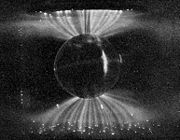
Birkeland currents can also be created in the laboratory with multi-terawatt pulsed power
generators. The resulting cross-section pattern indicates a hollow beam of electrons in the form of a circle of vortices, a formation called the diocotron instability
(similar, but different from the Kelvin-Helmholtz instability
), that subsequently leads to filamentation. Such vortices can be seen in aurora as "auroral curls".
Birkeland currents are also one of a class of plasma phenomena called a z-pinch
, so named because the azimuthal magnetic fields produced by the current pinches the current into a filamentary cable. This can also twist, producing a helical pinch that spirals like a twisted or braided rope, and this most closely corresponds to a Birkeland current. Pairs of parallel Birkeland currents can also interact; parallel Birkeland currents moving in the same direction will attract with an electromagnetic force inversely proportional to their distance apart (Note that the electromagnetic force between the individual particles is inversely proportional to the square of the distance, just like the gravitational force); parallel Birkeland currents moving in opposite directions will repel with an electromagnetic force inversely proportional to their distance apart. There is also a short-range circular component to the force between two Birkeland currents that is opposite to the longer-range parallel forces.
Electrons moving along a Birkeland current may be accelerated by a plasma double layer
. If the resulting electrons approach relativistic velocities (i.e. the speed of light) they may subsequently produce a Bennett pinch, which in a magnetic field will spiral and emit synchrotron radiation
that includes radio
, optical (i.e. light
), x-rays, and gamma rays.
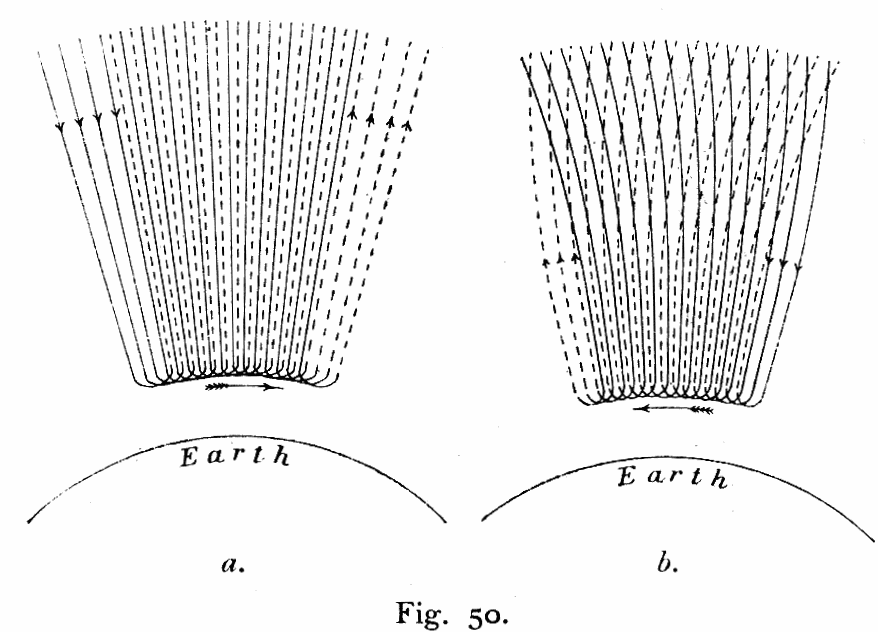 The history of Birkeland Currents appears to be mired in politics.
After Kristian Birkeland suggested "currents there are imagined as having come into existence mainly as a secondary effect of the electric corpuscles from the sun drawn in out of space," ), his ideas were generally ignored in favor of an alternative theory from British mathematician Sydney Chapman
.
In 1939, the Swedish Engineer and plasma physicist Hannes Alfvén
promoted Birkeland's ideas in a paper published on the generation of the current from the Solar Wind. One of Alfvén's colleagues, Rolf Boström, also used field-aligned currents in a new model of auroral electrojets (1964).
In 1966 Alfred Zmuda, J.H. Martin, and F.T.Heuring reported their findings of magnetic disturbance in the aurora, using a satellite magnetometer, but did not mention Alfvén, Birkeland, or field-aligned currents, even after it was brought to their attention by editor of the space physics section of the journal, Alex Dressler.
In 1967 Alex Dessler and one of his graduates students, David Cummings, wrote an article arguing that Zmuda et al. had indeed detected field align-currents. Even Alfvén subsequently credited that Dessler "discovered the currents that Birkeland had predicted" and should be called Birkeland-Dessler currents.
In 1969 Milo Schield, Alex Dessler and John Freeman, used the name "Birkeland currents" for the first time. In 1970, Zmuda, Armstrong and Heuring wrote another paper agreeing that their observations were compatible with field-aligned currents as suggested by Cummings and Dessler, and by Boström, but again made no mention of Alfvén and Birkeland.
In 1970, a group from Rice University also suggested that the results of an earlier rocket experiment was consistent with field-aligned currents, and credited the idea to Boström, and Dessler and his colleagues, rather than Alfvén and Birkeland. In the same year, Zmuda and Amstrong did credit Alfvén and Birkeland, but felt that they "...cannot definitely identify the particles constituting the field-aligned currents but … the current is probably carried by electrons …."
It wasn't until 1973 that the U. S. Navy satellite Triad, carrying equipment from A. Zmuda and James Armstrong , detected the magnetic signatures of two large sheets of electric current. Armstrong and Zmuda's papers in 1973 and 1974 reported "more conclusive evidence" of field-aligned currents, citing Cummings and Dessler but not mentioning Birkeland or Alfvén.
(Peer-reviewed journal articles, online in full)
Magnetosphere
A magnetosphere is formed when a stream of charged particles, such as the solar wind, interacts with and is deflected by the intrinsic magnetic field of a planet or similar body. Earth is surrounded by a magnetosphere, as are the other planets with intrinsic magnetic fields: Mercury, Jupiter,...
to the Earth's high latitude ionosphere
Ionosphere
The ionosphere is a part of the upper atmosphere, comprising portions of the mesosphere, thermosphere and exosphere, distinguished because it is ionized by solar radiation. It plays an important part in atmospheric electricity and forms the inner edge of the magnetosphere...
. They are a specific class of magnetic field-aligned currents. Lately, the term Birkeland currents has been expanded by some authors to include magnetic field aligned currents in general space plasmas. In the Earth’s magnetosphere, the currents are driven by the solar wind
Solar wind
The solar wind is a stream of charged particles ejected from the upper atmosphere of the Sun. It mostly consists of electrons and protons with energies usually between 1.5 and 10 keV. The stream of particles varies in temperature and speed over time...
and interplanetary magnetic field
Interplanetary Magnetic Field
The interplanetary magnetic field is the term for the solar magnetic field carried by the solar wind among the planets of the Solar System....
and by bulk motions of plasma through the magnetosphere (convection which is indirectly driven by the interplanetary environment). The strength of the Birkeland currents changes with activity in the magnetosphere (e.g. during substorm
Substorm
A substorm, sometimes referred to as a magnetospheric substorm or an auroral substorm, is a brief disturbance in the Earth's magnetosphere that causes energy to be released from the "tail" of the magnetosphere and injected into the high latitude ionosphere. Visually, a substorm is seen as a sudden...
s). Small scale variations in the upward current sheets (downward flowing electrons) accelerate magnetospheric electrons and when they reach the upper atmosphere, they create the aurora
Aurora (astronomy)
An aurora is a natural light display in the sky particularly in the high latitude regions, caused by the collision of energetic charged particles with atoms in the high altitude atmosphere...
Borealis and Australis. In the high latitude ionosphere (or auroral zones), the Birkeland currents close through the region of the auroral electrojet
Electrojet
An electrojet is an electric current which travels around the E region of the Earth's ionosphere. There are two electrojets: above the magnetic equator , and near the Northern and Southern Polar Circles . Electrojets are Hall currents carried primarily by electrons at altitudes from 100 to...
, which flows perpendicular to the local magnetic field in the ionosphere. The Birkeland currents occur in two pairs of field-lined current sheets. One pair extends from noon through the dusk sector to the midnight sector. The other pair extends from noon through the dawn sector to the midnight sector. The sheet on the high latitude side of the auroral zone is referred to as the Region 1 current sheet and the sheet on the low latitude side is referred to as the Region 2 current sheet.
The currents were predicted in 1903 by Norwegian explorer and physicist Kristian Birkeland
Kristian Birkeland
Kristian Olaf Birkeland was a Norwegian scientist. He is best remembered as the person who first elucidated the nature of the Aurora borealis. In order to fund his research on the aurorae, he invented the electromagnetic cannon and the Birkeland-Eyde process of fixing nitrogen from the air...
, who undertook expeditions into the Arctic Circle to study the aurora. He rediscovered, using simple magnetic field measure instruments, that when the aurora appeared the needles of the magnetometers changed direction, confirming the findings of Anders Celsius
Anders Celsius
Anders Celsius was a Swedish astronomer. He was professor of astronomy at Uppsala University from 1730 to 1744, but traveled from 1732 to 1735 visiting notable observatories in Germany, Italy and France. He founded the Uppsala Astronomical Observatory in 1741, and in 1742 he proposed the Celsius...
and assistant Olof Hjorter more than a century before. This could only imply that currents were flowing in the atmosphere above. He theorized that somehow the Sun emitted a cathode ray , and corpuscules from a solar wind
Solar wind
The solar wind is a stream of charged particles ejected from the upper atmosphere of the Sun. It mostly consists of electrons and protons with energies usually between 1.5 and 10 keV. The stream of particles varies in temperature and speed over time...
entered the Earth’s magnetic field and created currents, thereby creating the aurora. This view was scorned at by other researchers , and it took until the 1960s before sounding rockets, launched into the auroral region showed that indeed the currents posited by Birkeland existed. In honour of his ideas, these currents were named Birkeland currents. A good description of the discoveries by Birkeland is given in the book by Lucy Jago .
Professor Emeritus of the Alfvén Laboratory in Sweden, Carl-Gunne Fälthammar
Carl-Gunne Fälthammar
Carl-Gunne Fälthammar is Professor Emeritus at the Royal Institute of Technology in Stockholm, Sweden, specialising in space and plasma physics in the School of Electrical Engineering...
wrote : "A reason why Birkeland currents are particularly interesting is that, in the plasma forced to carry them, they cause a number of plasma physical processes to occur (waves
Waves in plasmas
Waves in plasmas are an interconnected set of particles and fields which propagates in a periodically repeating fashion. A plasma is a quasineutral, electrically conductive fluid. In the simplest case, it is composed of electrons and a single species of positive ions, but it may also contain...
, instabilities
Instability
In numerous fields of study, the component of instability within a system is generally characterized by some of the outputs or internal states growing without bounds...
, fine structure formation). These in turn lead to consequences such as acceleration of charged particles
Plasma acceleration
Plasma Wakefield acceleration is a technique for accelerating charged particles, such as electrons, positrons and ions, using an electric field associated with an electron plasma wave. The wave is created either using electron pulses or through the passage of a very brief laser pulses, a technique...
, both positive and negative, and element separation (such as preferential ejection of oxygen ions). Both of these classes of phenomena should have a general astrophysical interest far beyond that of understanding the space environment of our own Earth."
Characteristics
Auroral Birkeland currents carry about 100,000 ampereAmpere
The ampere , often shortened to amp, is the SI unit of electric current and is one of the seven SI base units. It is named after André-Marie Ampère , French mathematician and physicist, considered the father of electrodynamics...
s during quiet times and more than 1 million amperes during geomagnetically disturbed times . The ionospheric currents which connect the field-aligned currents heat up the upper atmosphere due to the finite conductivity of the ionosphere. The heat (also known as Joule heat) is transferred from the ionospheric plasma to the gas of the upper atmosphere which rises and increases drag on low-altitude satellites.
Birkeland currents can also be created in the laboratory with multi-terawatt pulsed power
Pulsed power
Pulsed power is the term used to describe the science and technology of accumulating energy over a relatively long period of time and releasing it very quickly thus increasing the instantaneous power.-Overview:...
generators. The resulting cross-section pattern indicates a hollow beam of electrons in the form of a circle of vortices, a formation called the diocotron instability
Diocotron instability
A diocotron instability is a plasma instability created by two sheets of charge slipping past each other. Energy is dissipated in the form of two surface waves propagating in opposite directions, with one flowing over the other. This instability is the plasma analog of the Kelvin-Helmholtz...
(similar, but different from the Kelvin-Helmholtz instability
Kelvin-Helmholtz instability
The Kelvin–Helmholtz instability, after Lord Kelvin and Hermann von Helmholtz, can occur when velocity shear is present within a continuous fluid, or when there is sufficient velocity difference across the interface between two fluids. One example is wind blowing over a water surface, where the...
), that subsequently leads to filamentation. Such vortices can be seen in aurora as "auroral curls".
Birkeland currents are also one of a class of plasma phenomena called a z-pinch
Z-pinch
In fusion power research, the Z-pinch, also known as zeta pinch or Bennett pinch , is a type of plasma confinement system that uses an electrical current in the plasma to generate a magnetic field that compresses it...
, so named because the azimuthal magnetic fields produced by the current pinches the current into a filamentary cable. This can also twist, producing a helical pinch that spirals like a twisted or braided rope, and this most closely corresponds to a Birkeland current. Pairs of parallel Birkeland currents can also interact; parallel Birkeland currents moving in the same direction will attract with an electromagnetic force inversely proportional to their distance apart (Note that the electromagnetic force between the individual particles is inversely proportional to the square of the distance, just like the gravitational force); parallel Birkeland currents moving in opposite directions will repel with an electromagnetic force inversely proportional to their distance apart. There is also a short-range circular component to the force between two Birkeland currents that is opposite to the longer-range parallel forces.
Electrons moving along a Birkeland current may be accelerated by a plasma double layer
Double layer (plasma)
A double layer is a structure in a plasma and consists of two parallel layers with opposite electrical charge. The sheets of charge cause a strong electric field and a correspondingly sharp change in voltage across the double layer. Ions and electrons which enter the double layer are accelerated,...
. If the resulting electrons approach relativistic velocities (i.e. the speed of light) they may subsequently produce a Bennett pinch, which in a magnetic field will spiral and emit synchrotron radiation
Synchrotron radiation
The electromagnetic radiation emitted when charged particles are accelerated radially is called synchrotron radiation. It is produced in synchrotrons using bending magnets, undulators and/or wigglers...
that includes radio
Radio
Radio is the transmission of signals through free space by modulation of electromagnetic waves with frequencies below those of visible light. Electromagnetic radiation travels by means of oscillating electromagnetic fields that pass through the air and the vacuum of space...
, optical (i.e. light
Light
Light or visible light is electromagnetic radiation that is visible to the human eye, and is responsible for the sense of sight. Visible light has wavelength in a range from about 380 nanometres to about 740 nm, with a frequency range of about 405 THz to 790 THz...
), x-rays, and gamma rays.
History
After Kristian Birkeland suggested "currents there are imagined as having come into existence mainly as a secondary effect of the electric corpuscles from the sun drawn in out of space," ), his ideas were generally ignored in favor of an alternative theory from British mathematician Sydney Chapman
Sydney Chapman (astronomer)
Sydney Chapman FRS was a British mathematician and geophysicist. His work on the kinetic theory of gases, solar-terrestrial physics, and the Earth's ozone layer has inspired a broad range of research over many decades....
.
In 1939, the Swedish Engineer and plasma physicist Hannes Alfvén
Hannes Alfvén
Hannes Olof Gösta Alfvén was a Swedish electrical engineer, plasma physicist and winner of the 1970 Nobel Prize in Physics for his work on magnetohydrodynamics . He described the class of MHD waves now known as Alfvén waves...
promoted Birkeland's ideas in a paper published on the generation of the current from the Solar Wind. One of Alfvén's colleagues, Rolf Boström, also used field-aligned currents in a new model of auroral electrojets (1964).
In 1966 Alfred Zmuda, J.H. Martin, and F.T.Heuring reported their findings of magnetic disturbance in the aurora, using a satellite magnetometer, but did not mention Alfvén, Birkeland, or field-aligned currents, even after it was brought to their attention by editor of the space physics section of the journal, Alex Dressler.
In 1967 Alex Dessler and one of his graduates students, David Cummings, wrote an article arguing that Zmuda et al. had indeed detected field align-currents. Even Alfvén subsequently credited that Dessler "discovered the currents that Birkeland had predicted" and should be called Birkeland-Dessler currents.
In 1969 Milo Schield, Alex Dessler and John Freeman, used the name "Birkeland currents" for the first time. In 1970, Zmuda, Armstrong and Heuring wrote another paper agreeing that their observations were compatible with field-aligned currents as suggested by Cummings and Dessler, and by Boström, but again made no mention of Alfvén and Birkeland.
In 1970, a group from Rice University also suggested that the results of an earlier rocket experiment was consistent with field-aligned currents, and credited the idea to Boström, and Dessler and his colleagues, rather than Alfvén and Birkeland. In the same year, Zmuda and Amstrong did credit Alfvén and Birkeland, but felt that they "...cannot definitely identify the particles constituting the field-aligned currents but … the current is probably carried by electrons …."
It wasn't until 1973 that the U. S. Navy satellite Triad, carrying equipment from A. Zmuda and James Armstrong , detected the magnetic signatures of two large sheets of electric current. Armstrong and Zmuda's papers in 1973 and 1974 reported "more conclusive evidence" of field-aligned currents, citing Cummings and Dessler but not mentioning Birkeland or Alfvén.
Further reading
(Books)- Egeland, Alv, Burke, William J.,(2005), Kristian Birkeland, The First Space Scientist, SpringerSpringer Science+Business Media- Selected publications :* Encyclopaedia of Mathematics* Ergebnisse der Mathematik und ihrer Grenzgebiete * Graduate Texts in Mathematics * Grothendieck's Séminaire de géométrie algébrique...
pp. 221, ISBN 1-4020-3293-5 - Peratt, Anthony (1992), Physics of the Plasma Universe, Birkeland Currents in Cosmic Plasma (p.43-92), Springer-VerlagSpringer Science+Business Media- Selected publications :* Encyclopaedia of Mathematics* Ergebnisse der Mathematik und ihrer Grenzgebiete * Graduate Texts in Mathematics * Grothendieck's Séminaire de géométrie algébrique...
, ISBN 0-387-97575-6 and ISBN 3-540-97575-6 http://www.plasma-universe.com/index.php/Physics_of_the_Plasma_Universe_%28Book%29 - Ohtani, Shin-ichi; Ryoichi Fujii, Michael Hesse and Robert Lysak, editors (2000), Magnetospheric Currents Systems, Am. Geophys. Union, Washington, D.C., ISBN 0-87590-976-0.
(Peer-reviewed journal articles, online in full)
- Rostoker, G.; Armstrong, J. C.; Zmuda, A. J. (1975), Field-aligned current flow associated with intrusion of the substorm-intensified westward electrojet into the evening sector", J. Geophys. Res. , vol. 80, Sept. 1, 1975, p. 3571-3579, doi:10.1029/JA080i025p03571
- Potemra, T. A. "Birkeland currents in the earth's magnetosphere", from a Special Issue of Astrophysics and Space Science" Dedicated to Hannes Alfvén on his 80th Birthday (Astrophysics and Space Science, vol. 144, no. 1-2, May 1988, p. 155-169, doi: 10.1007/BF00793179
- Alfvén, Hannes, On the Filamentary Structure of the Solar Corona (1963) The Solar Corona; Proceedings of IAU Symposium no. 16 held at Cloudcroft, New Mexico, U.S.A. 28-30 August, 1961. Edited by John Wainwright Evans. International Astronomical Union. Symposium no. 16, Academic Press, New York, 1963., p.35
- Alfvén, Hannes, Currents in the Solar Atmosphere and a Theory of Solar Flares (March 1967) ) Solar Physics, V 1, 2, pp.220-228, doi: 10.1007/BF00150857
- Alfvén, Hannes, On the Importance of Electric Fields in the Magnetosphere and Interplanetary Space (1967) Space Science Reviews, Volume 7, Issue 2-3, pp. 140-148, doi: 10.1007/BF00215591
- Carlqvist, P., Cosmic electric currents and the generalized Bennett relation, Astrophysics and Space Science (ISSN 0004-640X), vol. 144, no. 1-2, p. 73-84. (May 1988) doi: 10.1007/BF00793173
- Cloutier, P. A.; Anderson, H. R. Observations of Birkeland currents Space Science Reviews, 17, p. 563-587, Mar.-June 1975, doi: 10.1007/BF00718585
- Potemra, T. A. Observation of Birkeland currents with the TRIAD satellite, Astrophysics and Space Science, 58, 1, Sept. 1978, doi: 10.1007/BF00645387