
|
|
|
|
Bird of paradise
|
| |
|
| |
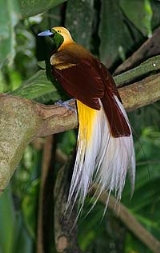
The birds of paradise are members of the family Paradisaeidae of the order Passeriformes. They are found in eastern Indonesia, Torres Strait Islands, Papua New Guinea, and eastern Australia. The members of this family are perhaps best known for the plumage of the males of most species, in particular highly elongated and elaborate feathers extending from the beak, wings or head. Birds of paradise range in size from the King Bird of Paradise at 50 grams (1.8 oz) and 15 cm (6 in) to the Black Sicklebill at 110 cm (43 in) and the Curl-crested Manucode at 430 grams (15.2 oz).
Best known are the members of the genus Paradisaea, including the type species, the Greater Bird of Paradise, Paradisaea apoda.

Discussion
Ask a question about 'Bird of paradise'
Start a new discussion about 'Bird of paradise'
Answer questions from other users
|
Encyclopedia
The birds of paradise are members of the family Paradisaeidae of the order Passeriformes. They are found in eastern Indonesia, Torres Strait Islands, Papua New Guinea, and eastern Australia. The members of this family are perhaps best known for the plumage of the males of most species, in particular highly elongated and elaborate feathers extending from the beak, wings or head. Birds of paradise range in size from the King Bird of Paradise at 50 grams (1.8 oz) and 15 cm (6 in) to the Black Sicklebill at 110 cm (43 in) and the Curl-crested Manucode at 430 grams (15.2 oz).
Best known are the members of the genus Paradisaea, including the type species, the Greater Bird of Paradise, Paradisaea apoda. This species was described from specimens brought back to Europe from trading expeditions. These specimens had been prepared by native traders by removing their wings and feet so that they could be used as decorations. This was not known to the explorers and led to the belief that the birds never landed but were kept permanently aloft by their plumes. This is the origin of both the name "birds of paradise" and the specific name apoda - without feet.
Biology
Birds of paradise are generally crow-like in general body-form, and, indeed are the brother group to the Corvids (crows & jays). They have stout or long bills and strong feet, with around two-thirds of the species being strongly sexually dimorphic.
They live in tropical forests, including rainforest, swamps and moss forest. In most species, the diet consists predominantly of fruit, although riflebirds and sicklebills also favour insects and other arthropods.
Most species have elaborate mating rituals, with the Paradisaea species using a lek-type mating system. Others, such as the Cicinnurus and Parotia species, have highly ritualized mating dances. Males are polygamous in the sexually dimorphic species, but monogamous in at least some of the monomorphic species. Hybridization is frequent in these birds, suggesting the polygamous species of bird of paradise are very closely related despite being in different genera. Many hybrids have been described as new species, and doubt remains regarding whether some forms, such as Rothschild's Lobe-billed Bird of Paradise, are valid.
Birds of paradise build their nests from soft materials, such as leaves, ferns, and vine tendrils, typically placed in a tree fork. Clutch size is somewhat uncertain. In the large species, it is probably almost always just one egg. Smaller species may produce clutches of 2-3.(Mackay 1990) Eggs hatch after 16-22 days, and the young leave the nest at between 16 and 30 days of age.
The manucodes are the most primitive members of the group.
Species of Birds of Paradise
Genus Lycocorax
Lycocorax pyrrhopterus
Genus Manucodia
Genus Paradigalla
Paradigalla carunculata Short-tailed Paradigalla, Paradigalla brevicauda
Genus Astrapia
Genus Parotia
Parotia sefilata Carola's Parotia, Parotia carolae Berlepsch's Parotia, Parotia berlepschi Lawes's Parotia, Parotia lawesii Eastern Parotia, Parotia helenae Wahnes's Parotia, Parotia wahnesi
Genus Pteridophora
Genus Lophorina
Lophorina superba
Genus Ptiloris
Genus Epimachus
Epimachus fastuosus Brown Sicklebill, Epimachus meyeri Black-billed Sicklebill, Epimachus albertisi Pale-billed Sicklebill, Epimachus bruijnii
Genus Cicinnurus
Genus Semioptera
Semioptera wallacii
Genus Seleucidis
Genus Paradisaea
Paradisaea minor Greater Bird of Paradise, Paradisaea apoda Raggiana Bird of Paradise, Paradisaea raggiana Goldie's Bird of Paradise, Paradisaea decora Red Bird of Paradise, Paradisaea rubra Emperor Bird of Paradise, Paradisaea guilielmi Blue Bird of Paradise, Paradisaea rudolphi
Formerly placed here
- Loria's Bird-of-paradise, Cnemophilus loriae - probably closer to Melanocharitidae (berrypeckers) (Cracraft & Feinstein 2000).
- Crested Bird-of-paradise, Cnemophilus macgregorii - probably closer to Melanocharitidae (Cracraft & Feinstein 2000).
- Yellow-breasted Bird-of-paradise, Loboparadisea sericea - probably closer to Melanocharitidae (Cracraft & Feinstein 2000).
- Macgregor's Giant Honeyeater (formerly "Macgregor's Bird-of-paradise"), Macgregoria pulchra - recently found to be a honeyeater (Cracraft & Feinstein 2000).
- Lesser Melampitta, Melampitta lugubris - for some time tentatively placed here; probably Orthonychidae (logrunners)
- Greater Melampitta, "Melampitta" gigantea - probably a logrunner or pitohui (Frith & Beehler 1998)
Relationship with humans
Societies of New Guinea often use bird of paradise plumes in their dress and rituals, and the plumes were very important in Europe in ladies' millinery in past centuries. Hunting for plumes and habitat destruction have reduced some species to endangered status; habitat destruction due to deforestation is now the predominant threat.
Hunting birds of paradise for their plumes for the millinery trade was extensive in the late 19th and early 20th century (Cribb 1997), but today the birds enjoy legal protection and hunting is only permitted at a sustainable level to fulfill the ceremonial needs of the local tribal population. In the case of Pteridophora plumes, scavenging from old bowerbird bowers is encouraged. When King Mahendra of Nepal was crowned in 1955, it was found that the bird of paradise plumes of the Nepali royal crown were in need of replacement. Due to the hunting ban, replacements were eventually procured from a confiscated shipment seized by United States Customs.
Hunting of birds of paradise has occurred for a long time, possibly since the beginning of human settlement. It is a peculiarity that among the most frequently-hunted species, males start mating opportunistically even before they grow their ornamental plumage. This may be an adaptation maintaining population levels in the face of hunting pressures, which have probably been present for 30 millennia.
The southern hemisphere constellation Apus represents a bird of paradise.
An adult-plumaged male bird of paradise is depicted on the flag of Papua New Guinea. David Attenborough has nominated some bird of paradise as his favorite animal species, probably referring to Wilson's Bird of Paradise.
Charlie Parker, himself nicknamed Bird, wrote and played a song entitled "Bird of Paradise".
See also
External links
|
| |
|
|