

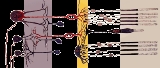
Bipolar cell

Encyclopedia
As a part of the retina
, the bipolar cell exists between photoreceptors (rod cell
s and cone cell
s) and ganglion cells. They act, directly or indirectly, to transmit signals from the photoreceptors to the ganglion cells.
s. The bipolar cells then transmit the signals from the photoreceptors or the horizontal cells, and pass it on to the ganglion cells directly or indirectly (via amacrine cells). Unlike most neurons, bipolar cells communicate via graded potentials
, rather than action potentials.
In the dark, a photoreceptor (rod/cone) cell will release glutamate, which inhibits (hyperpolarizes) the ON bipolar cells and excites (depolarizes) the OFF bipolar cells. In light, however, light strikes the photoreceptor which causes the photoreceptor to be inhibited (hyperpolarized) due to the activation of opsins which activate 11-trans-Retinal, giving energy to stimulate G-Protein coupled receptors to activate phosphodiesterase (PDE) which cleaves cGMP into GMP. In photoreceptor cells, there is an abundance of cGMP in dark conditions, keeping cGMP-gated Na channels open and so, activating PDE diminishes the supply of cGMP, reducing the number of open Na channels and thus hyperpolarizing the photoreceptor cell, causing less glutamate to be released. This causes the ON bipolar cell to lose its inhibition and become active (depolarized), while the OFF bipolar cell loses its excitation (becomes hyperpolarized) and becomes silent.
Rod bipolar cells do not synapse directly on to ganglion cells. Instead, rod bipolar cells synapse on to A II amacrine cells, which in turn excite cone ON bipolar cells (via gap junctions) and inhibit cone OFF bipolar cells (via glycine
-mediated inhibitory synapses) thereby overtaking the cone pathway in order to send signals to ganglion cells at scotopic (low) ambient light conditions.
OFF bipolar cells synapse in the outer layer of the inner plexiform layer of the retina, and ON bipolar cells terminate in the inner layer of the inner plexiform layer.
s. The amacrine cells also introduce lateral inhibition, however, its role is not yet well understood.
The mechanism for producing the center of a bipolar cell's receptive field
is well known: direct innervation of the photoreceptor cell above it, either through a metabotropic (ON) or ionotropic (OFF) receptor. However, the mechanism for producing the monochromatic surround of the same receptive field is under investigation. While it is known that an important cell
in the process is the horizontal cell
, the exact sequence of receptors
and molecules is as of yet unknown.
Retina
The vertebrate retina is a light-sensitive tissue lining the inner surface of the eye. The optics of the eye create an image of the visual world on the retina, which serves much the same function as the film in a camera. Light striking the retina initiates a cascade of chemical and electrical...
, the bipolar cell exists between photoreceptors (rod cell
Rod cell
Rod cells, or rods, are photoreceptor cells in the retina of the eye that can function in less intense light than can the other type of visual photoreceptor, cone cells. Named for their cylindrical shape, rods are concentrated at the outer edges of the retina and are used in peripheral vision. On...
s and cone cell
Cone cell
Cone cells, or cones, are photoreceptor cells in the retina of the eye that are responsible for color vision; they function best in relatively bright light, as opposed to rod cells that work better in dim light. If the retina is exposed to an intense visual stimulus, a negative afterimage will be...
s) and ganglion cells. They act, directly or indirectly, to transmit signals from the photoreceptors to the ganglion cells.
Overview
Bipolar cells are so-named as they have a central body from which two sets of processes arise. They can synapse with either rods or cones (but not both), and they also accept synapses from horizontal cellHorizontal cell
Horizontal cells are the laterally interconnecting neurons in the outer plexiform layer of the retina of mammalian eyes. They help integrate and regulate the input from multiple photoreceptor cells...
s. The bipolar cells then transmit the signals from the photoreceptors or the horizontal cells, and pass it on to the ganglion cells directly or indirectly (via amacrine cells). Unlike most neurons, bipolar cells communicate via graded potentials
Membrane potential
Membrane potential is the difference in electrical potential between the interior and exterior of a biological cell. All animal cells are surrounded by a plasma membrane composed of a lipid bilayer with a variety of types of proteins embedded in it...
, rather than action potentials.
Specification
Bipolar cells receive synaptic input from either rods or cones, but not both, and they are designated rod bipolar or cone bipolar cells respectively. There are roughly 10 distinct forms of cone bipolar cells, however, only one rod bipolar cell, due to the rod receptor arriving later in the evolutionary history than the cone receptor.In the dark, a photoreceptor (rod/cone) cell will release glutamate, which inhibits (hyperpolarizes) the ON bipolar cells and excites (depolarizes) the OFF bipolar cells. In light, however, light strikes the photoreceptor which causes the photoreceptor to be inhibited (hyperpolarized) due to the activation of opsins which activate 11-trans-Retinal, giving energy to stimulate G-Protein coupled receptors to activate phosphodiesterase (PDE) which cleaves cGMP into GMP. In photoreceptor cells, there is an abundance of cGMP in dark conditions, keeping cGMP-gated Na channels open and so, activating PDE diminishes the supply of cGMP, reducing the number of open Na channels and thus hyperpolarizing the photoreceptor cell, causing less glutamate to be released. This causes the ON bipolar cell to lose its inhibition and become active (depolarized), while the OFF bipolar cell loses its excitation (becomes hyperpolarized) and becomes silent.
Rod bipolar cells do not synapse directly on to ganglion cells. Instead, rod bipolar cells synapse on to A II amacrine cells, which in turn excite cone ON bipolar cells (via gap junctions) and inhibit cone OFF bipolar cells (via glycine
Glycine receptor
The glycine receptor, or GlyR, is the receptor for the amino acid neurotransmitter glycine. GlyR is an ionotropic receptor that produces its effects through chloride current...
-mediated inhibitory synapses) thereby overtaking the cone pathway in order to send signals to ganglion cells at scotopic (low) ambient light conditions.
OFF bipolar cells synapse in the outer layer of the inner plexiform layer of the retina, and ON bipolar cells terminate in the inner layer of the inner plexiform layer.
Functionality
Bipolar cells effectively transfer information from rods and cones to ganglion cells. The horizontal cells and the amacrine cells complicate matters somewhat. The horizontal cells introduce lateral inhibition and give rise to the center-surround inhibition which is apparent in retinal receptive fieldReceptive field
The receptive field of a sensory neuron is a region of space in which the presence of a stimulus will alter the firing of that neuron. Receptive fields have been identified for neurons of the auditory system, the somatosensory system, and the visual system....
s. The amacrine cells also introduce lateral inhibition, however, its role is not yet well understood.
The mechanism for producing the center of a bipolar cell's receptive field
Receptive field
The receptive field of a sensory neuron is a region of space in which the presence of a stimulus will alter the firing of that neuron. Receptive fields have been identified for neurons of the auditory system, the somatosensory system, and the visual system....
is well known: direct innervation of the photoreceptor cell above it, either through a metabotropic (ON) or ionotropic (OFF) receptor. However, the mechanism for producing the monochromatic surround of the same receptive field is under investigation. While it is known that an important cell
Cell (biology)
The cell is the basic structural and functional unit of all known living organisms. It is the smallest unit of life that is classified as a living thing, and is often called the building block of life. The Alberts text discusses how the "cellular building blocks" move to shape developing embryos....
in the process is the horizontal cell
Horizontal cell
Horizontal cells are the laterally interconnecting neurons in the outer plexiform layer of the retina of mammalian eyes. They help integrate and regulate the input from multiple photoreceptor cells...
, the exact sequence of receptors
Sensory receptor
In a sensory system, a sensory receptor is a sensory nerve ending that responds to a stimulus in the internal or external environment of an organism...
and molecules is as of yet unknown.
External links
- Diagram at mcgill.ca
- NIF Search - Retinal Bipolar Cell via the Neuroscience Information FrameworkNeuroscience Information FrameworkThe Neuroscience Information Framework is a repository of global neuroscience web resources, including experimental, clinical, and translational neuroscience databases, knowledge bases, atlases, and genetic/genomic resources.-Description:...