

Biostratigraphy

Encyclopedia
Biostratigraphy is the branch of stratigraphy
which focuses on correlating and assigning relative ages of rock strata
by using the fossil
assemblages contained within them. Usually the aim is correlation, demonstrating that a particular horizon in one geological section represents the same period of time as another horizon at some other section. The fossils are useful because sediment
s of the same age can look completely different because of local variations in the sedimentary environment
. For example, one section might have been made up of clay
s and marl
s while another has more chalk
y limestone
s, but if the fossil species recorded are similar, the two sediments are likely to have been laid down at the same time.
Ammonite
s, graptolite
s, archeocyathids, and trilobite
s are index fossil
s that are widely used in biostratigraphy. Microfossils
such as acritarchs, chitinozoa
ns, conodonts, dinoflagellate
cysts, pollen
, spores and foraminifera
ns are also frequently used. Different fossils work well for sediments of different ages; trilobite
s, for example, are particularly useful for sediments of Cambrian
age. To work well, the fossils used must be widespread geographically, so that they can occur in many different places. They must also be short lived as a species, so that the period of time during which they could be incorporated in the sediment is relatively narrow. The longer lived the species, the poorer the stratigraphic precision, so fossils that evolve rapidly, such as ammonites, are favoured over forms that evolve much more slowly, like nautiloid
s. Often biostratigraphic correlations are based on a fauna, not an individual species, as this allows greater precision. Further, if only one species is present in a sample, it can mean that (1) the strata were formed in the known fossil range of that organism; (2) that the fossil range of the organism was incompletely known, and the strata extend the known fossil range. For instance, the presence of the fossil Treptichnus pedum
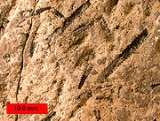
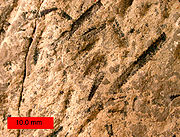
was used to define the base of the Cambrian period, but it has since been found in older strata.
Fossil assemblages were traditionally used to designate the duration of periods. Since a large change in fauna was required to make early stragtigraphers create a new period, most of the periods we recognise today are terminated by a major extinction event or faunal turnover.
is credited for the invention of this concept. He named stages after geographic localities with particularly good sections of rock strata that bear the characteristic fossils on which the stages are based.
introduced the concept of zone (also known as biozones or Oppel zone). A zone includes strata characterised by the overlapping range of fossils. They represent the time between the appearance of species chosen at the base of the zone and the appearance of other species chosen at the base of the next succeeding zone. Oppel's zones are named after a particular distinctive fossil species, called an index fossil. Index fossils are one of the species from the assemblage of species that characterise the zone.
The zone is the fundamental biostratigraphic unit. Its thickness range from a few to hundreds of metres, and its extant range from local to worldwide. Biostratigraphic units are divided into six principal kinds of biozones:
 To be useful in stratigraphic correlation index fossils should be:
Stratigraphy
Stratigraphy, a branch of geology, studies rock layers and layering . It is primarily used in the study of sedimentary and layered volcanic rocks....
which focuses on correlating and assigning relative ages of rock strata
Stratum
In geology and related fields, a stratum is a layer of sedimentary rock or soil with internally consistent characteristics that distinguish it from other layers...
by using the fossil
Fossil
Fossils are the preserved remains or traces of animals , plants, and other organisms from the remote past...
assemblages contained within them. Usually the aim is correlation, demonstrating that a particular horizon in one geological section represents the same period of time as another horizon at some other section. The fossils are useful because sediment
Sediment
Sediment is naturally occurring material that is broken down by processes of weathering and erosion, and is subsequently transported by the action of fluids such as wind, water, or ice, and/or by the force of gravity acting on the particle itself....
s of the same age can look completely different because of local variations in the sedimentary environment
Sedimentary depositional environment
In geology, sedimentary depositional environment describes the combination of physical, chemical and biological processes associated with the deposition of a particular type of sediment and, therefore, the rock types that will be formed after lithification, if the sediment is preserved in the rock...
. For example, one section might have been made up of clay
Clay
Clay is a general term including many combinations of one or more clay minerals with traces of metal oxides and organic matter. Geologic clay deposits are mostly composed of phyllosilicate minerals containing variable amounts of water trapped in the mineral structure.- Formation :Clay minerals...
s and marl
Marl
Marl or marlstone is a calcium carbonate or lime-rich mud or mudstone which contains variable amounts of clays and aragonite. Marl was originally an old term loosely applied to a variety of materials, most of which occur as loose, earthy deposits consisting chiefly of an intimate mixture of clay...
s while another has more chalk
Chalk
Chalk is a soft, white, porous sedimentary rock, a form of limestone composed of the mineral calcite. Calcite is calcium carbonate or CaCO3. It forms under reasonably deep marine conditions from the gradual accumulation of minute calcite plates shed from micro-organisms called coccolithophores....
y limestone
Limestone
Limestone is a sedimentary rock composed largely of the minerals calcite and aragonite, which are different crystal forms of calcium carbonate . Many limestones are composed from skeletal fragments of marine organisms such as coral or foraminifera....
s, but if the fossil species recorded are similar, the two sediments are likely to have been laid down at the same time.
Ammonite
Ammonite
Ammonite, as a zoological or paleontological term, refers to any member of the Ammonoidea an extinct subclass within the Molluscan class Cephalopoda which are more closely related to living coleoids Ammonite, as a zoological or paleontological term, refers to any member of the Ammonoidea an extinct...
s, graptolite
Graptolite
Graptolithina is a class in the animal phylum Hemichordata, the members of which are known as Graptolites. Graptolites are fossil colonial animals known chiefly from the Upper Cambrian through the Lower Carboniferous...
s, archeocyathids, and trilobite
Trilobite
Trilobites are a well-known fossil group of extinct marine arthropods that form the class Trilobita. The first appearance of trilobites in the fossil record defines the base of the Atdabanian stage of the Early Cambrian period , and they flourished throughout the lower Paleozoic era before...
s are index fossil
Index fossil
Index fossils are fossils used to define and identify geologic periods . They work on the premise that, although different sediments may look different depending on the conditions under which they were laid down, they may include the remains of the same species of fossil...
s that are widely used in biostratigraphy. Microfossils
Micropaleontology
Micropaleontology is the branch of paleontology that studies microfossils.-Microfossils:...
such as acritarchs, chitinozoa
Chitinozoa
Chitinozoa are a taxon of flask-shaped, organic walled marine microfossils produced by an as yet unknown animal. Common from the Ordovician to Devonian periods , the millimetre-scale organisms are abundant in almost all types of marine sediment across the globe...
ns, conodonts, dinoflagellate
Dinoflagellate
The dinoflagellates are a large group of flagellate protists. Most are marine plankton, but they are common in fresh water habitats as well. Their populations are distributed depending on temperature, salinity, or depth...
cysts, pollen
Pollen
Pollen is a fine to coarse powder containing the microgametophytes of seed plants, which produce the male gametes . Pollen grains have a hard coat that protects the sperm cells during the process of their movement from the stamens to the pistil of flowering plants or from the male cone to the...
, spores and foraminifera
Foraminifera
The Foraminifera , or forams for short, are a large group of amoeboid protists which are among the commonest plankton species. They have reticulating pseudopods, fine strands of cytoplasm that branch and merge to form a dynamic net...
ns are also frequently used. Different fossils work well for sediments of different ages; trilobite
Trilobite
Trilobites are a well-known fossil group of extinct marine arthropods that form the class Trilobita. The first appearance of trilobites in the fossil record defines the base of the Atdabanian stage of the Early Cambrian period , and they flourished throughout the lower Paleozoic era before...
s, for example, are particularly useful for sediments of Cambrian
Cambrian
The Cambrian is the first geological period of the Paleozoic Era, lasting from Mya ; it is succeeded by the Ordovician. Its subdivisions, and indeed its base, are somewhat in flux. The period was established by Adam Sedgwick, who named it after Cambria, the Latin name for Wales, where Britain's...
age. To work well, the fossils used must be widespread geographically, so that they can occur in many different places. They must also be short lived as a species, so that the period of time during which they could be incorporated in the sediment is relatively narrow. The longer lived the species, the poorer the stratigraphic precision, so fossils that evolve rapidly, such as ammonites, are favoured over forms that evolve much more slowly, like nautiloid
Nautiloid
Nautiloids are a large and diverse group of marine cephalopods belonging to the subclass Nautiloidea that began in the Late Cambrian and are represented today by the living Nautilus. Nautiloids flourished during the early Paleozoic era, where they constituted the main predatory animals, and...
s. Often biostratigraphic correlations are based on a fauna, not an individual species, as this allows greater precision. Further, if only one species is present in a sample, it can mean that (1) the strata were formed in the known fossil range of that organism; (2) that the fossil range of the organism was incompletely known, and the strata extend the known fossil range. For instance, the presence of the fossil Treptichnus pedum
Treptichnus pedum
Treptichnus pedum is regarded as the earliest widespread complex trace fossil...
was used to define the base of the Cambrian period, but it has since been found in older strata.
Fossil assemblages were traditionally used to designate the duration of periods. Since a large change in fauna was required to make early stragtigraphers create a new period, most of the periods we recognise today are terminated by a major extinction event or faunal turnover.
Concept of stage
A stage is a major subdivision of strata, each systematically following the other each bearing a unique assemblage of fossils. Therefore, stages can be defined as a group of strata containing the same major fossil assemblages. French palaeontologist Alcide d'OrbignyAlcide d'Orbigny
Alcide Charles Victor Marie Dessalines d'Orbigny was a French naturalist who made major contributions in many areas, including zoology , palaeontology, geology, archaeology and anthropology....
is credited for the invention of this concept. He named stages after geographic localities with particularly good sections of rock strata that bear the characteristic fossils on which the stages are based.
Concept of zone
In 1856 German palaeontologist Albert OppelAlbert Oppel
Carl Albert Oppel was a German paleontologist.-History:He was born at Hohenheim in Württemberg, on December 19, 1831. He first went to the University of Tübingen, where he graduated with a Ph.D. in 1853. The results of his work was published in Die Juraformation Englands, Frankreichs and des...
introduced the concept of zone (also known as biozones or Oppel zone). A zone includes strata characterised by the overlapping range of fossils. They represent the time between the appearance of species chosen at the base of the zone and the appearance of other species chosen at the base of the next succeeding zone. Oppel's zones are named after a particular distinctive fossil species, called an index fossil. Index fossils are one of the species from the assemblage of species that characterise the zone.
The zone is the fundamental biostratigraphic unit. Its thickness range from a few to hundreds of metres, and its extant range from local to worldwide. Biostratigraphic units are divided into six principal kinds of biozones:
- Taxon range biozone represent the known stratigraphic and geographic range of occurrence of a single taxon.
- Concurrent range biozone include the concurrent, coincident, or overlapping part of the range of two specified taxa.
- Interval biozone include the stata between two specific biostratigraphic surfaces. It can be based on lowest or highest occurrences.
- Lineage biozone are strata containing species representing a specific segment of an evolutionary lineage.
- Assemblage biozones are strata that contain a unique association of three or more taxa.
- Abundance biozone are strata in which the abundance of a particular taxon or group of taxa is significantly greater than in the adjacent part of the section.
Index fossils
- Independent of their environment
- Geographically widespread (provincialism/isolation of species should be avoided as much as possible)
- Rapidly evolving
- Abundant (easy to find in the rock record)
- Easy to preserve (Easier in low-energy, non-oxidized environment)
- Easy to identify