


Bicycle brake systems

Encyclopedia

Bicycle
A bicycle, also known as a bike, pushbike or cycle, is a human-powered, pedal-driven, single-track vehicle, having two wheels attached to a frame, one behind the other. A person who rides a bicycle is called a cyclist, or bicyclist....
. There have been various types of brake
Brake
A brake is a mechanical device which inhibits motion. Its opposite component is a clutch. The rest of this article is dedicated to various types of vehicular brakes....
used throughout history, and several are still in use today. The three main types are: rim brakes, disc brakes, and drum brakes.
Most bicycle brake systems consist of three main components: a mechanism for the rider to apply the brakes, such as brake levers or pedals
Bicycle pedal
A bicycle pedal is the part of a bicycle that the rider pushes with their foot to propel the bicycle. It provides the connection between the cyclist's foot or shoe and the crank allowing the leg to turn the bottom bracket spindle and propel the bicycle's wheels...
; a mechanism for transmitting that signal, such as Bowden cable
Bowden cable
A Bowden cable is a type of flexible cable used to transmit mechanical force or energy by the movement of an inner cable relative to a hollow outer cable housing...
s, hydraulic hoses, rods, or the bicycle chain
Bicycle chain
A bicycle chain is a roller chain that transfers power from the pedals to the drive-wheel of a bicycle, thus propelling it. Most bicycle chains are made from plain carbon or alloy steel, but some are nickel-plated to prevent rust, or simply for aesthetics. Nickel also confers a measure of...
; and the brake mechanism itself, a calliper or drum, to press two or more surfaces together in order to convert, via friction
Friction
Friction is the force resisting the relative motion of solid surfaces, fluid layers, and/or material elements sliding against each other. There are several types of friction:...
, kinetic energy
Kinetic energy
The kinetic energy of an object is the energy which it possesses due to its motion.It is defined as the work needed to accelerate a body of a given mass from rest to its stated velocity. Having gained this energy during its acceleration, the body maintains this kinetic energy unless its speed changes...
of the bike and rider into thermal energy
Thermal energy
Thermal energy is the part of the total internal energy of a thermodynamic system or sample of matter that results in the system's temperature....
to be dissipated
Dissipation
In physics, dissipation embodies the concept of a dynamical system where important mechanical models, such as waves or oscillations, lose energy over time, typically from friction or turbulence. The lost energy converts into heat, which raises the temperature of the system. Such systems are called...
.
History
The earliest bicycles with pedals such as the boneshaker were fitted with a spoon brake which pressed onto the rear wheel. The brake was operated by a lever or by a cord connecting to the handlebars. The rider could also slow down by resisting the pedals of the fixed wheel drive.The next development of the bicycle, the penny-farthing
Penny-farthing
Penny-farthing, high wheel, high wheeler, and ordinary are all terms used to describe a type of bicycle with a large front wheel and a much smaller rear wheel that was popular after the boneshaker, until the development of the safety bicycle, in the 1880s...
s, were similarly braked with a spoon brake or by back pedalling. During its development from 1870 to 1878, there were various designs for brakes, most of them operating on the rear wheel. However, as the rear wheel became smaller and smaller, with more of the rider's weight over the front wheel, braking on the rear wheel became less effective. The front brake, introduced by John Kean in 1873, had been generally adopted by 1880 because of its greater stopping power.
Some penny-farthing riders used only back pedalling and got off and walked down steep hills, but most also used a brake. Having a brake meant that riders could coast down hill by taking their feet off the pedals and placing the legs over the handlebars, although most riders preferred to dismount and walk down steep hills. Putting the legs under the handlebars with the feet off the pedals placed on foot-rests on the forks had resulted in serious accidents caused by the feet getting caught in the spokes.
An alternative to the spoon brake for penny-farthings was the calliper brake patented by Browett and Harrison in 1887. This early version of calliper braking used a rubber block to contact the outside of the penny-farthing's small rear tyre.
The 1870s and 1880s saw the development of the safety bicycle
Safety bicycle
A safety bicycle is a type of bicycle that became very popular beginning in the late 1880s as an alternative to the penny-farthing or ordinary and is now the most common type of bicycle. Early bicycles of this style were known as safety bicycles because they were noted for, and marketed as, being...
which roughly resembles bicycles today, with two wheels of equal size, initially with solid rubber tyres. These were typically equipped with a front spoon brake and no rear brake mechanism, but like penny-farthings they used fixed gears, allowing rear wheel braking by resisting the motion of the pedals. The relative fragility of the wooden rims used on most bicycles still precluded the use of rim brakes. In the late 1890s came the introduction of rim brakes and the freewheel.
With the introduction of mass-produced pneumatic tyres
Bicycle tire
A bicycle tire is a tire that fits on the wheel of a bicycle, unicycle, tricycle, quadracycle, bicycle trailer, or trailer bike. They may also be used on wheelchairs and handcycles, especially for racing...
by the Dunlop Tyre Company
Dunlop Rubber
Dunlop Rubber was a company based in the United Kingdom which manufactured tyres and other rubber products for most of the 20th century. It was acquired by BTR plc in 1985. Since then, ownership of the Dunlop trade-names has been fragmented.-Early history:...
, the use of spoon brakes began to decline, as they tended to quickly wear through the thin casing of the new tyres. This problem led to demands for alternative braking systems. On November 23, 1897, Abram W. Duck of Duck's Cyclery in Oakland, California was granted a patent for his Duck Roller Brake (U.S. Patent 594,234). The duck brake used a rod operated by a lever on the handlebar to pull twin rubber rollers against the front tyre, braking the front wheel.
In 1898, after the advent of freewheel
Freewheel
thumb|Freewheel mechanismIn mechanical or automotive engineering, a freewheel or overrunning clutch is a device in a transmission that disengages the driveshaft from the driven shaft when the driven shaft rotates faster than the driveshaft...
coasting mechanisms, the first internal coaster brakes were introduced for the rear wheel. The coaster brake was contained in the rear wheel hub, and was engaged and controlled by backpedaling, thus eliminating the issue of tyre wear. In the United States, the coaster brake was the most commonly fitted brake throughout the first half of the 20th century, often comprising the only braking system on the bicycle.
Spoon brakes

Roadster (bicycle)
A roadster, aka English roadster, is a type of utility bicycle once common in Britain and still very common in Asia, Africa, Denmark and the Netherlands, however, during the past several years, traditionally styled roadster bicycles have gained considerable popularity in the United States and...
. It consists of a spring-loaded flap attached to the back of the fork crown. This is depressed against the front tyre by the rider's foot.
Perhaps more so than any other form of bicycle brake, the spoon brake is sensitive to road conditions and increases tyre wear dramatically.
Though made obsolete by the introduction of the duck brake, coaster brake, and rod brake, spoon brakes continued to be used in the West
Western world
The Western world, also known as the West and the Occident , is a term referring to the countries of Western Europe , the countries of the Americas, as well all countries of Northern and Central Europe, Australia and New Zealand...
supplementally on adult bicycles until the 1930s, and on children's bicycles until the 1950s. In the developing world, they were manufactured until much more recently.
Duck Brake
Invented in 1897, the duck brake, aka Duck Roller Brake used a rod operated by a lever on the handlebar to pull twin friction rollers (usually made of wood or rubber) against the front tyre. Mounted on axles secured by friction washers and set at an angle to conform to the shape of the tyre, the rollers were forced against their friction washers upon contacting the tyre, thus braking the front wheel. A tension spring held the rollers away from the tyre except when braking. Braking power was enhanced by an extra-long brake lever mounted in parallel with and behind the handlebar, which provided additional leverage when braking (two hands could be used to pull the lever if necessary). Used in combination with a rear coaster brake, a cyclist of the day could stop much more quickly and with better modulation of braking effort than was possible using only a spoon brake or rear coaster brake. Known colloquially as the duck brake, the design was used by many notable riders of the day, and was widely exported to England, Australia, and other countries. In 1902, Louis H. Bill was granted a patent for an improved version of the Duck Roller Brake (Patent 708,114) for use on motorized bicycleMotorized bicycle
A motorized bicycle, motorbike, cyclemotor, or vélomoteur is a bicycle with an attached motor and transmission used either to power the vehicle unassisted, or to assist with pedaling. Since it always retains both pedals and a discrete connected drive for rider-powered propulsion, the motorized...
s (motorcycles).
Rim brakes
Rim brakes are so called because braking force is applied by friction pads to the rim of the rotating wheel, thus slowing it and the bicycle. Brake pads can be made of leatherLeather
Leather is a durable and flexible material created via the tanning of putrescible animal rawhide and skin, primarily cattlehide. It can be produced through different manufacturing processes, ranging from cottage industry to heavy industry.-Forms:...
, rubber
Rubber
Natural rubber, also called India rubber or caoutchouc, is an elastomer that was originally derived from latex, a milky colloid produced by some plants. The plants would be ‘tapped’, that is, an incision made into the bark of the tree and the sticky, milk colored latex sap collected and refined...
or cork and are mounted in metal
Metal
A metal , is an element, compound, or alloy that is a good conductor of both electricity and heat. Metals are usually malleable and shiny, that is they reflect most of incident light...
"shoes
Brake shoe
A brake shoe is the part of a braking system which carries the brake lining in the drum brakes used on automobiles, or the brake block in train brakes and bicycle brakes.-Automobile drum brake:...
". Rim brakes are typically actuated by the rider squeezing a lever mounted on the handlebar
Bicycle handlebar
Bicycle handlebar or often bicycle handlebars refers to the steering mechanism for bicycles; the equivalent of a steering wheel. Besides steering, handlebars also often support a portion of the rider's weight, depending on their riding position, and provide a convenient mounting place for brake...
.
Advantages and disadvantages
Rim brakes are cheap, light, mechanically simple, easy to maintain, and powerful. However, they perform poorly when the rims are wet. This problem is less serious with rims made of aluminiumAluminium
Aluminium or aluminum is a silvery white member of the boron group of chemical elements. It has the symbol Al, and its atomic number is 13. It is not soluble in water under normal circumstances....
, than on those with steel or chromed rims. Rim brakes are also prone to clogging with mud, particularly when mountain biking
Mountain biking
Mountain biking is a sport which consists of riding bicycles off-road, often over rough terrain, using specially adapted mountain bikes. Mountain bikes share similarities with other bikes, but incorporate features designed to enhance durability and performance in rough terrain.Mountain biking can...
.
Rim brakes require regular maintenance. Brake pads wear down and have to be replaced. Over longer time and use, rims become worn. Rims should be checked for wear periodically as they can fail catastrophically if the braking surface becomes too worn. Wear is accelerated by wet and muddy conditions. Some type of rim brakes e.g. dual pivot, require that the rim be relatively straight; if the rim has a pronounced wobble, then either the brake pads rub against it when the brakes are released, or apply insufficient or uneven pressure to the rim.
Rim brakes also heat the rim because the brake functions by converting kinetic energy
Kinetic energy
The kinetic energy of an object is the energy which it possesses due to its motion.It is defined as the work needed to accelerate a body of a given mass from rest to its stated velocity. Having gained this energy during its acceleration, the body maintains this kinetic energy unless its speed changes...
into thermal energy
Thermal energy
Thermal energy is the part of the total internal energy of a thermodynamic system or sample of matter that results in the system's temperature....
. In normal use this is not a problem, as the brakes are applied with limited force and for a short time, so the heat quickly dissipates to the surrounding air. However, on a heavily-laden bike on a long descent, heat energy is added more quickly than it can dissipate and temperature at the rim and its enclosed tube can increase tyre pressure
Pressure
Pressure is the force per unit area applied in a direction perpendicular to the surface of an object. Gauge pressure is the pressure relative to the local atmospheric or ambient pressure.- Definition :...
so much that the tyre blows off the rim. If this happens on the front wheel, a serious accident is almost inevitable. The risk can be reduced by using both brakes, or by fitting a drag brake.
Although becoming superseded by disc brakes on off-road machines, rims with a hard, rough ceramic coating on the braking surface are available. This coating significantly reduces rim wear and can also improve both wet and dry braking provided appropriate pads are used. It also reduces heat transfer to the air in the tyre because the ceramic coating, although thin, is a thermal insulator.
Brake pads
There are many designs of brake pads (brake blocks). Most consist of a replaceable rubber pad held in a metal channel (brake shoe), with a post or bolt protruding from the back to allow attachment to the brake. Some are made as one piece with the attachment directly molded in the pad for lower production costs; brake pads of the cartridge type are held in place by a metal split pin or threaded grub screw and can be replaced without moving the brake shoe from its alignment to the rim. The rubber can be softer for more braking force with less lever effort, or harder for longer life. The rubber can also contain abrasives for better braking, at the expense of rim wear. Compounds vie for better wet braking efficiency. Typically pads are relatively short, but longer varieties are also manufactured to provide more surface area for braking; these often must be curved to match the rim. A larger pad does not give more friction but wears more slowly, so a new pad can be made thinner, simplifying wheel removal with linear-pull brakes in particular. In general, a brake can be fitted with any of these many varieties of pads, as long as the pad mounting method is compatible. Carbon-fiber rims, as on some disc wheels, generally have to use non-abrasive cork pads.Ceramic-coated rims should be used with special pads because of heat build-up at the pad-rim interface; standard pads can leave a "glaze" on the ceramic braking surface, reducing its inherent roughness and leading to a severe drop in wet-weather braking performance. Kool-Stop, Mavic and Swisstop make "ceramic" pads, which contain substances such as chromium to improve heat tolerance.
Rod-actuated brakes

Bowden cable
A Bowden cable is a type of flexible cable used to transmit mechanical force or energy by the movement of an inner cable relative to a hollow outer cable housing...
s, to transmit force applied to a hand lever to pull friction pads upwards against the inner surface, which faces the hub, of the wheel rim. They were often called stirrup brakes due to their shape. Rod brakes are used with a rim profile known as the Westwood rim
Westwood rim
The Westwood rim style of cycle rim used on bicycles was one of the original steel rim designs, developed during or before 1891. Bowden brakes and cables designed for use with this rim were introduced in 1896. Westwood rims have also been found ideal for use with drum brakes...
, which has a slightly concave area on the braking surface and lacks the flat outer surface required by brakes that apply the pads on opposite sides of the rim.
The rear linkage mechanism is complicated by the need to allow rotation where the fork
Bicycle fork
A bicycle fork is the portion of a bicycle that holds the front wheel and allows the rider to steer and balance the bicycle. A fork consists of two fork ends which hold the front wheel axle, two blades which join at a fork crown, and a steerer or steering tube to which the handlebars attach ...
and handlebars attach to the frame. A common setup was to combine a front rod brake with a rear coaster brake. Although heavy and complex, the linkages are reliable and durable and can be repaired or adjusted with simple hand tools. The design is still in use, typically on roadsters
Roadster (bicycle)
A roadster, aka English roadster, is a type of utility bicycle once common in Britain and still very common in Asia, Africa, Denmark and the Netherlands, however, during the past several years, traditionally styled roadster bicycles have gained considerable popularity in the United States and...
, particularly in East
East Asia
East Asia or Eastern Asia is a subregion of Asia that can be defined in either geographical or cultural terms...
, South Asia
South Asia
South Asia, also known as Southern Asia, is the southern region of the Asian continent, which comprises the sub-Himalayan countries and, for some authorities , also includes the adjoining countries to the west and the east...
and Africa
Africa
Africa is the world's second largest and second most populous continent, after Asia. At about 30.2 million km² including adjacent islands, it covers 6% of the Earth's total surface area and 20.4% of the total land area...
(boda-boda
Boda-boda
Boda-boda also known as a Poda-Poda in some parts of Africa is a bicycle taxi, originally in East Africa . The bicycle rider can also be called boda-boda...
).
The calliper brake design
The calliper brake is a class of cableBowden cable
A Bowden cable is a type of flexible cable used to transmit mechanical force or energy by the movement of an inner cable relative to a hollow outer cable housing...
-actuated brake in which the brake mounts to a single point above the wheel, theoretically allowing the arms to auto-centre on the rim. Arms extend around the tyre and end in brake shoes that press against the rim. While some designs incorporate dual pivot points — the arms pivot on a sub-frame — the entire assembly still mounts to a single point.
Calliper brakes tend to become less effective as tyres get wider, and so, deeper, reducing the brakes' mechanical advantage
Mechanical advantage
Mechanical advantage is a measure of the force amplification achieved by using a tool, mechanical device or machine system. Ideally, the device preserves the input power and simply trades off forces against movement to obtain a desired amplification in the output force...
. Thus calliper brakes are rarely found on modern mountain bikes. But they are almost ubiquitous on road bikes
Road bicycle
The term road bicycle is used to describe bicycles built for traveling at speed on paved roads. Some sources use the term to mean racing bicycle...
, particularly the dual-pivot side-pull calliper brake.
Side-pull calliper brakes

These brakes are simple and effective for relatively narrow tyres but have significant flex and resulting poor performance if the arms are made long enough to fit wide tyres. Low-quality varieties also tend to rotate to one side during actuation and to stay there, so that one brake pad continually rubs the rim. These brakes are now used on inexpensive bikes; before the introduction of dual-pivot calliper brakes they were used on all types of road bikes.
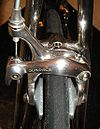
Racing bicycle
A racing bicycle, also known as a road bike, is a bicycle designed for competitive road cycling, a sport governed by according to the rules of the Union Cycliste Internationale...
s. One arm pivots at the centre, like a side-pull; and the other pivots at the side, like a centre-pull. The cable housing attaches like that of a side-pull brake.
The centring of side-pull brakes was improved with the mass-market adoption of dual-pivot side-pulls (an old design re-discovered by Shimano
Shimano
Shimano, Inc. is a Japanese multinational manufacturer of cycling components, fishing tackle, and rowing equipment.In 2005, the company had net sales of US $1.4 billion. Bicycle components provided 75% of its sales income...
in the early 1990s). These brakes offer a higher mechanical advantage
Mechanical advantage
Mechanical advantage is a measure of the force amplification achieved by using a tool, mechanical device or machine system. Ideally, the device preserves the input power and simply trades off forces against movement to obtain a desired amplification in the output force...
, and resulting better braking. Dual-pivot brakes are slightly heavier than conventional side-pull callipers and cannot accurately track an out-of-true rim.
Centre-pull calliper brakes
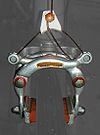
These brakes were reasonably priced, and in the past filled the price niche between the cheaper and the more expensive models of side-pull brakes.
U-brakes
U-brakes (also known by the trademarked term "990-style") are essentially the same design as the centre-pull calliper brake. The difference is that the two arm pivots attach directly to the frame or fork while those of the centre-pull calliper brake attach to an integral bridge frame that mounts to the frame or fork by a single bolt. Like roller cam brakes, this is a first-class cantilever design with pivots located above the rim. Thus U-brakes are often interchangeable with, and have the same maintenance issues as, roller cam brakes.U-brakes were used on mountain bikes through the early 1990s, particularly in the then-popular under-the-chainstays rear location.
They are the current standard on Freestyle BMX
Freestyle BMX
Freestyle BMX is a synonym for BMX stunt riding, a sport branch that hails from extreme sports. It consists of six disciplines: street, park, vert, trails, dirt and flatland .-History:...
frames and forks. The U-brake's main advantage over cantilever and linear-pull brakes in this application is that sideways protrusion of the brake and cable system is minimal, and the exposed parts are smooth. This is especially valuable on freestyle BMX bikes where any protruding parts are susceptible to damage and may interfere with the rider's body.
The cantilever brake design
The cantilever brake is a class of brake in which each arm is attached to a separate pivot point on one side of the seat stayBicycle frame
A bicycle frame is the main component of a bicycle, on to which wheels and other components are fitted. The modern and most common frame design for an upright bicycle is based on the safety bicycle, and consists of two triangles, a main triangle and a paired rear triangle...
or fork
Bicycle fork
A bicycle fork is the portion of a bicycle that holds the front wheel and allows the rider to steer and balance the bicycle. A fork consists of two fork ends which hold the front wheel axle, two blades which join at a fork crown, and a steerer or steering tube to which the handlebars attach ...
. Thus all cantilever brakes are dual-pivot. Both first- and second-class lever
Lever
In physics, a lever is a rigid object that is used with an appropriate fulcrum or pivot point to either multiply the mechanical force that can be applied to another object or resistance force , or multiply the distance and speed at which the opposite end of the rigid object travels.This leverage...
designs exist; second-class is by far the most common. In the second-class lever design, the arm pivots below the rim. The brake shoe is mounted above the pivot and is pressed against the rim as the two arms are drawn together. In the first-class lever design, the arm pivots above the rim. The brake shoe is mounted below the pivot and is pressed against the rim as the two arms are forced apart.
Cantilever brakes are preferred for bicycles that use wide tyres, such as those on mountain bike
Mountain bike
A mountain bike or mountain bicycle is a bicycle created for off-road cycling. This activity includes traversing of rocks and washouts, and steep declines,...
s. (Standard calliper brakes are problematic in these applications since the long distance from the pivot to the pad reduces mechanical advantage and allows the arms to flex, reducing braking effectiveness.) Because the arms move only in their designed arcs, the brake shoe must be adjustable in several planes. Thus cantilever brake shoes are notoriously difficult to adjust. As the brake shoes of a second-class cantilever brake wears, they ride lower on the rim. Eventually, one may go underneath the rim, inactivating the brake.
There are several brake types based on the cantilever brake design: cantilever brakes and direct-pull brakes - both second class lever designs - and roller cam brakes and U-brakes - both first class lever designs.
Traditional cantilever brakes
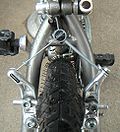
Traditional cantilever brakes are difficult to adapt to bicycle suspensions and protrude somewhat from the frame. Accordingly they are usually found only on bicycles without suspension.
V-brakes

Boss (engineering)
In engineering, a boss is a protruding feature on a workpiece.A common use for a boss is to locate one object within a pocket or hole of another object...
. However, the arms are longer, with the cable housing attached to one arm and the cable to the other. As the cable
Bowden cable
A Bowden cable is a type of flexible cable used to transmit mechanical force or energy by the movement of an inner cable relative to a hollow outer cable housing...
pulls against the housing the arms are drawn together. Because the housing enters from vertically above one arm yet force must be transmitted laterally between arms, the flexible housing is extended by a rigid tube with a 90° bend known as the "noodle". The noodle seats in a stirrup attached to the arm. A flexible bellows often covers the exposed cable.
Since there is no intervening mechanism between the cable and the arms, the design is called "direct-pull". And since the arms move the same distance that the cable moves with regard to its housing, the design is also called "linear-pull". The term "V-brake" is trademarked by Shimano
Shimano
Shimano, Inc. is a Japanese multinational manufacturer of cycling components, fishing tackle, and rowing equipment.In 2005, the company had net sales of US $1.4 billion. Bicycle components provided 75% of its sales income...
and represents the most popular implementation of this design.
V-brakes function well with the suspension systems found on many mountain bikes because they do not require a separate cable stop on the frame or fork. Because of the higher mechanical advantage of V-brakes, they require brake levers with longer cable travel than levers intended for older types of brakes. Mechanical (i.e. cable-actuated) disc brakes use the same amount of cable travel as V-brakes, except for those that are described as being "road" specific. (See Actuation mechanisms below.) As a general rule, mechanical disc brakes for so-called "flat bar" bicycles (chiefly mountain and hybrid bicycles) are compatible with V-brake levers, whereas mechanical disc brakes intended for "drop-bar" bicycles are compatible with the cable pull of older brake designs (cantilever, calliper, and U-brake).
Cheap or poorly-specified V-brakes can suffer from a sudden failure when the noodle end pulls through the metal stirrup, leaving that wheel with no braking power whatsoever. Although the noodle can be regarded as a service item and changed regularly, the hole in the stirrup may enlarge through wear. The stirrup cannot normally be replaced, so good quality V-brakes use a hard and tough steel for the stirrup.
Roller cam brakes
Roller cam brakes are centre-pull cantilever brakes actuated by the cable pulling a single two-sided sliding camCam
A cam is a rotating or sliding piece in a mechanical linkage used especially in transforming rotary motion into linear motion or vice-versa. It is often a part of a rotating wheel or shaft that strikes a lever at one or more points on its circular path...
. (First and second-class lever
Lever
In physics, a lever is a rigid object that is used with an appropriate fulcrum or pivot point to either multiply the mechanical force that can be applied to another object or resistance force , or multiply the distance and speed at which the opposite end of the rigid object travels.This leverage...
designs exist; first-class is most common and is described here.) Each arm has a cam follower
Cam follower
A cam follower, also known as a track follower, is a specialized type of roller or needle bearing designed to follow cams. Cam followers come in a vast array of different configurations, however the most defining characteristic is how the cam follower mounts to its mating part; stud style cam...
. As the cam presses against the follower it forces the arms apart. As the top of each arm moves outward, the brake shoe below the pivot is forced inward against the rim.
There is much in favor of the roller cam brake design. Since the cam controls the rate of closure, the clamping force can be made non-linear with the pull. And since the design can provide positive mechanical advantage
Mechanical advantage
Mechanical advantage is a measure of the force amplification achieved by using a tool, mechanical device or machine system. Ideally, the device preserves the input power and simply trades off forces against movement to obtain a desired amplification in the output force...
, maximum clamping force can be higher than that of other types of brakes. They are known for being strong and controllable. On the downside, they require some skill to set up and can complicate wheel changes. And they require maintenance: like U-brakes, as the pad wears it strikes the rim higher; unless re-adjusted it can eventually contact the tyre's sidewall.
The roller cam design was first developed by Charlie Cunningham
Charlie Cunningham
Charlie Cunningham is a mountain biking pioneer from Fairfax, California.With schooling in mechanical/aeronautical engineering, he rode a modified skinny tire ten speed bicycle up and down Mt Tamalpais, valuing nimbleness and gear selection over the ungainly 1930s ballooners then in vogue...
of WTB
Wilderness Trail Bikes
Wilderness Trail Bikes is a privately owned company based in Marin County, California, USA. Founded in 1983 as a company that specialized in mountain bicycle parts, today WTB sources and sells its product worldwide supplying bike manufacturers and bike shops with bike components such as tires,...
around 1982 and licensed to Suntour
SunTour
SunTour or SR Suntour is a manufacturer of bicycle components. It was Japanese owned and managed, based in Osaka, until the mid 1990s when its name was sold to a Taiwan conglomerate. Its products ranged from suspension forks to derailleurs...
. Roller cam brakes were used on early mountain bike
Mountain bike
A mountain bike or mountain bicycle is a bicycle created for off-road cycling. This activity includes traversing of rocks and washouts, and steep declines,...
s in the 1980s and into the 1990s, mounted to the head tube and seat stays in the standard locations, and below the chain stays for improved stiffness as they do not protrude to interfere with the crank. It is not unusual for a bicycle to have a single roller cam brake combined with another type. They are still used on some BMX
BMX bike
A BMX bike or BMX is the name of a popular bicycle used for both casual use and sport, and designed mainly for dirt and motocross cycling...
and recumbent bicycle
Recumbent bicycle
A recumbent bicycle is a bicycle that places the rider in a laid-back reclining position. Most recumbent riders choose this type of design for ergonomic reasons; the rider's weight is distributed comfortably over a larger area, supported by back and buttocks...
s.
Note that the common first-class lever roller cam brake is generally not convertible to second-class lever cantilever brake types as the pivots are in different locations.
There are two rare variants that use the roller cam principle. For locations where centre-pull is inappropriate, the side-pull toggle cam brake was developed. Also a first-class cantilever, it uses a single-sided sliding cam (the toggle) against one arm that is attached by a link to the other arm. As the cam presses against the (single) follower, the force is also transmitted to the other arm via the link. And specifically for suspension forks where the housing must terminate at the brake frame, the side-pull sabre cam brake was developed. In the sabre cam design, the cable end is fixed and the housing moves the single-sided cam.
Delta brakes
The delta brake is a road bicycle brake named due to its triangular shape. The cable enters at the centre, pulls a corner of a parallelogram linkage housed inside the brake across two opposite corners, pushing out at the other two corners on to the brake arms above the pivots, so that the arms below the pivots push pads in against the rim. A notable feature of the design is that the mechanical advantageMechanical advantage
Mechanical advantage is a measure of the force amplification achieved by using a tool, mechanical device or machine system. Ideally, the device preserves the input power and simply trades off forces against movement to obtain a desired amplification in the output force...
varies as a tangent function across its range, where that of most other designs remains fixed.
Many consider the brake attractive, and it has a lower wind profile than some other common brakes. However, Bicycle Quarterly
Bicycle Quarterly
Bicycle Quarterly is a magazine that examines the history of bicycles, their design, and evolution; with emphasis on Randonneuring bicycles. Articles evaluate equipment and bicycles for performance and function, and articles include footnotes. It is published and edited by Jan Heine, of Seattle,...
criticized the delta brake for being heavy, giving mediocre stopping power, and suffering disadvantageous variable mechanical advantage. In particular, with a small parallelogram, pad wear causes mechanical advantage to rise dramatically. However, with high leverage, the stroke of the lever is not enough to fully apply the brake, so the rider can have brakes that feel normal in light braking but which cannot be applied harder for hard braking.
The basic design dates from at least the 1930s. They were made most prominently by Campagnolo in 1985, but brakes based on the same mechanism were also manufactured by Modolo (Kronos), Weinmann, and others.
They are no longer made and are now uncommon.
Hydraulic rim brakes
Hydraulic rim brakes are one of the least common types. These brakes are mounted either on the same pivot points used for cantilever and linear-pull brakes or they can be mounted on four-bolt brake mounts found on many trials frames. They were available on some high-end mountain bikes in the US in the early 1990s, but declined in popularity with the rise of disc brakes. The moderate performance advantage (greater power and control) they offer over cable actuated rim brakes is offset by their greater weight and complexity. The only significant current use of these brakes in the US is on bicycles used for trials ridingMountain bike trials
Mountain bike trials, also known as observed trials, is a discipline of mountain biking in which the rider attempts to pass through an obstacle course without setting foot to ground. Derived from motorcycle trials, it originated in Catalonia, Spain and is said to have been invented by the father of...
. In Europe, however, the hydraulic rim brakes manufactured by Magura still enjoy a steady popularity, and remain a viable alternative to disc brakes.
Disc brakes
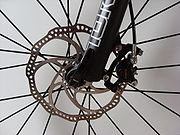
Kinetic energy
The kinetic energy of an object is the energy which it possesses due to its motion.It is defined as the work needed to accelerate a body of a given mass from rest to its stated velocity. Having gained this energy during its acceleration, the body maintains this kinetic energy unless its speed changes...
(motion) is transformed into thermal energy
Thermal energy
Thermal energy is the part of the total internal energy of a thermodynamic system or sample of matter that results in the system's temperature....
(heat). (In basic operation, disc brakes are identical to rim brakes.) A bicycle disc brake may be mechanically actuated, as with a Bowden cable
Bowden cable
A Bowden cable is a type of flexible cable used to transmit mechanical force or energy by the movement of an inner cable relative to a hollow outer cable housing...
, or hydraulically actuated, or a combination of the two.
Disc brakes are used mainly on mountain bikes ridden off-road, but sometimes on hybrid bicycle
Hybrid bicycle
A hybrid bicycle is a bicycle designed for general-purpose utility and commuting on a wide variety of surfaces, including paved and unpaved roads, paths and trails...
s and touring bicycle
Touring bicycle
A touring bicycle is a bicycle designed or modified to handle bicycle touring. To make the bikes sufficiently robust, comfortable and capable of carrying heavy loads, special features may include a long wheelbase , frame materials that favor flexibility over rigidity , heavy duty wheels , and...
s. A disc brake is sometimes employed as a drag brake.
Advantages and disadvantages
Disc brakes tend to perform equally well in all conditions including water, mud, and snow due to several factors:- The braking surface is farther from the ground and possible contaminants like mud which can coat or freeze on the rim and pads.
- Disc brake pads when fully retracted ride much closer to the braking surface than rim brake pads. This better prevents a buildup of water or debris under the pad.
- There are holes in the rotor, providing a path for water and debris to get out from under the pads.
- Wheel rims tend to be made of lightweight metal. Brake discs and pads are harder and can accept higher maximum loads.
The use of very wide tyres favours disc brakes, as rim brakes require ever-longer arms to clear the wider tyre. Longer arms tend to flex more, degrading braking. Disc brakes are unaffected by tyre width.
Unlike most rim brake designs, disc brakes are compatible with bicycle suspension
Bicycle suspension
A bicycle suspension is the system or systems used to suspend the rider and all or part of the bicycle in order to protect them from the roughness of the terrain over which they travel...
s.
Disc brake assemblies are heavier than rim brakes, and are generally more expensive.
Disc brakes require a hub built to accept the disc. Front hubs designed for discs often move the left hub's flange inward to make room for the disc, which causes the wheel to be dished. A dished wheel is laterally weaker when forced to the non-disc side. Other hubs use conventional flange spacing and provide a wheel without dish, but require a less common wide-spaced fork.
A rim brake works directly on the rim and the attached tyre; a disc brake applies a potentially large torque moment at the hub. The latter has two main disadvantages:
- The torque moment must be transmitted to the tyre through the wheel components: flanges, spokes, nipples, and rim spoke bed. Engineering for this moment inevitably leads to a heavier wheel.
- A front disc brake places a bending moment on the fork between the calliper anchor points and the tip of the dropout. In order to counter this moment and to support the anchor points and weight of the calliper, the fork must be thicker and heavier.
The heavier fork and wheels compound the weight disadvantage of the brake assembly itself.
Disc brakes are sensitive to lateral play or "slop", so careful manufacture and adjustment is required. Hub bearing wear is an issue with disc brakes.
While all types of brakes will eventually wear out the braking surface, a brake disc is easier and cheaper to replace than a wheel rim or drum.
While a disc brake does not heat the rim as does a rim brake, excessive heat build up can also lead to failure with disc brakes. If brake friction exceeds convection and radiation losses, the temperature of the disc can quickly rise to where the metal weakens, causing the disc to warp or crack. (With hydraulic actuation, brake fluid may boil. See Actuation mechanisms below.)
The design and positioning of disc brakes can interfere with pannier
Pannier
A pannier is a basket, bag, box, or similar container, carried in pairs either slung over the back of a beast of burden, or attached to the sides of a bicycle or motorcycle. The term derives from the Old French, from Classical Latin, word for bread basket....
racks not designed for them. For this reason, many manufacturers produce "disc" and "non-disc" versions.
Since about 2003, riders have reported a dangerous problem using disc brakes: under hard braking, the front wheel comes out from the dropouts. The problem occurs where the brake pads and dropouts are aligned so the brake reaction force tends to eject the wheel from the dropout. Under repeated hard braking, the axle moves in the dropout in a way that unscrews the quick release. Riders should make sure the skewers are properly tightened before riding.
Forks that use different brake/dropout orientations or through-axles are not subject to this problem.
Hydraulic vs. mechanical
There are two main types of disc brake: mechanical (cable-actuated) and hydraulic. For more details on this topic, see Actuation mechanisms.The advantages of mechanically actuated disc brakes are in their lower cost, lower maintenance, and lighter system weight. Additionally, mechanically actuated disc brakes also have another potential advantage: they are traditionally the only type of disc brake that can be used with drop handlebars, however prototype drop bar hydraulic conversion components have been developed.
Single vs dual actuation
Many disc brakes have their pads actuated from both sides of the calliper, while some have only one pad that moves. Dual actuation can move both pads relative to the calliper, or can move one pad relative to the calliper, then move the calliper and other pad relative to the rotor, called a "floating calliper" design. Single-actuation brakes use either a multi-part rotor that floats axially on the hub, or bend the rotor sideways as needed. Bending the rotor is theoretically inferior, but in practice gives good service, even under high-force braking with a hot disc, and can also yield more progressiveness (which is generally sought after for the rear brake).Self-adjusting
Many hydraulic disc brakes have a self-adjusting mechanism so as the brake pad wears, the pistons keep the distance from the pad to the disc consistent to maintain the same brake lever throw. Some hydraulic brakes, especially older ones, and most mechanical discs have manual controls to adjust the pad-to-rotor gap. Typically, several pad adjustments are needed during the life of the pads.Multi-part construction
Hydraulic callipers are typically made in one piece to reduce weight, increase stiffness and reduce leaks. The two-piece design reduces heat build-up more effectively. Many older brakes and high-performance models use a two-piece calliper, where the two parts are bolted together. Many mechanical disc brake callipers are two-piece, notably the popular Avid BB-5 and BB-7 brakes.Multiple pistons
Many high-performance callipers use two or three pistons per side; lower-cost and lower-performance callipers often have only one per side. Using more pistons allows a larger piston area and thus increased leverage with a given master cylinder. Also, pistons may be of several sizes so pad force can be controlled across the face of the pad, especially when the pad is long and narrow. A long narrow pad may be desired to increase pad area and thus reduce the frequency of pad changes. In contrast, using a single large piston may be heavier to accomplish the same results.Calliper mounting standards
There are many standards for mounting disc brake callipers. I.S. (International Standard) is different for 160mm and 203mm rotor and differs between forks with a QR and 20 mm through axle. The post-mount standard also differs by disc size and axle type. Many incompatible variants were produced over the years, mostly by fork manufacturers. The mount used on the RockshoxSRAM (bicycles)
SRAM Corporation is a privately held bicycle component manufacturer based in Chicago, Illinois, founded in 1987. SRAM is an acronym comprising the names of its founders, Scott, Ray, and Sam, .In 2008, the company received a strategic investment from Trilantic Capital Partners, formerly known as...
Boxxer is the most typical of these specialty mounts, but most fork manufactures now use either the IS or post-mount standard for their current forks. As a point of reference, Hayes
Hayes Brake
Hayes Brake is a Milwaukee, Wisconsin designer and manufacturer of disc brakes and disc brake systems for non-automotive applications, including Hayes Disc Brake specialising in disc brakes for bikes....
currently sells no fewer than 13 different adapters to fit their brakes to various mounting patterns.
Advantages and disadvantages of various types of mounts
A disadvantage of post mounts is that the bolt is threaded directly into the fork lowers. If the threading is stripped or if the bolt is stuck, then new fork lowers are required. Frame manufacturers have standardized the IS mount for the rear disc brake mount. In recent years post mount has gained ground and is becoming the most common. This is mostly due to decreased manufacturing and part cost for the brake callipers when using post mount. A limitation of the mount is that the location of the rotor disc is more tightly constrained: it is possible to encounter incompatible hub/fork combinations, where the rotor is out of range. With an IS mount, the calliper can be moved closer to or further from the mount point using spacers; this can permit a wider range.Disc mounting standards
There are many options for disc rotor mounting - International Standard (IS), centerlock, Cannondale's 4-bolt pattern, Hope's 5-bolt pattern and Rohloff's 4-bolt pattern, to name a few. IS is a six-bolt mount and is the industry standard. Centerlock is patented by Shimano and uses a splinedRotating spline
Splines are ridges or teethon a drive shaft that mesh with grooves in a mating piece and transfer torque to it, maintaining the angular correspondence between them....
interface along with a lockring
Lockring
A lock ring is a threaded washer used to prevent components from becoming loose during rotation. They are found on an adjustable bottom bracket and a track hub of a bicycle. Lokring is another form of fastener used in the automotive and air condition industries. These fittings are often confused...
to secure the disc. The advantages of centerlock are that the splined interface is theoretically stiffer, and removing the disc is quicker because it only requires one lockring to be removed. Some of the disadvantages are that the design is patented requiring a licensing fee from Shimano. A Shimano cassette lockring tool (or an external BB tool in case of through-axle hub) is needed to remove the rotor and is more expensive and less common than a Torx key. Advantages of IS six-bolt are that there are more choices when it comes to hubs and rotors. IS rotors use button head socket cap screws (typically M5x0.8x10mm with locking patch) with either a hex socket or Torx socket to secure them to the hub. This can make IS rotors more time consuming to install and remove. Torx screws are preferred for the superior torque: it is easy to strip the socket of a hex bolt by over tightening it, leaving a rotor that is hard to remove.
Standards
- Centerlock (ShimanoShimanoShimano, Inc. is a Japanese multinational manufacturer of cycling components, fishing tackle, and rowing equipment.In 2005, the company had net sales of US $1.4 billion. Bicycle components provided 75% of its sales income...
proprietary) - International Standard (IS) (in widespread use) 44mm PCD
- AMP 6-bolt (AMP proprietary, obsolete)
- Cannondale's 4-bolt pattern (obsolete)
- Freewheel thread (used by Mountain Cycles and others; obsolete)
- Hope Technologies' 5-bolt pattern (Hope proprietary, obsolete)
- Hope Technologies' 3-bolt pattern (Hope proprietary)
- RohloffRohloff SpeedhubThe Rohloff Speedhub is an epicyclic internal hub gear for bicycles, developed and patented by Rohloff AG. It has been manufactured and marketed by the German company since 1998. The Speedhub 500/14 has 14 equally-spaced sequential gears with no overlapping ratios and is operated by a single...
's 4-bolt pattern (proprietary, 65mm, same as some chainrings) - Rock Shox 3-bolt pattern (proprietary, obsolete)
Disc sizes
Disc brake rotors come in many different sizes, typically 160 millimeter, 185 mm, or 203 mm in diameter. However, many other sizes are available as brake manufacturers make discs specific to their callipers — the dimensions often vary by a few millimeters.Larger rotors provide greater braking force for a given pad pressure, by virtue of a longer moment arm for the calliper to act on. Smaller rotors provide less stopping power but also less weight and better protection from knocks. Larger rotors dissipate heat more quickly and have a larger amount of mass to absorb heat
Heat capacity
Heat capacity , or thermal capacity, is the measurable physical quantity that characterizes the amount of heat required to change a substance's temperature by a given amount...
, reducing brake fade or failure. Downhill racers typically run larger brakes to handle the greater braking loads and extended braking duration. Cross country racers typically run smaller rotors which can handle smaller braking loads yet offer a considerable weight savings of as much as 100g per rotor.
It is also common to use a larger diameter rotor on the front wheel and a smaller rotor on the rear wheel since the front wheel does the most braking (up to 90% of the total).
With large rotors to dissipate heat, disc brakes are becoming more popular as drag brakes.
Drum brakes
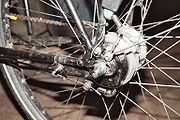
A Roller Brake is a modular cable-operated drum brake manufactured by Shimano
Shimano
Shimano, Inc. is a Japanese multinational manufacturer of cycling components, fishing tackle, and rowing equipment.In 2005, the company had net sales of US $1.4 billion. Bicycle components provided 75% of its sales income...
for use on specially splined front and rear hubs. Unlike a traditional drum brake, the Roller Brake can be easily removed from the hub. Some models contain a torque-limiting device called a power modulator designed to make it difficult to skid the wheel. In practice this can reduce its effectiveness on bicycles with adult-sized wheels.
Drum brakes are most common on utility bicycle
Utility bicycle
A utility bicycle is a bicycle designed for practical transportation, as opposed to bicycles which are primarily designed for recreation and competition, such as touring bicycles, racing bicycles, sport/training bicycles, and mountain bicycles. The vast majority of bicycles can be found in the...
s in some countries, especially the Netherlands
Netherlands
The Netherlands is a constituent country of the Kingdom of the Netherlands, located mainly in North-West Europe and with several islands in the Caribbean. Mainland Netherlands borders the North Sea to the north and west, Belgium to the south, and Germany to the east, and shares maritime borders...
, and are also often found on freight bicycle
Freight bicycle
Freight bicycles, carrier cycles, freight tricycles, cargo bikes, or bakfietsen, are human powered vehicles designed and constructed specifically for transporting large loads. Vehicle designs include a cargo area consisting of a steel tube carrier, an open or enclosed box, a flat platform, or a...
s and velomobile
Velomobile
A velomobile or bicycle car is a human-powered vehicle, enclosed for aerodynamic advantage and protection from weather and collisions. They are virtually always single-passenger vehicles. They are derived from recumbent bicycles and tricycles, with the addition of a full fairing . There are few...
s.
Advantages and disadvantages
Drum brakes provide consistent braking in wet or dirty conditions since the mechanism is fully enclosed.Brake drums are less susceptible to wear than lightweight wheel rim sidewalls.
Drum brakes are heavier, more complicated, and often weaker than rim brakes, but they require less maintenance. Drum brakes do not adapt well to quick release axle fastening, and removing a drum brake wheel requires the operator to disconnect the brake cable as well as the axle.
Drum brakes have torque arms which must be anchored to the frame or fork of the bicycle, and not all bicycles are constructed to accommodate such fastenings or tolerate their applied forces.
Drum brakes often have a long break-in period during which their braking power increases gradually over the course of hundreds of miles of riding.
Coaster brakes
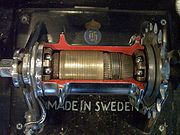
Hub gear
A hub gear, internal-gear hub, or just gear hub is a gear ratio changing system commonly used on bicycles that is implemented with planetary or epicyclic gears. The gears and lubricants are sealed within the hub-shell of the bicycle's rear wheel, as opposed to derailleur gears, where the gears and...
.
When such a hub is pedaled forwards, the sprocket drives a screw which forces a clutch
Clutch
A clutch is a mechanical device which provides for the transmission of power from one component to another...
to move along the axle, driving the hub shell or gear assembly. When pedaling is reversed, the screw drives the clutch in the opposite direction, forcing it either between two brake pads and pressing them against the shell, or into a split collar and expanding it against the shell. The braking surface is often steel, and the braking element brass or phosphor-bronze, as in the Birmingham
Birmingham
Birmingham is a city and metropolitan borough in the West Midlands of England. It is the most populous British city outside the capital London, with a population of 1,036,900 , and lies at the heart of the West Midlands conurbation, the second most populous urban area in the United Kingdom with a...
-made Perry Coaster Hub.
Coaster-brake bicycles are generally equipped with a single cog and chain wheel and often use 1/8" wide chain. However, there have been several models of coaster brake hubs with dérailleurs
Derailleur gears
Derailleur gears are a variable-ratio transmission system commonly used on bicycles, consisting of a chain, multiple sprockets of different sizes, and a mechanism to move the chain from one sprocket to another...
, most notably the Sachs 2x3. These use special extra-short dérailleurs which can stand up to the forces of being straightened out frequently and do not require an excessive amount of reverse pedal rotation before the brake engages. Coaster brakes have also been incorporated into hub gear designs - for example the AWC from Sturmey Archer, and the Shimano Nexus 3-speed.
Advantages and disadvantages
Coaster brakes have the advantage of being protected from the elements and thus perform well in rain or snow. Though coaster brakes generally go years without needing maintenance, they are more complicated than rim brakes to repair if it becomes necessary. Coaster brakes also do not have sufficient heat dissipation for use on long descents. A coaster brake can only be applied when the cranks are reasonably level, limiting how quickly it can be applied. As coaster brakes are only made for rear wheels, they have the disadvantage common to all rear brakes of skidding the wheel easily. This disadvantage may, however, be alleviated if the bicycle also has a hand-lever-operated front brake and the cyclist uses it.Drag brakes
A drag brake is a type of brake defined by its use rather than by its mechanical design.A drag brake is intended to provide a constant decelerating force to slow a bicycle on a long downhill rather than to stop it — a separate braking system is used to stop the bicycle. A drag brake is often employed on a heavy bicycle such as a tandem in mountainous areas where extended use of rim brakes could cause a rim to become hot enough to blow out
Blowout (tire)
A blowout is a rapid loss of inflation pressure of a pneumatic tire leading to an explosion. The primary cause for this is encountering an object that cuts or tears the structural components of the tire to the point where the structure is incapable of containing the pressurized air, with the...
.
The typical drag brake has long been a drum brake. The largest manufacturer of this type of brake is Arai
Arai (company)
is a Japanese company that designs and manufactures motorcycle helmets and other helmets for motorsport. It was formed in 1926 by Hirotake Arai as a hatmaker. Currently, Michio "Mitch" Arai runs the company and his son, Akihito, is also involved....
, whose brakes are screwed onto hubs with conventional freewheel threading on the left side of the rear hub and operated via Bowden cable
Bowden cable
A Bowden cable is a type of flexible cable used to transmit mechanical force or energy by the movement of an inner cable relative to a hollow outer cable housing...
s. As of 2011, the Arai drum brake has been out of production for several years, with remaining stocks nearing depletion, and used units commanding premium prices on internet auction sites.
More recently, large-rotor disc brakes are being used as drag brakes. DT-Swiss make an adapter to mate disk rotors with hubs threaded for the Arai drum brake, but this still leaves the problem of fitting the caliper.
Band brake
A band brake consists of a band, strap, or cable that wraps around a drumPulley
A pulley, also called a sheave or a drum, is a mechanism composed of a wheel on an axle or shaft that may have a groove between two flanges around its circumference. A rope, cable, belt, or chain usually runs over the wheel and inside the groove, if present...
that rotates with a wheel and is pulled tight to generate braking friction. Band brakes appeared as early as 1884 on tricycles. Star Cycles introduced a band brake in 1902 on its bicycles with freewheel
Freewheel
thumb|Freewheel mechanismIn mechanical or automotive engineering, a freewheel or overrunning clutch is a device in a transmission that disengages the driveshaft from the driven shaft when the driven shaft rotates faster than the driveshaft...
s. Band brakes are still manufactured for bicycles today.
A rim band brake, as implemented on the Yankee bicycle by Royce Husted in the 1990s, consists of a stainless-steel cable, wrapped in a kevlar
Kevlar
Kevlar is the registered trademark for a para-aramid synthetic fiber, related to other aramids such as Nomex and Technora. Developed at DuPont in 1965, this high strength material was first commercially used in the early 1970s as a replacement for steel in racing tires...
sheath, that rides in a u-shaped channel on the side of the wheel rim. Squeezing the brake lever tightens the cable against the channel to produce braking friction. A return spring slackens the cable when the brake lever is released, no adjustment is required, and the brake becomes more forceful when wet. Husted said his inspiration was the band brake
Band brake
A band brake is a primary or secondary brake, consisting of a band of friction material that tightens concentrically around a cylindrical piece of equipment to either prevent it from rotating , or to slow it . This application is common on winch drums and chain saws and is also used for some...
used on industrial machinery. The Yankee bicycle only included a rear brake, but that met U.S. Consumer Product Safety Commission standards.
Actuation mechanisms
The actuation mechanism is that part of the brake system that transmits force from the rider to that part of the system that does the actual braking. Brake system actuation mechanisms are either mechanical or hydraulic.Mechanical
The primary modern mechanical actuation mechanism uses brake levers coupled to Bowden cableBowden cable
A Bowden cable is a type of flexible cable used to transmit mechanical force or energy by the movement of an inner cable relative to a hollow outer cable housing...
s to move brake arms, thus forcing pads against a braking surface. Other mechanical actuation mechanisms exist: see Coaster brakes for back-pedal actuation mechanisms, and Rod-actuated brakes for a mechanism incorporating metal rods.
The first Spoon brakes were actuated by a cable that was pulled by twisting the end of a handlebar.
Hydraulic
Hydraulic brakes also use brake levers to push fluid from a reservoir through a hose to move pistons in a calliper, thus forcing pads against a braking surface. While hydraulic rim brakes exist, today the hydraulic actuation mechanism is identified mostly with Disc brakes.Two types of brake fluid are used today: mineral oil and DOT fluid. Mineral oil is generally inert, while DOT is corrosive to frame paint but has a higher boiling point. Using the wrong fluid can cause seals to swell or become corroded.
Hybrid
Some older designs, notably the AMP and Mountain Cycles brakes, use a cable from lever to calliper, then use a master cylinder integrated into the piston. Some SantanaSantana Cycles
Santana Cycles is the world's leading manufacturer of tandem bicycles. Santana was founded in 1976 by Bill McCready, an Associate Editor at Bicycling Magazine, and is located in La Verne, California...
tandem bicycles used a cable from lever to a master cylinder mounted near the head tube, with a hydraulic line to the rear wheel calliper. Such "hybrid" designs allow the leverage of a hydraulic system while allowing use of cable brake levers, but may be heavier and can suffer from grit intrusion in the standard cable.
Brake levers

Bicycle handlebar
Bicycle handlebar or often bicycle handlebars refers to the steering mechanism for bicycles; the equivalent of a steering wheel. Besides steering, handlebars also often support a portion of the rider's weight, depending on their riding position, and provide a convenient mounting place for brake...
within easy reach of the rider's hands. They may be distinct or integrated into the shifting mechanism. The brake lever transmits the force applied by the rider through either a mechanical or hydraulic mechanism.
Bicycles with drop handlebars may have more than one brake lever for each brake to facilitate braking from multiple hand positions. Levers that allow the rider to work the brakes from the tops of the bars, introduced in the '70s, are called extension levers or safety levers. The modern equivalents are called interrupt brake levers and are considered superior.
The mechanical advantage
Mechanical advantage
Mechanical advantage is a measure of the force amplification achieved by using a tool, mechanical device or machine system. Ideally, the device preserves the input power and simply trades off forces against movement to obtain a desired amplification in the output force...
of the brake lever must be matched to the brake it is connected to in order for the rider to have sufficient leverage and travel to actuate the brake. Using mismatched brakes and levers could result in too much mechanical advantage and hence not enough travel to properly actuate the brake (v-brakes with conventional levers) or too little mechanical advantage, requiring a very strong pull to apply the brakes hard (v-brake levers with other types of brake).
Mechanical (cable) brake levers come in two varieties based on the length of brake cable pulled for a given amount of lever movement:
- Standard pull levers work with most brake designs, including calliper brakes, traditional cantilever brakes, and mechanically actuated disc brakes branded for "Road".
- Long pull levers work with "direct-pull" cantilever brakes, such as Shimano "V-Brakes, and mechanically actuated disc brakes branded for "Mountain". Direct-pull levers are generally unsuited for use on drop handlebars.
Adapters are available to allow the use of one type of lever with an otherwise incompatible type of rim brake. Some brake levers have adjustable leverage that can be made to work with either type of brake. Others vary their mechanical advantage as the lever moves to move the pad quickly at first, then provide more leverage once it contact the brake surface.
Hydraulic brake levers move a piston in a fluid reservoir. The mechanical advantage of the lever depends on the brake system design.
Advantages and disadvantages
The cable mechanism is cheaper, but Bowden cableBowden cable
A Bowden cable is a type of flexible cable used to transmit mechanical force or energy by the movement of an inner cable relative to a hollow outer cable housing...
s have issues (see here) that are applicable to any braking system incorporating them.
A hydraulic mechanism is closed and so less likely than a cable mechanism to suffer from contamination. Hydraulic brakes rarely fail, but failure tends to be complete. Hydraulic systems require specialized equipment to repair. Hydraulic fluid may boil from excessive heat build up, causing complete brake failure.
Braking technique
There are several techniques for efficient braking on a standard, two-brake bicycle. The one most commonly taught is the 25-75 technique. This method entails supplying 75% of the stopping power to the front brake, and about 25% of the power to the rear. Since the bicycle's deceleration causes a transfer of weightWeight transfer
Weight transfer and load transfer are two expressions used somewhat confusingly to describe two distinct effects: the change in load borne by different wheels of even perfectly rigid vehicles during acceleration, and the change in center of mass location relative to the wheels because of...
to the front wheel, there is much more traction
Traction (engineering)
Traction refers to the maximum frictional force that can be produced between surfaces without slipping.The units of traction are those of force, or if expressed as a coefficient of traction a ratio.-Traction:...
on the front wheel. Therefore, the rear brake can exert less braking force than on the front before the rear wheel starts skidding. For a more-detailed analysis, see bicycle and motorcycle dynamics.
If too much power is applied to the front brake, then the momentum of the rider propels him/her over the handlebars, thereby flipping the bicycle. The skidding of the rear wheel can serve as a signal to reduce force on the front brake; a skillful cyclist in effect becomes a human anti-lock braking machine, thus they must use both front and back brakes
Some front brakes have a spring that limits the applied force; this is easier to use but limits the braking force and cannot compensate for changes in brake effectiveness due, for example, to a wet rim or overheated brake disc. On tandem bicycle
Tandem bicycle
The tandem bicycle or twin is a form of bicycle designed to be ridden by more than one person. The term tandem refers to the seating arrangement , not the number of riders. A bike with two riders side-by-side is called a sociable.-History:Patents related to tandem bicycles date from the late 19th...
s and other long-wheel-base bicycles (including recumbents
Recumbent bicycle
A recumbent bicycle is a bicycle that places the rider in a laid-back reclining position. Most recumbent riders choose this type of design for ergonomic reasons; the rider's weight is distributed comfortably over a larger area, supported by back and buttocks...
and other specialized bicycles), the lower relative centre of mass makes it virtually impossible for heavy front braking to flip the bicycle; the front wheel would skid first. On these bicycles, the safest quick stop is achieved with a somewhat higher proportion of force at the rear brake.
A skillful bicyclist often will use the front brake alone for moderate braking when riding on a good, paved surface. As the front wheel does not skid in those conditions, the front brake poses less risk of loss of control, and does not cause rapid tyre wear.
In some situations, it is advisable to slow down and to use the rear brake more and the front brake less:
- When unfamiliar with the braking characteristics of a bicycle. It is important to test the brakes and learn how much hand force is needed when first riding it.
- When leaning in a turn (or preferably, brake before turning).
- Slippery surfaces, such as wet pavement, mud, snow, ice, or loose stones/gravel. It is difficult to recover from a front-wheel skid on a slippery surface, especially when leaned over.
- Bumpy surfaces: If the front wheel comes off the ground during braking, it will stop completely. Landing on a stopped front wheel with the brakes still applied is likely to cause the front wheel to skid and may flip the rider over the handlebar.
- Very loose surfaces (such as gravel and loose dirt): In some loose-surface situations, it may be beneficial to completely lock up the rear wheel in order to slow down or maintain control. On very steep slopes with loose surfaces where any braking will cause the wheel to skid, it can be better to maintain control of the bicycle by the rear-brake more than one would normally. However neither wheel should stop rotating completely, as this will result in very little control.
- Steep descents : the slope angle makes the front flip more easily reached, and moreover a front-wheel skid would be very difficult to recover (crash highly probable), whereas a rear skid does still drag the bike without losing too much control.
- Wet weather conditions, when the road surfaces are generally more slippery.
- Long descents: alternating the front and back brake can help prevent hand fatigue and overheating of the wheel rims which can cause a disastrous tyre blow-out, or boiling of the hydraulic fluid in case of hydraulic disc brakes.
- Flat front tyre: braking a tyre that has little air can cause the tyre to come off the rim, which is likely to cause a crash.
It is customary to place the front brake lever on the left in right-side-driving countries, and vice versa, because the hand on the side nearer the centre of the road is more commonly used for hand signals, and the rear brake can not pitch the bicyclist forward. However, a skillful bicyclist does better with the front brake on the side that is less often used for hand signals. In an emergency situation, operation of the brake has to be second nature; an unskilled bicyclist could find reversed brake levers confusing. Fortunately, it is usually easy to switch brake cables.
Bicycles without brakes
Track bicycleTrack bicycle
A track bicycle or track bike is a bicycle optimized for racing at a velodrome or outdoor track. Unlike road bicycles, the track bike is a fixed-gear bicycle and so has a single gear and neither freewheel nor brakes. Tires are narrow and inflated to high pressure to reduce rolling resistance...
s are built without brakes so as to avoid sudden changes in speed when racing on a velodrome
Velodrome
A velodrome is an arena for track cycling. Modern velodromes feature steeply banked oval tracks, consisting of two 180-degree circular bends connected by two straights...
. Since track bikes have a fixed gear, braking can be accomplished by reversing the force on the pedals to slow down, or by locking the pedals and inducing a skid.
Fixed gear road bikes may also lack brakes. Slowing and stopping is accomplished as with a track bike. Many fixed gear bikes are, however, fitted with a front brake for safety reasons, or because it is a legal requirement.
Some BMX
BMX
Bicycle motocross or BMX refers to the sport in which the main goal is extreme racing on bicycles in motocross style on tracks with inline start and expressive obstacles, and it is also the term that refers to the bicycle itself that is designed for dirt and motocross cycling.- History :BMX started...
bicycles do not have brakes. The usual method of stopping is for the rider to put one or both feet on the ground, or to wedge a foot between the seat and the rear tire, effectively acting as a spoon brake.
In Australia and the UK, it is illegal to ride a bicycle without brakes on a public road.
See also
- Bicycle and motorcycle dynamicsBicycle and motorcycle dynamicsBicycle and motorcycle dynamics is the science of the motion of bicycles and motorcycles and their components, due to the forces acting on them. Dynamics is a branch of classical mechanics, which in turn is a branch of physics. Bike motions of interest include balancing, steering, braking,...
- DetanglerDetanglerThe detangler or rotor is an invention for the Freestyle BMX bicycle, allowing the handlebars to turn a complete 360° rotation without the brake cables getting tangled up. It is commonly called the Gyro. The trademark for the term Gyro is owned by Odyssey BMX, of Cerritos, California...