

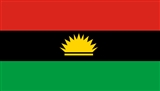
Biafra

Encyclopedia
Biafra, officially the Republic of Biafra, was a secessionist state in south-eastern Nigeria
that existed from 30 May 1967 to 15 January 1970, taking its name from the Bight of Biafra (the Atlantic
bay to its south). The inhabitants were mostly the Igbo people
who led the secession due to economic, ethnic, cultural and religious tensions among the various peoples of Nigeria. The creation of the new country was among the complex causes for the Nigerian Civil War
, also known as the Nigerian-Biafran War.
Land of the Rising Sun
was chosen for Biafra's national anthem, and the state was formally recognized by Gabon
, Haiti
, Ivory Coast
, Tanzania
and Zambia
. Other nations which did not give official recognition but which did provide support and assistance to Biafra included Israel
, France
, Portugal
, Rhodesia
, South Africa
and the Vatican City
. Biafra also received aid from non-state actors, including Joint Church Aid, Holy Ghost Fathers
of Ireland, Caritas International, MarkPress and U.S. Catholic Relief Services
.
After two-and-a-half years of war, during which a million civilians had died in fighting and from famine, Biafran forces agreed to a ceasefire with the Nigerian Federal Military Government (FMG), and Biafra was reintegrated into Nigeria.
. As with many other new African states, the borders of the country did not reflect earlier ethnic boundaries. Thus the northern desert region of the country contained semi-autonomous feudal Muslim states, while the southern population was predominantly Christian
and Animist. Furthermore, Nigeria's oil, its primary source of income, was located in the south of the country.
Following independence, Nigeria was divided primarily along ethnic lines with Hausa
and Fulani
in the north, Yoruba
in the south-west, and Igbo
in the south-east. In January 1966, a group of primarily eastern Igbo led a military coup during which 30 political leaders including Nigeria's Prime Minister, Sir Abubakar Tafawa Balewa
and the Northern premier, Sir Ahmadu Bello
were killed.
In July 1966 northern officers and army units staged a counter-coup. Muslim officers named a Christian from a small ethnic group (the Anga) in central Nigeria, General Yakubu "Jack" Gowon
, as the head of the Federal Military Government (FMG). The two coups deepened Nigeria's ethnic tensions. In September, 1966, approximately 30,000 Igbo were killed in the north, and some Northerners were killed in backlashes in eastern cities.
In January 1967, the military leaders and senior police officials of each region met in Aburi
, Ghana
and agreed on a loose confederation of regions. The Northerners were at odds with the Aburi Accord
; Obafemi Awolowo
, the leader of the Western Region warned that if the Eastern Region seceded, the Western Region would also, which persuaded the northerners.
After the federal and eastern governments failed to reconcile, on 26 May the Eastern region voted to secede from Nigeria. On 30 May, Chukwuemeka Odumegwu Ojukwu
, the Eastern Region's military governor, announced the Republic of Biafra, citing the Easterners killed in the post-coup violence. The large amount of oil in the region created conflict, as oil was a major component of the Nigerian economy. The Eastern region was very ill equipped for war, out-manned, and out-gunned by the military of the remainder of Nigeria. Their advantages included fighting in their homeland, support of most Easterners, determination, and use of limited resources. The British
, Soviet Union
, and U.S. support (especially militarily) of the Nigerian government played a major role in the outcome of the war.
 The FMG launched "police measures" to annex the Eastern Region on July 6, 1967. The FMG's initial efforts were unsuccessful;
the Biafrans successfully launched their own offensive, taking land in the Mid-Western Region August 1967. By October 1967,
the FMG had regained the land after intense fighting.
In September 1968, the federal army planned what Gowon described as the "final offensive." Initially the final offensive was neutralized by Biafran troops. In the latter stages, a Southern FMG offensive managed to break through the fierce resistance.
On 30 June 1969, the Nigerian government banned all Red Cross aid to Biafra; two weeks later it allowed medical supplies through the front line, but restricted food supplies. Later in October 1969, Ojukwu appealed to United Nations
to mediate a cease-fire. The federal government called for Biafra's surrender. In December, the FMG managed to cut Biafra in half, primarily by the efforts of 3 Marine Commando Division of the Nigerian Army
, led by then Colonel Benjamin Adekunle
, popularly called 'The Black Scorpion' and later Olusegun Obasanjo. Ojukwu fled to the Ivory Coast, leaving his chief of staff, Philip Effiong
, to act as the "officer administering the government". Effiong called for a cease-fire 12 January and submitted to the FMG. More than one million people had died in battle or from starvation. Biafra was reabsorbed into Nigeria.
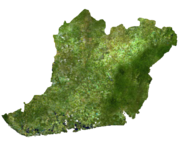 Enclosed in Biafra's borders were over 29848 square miles (77,306 km²) of land; the land borders were shared with Nigeria
to the north and Cameroon
to the east. Its coast was on the Gulf of Guinea
in the south.
The former country's southeast borders the Benue Hills and mountains that lead to Cameroon.
Two rivers flow from Biafra into the Gulf of Guinea: the Cross River
and the Niger River
.
s, dry and rainy. From April to October the rainy season takes place, with heavy rain
and high humidity. The heaviest rain occurs between June and July with up to 360 mm (14.2 in) of rain level. The temperature of the region on a clear day is 30 degrees Celsius (86 degrees Fahrenheit) high and 22 degrees Celsius (71.6 degrees Fahrenheit) low. The dry season starts in November and ends in April. The lowest rain level 16 mm (0.62992125984252 in) in February. The temperature at night reaches 20 °C (68 °F) and in the day has a peak temperature of 36 °C (96.8 °F).
. Along with Igbo there were a variety of other different languages, including Efik
and Ibibio
.
The bank was first located in Enugu, but due to the ongoing war, the bank was relocated several times.
Biafra attempted to finance the war through foreign exchange. After Nigeria announced their currency would no longer be legal tender (to make way for a new currency), this effort increased. After the announcement, tons of Nigerian bank notes were transported in an effort to acquire foreign exchange. The currency of Biafra had been the Nigerian pound, until the Bank of Biafra started printing out its own notes, the Biafran pound
. The new currency went public on 28 January 1968, and the Nigerian pound was not accepted as an exchange unit. The first issue of the bank notes included only 5 shillings notes and 1 pound notes. The Bank of Nigeria exchanged only 30 pounds for an individual and 300 pounds for enterprises in the second half of 1968.
In 1969 new notes were introduced: £
10, £5, £1, 10/-
and 5/-.
It is estimated that a total of £115-140 million Biafran pounds were in circulation by the end of the conflict, with a population of about 14 million, approximately £10 per person.
was a Lt. Colonel assigned to the 4th Commando Brigade and Welshman Taffy Williams
served as a Major until the very end of the conflict.
The Biafrans managed to set up a small yet effective air force. The BAF commanders were Chude Sokey and later Godwin Ezeilo, who had trained with the Royal Canadian Air Force. Early inventory included two B-25 Mitchell
s, one B-26 Invader (piloted by Polish pilot Jan Zumbach
, known also as John Brown), a converted DC-3 and one Dove
. In 1968 the Swedish
pilot Carl Gustaf von Rosen
suggested the MiniCOIN project to General Ojukwu. By the spring of 1969, Biafra had built five MFI-9B
s in Gabon
, calling them "Biafra Babies". They were coloured green, were able to carry six 68 mm anti-armour rockets under each wing and had simple sights. The six airplanes were flown by three Swedish pilots and three Biafran pilots. In September 1969, Biafra acquired four ex-Armee de l'Air North American T-6Gs, which were flown successfully to Biafra the following month, with another aircraft lost on the ferry flight. These aircraft flew missions until January 1970, flown by Portuguese ex-military pilots.
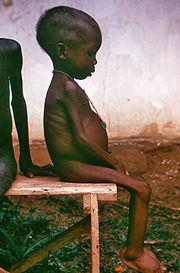 The international humanitarian organization Médecins Sans Frontières
("Doctors Without Borders") came out of the suffering in Biafra. During the crisis, French medical volunteers, in addition to Biafran health workers and hospitals, were subjected to attacks by the Nigerian army and witnessed civilians being murdered and starved by the blockading forces. French doctor Bernard Kouchner
also witnessed these events, particularly the huge number of starving children, and, when he returned to France, he publicly criticised the Nigerian government and the Red Cross for their seemingly complicit behaviour. With the help of other French doctors, Kouchner put Biafra in the media spotlight and called for an international response to the situation. These doctors, led by Kouchner, concluded that a new aid organisation was needed that would ignore political/religious boundaries and prioritise the welfare of victims.
In their book, Smallpox and its Eradication, Fenner and colleagues describe how vaccine supply shortages during the Biafra smallpox campaign led to the development of the focal vaccination technique, later adopted worldwide by the World Health Organization
, which led to the early and cost effective interruption of smallpox transmission in west Africa and elsewhere.
On 29 May 2000, the Lagos Guardian
newspaper reported that the now ex-president Olusegun Obasanjo commuted to retirement the dismissal of all military persons who fought for the breakaway state of Biafra during Nigeria's 1967–1970 civil war. In a national broadcast, he said the decision was based on the belief that "justice must at all times be tempered with mercy".
Violence between Christians and Muslims (usually Igbo Christians and Hausa or Fulani Muslims) has been incessant since the end of the civil war in 1970.
In July 2006 the Center for World Indigenous Studies
reported that government sanctioned killings were taking place in the southeastern city of Onitsha
, because of a shoot-to-kill policy directed toward Biafran loyalists, particularly members of the Movement for the Actualization of the Sovereign State of Biafra
(MASSOB).
In 2010, researchers from Karolinska Institutet
in Sweden and University of Nigeria, Nsukka, showed that Igbos born in Biafra during the years of the famine were of higher risk of suffering from overweight, hypertension and impaired glucose metabolism compared to controls born a short period after the famine had ended. The findings are in line with the developmental origin of health and disease hypothesis suggesting that malnutrition in early life is a predisposing factor for cardiovascular diseases and diabetes later in life.
(MASSOB) advocates a separate country for the Igbo people of south-eastern Nigeria. They accuse the state of marginalising the Igbo people. MASSOB says it is a peaceful group and advertises a 25-stage plan to achieve its goal peacefully. there are two arms to the government, the Biafra Government in Exile
and Biafra Shadow Government. The Nigerian government accuses MASSOB of violence; MASSOB's leader, Ralph Uwazuruike, was arrested in 2005 and is being detained on treason charges; MASSOB is calling for his release. MASSOB is also championing the release of oil militant Mujahid Dokubo-Asari, who is facing similar charges. In 2009, The MASSOB launched "the Biafran International Passport
" in response to persistent demand by Biafrans in diaspora.
. It is unclear whether the origin of the word Biafra has any relationship to "Bia", the Igbo word for "Come". The word Biafra most likely derives from the subgroup Biafar or Biafada of the Tenda ethnic group who reside primarily in Guinea-Bissau
. Manuel Álvares (1526–1583), a Portuguese Jesuit educator, in his work "Ethiopia Minor and a geographical account of the Province of Sierra Leone", writes about the "Biafar heathen" in chapter 13 of the same book. The word Biafar thus appears to have been a common word in the Portuguese language back in the sixteenth century.
Maps indicating the word Biafara (sometimes also Biafares or Biafar) with corresponding year:
Maps from the nineteenth century indicating Biafra as the region around today's Cameroon:
Nigeria
Nigeria , officially the Federal Republic of Nigeria, is a federal constitutional republic comprising 36 states and its Federal Capital Territory, Abuja. The country is located in West Africa and shares land borders with the Republic of Benin in the west, Chad and Cameroon in the east, and Niger in...
that existed from 30 May 1967 to 15 January 1970, taking its name from the Bight of Biafra (the Atlantic
Atlantic Ocean
The Atlantic Ocean is the second-largest of the world's oceanic divisions. With a total area of about , it covers approximately 20% of the Earth's surface and about 26% of its water surface area...
bay to its south). The inhabitants were mostly the Igbo people
Igbo people
Igbo people, also referred to as the Ibo, Ebo, Eboans or Heebo are an ethnic group living chiefly in southeastern Nigeria. They speak Igbo, which includes various Igboid languages and dialects; today, a majority of them speak English alongside Igbo as a result of British colonialism...
who led the secession due to economic, ethnic, cultural and religious tensions among the various peoples of Nigeria. The creation of the new country was among the complex causes for the Nigerian Civil War
Nigerian Civil War
The Nigerian Civil War, also known as the Nigerian-Biafran War, 6 July 1967–15 January 1970, was a political conflict caused by the attempted secession of the southeastern provinces of Nigeria as the self-proclaimed Republic of Biafra...
, also known as the Nigerian-Biafran War.
Land of the Rising Sun
Land of the Rising Sun (national anthem)
"Land of the Rising Sun" was the proclaimed national anthem of the secessionist African state of Biafra, in south-eastern Nigeria. The tune was adopted from Sibelius' "Finlandia"...
was chosen for Biafra's national anthem, and the state was formally recognized by Gabon
Gabon
Gabon , officially the Gabonese Republic is a state in west central Africa sharing borders with Equatorial Guinea to the northwest, Cameroon to the north, and with the Republic of the Congo curving around the east and south. The Gulf of Guinea, an arm of the Atlantic Ocean is to the west...
, Haiti
Haiti
Haiti , officially the Republic of Haiti , is a Caribbean country. It occupies the western, smaller portion of the island of Hispaniola, in the Greater Antillean archipelago, which it shares with the Dominican Republic. Ayiti was the indigenous Taíno or Amerindian name for the island...
, Ivory Coast
Côte d'Ivoire
The Republic of Côte d'Ivoire or Ivory Coast is a country in West Africa. It has an area of , and borders the countries Liberia, Guinea, Mali, Burkina Faso and Ghana; its southern boundary is along the Gulf of Guinea. The country's population was 15,366,672 in 1998 and was estimated to be...
, Tanzania
Tanzania
The United Republic of Tanzania is a country in East Africa bordered by Kenya and Uganda to the north, Rwanda, Burundi, and the Democratic Republic of the Congo to the west, and Zambia, Malawi, and Mozambique to the south. The country's eastern borders lie on the Indian Ocean.Tanzania is a state...
and Zambia
Zambia
Zambia , officially the Republic of Zambia, is a landlocked country in Southern Africa. The neighbouring countries are the Democratic Republic of the Congo to the north, Tanzania to the north-east, Malawi to the east, Mozambique, Zimbabwe, Botswana and Namibia to the south, and Angola to the west....
. Other nations which did not give official recognition but which did provide support and assistance to Biafra included Israel
Israel
The State of Israel is a parliamentary republic located in the Middle East, along the eastern shore of the Mediterranean Sea...
, France
France
The French Republic , The French Republic , The French Republic , (commonly known as France , is a unitary semi-presidential republic in Western Europe with several overseas territories and islands located on other continents and in the Indian, Pacific, and Atlantic oceans. Metropolitan France...
, Portugal
Portugal
Portugal , officially the Portuguese Republic is a country situated in southwestern Europe on the Iberian Peninsula. Portugal is the westernmost country of Europe, and is bordered by the Atlantic Ocean to the West and South and by Spain to the North and East. The Atlantic archipelagos of the...
, Rhodesia
Rhodesia
Rhodesia , officially the Republic of Rhodesia from 1970, was an unrecognised state located in southern Africa that existed between 1965 and 1979 following its Unilateral Declaration of Independence from the United Kingdom on 11 November 1965...
, South Africa
South Africa
The Republic of South Africa is a country in southern Africa. Located at the southern tip of Africa, it is divided into nine provinces, with of coastline on the Atlantic and Indian oceans...
and the Vatican City
Vatican City
Vatican City , or Vatican City State, in Italian officially Stato della Città del Vaticano , which translates literally as State of the City of the Vatican, is a landlocked sovereign city-state whose territory consists of a walled enclave within the city of Rome, Italy. It has an area of...
. Biafra also received aid from non-state actors, including Joint Church Aid, Holy Ghost Fathers
Holy Ghost Fathers
The Congregation of the Holy Spirit is a Roman Catholic congregation of priests, lay brothers, and since Vatican II, lay associates...
of Ireland, Caritas International, MarkPress and U.S. Catholic Relief Services
Catholic Relief Services
Catholic Relief Services is the international humanitarian agency of the Catholic community in the United States. Founded in 1943 by the U.S. bishops, the agency provides assistance to 130 million people in more than 90 countries and territories in Africa, Asia, Latin America, the Middle East and...
.
After two-and-a-half years of war, during which a million civilians had died in fighting and from famine, Biafran forces agreed to a ceasefire with the Nigerian Federal Military Government (FMG), and Biafra was reintegrated into Nigeria.
Secession
In 1960, Nigeria became independent of the United KingdomUnited Kingdom
The United Kingdom of Great Britain and Northern IrelandIn the United Kingdom and Dependencies, other languages have been officially recognised as legitimate autochthonous languages under the European Charter for Regional or Minority Languages...
. As with many other new African states, the borders of the country did not reflect earlier ethnic boundaries. Thus the northern desert region of the country contained semi-autonomous feudal Muslim states, while the southern population was predominantly Christian
Christian
A Christian is a person who adheres to Christianity, an Abrahamic, monotheistic religion based on the life and teachings of Jesus of Nazareth as recorded in the Canonical gospels and the letters of the New Testament...
and Animist. Furthermore, Nigeria's oil, its primary source of income, was located in the south of the country.
Following independence, Nigeria was divided primarily along ethnic lines with Hausa
Hausa people
The Hausa are one of the largest ethnic groups in West Africa. They are a Sahelian people chiefly located in northern Nigeria and southeastern Niger, but having significant numbers living in regions of Cameroon, Ghana, Cote d'Ivoire, Chad and Sudan...
and Fulani
Fula people
Fula people or Fulani or Fulbe are an ethnic group spread over many countries, predominantly in West Africa, but found also in Central Africa and Sudanese North Africa...
in the north, Yoruba
Yoruba people
The Yoruba people are one of the largest ethnic groups in West Africa. The majority of the Yoruba speak the Yoruba language...
in the south-west, and Igbo
Igbo people
Igbo people, also referred to as the Ibo, Ebo, Eboans or Heebo are an ethnic group living chiefly in southeastern Nigeria. They speak Igbo, which includes various Igboid languages and dialects; today, a majority of them speak English alongside Igbo as a result of British colonialism...
in the south-east. In January 1966, a group of primarily eastern Igbo led a military coup during which 30 political leaders including Nigeria's Prime Minister, Sir Abubakar Tafawa Balewa
Abubakar Tafawa Balewa
Alhaji Sir Abubakar Tafawa Balewa, KBE was a Nigerian politician, and the only prime minister of an independent Nigeria. Originally a trained teacher, he became a vocal leader for Northern interest as one of the few educated Nigerians of his time...
and the Northern premier, Sir Ahmadu Bello
Ahmadu Bello
Sir Ahmadu Bello was a Nigerian politician, and was the first premier of the Northern Nigeria region from 1954-1966. He was one of the prominent leaders in Northern Nigeria alongside Abubakar Tafawa Balewa, both of whom were prominent in negotiations about the region's place in an independent...
were killed.
In July 1966 northern officers and army units staged a counter-coup. Muslim officers named a Christian from a small ethnic group (the Anga) in central Nigeria, General Yakubu "Jack" Gowon
Yakubu Gowon
General Yakubu "Jack" Dan-Yumma Gowon was the head of state of Nigeria from 1966 to 1975. He took power after one military coup d'etat and was overthrown in another...
, as the head of the Federal Military Government (FMG). The two coups deepened Nigeria's ethnic tensions. In September, 1966, approximately 30,000 Igbo were killed in the north, and some Northerners were killed in backlashes in eastern cities.
In January 1967, the military leaders and senior police officials of each region met in Aburi
Aburi
Aburi is a town north east of Accra, the capital city of Ghana. It is famous for the Aburi Botanical Gardens. Aburi is home to Aburi Presbyterian Technical Secondary School, which is linked to The Sixth Form College, Farnborough in Hampshire, England. Aburi has a relatively small population and is...
, Ghana
Ghana
Ghana , officially the Republic of Ghana, is a country located in West Africa. It is bordered by Côte d'Ivoire to the west, Burkina Faso to the north, Togo to the east, and the Gulf of Guinea to the south...
and agreed on a loose confederation of regions. The Northerners were at odds with the Aburi Accord
Aburi Accord
Aburi Accord was reached 1967 at a meeting attended by delegates of both the Federal Government of Nigeria and the Eastern delegates, led by the soon-to-become-Biafran leader Colonel Ojukwu. The meeting was billed to be the last chance of preventing all out war...
; Obafemi Awolowo
Obafemi Awolowo
Jeremiah Obafemi Awolowo was a Nigerian politician, trade unionist, author and statesman. A Yoruba and native of Ikenne in Ogun State of Nigeria, he started his career as a regional political leader like most of his pre-independence contemporaries and was responsible for much of the progressive...
, the leader of the Western Region warned that if the Eastern Region seceded, the Western Region would also, which persuaded the northerners.
After the federal and eastern governments failed to reconcile, on 26 May the Eastern region voted to secede from Nigeria. On 30 May, Chukwuemeka Odumegwu Ojukwu
Chukwuemeka Odumegwu Ojukwu
Chukwuemeka Odumegwu Ojukwu was a Nigerian military officer and politician.Ojukwu served as the military governor of the Eastern Region of Nigeria in 1966, the leader of the breakaway Republic of Biafra from 1967 to 1970 and a leading Nigerian politician from 1983 to 2011, when he died, aged...
, the Eastern Region's military governor, announced the Republic of Biafra, citing the Easterners killed in the post-coup violence. The large amount of oil in the region created conflict, as oil was a major component of the Nigerian economy. The Eastern region was very ill equipped for war, out-manned, and out-gunned by the military of the remainder of Nigeria. Their advantages included fighting in their homeland, support of most Easterners, determination, and use of limited resources. The British
United Kingdom
The United Kingdom of Great Britain and Northern IrelandIn the United Kingdom and Dependencies, other languages have been officially recognised as legitimate autochthonous languages under the European Charter for Regional or Minority Languages...
, Soviet Union
Soviet Union
The Soviet Union , officially the Union of Soviet Socialist Republics , was a constitutionally socialist state that existed in Eurasia between 1922 and 1991....
, and U.S. support (especially militarily) of the Nigerian government played a major role in the outcome of the war.
War
the Biafrans successfully launched their own offensive, taking land in the Mid-Western Region August 1967. By October 1967,
the FMG had regained the land after intense fighting.
In September 1968, the federal army planned what Gowon described as the "final offensive." Initially the final offensive was neutralized by Biafran troops. In the latter stages, a Southern FMG offensive managed to break through the fierce resistance.
On 30 June 1969, the Nigerian government banned all Red Cross aid to Biafra; two weeks later it allowed medical supplies through the front line, but restricted food supplies. Later in October 1969, Ojukwu appealed to United Nations
United Nations
The United Nations is an international organization whose stated aims are facilitating cooperation in international law, international security, economic development, social progress, human rights, and achievement of world peace...
to mediate a cease-fire. The federal government called for Biafra's surrender. In December, the FMG managed to cut Biafra in half, primarily by the efforts of 3 Marine Commando Division of the Nigerian Army
Nigerian Army
The Nigerian Army the largest of the Nigerian Armed Forces, has about 100,000 professional personnel. The original elements of the Royal West African Frontier Force in Nigeria were formed in 1900....
, led by then Colonel Benjamin Adekunle
Benjamin Adekunle
General Benjamin Adesanya Maja Adekunle, Nigerian Army, , was a Nigerian military leader.-Early years and background:...
, popularly called 'The Black Scorpion' and later Olusegun Obasanjo. Ojukwu fled to the Ivory Coast, leaving his chief of staff, Philip Effiong
Philip Effiong
Philip Efiong was the first Vice President and the second and last President of the now defunct Republic of Biafra during the Nigerian Civil War of 1967 to 1970.-Early life:...
, to act as the "officer administering the government". Effiong called for a cease-fire 12 January and submitted to the FMG. More than one million people had died in battle or from starvation. Biafra was reabsorbed into Nigeria.
Geography
Nigeria
Nigeria , officially the Federal Republic of Nigeria, is a federal constitutional republic comprising 36 states and its Federal Capital Territory, Abuja. The country is located in West Africa and shares land borders with the Republic of Benin in the west, Chad and Cameroon in the east, and Niger in...
to the north and Cameroon
Cameroon
Cameroon, officially the Republic of Cameroon , is a country in west Central Africa. It is bordered by Nigeria to the west; Chad to the northeast; the Central African Republic to the east; and Equatorial Guinea, Gabon, and the Republic of the Congo to the south. Cameroon's coastline lies on the...
to the east. Its coast was on the Gulf of Guinea
Gulf of Guinea
The Gulf of Guinea is the northeasternmost part of the tropical Atlantic Ocean between Cape Lopez in Gabon, north and west to Cape Palmas in Liberia. The intersection of the Equator and Prime Meridian is in the gulf....
in the south.
The former country's southeast borders the Benue Hills and mountains that lead to Cameroon.
Two rivers flow from Biafra into the Gulf of Guinea: the Cross River
Cross River (Nigeria)
Cross River is the main river in southeastern Nigeria and gives its name to Cross River State.It originates in Cameroon, where it takes the name of the Manyu River....
and the Niger River
Niger River
The Niger River is the principal river of western Africa, extending about . Its drainage basin is in area. Its source is in the Guinea Highlands in southeastern Guinea...
.
Climate
Biafra has a tropical climate with two distinct seasonSeason
A season is a division of the year, marked by changes in weather, ecology, and hours of daylight.Seasons result from the yearly revolution of the Earth around the Sun and the tilt of the Earth's axis relative to the plane of revolution...
s, dry and rainy. From April to October the rainy season takes place, with heavy rain
Rain
Rain is liquid precipitation, as opposed to non-liquid kinds of precipitation such as snow, hail and sleet. Rain requires the presence of a thick layer of the atmosphere to have temperatures above the melting point of water near and above the Earth's surface...
and high humidity. The heaviest rain occurs between June and July with up to 360 mm (14.2 in) of rain level. The temperature of the region on a clear day is 30 degrees Celsius (86 degrees Fahrenheit) high and 22 degrees Celsius (71.6 degrees Fahrenheit) low. The dry season starts in November and ends in April. The lowest rain level 16 mm (0.62992125984252 in) in February. The temperature at night reaches 20 °C (68 °F) and in the day has a peak temperature of 36 °C (96.8 °F).
Language
The predominant language of Biafra was the Igbo languageIgbo language
Igbo , or Igbo proper, is a native language of the Igbo people, an ethnic group primarily located in southeastern Nigeria. There are approximately 20 million speakers that are mostly in Nigeria and are primarily of Igbo descent. Igbo is a national language of Nigeria. It is written in the Latin...
. Along with Igbo there were a variety of other different languages, including Efik
Efik language
Efik , also known as Riverain Ibibio, is the native language of the Efik people of Nigeria, where it is a national language. It is the official language of the Cross River State in Nigeria.The name Efik is also used for Ibibio-Efik....
and Ibibio
Ibibio language
Ibibio-Efik, also known as Ibibio and Efik, is the major dialect cluster of the Benue–Congo language family called Cross River. Efik proper has national status in Nigeria and is the literary standard of the Efik languages, though Ibibio proper has more native speakers.-Varieties:Efik is a dialect...
.
Economy
An early institution created by the Biafran government was the Bank of Biafra, accomplished under ‘Decree No. 3 of 1967'. The bank carried out all central banking functions including the administration of foreign exchange and the management of the public debt of the Republic. The bank was administered by a governor and four directors; the first governor, per the signature on bank notes, was Sylvester U. Ugoh. A second decree, ‘Decree No.4 of 1967’, modified the Banking Act of the Federal Republic of Nigeria for the Republic of Biafra.The bank was first located in Enugu, but due to the ongoing war, the bank was relocated several times.
Biafra attempted to finance the war through foreign exchange. After Nigeria announced their currency would no longer be legal tender (to make way for a new currency), this effort increased. After the announcement, tons of Nigerian bank notes were transported in an effort to acquire foreign exchange. The currency of Biafra had been the Nigerian pound, until the Bank of Biafra started printing out its own notes, the Biafran pound
Biafran pound
The Biafran pound was the currency of the breakaway Republic of Biafra between 1968 and 1970.The first notes denominated in 5 shillings and £1 were introduced on January 29, 1968. A series of coins was issued in 1969; 3 pence, 6 pence, 1 shilling and 2½ shilling coins were minted, all made of...
. The new currency went public on 28 January 1968, and the Nigerian pound was not accepted as an exchange unit. The first issue of the bank notes included only 5 shillings notes and 1 pound notes. The Bank of Nigeria exchanged only 30 pounds for an individual and 300 pounds for enterprises in the second half of 1968.
In 1969 new notes were introduced: £
Pound (currency)
The pound is a unit of currency in some nations. The term originated in England as the value of a pound of silver.The word pound is the English translation of the Latin word libra, which was the unit of account of the Roman Empire...
10, £5, £1, 10/-
Shilling
The shilling is a unit of currency used in some current and former British Commonwealth countries. The word shilling comes from scilling, an accounting term that dates back to Anglo-Saxon times where it was deemed to be the value of a cow in Kent or a sheep elsewhere. The word is thought to derive...
and 5/-.
It is estimated that a total of £115-140 million Biafran pounds were in circulation by the end of the conflict, with a population of about 14 million, approximately £10 per person.
Military
At the beginning of the war Biafra had 3,000 troops, but at the end of the war the troops totaled 30,000. There was no official support for the Biafran army by another nation throughout the war, although arms were clandestinely acquired. Because of the lack of official support, the Biafrans manufactured many of their weapons locally. A number of Europeans served in the Biafran cause; German born Rolf SteinerRolf Steiner
Rolf Steiner was a professional soldier of fortune, born in Munich, Bavaria on January 3, 1933. He rose to the level of Lt. Commander of the 4th Commando Brigade in the Biafran Army during the Nigerian Civil War, and later served with the Anyanya rebels in southern Sudan.The son of a Protestant...
was a Lt. Colonel assigned to the 4th Commando Brigade and Welshman Taffy Williams
Taffy Williams
Taffy Williams was a professional soldier of fortune who served in the Congo with Mike Hoare and 5 Commando Congo as well as a Major in Biafra. Born in Wales, he grew up and received his military training in South Africa.-Biafran War:...
served as a Major until the very end of the conflict.
The Biafrans managed to set up a small yet effective air force. The BAF commanders were Chude Sokey and later Godwin Ezeilo, who had trained with the Royal Canadian Air Force. Early inventory included two B-25 Mitchell
B-25 Mitchell
The North American B-25 Mitchell was an American twin-engined medium bomber manufactured by North American Aviation. It was used by many Allied air forces, in every theater of World War II, as well as many other air forces after the war ended, and saw service across four decades.The B-25 was named...
s, one B-26 Invader (piloted by Polish pilot Jan Zumbach
Jan Zumbach
Jan Eugeniusz Ludwig Zumbach was a Polish fighter pilot who became an ace during the Second World War.-Early years:...
, known also as John Brown), a converted DC-3 and one Dove
De Havilland Dove
The de Havilland DH.104 Dove was a British monoplane short-haul airliner from de Havilland, the successor to the biplane de Havilland Dragon Rapide and was one of Britain's most successful post-war civil designs...
. In 1968 the Swedish
Sweden
Sweden , officially the Kingdom of Sweden , is a Nordic country on the Scandinavian Peninsula in Northern Europe. Sweden borders with Norway and Finland and is connected to Denmark by a bridge-tunnel across the Öresund....
pilot Carl Gustaf von Rosen
Carl Gustaf von Rosen
Count Carl Gustaf Ericsson von Rosen was a Swedish pioneer aviator. He flew relief missions in a number of conflicts as well as combat missions for Finland and Biafran rebels...
suggested the MiniCOIN project to General Ojukwu. By the spring of 1969, Biafra had built five MFI-9B
Malmö MFI-9
|-See also:-References:* -External links:*...
s in Gabon
Gabon
Gabon , officially the Gabonese Republic is a state in west central Africa sharing borders with Equatorial Guinea to the northwest, Cameroon to the north, and with the Republic of the Congo curving around the east and south. The Gulf of Guinea, an arm of the Atlantic Ocean is to the west...
, calling them "Biafra Babies". They were coloured green, were able to carry six 68 mm anti-armour rockets under each wing and had simple sights. The six airplanes were flown by three Swedish pilots and three Biafran pilots. In September 1969, Biafra acquired four ex-Armee de l'Air North American T-6Gs, which were flown successfully to Biafra the following month, with another aircraft lost on the ferry flight. These aircraft flew missions until January 1970, flown by Portuguese ex-military pilots.
Legacy
Médecins Sans Frontières
' , or Doctors Without Borders, is a secular humanitarian-aid non-governmental organization best known for its projects in war-torn regions and developing countries facing endemic diseases. Its headquarters are in Geneva, Switzerland...
("Doctors Without Borders") came out of the suffering in Biafra. During the crisis, French medical volunteers, in addition to Biafran health workers and hospitals, were subjected to attacks by the Nigerian army and witnessed civilians being murdered and starved by the blockading forces. French doctor Bernard Kouchner
Bernard Kouchner
Bernard Kouchner is a French politician, diplomat, and doctor. He is co-founder of Médecins Sans Frontières and Médecins du Monde...
also witnessed these events, particularly the huge number of starving children, and, when he returned to France, he publicly criticised the Nigerian government and the Red Cross for their seemingly complicit behaviour. With the help of other French doctors, Kouchner put Biafra in the media spotlight and called for an international response to the situation. These doctors, led by Kouchner, concluded that a new aid organisation was needed that would ignore political/religious boundaries and prioritise the welfare of victims.
In their book, Smallpox and its Eradication, Fenner and colleagues describe how vaccine supply shortages during the Biafra smallpox campaign led to the development of the focal vaccination technique, later adopted worldwide by the World Health Organization
World Health Organization
The World Health Organization is a specialized agency of the United Nations that acts as a coordinating authority on international public health. Established on 7 April 1948, with headquarters in Geneva, Switzerland, the agency inherited the mandate and resources of its predecessor, the Health...
, which led to the early and cost effective interruption of smallpox transmission in west Africa and elsewhere.
On 29 May 2000, the Lagos Guardian
The Guardian (Nigeria)
The Guardian is an independent daily newspaper published in Nigeria by Guardian Newspapers Limited.The Guardian has been described as "Nigeria's most respected newspaper".-Foundation:...
newspaper reported that the now ex-president Olusegun Obasanjo commuted to retirement the dismissal of all military persons who fought for the breakaway state of Biafra during Nigeria's 1967–1970 civil war. In a national broadcast, he said the decision was based on the belief that "justice must at all times be tempered with mercy".
Violence between Christians and Muslims (usually Igbo Christians and Hausa or Fulani Muslims) has been incessant since the end of the civil war in 1970.
In July 2006 the Center for World Indigenous Studies
Center for World Indigenous Studies
The Center for World Indigenous Studies is a non-profit American organization. It was founded in 1984 by Dr. Rudolph C. Ryser, Ph.D. and Chief George Manuel as an independent research and education organization...
reported that government sanctioned killings were taking place in the southeastern city of Onitsha
Onitsha
Onitsha is a city, a commercial, educational, and religious center and river port on the eastern bank of the Niger river in Anambra State, southeastern Nigeria....
, because of a shoot-to-kill policy directed toward Biafran loyalists, particularly members of the Movement for the Actualization of the Sovereign State of Biafra
Movement for the Actualization of the Sovereign State of Biafra
The Movement for the Actualization of the Sovereign State of Biafra is a secessionist movement with the aim of securing the resurgence of the defunct state of Biafra from Nigeria...
(MASSOB).
In 2010, researchers from Karolinska Institutet
Karolinska Institutet
Karolinska institutet is a medical university in Solna within the Stockholm urban area, Sweden, and one of Europe's largest medical universities...
in Sweden and University of Nigeria, Nsukka, showed that Igbos born in Biafra during the years of the famine were of higher risk of suffering from overweight, hypertension and impaired glucose metabolism compared to controls born a short period after the famine had ended. The findings are in line with the developmental origin of health and disease hypothesis suggesting that malnutrition in early life is a predisposing factor for cardiovascular diseases and diabetes later in life.
Movement to re-secede
The Movement for the Actualization of the Sovereign State of BiafraMovement for the Actualization of the Sovereign State of Biafra
The Movement for the Actualization of the Sovereign State of Biafra is a secessionist movement with the aim of securing the resurgence of the defunct state of Biafra from Nigeria...
(MASSOB) advocates a separate country for the Igbo people of south-eastern Nigeria. They accuse the state of marginalising the Igbo people. MASSOB says it is a peaceful group and advertises a 25-stage plan to achieve its goal peacefully. there are two arms to the government, the Biafra Government in Exile
Government in exile
A government in exile is a political group that claims to be a country's legitimate government, but for various reasons is unable to exercise its legal power, and instead resides in a foreign country. Governments in exile usually operate under the assumption that they will one day return to their...
and Biafra Shadow Government. The Nigerian government accuses MASSOB of violence; MASSOB's leader, Ralph Uwazuruike, was arrested in 2005 and is being detained on treason charges; MASSOB is calling for his release. MASSOB is also championing the release of oil militant Mujahid Dokubo-Asari, who is facing similar charges. In 2009, The MASSOB launched "the Biafran International Passport
Passport
A passport is a document, issued by a national government, which certifies, for the purpose of international travel, the identity and nationality of its holder. The elements of identity are name, date of birth, sex, and place of birth....
" in response to persistent demand by Biafrans in diaspora.
Meaning of "Biafra" and location
Little is known about the literal meaning of the word Biafra. It is not part of the Igbo languageIgbo language
Igbo , or Igbo proper, is a native language of the Igbo people, an ethnic group primarily located in southeastern Nigeria. There are approximately 20 million speakers that are mostly in Nigeria and are primarily of Igbo descent. Igbo is a national language of Nigeria. It is written in the Latin...
. It is unclear whether the origin of the word Biafra has any relationship to "Bia", the Igbo word for "Come". The word Biafra most likely derives from the subgroup Biafar or Biafada of the Tenda ethnic group who reside primarily in Guinea-Bissau
Guinea-Bissau
The Republic of Guinea-Bissau is a country in West Africa. It is bordered by Senegal to the north, and Guinea to the south and east, with the Atlantic Ocean to its west....
. Manuel Álvares (1526–1583), a Portuguese Jesuit educator, in his work "Ethiopia Minor and a geographical account of the Province of Sierra Leone", writes about the "Biafar heathen" in chapter 13 of the same book. The word Biafar thus appears to have been a common word in the Portuguese language back in the sixteenth century.
Historical maps
Early modern maps of Africa from the fifteenth–ninteenth centuries, drawn by European cartographers from accounts written by explorers and travellers, reveal some interesting information about Biafra:- The original word used by the European travellers was not Biafra but Biafara, Biafar and sometimes also Biafares.
- The exact original region of Biafra is not restricted to Eastern Nigeria alone. According to the maps, the European travellers used the word Biafara to describe the entire region east of River Niger going down to the Mount Cameroon region, thus including Cameroon and a large area around Gabon. The word Biafara also appears on maps from the eighteenth century in the area around Gambia.
Maps indicating the word Biafara (sometimes also Biafares or Biafar) with corresponding year:


Maps from the nineteenth century indicating Biafra as the region around today's Cameroon:

See also
- Land of the Rising Sun (national anthem)Land of the Rising Sun (national anthem)"Land of the Rising Sun" was the proclaimed national anthem of the secessionist African state of Biafra, in south-eastern Nigeria. The tune was adopted from Sibelius' "Finlandia"...
- List of A-26 Invader operators
- ManillasManillasManillas are penannular armlets, mostly in bronze or copper, very rarely gold, which served as a form of money or barter coinage and to a degree, ornamentation, amongst certain West African peoples...
- Nigerian Civil WarNigerian Civil WarThe Nigerian Civil War, also known as the Nigerian-Biafran War, 6 July 1967–15 January 1970, was a political conflict caused by the attempted secession of the southeastern provinces of Nigeria as the self-proclaimed Republic of Biafra...
- Movement for the Actualization of the Sovereign State of BiafraMovement for the Actualization of the Sovereign State of BiafraThe Movement for the Actualization of the Sovereign State of Biafra is a secessionist movement with the aim of securing the resurgence of the defunct state of Biafra from Nigeria...
- Radio Northsea International
- AmbazoniaAmbazoniaThe name Ambazonia or Ambazania refers to two separate entities. One pertains to an advocacy group struggling for the total restoration of the statehood of the Crown Colony formerly known as the British Southern Cameroons...
- Chimamanda Ngozi AdichieChimamanda Ngozi AdichieChimamanda Ngozi Adichie is a Nigerian writer.Her family is of Igbo descent. In 2008 she was awarded a MacArthur Fellowship.-Early life and education:...
: Half of a Yellow SunHalf of a Yellow SunHalf of a Yellow Sun is a novel by the Nigerian author Chimamanda Ngozi Adichie. Published in 2006 by Knopf/Anchor, it tells the story of two sisters, Olanna and Kainene, during the Biafran War.-Plot:... - Rolf SteinerRolf SteinerRolf Steiner was a professional soldier of fortune, born in Munich, Bavaria on January 3, 1933. He rose to the level of Lt. Commander of the 4th Commando Brigade in the Biafran Army during the Nigerian Civil War, and later served with the Anyanya rebels in southern Sudan.The son of a Protestant...
- Taffy WilliamsTaffy WilliamsTaffy Williams was a professional soldier of fortune who served in the Congo with Mike Hoare and 5 Commando Congo as well as a Major in Biafra. Born in Wales, he grew up and received his military training in South Africa.-Biafran War:...
- Postage stamps and postal history of BiafraPostage stamps and postal history of BiafraThis is a survey of the postage stamps and postal history of Biafra.The Republic of Biafra was a secessionist state in south-eastern Nigeria which existed from 30 May 1967 to 15 January 1970...
External links
- My Biafran Eyes - Writer Okey NdibeOkey NdibeOkey Ndibe is a novelist, political columnist, and essayist. Of Igbo ethnicity, Ndibe was born in Yola, Nigeria. He is the author of Arrows of Rain, a critically acclaimed novel published in 2000...
's memoir of the Biafran War in Guernica - These Women Are Brave - A project on Igbo women's experiences during the Biafran war.
- Remember Biafra Page http://www.myspace.com/rememberbiafra - A brief history on the Republic and conflict
- Insight guide into Igboland