
All Topics  
Betel

 
Betel

   Email Print
   Bookmark   Link


Betel


The Betel (Piper betle) is the leaf of a vine belonging to the Piperaceae
Piperaceae

Piperaceae is the botanical name for a family of flowering plants. Such a family has been recognized by most taxonomists: it is sometimes known as the "pepper family"....
 family, which includes pepper
Black pepper

Black pepper is a flowering plant vine in the family Piperaceae, cultivated for its fruit, which is usually dried and used as a spice and seasoning....
 and Kava
Kava

Kava is an ancient crop of the western Pacific. Other names for kava include awa , 'ava , yaqona , and sakau . The word kava is used to refer both to the plant and the beverage produced from its roots....
. It is valued both as a mild stimulant and for its medicinal properties.

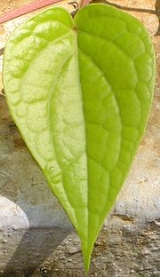
The betel plant is an evergreen and perennial
Perennial plant

A perennial plant or perennial is a plant that lives for more than two years. When used by gardeners or horticulturalists, this term applies specifically to perennial herbaceous plants....
 creeper, with glossy heart-shaped leaves and white catkin
Catkin

A catkin or ament is a slim, cylindrical flower cluster, with inconspicuous or no petals, usually wind-pollination but sometimes insect pollinated ....
. The Betel plant originated from South (India
India

India, officially the Republic of India , is a country in South Asia. It is the List of countries and outlying territories by total area country by geographical area, the List of countries by population country, and the most populous liberal democracy in the world....
 and Sri Lanka
Sri Lanka

Sri Lanka, officially the Democratic Socialist Republic of Sri Lanka is an island country in South Asia, located about off the southern coast of India....
) and South East Asia.

betel leaf is known as Paan in Urdu
Urdu

Urdu is a Central_Indo-Aryan_languages#Central_Zone_.28Madhya_or_Hindi.29 Indo-Aryan languages of the Indo-Iranian languages, belonging to the Indo-European languages family of languages....
/Hindi
Hindi

Standard Hindi, also known as High Hindi, Nagari Hindi or Literary Hindi is a Standard language register of Hindi. It is one of the 22 official languages of India, and is used, along with English language, for administration of the central government....
, and Taambuul and Nagavalli in Sanskrit
Sanskrit

Sanskrit is a historical Indo-Aryan language, one of the liturgical languages of Hinduism and Buddhism, and one of the 22 official languages of India....
.


Discussion
Ask a question about 'Betel'
Start a new discussion about 'Betel'
Answer questions from other users
Full Discussion Forum


Recent Posts


Encyclopedia


The Betel (Piper betle) is the leaf of a vine belonging to the Piperaceae
Piperaceae

Piperaceae is the botanical name for a family of flowering plants. Such a family has been recognized by most taxonomists: it is sometimes known as the "pepper family"....
 family, which includes pepper
Black pepper

Black pepper is a flowering plant vine in the family Piperaceae, cultivated for its fruit, which is usually dried and used as a spice and seasoning....
 and Kava
Kava

Kava is an ancient crop of the western Pacific. Other names for kava include awa , 'ava , yaqona , and sakau . The word kava is used to refer both to the plant and the beverage produced from its roots....
. It is valued both as a mild stimulant and for its medicinal properties.

The betel plant is an evergreen and perennial
Perennial plant

A perennial plant or perennial is a plant that lives for more than two years. When used by gardeners or horticulturalists, this term applies specifically to perennial herbaceous plants....
 creeper, with glossy heart-shaped leaves and white catkin
Catkin

A catkin or ament is a slim, cylindrical flower cluster, with inconspicuous or no petals, usually wind-pollination but sometimes insect pollinated ....
. The Betel plant originated from South (India
India

India, officially the Republic of India , is a country in South Asia. It is the List of countries and outlying territories by total area country by geographical area, the List of countries by population country, and the most populous liberal democracy in the world....
 and Sri Lanka
Sri Lanka

Sri Lanka, officially the Democratic Socialist Republic of Sri Lanka is an island country in South Asia, located about off the southern coast of India....
) and South East Asia.

Vernacular names

The betel leaf is known as Paan in Urdu
Urdu

Urdu is a Central_Indo-Aryan_languages#Central_Zone_.28Madhya_or_Hindi.29 Indo-Aryan languages of the Indo-Iranian languages, belonging to the Indo-European languages family of languages....
/Hindi
Hindi

Standard Hindi, also known as High Hindi, Nagari Hindi or Literary Hindi is a Standard language register of Hindi. It is one of the 22 official languages of India, and is used, along with English language, for administration of the central government....
, and Taambuul and Nagavalli in Sanskrit
Sanskrit

Sanskrit is a historical Indo-Aryan language, one of the liturgical languages of Hinduism and Buddhism, and one of the 22 official languages of India....
. Some of the names in the regions in which it is consumed are: Vetrilai Tamil
Tamil language

Tamil is a Dravidian language spoken predominantly by Tamil people of the Indian subcontinent. It has Official language in India, Sri Lanka and Singapore....
,Tamalapaku Telugu, Vidyache pan Marathi, veeleya/vilya Kannada, Vettila Malayalam
Malayalam language

Malayalam is a Dravidian language used predominantly in the States and territories of India of Kerala, in South India India. It is one of the 22 List of national languages of India, and it is used by around 36 million people....
, Plu Mon
Mon language

The Mon language is an Austroasiatic languages spoken by the Mon people, who live in Burma and Thailand. Mon, unlike most languages in the Southeast Asian region, is not tonal language....
, Malus Tetum, Maluu Khmer
Khmer language

Khmer , or Cambodian, is the language of the Khmer people and the official language of Cambodia. It is the second most widely spoken Austro-Asiatic languages, with speakers in the tens of millions....
, Plue Thai
Thai language

Thai , is the national language and official language language of Thailand and the mother tongue of the Thai people, Thailand's dominant ethnic group....
, Malus Tetum, Bulath Sinhalese, Malu Tokodede, Bileiy Divehi, bulung samat Kapampangan language
Kapampangan language

Kapampangan is one of the major languages of the Philippines. It is the major language spoken by the people in Pampanga. The language is also called Pampango, Capampan?gan, Pampangue?o, and Amanung Sisuan....
, daun sirih Malay language
Malay language

The Malay language is an Austronesian languages spoken by the Malays and people of other ethnic groups who reside in Peninsular Malaysia, southern Thailand, Singapore, central eastern Sumatra, the Riau Islands and parts of the coast of Borneo....
, Papulu Chamorro
Chamorro

Chamorro may refer to:* Chamorro language, an Austronesian language spoken on Guam and the Northern Mariana Islands* Chamorro Party, a 19th century Portuguese political party ...
 and Tr?u Vietnamese
Vietnamese language

Vietnamese , formerly known under French colonization as Annamese , is the national language and official language language of Vietnam. It is the mother tongue of the Vietnamese people , who constitute 86% of Demographics of Vietnam, and of about three million overseas Vietnamese, most of whom live in the United States....
.

Cultivation

Piper Betle Plant
The betel leaf is cultivated in most of South and Southeast Asia. Since it is a creeper, it needs a compatible tree or a long pole to prop the vine against it.

Paan cultivation is a special type of agriculture. High land and special fertile soil are best for betel. Waterlogged, saline and alkali soils are unsuitable for its cultivation. Farmers who are called barui prepare garden for this. Paan garden is called barouj. Barouj is fenced with bamboo sticks and coconut leaves and on top it is also covered by paddy leaves. The land is dug well and laid out into furrows of 10-15 m length, 75 cm width and 75 cm depth. Oil cakes, cow dung, rotten farmyard manure and leaves are thoroughly incorporated with the topsoil of the furrows and wood ash. The creeper cuttings are planted after proper dressing in the months of May and June, at the beginning of the monsoon season. The plants are neatly arranged in parallel rows about two feet apart, and the saplings are twined around upright sticks of split bamboo
Bamboo

The bamboos are a group of woody perennial plant evergreen plants in the true grass family Poaceae, subfamily Bambusoideae, tribe Bambuseae....
 and reeds.

Proper shade and irrigation are essential for the successful cultivation of this crop. The plants are regularly watered in the hot months. The leaves of the plant become ready for plucking after one year of planting and the production of the barouj lasts for several years from the date of planting. Betel needs constantly moist soil, but there should not be excessive moisture. Hence, frequent light irrigations are given. The quantity of irrigation water should be such that the standing water should not remain for more than half an hour in the bed. If water logging by heavy rains or excess irrigation occurs, drainage should be arranged immediately. The best time for irrigation is morning or evening.

Dried leaves and wood ash are applied to the furrows at fortnightly intervals and cow dung slurry is sprinkled. Application of different kinds of leaves at monthly intervals is found advantageous for the growth of the betel. In about 3-6 months time, vines grow to a height 150-180 cm. At this stage branching is noticed in the vines. Leaves are removed along with the petiole with the right thumb. Once harvesting is commenced, it is continued almost every day or week. The interval of harvesting varies from 15 days to about a month till the next lowering of vines. After each harvest, manuring has to be done.

There are various types of leaves, the most popular being : Calcutta, Banarasi, Magahi, etc. In South Asia Dinajpur, Rangpur
Rangpur

Rangpur stands for the following:*Rangpur - citrus fruitplaces*Rangpur Baghoor*Rangpur, India*Rangpur District in Bangladesh**Rangpur, Bangladesh, administrative centre of Rangpur District...
, Chittagong
Chittagong

Chittagong is the second-largest city and main seaport of Bangladesh. Situated on the banks of the Karnaphuli River, it is the principle city of Chittagong Division and a major center of commerce and industry in South Asia....
, Faridpur
Faridpur

Faridpur, , may refer to:* Faridpur, Bangladesh, a district in Bangladesh* Faridpur, India, a town in Uttar Pradesh, India* Faridpur, Durgapur, a town in Durgapur subdivision of Bardhaman district of the Indian state of West Bengal....
, Jessore, Narayanganj
Narayanganj

Narayanganj is a city in central Bangladesh. It is located in the Narayanganj District, near the capital city of Dhaka and has a population of 220,000....
, Barisal and Sylhet
Sylhet

Sylhet , is a major city in north-eastern Bangladesh. It is the capital of Sylhet Division and Sylhet District. Sylhet is located on the banks of the Surma River and is surrounded by the Jaintia, Khasi and Tripura hills....
 are the areas producing most betel. The harvested leaves are used both for domestic consumption and for export to Middle East, to European countries, USA, UK, Pakistan, and Myanmar. Paan is one of the major economic sources of rural Bangladesh. The best Betel leaf is the "Magadhi" variety (literally from the Magadha
Magadha

Magadha formed one of the sixteen Mahajanapadas or Kingdoms of Ancient India. The core of the kingdom was the area of Bihar south of the Ganges; its first capital was Rajagaha then Pataliputra ....
 region) grown near Patna
Patna

Pa?na is the capital city of the Indian States and territories of India of Bihar, and one of the oldest continuously inhabited places in the world....
 in Bihar
Bihar

Bihar is a States and territories of India in East India. Bihar is the 12th largest state in terms of geographical size 38,202 square mile and 3rd largest by population....
, India. In Kerala, the famous variety of betel leaf is from Venmony near Chengannur
Chengannur

Chengannur,:ml:???????????? , is a municipal town in Alappuzha district of the States and territories of India of Kerala in South India. Chengannur is located in the extreme eastern part of Alappuzha district....
 and it is called "Venmony Vettila". Betel leaf cultivated in Tirur
Tirur

Tirur is a town and a municipality in Malappuram district in the Indian States and territories of India of Kerala. It is one of the most important business centres of Malappuram district....
, Kerala is also of fine quality. Betel leaves exported from Tirur are famous in Pakistan as "Tirur Pan".

Compounds

The active ingredients of betel oil, which is obtained from the leaves, are primarily a class of allylbenzene compounds. Though particular emphasis has been placed on chavibetol (betel-phenol; 3-hydroxy-4-methoxyallylbenzene), it also contains chavicol
Chavicol

Chavicol, or p-allylphenol, is a natural organic compound . Its chemical structure consists of a benzene ring substituted with a hydroxy group and a propenyl group....
 (p-allyl-phenol; 4-allyl-phenol), estragole
Estragole

Estragole, or p-allylanisole or methyl chavicol, is a natural organic compound. Its chemical structure consists of a benzene ring substituted with a methoxy group and a propenyl group....
 (p-allyl-anisole; 4-methoxy-allylbenzene), eugenol
Eugenol

Eugenol , is an allyl chain-substituted guaiacol. Eugenol is a member of the phenylpropanoids class of chemical compounds. It is a clear to pale yellow oily liquid extracted from certain essential oils especially from clove oil, nutmeg, cinnamon, and bay leaf....
 (allylguaiacol; 4-hydroxy-3-methoxy-allylbenzene; 2-methoxy-4-allyl-phenol), methyl eugenol (eugenol methyl ether; 3,4-dimethoxy-allylbenzene), and hydroxycatechol (2,4-dihydroxy-allylbenzene).

Several terpenes and terpenoids are present in the betel oil as well. There are two monoterpenes, p-cymene
Cymene

Cymene, or p-cymene, is a naturally occurring aromatic organic compound. It is classified as a hydrocarbon related to a terpene. Its structure consists of a benzene ring para-substituted with a methyl group and an isopropyl group....
 and terpinene
Terpinene

The terpinenes are three isomeric hydrocarbons that are classified as terpenes. They each have the same molecular formula and carbon framework, but they differ in the position of carbon-carbon double bonds....
, and two monoterpenoids, eucalyptol
Eucalyptol

Eucalyptol is a natural organic compound which is a colorless liquid. It is a cyclic ether and a monoterpenoid.Eucalyptol is also known by a variety of synonyms: 1,8-cineol, 1,8-cineole, limonene oxide, cajeputol, 1,8-epoxy-p-menthane, 1,8-oxido-p-menthane, eucalyptol, eucalyptole, 1,3,3-trimethyl-2-oxabicyclo[2,2,2]octane, cineol, cineole...
 and carvacrol
Carvacrol

Carvacrol, or cymophenol, C6H3CH3, is a monoterpene phenol. It has a characteristic pungent, warm odor of oregano and a pizza-like taste....
. Additionally, there are two sesquiterpenes, cadinene
Cadinene

Cadinene is the trivial chemical name of a number of isomeric hydrocarbons that occur in a wide variety of essential oil-producing plants. The name is derived from that of the Juniperus oxycedrus, the wood of which yields an oil from which cadinene isomers were first isolated....
 and caryophyllene
Caryophyllene

Caryophyllene , or -?-caryophyllene, is a natural bicyclic terpene that is a constituent of many essential oils, especially clove oil, the oil from the stems and flowers of Syzygium aromaticum , the essential oil of hemp Cannabis sativa, and rosemary Rosemary....
.

Chewing


There is archaeological evidence that the betel leaves are chewed along with the areca nut since very ancient times. It is not known, however, when these two different stimulants substances were put together for the first time. In most countries the mixture of both has a ceremonial and highly symbolical value.

In India, Burma, Nepal
Nepal

Nepal , officially the Federal Democratic Republic of Nepal, is a landlocked country in South Asia and is the world's youngest republic. It is bordered to the north by the People's Republic of China, and to the south, east, and west by India....
, Sri Lanka
Sri Lanka

Sri Lanka, officially the Democratic Socialist Republic of Sri Lanka is an island country in South Asia, located about off the southern coast of India....
 and other parts of South Asia, as well as Southeast Asia, the leaves are chewed together in a wrapped package along with the areca nut (which, by association, is often inaccurately called the "betel nut
Betel nut

The Areca nut is the seed of the Areca palm , which grows in much of the tropical Pacific, Asia, and parts of east Africa.The areca nut is not a true nut but rather a drupe....
") and mineral slaked lime (calcium hydroxide
Calcium hydroxide

Calcium hydroxide, traditionally called slaked lime, hydrated lime, or pickling lime, is a chemical compound with the chemical formula Calcium2....
). Catechu
Catechu

Catechu is an extract of any of several species of Acacia—but especially Acacia catechu—produced by boiling the wood in water and evaporating the resulting brew....
, called "Kattha" in Hindi, and ther lavoring substances and spices might be added. The lime acts to keep the active ingredient in its freebase
Freebase (chemistry)

Freebase or free base refers to the standalone neutral, Base form of an amine, as opposed to its water-soluble Salt . The amine is usually an alkaloid natural product....
 or alkaline form, thus enabling it to enter the bloodstream via sublingual
Sublingual

Sublingual, literally 'under the tongue', from Latin, refers to the pharmacological route of administration by which medications diffuse into the blood through tissues under the tongue....
 absorption. The areca nut contains the alkaloid
Alkaloid

Alkaloids are naturally occurring chemical compounds containing base nitrogen atoms. The name derives from the word alkaline and was used to describe any nitrogen-containing base....
 arecoline
Arecoline

Arecoline is an alkaloid-type natural product found in the areca nut, the fruit of the areca palm . It is an oily liquid that is soluble in water, alcohols, and ether....
, which promotes salivation (the saliva
Saliva

Saliva is the watery and usually frothy substance produced in the mouths of humans and most other animals. Saliva is produced in and secreted from the salivary glands....
 is stained red), and is itself a stimulant. This combination, known as a "betel quid", has been used for several thousand years. Tobacco
Tobacco

Tobacco is an agricultural product processed from the fresh leaves of plants in the genus Nicotiana. It can be consumed, used as an organic pesticide, and in the form of nicotine tartrate it is used in some medicines....
 is sometimes added.

Betel leaves are used as a stimulant
Stimulant

Stimulant drugs are drugs that temporarily increase alertness and awareness. They usually have increased side-effects with increased effectiveness, and the more powerful variants are therefore often prescription medicines or illegal drugs....
, an antiseptic
Antiseptic

Antiseptics are antimicrobials that are applied to living biological tissue/skin to reduce the possibility of infection, sepsis, or putrefaction....
 and a breath-freshener Paan
Paan

Paan, from the word pan in Urdu, ???, and Hindi, ???, is a South and South East Asian tradition which consists of chewing Betel leaf combined with the areca nut....
. In India, the betel and areca play an important role in Indian culture
Culture of India

File:Kathakali of kerala.jpgFile:Cultural regional areas of India.pngThe culture of India has been shaped by the long history of India, its unique Geography of India and the absorption of customs, traditions and ideas from some of its neighbors as well as by preserving its ancient heritages, which were formed during the Indus Valley Civili...
, especially among Hindus. Many traditional ceremonies governing the lives of Hindus use betel and areca. For example to pay money to the priest, they keep money in the betel leaves and place it beside the priest.

The betel and areca also play an important role in Vietnamese culture
Culture of Vietnam

The Culture of Vietnam which is the agricultural civilization based on the wet rice cultivating is one of the oldest of such in the Asia Pacific region....
. In Vietnamese there is a saying that "the betel begins the conversation", referring to the practice of people chewing betel in formal occasions or "to break the ice" in awkward situational conversations. The betel leaves and areca nuts are used ceremonially in traditional Vietnamese weddings. Based on a folk tale about the origins of these plants, the groom traditionally offer the bride's parents betel leaves and areca nuts (among other things) in exchange for the bride. The betel and areca nut are praised as an ideal combination to the point that have become important symbols of the ideal married couple bound together in love. Therefore in Vietnamese the phrase "matters of betel and areca" (chuy?n tr?u cau) is synonymous with marriage.

The high rate of oral cancer in India is thought to be due to the chewing of betel preparations, though it is unclear whether this can be attributed to the betel leaf, the areca nut, or to the tobacco which is added to some betel preparations. There is an association between the chewing of betel preparations and oral and esophageal squamous cell carcinoma
Squamous cell carcinoma

In medicine, squamous cell carcinoma is a form of cancer of the carcinoma type that may occur in many different organs, including the skin, lips, mouth, esophagus, urinary bladder, prostate, lungs, vagina, and cervix....
. It is also unclear whether similar health risks exist with traditional recipes as those that are associated with modern betel mixtures. The addition of tobacco leaf (the most harmful and addictive component) to the chewing mixture is a relatively recent one, introduced during colonial times a mere few centuries ago.

The muddling between the betel leaf and the areca nut, by calling the nut "betel nut", is restricted to the colonial languages, like English
English language

English is a West Germanic language that originated in Anglo-Saxon England and has lingua franca status in many parts of the world as a result of the military, economic, scientific, political and cultural influence of the British Empire in the 18th, 19th and early 20th centuries and that of the United States from the mid 20th century onwa...
, French
French language

French is a Romance language spoken around the world by around 80 million people as first language, by 190 million as second language, and by about another 200 million people as an acquired tongue, with significant speakers in 54 countries....
, Dutch
Dutch language

Dutch is a West Germanic languages spoken by over 22 million people as a first language, and about 5 million people as a second language."1% of the EU population claims to speak Dutch well enough in order to have a conversation." Outside the European Union the number of second language speakers of Dutch is very small. Most native...
 and German
German language

German is a West Germanic languages, thus related to and classified alongside English language and Dutch language. It is one of the world's world language and the most widely spoken mother tongue in the European Union....
. This lack of accuracy is likely a legacy of the colonial era in which chewing the mixture was restricted to "the natives". In the languages of the places where the Areca nut is traditionally chewed there is a clear and separate term for the areca nut and another for the betel leaf. This clear distinction is important in societies where both the areca nut and the betel leaf have a ceremonial and even sacred value. Furthermore, there is commonly a specific verb for the activity of chewing both of them together.

There was a certain amount of prejudice among the European colonial powers against the tradition of chewing of Areca nut and betel. Unlike the quick adoption of tobacco by Europeans in the American colonies, chewing areca nut and betel was an addictive habit not adopted by the colonizers of South and Southeast Asia. Officers freshly posted in the East India
East India

East India, or more properly Eastern India, is a List_of_regions_in_India of India consisting of the states of West Bengal, Bihar, Jharkhand, and Orissa....
 or Indochina
Indochina

Indochina, or the Indochinese Peninsula, is a subregion in Southeast Asia. It lies roughly east of India, south of China.The word has French origins, Indochine, and was adopted when French colonizers in Vietnam began expanding their territory to bordering countries....
 colonies, whether British, French or Dutch, regarded the red-stained mouths of pan-chewers with dread, as something too foreign for them. This abhorrence is not only evident in the writings of authors of the Victorian era
Victorian era

The Victorian Era of the United Kingdom of Great Britain and Ireland was the period of Victoria of the United Kingdom reign from June 1837 to January 1901....
, but also in the works of more recent writers like George Orwell
George Orwell

Eric Arthur Blair , better known by his pen name George Orwell, was an England author. His work is marked by a profound consciousness of social injustice, an intense dislike of totalitarianism, and a passion for clarity in language....
, Somerset Maugham and V.S. Naipaul. Often this spirit expresses itself in mockery and ridicule, like in the Broadway musical South Pacific
South Pacific (musical)

South Pacific is a 1949 in music#Musical theater with music by Richard Rodgers, lyrics by Oscar Hammerstein II and book by Hammerstein and Joshua Logan....
 tune "There Is Nothing Like a Dame
There Is Nothing Like a Dame

"There is Nothing Like a Dame" is one of the songs from the famous musical South Pacific . The song was written by Richard Rodgers with lyrics by Oscar Hammerstein II....
," with the line "Bloody Mary's chewing betel nuts... and she don't use Pepsodent."

Medicinal properties

In India, betel is used to cast out (cure) worms. And according to traditional Ayurvedic medicine, chewing areca nut and betel leaf is a good remedy against bad breath (halitosis
Halitosis

Halitosis, oral malodor, breath odor, mouth odor, foul breath, fetor oris, fetor ex ore, or most commonly bad breath are terms used to describe noticeably unpleasant odors exhaled in breathing ? whether the smell is from an oral source or not....
). They are also said to have aphrodisiac
Aphrodisiac

An aphrodisiac is a substance which is used in the belief that it increases sexual desire. The name comes from Aphrodite, the Greek mythology of sensuality....
 properties.

In Malaysia they are used to treat headache
Headache

In medicine a headache or wiktionary:cephalalgia is a symptom of a number of different conditions of the head and sometimes neck. Some of the causes are benign while others are medical emergencies....
s, arthritis
Arthritis

Arthritis is a group of conditions involving damage to the joints of the body. Arthritis is the leading cause of disability in people older than fifty-five years....
 and joint pain. In the Philippines
Philippines

The Philippines, officially known as the Republic of the Philippines, is a country in Southeast Asia with Manila as its capital city. It comprises 7,107 islands in the western Pacific Ocean....
, Thailand
Thailand

The Kingdom of Thailand is an independent country that lies in the heart of Southeast Asia. It is bordered to the north by Laos and Myanmar, to the east by Laos and Cambodia, to the south by the Gulf of Thailand and Malaysia, and to the west by the Andaman Sea and Myanmar....
, Indonesia
Indonesia

The Republic of Indonesia , is a transcontinental country in Southeast Asia and Oceania. Comprising Islands of Indonesia, it is the world's largest Archipelago state....
 and China
China

China is a Culture of China, an ancient civilization, and, depending on perspective, a national or multinational entity extending over a large area in East Asia....
 they are used to relieve toothache
Toothache

A toothache, also known as odontalgia or, less frequently, as odontalgy, is an aching pain in or around a tooth. In most cases toothaches are caused by problems in the tooth or jaw, such as Dental caries, gingivitis, the emergence of wisdom teeth, a cracked tooth, infected dental pulp , jaw disease, or exposed root canal....
. In the Philippines, they are used specifically as a stimulant. In Indonesia they are drunk as an infusion and used as an antibiotic
Antibiotic

In common usage, an antibiotic is a substance or compound that kills or inhibits the growth of bacteria. Antibiotics belong to the group of antimicrobial compounds used to treat infections caused by microorganisms, including fungus and protozoa....
. They are also used in an infusion to cure indigestion, as a topical cure for constipation
Constipation

Constipation, costiveness, or irregularity, is a condition of the digestive system in which a person experiences hard feces that are difficult to expel....
, as a decongestant and as an aid to lactation
Lactation

Lactation describes the secretion of milk from the mammary glands, the process of providing that milk to the young, and the period of time that a mother lactates to feed her young....
.

A related plant P. sarmentosum
Piper sarmentosum

Piper sarmentosum is a plant in the Piperaceae family used in many Southeast Asian cuisines. There is no official English language name for it, but it is sometimes called "wild betel", as the leaves are often confused with betel....
, which is used in cooking, is sometimes called "wild betel leaf".

Further reading

  • P. Guha: Betel leaf:The neglected green gold of India. J. Hum Ecol., 19(2) 2006


  • U J Nair et al: Role of lime in the generation of reactive oxygen species from betel-quid ingredients.


  • The Merck Manual. Tumours of The head and neck.


External links

  • - Alcohol and Drugs History Society
    Alcohol and Drugs History Society

    The Alcohol and Drugs History Society is a scholarly organization whose members study the history of a variety of illegal, regulated, and unregulated drugs such as opium, alcohol, and coffee....