


Bermuda rig

Encyclopedia
The term Bermuda rig refers to a configuration of mast
and rigging
for a type of sailboat
and is also known as a Marconi rig; this is the typical configuration for most modern sailboats. This configuration was developed in Bermuda
in the 17th century; the term Marconi was a much later reference to the inventor Guglielmo Marconi
, whose wireless radio masts the Bermuda rigs were said to resemble.
raised to the top of the mast; its luff
runs down the mast and is normally attached to it for its entire length; its tack
is attached at the base of the mast; its foot
controlled by a boom
; and its clew
attached to the aft end of the boom, which is controlled by its sheet
.
Originally developed for smaller Bermudian vessels, and ultimately adapted to the larger, ocean-going Bermuda sloop
, the Bermuda sail is either set as a mainsail
on the main mast
, or as the course
(the principal sail) on another mast. The Bermuda rigging has largely replaced the older gaff rig
ged fore-and-aft
sails, except notably on schooner
s. The traditional design as developed in Bermuda
featured very tall, raked masts, long bowsprit
s and booms (or omitted booms), and vast areas of sail. This is still seen, today, in the Bermuda Fitted Dinghy
, which is raced in Bermuda, but elsewhere the design has omitted the bowsprit, and otherwise become less extreme (Bermuda sloops, especially the single-masted ones, were demanding vessels that required large, experienced crews. This fact was the reason the Bermuda Sloop Foundation chose a three-masted, rather than a single-masted, design for its newly-built Spirit of Bermuda
, which is intended as a training ship for inexperienced youths).
A Bermuda rigged sloop
with exactly one jib
is known as a Bermuda sloop, Marconi sloop or Marconi rig. Bermuda sloop
can also refer to a more specific type of vessel, small sailing ships, traditional in Bermuda, which may, or may not, be Bermuda rigged.
The foot of a Bermuda sail may be attached to the boom along its length, or in some modern rigs the sail is attached to the boom only at its ends. This modern variation of a Bermuda mainsail is known as a loose-footed main. In some early Bermudian vessels, the mainsails were attached only to the mast and deck, lacking booms. This is the case on two of the three masts of the newly-built Spirit of Bermuda
, a replica of an 1830s Royal Navy Sloop of war. Additional sails were also often mounted on traditional Bermudian craft, when running down wind, which included a spinnaker, with a spinnaker boom, and additional jibs. This can still be seen today in the vast sail areas that can be carried by the Bermuda Fitted Dinghy
.
The main controls on a Bermuda sail are:
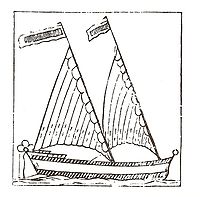 The Bermuda rig developed from leg-of-mutton sails in Bermuda during the course of the 17th and 18th Centuries. The design was very useful on the gusty Bermudian waters for the boats that were the mainstay of transport around the archipelago into the 20th Century. The mean wind direction is from the West, and as the islands lie in a line near to the wind, the ability to sail upwind, to the West was vital. As Bermuda turned to a maritime economy, after the dissolution of the Somers Isles Company
in 1684, the rig was adapted to larger, ocean-going ships, the famous Bermuda sloop
s.
The development of the rig is thought to have begun with fore-and-aft rigged boats built by a Dutch-born Bermudian in the 17th Century. The Dutch were influenced by Moorish lateen rigs introduced during Spain's rule of their country. The Dutch eventually modified the design by omitting the masts, with the yard arms of the lateens being stepped in thwarts. By this process, the yards became raked masts. Lateen sails mounted this way were known as leg-of-mutton sails in English. The Dutch called a vessel rigged in this manner a bezaan jacht. A bezaan jacht is visible in a painting of King Charles II
arriving in Rotterdam in 1660. After sailing on such a vessel, Charles was so impressed that his eventual successor, The Prince of Orange
presented him with a copy of his own, which Charles named Bezaan, The rig had been introduced to Bermuda some decades before this. Captain John Smith
reported that Captain Nathaniel Butler
, who was the governor of Bermuda from 1619 to 1622, employed the Dutch boat builder, one of the crew of a Dutch frigate which had been wrecked on Bermuda, who quickly established a leading position among Bermuda's boat makers (to the resentment of many of his competitors, who were forced to emulate his designs). A poem published by John H. Hardie in 1671 described Bermuda's boats such: With tripple corner'd Sayls they always float, About the Islands, in the world there are, None in all points that may with them compare.
Ships with somewhat similar rigs were in fact recorded in Holland during the 17th Century. By the 19th century, the design of Bermudian vessels had largely dispensed with square topsails and gaff rig, replacing them with triangular main sails and jibs. The lightweight Bermuda cedar
vessels were widely prized for their agility and speed, especially upwind. The high, raked masts and long bowsprits and booms favoured in Bermuda allowed its vessels of all sizes to carry vast areas of sail when running down-wind with spinnakers and multiple jibs, allowing great speeds to be reached. Bermudian work boats, mostly small sloops, were ubiquitous on the archipelagos waters in the 19th century, moving freight, people, and everything else about. The rig was eventually adopted almost universally on small sailing craft in the 20th Century, although as seen on most modern vessels it is very much less extreme than on traditional Bermudian designs, with lower, vertical masts, shorter booms, omitted bowsprits, and much less area of canvas.
Mast (sailing)
The mast of a sailing vessel is a tall, vertical, or near vertical, spar, or arrangement of spars, which supports the sails. Large ships have several masts, with the size and configuration depending on the style of ship...
and rigging
Rigging
Rigging is the apparatus through which the force of the wind is used to propel sailboats and sailing ships forward. This includes masts, yards, sails, and cordage.-Terms and classifications:...
for a type of sailboat
Sailboat
A sailboat or sailing boat is a boat propelled partly or entirely by sails. The term covers a variety of boats, larger than small vessels such as sailboards and smaller than sailing ships, but distinctions in the size are not strictly defined and what constitutes a sailing ship, sailboat, or a...
and is also known as a Marconi rig; this is the typical configuration for most modern sailboats. This configuration was developed in Bermuda
Bermuda
Bermuda is a British overseas territory in the North Atlantic Ocean. Located off the east coast of the United States, its nearest landmass is Cape Hatteras, North Carolina, about to the west-northwest. It is about south of Halifax, Nova Scotia, Canada, and northeast of Miami, Florida...
in the 17th century; the term Marconi was a much later reference to the inventor Guglielmo Marconi
Guglielmo Marconi
Guglielmo Marconi was an Italian inventor, known as the father of long distance radio transmission and for his development of Marconi's law and a radio telegraph system. Marconi is often credited as the inventor of radio, and indeed he shared the 1909 Nobel Prize in Physics with Karl Ferdinand...
, whose wireless radio masts the Bermuda rigs were said to resemble.
Description
The rig consists of a triangular sail set aft of the mast with its headParts of a sail
In sailing the parts of a sail have common terminology for each corner and edge of the sail.-The corners:In a triangular sail, the upper point is known as the head; the halyard, the line which raises the sail, is attached to the head...
raised to the top of the mast; its luff
Parts of a sail
In sailing the parts of a sail have common terminology for each corner and edge of the sail.-The corners:In a triangular sail, the upper point is known as the head; the halyard, the line which raises the sail, is attached to the head...
runs down the mast and is normally attached to it for its entire length; its tack
Tack (sailing)
Tack is a term used in sailing that has different meanings in different contexts, variously a part of a sail, and an alignment with the wind. When using the latter sense, the maneuver of turning between starboard and port tack is either tacking or jibing....
is attached at the base of the mast; its foot
Parts of a sail
In sailing the parts of a sail have common terminology for each corner and edge of the sail.-The corners:In a triangular sail, the upper point is known as the head; the halyard, the line which raises the sail, is attached to the head...
controlled by a boom
Boom (sailing)
In sailing, a boom is a spar , along the foot of a fore and aft rigged sail, that greatly improves control of the angle and shape of the sail. The primary action of the boom is to keep the foot of the sail flatter when the sail angle is away from the centerline of the boat. The boom also serves...
; and its clew
Parts of a sail
In sailing the parts of a sail have common terminology for each corner and edge of the sail.-The corners:In a triangular sail, the upper point is known as the head; the halyard, the line which raises the sail, is attached to the head...
attached to the aft end of the boom, which is controlled by its sheet
Sheet (sailing)
In sailing, a sheet is a line used to control the movable corner of a sail.- Fore-and-aft rigs:Fore-and-aft rigs comprise the vast majority of sailing vessels in use today, including effectively all dinghies and yachts. The sheet on a fore-and-aft sail controls the angle of the sail to the wind,...
.
Originally developed for smaller Bermudian vessels, and ultimately adapted to the larger, ocean-going Bermuda sloop
Bermuda sloop
The Bermuda sloop is a type of fore-and-aft rigged sailing vessel developed on the islands of Bermuda in the 17th century. In its purest form, it is single-masted, although ships with such rigging were built with as many as three masts, which are then referred to as schooners...
, the Bermuda sail is either set as a mainsail
Mainsail
A mainsail is a sail located behind the main mast of a sailing vessel.On a square rigged vessel, it is the lowest and largest sail on the main mast....
on the main mast
Mast (sailing)
The mast of a sailing vessel is a tall, vertical, or near vertical, spar, or arrangement of spars, which supports the sails. Large ships have several masts, with the size and configuration depending on the style of ship...
, or as the course
Course (sail)
In sailing, a course is the lowermost sail on a mast.This term is used predominantly in the plural to describe the lowest sails on a square rigged vessel, i.e., a ship's courses would be the foresail, mainsail, and, on the rare occasions in which one is shipped, mizen...
(the principal sail) on another mast. The Bermuda rigging has largely replaced the older gaff rig
Gaff rig
Gaff rig is a sailing rig in which the sail is four-cornered, fore-and-aft rigged, controlled at its peak and, usually, its entire head by a spar called the gaff...
ged fore-and-aft
Fore-and-aft rig
A fore-and-aft rig is a sailing rig consisting mainly of sails that are set along the line of the keel rather than perpendicular to it. Such sails are described as fore-and-aft rigged....
sails, except notably on schooner
Schooner
A schooner is a type of sailing vessel characterized by the use of fore-and-aft sails on two or more masts with the forward mast being no taller than the rear masts....
s. The traditional design as developed in Bermuda
Bermuda
Bermuda is a British overseas territory in the North Atlantic Ocean. Located off the east coast of the United States, its nearest landmass is Cape Hatteras, North Carolina, about to the west-northwest. It is about south of Halifax, Nova Scotia, Canada, and northeast of Miami, Florida...
featured very tall, raked masts, long bowsprit
Bowsprit
The bowsprit of a sailing vessel is a pole extending forward from the vessel's prow. It provides an anchor point for the forestay, allowing the fore-mast to be stepped farther forward on the hull.-Origin:...
s and booms (or omitted booms), and vast areas of sail. This is still seen, today, in the Bermuda Fitted Dinghy
Bermuda Fitted Dinghy
The Bermuda Fitted Dinghy is a type of racing-dedicated sail boat used for competitions between the yacht clubs of Bermuda. Although the class has only existed for about 130 years, the boats are a continuance of a tradition of boat and ship design in Bermuda that stretches back to the earliest...
, which is raced in Bermuda, but elsewhere the design has omitted the bowsprit, and otherwise become less extreme (Bermuda sloops, especially the single-masted ones, were demanding vessels that required large, experienced crews. This fact was the reason the Bermuda Sloop Foundation chose a three-masted, rather than a single-masted, design for its newly-built Spirit of Bermuda
Spirit of Bermuda
The Spirit of Bermuda is a modern-built Bermuda sloop. She is a replica of a Royal Navy Sloop-of-war, depicted in a well-known 1831 painting.-History of the Bermuda Sloop:...
, which is intended as a training ship for inexperienced youths).
A Bermuda rigged sloop
Sloop
A sloop is a sail boat with a fore-and-aft rig and a single mast farther forward than the mast of a cutter....
with exactly one jib
Jib
A jib is a triangular staysail set ahead of the foremast of a sailing vessel. Its tack is fixed to the bowsprit, to the bow, or to the deck between the bowsprit and the foremost mast...
is known as a Bermuda sloop, Marconi sloop or Marconi rig. Bermuda sloop
Bermuda sloop
The Bermuda sloop is a type of fore-and-aft rigged sailing vessel developed on the islands of Bermuda in the 17th century. In its purest form, it is single-masted, although ships with such rigging were built with as many as three masts, which are then referred to as schooners...
can also refer to a more specific type of vessel, small sailing ships, traditional in Bermuda, which may, or may not, be Bermuda rigged.
The foot of a Bermuda sail may be attached to the boom along its length, or in some modern rigs the sail is attached to the boom only at its ends. This modern variation of a Bermuda mainsail is known as a loose-footed main. In some early Bermudian vessels, the mainsails were attached only to the mast and deck, lacking booms. This is the case on two of the three masts of the newly-built Spirit of Bermuda
Spirit of Bermuda
The Spirit of Bermuda is a modern-built Bermuda sloop. She is a replica of a Royal Navy Sloop-of-war, depicted in a well-known 1831 painting.-History of the Bermuda Sloop:...
, a replica of an 1830s Royal Navy Sloop of war. Additional sails were also often mounted on traditional Bermudian craft, when running down wind, which included a spinnaker, with a spinnaker boom, and additional jibs. This can still be seen today in the vast sail areas that can be carried by the Bermuda Fitted Dinghy
Bermuda Fitted Dinghy
The Bermuda Fitted Dinghy is a type of racing-dedicated sail boat used for competitions between the yacht clubs of Bermuda. Although the class has only existed for about 130 years, the boats are a continuance of a tradition of boat and ship design in Bermuda that stretches back to the earliest...
.
The main controls on a Bermuda sail are:
- The halyardHalyardIn sailing, a halyard or halliard is a line that is used to hoist a sail, a flag or a yard. The term halyard comes from the phrase, 'to haul yards'...
used to raise the head, and sometimes to tension the luffParts of a sailIn sailing the parts of a sail have common terminology for each corner and edge of the sail.-The corners:In a triangular sail, the upper point is known as the head; the halyard, the line which raises the sail, is attached to the head...
. - The outhaulOuthaulAn outhaul is a line which is part of the running rigging of a sailboat, used to extend a sail and control the shape of the curve of the foot of the sail. It runs from the clew to the end of the boom...
used to tension the foot by hauling the clew towards the end of the boom. - The sheetSheet (sailing)In sailing, a sheet is a line used to control the movable corner of a sail.- Fore-and-aft rigs:Fore-and-aft rigs comprise the vast majority of sailing vessels in use today, including effectively all dinghies and yachts. The sheet on a fore-and-aft sail controls the angle of the sail to the wind,...
used to haul the boom down and towards the center of the boat. - The vangBoom vangA boom vang or kicking strap is a line or piston system on a sailboat used to exert downward force on the boom and thus control the shape of the sail. An older term is "martingale"....
or kicking strap which runs between a point partway along the boom and the base of the mast, and is used to haul the boom down when on a run.
History of the Bermuda rig
Somers Isles Company
The Somers Isles Company was formed in 1615 to operate the English colony of the Somers Isles, also known as Bermuda, as a commercial venture. It held a royal charter for Bermuda until 1684, when it was dissolved, and the Crown assumed responsibility for the administration of Bermuda as a royal...
in 1684, the rig was adapted to larger, ocean-going ships, the famous Bermuda sloop
Bermuda sloop
The Bermuda sloop is a type of fore-and-aft rigged sailing vessel developed on the islands of Bermuda in the 17th century. In its purest form, it is single-masted, although ships with such rigging were built with as many as three masts, which are then referred to as schooners...
s.
The development of the rig is thought to have begun with fore-and-aft rigged boats built by a Dutch-born Bermudian in the 17th Century. The Dutch were influenced by Moorish lateen rigs introduced during Spain's rule of their country. The Dutch eventually modified the design by omitting the masts, with the yard arms of the lateens being stepped in thwarts. By this process, the yards became raked masts. Lateen sails mounted this way were known as leg-of-mutton sails in English. The Dutch called a vessel rigged in this manner a bezaan jacht. A bezaan jacht is visible in a painting of King Charles II
Charles II of England
Charles II was monarch of the three kingdoms of England, Scotland, and Ireland.Charles II's father, King Charles I, was executed at Whitehall on 30 January 1649, at the climax of the English Civil War...
arriving in Rotterdam in 1660. After sailing on such a vessel, Charles was so impressed that his eventual successor, The Prince of Orange
William III of England
William III & II was a sovereign Prince of Orange of the House of Orange-Nassau by birth. From 1672 he governed as Stadtholder William III of Orange over Holland, Zeeland, Utrecht, Guelders, and Overijssel of the Dutch Republic. From 1689 he reigned as William III over England and Ireland...
presented him with a copy of his own, which Charles named Bezaan, The rig had been introduced to Bermuda some decades before this. Captain John Smith
John Smith of Jamestown
Captain John Smith Admiral of New England was an English soldier, explorer, and author. He was knighted for his services to Sigismund Bathory, Prince of Transylvania and friend Mózes Székely...
reported that Captain Nathaniel Butler
Nathaniel Butler
Nathaniel Butler was an English privateer who later served as the colonial governor of Bermuda during the early 17th century. He had built many structures still seen in Bermuda today including many of the island's coastal fortresses and the State House, in St...
, who was the governor of Bermuda from 1619 to 1622, employed the Dutch boat builder, one of the crew of a Dutch frigate which had been wrecked on Bermuda, who quickly established a leading position among Bermuda's boat makers (to the resentment of many of his competitors, who were forced to emulate his designs). A poem published by John H. Hardie in 1671 described Bermuda's boats such: With tripple corner'd Sayls they always float, About the Islands, in the world there are, None in all points that may with them compare.
Ships with somewhat similar rigs were in fact recorded in Holland during the 17th Century. By the 19th century, the design of Bermudian vessels had largely dispensed with square topsails and gaff rig, replacing them with triangular main sails and jibs. The lightweight Bermuda cedar
Juniperus bermudiana
Juniperus bermudiana is a species of juniper endemic to Bermuda. This species is most commonly known as Bermuda cedar although, like most "cedars" it is not a true cedar ; a more botanically accurate name would be Bermuda juniper, but this term is extremely rare.It is an evergreen tree growing up...
vessels were widely prized for their agility and speed, especially upwind. The high, raked masts and long bowsprits and booms favoured in Bermuda allowed its vessels of all sizes to carry vast areas of sail when running down-wind with spinnakers and multiple jibs, allowing great speeds to be reached. Bermudian work boats, mostly small sloops, were ubiquitous on the archipelagos waters in the 19th century, moving freight, people, and everything else about. The rig was eventually adopted almost universally on small sailing craft in the 20th Century, although as seen on most modern vessels it is very much less extreme than on traditional Bermudian designs, with lower, vertical masts, shorter booms, omitted bowsprits, and much less area of canvas.
Sources
- Sailing in Bermuda: Sail Racing in the Nineteenth Century, by J.C. Arnell, 1982. Published by the Royal Hamilton Amateur Dinghy Club. Printed by the University of Toronto Press.
External links
- Bermuda Sloop Foundation
- Article on the Spirit of Bermuda —- from Classic Boat, December 2006.
- Burning Sea: Sloop History.
- http://freepages.genealogy.rootsweb.com/~fassitt/footner.htmlRootsweb: Excerpt of Tidewater Triumph, by Geoffrey Footner, describing development of the Baltimore clipperBaltimore ClipperBaltimore Clipper is the colloquial name for fast sailing ships built on the south-eastern seaboard of the United States of America, especially at the port of Baltimore, Maryland...
(large chapter on Bermuda sloops and role of Bermudian boatbuilders).] - Partial list of Bermudian-built Royal Naval vessels (from The Andrew and the Onions, by Lt. Cmdr. I. Strannack).
- Rootsweb: Comprehensive list of Ships of Bermuda.
- Boats.com: New Bermuda Sloop Commissioned.
- Fourteen Feet, Crew of Six.
- Class Rules: Bermuda Fitted Dinghy
- The Royal Bermuda Yacht Club
- Royal Hamilton Amateur Dinghy Club