


Berlin State Opera

Encyclopedia
The Staatsoper Unter den Linden (Berlin State Opera) is a German
opera company. Its permanent home is the opera house on the Unter den Linden
boulevard in the Mitte
district of Berlin
, which also hosts the Staatskapelle Berlin
orchestra.
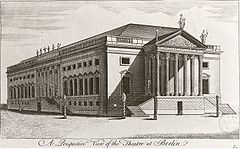
 King Frederick II of Prussia
shortly after his accession to the throne commissioned the original building on the site. Construction work began in July 1741 with what was designed by Georg Wenzeslaus von Knobelsdorff
to be the first part of a "Forum Fredericianum" on present-day Bebelplatz
. Although not entirely completed, the Court Opera (Hofoper) was inaugurated with a performance of Carl Heinrich Graun
's Cesare e Cleopatra
on December 7, 1742. This event marked the beginning of the successful, 250-year co-operation between the Staatsoper and the Staatskapelle Berlin
, the state orchestra, whose roots trace back to the 16th century.
In 1842, Gottfried Wilhelm Taubert instituted the tradition of regular symphonic concerts. In the same year, Giacomo Meyerbeer
succeeded Gaspare Spontini
as General Music Director. Felix Mendelssohn
also conducted symphonic concerts for a year.
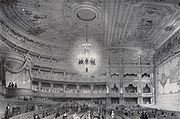
On August 18, 1843 the Linden Opera was destroyed by fire. The reconstruction of the building was supervised by architect Carl Ferdinand Langhans
, and the Königliches Opernhaus (Royal Opera House) was inaugurated the following autumn by a performance of Meyerbeer's Ein Feldlager in Schlesien.
In 1821, the Berlin Opera gave the premiere of Weber's Der Freischütz
. In 1849, it premiered Otto Nicolai's Die lustigen Weiber von Windsor, conducted by the composer himself.
, Richard Strauss
, and Leo Blech
.
After the collapse of the German Empire
in 1918, the Opera was renamed Staatsoper unter den Linden and the Königliche Kapelle became Kapelle der Staatsoper.
In the 1920s, Kurt Adler
, Wilhelm Furtwängler
, Erich Kleiber
, Otto Klemperer
, Alexander von Zemlinsky
, Bruno Walter
occupied the conductor's post. In 1925, Alban Berg
's Wozzeck
, was given its premiere in a production conducted by Erich Kleiber
in the composer's presence.
After having undergone an extensive renovation, the Linden Opera reopened in April 1928 with a new production of Die Zauberflöte. In the same year, the famous Russia
n bass Feodor Chaliapin
and Serge Diaghilev's Ballets Russes
with conductor Ernest Ansermet are guest performers. In 1930 Erich Kleiber conducted premiere of Darius Milhaud
's Christoph Columbus.
However, in 1934, when symphonic pieces from Alban Berg's Lulu
were performed by Kleiber, the National Socialists provoked a scandal and he was forced into exile.
After Hitler's Nazi
takeover
, members of Jewish origin were dismissed from the ensemble. Many German musicians associated with the opera went into exile, including the conductors Kurt Adler
, Otto Klemperer
and Fritz Busch
. Clemens Krauss
became a prominent German conductor first at The Berlin State Opera in 1933 and then appointed as its director in 1935 due to Fritz Busch
and Erich Kleiber
resigning, respectively, their positions in protest over Nazi rule. During the Third Reich, Robert Heger
, Herbert von Karajan
(1939-1945) and Johannes Schüler were the "Staatskapellmeister".
(today's Metropoltheater). From 1949, the company served as the state opera of East Germany. It moved back to its original home after the rebuilding in freely adapted baroque forms was finally completed in 1955. The newly rebuilt opera house was opened, again, with Wagner's Die Meistersinger von Nürnberg. The capacity is now about 1,300.
After the Berlin Wall
was built in 1961, the Opera was somewhat isolated, but still maintained a comprehensive repertoire that featured the classic and romantic period together with contemporary ballet and operas.
After reunification, the Linden Opera rejoined the operatic world. Important works that had already performed in the past were rediscovered and discussed anew within the framework of a "Berlin Dramaturgy". Baroque Opera in particular was at the center of attention, with Cleopatra e Cesare, Croesus, L'Opera seria and Griselda. These works were performed by Belgian conductor René Jacobs together with the Akademie für Alte Musik Berlin and the Freiburger Barockorchester on period instruments. In the 1990s, the opera was officially renamed "Staatsoper Unter den Linden".
In 1992, the Argentine
-Israel
i conductor Daniel Barenboim
was appointed Music Director. In 2000, the orchestra (according to its official website) elected Barenboim "conductor for life." During the 2002 Festtage, he led a Wagner cycle in ten parts, a production created in collaboration with director Harry Kupfer.
Germany
Germany , officially the Federal Republic of Germany , is a federal parliamentary republic in Europe. The country consists of 16 states while the capital and largest city is Berlin. Germany covers an area of 357,021 km2 and has a largely temperate seasonal climate...
opera company. Its permanent home is the opera house on the Unter den Linden
Unter den Linden
Unter den Linden is a boulevard in the Mitte district of Berlin, the capital of Germany. It is named for its linden trees that line the grassed pedestrian mall between two carriageways....
boulevard in the Mitte
Mitte (locality)
Mitte is a central locality of Berlin in the homonymous district of Mitte. Until 2001 it was itself an autonomous district....
district of Berlin
Berlin
Berlin is the capital city of Germany and is one of the 16 states of Germany. With a population of 3.45 million people, Berlin is Germany's largest city. It is the second most populous city proper and the seventh most populous urban area in the European Union...
, which also hosts the Staatskapelle Berlin
Staatskapelle Berlin
The Staatskapelle Berlin is a German orchestra, the orchestra of the Berlin State Opera .The orchestra traces its roots to 1570, when Joachim II Hector, Elector of Brandenburg established an orchestra at his court...
orchestra.
Early years
Frederick II of Prussia
Frederick II was a King in Prussia and a King of Prussia from the Hohenzollern dynasty. In his role as a prince-elector of the Holy Roman Empire, he was also Elector of Brandenburg. He was in personal union the sovereign prince of the Principality of Neuchâtel...
shortly after his accession to the throne commissioned the original building on the site. Construction work began in July 1741 with what was designed by Georg Wenzeslaus von Knobelsdorff
Georg Wenzeslaus von Knobelsdorff
Hans Georg Wenzeslaus von Knobelsdorff was a painter and architect in Prussia.Knobelsdorff was born in Kuckädel, now in Krosno Odrzańskie County. A soldier in the service of Prussia, he resigned his commission in 1729 as captain so that he could pursue his interest in architecture...
to be the first part of a "Forum Fredericianum" on present-day Bebelplatz
Bebelplatz
The Bebelplatz is a public square in the central Mitte district of Berlin, the capital of Germany.The square is located on the south side of the Unter den Linden boulevard, a major east-west thoroughfare in the city centre...
. Although not entirely completed, the Court Opera (Hofoper) was inaugurated with a performance of Carl Heinrich Graun
Carl Heinrich Graun
Carl Heinrich Graun was a German composer and tenor singer. Along with Johann Adolf Hasse, he is considered to be the most important German composer of Italian opera of his time.-Biography:...
's Cesare e Cleopatra
Cesare e Cleopatra
Cesare e Cleopatra is a dramma per musica in three acts by composer Carl Heinrich Graun. The opera uses an Italian language libretto by Giovan Gualberto Bottarelli.-Royal Opera House premiere:...
on December 7, 1742. This event marked the beginning of the successful, 250-year co-operation between the Staatsoper and the Staatskapelle Berlin
Staatskapelle Berlin
The Staatskapelle Berlin is a German orchestra, the orchestra of the Berlin State Opera .The orchestra traces its roots to 1570, when Joachim II Hector, Elector of Brandenburg established an orchestra at his court...
, the state orchestra, whose roots trace back to the 16th century.
In 1842, Gottfried Wilhelm Taubert instituted the tradition of regular symphonic concerts. In the same year, Giacomo Meyerbeer
Giacomo Meyerbeer
Giacomo Meyerbeer was a noted German opera composer, and the first great exponent of "grand opera." At his peak in the 1830s and 1840s, he was the most famous and successful composer of opera in Europe, yet he is rarely performed today.-Early years:He was born to a Jewish family in Tasdorf , near...
succeeded Gaspare Spontini
Gaspare Spontini
Gaspare Luigi Pacifico Spontini was an Italian opera composer and conductor, extremely celebrated in his time, though largely forgotten after his death.-Biography:...
as General Music Director. Felix Mendelssohn
Felix Mendelssohn
Jakob Ludwig Felix Mendelssohn Barthóldy , use the form 'Mendelssohn' and not 'Mendelssohn Bartholdy'. The Grove Dictionary of Music and Musicians gives ' Felix Mendelssohn' as the entry, with 'Mendelssohn' used in the body text...
also conducted symphonic concerts for a year.
On August 18, 1843 the Linden Opera was destroyed by fire. The reconstruction of the building was supervised by architect Carl Ferdinand Langhans
Carl Ferdinand Langhans
Carl Ferdinand Langhans was a Prussian architect with a special interest in theatre architecture.Born in Breslau, Silesia, Langhans was the son of the architect Carl Gotthard Langhans....
, and the Königliches Opernhaus (Royal Opera House) was inaugurated the following autumn by a performance of Meyerbeer's Ein Feldlager in Schlesien.
In 1821, the Berlin Opera gave the premiere of Weber's Der Freischütz
Der Freischütz
Der Freischütz is an opera in three acts by Carl Maria von Weber with a libretto by Friedrich Kind. It premiered on 18 June 1821 at the Schauspielhaus Berlin...
. In 1849, it premiered Otto Nicolai's Die lustigen Weiber von Windsor, conducted by the composer himself.
20th century
At the end of the 19th century and the beginning of the 20th century, the Royal Court Opera, Berlin, attracted many illustrious conductors. They included Felix von Weingartner, Karl MuckKarl Muck
Karl Muck was a German-born conductor of classical music. He based his activities principally in Europe and mostly in opera. His American career comprised two stints at the Boston Symphony Orchestra. He endured a public outcry in 1917 that questioned whether his loyalties lay with Germany or the...
, Richard Strauss
Richard Strauss
Richard Georg Strauss was a leading German composer of the late Romantic and early modern eras. He is known for his operas, which include Der Rosenkavalier and Salome; his Lieder, especially his Four Last Songs; and his tone poems and orchestral works, such as Death and Transfiguration, Till...
, and Leo Blech
Leo Blech
Leo Blech was a German opera composer and conductor who is perhaps most famous for his work at the Königliches Schauspielhaus Leo Blech (21 April 1871 – 25 August 1958) was a German opera composer and conductor who is perhaps most famous for his work at the Königliches Schauspielhaus Leo...
.
After the collapse of the German Empire
German Empire
The German Empire refers to Germany during the "Second Reich" period from the unification of Germany and proclamation of Wilhelm I as German Emperor on 18 January 1871, to 1918, when it became a federal republic after defeat in World War I and the abdication of the Emperor, Wilhelm II.The German...
in 1918, the Opera was renamed Staatsoper unter den Linden and the Königliche Kapelle became Kapelle der Staatsoper.
In the 1920s, Kurt Adler
Kurt Adler
Kurt Adler was an Austrian classical music conductor, chorus master and pianist with a European musical education. He was best known as the chorus master and conductor of the Metropolitan Opera in New York City from 1943 to 1973...
, Wilhelm Furtwängler
Wilhelm Furtwängler
Wilhelm Furtwängler was a German conductor and composer. He is widely considered to have been one of the greatest symphonic and operatic conductors of the 20th century. By the 1930s he had built a reputation as one of the leading conductors in Europe, and he was the leading conductor who remained...
, Erich Kleiber
Erich Kleiber
Erich Kleiber was an Austrian conductor.- Biography :Born in Vienna, Kleiber studied in Prague...
, Otto Klemperer
Otto Klemperer
Otto Klemperer was a German conductor and composer. He is widely regarded as one of the leading conductors of the 20th century.-Biography:Otto Klemperer was born in Breslau, Silesia Province, then in Germany...
, Alexander von Zemlinsky
Alexander von Zemlinsky
Alexander Zemlinsky or Alexander von Zemlinsky was an Austrian composer, conductor, and teacher.-Early life:...
, Bruno Walter
Bruno Walter
Bruno Walter was a German-born conductor. He is considered one of the best known conductors of the 20th century. Walter was born in Berlin, but is known to have lived in several countries between 1933 and 1939, before finally settling in the United States in 1939...
occupied the conductor's post. In 1925, Alban Berg
Alban Berg
Alban Maria Johannes Berg was an Austrian composer. He was a member of the Second Viennese School with Arnold Schoenberg and Anton Webern, and produced compositions that combined Mahlerian Romanticism with a personal adaptation of Schoenberg's twelve-tone technique.-Early life:Berg was born in...
's Wozzeck
Wozzeck
Wozzeck is the first opera by the Austrian composer Alban Berg. It was composed between 1914 and 1922 and first performed in 1925. The opera is based on the drama Woyzeck left incomplete by the German playwright Georg Büchner at his death. Berg attended the first production in Vienna of Büchner's...
, was given its premiere in a production conducted by Erich Kleiber
Erich Kleiber
Erich Kleiber was an Austrian conductor.- Biography :Born in Vienna, Kleiber studied in Prague...
in the composer's presence.
After having undergone an extensive renovation, the Linden Opera reopened in April 1928 with a new production of Die Zauberflöte. In the same year, the famous Russia
Russia
Russia or , officially known as both Russia and the Russian Federation , is a country in northern Eurasia. It is a federal semi-presidential republic, comprising 83 federal subjects...
n bass Feodor Chaliapin
Feodor Chaliapin
Feodor Ivanovich Chaliapin was a Russian opera singer. The possessor of a large and expressive bass voice, he enjoyed an important international career at major opera houses and is often credited with establishing the tradition of naturalistic acting in his chosen art form.During the first phase...
and Serge Diaghilev's Ballets Russes
Ballets Russes
The Ballets Russes was an itinerant ballet company from Russia which performed between 1909 and 1929 in many countries. Directed by Sergei Diaghilev, it is regarded as the greatest ballet company of the 20th century. Many of its dancers originated from the Imperial Ballet of Saint Petersburg...
with conductor Ernest Ansermet are guest performers. In 1930 Erich Kleiber conducted premiere of Darius Milhaud
Darius Milhaud
Darius Milhaud was a French composer and teacher. He was a member of Les Six—also known as The Group of Six—and one of the most prolific composers of the 20th century. His compositions are influenced by jazz and make use of polytonality...
's Christoph Columbus.
However, in 1934, when symphonic pieces from Alban Berg's Lulu
Lulu (opera)
Lulu is an opera by the composer Alban Berg. The libretto was adapted by Berg himself from Frank Wedekind's plays Erdgeist and Die Büchse der Pandora .-Composition history:...
were performed by Kleiber, the National Socialists provoked a scandal and he was forced into exile.
After Hitler's Nazi
Nazism
Nazism, the common short form name of National Socialism was the ideology and practice of the Nazi Party and of Nazi Germany...
takeover
Machtergreifung
Machtergreifung is a German word meaning "seizure of power". It is normally used specifically to refer to the Nazi takeover of power in the democratic Weimar Republic on 30 January 1933, the day Hitler was sworn in as Chancellor of Germany, turning it into the Nazi German dictatorship.-Term:The...
, members of Jewish origin were dismissed from the ensemble. Many German musicians associated with the opera went into exile, including the conductors Kurt Adler
Kurt Adler
Kurt Adler was an Austrian classical music conductor, chorus master and pianist with a European musical education. He was best known as the chorus master and conductor of the Metropolitan Opera in New York City from 1943 to 1973...
, Otto Klemperer
Otto Klemperer
Otto Klemperer was a German conductor and composer. He is widely regarded as one of the leading conductors of the 20th century.-Biography:Otto Klemperer was born in Breslau, Silesia Province, then in Germany...
and Fritz Busch
Fritz Busch
Fritz Busch was a German conductor.Busch was born in Siegen, Province of Westphalia. He held posts conducting opera at Aachen, Stuttgart and Dresden. In 1933 he was dismissed from his post at Dresden because of his opposition to the new Nazi government of Germany...
. Clemens Krauss
Clemens Krauss
Clemens Heinrich Krauss was an Austrian conductor and opera impresario, particularly associated with the music of Richard Strauss.-Biography:...
became a prominent German conductor first at The Berlin State Opera in 1933 and then appointed as its director in 1935 due to Fritz Busch
Fritz Busch
Fritz Busch was a German conductor.Busch was born in Siegen, Province of Westphalia. He held posts conducting opera at Aachen, Stuttgart and Dresden. In 1933 he was dismissed from his post at Dresden because of his opposition to the new Nazi government of Germany...
and Erich Kleiber
Erich Kleiber
Erich Kleiber was an Austrian conductor.- Biography :Born in Vienna, Kleiber studied in Prague...
resigning, respectively, their positions in protest over Nazi rule. During the Third Reich, Robert Heger
Robert Heger
Robert Heger was a German conductor and composer from Strasbourg, Alsace-Lorraine.He studied at the Conservatory of Strasbourg, under Franz Stockhausen, then in Zurich under Lothar Kempter, and finally in Munich under Max von Schillings. After early conducting engagements in Strasbourg he made his...
, Herbert von Karajan
Herbert von Karajan
Herbert von Karajan was an Austrian orchestra and opera conductor. To the wider world he was perhaps most famously associated with the Berlin Philharmonic, of which he was principal conductor for 35 years...
(1939-1945) and Johannes Schüler were the "Staatskapellmeister".
- 1938 Werner EgkWerner EgkWerner Egk , born Werner Joseph Mayer, was a German composer.-Early career:He was born in the Swabian town of Auchsesheim, today part of Donauwörth, Germany. His family, of Catholic peasant stock, moved to Augsburg when Egk was six. He studied at a Benedictine Gymnasium and entered the municipal...
conducted the first night of his opera Peer GyntPeer GyntPeer Gynt is a five-act play in verse by the Norwegian dramatist Henrik Ibsen, loosely based on the fairy tale Per Gynt. It is the most widely performed Norwegian play. According to Klaus Van Den Berg, the "cinematic script blends poetry with social satire and realistic scenes with surreal ones"...
on November 24. Herbert von KarajanHerbert von KarajanHerbert von Karajan was an Austrian orchestra and opera conductor. To the wider world he was perhaps most famously associated with the Berlin Philharmonic, of which he was principal conductor for 35 years...
´s interpretation of Mozart´s Die Zauberflöte was performed on December 18. Karajan continued as Generalmusikdirektor, the principal musical director of the Staatsoper Unter den Linden between 1941 and 1945. - 1939 Karajan conducted a performance of Rudolf Wagner-RégenyRudolf Wagner-RégenyRudolf Wagner-Régeny was a composer, conductor, and pianist. Born in Transylvania, Kingdom of Hungary, since 1920 Romania, he became a German citizen in 1930, and then East Germany after 1945.From 1919–1920 he studied at the Leipzig Conservatory and then at the Berlin Hochschule für Musik from...
's Die Bürger von Calais. - 1940 On October 21, Karajan conducted a symphonic concert with the Staatskapelle at the Old Philharmonic.
- 1942 The Lindenoper was bombed in 1941. The House reopened on December 12 with Wilhelm FurtwänglerWilhelm FurtwänglerWilhelm Furtwängler was a German conductor and composer. He is widely considered to have been one of the greatest symphonic and operatic conductors of the 20th century. By the 1930s he had built a reputation as one of the leading conductors in Europe, and he was the leading conductor who remained...
´s interpretation of Wagner´s Die Meistersinger von NürnbergDie Meistersinger von NürnbergDie Meistersinger von Nürnberg is an opera in three acts, written and composed by Richard Wagner. It is among the longest operas still commonly performed today, usually taking around four and a half hours. It was first performed at the Königliches Hof- und National-Theater in Munich, on June 21,...
. - 1944 When Joseph GoebbelsJoseph GoebbelsPaul Joseph Goebbels was a German politician and Reich Minister of Propaganda in Nazi Germany from 1933 to 1945. As one of Adolf Hitler's closest associates and most devout followers, he was known for his zealous oratory and anti-Semitism...
proclaimed his “Total War“, the Staatsoper was closed. The last performance was Mozart´s Le nozze di Figaro, conducted by Johannes Schüler on August 31. The Staatskapelle continued to perform symphonic and opera concerts. On October 4 and 5, KarajanHerbert von KarajanHerbert von Karajan was an Austrian orchestra and opera conductor. To the wider world he was perhaps most famously associated with the Berlin Philharmonic, of which he was principal conductor for 35 years...
conducted Bruckner´s 8th symphony. - 1945 The Lindenoper was once again destroyed on February 3. The concerts were relocated to the Admiralspalast and the Schauspielhaus. On February 18, Herbert von Karajan conducted his last symphonic concert with the Staatskapelle in the Beethoven hall.
Postwar years
The second rebuilding took a long time. From 1945, the opera company played in the former AdmiralspalastAdmiralspalast
The Admiralspalast is a theatre in the Mitte district of Berlin, Germany, located on Friedrichstraße No. 101. Opened in 1910, it is one of the few preserved variety venues of the pre-World War II era in the city....
(today's Metropoltheater). From 1949, the company served as the state opera of East Germany. It moved back to its original home after the rebuilding in freely adapted baroque forms was finally completed in 1955. The newly rebuilt opera house was opened, again, with Wagner's Die Meistersinger von Nürnberg. The capacity is now about 1,300.
After the Berlin Wall
Berlin Wall
The Berlin Wall was a barrier constructed by the German Democratic Republic starting on 13 August 1961, that completely cut off West Berlin from surrounding East Germany and from East Berlin...
was built in 1961, the Opera was somewhat isolated, but still maintained a comprehensive repertoire that featured the classic and romantic period together with contemporary ballet and operas.
After reunification, the Linden Opera rejoined the operatic world. Important works that had already performed in the past were rediscovered and discussed anew within the framework of a "Berlin Dramaturgy". Baroque Opera in particular was at the center of attention, with Cleopatra e Cesare, Croesus, L'Opera seria and Griselda. These works were performed by Belgian conductor René Jacobs together with the Akademie für Alte Musik Berlin and the Freiburger Barockorchester on period instruments. In the 1990s, the opera was officially renamed "Staatsoper Unter den Linden".
In 1992, the Argentine
Argentina
Argentina , officially the Argentine Republic , is the second largest country in South America by land area, after Brazil. It is constituted as a federation of 23 provinces and an autonomous city, Buenos Aires...
-Israel
Israel
The State of Israel is a parliamentary republic located in the Middle East, along the eastern shore of the Mediterranean Sea...
i conductor Daniel Barenboim
Daniel Barenboim
Daniel Barenboim, KBE is an Argentinian-Israeli pianist and conductor. He has served as music director of several major symphonic and operatic orchestras and made numerous recordings....
was appointed Music Director. In 2000, the orchestra (according to its official website) elected Barenboim "conductor for life." During the 2002 Festtage, he led a Wagner cycle in ten parts, a production created in collaboration with director Harry Kupfer.
Leadership
|
Leo Blech Leo Blech was a German opera composer and conductor who is perhaps most famous for his work at the Königliches Schauspielhaus Leo Blech (21 April 1871 – 25 August 1958) was a German opera composer and conductor who is perhaps most famous for his work at the Königliches Schauspielhaus Leo... (Hofkapellmeister) Erich Kleiber Erich Kleiber was an Austrian conductor.- Biography :Born in Vienna, Kleiber studied in Prague... Clemens Krauss Clemens Heinrich Krauss was an Austrian conductor and opera impresario, particularly associated with the music of Richard Strauss.-Biography:... Herbert von Karajan Herbert von Karajan was an Austrian orchestra and opera conductor. To the wider world he was perhaps most famously associated with the Berlin Philharmonic, of which he was principal conductor for 35 years... Joseph Keilberth Joseph Keilberth was a German conductor who specialized in opera.He started his career in the State Theatre of his native city, Karlsruhe. In 1940 he became director of the German Philharmonic Orchestra of Prague. Near the end of World War II he became principal conductor of the Dresden... Erich Kleiber Erich Kleiber was an Austrian conductor.- Biography :Born in Vienna, Kleiber studied in Prague... Franz Konwitschny Franz Konwitschny was a German conductor and violist.He started his career on the viola, playing in the Leipzig Gewandhaus Orchestra under Wilhelm Furtwängler. In 1925, he moved to Vienna, where he played the viola with the Fitzner Quartet. He also began teaching at the Wiener Volkskonservatorium... Otmar Suitner Otmar Suitner was an Austrian conductor who spent most of his professional career in East Germany. He was born in Innsbruck and died in Berlin. He was Principal Conductor of the Staatskapelle Dresden from 1960 to 1964, and then Music Director at the Berlin State Opera from 1964 to 1990... Daniel Barenboim Daniel Barenboim, KBE is an Argentinian-Israeli pianist and conductor. He has served as music director of several major symphonic and operatic orchestras and made numerous recordings.... |