


Bereavement in Judaism

Encyclopedia
Bereavement in Judaism is a combination of minhag
(traditional custom) and mitzvah
(religious obligation) derived from Judaism
's classical Torah
and rabbinic texts. The details of observance and practice vary according to each Jewish community.
There is also a custom of rending one's clothes at the moment one hears news of a passing.
Orthodox men will cut the lapel of their suit on the left side, over the heart. Non-orthodox practice may be to cut a necktie or to wear a button with a torn black ribbon.
usually consisting of volunteers, men and women, who prepare the deceased for proper Jewish burial. Their job is to ensure that the body of the deceased is shown proper respect, ritually cleansed and dressed in shrouds.
Many local chevra kadishas in urban areas are affiliated with local synagogue
s, and they often own their own burial plots in various local cemeteries. Some Jews pay an annual token membership fee to the chevra kadisha of their choice, so that when the time comes, the society will not only attend to the body of the deceased as befits Jewish law, but will also ensure burial in a plot that it controls at an appropriate nearby Jewish cemetery
.
If no gravedigger
s are available, then it is additionally the function of the male society members to ensure that graves are dug. In Israel
, members of chevra kadishas consider it an honor to not only prepare the body for burial but also to dig the grave for a fellow Jew's body, particularly if the deceased was known to be a righteous person.
Many burial societies hold one or two annual fast days and organize regular study sessions to remain up to date with the relevant articles of Jewish law. In addition, most burial societies also support families during the shiva (traditional week of mourning) by arranging prayer services
, preparing meals, and providing other services for the mourners.
(Note- Buried not within 24 hours)
The general sequence of steps for performing taharah is as follows. Blessings, prayers, and readings from Torah, Psalms
and other Jewish scripture may be recited at several points:
Once the body is dressed, the coffin
is sealed. Unlike other religions, in Judaism there is no viewing of the body and no "open casket" at the funeral, though the immediate family is allowed a visitation right prior to the coffin being sealed to pay their final respects.
In Israel
caskets are not used at all, with the exception of military and state funerals. The body is carried to the grave wrapped in a tallit.
Once the coffin is closed, the chevra then asks for forgiveness from the deceased for anything that they may have done to offend them or not show proper respect during the taharah. If the body is not taken immediately for burial, guards or watchers
(shomrim) sit with the coffin until it is taken for burial. It is traditional to recite Psalms
during this time.
. Displaying of the body prior to burial does not take place. Flowers would not be found at a traditional funeral.
In Israel the Jewish funeral service will usually commence at the burial ground. In the United States
and Canada
, the funeral service will either commence at a funeral home
or at the cemetery
. Occasionally the service will commence at a synagogue
. In the case of a very prominent individual the funeral service can begin at a synagogue or a yeshivah. If the funeral service begins at a point other than at the cemetery the entourage accompanies the body in a procession to the cemetery. The funeral itself, the procession, the burial, are referred to by the word levayah, meaning "accompanying."
Levayah means "accompaniment" because the funeral procession involves accompanying the body to the place of burial. Levayah is Hebrew and it also indicates "joining" and "bonding." This aspect of the meaning of the word levayah conveys the implication of a commonality between the "souls" of the living and the dead.
, and it is common that several people speak at the start of the ceremony at the funeral home, as well as prior to burial at the gravesite, though some people specify in their wills that nothing should be said about them. On certain days, such as on Chol HaMo'ed ("intermediate days" of Jewish holiday
s), eulogies are forbidden.
requires burial as soon as possible, even for executed criminals. Burial is delayed "for the honor of the deceased," usually to allow more time for far-flung family to come to the funeral and participate in the other post-burial rituals, but also to hire professionals, or to bury the deceased in a cemetery of their choice.
This traditional practice may have originated from the fact that Israel
was, and is, a country with a hot climate. In Biblical times, there were few ways of keeping the dead body from decomposing. Not only would this be generally undesirable, but allowing the dead body of any person to decompose would be showing that person great disrespect. Decomposition would have occurred especially quickly in Israel due to the constant heat. Thus, the custom of burying the body as soon as possible. (Although the practice of embalming
and mummification
had advanced to a high level in Egypt
, this, too, is considered disrespectful, since it involves a great deal of manipulation and the removal of bodily organs.) In addition, respect for the dead can be seen from many examples in the Torah
and Tanakh
. For example, one of the last events in the Torah is the death of Moses
when God himself
buries him: "[God] buried him in the depression in the land of Moab, opposite Beth Peor. No man knows the place that he was buried, even to this day." (Deuteronomy
34:6)
When the funeral service has ended, the mourners come forward to fill the grave. Symbolically, this gives the mourners closure as they observe the grave being filled in. One custom is for people present at the funeral to take a spade or shovel, held pointing down instead of up, to show the antithesis of death
to life
and that this use of the shovel is different from all other uses, to throw three shovelfuls of dirt into the grave. When someone is finished, they put the shovel back in the ground, rather than handing it to the next person, to avoid passing along their grief
to other mourners. This literal participation in the burial is considered a particularly good mitzvah because it is one for which the beneficiary — the deceased — can offer no repayment or gratitude and thus it is a pure gesture.
Halachos concerning mourning are not obligatory on children under 13 years of age. Also, halachos of mourning do not apply when the deceased is a newborn infant aged 30 days or less.
In the instance when a mourner receives the news of the death and burial of a relative after an elapsed period of thirty days or more, there is no keriah, or tearing of the garment, except in the case of a parent. In the case of a parent, the tearing of the garment is to be performed no matter how long an amount of time has elapsed between the time of death and the time of receiving the news.
If a son or daughter of the deceased needs to change clothes during the shiva period, he or she must tear the changed clothes. No other family member is required to rend changed clothes during shiva. Neither son nor daughter may ever sew the rent clothes, but any other mourner may mend the clothing 30 days after the burial.
When they get home, the mourners do not shower or bathe for a week, do not wear leather shoes or jewelry, men do not shave, and in many communities large wall mirrors in the mourners' home are covered. It is customary for the mourners to sit on low stools or even the floor, symbolic of the emotional reality of being "brought low" by the grief. The meal of consolation (seudat havra'ah), the first meal eaten on returning from the funeral, traditionally consists of hard boiled eggs
and other round or oblong foods. This is often credited to the Biblical story of Jacob
purchasing the birthright from Esau
with stewed lentils (Genesis 25:34); it is traditionally stated that Jacob was cooking the lentils soon after the death of his grandfather Abraham
.
During this time distant family and friends come to visit or call the mourners to comfort them via "shiva calls".
(the Jewish Sabbath), nor may the burial take place on Shabbat, but the day of Shabbat does count as one of the seven days. If a Jewish holiday
occurs after the first day, that curtails the mourning period. If the funeral occurs during a festival, the start of the mourning period awaits the end of the festival. Some holidays, such as Rosh Hashanah
, cancel the mourning period completely.
that require action (and attention), such as praying and reciting blessings, wearing tefillin
(phylacteries), in order to be able to tend unhindered to the funeral arrangements. However the onen is still obligated in commandments that forbid an action (such as not violating the Shabbat).
Aninut lasts until the burial is over, or, if a mourner is unable to attend the funeral, from the moment he is no longer involved with the funeral itself.
or go to concert
s, and does not attend any joyous events or parties such as marriages
or Bar or Bat Mitzvahs
, unless absolutely necessary. (If the date for such an event has already been set prior to the death, it is strictly forbidden for it to be postponed or canceled.)
Avelut consists of three distinct periods.
. Observance of shiva is referred to by English-speaking Jews
as "sitting shiva". During this period, mourners traditionally gather in one home and receive visitors.
It is considered a great mitzvah
(commandment) of kindness and compassion to pay a home visit to the mourners. Traditionally, no greetings are exchanged and visitors wait for the mourners to initiate conversation. The mourner is under no obligation to engage in conversation and may, in fact, completely ignore his/her visitors.
Visitors will traditionally take on more of the hosting role when attending a Shiva. Often bringing food and serving it to the mourning family and other guests. The mourning family will often avoid any cooking or cleaning during the Shiva period and those responsibilities become those of visitors.
There are various customs as to what to say when taking leave of the mourner(s). One of the most common is to say to them:
Depending on their community's customs, others may also add such wishes as: "You should have no more tza'ar ('pain')" or "You should have only simchas ('celebrations')" or "we should hear only good news (besorot tovot) from each other" or "I wish you long life".
Traditionally, prayer services
are organised in the house of mourning. It is customary for the family to lead the services themselves.
("religious festive meal"). Men do not shave or get haircuts during this time.
Since Judaism teaches that a deceased person can still benefit from the merit of mitzvot
(deeds commanded by God) done in their memory, it is considered a special privilege to bring merit to the departed by learning Torah
in their name. A popular custom is to coordinate a group of people who will jointly study the complete Mishnah
during the shloshim period.
as part of synagogue services for eleven months. In Orthodox tradition, this was an obligation of the sons as mourners, not for women. There remain restrictions on attending festive occasions and large gatherings, especially where live music is played.
(tombstone) is known as a matzevah ("monument"). Although there is no Halakhic obligation to hold an unveiling ceremony, the ritual became popular in many communities toward the end of the 19th century. There are varying customs about when it should be placed on the grave. Most communities have an unveiling ceremony a year after the death. Some communities have it earlier, even a week after the burial. In Israel it is done after the "shloshim", the first thirty days of mourning. There is no restriction about the timing, other than the unveiling cannot be held during certain periods such as Passover
or Chol Ha'Moed
.
At the end of the ceremony, a cloth or shroud covering that has been placed on the headstone is removed, customarily by close family members. Services include reading of several psalms (1, 23, 24, 103), Mourners Kaddish (if a minyan
is available), and the prayer "El Malei Rachamim." The service may include a brief eulogy for the deceased.
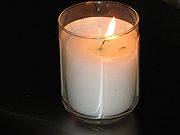 Yahrtzeit, יאָרצײַט, means "Time (of) Year" in Yiddish. (Alternative spellings include yortsayt (using the YIVO
standard Yiddish orthography
), Yohr Tzeit, yahrzeit, and yartzeit.) The word is also used by non-Yiddish-speaking Ashkenazi Jews
, and refers to the anniversary of the day of death of a relative. Yahrtzeit literally means "time of [one] year".
The commemoration is known in Ladino as nahala. It is widely observed, and based on the Jewish tradition that mourners are required to commemorate the death of a relative.
Jews are required to commemorate the death of parents, siblings, spouses, or children. The main halakhic
obligation is to recite the mourner's version of the Kaddish
prayer at least three times, Maariv
at the evening services, Shacharit
at morning services
, and Mincha
at the afternoon services. The customs are first discussed in detail in Sefer HaMinhagim (pub. 1566) by Rabbi
Isaac Tyrnau
.
The Yahrtzeit falls annually on the Hebrew date of the deceased relative's death according to the Hebrew calendar
. There are questions that arise as to what the date should be if this date falls on Rosh Chodesh or in a leap year of the Hebrew calendar. In particular, there are a few permutations, as follows:
The main halakhic obligation is to recite the mourner's version of the Kaddish
prayer three times (evening of the previous day, morning, and afternoon), and many attend synagogue for the evening, morning, and afternoon services on this day. (During the morning prayer service the mourner's Kaddish is recited at least four times.) As a widely practiced custom
, mourners also light a special candle that burns for 24 hours, called a "Yahrzeit candle".
Lighting a yahrtzeit candle in memory of a loved one is a minhag ("custom") that is deeply ingrained in Jewish life honoring the memory and souls of the deceased.
Strict Jewish law requires that one should fast on the day of a parent's Yahrzeit; although this is not required, some people do observe the custom of fasting on the day of the Yahrtzeit, or at least refraining from meat and wine. Among many Orthodox
Jews it has become customary to make a siyum
by completing a tractate of Talmud
or a volume of the Mishnah
on the day prior to the Yahrtzeit, in the honor of the deceased. A halakha requiring a siyum ("celebratory meal"), upon the completion of such a study, overrides the requirement to fast.
Many synagogues will have lights on a special memorial plaque on one of the synagogue's walls, with names of synagogue members who have died. Each of these lights will be lit for individuals on their Yahrzeit, and all the lights will be lit for a Yizkor service. Some synagogues will also turn on all the lights for memorial days, such as Yom Ha'Shoah.
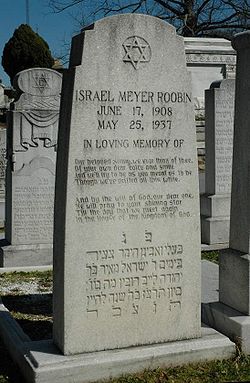 Some have a custom to visit the cemetery on fast days (Shulchan Aruch
Orach Chayim 559:10) and before Rosh Hashanah
and Yom Kippur
(581:4, 605), when possible, and for a Yahrzeit. During the first year the grave may be visited on the shloshim, and the yartzeit.
Even when visiting Jewish graves of someone that the visitor never knew, the custom is to place a small stone on the grave using the left hand. This shows that someone visited the gravesite, and is also a way of participating in the mitzvah of burial. Leaving flowers is not a traditional Jewish practice. Another reason for leaving stones is to tend the grave. In Biblical times, gravestones were not used; graves were marked with mounds of stones (a kind of cairn
), so by placing (or replacing) them, one perpetuated the existence of the site.
קדיש יתום lit. "Orphan's Kaddish") or the "Mourner's" Kaddish, is said at all prayer services
, as well as at funerals and memorials. Customs for reciting the Mourner's Kaddish vary markedly among various communities. In many Ashkenazi synagogues, particularly Orthodox
ones, it is customary that everyone in the synagogue stands. In Sephardi synagogues, and in many non-Orthodox Ashkenazi ones, the custom is that only the mourners themselves stand and chant, while the rest of the congregation sits, chanting only responsively.
The Yizkor prayers are recited four times a year, and are intended to be recited in a synagogue with a minyan
; if one is unable to be with a minyan, one can recite it without one. These four Yizkor services are held on Yom Kippur
, Shmini Atzeret, on the last day of Passover
, and on Shavuot
(the second day of Shavuot, in communities that observe Shavuot for two days). In the Yizkor prayers God is asked to remember and grant repose to the souls of the departed.
Yizkor is customarily not said within the first year of mourning, until the first yahrzeit has passed.
In Sephardic
custom there is no Yizkor prayer, but Hashkabóth are recited on Yom Kippur
for all members of the community who have died during the last year. A person called up to the Torah may also request the reader to recite Hashkabah for his deceased parents.
is a Jewish memorial prayer that was written in the late 11th or early 12th Century, after the destruction of the Ashkenazi communities around the Rhine River by Christian mobs during the First Crusade
.
זק"א abbr. for Zihui Korbanot Asson lit. "Identifying Victims of Disaster" – חסד של אמת Hessed shel Emet lit. "True Kindness" – איתור חילוץ והצלה), is a community emergency response team
in the State of Israel
, officially recognized by the government. The organization was founded in 1989. Members of ZAKA, most of whom are Orthodox
, assist ambulance
crews, identify the victims of terrorism
, road accidents and other disasters and, where necessary, gather body parts and spilled blood
for proper burial. They also provide first aid
and rescue
services, and help with the search for missing persons. In the past they have responded in the aftermath of disasters around the world.
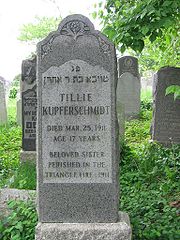 The Hebrew Free Burial Association is a non-profit agency whose mission is to ensure that all Jews receive a proper Jewish burial, regardless of their financial ability. Since 1888, more than 55,000 Jews have been buried by HFBA in their cemeteries located on Staten Island, New York, Silver Lake Cemetery and Mount Richmond Cemetery.
once death has been clearly established, provided that instructions have been left in a written living will
. However, there are a number of practical difficulties for those who wish to adhere strictly to Jewish law. For example, someone who is dead by clinical standards may not yet be dead according to Jewish law. Jewish law does not permit donation of organs that are vital for survival from a donor who is in a near-dead state but who is not yet dead according to Jewish law. Orthodox
and Haredi
Jews may need to consult their rabbis on a case by case basis.
(Jewish law) forbids cremation
. Burial is considered the only proper form of disposal for a Jew who has died (and is the only method used in the Tanakh
), and is seen in Judaism as providing a final measure of atonement for the deceased.
From a philosophical
and ritual
standpoint, as with a geniza, Jews bury things as an honorable "interment
," and would only burn things as a means of destruction.
Judaism considers suicide
to be a form of "self-murder
" and thus a Jew who commits suicide is denied some important after-death privileges: no eulogies should be held for that person, and burial in the main section of the Jewish cemetery is normally not allowed.
However, in recent times, most people who die by suicide have been deemed to be the unfortunate victims of depression
or of a serious mental illness
. Under this interpretation, their act of "self-murder" is not deemed to be a voluntary act of self-destruction, but rather the result of an involuntary condition. They have therefore been looked upon as having died of causes beyond their control.
Additionally, the Talmud
(in Semakhot, one of the minor tractates) recognizes that many elements of the mourning ritual exist as much for the living survivors as for the dead, and that these elements ought to be carried out even in the case of the suicide. Furthermore, if reasonable doubt exists that the death may not have been suicide or if the person changed their mind and repented at the last moment (e.g. if it is unknown whether the victim fell or jumped off a building or if the person falling changes his mind), the benefit of the doubt is given and regular burial and mourning rituals take place. Lastly, the suicide of a minor
is considered a result of a lack of understanding ("da'at"), and in such a case, regular mourning is observed.
(Jewish law) forbids tattoo
s, and there is a persistent myth that this prevents burial in a Jewish cemetery, but this is not true. A small minority of burial societies will not accept someone with a tattoo, but Jewish law does not require this, and most burial societies do not have this restriction. Removing the tattoo after death would be completely forbidden.
according to Jewish law. (See that article for a discussion of precisely what actions and motivations render a Jew an "apostate.")
In the past several centuries, the custom developed among Ashkenazic Orthodox Jews
(including Hassidic and Haredi Jews), that the family would "sit shiva" if and when one of their relatives would leave the fold of traditional Judaism. The definition of "leaving the fold" varies within communities; some would sit shiva if a family member married a non-Jew; others would only sit shiva if the individual actually converted to another faith, and even then, some would make a distinction between those who chose to do so of their own will, and those who were pressured into conversion. (In Sholom Aleichem
's Tevye
, when the title character's daughter converts to Christianity
to marry a Christian
, Tevye sits shiva for her and generally refers to her as "dead.") At the height of the Mitnagdim (anti-Hassidic) movement, in the early-to-mid nineteenth century, some Mitnagdim even sat shiva if a family member joined Hassidism. (It is said that when Leibel Eiger joined Hassidism, his father, Rabbi Shlomo Eiger sat shiva, but his grandfather, the famed Rabbi Akiva Eiger, did not.) By the mid-twentieth century, however, Hassidism was recognized as a valid form of Orthodox Judaism
, and thus the (controversial) practice of sitting shiva for those who realign to Hassidism ceased to exist.
Today, some Orthodox Jews, particularly the more traditional ones (such as many Haredi and Hassidic communities), continue the practice of sitting shiva for a family member who has left the religious community. More liberal Jews, however, may question and not observe the practice as a very harsh act that could make it much more difficult for the family member to return to traditional practice if/when s/he would consider doing so.
(Day of mourning for the destruction of both the First and Second Temple in Jerusalem
and other events.)
(the four days on which Yizkor is recited)
(a fast day on which it has become a custom for some to say Kaddish for those whose yahrzeits are unknown or died in the Holocaust)
(national day of remembrance in Israel (and by many Jews worldwide) for those murdered in the Holocaust
as well as righteous gentiles)
(national day of remembrance to those who died in service of Israel or killed in terrorist attacks)
, massive crematoria were constructed and operated round-the-clock by the Nazis within their concentration and extermination camps to dispose of the bodies of thousands of Jews and others. The bodies of thousands of Jews were thus disposed of in a manner deeply offensive to Judaism. Since then, cremation has carried an extremely negative connotation for many Jews, even more so than it had previously.
Minhag
Minhag is an accepted tradition or group of traditions in Judaism. A related concept, Nusach , refers to the traditional order and form of the prayers...
(traditional custom) and mitzvah
Mitzvah
The primary meaning of the Hebrew word refers to precepts and commandments as commanded by God...
(religious obligation) derived from Judaism
Judaism
Judaism ) is the "religion, philosophy, and way of life" of the Jewish people...
's classical Torah
Torah
Torah- A scroll containing the first five books of the BibleThe Torah , is name given by Jews to the first five books of the bible—Genesis , Exodus , Leviticus , Numbers and Deuteronomy Torah- A scroll containing the first five books of the BibleThe Torah , is name given by Jews to the first five...
and rabbinic texts. The details of observance and practice vary according to each Jewish community.
Upon receiving news of the passing
Upon receiving the news of the passing, the following blessing is recited:- Transliteration: Barukh atah Adonai Eloheinu melekh ha'olam, dayan ha-emet.
- Translation: "Blessed are You, Lord, our God, King of the universe, the True Judge."
There is also a custom of rending one's clothes at the moment one hears news of a passing.
Orthodox men will cut the lapel of their suit on the left side, over the heart. Non-orthodox practice may be to cut a necktie or to wear a button with a torn black ribbon.
Chevra kadisha
The chevra kadisha (חברה קדישא "holy group") is a Jewish burial societyBurial society
A burial society is a form of friendly society. These groups historically existed in England, and constituted for the purpose of providing by voluntary subscriptions, for insuring money to be paid on the death of a member, or for the funeral expenses of the husband, wife or child of a member, or of...
usually consisting of volunteers, men and women, who prepare the deceased for proper Jewish burial. Their job is to ensure that the body of the deceased is shown proper respect, ritually cleansed and dressed in shrouds.
Many local chevra kadishas in urban areas are affiliated with local synagogue
Synagogue
A synagogue is a Jewish house of prayer. This use of the Greek term synagogue originates in the Septuagint where it sometimes translates the Hebrew word for assembly, kahal...
s, and they often own their own burial plots in various local cemeteries. Some Jews pay an annual token membership fee to the chevra kadisha of their choice, so that when the time comes, the society will not only attend to the body of the deceased as befits Jewish law, but will also ensure burial in a plot that it controls at an appropriate nearby Jewish cemetery
Jewish cemetery
A Jewish cemetery is a cemetery where members of the Jewish faith are buried in keeping with Jewish tradition....
.
If no gravedigger
Gravedigger
A gravedigger is a cemetery worker responsible for digging graves used in the process of burial.-Fossors:Fossor or Fossarius , from the Latin verb fodere 'to dig', referred to grave diggers in the Roman catacombs in the first three centuries of the Christian Era...
s are available, then it is additionally the function of the male society members to ensure that graves are dug. In Israel
Israel
The State of Israel is a parliamentary republic located in the Middle East, along the eastern shore of the Mediterranean Sea...
, members of chevra kadishas consider it an honor to not only prepare the body for burial but also to dig the grave for a fellow Jew's body, particularly if the deceased was known to be a righteous person.
Many burial societies hold one or two annual fast days and organize regular study sessions to remain up to date with the relevant articles of Jewish law. In addition, most burial societies also support families during the shiva (traditional week of mourning) by arranging prayer services
Jewish services
Jewish prayer are the prayer recitations that form part of the observance of Judaism. These prayers, often with instructions and commentary, are found in the siddur, the traditional Jewish prayer book....
, preparing meals, and providing other services for the mourners.
Preparing the body — Taharah
There are three major stages to preparing the body for burial: washing (rechitzah), ritual purification (taharah), and dressing (halbashah). The term taharah is used to refer both to the overall process of burial preparation, and to the specific step of ritual purification.(Note- Buried not within 24 hours)
The general sequence of steps for performing taharah is as follows. Blessings, prayers, and readings from Torah, Psalms
Psalms
The Book of Psalms , commonly referred to simply as Psalms, is a book of the Hebrew Bible and the Christian Bible...
and other Jewish scripture may be recited at several points:
- The body (guf) is uncovered. (It has been covered with a sheet awaiting taharah.)
- The body is washed carefully. As all blood must be buried along with the deceased, any open bleeding is stopped. The body is thoroughly cleaned of dirt, body fluids and solids, and anything else that may be on the skin. All jewellery is removed.
- The body is purified with water, either by immersion in a mikveh or by pouring a continuous stream in a prescribed manner.
- The body is dried (according to most customs).
- The body is dressed in traditional burial clothing (tachrichimTachrichimTachrichim are traditional simple white burial garments, usually made from 100% pure linen, in which Jews are dressed by the Chevra Kadisha for burial after undergoing a taharah ....
). A sash (avnet) is wrapped around the clothing and tied in the form of the Hebrew letter "shin," representing one of the names of God. - The coffin (aron) (if there is a coffin) is prepared by removing any linings or other embellishments. A winding sheet (sovev) is laid into the coffin. Outside the Land of Israel, if the person wore a prayer shawl (tallitTallitA tallit pl. tallitot is a Jewish prayer shawl. The tallit is worn over the outer clothes during the morning prayers on weekdays, Shabbat and holidays...
) during their life, one is laid in the coffin for wrapping the body once it is placed there. One of the corner fringes (tzitzitTzitzitThe Hebrew noun tzitzit is the name for specially knotted ritual fringes worn by observant Jews. Tzitzit are attached to the four corners of the tallit and tallit katan.-Etymology:The word may derive from the semitic root N-TZ-H...
) is removed from the shawl to signify that it will no longer be used for prayer in life and it also signifies that the person is absolved from having to keep any of the Mitzvot (Commandments) as written in the Torah. - The body is then lifted into the coffin and wrapped in the prayer shawl and sheet. Soil from IsraelIsraelThe State of Israel is a parliamentary republic located in the Middle East, along the eastern shore of the Mediterranean Sea...
(afar), if available, is placed over various parts of the body and sprinkled in the coffin. - The coffin is closed.
Once the body is dressed, the coffin
Coffin
A coffin is a funerary box used in the display and containment of dead people – either for burial or cremation.Contemporary North American English makes a distinction between "coffin", which is generally understood to denote a funerary box having six sides in plan view, and "casket", which...
is sealed. Unlike other religions, in Judaism there is no viewing of the body and no "open casket" at the funeral, though the immediate family is allowed a visitation right prior to the coffin being sealed to pay their final respects.
In Israel
Israel
The State of Israel is a parliamentary republic located in the Middle East, along the eastern shore of the Mediterranean Sea...
caskets are not used at all, with the exception of military and state funerals. The body is carried to the grave wrapped in a tallit.
Once the coffin is closed, the chevra then asks for forgiveness from the deceased for anything that they may have done to offend them or not show proper respect during the taharah. If the body is not taken immediately for burial, guards or watchers
Shemira
Shemira refers to the Jewish religious ritual of watching over the body of a deceased person from the time of death until burial. A male guardian is called a shomer and a female guardian is a shomeret . Shomrim are people who perform shemira...
(shomrim) sit with the coffin until it is taken for burial. It is traditional to recite Psalms
Psalms
The Book of Psalms , commonly referred to simply as Psalms, is a book of the Hebrew Bible and the Christian Bible...
during this time.
Funeral service
The Jewish funeral consists of burial, also known as interment. Cremation is not considered a viable possibility. Burial is considered to allow the body to decompose naturally. Burial is intended to take place in as short an interval of time after death as possible. Jewish law forbids embalmingEmbalming
Embalming, in most modern cultures, is the art and science of temporarily preserving human remains to forestall decomposition and to make them suitable for public display at a funeral. The three goals of embalming are thus sanitization, presentation and preservation of a corpse to achieve this...
. Displaying of the body prior to burial does not take place. Flowers would not be found at a traditional funeral.
In Israel the Jewish funeral service will usually commence at the burial ground. In the United States
United States
The United States of America is a federal constitutional republic comprising fifty states and a federal district...
and Canada
Canada
Canada is a North American country consisting of ten provinces and three territories. Located in the northern part of the continent, it extends from the Atlantic Ocean in the east to the Pacific Ocean in the west, and northward into the Arctic Ocean...
, the funeral service will either commence at a funeral home
Funeral home
A funeral home, funeral parlor or mortuary, is a business that provides burial and funeral services for the deceased and their families. These services may include aprepared wake and funeral, and the provision of a chapel for the funeral....
or at the cemetery
Cemetery
A cemetery is a place in which dead bodies and cremated remains are buried. The term "cemetery" implies that the land is specifically designated as a burying ground. Cemeteries in the Western world are where the final ceremonies of death are observed...
. Occasionally the service will commence at a synagogue
Synagogue
A synagogue is a Jewish house of prayer. This use of the Greek term synagogue originates in the Septuagint where it sometimes translates the Hebrew word for assembly, kahal...
. In the case of a very prominent individual the funeral service can begin at a synagogue or a yeshivah. If the funeral service begins at a point other than at the cemetery the entourage accompanies the body in a procession to the cemetery. The funeral itself, the procession, the burial, are referred to by the word levayah, meaning "accompanying."
Levayah means "accompaniment" because the funeral procession involves accompanying the body to the place of burial. Levayah is Hebrew and it also indicates "joining" and "bonding." This aspect of the meaning of the word levayah conveys the implication of a commonality between the "souls" of the living and the dead.
Eulogies
A hesped is a eulogyEulogy
A eulogy is a speech or writing in praise of a person or thing, especially one recently deceased or retired. Eulogies may be given as part of funeral services. However, some denominations either discourage or do not permit eulogies at services to maintain respect for traditions...
, and it is common that several people speak at the start of the ceremony at the funeral home, as well as prior to burial at the gravesite, though some people specify in their wills that nothing should be said about them. On certain days, such as on Chol HaMo'ed ("intermediate days" of Jewish holiday
Jewish holiday
Jewish holidays are days observed by Jews as holy or secular commemorations of important events in Jewish history. In Hebrew, Jewish holidays and festivals, depending on their nature, may be called yom tov or chag or ta'anit...
s), eulogies are forbidden.
Burial
Kevura, or burial, should take place as soon as possible after death. The TorahTorah
Torah- A scroll containing the first five books of the BibleThe Torah , is name given by Jews to the first five books of the bible—Genesis , Exodus , Leviticus , Numbers and Deuteronomy Torah- A scroll containing the first five books of the BibleThe Torah , is name given by Jews to the first five...
requires burial as soon as possible, even for executed criminals. Burial is delayed "for the honor of the deceased," usually to allow more time for far-flung family to come to the funeral and participate in the other post-burial rituals, but also to hire professionals, or to bury the deceased in a cemetery of their choice.
This traditional practice may have originated from the fact that Israel
Israel
The State of Israel is a parliamentary republic located in the Middle East, along the eastern shore of the Mediterranean Sea...
was, and is, a country with a hot climate. In Biblical times, there were few ways of keeping the dead body from decomposing. Not only would this be generally undesirable, but allowing the dead body of any person to decompose would be showing that person great disrespect. Decomposition would have occurred especially quickly in Israel due to the constant heat. Thus, the custom of burying the body as soon as possible. (Although the practice of embalming
Embalming
Embalming, in most modern cultures, is the art and science of temporarily preserving human remains to forestall decomposition and to make them suitable for public display at a funeral. The three goals of embalming are thus sanitization, presentation and preservation of a corpse to achieve this...
and mummification
Mummy
A mummy is a body, human or animal, whose skin and organs have been preserved by either intentional or incidental exposure to chemicals, extreme coldness , very low humidity, or lack of air when bodies are submerged in bogs, so that the recovered body will not decay further if kept in cool and dry...
had advanced to a high level in Egypt
Egypt
Egypt , officially the Arab Republic of Egypt, Arabic: , is a country mainly in North Africa, with the Sinai Peninsula forming a land bridge in Southwest Asia. Egypt is thus a transcontinental country, and a major power in Africa, the Mediterranean Basin, the Middle East and the Muslim world...
, this, too, is considered disrespectful, since it involves a great deal of manipulation and the removal of bodily organs.) In addition, respect for the dead can be seen from many examples in the Torah
Torah
Torah- A scroll containing the first five books of the BibleThe Torah , is name given by Jews to the first five books of the bible—Genesis , Exodus , Leviticus , Numbers and Deuteronomy Torah- A scroll containing the first five books of the BibleThe Torah , is name given by Jews to the first five...
and Tanakh
Tanakh
The Tanakh is a name used in Judaism for the canon of the Hebrew Bible. The Tanakh is also known as the Masoretic Text or the Miqra. The name is an acronym formed from the initial Hebrew letters of the Masoretic Text's three traditional subdivisions: The Torah , Nevi'im and Ketuvim —hence...
. For example, one of the last events in the Torah is the death of Moses
Moses
Moses was, according to the Hebrew Bible and Qur'an, a religious leader, lawgiver and prophet, to whom the authorship of the Torah is traditionally attributed...
when God himself
Names of God in Judaism
In Judaism, the name of God is more than a distinguishing title; it represents the Jewish conception of the divine nature, and of the relationship of God to the Jewish people and to the world. To demonstrate the sacredness of the names of God, and as a means of showing respect and reverence for...
buries him: "[God] buried him in the depression in the land of Moab, opposite Beth Peor. No man knows the place that he was buried, even to this day." (Deuteronomy
Deuteronomy
The Book of Deuteronomy is the fifth book of the Hebrew Bible, and of the Jewish Torah/Pentateuch...
34:6)
When the funeral service has ended, the mourners come forward to fill the grave. Symbolically, this gives the mourners closure as they observe the grave being filled in. One custom is for people present at the funeral to take a spade or shovel, held pointing down instead of up, to show the antithesis of death
Death
Death is the permanent termination of the biological functions that sustain a living organism. Phenomena which commonly bring about death include old age, predation, malnutrition, disease, and accidents or trauma resulting in terminal injury....
to life
Life
Life is a characteristic that distinguishes objects that have signaling and self-sustaining processes from those that do not, either because such functions have ceased , or else because they lack such functions and are classified as inanimate...
and that this use of the shovel is different from all other uses, to throw three shovelfuls of dirt into the grave. When someone is finished, they put the shovel back in the ground, rather than handing it to the next person, to avoid passing along their grief
Grief
Grief is a multi-faceted response to loss, particularly to the loss of someone or something to which a bond was formed. Although conventionally focused on the emotional response to loss, it also has physical, cognitive, behavioral, social, and philosophical dimensions...
to other mourners. This literal participation in the burial is considered a particularly good mitzvah because it is one for which the beneficiary — the deceased — can offer no repayment or gratitude and thus it is a pure gesture.
Keriah and Shiva
The mourners traditionally make a tear (keriah קריעה) in an outer garment either before the funeral or immediately after it. The tear should be on the left side for a parent (over the heart and clearly visible) and on the right side for brothers, sisters (including half-brothers and half-sisters), children and spouses (and does not need to be visible).Halachos concerning mourning are not obligatory on children under 13 years of age. Also, halachos of mourning do not apply when the deceased is a newborn infant aged 30 days or less.
In the instance when a mourner receives the news of the death and burial of a relative after an elapsed period of thirty days or more, there is no keriah, or tearing of the garment, except in the case of a parent. In the case of a parent, the tearing of the garment is to be performed no matter how long an amount of time has elapsed between the time of death and the time of receiving the news.
If a son or daughter of the deceased needs to change clothes during the shiva period, he or she must tear the changed clothes. No other family member is required to rend changed clothes during shiva. Neither son nor daughter may ever sew the rent clothes, but any other mourner may mend the clothing 30 days after the burial.
When they get home, the mourners do not shower or bathe for a week, do not wear leather shoes or jewelry, men do not shave, and in many communities large wall mirrors in the mourners' home are covered. It is customary for the mourners to sit on low stools or even the floor, symbolic of the emotional reality of being "brought low" by the grief. The meal of consolation (seudat havra'ah), the first meal eaten on returning from the funeral, traditionally consists of hard boiled eggs
Egg (food)
Eggs are laid by females of many different species, including birds, reptiles, amphibians, and fish, and have probably been eaten by mankind for millennia. Bird and reptile eggs consist of a protective eggshell, albumen , and vitellus , contained within various thin membranes...
and other round or oblong foods. This is often credited to the Biblical story of Jacob
Jacob
Jacob "heel" or "leg-puller"), also later known as Israel , as described in the Hebrew Bible, the Talmud, the New Testament and the Qur'an was the third patriarch of the Hebrew people with whom God made a covenant, and ancestor of the tribes of Israel, which were named after his descendants.In the...
purchasing the birthright from Esau
Esau
Esau , in the Hebrew Bible, is the oldest son of Isaac. He is mentioned in the Book of Genesis, and by the minor prophets, Obadiah and Malachi. The New Testament later references him in the Book of Romans and the Book of Hebrews....
with stewed lentils (Genesis 25:34); it is traditionally stated that Jacob was cooking the lentils soon after the death of his grandfather Abraham
Abraham
Abraham , whose birth name was Abram, is the eponym of the Abrahamic religions, among which are Judaism, Christianity and Islam...
.
During this time distant family and friends come to visit or call the mourners to comfort them via "shiva calls".
Commencing and calculating the seven days of mourning
If the mourner returns from the cemetery after the burial before sundown, then the day of the funeral is counted as the first of the seven days of mourning. Mourning generally concludes in the morning of the seventh day. No mourning may occur on ShabbatShabbat
Shabbat is the seventh day of the Jewish week and a day of rest in Judaism. Shabbat is observed from a few minutes before sunset on Friday evening until a few minutes after when one would expect to be able to see three stars in the sky on Saturday night. The exact times, therefore, differ from...
(the Jewish Sabbath), nor may the burial take place on Shabbat, but the day of Shabbat does count as one of the seven days. If a Jewish holiday
Jewish holiday
Jewish holidays are days observed by Jews as holy or secular commemorations of important events in Jewish history. In Hebrew, Jewish holidays and festivals, depending on their nature, may be called yom tov or chag or ta'anit...
occurs after the first day, that curtails the mourning period. If the funeral occurs during a festival, the start of the mourning period awaits the end of the festival. Some holidays, such as Rosh Hashanah
Rosh Hashanah
Rosh Hashanah , , is the Jewish New Year. It is the first of the High Holy Days or Yamim Nora'im which occur in the autumn...
, cancel the mourning period completely.
Aninut
The first stage of mourning is aninut, or "[intense] mourning." An onen (a person in aninut) is considered to be in a state of total shock and disorientation. Thus the onen is exempt from performing mitzvotMitzvah
The primary meaning of the Hebrew word refers to precepts and commandments as commanded by God...
that require action (and attention), such as praying and reciting blessings, wearing tefillin
Tefillin
Tefillin also called phylacteries are a set of small black leather boxes containing scrolls of parchment inscribed with verses from the Torah, which are worn by observant Jews during weekday morning prayers. Although "tefillin" is technically the plural form , it is loosely used as a singular as...
(phylacteries), in order to be able to tend unhindered to the funeral arrangements. However the onen is still obligated in commandments that forbid an action (such as not violating the Shabbat).
Aninut lasts until the burial is over, or, if a mourner is unable to attend the funeral, from the moment he is no longer involved with the funeral itself.
Avelut
Aninut is immediately followed by avelut ("mourning"). An avel ("mourner") does not listen to musicMusic
Music is an art form whose medium is sound and silence. Its common elements are pitch , rhythm , dynamics, and the sonic qualities of timbre and texture...
or go to concert
Concert
A concert is a live performance before an audience. The performance may be by a single musician, sometimes then called a recital, or by a musical ensemble, such as an orchestra, a choir, or a musical band...
s, and does not attend any joyous events or parties such as marriages
Jewish view of marriage
In Judaism, marriage is viewed as a contractual bond commanded by God in which a man and a woman come together to create a relationship in which God is directly involved. Though procreation is not the sole purpose, a Jewish marriage is also expected to fulfill the commandment to have children. The...
or Bar or Bat Mitzvahs
B'nai Mitzvah
Bar Mitzvah and Bat Mitzvah are Jewish coming of age rituals. According to Jewish law, when Jewish boys reach 13, they become responsible for their actions and become a Bar Mitzvah . The age for girls is 12...
, unless absolutely necessary. (If the date for such an event has already been set prior to the death, it is strictly forbidden for it to be postponed or canceled.)
Avelut consists of three distinct periods.
Shiva – Seven days
The first stage of avelut is shiva , a week-long period of grief and mourningMourning
Mourning is, in the simplest sense, synonymous with grief over the death of someone. The word is also used to describe a cultural complex of behaviours in which the bereaved participate or are expected to participate...
. Observance of shiva is referred to by English-speaking Jews
Jewish English languages
Jewish English languages are varieties of English that include significant amounts of vocabulary and syntax taken from Yiddish, and both classical and modern Hebrew...
as "sitting shiva". During this period, mourners traditionally gather in one home and receive visitors.
It is considered a great mitzvah
Mitzvah
The primary meaning of the Hebrew word refers to precepts and commandments as commanded by God...
(commandment) of kindness and compassion to pay a home visit to the mourners. Traditionally, no greetings are exchanged and visitors wait for the mourners to initiate conversation. The mourner is under no obligation to engage in conversation and may, in fact, completely ignore his/her visitors.
Visitors will traditionally take on more of the hosting role when attending a Shiva. Often bringing food and serving it to the mourning family and other guests. The mourning family will often avoid any cooking or cleaning during the Shiva period and those responsibilities become those of visitors.
There are various customs as to what to say when taking leave of the mourner(s). One of the most common is to say to them:
- המקום ינחם אתכם בתוך שאר אבלי ציון וירושלים
- Hamakom y'nachem etkhem b'tokh sha'ar avelei tziyon viyrushalayim:
- "The OmnipresentNames of God in JudaismIn Judaism, the name of God is more than a distinguishing title; it represents the Jewish conception of the divine nature, and of the relationship of God to the Jewish people and to the world. To demonstrate the sacredness of the names of God, and as a means of showing respect and reverence for...
will comfort you (pl.) among the mourners of ZionZionZion is a place name often used as a synonym for Jerusalem. The word is first found in Samuel II, 5:7 dating to c.630-540 BCE...
and Jerusalem"
Depending on their community's customs, others may also add such wishes as: "You should have no more tza'ar ('pain')" or "You should have only simchas ('celebrations')" or "we should hear only good news (besorot tovot) from each other" or "I wish you long life".
Traditionally, prayer services
Jewish services
Jewish prayer are the prayer recitations that form part of the observance of Judaism. These prayers, often with instructions and commentary, are found in the siddur, the traditional Jewish prayer book....
are organised in the house of mourning. It is customary for the family to lead the services themselves.
Shloshim – Thirty days
The thirty-day period following burial (including shiva) is known as shloshim . During shloshim, a mourner is forbidden to marry or to attend a seudat mitzvahSeudat mitzvah
A seudat mitzvah , in Judaism, is an obligatory festive meal, usually referring to the celebratory meal following the fulfillment of a mitzvah , such as a bar mitzvah, a wedding, a brit milah , or a siyum...
("religious festive meal"). Men do not shave or get haircuts during this time.
Since Judaism teaches that a deceased person can still benefit from the merit of mitzvot
Mitzvah
The primary meaning of the Hebrew word refers to precepts and commandments as commanded by God...
(deeds commanded by God) done in their memory, it is considered a special privilege to bring merit to the departed by learning Torah
Torah study
Torah study is the study by Jewish people of the Torah, Hebrew Bible, Talmud, responsa, rabbinic literature and similar works, all of which are Judaism's religious texts...
in their name. A popular custom is to coordinate a group of people who will jointly study the complete Mishnah
Mishnah
The Mishnah or Mishna is the first major written redaction of the Jewish oral traditions called the "Oral Torah". It is also the first major work of Rabbinic Judaism. It was redacted c...
during the shloshim period.
Shneim asar chodesh – Twelve months
Those mourning a parent additionally observe a twelve-month period , counted from the day of death. During this period, most activity returns to normal, although the mourners continue to recite the mourner's kaddishKaddish
Kaddish is a prayer found in the Jewish prayer service. The central theme of the Kaddish is the magnification and sanctification of God's name. In the liturgy different versions of the Kaddish are used functionally as separators between sections of the service...
as part of synagogue services for eleven months. In Orthodox tradition, this was an obligation of the sons as mourners, not for women. There remain restrictions on attending festive occasions and large gatherings, especially where live music is played.
Matzevah (Unveiling of the tombstone)
A headstoneHeadstone
A headstone, tombstone, or gravestone is a marker, usually stone, that is placed over a grave. In most cases they have the deceased's name, date of birth, and date of death inscribed on them, along with a personal message, or prayer.- Use :...
(tombstone) is known as a matzevah ("monument"). Although there is no Halakhic obligation to hold an unveiling ceremony, the ritual became popular in many communities toward the end of the 19th century. There are varying customs about when it should be placed on the grave. Most communities have an unveiling ceremony a year after the death. Some communities have it earlier, even a week after the burial. In Israel it is done after the "shloshim", the first thirty days of mourning. There is no restriction about the timing, other than the unveiling cannot be held during certain periods such as Passover
Passover
Passover is a Jewish holiday and festival. It commemorates the story of the Exodus, in which the ancient Israelites were freed from slavery in Egypt...
or Chol Ha'Moed
Chol HaMoed
Chol HaMoed, a Hebrew phrase meaning "weekdays [of] the festival" , refers to the intermediate days of Passover and Sukkot. During Chol HaMoed the usual restrictions that apply to the Biblical Jewish holidays are relaxed, but not entirely eliminated...
.
At the end of the ceremony, a cloth or shroud covering that has been placed on the headstone is removed, customarily by close family members. Services include reading of several psalms (1, 23, 24, 103), Mourners Kaddish (if a minyan
Minyan
A minyan in Judaism refers to the quorum of ten Jewish adults required for certain religious obligations. According to many non-Orthodox streams of Judaism adult females count in the minyan....
is available), and the prayer "El Malei Rachamim." The service may include a brief eulogy for the deceased.
Yahrtzeit, Nahala
YIVO
YIVO, , established in 1925 in Wilno, Poland as the Yidisher Visnshaftlekher Institut , or Yiddish Scientific Institute, is a source for orthography, lexicography, and other studies related to the Yiddish language...
standard Yiddish orthography
Yiddish orthography
The Yiddish language is written using Hebrew script as the basis of a full vocalic alphabet. This adaptation uses letters that are silent or glottal stops in Hebrew, as vowels in Yiddish...
), Yohr Tzeit, yahrzeit, and yartzeit.) The word is also used by non-Yiddish-speaking Ashkenazi Jews
Ashkenazi Jews
Ashkenazi Jews, also known as Ashkenazic Jews or Ashkenazim , are the Jews descended from the medieval Jewish communities along the Rhine in Germany from Alsace in the south to the Rhineland in the north. Ashkenaz is the medieval Hebrew name for this region and thus for Germany...
, and refers to the anniversary of the day of death of a relative. Yahrtzeit literally means "time of [one] year".
The commemoration is known in Ladino as nahala. It is widely observed, and based on the Jewish tradition that mourners are required to commemorate the death of a relative.
Jews are required to commemorate the death of parents, siblings, spouses, or children. The main halakhic
Halakha
Halakha — also transliterated Halocho , or Halacha — is the collective body of Jewish law, including biblical law and later talmudic and rabbinic law, as well as customs and traditions.Judaism classically draws no distinction in its laws between religious and ostensibly non-religious life; Jewish...
obligation is to recite the mourner's version of the Kaddish
Kaddish
Kaddish is a prayer found in the Jewish prayer service. The central theme of the Kaddish is the magnification and sanctification of God's name. In the liturgy different versions of the Kaddish are used functionally as separators between sections of the service...
prayer at least three times, Maariv
Maariv
Maariv is a Hebrew language daily newspaper published in Israel. It is second in sales after Yedioth Ahronoth and third in readership after Yedioth Ahronoth and Israel HaYom. In a TGI survey comparing the last half of 2009 with the same period in 2008, Maariv saw its market share fall slightly...
at the evening services, Shacharit
Shacharit
Shacharit is the the daily morning Tefillah of the Jewish people, one of the three times there is prayer each day.Shacharit is said to have been established by the patriarch Abraham when he prayed in the morning...
at morning services
Jewish services
Jewish prayer are the prayer recitations that form part of the observance of Judaism. These prayers, often with instructions and commentary, are found in the siddur, the traditional Jewish prayer book....
, and Mincha
Mincha
Mincha, מנחה is the afternoon prayer service in Judaism.-Etymology:The name "Mincha" is derived from the meal offering that accompanied each sacrifice.-Origin:...
at the afternoon services. The customs are first discussed in detail in Sefer HaMinhagim (pub. 1566) by Rabbi
Rabbi
In Judaism, a rabbi is a teacher of Torah. This title derives from the Hebrew word רבי , meaning "My Master" , which is the way a student would address a master of Torah...
Isaac Tyrnau
Isaac Tyrnau
Isaac Tyrnau, aka Isaak Tyrnau was an Austrian rabbi, active in the late 14th century; he is most famous for his Sefer haMinhagim .- Biography :Little is known about his life...
.
The Yahrtzeit falls annually on the Hebrew date of the deceased relative's death according to the Hebrew calendar
Hebrew calendar
The Hebrew calendar , or Jewish calendar, is a lunisolar calendar used today predominantly for Jewish religious observances. It determines the dates for Jewish holidays and the appropriate public reading of Torah portions, yahrzeits , and daily Psalm reading, among many ceremonial uses...
. There are questions that arise as to what the date should be if this date falls on Rosh Chodesh or in a leap year of the Hebrew calendar. In particular, there are a few permutations, as follows:
| Date of Passing | Situation on the day of Yartzheit | Commemorated On |
|---|---|---|
| First day of a two-day Rosh Chodesh Rosh Chodesh Rosh Chodesh or Rosh ḥodesh is the name for the first day of every month in the Hebrew calendar, marked by the appearance of the new moon. The new moon is marked by the day and hour that the new crescent is observed... (i.e. last, 30th, day of the previous month) |
Rosh Chodesh only has one day | 29th (last) day of the earlier month (not a Rosh Chodesh) |
| Second day of a two-day Rosh Chodesh (i.e. first day of the new month) | Rosh Chodesh only has one day | First day of the month (Rosh Chodesh) |
| First day of a two-day Rosh Chodesh (i.e. last, 30th, day of the previous month) | Rosh Chodesh has two days | First day of the two day Rosh Chodesh |
| Second day of a two-day Rosh Chodesh (i.e. first day of the new month) | Rosh Chodesh has two days | Second day of the two day Rosh Chodesh |
| Adar Adar Adar is the sixth month of the civil year and the twelfth month of the ecclesiastical year on the Hebrew calendar. It is a winter month of 29 days... I (leap year) |
Is a leap year | Adar I |
| Adar I (leap year) | Not a leap year | Adar (there is only one Adar) |
| Adar (not a leap year) | Is a leap year | Ask your Rabbi, opinions vary (Either Adar I, Adar II, or both) |
| Adar (not a leap year) | Is not a leap year | Adar |
| Adar II (leap year) | Is a leap year | Adar II |
| Adar II (leap year) | Is not a leap year | Adar |
| Other days (incl. Shabbat Shabbat Shabbat is the seventh day of the Jewish week and a day of rest in Judaism. Shabbat is observed from a few minutes before sunset on Friday evening until a few minutes after when one would expect to be able to see three stars in the sky on Saturday night. The exact times, therefore, differ from... or Yom Tov) |
Any | On date of passing |
The main halakhic obligation is to recite the mourner's version of the Kaddish
Kaddish
Kaddish is a prayer found in the Jewish prayer service. The central theme of the Kaddish is the magnification and sanctification of God's name. In the liturgy different versions of the Kaddish are used functionally as separators between sections of the service...
prayer three times (evening of the previous day, morning, and afternoon), and many attend synagogue for the evening, morning, and afternoon services on this day. (During the morning prayer service the mourner's Kaddish is recited at least four times.) As a widely practiced custom
Minhag
Minhag is an accepted tradition or group of traditions in Judaism. A related concept, Nusach , refers to the traditional order and form of the prayers...
, mourners also light a special candle that burns for 24 hours, called a "Yahrzeit candle".
Lighting a yahrtzeit candle in memory of a loved one is a minhag ("custom") that is deeply ingrained in Jewish life honoring the memory and souls of the deceased.
Strict Jewish law requires that one should fast on the day of a parent's Yahrzeit; although this is not required, some people do observe the custom of fasting on the day of the Yahrtzeit, or at least refraining from meat and wine. Among many Orthodox
Orthodox Judaism
Orthodox Judaism , is the approach to Judaism which adheres to the traditional interpretation and application of the laws and ethics of the Torah as legislated in the Talmudic texts by the Sanhedrin and subsequently developed and applied by the later authorities known as the Gaonim, Rishonim, and...
Jews it has become customary to make a siyum
Siyum
A siyum means the completion of any unit of Torah study, or book of the Mishnah or Talmud in Judaism. A siyum is usually followed by a celebratory meal, or seudat mitzvah, a meal in honor of a mitzvah, or commandment...
by completing a tractate of Talmud
Talmud
The Talmud is a central text of mainstream Judaism. It takes the form of a record of rabbinic discussions pertaining to Jewish law, ethics, philosophy, customs and history....
or a volume of the Mishnah
Mishnah
The Mishnah or Mishna is the first major written redaction of the Jewish oral traditions called the "Oral Torah". It is also the first major work of Rabbinic Judaism. It was redacted c...
on the day prior to the Yahrtzeit, in the honor of the deceased. A halakha requiring a siyum ("celebratory meal"), upon the completion of such a study, overrides the requirement to fast.
Many synagogues will have lights on a special memorial plaque on one of the synagogue's walls, with names of synagogue members who have died. Each of these lights will be lit for individuals on their Yahrzeit, and all the lights will be lit for a Yizkor service. Some synagogues will also turn on all the lights for memorial days, such as Yom Ha'Shoah.
Visiting the gravesite
Shulchan Aruch
The Shulchan Aruch also known as the Code of Jewish Law, is the most authoritative legal code of Judaism. It was authored in Safed, Israel, by Yosef Karo in 1563 and published in Venice two years later...
Orach Chayim 559:10) and before Rosh Hashanah
Rosh Hashanah
Rosh Hashanah , , is the Jewish New Year. It is the first of the High Holy Days or Yamim Nora'im which occur in the autumn...
and Yom Kippur
Yom Kippur
Yom Kippur , also known as Day of Atonement, is the holiest and most solemn day of the year for the Jews. Its central themes are atonement and repentance. Jews traditionally observe this holy day with a 25-hour period of fasting and intensive prayer, often spending most of the day in synagogue...
(581:4, 605), when possible, and for a Yahrzeit. During the first year the grave may be visited on the shloshim, and the yartzeit.
Even when visiting Jewish graves of someone that the visitor never knew, the custom is to place a small stone on the grave using the left hand. This shows that someone visited the gravesite, and is also a way of participating in the mitzvah of burial. Leaving flowers is not a traditional Jewish practice. Another reason for leaving stones is to tend the grave. In Biblical times, gravestones were not used; graves were marked with mounds of stones (a kind of cairn
Cairn
Cairn is a term used mainly in the English-speaking world for a man-made pile of stones. It comes from the or . Cairns are found all over the world in uplands, on moorland, on mountaintops, near waterways and on sea cliffs, and also in barren desert and tundra areas...
), so by placing (or replacing) them, one perpetuated the existence of the site.
Mourner's Kaddish
Kaddish Yatom (heb.Hebrew language
Hebrew is a Semitic language of the Afroasiatic language family. Culturally, is it considered by Jews and other religious groups as the language of the Jewish people, though other Jewish languages had originated among diaspora Jews, and the Hebrew language is also used by non-Jewish groups, such...
קדיש יתום lit. "Orphan's Kaddish") or the "Mourner's" Kaddish, is said at all prayer services
Jewish services
Jewish prayer are the prayer recitations that form part of the observance of Judaism. These prayers, often with instructions and commentary, are found in the siddur, the traditional Jewish prayer book....
, as well as at funerals and memorials. Customs for reciting the Mourner's Kaddish vary markedly among various communities. In many Ashkenazi synagogues, particularly Orthodox
Orthodox Judaism
Orthodox Judaism , is the approach to Judaism which adheres to the traditional interpretation and application of the laws and ethics of the Torah as legislated in the Talmudic texts by the Sanhedrin and subsequently developed and applied by the later authorities known as the Gaonim, Rishonim, and...
ones, it is customary that everyone in the synagogue stands. In Sephardi synagogues, and in many non-Orthodox Ashkenazi ones, the custom is that only the mourners themselves stand and chant, while the rest of the congregation sits, chanting only responsively.
Yizkor
Yizkor ("remembrance") prayers are recited by those that have lost either one or both of their parents; in some modern moderate Jewish congregations, one might say yizkor for any relative or close friend whose death is mourned. There is a custom that those who do not recite the Yizkor prayers leave the synagogue until the completion of Yizkor; the symbolic reason for this is to respect the life of one's living parents. (Some rabbinic authorities regard this custom as a superstition.)The Yizkor prayers are recited four times a year, and are intended to be recited in a synagogue with a minyan
Minyan
A minyan in Judaism refers to the quorum of ten Jewish adults required for certain religious obligations. According to many non-Orthodox streams of Judaism adult females count in the minyan....
; if one is unable to be with a minyan, one can recite it without one. These four Yizkor services are held on Yom Kippur
Yom Kippur
Yom Kippur , also known as Day of Atonement, is the holiest and most solemn day of the year for the Jews. Its central themes are atonement and repentance. Jews traditionally observe this holy day with a 25-hour period of fasting and intensive prayer, often spending most of the day in synagogue...
, Shmini Atzeret, on the last day of Passover
Passover
Passover is a Jewish holiday and festival. It commemorates the story of the Exodus, in which the ancient Israelites were freed from slavery in Egypt...
, and on Shavuot
Shavuot
The festival of is a Jewish holiday that occurs on the sixth day of the Hebrew month of Sivan ....
(the second day of Shavuot, in communities that observe Shavuot for two days). In the Yizkor prayers God is asked to remember and grant repose to the souls of the departed.
Yizkor is customarily not said within the first year of mourning, until the first yahrzeit has passed.
In Sephardic
Sephardic Judaism
Sephardic law and customs means the practice of Judaism as observed by the Sephardi and Mizrahi Jews, so far as it is peculiar to themselves and not shared with other Jewish groups such as the Ashkenazim...
custom there is no Yizkor prayer, but Hashkabóth are recited on Yom Kippur
Yom Kippur
Yom Kippur , also known as Day of Atonement, is the holiest and most solemn day of the year for the Jews. Its central themes are atonement and repentance. Jews traditionally observe this holy day with a 25-hour period of fasting and intensive prayer, often spending most of the day in synagogue...
for all members of the community who have died during the last year. A person called up to the Torah may also request the reader to recite Hashkabah for his deceased parents.
Av HaRachamim
Av HarachamimAv HaRachamim
Av Harachamim or Abh Haraḥamim is a Jewish memorial prayer which was written in the late eleventh or early twelfth century, after the destruction of the Ashkenazi communities around the Rhine River by Christian crusaders during the First Crusade...
is a Jewish memorial prayer that was written in the late 11th or early 12th Century, after the destruction of the Ashkenazi communities around the Rhine River by Christian mobs during the First Crusade
First Crusade
The First Crusade was a military expedition by Western Christianity to regain the Holy Lands taken in the Muslim conquest of the Levant, ultimately resulting in the recapture of Jerusalem...
.
Zihui Korbanot Asson (ZAKA)
ZAKA (heb.Hebrew language
Hebrew is a Semitic language of the Afroasiatic language family. Culturally, is it considered by Jews and other religious groups as the language of the Jewish people, though other Jewish languages had originated among diaspora Jews, and the Hebrew language is also used by non-Jewish groups, such...
זק"א abbr. for Zihui Korbanot Asson lit. "Identifying Victims of Disaster" – חסד של אמת Hessed shel Emet lit. "True Kindness" – איתור חילוץ והצלה), is a community emergency response team
Community Emergency Response Team
In the United States a community emergency response team can refer to* one of five federal programs promoted under the umbrella organization Citizen Corps, which is funded in part by the Stafford Act;...
in the State of Israel
Israel
The State of Israel is a parliamentary republic located in the Middle East, along the eastern shore of the Mediterranean Sea...
, officially recognized by the government. The organization was founded in 1989. Members of ZAKA, most of whom are Orthodox
Orthodox Judaism
Orthodox Judaism , is the approach to Judaism which adheres to the traditional interpretation and application of the laws and ethics of the Torah as legislated in the Talmudic texts by the Sanhedrin and subsequently developed and applied by the later authorities known as the Gaonim, Rishonim, and...
, assist ambulance
Ambulance
An ambulance is a vehicle for transportation of sick or injured people to, from or between places of treatment for an illness or injury, and in some instances will also provide out of hospital medical care to the patient...
crews, identify the victims of terrorism
Palestinian political violence
Palestinian political violence refers to acts of violence undertaken to further the Palestinian cause. These political objectives include self-determination in and sovereignty over Palestine, the liberation of Palestine and establishment of a Palestinian state, either in place of both Israel and...
, road accidents and other disasters and, where necessary, gather body parts and spilled blood
Blood
Blood is a specialized bodily fluid in animals that delivers necessary substances such as nutrients and oxygen to the cells and transports metabolic waste products away from those same cells....
for proper burial. They also provide first aid
First aid
First aid is the provision of initial care for an illness or injury. It is usually performed by non-expert, but trained personnel to a sick or injured person until definitive medical treatment can be accessed. Certain self-limiting illnesses or minor injuries may not require further medical care...
and rescue
Rescue
Rescue refers to responsive operations that usually involve the saving of life, or prevention of injury during an incident or dangerous situation....
services, and help with the search for missing persons. In the past they have responded in the aftermath of disasters around the world.
Hebrew Free Burial Association (HFBA)
Donating organs
Being an organ donor is permitted, in principle, according to all Jewish denominationsJewish denominations
Jewish religious movements , sometimes called "denominations" or "branches", include different groups which have developed among Jews from ancient times and especially in the modern era among Ashkenazi Jews living in anglophone countries...
once death has been clearly established, provided that instructions have been left in a written living will
Living will
An advance health care directive, also known as living will, personal directive, advance directive, or advance decision, are instructions given by individuals specifying what actions should be taken for their health in the event that they are no longer able to make decisions due to illness or...
. However, there are a number of practical difficulties for those who wish to adhere strictly to Jewish law. For example, someone who is dead by clinical standards may not yet be dead according to Jewish law. Jewish law does not permit donation of organs that are vital for survival from a donor who is in a near-dead state but who is not yet dead according to Jewish law. Orthodox
Orthodox Judaism
Orthodox Judaism , is the approach to Judaism which adheres to the traditional interpretation and application of the laws and ethics of the Torah as legislated in the Talmudic texts by the Sanhedrin and subsequently developed and applied by the later authorities known as the Gaonim, Rishonim, and...
and Haredi
Haredi Judaism
Haredi or Charedi/Chareidi Judaism is the most conservative form of Orthodox Judaism, often referred to as ultra-Orthodox. A follower of Haredi Judaism is called a Haredi ....
Jews may need to consult their rabbis on a case by case basis.
Jewish view of cremation
HalakhaHalakha
Halakha — also transliterated Halocho , or Halacha — is the collective body of Jewish law, including biblical law and later talmudic and rabbinic law, as well as customs and traditions.Judaism classically draws no distinction in its laws between religious and ostensibly non-religious life; Jewish...
(Jewish law) forbids cremation
Cremation
Cremation is the process of reducing bodies to basic chemical compounds such as gasses and bone fragments. This is accomplished through high-temperature burning, vaporization and oxidation....
. Burial is considered the only proper form of disposal for a Jew who has died (and is the only method used in the Tanakh
Tanakh
The Tanakh is a name used in Judaism for the canon of the Hebrew Bible. The Tanakh is also known as the Masoretic Text or the Miqra. The name is an acronym formed from the initial Hebrew letters of the Masoretic Text's three traditional subdivisions: The Torah , Nevi'im and Ketuvim —hence...
), and is seen in Judaism as providing a final measure of atonement for the deceased.
From a philosophical
Philosophy
Philosophy is the study of general and fundamental problems, such as those connected with existence, knowledge, values, reason, mind, and language. Philosophy is distinguished from other ways of addressing such problems by its critical, generally systematic approach and its reliance on rational...
and ritual
Ritual
A ritual is a set of actions, performed mainly for their symbolic value. It may be prescribed by a religion or by the traditions of a community. The term usually excludes actions which are arbitrarily chosen by the performers....
standpoint, as with a geniza, Jews bury things as an honorable "interment
Burial
Burial is the act of placing a person or object into the ground. This is accomplished by excavating a pit or trench, placing an object in it, and covering it over.-History:...
," and would only burn things as a means of destruction.
Suicide
- See the section on Judaism on the main article, Religious views of suicide.
Judaism considers suicide
Suicide
Suicide is the act of intentionally causing one's own death. Suicide is often committed out of despair or attributed to some underlying mental disorder, such as depression, bipolar disorder, schizophrenia, alcoholism, or drug abuse...
to be a form of "self-murder
Murder
Murder is the unlawful killing, with malice aforethought, of another human being, and generally this state of mind distinguishes murder from other forms of unlawful homicide...
" and thus a Jew who commits suicide is denied some important after-death privileges: no eulogies should be held for that person, and burial in the main section of the Jewish cemetery is normally not allowed.
However, in recent times, most people who die by suicide have been deemed to be the unfortunate victims of depression
Clinical depression
Major depressive disorder is a mental disorder characterized by an all-encompassing low mood accompanied by low self-esteem, and by loss of interest or pleasure in normally enjoyable activities...
or of a serious mental illness
Mental illness
A mental disorder or mental illness is a psychological or behavioral pattern generally associated with subjective distress or disability that occurs in an individual, and which is not a part of normal development or culture. Such a disorder may consist of a combination of affective, behavioural,...
. Under this interpretation, their act of "self-murder" is not deemed to be a voluntary act of self-destruction, but rather the result of an involuntary condition. They have therefore been looked upon as having died of causes beyond their control.
Additionally, the Talmud
Talmud
The Talmud is a central text of mainstream Judaism. It takes the form of a record of rabbinic discussions pertaining to Jewish law, ethics, philosophy, customs and history....
(in Semakhot, one of the minor tractates) recognizes that many elements of the mourning ritual exist as much for the living survivors as for the dead, and that these elements ought to be carried out even in the case of the suicide. Furthermore, if reasonable doubt exists that the death may not have been suicide or if the person changed their mind and repented at the last moment (e.g. if it is unknown whether the victim fell or jumped off a building or if the person falling changes his mind), the benefit of the doubt is given and regular burial and mourning rituals take place. Lastly, the suicide of a minor
Minor (law)
In law, a minor is a person under a certain age — the age of majority — which legally demarcates childhood from adulthood; the age depends upon jurisdiction and application, but is typically 18...
is considered a result of a lack of understanding ("da'at"), and in such a case, regular mourning is observed.
Tattoos
HalakhaHalakha
Halakha — also transliterated Halocho , or Halacha — is the collective body of Jewish law, including biblical law and later talmudic and rabbinic law, as well as customs and traditions.Judaism classically draws no distinction in its laws between religious and ostensibly non-religious life; Jewish...
(Jewish law) forbids tattoo
Tattoo
A tattoo is made by inserting indelible ink into the dermis layer of the skin to change the pigment. Tattoos on humans are a type of body modification, and tattoos on other animals are most commonly used for identification purposes...
s, and there is a persistent myth that this prevents burial in a Jewish cemetery, but this is not true. A small minority of burial societies will not accept someone with a tattoo, but Jewish law does not require this, and most burial societies do not have this restriction. Removing the tattoo after death would be completely forbidden.
Death of an apostate Jew
There is no mourning for an Apostate JewJews in apostasy
In Judaism, apostasy refers to the rejection of Judaism and possible defection to another religion by a Jew. The term apostasy is derived from , meaning "rebellious" Equivalent expressions for apostate in Hebrew that are used by rabbinical scholars include mumar , poshea Yisrael , and kofer...
according to Jewish law. (See that article for a discussion of precisely what actions and motivations render a Jew an "apostate.")
In the past several centuries, the custom developed among Ashkenazic Orthodox Jews
Orthodox Judaism
Orthodox Judaism , is the approach to Judaism which adheres to the traditional interpretation and application of the laws and ethics of the Torah as legislated in the Talmudic texts by the Sanhedrin and subsequently developed and applied by the later authorities known as the Gaonim, Rishonim, and...
(including Hassidic and Haredi Jews), that the family would "sit shiva" if and when one of their relatives would leave the fold of traditional Judaism. The definition of "leaving the fold" varies within communities; some would sit shiva if a family member married a non-Jew; others would only sit shiva if the individual actually converted to another faith, and even then, some would make a distinction between those who chose to do so of their own will, and those who were pressured into conversion. (In Sholom Aleichem
Sholom Aleichem
Sholem Aleichem was the pen name of Solomon Naumovich Rabinovich, a leading Yiddish author and playwright...
's Tevye
Tevye
Tevye the Dairyman is the protagonist of several of Sholem Aleichem's stories, originally written in Yiddish and first published in 1894. The character became best known from the fictional memoir Tevye and his Daughters , about a pious Jewish milkman in Tsarist Russia, and the troubles he has with...
, when the title character's daughter converts to Christianity
Christianity
Christianity is a monotheistic religion based on the life and teachings of Jesus as presented in canonical gospels and other New Testament writings...
to marry a Christian
Christian
A Christian is a person who adheres to Christianity, an Abrahamic, monotheistic religion based on the life and teachings of Jesus of Nazareth as recorded in the Canonical gospels and the letters of the New Testament...
, Tevye sits shiva for her and generally refers to her as "dead.") At the height of the Mitnagdim (anti-Hassidic) movement, in the early-to-mid nineteenth century, some Mitnagdim even sat shiva if a family member joined Hassidism. (It is said that when Leibel Eiger joined Hassidism, his father, Rabbi Shlomo Eiger sat shiva, but his grandfather, the famed Rabbi Akiva Eiger, did not.) By the mid-twentieth century, however, Hassidism was recognized as a valid form of Orthodox Judaism
Orthodox Judaism
Orthodox Judaism , is the approach to Judaism which adheres to the traditional interpretation and application of the laws and ethics of the Torah as legislated in the Talmudic texts by the Sanhedrin and subsequently developed and applied by the later authorities known as the Gaonim, Rishonim, and...
, and thus the (controversial) practice of sitting shiva for those who realign to Hassidism ceased to exist.
Today, some Orthodox Jews, particularly the more traditional ones (such as many Haredi and Hassidic communities), continue the practice of sitting shiva for a family member who has left the religious community. More liberal Jews, however, may question and not observe the practice as a very harsh act that could make it much more difficult for the family member to return to traditional practice if/when s/he would consider doing so.
After death in Judaism
- Honorifics for the dead in Judaism
- The afterlife according to Judaism
- The final redemption according to Judaism
Days of remembrance
- Tisha B'AvTisha B'Av|Av]],") is an annual fast day in Judaism, named for the ninth day of the month of Av in the Hebrew calendar. The fast commemorates the destruction of both the First Temple and Second Temple in Jerusalem, which occurred about 655 years apart, but on the same Hebrew calendar date...
(Day of mourning for the destruction of both the First and Second Temple in Jerusalem
Temple in Jerusalem
The Temple in Jerusalem or Holy Temple , refers to one of a series of structures which were historically located on the Temple Mount in the Old City of Jerusalem, the current site of the Dome of the Rock. Historically, these successive temples stood at this location and functioned as the centre of...
and other events.)
- Yom KippurYom KippurYom Kippur , also known as Day of Atonement, is the holiest and most solemn day of the year for the Jews. Its central themes are atonement and repentance. Jews traditionally observe this holy day with a 25-hour period of fasting and intensive prayer, often spending most of the day in synagogue...
, Shemini AtzeretShemini AtzeretShemini Atzeret is a Jewish holiday. It is celebrated on the 22nd day of the Hebrew month of Tishrei. In the Diaspora, an additional day is celebrated, the second day being separately referred to as Simchat Torah...
, Final day of Pesach, ShavuotShavuotThe festival of is a Jewish holiday that occurs on the sixth day of the Hebrew month of Sivan ....
(the four days on which Yizkor is recited)
- Tenth of TevetTenth of TevetTenth of Tevet , the tenth day of the Hebrew month of Tevet, is a minor fast day in Judaism. It is a "low fast" observed from sunrise to sunset. The day has no relationship to Hanukkah, but it happens to follow that festival by a week...
(a fast day on which it has become a custom for some to say Kaddish for those whose yahrzeits are unknown or died in the Holocaust)
- Yom HaShoahYom HaShoahYom HaZikaron laShoah ve-laG'vurah , known colloquially in Israel and abroad as Yom HaShoah and in English as Holocaust Remembrance Day, or Holocaust Day, is observed as Israel's day of commemoration for the approximately six million Jews and five million others who perished in the...
(national day of remembrance in Israel (and by many Jews worldwide) for those murdered in the Holocaust
The Holocaust
The Holocaust , also known as the Shoah , was the genocide of approximately six million European Jews and millions of others during World War II, a programme of systematic state-sponsored murder by Nazi...
as well as righteous gentiles)
- Yom HazikaronYom HazikaronYom Hazikaron is Israel's official Memorial Day. In 2011, Israel honored the memory of soldiers killed in the line of duty and the civilian casualties too.-Observance:...
(national day of remembrance to those who died in service of Israel or killed in terrorist attacks)
The Holocaust
During the HolocaustThe Holocaust
The Holocaust , also known as the Shoah , was the genocide of approximately six million European Jews and millions of others during World War II, a programme of systematic state-sponsored murder by Nazi...
, massive crematoria were constructed and operated round-the-clock by the Nazis within their concentration and extermination camps to dispose of the bodies of thousands of Jews and others. The bodies of thousands of Jews were thus disposed of in a manner deeply offensive to Judaism. Since then, cremation has carried an extremely negative connotation for many Jews, even more so than it had previously.
Further reading
- Brener, Anne, Mourning and Mitzvah: A Guided Journal for Walking the Mourner’s Path Through Grief to Healing, Jewish Lights Publishing, 1993.
- Diamant, Anita, Saying Kaddish: How to Comfort the Dying, Bury the Dead, and Mourn as a Jew. Schocken Books, 1999.
- Goodman, Arnold M., A Plain Pine Box: A Return to Simple Jewish Funerals and Eternal Traditions, Ktav Publishing House, 2003.
- Kolatch, Alfred J., The Jewish Mourners Book of Why, Jonathan David Publishers, 1993.
- Kelman, Stuart, Chesed Shel Emet: Guidelines for Taharah, EKS Publishing Co, 2003.
- Lamm, Maurice The Jewish Way in Death and Dying, Jonathan David Publishers, 2000.
- Riemer, Jack, So That Your Values Live On – Ethical Wills and How to Prepare Them, Jewish Lights Publishing, 1991.
- Riemer, Jack, Jewish Insights on Death and Mourning, Syracuse University Press, 2002.
- Syme, Daniel B. and Sonsino, Rifat, What Happens After I Die? Jewish Views of Life After Death, URJ Press, 1990.
- Wolfson, Ron, A Time to Mourn, A Time to Comfort: A Guide to Jewish Bereavement and Comfort, Jewish Lights Publishing, Woodstock, Vermont. 1996.
- Wolpe, David, Making Loss Matter - Creating Meaning in Difficult Times, Penguin, 1999.
External links
- Jewish Funerals Burial and Mourning
- A Jewish guide to death and bereavement at OzTorah
- Death Burial and Bereavement at Torah.org Knowledge Base
- Jewish Encyclopedia article on Mourning
- Yahrzeit tefillah devoted to a deceased (when visiting a grave.)
- A Yahrzeit Calendar Calculator.
- ABC's of Death & Mourning from aish.com.
- Death and the Dead at the YIVO Encyclopedia of Jews in Eastern Europe