

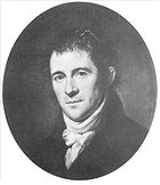
Benjamin Latrobe

Encyclopedia
Benjamin Henry Boneval Latrobe (May 1, 1764 – September 3, 1820) was a British-born American neoclassical
architect
best known for his design of the United States Capitol
, along with his work on the Baltimore Basilica
, the first Roman Catholic Cathedral in the United States. Latrobe was one of the first formally-trained, professional architects in the United States, drawing influences from his travels in Italy, as well as British and French Neoclassical architects such as Claude Nicolas Ledoux
.
Latrobe came to the United States in 1796, initially settling in Virginia
where he worked on the State Penitentiary in Richmond
. Latrobe then relocated to Philadelphia where he established his practice. In 1803, he was hired as Surveyor of the Public Buildings of the United States, and spent much of the next fourteen years working on projects in Washington, D.C.
Latrobe spent the later years of his life in New Orleans, working on a waterworks project, and died there in 1820 from yellow fever
. He has been called the "Father of American Architecture".
 Benjamin Henry Latrobe was born on May 1, 1764 at the Fulneck Moravian Settlement
, near Pudsey
in West Yorkshire
, England, to Reverend Benjamin Latrobe and Anna Margaretta Antes. Antes was born in the American colony of Pennsylvania
, but was sent to England by her father, a wealthy landowner, to attend a Moravian school at Fulneck. Latrobe's father, responsible for all Moravian schools and establishments in Britain, had an extensive circle of friends in the higher ranks of society. He stressed the importance of education, scholarship, and the value of social exchange, while Latrobe's mother instilled curiosity and interest in America. From a young age, Latrobe enjoyed drawing landscapes and buildings. He was a brother of Christian Ignatius Latrobe
.
In 1776, at the age of 12, Latrobe was sent away to a Moravian School at Niesky
in Silesia
, near the border of Saxony
and Prussia
. At age 18, Latrobe spent several months traveling around Germany, and then joined the Prussia
n army, becoming close friends with a distinguished officer in the army of the United States. Latrobe may have served in the Austria
n army, and suffered some injuries or illness. After recovering, he embarked on a continental Grand Tour
, visiting eastern Saxony, Paris
, Italy
, and other places. Through his education and travels, Latrobe mastered German, French, Greek, and Latin, had advanced ability in Italian and Spanish, and knowledge of Hebrew.
When Latrobe returned to England in 1784, he entered apprenticeship under John Smeaton
, an engineer known for designing Eddystone Lighthouse
. Then in 1787 or 1788, he worked as an apprentice with neoclassical
architect S.P. Cockerell
, serving for a brief time before leaving to practice the profession. In 1790, Latrobe was hired as Surveyor of the Public Offices in London, and established his own private practice in 1791. Latrobe was commissioned in 1792 to design Hammerwood Park
, near East Grinstead
in Sussex
, which was his first independent work, and he designed nearby Ashdown House
in 1793. Latrobe was involved in construction of the Basingstoke Canal
in Surrey
, together with engineers John Smeaton
and William Jessop
. In spring 1793, Latrobe was hired to plan improvements to the River Blackwater from Maldon to Beeleigh, so that the port of Maldon could compete with the Chelmer and Blackwater Navigation
, which bypassed the town. The project lasted until early 1795, when Parliament denied approval of his plan. Latrobe had problems getting payment for his work on the project, and faced bankruptcy.
In February 1790, Latrobe married Lydia Sellon, and they lived a busy social life in London. The couple had a daughter (Lydia Sellon Latrobe) and son (Henry Sellon Latrobe), before she died in November 1793 during childbirth of a third child. Lydia had inherited her father's wealth, which in turn was to be left to the children through a trust with the children's uncles, but never ended up going to the children. In 1795, after his wife's death, Latrobe suffered a severe nervous breakdown and decided to emigrate to America, departing on November 25 aboard the Eliza.
Later in America, Latrobe was known for his series of topological and landscape watercolours and the series started with a view of the White Cliffs of the south coast of England viewed from the Eliza. However, this was preceded by a watercolour of East Grinstead dated Sept 8th 1795.
in mid-March 1796 after a harrowing four month journey aboard the ship, which was plagued with food shortages and near starvation conditions. Latrobe initially spent time in Norfolk, where he designed the William Pennock House, then set out for Richmond, Virginia
in April 1796. Soon after arriving in Virginia, Latrobe became friends with Bushrod Washington
, nephew of President George Washington
, along with Edmund Randolph
and other notable figures. Through Bushrod Washington, Latrobe was able to pay a visit to Mount Vernon
to meet with the President in the summer of 1796.
Latrobe's first major project in the United States was the State Penitentiary in Richmond, commissioned in 1797. The penitentiary included many innovative ideas in penal reform, espoused by Thomas Jefferson
and other figures, including cells arranged in a semicircle, similar but not identical to Jeremy Bentham
's panopticon
, that allowed for easy surveillance, as well as improved living conditions for sanitation and ventilation. He also pioneered the use of solitary confinement in the Richmond penitentiary. While in Virginia, Latrobe worked on the Green Spring
mansion near Williamsburg
, which had been built by Governor Sir William Berkeley in the 17th century, but fell into disrepair after the American Revolutionary War
. He also made drawings for a number of houses that were not built, including the Mill Hill plantation house near Richmond.
After spending a year in Virginia, the novelty of being in a new place wore off, and Latrobe was lonely and restless in Virginia. Giambattista Scandella
, a friend, suggested Philadelphia as an ideal location for him. In April 1798, Latrobe visited Philadelphia for the first time, meeting with Bank of Pennsylvania
president Samuel J. Fox, and presented a design for a new bank building. At the time, the political climate in Philadelphia was quite different than Virginia, with a strong division between the Federalists and Jefferson's Democratic-Republicans, along with anti-French sentiment, thus the city was not entirely welcoming for Latrobe. On his way to Philadelphia, Latrobe passed through Washington, D.C.
, where he met with William Thornton
and viewed the United States Capitol
for the first time. He stopped by Washington again on his way back to Richmond. Latrobe remained in Richmond, Virginia until November 1798 when his design was selected for the Bank of Pennsylvania. He moved to Philadelphia, so that he could supervise the construction, though he continued to do occasional projects for clients in Virginia.
 Upon arriving in Philadelphia, Latrobe's two friends, Scandella and Volney, had left due to concerns regarding the Alien and Sedition Acts
, but Latrobe made friends with some of their acquaintances at the American Philosophical Society
. Latrobe submitted several papers to the society, on his geology and natural history observations, and became a member of the society. With his charming personality, Latrobe quickly made other friends among the influential financial and business families in Philadelphia, and became close friends with Nicholas Roosevelt
, a talented steam-engine builder who would help Latrobe in his waterworks projects.
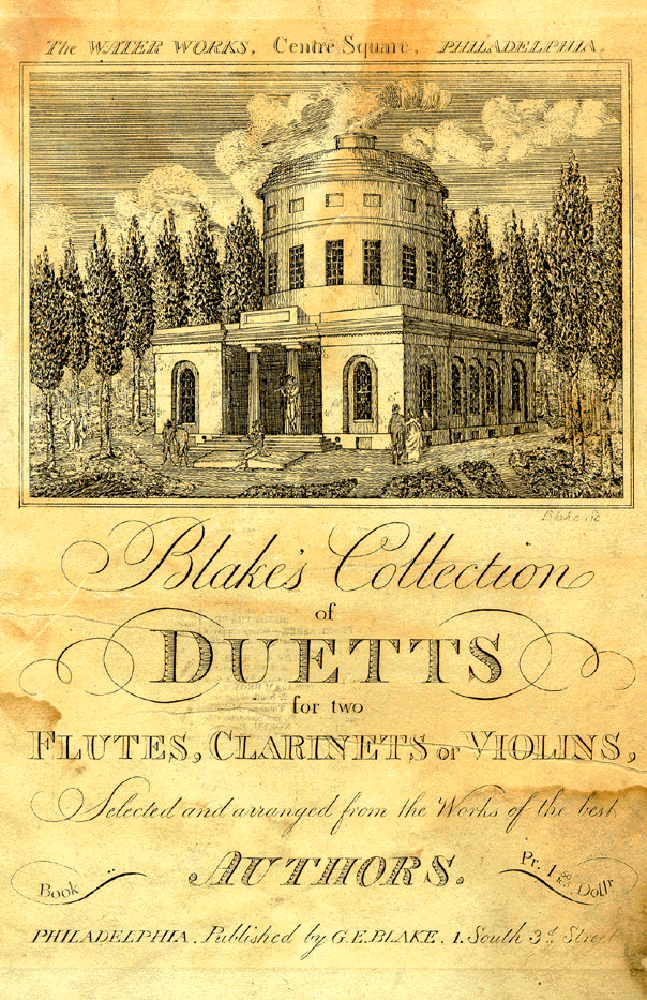
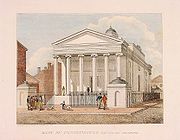
Latrobe's first major project in Philadelphia was to design the Bank of Pennsylvania, which was the first example of Greek Revival architecture in the United States. The Bank of Pennsylvania building was since demolished in 1870. This commission is what convinced him to set up his practice in Philadelphia, where he developed his reputation. Latrobe was also hired to design the Fairmount Water Works
in Philadelphia. The Pump House, located at Center Square, was designed by Latrobe in a Greek Revival style. Following his work on the Philadelphia water works project, Latrobe worked as an engineer of the Chesapeake and Delaware Canal
.
In addition to Greek Revival designs, Latrobe also used Gothic Revival
designs in many of his works, including the 1799 design of Sedgeley
, a country mansion in Philadelphia. The Gothic Revival style was also used in Latrobe's design of the Philadelphia Bank building, which was built in 1807 and demolished in 1836. As a young architect, Robert Mills
worked as an assistant with Latrobe from 1803 until 1808 when he set up his own practice. While in Philadelphia, Latrobe married Mary Elizabeth Hazlehurst in 1800.
, likely influencing Jefferson's design for the University of Virginia
. Latrobe also knew James Monroe
, as well as New Orleans architect and pirate, Barthelemy Lafon
, was Aaron Burr
's preferred architect, and he trained architect William Strickland
.
In 1803, Jefferson hired Latrobe as surveyor
of the Public Buildings of the United States, and to work on as superintendent of construction of the United States Capitol
. As construction of the Capitol was already underway, Latrobe was tasked to work with William Thornton
's plans which Latrobe criticized. In an 1803 letter to Vice President Aaron Burr
, he characterized the plans and work done as "faulty construction". Nonetheless, President Thomas Jefferson
insisted that Latrobe follow Thornton's design for the Capitol.
 Although Latrobe's major work was overseeing construction of the United States Capitol
, he also was responsible for numerous other projects in Washington. In 1804, became chief engineer in the United States Navy
. As chief surveyor, Latrobe was responsible for the Washington Canal
. Latrobe faced bureaucratic hurdles in moving forward with the canal, with the Directors of the Company rejecting his request for stone lock
s. Instead, the canal was built with wooden locks which were subsequently destroyed in a heavy storm in 1811. Latrobe also designed the main gate
of the Washington Navy Yard
. Latrobe worked on other transportation projects in Washington, D.C., including the Washington & Alexandria Turnpike which connected Washington with Alexandria
, as well as a road connecting with Frederick, Maryland
, and a third road, the Columbia Turnpike going through Bladensburg
to Baltimore
. Latrobe also provided consulting on the construction of the Washington Bridge across the Potomac River
in a way that would not impede navigation and commerce to Georgetown
.
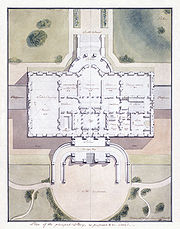 Benjamin Latrobe was responsible for several other projects located around Lafayette Square, including St. John's Episcopal Church
, Decatur House
, and the White House
porticos. Private homes designed by Latrobe include commissions by John P. Van Ness and Peter Casanove.
In June 1812, construction of the Capitol came to a halt with the outbreak of the War of 1812
and the failure of the First Bank of the United States
. During the war, Latrobe relocated to Pittsburgh, and returned to Washington in 1815, as Architect of the Capitol
, charged with responsibility of rebuilding the Capitol after it was destroyed in the war. Latrobe was given more freedom in rebuilding the Capitol, to apply his own design elements for the interior. Through much of Latrobe's time in Washington, he remained involved to some extent with his private practice and other projects in Philadelphia and elsewhere. His clerk of works, John Lenthal, often urged Latrobe to spend more time in Washington.
By 1817, Latrobe had provided President James Monroe
with complete drawings for the entire building. He resigned as Architect of the Capitol on November 20, 1817, and without this major commission, Latrobe faced difficulties and was forced into bankruptcy. Latrobe left Washington, for Baltimore
in January 1818.
Latrobe left Washington with pessimism, with the city's design contradicting many of his ideals. Latrobe disliked the Baroque-style plan for the city, and other aspects of L'Enfant
's plan, and resented having to conform to Thornton's plans for the Capitol Building. One of the greatest problems with the overall city plan, in the view of Latrobe, was its vast interior distances, and Latrobe considered the Washington Canal as a key factor that, if successful, could help alleviate this issue. Latrobe also had concerns about the city's economic potential, and argued for constructing a road connecting Washington with Frederick
to the northwest to enhance economic commerce through Washington.
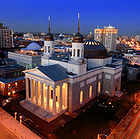 Latrobe also worked on projects in Baltimore, including the Baltimore Basilica
, the first Roman Catholic Cathedral in the United States of America commissioned by John Carroll
. Construction of the Baltimore Basilica
commenced in 1806, and was completed in 1821, after financial setbacks interrupted construction for a number of years. Latrobe also worked on the Baltimore Exchange project, with hopes of generating more financial capital to use for the waterworks project, completing the project in 1818. He left for New Orleans in December 1818, arriving on January 10, 1819.
, with the advent of the steamboat
and great interest in steamboat technology. Latrobe's first project in New Orleans was the New Orleans Custom House, built in 1807.
In 1810, Latrobe sent his son, Henry Sellon Boneval Latrobe, to New Orleans to present a plan for a waterworks system before the New Orleans City Council. Latrobe's plan for the New Orleans waterworks system was based on that of Philadelphia, which he earlier designed. The system in Philadelphia was created as a response to yellow fever
epidemics affecting the city. Latrobe's system utilized steam pumps to move water from the Schuylkill River
to a reservoir, located upstream, so that gravity could be used to transmit the water from there to residents in the city. The New Orleans waterworks project was also designed to desalt water, using steam-powered pumps. While in New Orleans, Latrobe's son participated in battles during the War of 1812, and took on projects including building a lighthouse, New Orleans' Charity Hospital, and the French Opera House.
New Orleans agreed to commission the waterworks project in 1811, though Latrobe was not ready to take on the project immediately, and faced financial problems in securing enough investors for the project. Latrobe's work on the United States Capitol was completed shortly before the War of 1812
started, ending his source of steady income. During the war, Latrobe unsuccessfully tried several wartime schemes to make money, including some steamboat projects. In 1814, Latrobe partnered with Robert Fulton
in a steamship venture based at Pittsburgh. While in Pittsburgh, Latrobe designed and built a theater for the Circus of Pepin and Breschard
. After the United States Capitol and White House were burned during the war, Latrobe remained in Washington, D.C. to help with rebuilding, and Latrobe's son took on much of the work for waterworks project.
Latrobe faced further delays with the New Orleans waterworks project, trying to get an engine built for the project, which he finally achieved in 1819. The process of designing and constructing the waterworks system in New Orleans spanned eleven years. In addition to the waterworks project, Latrobe designed the central tower of the St. Louis Cathedral
, which was his last architectural project. Latrobe died September 30, 1820 from yellow fever
, while working in New Orleans on the waterworks project. He was buried in Saint Louis Cemetery
in New Orleans, where his son, Henry, was buried three years earlier after also dying from yellow fever.
and others, was emerging with return to more Classical
or Vitruvian designs.
In 1784, Latrobe set off on a Grand Tour
around Europe, visiting Paris where the Panthéon, a church dedicated to St. Genevieve
, was nearing completion. The Panthéon in Paris, designed by Jacques Germain Soufflot and Jean Rondelet, represented an early example of Neoclassicism
. At that time, Claude Nicolas Ledoux
was designing numerous houses in France, in Neoclassical style. Latrobe also visited Rome
, where he was impressed by the Roman Pantheon
and other ancient structures with Greek influence. Influential architects in Britain, at the time when Latrobe returned in 1784, adhered to a number of different styles. Sir William Chambers was at the forefront, designing in Palladianism
style, while Chambers' rival, Robert Adam
's designs had Roman influence, in a style known as Adam style
. Latrobe was interested in neither the Palladian nor Adam style, but Neoclassicalism was also being introduced to Great Britain at the time by George Dance the Younger
. Other British architects, including John Soane
and Henry Holland
, also designed in the Neoclassical style while Latrobe was in London.
During his European tour, Latrobe also gathered ideas on how American cities should be designed. He suggested city block
s be laid out as thin rectangles, with the long side of the blocks oriented east-west so that as many houses as possible could be facing in the southerly direction. For a city to succeed, he thought it needed to be established only in places with good prospects for commerce and industrial growth, and with a good water supply. Public health was another key consideration of Latrobe, who believed that the eastern shores of rivers were unhealthy, due to prevailing direction of the wind, and recommended cities be built on the western shores of rivers.
described the Bank of Pennsylvania, as an example of how Latrobe "married English Neo-Classicism to Jeffersonian Neo-Classicism [and] ... from that moment, the classical revival in America took on a national form". The American form of Greek Revival architecture that Latrobe developed became associated with political ideals of democracy
—meaning that was less apparent in Britain. The direct link between the Greek Revival and American democracy has been disputed by recent scholars such as W. Barksdale Maynard, who sees the Greek Revival as an international phenomenon.
and also Ashdown House, East Sussex
. Alterations done early in his career may have included Tanton Hall, Sheffield Park, Frimley, and Teston Hall, though these homes have since been altered and it is difficult now to isolate Latrobe's work in the current designs. His designs were simpler, than was typical at the time, and had influences of Robert Adam. Features in his designs often included Greek ionic
, as used in Ashdown House, or doric
columns, seen in Hammerwood Park, as part of the front portico
s.
Latrobe continued to design houses after he emigrated to the United States, mostly using Greek Revival designs. Three House still stand that Latrobe designed. The Decatur House
in Washington DC, Adena in Chillicothe, Ohio and the Pope Villa in Lexington, Kentucky. The Pope Villa
in Lexington, Kentucky
is one of only three extant Latrobe residences in the United States. As one of Latrobe's most avant-garde designs, the Pope Villa has national significance for its unique design. He also introduced Gothic Revival architecture
to the United States, in designing the Sedgeley
mansion. A theme seen in many of Latrobe's designs are plans with squarish-dimensions and a central, multi-story hall with a cupola
to provide lighting, which was contrary to the popular trend of the time of building houses with long narrow plans.
Neoclassical architecture
Neoclassical architecture was an architectural style produced by the neoclassical movement that began in the mid-18th century, manifested both in its details as a reaction against the Rococo style of naturalistic ornament, and in its architectural formulas as an outgrowth of some classicizing...
architect
Architect
An architect is a person trained in the planning, design and oversight of the construction of buildings. To practice architecture means to offer or render services in connection with the design and construction of a building, or group of buildings and the space within the site surrounding the...
best known for his design of the United States Capitol
United States Capitol
The United States Capitol is the meeting place of the United States Congress, the legislature of the federal government of the United States. Located in Washington, D.C., it sits atop Capitol Hill at the eastern end of the National Mall...
, along with his work on the Baltimore Basilica
Basilica of the National Shrine of the Assumption of the Blessed Virgin Mary
The Basilica of the National Shrine of the Assumption of the Blessed Virgin Mary, also called the Baltimore Basilica, was the first Roman Catholic cathedral built in the United States, and was the first major religious building constructed in the nation after the adoption of the U.S. Constitution...
, the first Roman Catholic Cathedral in the United States. Latrobe was one of the first formally-trained, professional architects in the United States, drawing influences from his travels in Italy, as well as British and French Neoclassical architects such as Claude Nicolas Ledoux
Claude Nicolas Ledoux
Claude-Nicolas Ledoux was one of the earliest exponents of French Neoclassical architecture. He used his knowledge of architectural theory to design not only in domestic architecture but town planning; as a consequence of his visionary plan for the Ideal City of Chaux, he became known as a utopian...
.
Latrobe came to the United States in 1796, initially settling in Virginia
Virginia
The Commonwealth of Virginia , is a U.S. state on the Atlantic Coast of the Southern United States. Virginia is nicknamed the "Old Dominion" and sometimes the "Mother of Presidents" after the eight U.S. presidents born there...
where he worked on the State Penitentiary in Richmond
Richmond, Virginia
Richmond is the capital of the Commonwealth of Virginia, in the United States. It is an independent city and not part of any county. Richmond is the center of the Richmond Metropolitan Statistical Area and the Greater Richmond area...
. Latrobe then relocated to Philadelphia where he established his practice. In 1803, he was hired as Surveyor of the Public Buildings of the United States, and spent much of the next fourteen years working on projects in Washington, D.C.
Washington, D.C.
Washington, D.C., formally the District of Columbia and commonly referred to as Washington, "the District", or simply D.C., is the capital of the United States. On July 16, 1790, the United States Congress approved the creation of a permanent national capital as permitted by the U.S. Constitution....
Latrobe spent the later years of his life in New Orleans, working on a waterworks project, and died there in 1820 from yellow fever
Yellow fever
Yellow fever is an acute viral hemorrhagic disease. The virus is a 40 to 50 nm enveloped RNA virus with positive sense of the Flaviviridae family....
. He has been called the "Father of American Architecture".
Biography
Fulneck Moravian Settlement
Fulneck Moravian Settlement is a village in Pudsey in the City of Leeds metropolitan borough, West Yorkshire, England. It was established in 1744. It is named after Fulneck , the German name of a town in Northern Moravia, Czech Republic....
, near Pudsey
Pudsey
Pudsey is a market town in West Yorkshire, England. Once an independent town, it was incorporated into the metropolitan borough of the City of Leeds in 1974, and is located midway between Bradford and Leeds city centres. It has a population of 32,391....
in West Yorkshire
West Yorkshire
West Yorkshire is a metropolitan county within the Yorkshire and the Humber region of England with a population of 2.2 million. West Yorkshire came into existence as a metropolitan county in 1974 after the passage of the Local Government Act 1972....
, England, to Reverend Benjamin Latrobe and Anna Margaretta Antes. Antes was born in the American colony of Pennsylvania
Pennsylvania
The Commonwealth of Pennsylvania is a U.S. state that is located in the Northeastern and Mid-Atlantic regions of the United States. The state borders Delaware and Maryland to the south, West Virginia to the southwest, Ohio to the west, New York and Ontario, Canada, to the north, and New Jersey to...
, but was sent to England by her father, a wealthy landowner, to attend a Moravian school at Fulneck. Latrobe's father, responsible for all Moravian schools and establishments in Britain, had an extensive circle of friends in the higher ranks of society. He stressed the importance of education, scholarship, and the value of social exchange, while Latrobe's mother instilled curiosity and interest in America. From a young age, Latrobe enjoyed drawing landscapes and buildings. He was a brother of Christian Ignatius Latrobe
Christian Ignatius Latrobe
Christian Ignatius Latrobe was an English clergyman, artist, musician, and composer. He composed a large number of works for the Moravian Church, and most famously edited a Selection of Sacred Music in six volumes between 1806 and 1826, introducing the sacred music of Haydn, Mozart and...
.
In 1776, at the age of 12, Latrobe was sent away to a Moravian School at Niesky
Niesky
Niesky is a small town in Upper Lusatia in eastern the Free State of Saxony, Germany. It has a population of about 11,000 and is part of the district of Görlitz....
in Silesia
Silesia
Silesia is a historical region of Central Europe located mostly in Poland, with smaller parts also in the Czech Republic, and Germany.Silesia is rich in mineral and natural resources, and includes several important industrial areas. Silesia's largest city and historical capital is Wrocław...
, near the border of Saxony
Saxony
The Free State of Saxony is a landlocked state of Germany, contingent with Brandenburg, Saxony Anhalt, Thuringia, Bavaria, the Czech Republic and Poland. It is the tenth-largest German state in area, with of Germany's sixteen states....
and Prussia
Prussia
Prussia was a German kingdom and historic state originating out of the Duchy of Prussia and the Margraviate of Brandenburg. For centuries, the House of Hohenzollern ruled Prussia, successfully expanding its size by way of an unusually well-organized and effective army. Prussia shaped the history...
. At age 18, Latrobe spent several months traveling around Germany, and then joined the Prussia
Prussia
Prussia was a German kingdom and historic state originating out of the Duchy of Prussia and the Margraviate of Brandenburg. For centuries, the House of Hohenzollern ruled Prussia, successfully expanding its size by way of an unusually well-organized and effective army. Prussia shaped the history...
n army, becoming close friends with a distinguished officer in the army of the United States. Latrobe may have served in the Austria
Austria
Austria , officially the Republic of Austria , is a landlocked country of roughly 8.4 million people in Central Europe. It is bordered by the Czech Republic and Germany to the north, Slovakia and Hungary to the east, Slovenia and Italy to the south, and Switzerland and Liechtenstein to the...
n army, and suffered some injuries or illness. After recovering, he embarked on a continental Grand Tour
Grand Tour
The Grand Tour was the traditional trip of Europe undertaken by mainly upper-class European young men of means. The custom flourished from about 1660 until the advent of large-scale rail transit in the 1840s, and was associated with a standard itinerary. It served as an educational rite of passage...
, visiting eastern Saxony, Paris
Paris
Paris is the capital and largest city in France, situated on the river Seine, in northern France, at the heart of the Île-de-France region...
, Italy
Italy
Italy , officially the Italian Republic languages]] under the European Charter for Regional or Minority Languages. In each of these, Italy's official name is as follows:;;;;;;;;), is a unitary parliamentary republic in South-Central Europe. To the north it borders France, Switzerland, Austria and...
, and other places. Through his education and travels, Latrobe mastered German, French, Greek, and Latin, had advanced ability in Italian and Spanish, and knowledge of Hebrew.
When Latrobe returned to England in 1784, he entered apprenticeship under John Smeaton
John Smeaton
John Smeaton, FRS, was an English civil engineer responsible for the design of bridges, canals, harbours and lighthouses. He was also a capable mechanical engineer and an eminent physicist...
, an engineer known for designing Eddystone Lighthouse
Eddystone Lighthouse
Eddystone Lighthouse is on the treacherous Eddystone Rocks, south west of Rame Head, United Kingdom. While Rame Head is in Cornwall, the rocks are in Devon and composed of Precambrian Gneiss....
. Then in 1787 or 1788, he worked as an apprentice with neoclassical
Neoclassical architecture
Neoclassical architecture was an architectural style produced by the neoclassical movement that began in the mid-18th century, manifested both in its details as a reaction against the Rococo style of naturalistic ornament, and in its architectural formulas as an outgrowth of some classicizing...
architect S.P. Cockerell
Samuel Pepys Cockerell
Samuel Pepys Cockerell was an English architect. He was the son of John Cockerell, of Bishop's Hull, Somerset, and the brother of Sir Charles Cockerell, 1st Baronet, for whom he designed the house he is best known for, Sezincote House, Gloucestershire, where the uniquely Orientalizing features...
, serving for a brief time before leaving to practice the profession. In 1790, Latrobe was hired as Surveyor of the Public Offices in London, and established his own private practice in 1791. Latrobe was commissioned in 1792 to design Hammerwood Park
Hammerwood Park
Hammerwood Park is a grade I listed country house near East Grinstead, Sussex, England at and Grade 1 listed of historical interest.- History :It was the first work of the architect Benjamin Latrobe...
, near East Grinstead
East Grinstead
East Grinstead is a town and civil parish in the northeastern corner of Mid Sussex, West Sussex in England near the East Sussex, Surrey, and Kent borders. It lies south of London, north northeast of Brighton, and east northeast of the county town of Chichester...
in Sussex
Sussex
Sussex , from the Old English Sūþsēaxe , is an historic county in South East England corresponding roughly in area to the ancient Kingdom of Sussex. It is bounded on the north by Surrey, east by Kent, south by the English Channel, and west by Hampshire, and is divided for local government into West...
, which was his first independent work, and he designed nearby Ashdown House
Ashdown House, East Sussex
Ashdown House is a mixed independent preparatory school in Forest Row, East Sussex. There are currently 169 pupils from the ages seven to thirteen, currently comprising around 110 boys and 59 girls.-Headmaster:...
in 1793. Latrobe was involved in construction of the Basingstoke Canal
Basingstoke Canal
The Basingstoke Canal is a British Canal, completed in 1794, built to connect Basingstoke with the River Thames at Weybridge via the Wey Navigation....
in Surrey
Surrey
Surrey is a county in the South East of England and is one of the Home Counties. The county borders Greater London, Kent, East Sussex, West Sussex, Hampshire and Berkshire. The historic county town is Guildford. Surrey County Council sits at Kingston upon Thames, although this has been part of...
, together with engineers John Smeaton
John Smeaton
John Smeaton, FRS, was an English civil engineer responsible for the design of bridges, canals, harbours and lighthouses. He was also a capable mechanical engineer and an eminent physicist...
and William Jessop
William Jessop
William Jessop was an English civil engineer, best known for his work on canals, harbours and early railways in the late 18th and early 19th centuries.-Early life:...
. In spring 1793, Latrobe was hired to plan improvements to the River Blackwater from Maldon to Beeleigh, so that the port of Maldon could compete with the Chelmer and Blackwater Navigation
Chelmer and Blackwater Navigation
The Chelmer and Blackwater Navigation is the canalisation of the Rivers Chelmer and Blackwater in Essex, in the east of England. The navigation runs for from Springfield Basin in Chelmsford to the sea lock at Heybridge Basin near Maldon. It was opened in 1797, and remained under the control of...
, which bypassed the town. The project lasted until early 1795, when Parliament denied approval of his plan. Latrobe had problems getting payment for his work on the project, and faced bankruptcy.
In February 1790, Latrobe married Lydia Sellon, and they lived a busy social life in London. The couple had a daughter (Lydia Sellon Latrobe) and son (Henry Sellon Latrobe), before she died in November 1793 during childbirth of a third child. Lydia had inherited her father's wealth, which in turn was to be left to the children through a trust with the children's uncles, but never ended up going to the children. In 1795, after his wife's death, Latrobe suffered a severe nervous breakdown and decided to emigrate to America, departing on November 25 aboard the Eliza.
Later in America, Latrobe was known for his series of topological and landscape watercolours and the series started with a view of the White Cliffs of the south coast of England viewed from the Eliza. However, this was preceded by a watercolour of East Grinstead dated Sept 8th 1795.
Virginia
Latrobe arrived in Norfolk, VirginiaNorfolk, Virginia
Norfolk is an independent city in the Commonwealth of Virginia in the United States. With a population of 242,803 as of the 2010 Census, it is Virginia's second-largest city behind neighboring Virginia Beach....
in mid-March 1796 after a harrowing four month journey aboard the ship, which was plagued with food shortages and near starvation conditions. Latrobe initially spent time in Norfolk, where he designed the William Pennock House, then set out for Richmond, Virginia
Richmond, Virginia
Richmond is the capital of the Commonwealth of Virginia, in the United States. It is an independent city and not part of any county. Richmond is the center of the Richmond Metropolitan Statistical Area and the Greater Richmond area...
in April 1796. Soon after arriving in Virginia, Latrobe became friends with Bushrod Washington
Bushrod Washington
Bushrod Washington was a U.S. Supreme Court associate justice and the nephew of George Washington.Washington was born in Westmoreland County, Virginia, and was the son of John Augustine Washington, brother of the first president. Bushrod attended Delamere, an academy administered by the Rev....
, nephew of President George Washington
George Washington
George Washington was the dominant military and political leader of the new United States of America from 1775 to 1799. He led the American victory over Great Britain in the American Revolutionary War as commander-in-chief of the Continental Army from 1775 to 1783, and presided over the writing of...
, along with Edmund Randolph
Edmund Randolph
Edmund Jennings Randolph was an American attorney, the seventh Governor of Virginia, the second Secretary of State, and the first United States Attorney General.-Biography:...
and other notable figures. Through Bushrod Washington, Latrobe was able to pay a visit to Mount Vernon
Mount Vernon
The name Mount Vernon is a dedication to the English Vice-Admiral Edward Vernon. It was first applied to Mount Vernon, the Virginia estate of George Washington, the first President of the United States...
to meet with the President in the summer of 1796.
Latrobe's first major project in the United States was the State Penitentiary in Richmond, commissioned in 1797. The penitentiary included many innovative ideas in penal reform, espoused by Thomas Jefferson
Thomas Jefferson
Thomas Jefferson was the principal author of the United States Declaration of Independence and the Statute of Virginia for Religious Freedom , the third President of the United States and founder of the University of Virginia...
and other figures, including cells arranged in a semicircle, similar but not identical to Jeremy Bentham
Jeremy Bentham
Jeremy Bentham was an English jurist, philosopher, and legal and social reformer. He became a leading theorist in Anglo-American philosophy of law, and a political radical whose ideas influenced the development of welfarism...
's panopticon
Panopticon
The Panopticon is a type of building designed by English philosopher and social theorist Jeremy Bentham in the late eighteenth century. The concept of the design is to allow an observer to observe all inmates of an institution without them being able to tell whether or not they are being watched...
, that allowed for easy surveillance, as well as improved living conditions for sanitation and ventilation. He also pioneered the use of solitary confinement in the Richmond penitentiary. While in Virginia, Latrobe worked on the Green Spring
Green Spring Plantation
Green Spring Plantation in James City County about five miles west of Williamsburg, was the 17th century plantation of one of the more popular governors of Colonial Virginia in North America, Sir William Berkeley, and his second wife....
mansion near Williamsburg
Williamsburg, Virginia
Williamsburg is an independent city located on the Virginia Peninsula in the Hampton Roads metropolitan area of Virginia, USA. As of the 2010 Census, the city had an estimated population of 14,068. It is bordered by James City County and York County, and is an independent city...
, which had been built by Governor Sir William Berkeley in the 17th century, but fell into disrepair after the American Revolutionary War
American Revolutionary War
The American Revolutionary War , the American War of Independence, or simply the Revolutionary War, began as a war between the Kingdom of Great Britain and thirteen British colonies in North America, and ended in a global war between several European great powers.The war was the result of the...
. He also made drawings for a number of houses that were not built, including the Mill Hill plantation house near Richmond.
After spending a year in Virginia, the novelty of being in a new place wore off, and Latrobe was lonely and restless in Virginia. Giambattista Scandella
Giambattista Scandella
Giambattista Scandella was an Italian physician and scientist who emigrated to the United States in 1796. Scandella studied medicine at the University of Padua, and then went into medical practice in Venice in 1786. He also conducted agricultural research on fertilizer and other topics.Scandella...
, a friend, suggested Philadelphia as an ideal location for him. In April 1798, Latrobe visited Philadelphia for the first time, meeting with Bank of Pennsylvania
Bank of Pennsylvania
The Bank of Pennsylvania was established on July 17, 1780, by Philadelphia merchants to provide funds for the Continental Army during the American Revolutionary War...
president Samuel J. Fox, and presented a design for a new bank building. At the time, the political climate in Philadelphia was quite different than Virginia, with a strong division between the Federalists and Jefferson's Democratic-Republicans, along with anti-French sentiment, thus the city was not entirely welcoming for Latrobe. On his way to Philadelphia, Latrobe passed through Washington, D.C.
Washington, D.C.
Washington, D.C., formally the District of Columbia and commonly referred to as Washington, "the District", or simply D.C., is the capital of the United States. On July 16, 1790, the United States Congress approved the creation of a permanent national capital as permitted by the U.S. Constitution....
, where he met with William Thornton
William Thornton
Dr. William Thornton was a British-American physician, inventor, painter and architect who designed the United States Capitol, an authentic polymath...
and viewed the United States Capitol
United States Capitol
The United States Capitol is the meeting place of the United States Congress, the legislature of the federal government of the United States. Located in Washington, D.C., it sits atop Capitol Hill at the eastern end of the National Mall...
for the first time. He stopped by Washington again on his way back to Richmond. Latrobe remained in Richmond, Virginia until November 1798 when his design was selected for the Bank of Pennsylvania. He moved to Philadelphia, so that he could supervise the construction, though he continued to do occasional projects for clients in Virginia.
Philadelphia
Alien and Sedition Acts
The Alien and Sedition Acts were four bills passed in 1798 by the Federalists in the 5th United States Congress in the aftermath of the French Revolution's reign of terror and during an undeclared naval war with France, later known as the Quasi-War. They were signed into law by President John Adams...
, but Latrobe made friends with some of their acquaintances at the American Philosophical Society
American Philosophical Society
The American Philosophical Society, founded in 1743, and located in Philadelphia, Pa., is an eminent scholarly organization of international reputation, that promotes useful knowledge in the sciences and humanities through excellence in scholarly research, professional meetings, publications,...
. Latrobe submitted several papers to the society, on his geology and natural history observations, and became a member of the society. With his charming personality, Latrobe quickly made other friends among the influential financial and business families in Philadelphia, and became close friends with Nicholas Roosevelt
Nicholas Roosevelt (inventor)
Nicholas Isaac Roosevelt was an American inventor, a major investor in Upstate New York land, and a member of the Roosevelt family. His primary invention was to introduce vertical paddle wheels for steamboats.-Inventor:Nicholas Roosevelt was carefully educated...
, a talented steam-engine builder who would help Latrobe in his waterworks projects.
Latrobe's first major project in Philadelphia was to design the Bank of Pennsylvania, which was the first example of Greek Revival architecture in the United States. The Bank of Pennsylvania building was since demolished in 1870. This commission is what convinced him to set up his practice in Philadelphia, where he developed his reputation. Latrobe was also hired to design the Fairmount Water Works
Fairmount Water Works
The Fairmount Water Works in Philadelphia, Pennsylvania was Philadelphia's second municipal waterworks. Designed in 1812 by Frederick Graff and built between 1812 and 1872, it operated until 1909, winning praise for its design and becoming a popular tourist attraction...
in Philadelphia. The Pump House, located at Center Square, was designed by Latrobe in a Greek Revival style. Following his work on the Philadelphia water works project, Latrobe worked as an engineer of the Chesapeake and Delaware Canal
Chesapeake and Delaware Canal
The Chesapeake and Delaware Canal is a 14-mile long, 450-foot wide and 40-foot deep ship canal that cuts across the states of Maryland and Delaware, in the United States. It connects the waters of the Delaware River with those of the Chesapeake Bay and the Port of Baltimore...
.
In addition to Greek Revival designs, Latrobe also used Gothic Revival
Gothic Revival architecture
The Gothic Revival is an architectural movement that began in the 1740s in England...
designs in many of his works, including the 1799 design of Sedgeley
Sedgeley
Sedgeley was a mansion, designed by architect Benjamin Henry Latrobe, and built on the east banks of the Schuylkill River in Philadelphia in 1799-1802.-Design and construction:...
, a country mansion in Philadelphia. The Gothic Revival style was also used in Latrobe's design of the Philadelphia Bank building, which was built in 1807 and demolished in 1836. As a young architect, Robert Mills
Robert Mills (architect)
Robert Mills , most famously known for designing the Washington Monument, is sometimes called the first native born American to become a professional architect, though Charles Bulfinch perhaps has a clearer claim to this honor...
worked as an assistant with Latrobe from 1803 until 1808 when he set up his own practice. While in Philadelphia, Latrobe married Mary Elizabeth Hazlehurst in 1800.
Washington, D.C.
In the United States, Latrobe quickly achieved eminence as the first professional architect working in the country. Latrobe was a friend of Thomas JeffersonThomas Jefferson
Thomas Jefferson was the principal author of the United States Declaration of Independence and the Statute of Virginia for Religious Freedom , the third President of the United States and founder of the University of Virginia...
, likely influencing Jefferson's design for the University of Virginia
University of Virginia
The University of Virginia is a public research university located in Charlottesville, Virginia, United States, founded by Thomas Jefferson...
. Latrobe also knew James Monroe
James Monroe
James Monroe was the fifth President of the United States . Monroe was the last president who was a Founding Father of the United States, and the last president from the Virginia dynasty and the Republican Generation...
, as well as New Orleans architect and pirate, Barthelemy Lafon
Barthelemy Lafon
Barthelemy Lafon was a notable architect, engineer, city planner and surveyor in New Orleans, Louisiana. In later life, he turned away from architecture and engaged in piracy and smuggling....
, was Aaron Burr
Aaron Burr
Aaron Burr, Jr. was an important political figure in the early history of the United States of America. After serving as a Continental Army officer in the Revolutionary War, Burr became a successful lawyer and politician...
's preferred architect, and he trained architect William Strickland
William Strickland (architect)
William Strickland , was a noted architect in nineteenth-century Philadelphia, Pennsylvania and Nashville, Tennessee.-Life and career:...
.
In 1803, Jefferson hired Latrobe as surveyor
Surveying
See Also: Public Land Survey SystemSurveying or land surveying is the technique, profession, and science of accurately determining the terrestrial or three-dimensional position of points and the distances and angles between them...
of the Public Buildings of the United States, and to work on as superintendent of construction of the United States Capitol
United States Capitol
The United States Capitol is the meeting place of the United States Congress, the legislature of the federal government of the United States. Located in Washington, D.C., it sits atop Capitol Hill at the eastern end of the National Mall...
. As construction of the Capitol was already underway, Latrobe was tasked to work with William Thornton
William Thornton
Dr. William Thornton was a British-American physician, inventor, painter and architect who designed the United States Capitol, an authentic polymath...
's plans which Latrobe criticized. In an 1803 letter to Vice President Aaron Burr
Aaron Burr
Aaron Burr, Jr. was an important political figure in the early history of the United States of America. After serving as a Continental Army officer in the Revolutionary War, Burr became a successful lawyer and politician...
, he characterized the plans and work done as "faulty construction". Nonetheless, President Thomas Jefferson
Thomas Jefferson
Thomas Jefferson was the principal author of the United States Declaration of Independence and the Statute of Virginia for Religious Freedom , the third President of the United States and founder of the University of Virginia...
insisted that Latrobe follow Thornton's design for the Capitol.
United States Capitol
The United States Capitol is the meeting place of the United States Congress, the legislature of the federal government of the United States. Located in Washington, D.C., it sits atop Capitol Hill at the eastern end of the National Mall...
, he also was responsible for numerous other projects in Washington. In 1804, became chief engineer in the United States Navy
United States Navy
The United States Navy is the naval warfare service branch of the United States Armed Forces and one of the seven uniformed services of the United States. The U.S. Navy is the largest in the world; its battle fleet tonnage is greater than that of the next 13 largest navies combined. The U.S...
. As chief surveyor, Latrobe was responsible for the Washington Canal
Washington City Canal
The Washington City Canal operated from 1815 until the mid-1850s in Washington, D.C. The canal connected the Anacostia River, called the "Eastern Branch" at that time, to Tiber Creek, the Potomac River, and later the Chesapeake and Ohio Canal...
. Latrobe faced bureaucratic hurdles in moving forward with the canal, with the Directors of the Company rejecting his request for stone lock
Lock (water transport)
A lock is a device for raising and lowering boats between stretches of water of different levels on river and canal waterways. The distinguishing feature of a lock is a fixed chamber in which the water level can be varied; whereas in a caisson lock, a boat lift, or on a canal inclined plane, it is...
s. Instead, the canal was built with wooden locks which were subsequently destroyed in a heavy storm in 1811. Latrobe also designed the main gate
Latrobe Gate
The Latrobe Gate is a historic gatehouse located at the Washington Navy Yard in Southeast Washington, D.C. Built in 1806 and substantially altered in 1881, the ceremonial entrance to the U.S. Navy's oldest shore establishment is an example of Greek Revival and Italianate architecture...
of the Washington Navy Yard
Washington Navy Yard
The Washington Navy Yard is the former shipyard and ordnance plant of the United States Navy in Southeast Washington, D.C. It is the oldest shore establishment of the U.S. Navy...
. Latrobe worked on other transportation projects in Washington, D.C., including the Washington & Alexandria Turnpike which connected Washington with Alexandria
Alexandria, Virginia
Alexandria is an independent city in the Commonwealth of Virginia. As of 2009, the city had a total population of 139,966. Located along the Western bank of the Potomac River, Alexandria is approximately six miles south of downtown Washington, D.C.Like the rest of northern Virginia, as well as...
, as well as a road connecting with Frederick, Maryland
Frederick, Maryland
Frederick is a city in north-central Maryland. It is the county seat of Frederick County, the largest county by area in the state of Maryland. Frederick is an outlying community of the Washington-Arlington-Alexandria, DC-VA-MD-WV Metropolitan Statistical Area, which is part of a greater...
, and a third road, the Columbia Turnpike going through Bladensburg
Bladensburg, Maryland
Bladensburg is a town in Prince George's County, Maryland, United States. The population was 7,661 at the 2000 census.Bladensburg is from central Washington, DC...
to Baltimore
Baltimore
Baltimore is the largest independent city in the United States and the largest city and cultural center of the US state of Maryland. The city is located in central Maryland along the tidal portion of the Patapsco River, an arm of the Chesapeake Bay. Baltimore is sometimes referred to as Baltimore...
. Latrobe also provided consulting on the construction of the Washington Bridge across the Potomac River
Potomac River
The Potomac River flows into the Chesapeake Bay, located along the mid-Atlantic coast of the United States. The river is approximately long, with a drainage area of about 14,700 square miles...
in a way that would not impede navigation and commerce to Georgetown
Georgetown, Washington, D.C.
Georgetown is a neighborhood located in northwest Washington, D.C., situated along the Potomac River. Founded in 1751, the port of Georgetown predated the establishment of the federal district and the City of Washington by 40 years...
.
St. John's Episcopal Church, Washington, D.C.
St. John's Episcopal Church, Lafayette Square, is a historic Episcopal church located at 16th and H Streets NW, in Washington, D.C. It is near Lafayette Square and the White House....
, Decatur House
Decatur House
Decatur House is a historic home in Washington, D.C., named after its first owner and occupant Stephen Decatur. The house is located northwest of Lafayette Square, at the southwest corner of Jackson Place and H Street, near the White House...
, and the White House
White House
The White House is the official residence and principal workplace of the president of the United States. Located at 1600 Pennsylvania Avenue NW in Washington, D.C., the house was designed by Irish-born James Hoban, and built between 1792 and 1800 of white-painted Aquia sandstone in the Neoclassical...
porticos. Private homes designed by Latrobe include commissions by John P. Van Ness and Peter Casanove.
In June 1812, construction of the Capitol came to a halt with the outbreak of the War of 1812
War of 1812
The War of 1812 was a military conflict fought between the forces of the United States of America and those of the British Empire. The Americans declared war in 1812 for several reasons, including trade restrictions because of Britain's ongoing war with France, impressment of American merchant...
and the failure of the First Bank of the United States
First Bank of the United States
The First Bank of the United States is a National Historic Landmark located in Philadelphia, Pennsylvania within Independence National Historical Park.-Banking History:...
. During the war, Latrobe relocated to Pittsburgh, and returned to Washington in 1815, as Architect of the Capitol
Architect of the Capitol
The Architect of the Capitol is the federal agency responsible for the maintenance, operation, development, and preservation of the United States Capitol Complex, and also the head of that agency. The Architect of the Capitol is in the legislative branch and is responsible to the United States...
, charged with responsibility of rebuilding the Capitol after it was destroyed in the war. Latrobe was given more freedom in rebuilding the Capitol, to apply his own design elements for the interior. Through much of Latrobe's time in Washington, he remained involved to some extent with his private practice and other projects in Philadelphia and elsewhere. His clerk of works, John Lenthal, often urged Latrobe to spend more time in Washington.
By 1817, Latrobe had provided President James Monroe
James Monroe
James Monroe was the fifth President of the United States . Monroe was the last president who was a Founding Father of the United States, and the last president from the Virginia dynasty and the Republican Generation...
with complete drawings for the entire building. He resigned as Architect of the Capitol on November 20, 1817, and without this major commission, Latrobe faced difficulties and was forced into bankruptcy. Latrobe left Washington, for Baltimore
Baltimore
Baltimore is the largest independent city in the United States and the largest city and cultural center of the US state of Maryland. The city is located in central Maryland along the tidal portion of the Patapsco River, an arm of the Chesapeake Bay. Baltimore is sometimes referred to as Baltimore...
in January 1818.
Latrobe left Washington with pessimism, with the city's design contradicting many of his ideals. Latrobe disliked the Baroque-style plan for the city, and other aspects of L'Enfant
Pierre Charles L'Enfant
Pierre Charles L'Enfant was a French-born American architect and civil engineer best known for designing the layout of the streets of Washington, D.C..-Early life:...
's plan, and resented having to conform to Thornton's plans for the Capitol Building. One of the greatest problems with the overall city plan, in the view of Latrobe, was its vast interior distances, and Latrobe considered the Washington Canal as a key factor that, if successful, could help alleviate this issue. Latrobe also had concerns about the city's economic potential, and argued for constructing a road connecting Washington with Frederick
Frederick, Maryland
Frederick is a city in north-central Maryland. It is the county seat of Frederick County, the largest county by area in the state of Maryland. Frederick is an outlying community of the Washington-Arlington-Alexandria, DC-VA-MD-WV Metropolitan Statistical Area, which is part of a greater...
to the northwest to enhance economic commerce through Washington.
Baltimore
Basilica of the National Shrine of the Assumption of the Blessed Virgin Mary
The Basilica of the National Shrine of the Assumption of the Blessed Virgin Mary, also called the Baltimore Basilica, was the first Roman Catholic cathedral built in the United States, and was the first major religious building constructed in the nation after the adoption of the U.S. Constitution...
, the first Roman Catholic Cathedral in the United States of America commissioned by John Carroll
John Carroll (bishop)
John Carroll, was the first Roman Catholic bishop and archbishop in the United States — serving as the ordinary of the Archdiocese of Baltimore. He is also known as the founder of Georgetown University, the oldest Catholic university in the United States, and St...
. Construction of the Baltimore Basilica
Basilica of the National Shrine of the Assumption of the Blessed Virgin Mary
The Basilica of the National Shrine of the Assumption of the Blessed Virgin Mary, also called the Baltimore Basilica, was the first Roman Catholic cathedral built in the United States, and was the first major religious building constructed in the nation after the adoption of the U.S. Constitution...
commenced in 1806, and was completed in 1821, after financial setbacks interrupted construction for a number of years. Latrobe also worked on the Baltimore Exchange project, with hopes of generating more financial capital to use for the waterworks project, completing the project in 1818. He left for New Orleans in December 1818, arriving on January 10, 1819.
New Orleans
Latrobe saw great potential for growth in New Orleans, situated at the mouth of the Mississippi RiverMississippi River
The Mississippi River is the largest river system in North America. Flowing entirely in the United States, this river rises in western Minnesota and meanders slowly southwards for to the Mississippi River Delta at the Gulf of Mexico. With its many tributaries, the Mississippi's watershed drains...
, with the advent of the steamboat
Steamboat
A steamboat or steamship, sometimes called a steamer, is a ship in which the primary method of propulsion is steam power, typically driving propellers or paddlewheels...
and great interest in steamboat technology. Latrobe's first project in New Orleans was the New Orleans Custom House, built in 1807.
In 1810, Latrobe sent his son, Henry Sellon Boneval Latrobe, to New Orleans to present a plan for a waterworks system before the New Orleans City Council. Latrobe's plan for the New Orleans waterworks system was based on that of Philadelphia, which he earlier designed. The system in Philadelphia was created as a response to yellow fever
Yellow fever
Yellow fever is an acute viral hemorrhagic disease. The virus is a 40 to 50 nm enveloped RNA virus with positive sense of the Flaviviridae family....
epidemics affecting the city. Latrobe's system utilized steam pumps to move water from the Schuylkill River
Schuylkill River
The Schuylkill River is a river in Pennsylvania. It is a designated Pennsylvania Scenic River.The river is about long. Its watershed of about lies entirely within the state of Pennsylvania. The source of its eastern branch is in the Appalachian Mountains at Tuscarora Springs, near Tamaqua in...
to a reservoir, located upstream, so that gravity could be used to transmit the water from there to residents in the city. The New Orleans waterworks project was also designed to desalt water, using steam-powered pumps. While in New Orleans, Latrobe's son participated in battles during the War of 1812, and took on projects including building a lighthouse, New Orleans' Charity Hospital, and the French Opera House.
New Orleans agreed to commission the waterworks project in 1811, though Latrobe was not ready to take on the project immediately, and faced financial problems in securing enough investors for the project. Latrobe's work on the United States Capitol was completed shortly before the War of 1812
War of 1812
The War of 1812 was a military conflict fought between the forces of the United States of America and those of the British Empire. The Americans declared war in 1812 for several reasons, including trade restrictions because of Britain's ongoing war with France, impressment of American merchant...
started, ending his source of steady income. During the war, Latrobe unsuccessfully tried several wartime schemes to make money, including some steamboat projects. In 1814, Latrobe partnered with Robert Fulton
Robert Fulton
Robert Fulton was an American engineer and inventor who is widely credited with developing the first commercially successful steamboat...
in a steamship venture based at Pittsburgh. While in Pittsburgh, Latrobe designed and built a theater for the Circus of Pepin and Breschard
Circus of Pepin and Breschard
The equestrian theatre company of Pépin and Breschard, American Victor Pépin and Frenchman Jean Baptiste Casmiere Breschard, arrived in the United States of America from Madrid, Spain , in November 1807. They toured that new country until 1815...
. After the United States Capitol and White House were burned during the war, Latrobe remained in Washington, D.C. to help with rebuilding, and Latrobe's son took on much of the work for waterworks project.
Latrobe faced further delays with the New Orleans waterworks project, trying to get an engine built for the project, which he finally achieved in 1819. The process of designing and constructing the waterworks system in New Orleans spanned eleven years. In addition to the waterworks project, Latrobe designed the central tower of the St. Louis Cathedral
St. Louis Cathedral, New Orleans
Saint Louis Cathedral , also known as the Basilica of St. Louis, King of France, is the seat of the Roman Catholic Archdiocese of New Orleans; it has the distinction of being the oldest continuously operating cathedral in the United States...
, which was his last architectural project. Latrobe died September 30, 1820 from yellow fever
Yellow fever
Yellow fever is an acute viral hemorrhagic disease. The virus is a 40 to 50 nm enveloped RNA virus with positive sense of the Flaviviridae family....
, while working in New Orleans on the waterworks project. He was buried in Saint Louis Cemetery
Saint Louis Cemetery
Saint Louis Cemetery is the name of three Roman Catholic cemeteries in New Orleans, Louisiana. All of these graves are above ground vaults; most were constructed in the 18th century and 19th century....
in New Orleans, where his son, Henry, was buried three years earlier after also dying from yellow fever.
Influences
While studying in Germany, Latrobe was mentored by a Baron Karl von Schachmann, a classical scholar interested in art and collecting. Around 1783, Latrobe made the decision to become an architect, a decision influenced by the baron. While Latrobe was in Germany, a new architectural movement, led by Carl Gotthard LanghansCarl Gotthard Langhans
Carl Gotthard Langhans was a Prussian builder and architect. His works are among the earliest buildings in the German classicism movement. His best-known work is the Brandenburg Gate in Berlin.- Life :...
and others, was emerging with return to more Classical
Classical architecture
Classical architecture is a mode of architecture employing vocabulary derived in part from the Greek and Roman architecture of classical antiquity, enriched by classicizing architectural practice in Europe since the Renaissance...
or Vitruvian designs.
In 1784, Latrobe set off on a Grand Tour
Grand Tour
The Grand Tour was the traditional trip of Europe undertaken by mainly upper-class European young men of means. The custom flourished from about 1660 until the advent of large-scale rail transit in the 1840s, and was associated with a standard itinerary. It served as an educational rite of passage...
around Europe, visiting Paris where the Panthéon, a church dedicated to St. Genevieve
Genevieve
St Genevieve , in Latin Sancta Genovefa, from Germanic keno and wefa , is the patron saint of Paris in Roman Catholic and Eastern Orthodox tradition...
, was nearing completion. The Panthéon in Paris, designed by Jacques Germain Soufflot and Jean Rondelet, represented an early example of Neoclassicism
Neoclassicism
Neoclassicism is the name given to Western movements in the decorative and visual arts, literature, theatre, music, and architecture that draw inspiration from the "classical" art and culture of Ancient Greece or Ancient Rome...
. At that time, Claude Nicolas Ledoux
Claude Nicolas Ledoux
Claude-Nicolas Ledoux was one of the earliest exponents of French Neoclassical architecture. He used his knowledge of architectural theory to design not only in domestic architecture but town planning; as a consequence of his visionary plan for the Ideal City of Chaux, he became known as a utopian...
was designing numerous houses in France, in Neoclassical style. Latrobe also visited Rome
Rome
Rome is the capital of Italy and the country's largest and most populated city and comune, with over 2.7 million residents in . The city is located in the central-western portion of the Italian Peninsula, on the Tiber River within the Lazio region of Italy.Rome's history spans two and a half...
, where he was impressed by the Roman Pantheon
Pantheon, Rome
The Pantheon ,Rarely Pantheum. This appears in Pliny's Natural History in describing this edifice: Agrippae Pantheum decoravit Diogenes Atheniensis; in columnis templi eius Caryatides probantur inter pauca operum, sicut in fastigio posita signa, sed propter altitudinem loci minus celebrata.from ,...
and other ancient structures with Greek influence. Influential architects in Britain, at the time when Latrobe returned in 1784, adhered to a number of different styles. Sir William Chambers was at the forefront, designing in Palladianism
Palladian architecture
Palladian architecture is a European style of architecture derived from the designs of the Venetian architect Andrea Palladio . The term "Palladian" normally refers to buildings in a style inspired by Palladio's own work; that which is recognised as Palladian architecture today is an evolution of...
style, while Chambers' rival, Robert Adam
Robert Adam
Robert Adam was a Scottish neoclassical architect, interior designer and furniture designer. He was the son of William Adam , Scotland's foremost architect of the time, and trained under him...
's designs had Roman influence, in a style known as Adam style
Adam style
The Adam style is an 18th century neoclassical style of interior design and architecture, as practiced by the three Adam brothers from Scotland; of whom Robert Adam and James Adam were the most widely known.The Adam brothers were the first to advocate an integrated style for architecture and...
. Latrobe was interested in neither the Palladian nor Adam style, but Neoclassicalism was also being introduced to Great Britain at the time by George Dance the Younger
George Dance the Younger
George Dance the Younger was an English architect and surveyor. The fifth and youngest son of George Dance the Elder, he came from a distinguished family of architects, artists and dramatists...
. Other British architects, including John Soane
John Soane
Sir John Soane, RA was an English architect who specialised in the Neo-Classical style. His architectural works are distinguished by their clean lines, massing of simple form, decisive detailing, careful proportions and skilful use of light sources...
and Henry Holland
Henry Holland (architect)
Henry Holland was an architect to the English nobility. Born in Fulham, London, his father also Henry ran a building firm and he built several of Capability Brown's buildings, although Henry would have learnt a lot from his father about the practicalities of construction it was under Brown that he...
, also designed in the Neoclassical style while Latrobe was in London.
During his European tour, Latrobe also gathered ideas on how American cities should be designed. He suggested city block
City block
A city block, urban block or simply block is a central element of urban planning and urban design. A city block is the smallest area that is surrounded by streets. City blocks are the space for buildings within the street pattern of a city, they form the basic unit of a city's urban fabric...
s be laid out as thin rectangles, with the long side of the blocks oriented east-west so that as many houses as possible could be facing in the southerly direction. For a city to succeed, he thought it needed to be established only in places with good prospects for commerce and industrial growth, and with a good water supply. Public health was another key consideration of Latrobe, who believed that the eastern shores of rivers were unhealthy, due to prevailing direction of the wind, and recommended cities be built on the western shores of rivers.
Greek Revival in America
Latrobe brought from England influences of British Neoclassicism, and was able to combine it with styles introduced by Thomas Jefferson, to devise an American Greek Revival style. John SummersonJohn Summerson
Sir John Newenham Summerson CH CBE was one of the leading British architectural historians of the 20th century....
described the Bank of Pennsylvania, as an example of how Latrobe "married English Neo-Classicism to Jeffersonian Neo-Classicism [and] ... from that moment, the classical revival in America took on a national form". The American form of Greek Revival architecture that Latrobe developed became associated with political ideals of democracy
Democracy
Democracy is generally defined as a form of government in which all adult citizens have an equal say in the decisions that affect their lives. Ideally, this includes equal participation in the proposal, development and passage of legislation into law...
—meaning that was less apparent in Britain. The direct link between the Greek Revival and American democracy has been disputed by recent scholars such as W. Barksdale Maynard, who sees the Greek Revival as an international phenomenon.
Houses
When Latrobe began private practice in England, his first projects were alterations to existing houses, along with designing Hammerwood ParkHammerwood Park
Hammerwood Park is a grade I listed country house near East Grinstead, Sussex, England at and Grade 1 listed of historical interest.- History :It was the first work of the architect Benjamin Latrobe...
and also Ashdown House, East Sussex
Ashdown House, East Sussex
Ashdown House is a mixed independent preparatory school in Forest Row, East Sussex. There are currently 169 pupils from the ages seven to thirteen, currently comprising around 110 boys and 59 girls.-Headmaster:...
. Alterations done early in his career may have included Tanton Hall, Sheffield Park, Frimley, and Teston Hall, though these homes have since been altered and it is difficult now to isolate Latrobe's work in the current designs. His designs were simpler, than was typical at the time, and had influences of Robert Adam. Features in his designs often included Greek ionic
Ionic order
The Ionic order forms one of the three orders or organizational systems of classical architecture, the other two canonic orders being the Doric and the Corinthian...
, as used in Ashdown House, or doric
Doric order
The Doric order was one of the three orders or organizational systems of ancient Greek or classical architecture; the other two canonical orders were the Ionic and the Corinthian.-History:...
columns, seen in Hammerwood Park, as part of the front portico
Portico
A portico is a porch leading to the entrance of a building, or extended as a colonnade, with a roof structure over a walkway, supported by columns or enclosed by walls...
s.
Latrobe continued to design houses after he emigrated to the United States, mostly using Greek Revival designs. Three House still stand that Latrobe designed. The Decatur House
Decatur House
Decatur House is a historic home in Washington, D.C., named after its first owner and occupant Stephen Decatur. The house is located northwest of Lafayette Square, at the southwest corner of Jackson Place and H Street, near the White House...
in Washington DC, Adena in Chillicothe, Ohio and the Pope Villa in Lexington, Kentucky. The Pope Villa
Pope Villa
The Pope Villa in Lexington, Kentucky, USA, was designed by Benjamin Henry Latrobe in 1811 for Senator John Pope. It is one of only three extant Latrobe residences in the United States. The Pope Villa in Lexington, Kentucky, USA, was designed by Benjamin Henry Latrobe in 1811 for Senator John Pope....
in Lexington, Kentucky
Lexington, Kentucky
Lexington is the second-largest city in Kentucky and the 63rd largest in the US. Known as the "Thoroughbred City" and the "Horse Capital of the World", it is located in the heart of Kentucky's Bluegrass region...
is one of only three extant Latrobe residences in the United States. As one of Latrobe's most avant-garde designs, the Pope Villa has national significance for its unique design. He also introduced Gothic Revival architecture
Gothic Revival architecture
The Gothic Revival is an architectural movement that began in the 1740s in England...
to the United States, in designing the Sedgeley
Sedgeley
Sedgeley was a mansion, designed by architect Benjamin Henry Latrobe, and built on the east banks of the Schuylkill River in Philadelphia in 1799-1802.-Design and construction:...
mansion. A theme seen in many of Latrobe's designs are plans with squarish-dimensions and a central, multi-story hall with a cupola
Cupola
In architecture, a cupola is a small, most-often dome-like, structure on top of a building. Often used to provide a lookout or to admit light and air, it usually crowns a larger roof or dome....
to provide lighting, which was contrary to the popular trend of the time of building houses with long narrow plans.
External links
- Fine Arts Library Image Collection - University of Pennsylvania
- Library of Congress, Jefferson Building East Corridor mosaics
- Benjamin Latrobe: America's First Architect on PBSPublic Broadcasting ServiceThe Public Broadcasting Service is an American non-profit public broadcasting television network with 354 member TV stations in the United States which hold collective ownership. Its headquarters is in Arlington, Virginia....