

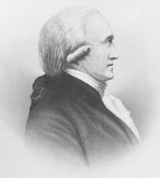
Benjamin Hawkins

Encyclopedia
Benjamin Hawkins was an American
planter, statesman, and United States Indian agent
. He was a delegate to the Continental Congress
and a United States Senator
from North Carolina
, having grown up among the planter elite. Appointed by George Washington as General Superintendent for Indian Affairs (1796–1818), he had responsibility for the territory of the Southeast south of the Ohio River, and was principal Indian agent to the Creek Indians.
Hawkins established the Creek Agency and his plantation in present-day Georgia, where he lived in what became Crawford County
. He learned the Muscogee
language, was adopted by the tribe and married Lavinia Downs, a Creek woman, with whom he had seven children. He wrote extensively about the Creek and other Southeast tribes: the Choctaw
, Cherokee
and Chickasaw
. He eventually built a large complex with African slave labor, including mills, and raised considerable livestock in cattle and hogs.
in what was then Granville County, North Carolina
, but is now Warren County
. He attended the College of New Jersey, later to become Princeton
, but left in his last year to join the Continental Army
. Hawkins was commissioned a Colonel and served for several years on George Washington
's staff as his main interpreter of French
.
Hawkins was released from federal service late in 1777, as Washington learned to rely on la Fayette for dealing with the French. He returned home, where he was elected to the North Carolina House of Representatives in 1778. He served there until 1779, and again in 1784. The Carolina Assembly sent him to the Continental Congress
as their delegate from 1781 to 1783, and again in 1787.
In 1789, Hawkins was a delegate to the North Carolina convention that ratified the United States Constitution
. He was elected to the first U.S. Senate, where he served from 1789 to 1795. Although the Senate did not have organized political parties at the time, Hawkins' views aligned with different groups. Early in his Senate career, he was counted in the ranks of those senators viewed as pro-Administration
, but by the third congress, he generally sided with senators of the Republican or Anti-Administration
Party.
 In 1785, Hawkins had served as a representative for the Congress in negotiations over land with the Creek Indians of the Southeast. He was generally successful, and convinced the tribe to lessen their raids for several years, although he could not conclude a formal treaty. The Creek wanted to deal with the 'head man'. They finally signed the Treaty of New York
after Hawkins convinced George Washington to become involved.
In 1786, Hawkins and fellow Indian agents Andrew Pickens
and Joseph Martin
concluded a treaty with the Choctaw
nation at Seneca Old Town, today's Hopewell, South Carolina
. They set out the boundaries for the Choctaw lands as well as provisions for relations between the tribe and the U.S. government.
In 1796, Washington appointed Benjamin Hawkins as General Superintendent of Indian Affairs, dealing with all tribes south of the Ohio River
. As principal agent to the Creek tribe, Hawkins soon moved to present-day Crawford County
in Georgia
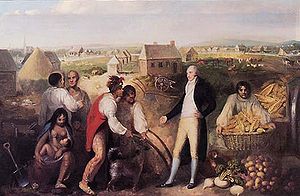
where he established his home and the Creek Agency. He studied the language and was adopted by the Creek. He wrote extensively about them and the other southeast tribes.
, and gained their Creek status from her.
Hawkins was close to his nephew William Hawkins of North Carolina, whom he made an executor of his estate along with his wife; he bequeathed him a share of his estate, reputed to be quite large. This bequest became a source of contention among his heirs, especially as he had not altered his will to include his last daughter Jeffersonia Hawkins.
. In time, he purchased enslaved Africans and hired other workers to clear several hundred acres for his plantation. They built a sawmill, gristmill and a trading post for the agency. Hawkins expanded his operation to include more than 1,000 head of cattle and a large number of hogs. For years, he met with chiefs on his porch and discussed matters there. His personal hard work and open-handed generosity won him such respect that reports say that he never lost an animal to Indian raiders.
He was responsible for 19 years of peace between the settlers and the tribe, the longest such period during European-American settlement. When in 1806 the government built a fort at the fall line of the Ocmulgee River
, to protect expanding settlements just east of modern Macon, Georgia
, the government named it Fort Benjamin Hawkins
in his honor.
Hawkins saw much of his work to preserve peace destroyed in 1812. A group of Upper Creek (who became known as the Red Sticks) were working to revive traditional ways, and they opposed the assimilation of the Lower Creek (with whom Hawkins worked closely) and continuing encroachment by European Americans. They allied with the Shawnee chief Tecumseh
of the Western Confederacy
to resist increasing settlement by European Americans. During the War of 1812
, the British encouraged the Red Stick resistance. Although Hawkins was not attacked, he was dismayed by the damage to the Creek people from their civil war
, with the White Sticks and Red Sticks at odds.
During the Creek War
of 1813-1814, Hawkins organized the friendly Lower Creek under Major William McIntosh, a chief, to aid Georgia and Tennessee militias in their forays against the Red Sticks. General Andrew Jackson
led the defeat of the Red Sticks at the Battle of Horseshoe Bend in present-day Alabama. Hawkins was unable to attend negotiations of the Treaty of Fort Jackson
in August 1814, which required the Creek to cede most of their territory and give up their way of life. Hawkins later organized friendly Creek warriors against a British force on the Apalachicola River
; they had threatened to rally the scattered Red Sticks and reignite the war on the Georgia frontier. After the British withdrew in 1815, Hawkins was organizing a force to secure the area when he died from a sudden illness in June 1816.
Hawkins never recovered from the shock of the Creek civil war. He tried to resign his post and return from the Georgia wilderness, but his resignation was refused by every president after Washington. He remained Superintendent until his death on June 6, 1816. At the end of his life, he formally married Lavina Downs in a European-American ceremony, making their children legitimate in United States society. They already belonged to Downs' clan
among the Creek, as they had a matrilineal system; this gave them status in the tribe.
Benjamin Hawkins was buried32°40′0.61"N 84°5′45.73"W at the Creek Agency near the Flint River and Roberta, Georgia
.
Fort Hawkins was built overlooking the ancient site since designated as the Ocmulgee National Monument
. Revealing 17,000 years of human habitation, it is a National Historic Landmark
and has been sacred for centuries to the Creek. It has massive earthwork mounds
built nearly 1,000 years ago as expressions of the religious and political world of the Mississippian culture
, the ancestors to the Creek.
The archeological site of the original Fort Benjamin Hawkins
is listed on the National Register of Historic Places
(NRHP), and it is within the Fort Hill Historic District of Macon, Georgia, also listed on the NRHP.
United States
The United States of America is a federal constitutional republic comprising fifty states and a federal district...
planter, statesman, and United States Indian agent
Indian agent
In United States history, an Indian agent was an individual authorized to interact with Native American tribes on behalf of the U.S. government.-Indian agents:*Leander Clark was agent for the Sac and Fox in Iowa beginning in 1866....
. He was a delegate to the Continental Congress
Continental Congress
The Continental Congress was a convention of delegates called together from the Thirteen Colonies that became the governing body of the United States during the American Revolution....
and a United States Senator
United States Senate
The United States Senate is the upper house of the bicameral legislature of the United States, and together with the United States House of Representatives comprises the United States Congress. The composition and powers of the Senate are established in Article One of the U.S. Constitution. Each...
from North Carolina
North Carolina
North Carolina is a state located in the southeastern United States. The state borders South Carolina and Georgia to the south, Tennessee to the west and Virginia to the north. North Carolina contains 100 counties. Its capital is Raleigh, and its largest city is Charlotte...
, having grown up among the planter elite. Appointed by George Washington as General Superintendent for Indian Affairs (1796–1818), he had responsibility for the territory of the Southeast south of the Ohio River, and was principal Indian agent to the Creek Indians.
Hawkins established the Creek Agency and his plantation in present-day Georgia, where he lived in what became Crawford County
Crawford County, Georgia
Crawford County is a county located in the U.S. state of Georgia. As of 2000, the population was 12,495. The 2007 Census Estimate shows a population of 12,483. The unincorporated county seat is Knoxville.-History:...
. He learned the Muscogee
Muskogean languages
Muskogean is an indigenous language family of the Southeastern United States. Though there is an ongoing debate concerning their interrelationships, the Muskogean languages are generally divided into two branches, Eastern Muskogean and Western Muskogean...
language, was adopted by the tribe and married Lavinia Downs, a Creek woman, with whom he had seven children. He wrote extensively about the Creek and other Southeast tribes: the Choctaw
Choctaw
The Choctaw are a Native American people originally from the Southeastern United States...
, Cherokee
Cherokee
The Cherokee are a Native American people historically settled in the Southeastern United States . Linguistically, they are part of the Iroquoian language family...
and Chickasaw
Chickasaw
The Chickasaw are Native American people originally from the region that would become the Southeastern United States...
. He eventually built a large complex with African slave labor, including mills, and raised considerable livestock in cattle and hogs.
Biography
Hawkins was born to Philemon and Delia Martin Hawkins on August 15, 1754, the third of four sons. The family farmed and operated a plantationPlantation
A plantation is a long artificially established forest, farm or estate, where crops are grown for sale, often in distant markets rather than for local on-site consumption...
in what was then Granville County, North Carolina
Granville County, North Carolina
-Demographics:As of the census of 2010, there were 59,916 people in 20,628 households residing in the county. The population density was 111.6 people per square mile . There were 22,827 housing units at an average density of 42.5 per square mile...
, but is now Warren County
Warren County, North Carolina
-Demographics:As of the census of 2000, there were 19,972 people, 7,708 households, and 5,449 families residing in the county. The population density was 47 people per square mile . There were 10,548 housing units at an average density of 25 per square mile...
. He attended the College of New Jersey, later to become Princeton
Princeton University
Princeton University is a private research university located in Princeton, New Jersey, United States. The school is one of the eight universities of the Ivy League, and is one of the nine Colonial Colleges founded before the American Revolution....
, but left in his last year to join the Continental Army
Continental Army
The Continental Army was formed after the outbreak of the American Revolutionary War by the colonies that became the United States of America. Established by a resolution of the Continental Congress on June 14, 1775, it was created to coordinate the military efforts of the Thirteen Colonies in...
. Hawkins was commissioned a Colonel and served for several years on George Washington
George Washington
George Washington was the dominant military and political leader of the new United States of America from 1775 to 1799. He led the American victory over Great Britain in the American Revolutionary War as commander-in-chief of the Continental Army from 1775 to 1783, and presided over the writing of...
's staff as his main interpreter of French
French language
French is a Romance language spoken as a first language in France, the Romandy region in Switzerland, Wallonia and Brussels in Belgium, Monaco, the regions of Quebec and Acadia in Canada, and by various communities elsewhere. Second-language speakers of French are distributed throughout many parts...
.
Hawkins was released from federal service late in 1777, as Washington learned to rely on la Fayette for dealing with the French. He returned home, where he was elected to the North Carolina House of Representatives in 1778. He served there until 1779, and again in 1784. The Carolina Assembly sent him to the Continental Congress
Continental Congress
The Continental Congress was a convention of delegates called together from the Thirteen Colonies that became the governing body of the United States during the American Revolution....
as their delegate from 1781 to 1783, and again in 1787.
In 1789, Hawkins was a delegate to the North Carolina convention that ratified the United States Constitution
United States Constitution
The Constitution of the United States is the supreme law of the United States of America. It is the framework for the organization of the United States government and for the relationship of the federal government with the states, citizens, and all people within the United States.The first three...
. He was elected to the first U.S. Senate, where he served from 1789 to 1795. Although the Senate did not have organized political parties at the time, Hawkins' views aligned with different groups. Early in his Senate career, he was counted in the ranks of those senators viewed as pro-Administration
Pro-Administration Party (United States)
Pro-Administration "Party" is a term by historians to describe the supporters of the policies of George Washington's administration — especially Treasury Secretary Alexander Hamilton's financial policies — prior to the formation of the Federalist and Democratic-Republican Parties.Almost the entire...
, but by the third congress, he generally sided with senators of the Republican or Anti-Administration
Anti-Administration Party (United States)
Anti-Administration "Party" was the informal faction comprising the opponents of the policies of Treasury Secretary Alexander Hamilton in the first term of President George Washington. This was not an organized political party but an unorganized faction...
Party.
US Indian Agent
Treaty of New York
The Treaty of New York is one of several treaties signed between the United States and Native American tribes, conducted in the city of New York.-1790:...
after Hawkins convinced George Washington to become involved.
In 1786, Hawkins and fellow Indian agents Andrew Pickens
Andrew Pickens (congressman)
Andrew Pickens was a militia leader in the American Revolution and a member of the United States House of Representatives from South Carolina.-Early life:...
and Joseph Martin
Joseph Martin (general)
Joseph Martin was a brigadier general in the Virginia militia during the American Revolutionary War, in which Martin's frontier diplomacy with the Cherokee people is credited with averting Indian attacks on the Scotch-Irish settlers who helped win the battles of Kings Mountain and Cowpens...
concluded a treaty with the Choctaw
Choctaw
The Choctaw are a Native American people originally from the Southeastern United States...
nation at Seneca Old Town, today's Hopewell, South Carolina
Hopewell, York County, South Carolina
Hopewell is an unincorporated community in York County, South Carolina, United States. It lies at an elevation of 587 feet ....
. They set out the boundaries for the Choctaw lands as well as provisions for relations between the tribe and the U.S. government.
In 1796, Washington appointed Benjamin Hawkins as General Superintendent of Indian Affairs, dealing with all tribes south of the Ohio River
Ohio River
The Ohio River is the largest tributary, by volume, of the Mississippi River. At the confluence, the Ohio is even bigger than the Mississippi and, thus, is hydrologically the main stream of the whole river system, including the Allegheny River further upstream...
. As principal agent to the Creek tribe, Hawkins soon moved to present-day Crawford County
Crawford County, Georgia
Crawford County is a county located in the U.S. state of Georgia. As of 2000, the population was 12,495. The 2007 Census Estimate shows a population of 12,483. The unincorporated county seat is Knoxville.-History:...
in Georgia
Georgia (U.S. state)
Georgia is a state located in the southeastern United States. It was established in 1732, the last of the original Thirteen Colonies. The state is named after King George II of Great Britain. Georgia was the fourth state to ratify the United States Constitution, on January 2, 1788...
where he established his home and the Creek Agency. He studied the language and was adopted by the Creek. He wrote extensively about them and the other southeast tribes.
Marriage and family
He made a common-law marriage for years with Lavinia Downs, a Creek woman. They had a total of six daughters: Georgia, Muscogee, Cherokee, Carolina, Virginia, and Jeffersonia, and one son, Madison Hawkins. In 1812, thinking he was on his death bed, Hawkins married Lavinia formally in the European-American style to make their children legitimate in US society. Jeffersonia was born after this marriage. As the Creek had a matrilineal system, all the children were born into their mother's clanClan
A clan is a group of people united by actual or perceived kinship and descent. Even if lineage details are unknown, clan members may be organized around a founding member or apical ancestor. The kinship-based bonds may be symbolical, whereby the clan shares a "stipulated" common ancestor that is a...
, and gained their Creek status from her.
Hawkins was close to his nephew William Hawkins of North Carolina, whom he made an executor of his estate along with his wife; he bequeathed him a share of his estate, reputed to be quite large. This bequest became a source of contention among his heirs, especially as he had not altered his will to include his last daughter Jeffersonia Hawkins.
Georgia
Hawkins began to teach European-American agricultural practices to the Creek, and started a farm at his and Lavina's home on the Flint RiverFlint River (Georgia)
The Flint River is a river in the U.S. state of Georgia. The river drains of western Georgia, flowing south from the upper Piedmont region south of Atlanta to the wetlands of the Gulf Coastal Plain in the southwestern corner of the state. Along with the Apalachicola and the Chattahoochee rivers,...
. In time, he purchased enslaved Africans and hired other workers to clear several hundred acres for his plantation. They built a sawmill, gristmill and a trading post for the agency. Hawkins expanded his operation to include more than 1,000 head of cattle and a large number of hogs. For years, he met with chiefs on his porch and discussed matters there. His personal hard work and open-handed generosity won him such respect that reports say that he never lost an animal to Indian raiders.
He was responsible for 19 years of peace between the settlers and the tribe, the longest such period during European-American settlement. When in 1806 the government built a fort at the fall line of the Ocmulgee River
Ocmulgee River
The Ocmulgee River is a tributary of the Altamaha River, approximately 255 mi long, in the U.S. state of Georgia...
, to protect expanding settlements just east of modern Macon, Georgia
Macon, Georgia
Macon is a city located in central Georgia, US. Founded at the fall line of the Ocmulgee River, it is part of the Macon metropolitan area, and the county seat of Bibb County. A small portion of the city extends into Jones County. Macon is the biggest city in central Georgia...
, the government named it Fort Benjamin Hawkins
Fort Benjamin Hawkins
Fort Hawkins was a fort built in 1806-1809 in the historic Creek Nation by the United States government under President Thomas Jefferson and used until 1821...
in his honor.
Hawkins saw much of his work to preserve peace destroyed in 1812. A group of Upper Creek (who became known as the Red Sticks) were working to revive traditional ways, and they opposed the assimilation of the Lower Creek (with whom Hawkins worked closely) and continuing encroachment by European Americans. They allied with the Shawnee chief Tecumseh
Tecumseh
Tecumseh was a Native American leader of the Shawnee and a large tribal confederacy which opposed the United States during Tecumseh's War and the War of 1812...
of the Western Confederacy
Western Confederacy
The Western Confederacy, also known as Western Indian Confederacy, was a loose confederacy of North American Natives in the Great Lakes region following the American Revolutionary War...
to resist increasing settlement by European Americans. During the War of 1812
War of 1812
The War of 1812 was a military conflict fought between the forces of the United States of America and those of the British Empire. The Americans declared war in 1812 for several reasons, including trade restrictions because of Britain's ongoing war with France, impressment of American merchant...
, the British encouraged the Red Stick resistance. Although Hawkins was not attacked, he was dismayed by the damage to the Creek people from their civil war
Creek War
The Creek War , also known as the Red Stick War and the Creek Civil War, began as a civil war within the Creek nation...
, with the White Sticks and Red Sticks at odds.
During the Creek War
Creek War
The Creek War , also known as the Red Stick War and the Creek Civil War, began as a civil war within the Creek nation...
of 1813-1814, Hawkins organized the friendly Lower Creek under Major William McIntosh, a chief, to aid Georgia and Tennessee militias in their forays against the Red Sticks. General Andrew Jackson
Andrew Jackson
Andrew Jackson was the seventh President of the United States . Based in frontier Tennessee, Jackson was a politician and army general who defeated the Creek Indians at the Battle of Horseshoe Bend , and the British at the Battle of New Orleans...
led the defeat of the Red Sticks at the Battle of Horseshoe Bend in present-day Alabama. Hawkins was unable to attend negotiations of the Treaty of Fort Jackson
Treaty of Fort Jackson
The Treaty of Fort Jackson was signed on August 9, 1814 at Fort Jackson near Wetumpka, Alabama following the defeat of the Red Stick resistance by United States allied forces at the Battle of Horseshoe Bend. It occurred on the banks of the Tallapoosa River near the present city of Alexander City,...
in August 1814, which required the Creek to cede most of their territory and give up their way of life. Hawkins later organized friendly Creek warriors against a British force on the Apalachicola River
Apalachicola River
The Apalachicola River is a river, approximately 112 mi long in the State of Florida. This river's large watershed, known as the ACF River Basin for short, drains an area of approximately into the Gulf of Mexico. The distance to its farthest headstream in northeast Georgia is approximately 500...
; they had threatened to rally the scattered Red Sticks and reignite the war on the Georgia frontier. After the British withdrew in 1815, Hawkins was organizing a force to secure the area when he died from a sudden illness in June 1816.
Hawkins never recovered from the shock of the Creek civil war. He tried to resign his post and return from the Georgia wilderness, but his resignation was refused by every president after Washington. He remained Superintendent until his death on June 6, 1816. At the end of his life, he formally married Lavina Downs in a European-American ceremony, making their children legitimate in United States society. They already belonged to Downs' clan
Clan
A clan is a group of people united by actual or perceived kinship and descent. Even if lineage details are unknown, clan members may be organized around a founding member or apical ancestor. The kinship-based bonds may be symbolical, whereby the clan shares a "stipulated" common ancestor that is a...
among the Creek, as they had a matrilineal system; this gave them status in the tribe.
Benjamin Hawkins was buried32°40′0.61"N 84°5′45.73"W at the Creek Agency near the Flint River and Roberta, Georgia
Roberta, Georgia
Roberta is a city in Crawford County, Georgia, United States. The population was 808 at the 2000 census. It is part of the Macon Metropolitan Statistical Area.-Geography:Roberta is located at ....
.
Fort Hawkins was built overlooking the ancient site since designated as the Ocmulgee National Monument
Ocmulgee National Monument
Ocmulgee National Monument preserves traces of over ten millennia of Southeastern Native American culture, including major earthworks built more than 1,000 years ago by Mississippian culture peoples: the Great Temple and other ceremonial mounds, a burial mound, and defensive trenches...
. Revealing 17,000 years of human habitation, it is a National Historic Landmark
National Historic Landmark
A National Historic Landmark is a building, site, structure, object, or district, that is officially recognized by the United States government for its historical significance...
and has been sacred for centuries to the Creek. It has massive earthwork mounds
Earthworks (archaeology)
In archaeology, earthwork is a general term to describe artificial changes in land level. Earthworks are often known colloquially as 'lumps and bumps'. Earthworks can themselves be archaeological features or they can show features beneath the surface...
built nearly 1,000 years ago as expressions of the religious and political world of the Mississippian culture
Mississippian culture
The Mississippian culture was a mound-building Native American culture that flourished in what is now the Midwestern, Eastern, and Southeastern United States from approximately 800 CE to 1500 CE, varying regionally....
, the ancestors to the Creek.
Legacy and honors
- Hawkins CountyHawkins County, TennesseeHawkins County is a county located in the U.S. state of Tennessee. As of 2010, the population was 56,833. Its county seat is Rogersville, Tennessee's second-oldest town....
in TennesseeTennesseeTennessee is a U.S. state located in the Southeastern United States. It has a population of 6,346,105, making it the nation's 17th-largest state by population, and covers , making it the 36th-largest by total land area...
is named in his honor. - Boy Scout Camp Benjamin Hawkins near Byron, Georgia is named in his honor.
The archeological site of the original Fort Benjamin Hawkins
Fort Benjamin Hawkins
Fort Hawkins was a fort built in 1806-1809 in the historic Creek Nation by the United States government under President Thomas Jefferson and used until 1821...
is listed on the National Register of Historic Places
National Register of Historic Places
The National Register of Historic Places is the United States government's official list of districts, sites, buildings, structures, and objects deemed worthy of preservation...
(NRHP), and it is within the Fort Hill Historic District of Macon, Georgia, also listed on the NRHP.
Further reading
- Robbie Franklyn Ethridge, Creek Country: The Creek Indians and Their World, Chapel Hill: University of North Carolina Press, 2003.
- Thomas Foster, editor. The Collected Works of Benjamin Hawkins, 1796-1810. 2003, University of Alabama Press, ISBN 0-8173-5040-3.
- C. L. Grant, editor. Benjamin Hawkins: Letters, Journals and Writings. 2 volumes. 1980, Beehive Press, volume 1: ISBN 99921-1-543-2, volume 2: ISBN 99938-28-28-9.
- Florette Henri. The Southern Indians and Benjamin Hawkins, 1796-1816. 1986, University of Oklahoma Press, ISBN 0-8061-1968-3.
External links
Retrieved on 2009-03-04- Merritt B. Pound, "Benjamin Hawkins, Indian Agent", Digital Library of Georgia
- "Benjamin Hawkins", New Georgia Encyclopedia
- "Benjamin Hawkins", History and Culture, Ocmulgee National Monument, National Park Service
- "Benjamin Hawkins", Horseshoe Bend National Military Park
- "Camp Benjamin Hawkins", Boy Scouts of America