

Belzig

Encyclopedia
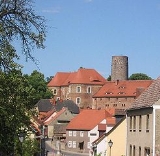
Bad Belzig, also known as Belzig, is a historic town
in Brandenburg
, Germany
located about 70 km (43.5 mi) southwest of Berlin
. It is the capital of the Potsdam-Mittelmark
district.
hill range and in the centre of the High Fläming Nature Park
. The plains north of the town are home to one of the few Great Bustard
populations in Germany.
Since 2003, when 14 surrounding villages were incorporated into Bad Belzig, some of them voluntarily, others by Brandenburg Landtag
(state parliament) legislation, Bad Belzig has an area of 234.83 km². These villages became districts (Ortsteile) of Belzig:
The forest of Verlorenwasser near Werbig encompassed the geographical centre
of East Germany.
fort of Belizi was first mentioned in a 997 deed issued by Emperor Otto III
in favour of the Archbishopric of Magdeburg
. Whether this denotation refers to Bad Belzig or the neighbouring town of Beelitz
has not been conclusively established. Nevertheless both towns celebrated their 1000 years anniversary in 1997.
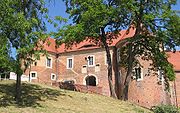
 The estates however had actually already been lost in the Slavic uprising of 983 and were not conquered again until 1153 by Albert the Bear from the House of Ascania. In 1251 the castle (Burg Eisenhardt) and the adjacent settlement became part of Saxe-Wittenberg
under Albert's successor Duke Albert I
. However it was claimed by the bishops of Magdeburg, whose forces devastated Belzig in 1406. The rebuilt castle was again seized by the Hussite
general Prokop the Great
when he invaded Saxony in 1429, after which Elector Ernest of Saxony
from the House of Wettin enlarged it to a fortress. During the Thirty Years' War
it was seized by the troops of the Swedish Empire
in 1636, after Elector John George I
had allied with Emperor Ferdinand II
in the Peace of Prague
.
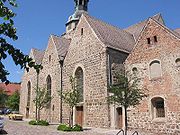
The Romanesque
St Mary's Church was built in the late 13th century. According to an inscription in the keystone
of the western entrance, Martin Luther
preached here on January 14, 1530. Eisenhardt Castle. Bad Belzig was granted town privileges
in 1702. During the War of the Sixth Coalition
on August 27, 1813 troops of the French Empire
and Saxony were attacked by Prussian
and Russian
forces near the village of Hagelberg. The encounter ended in a French defeat, while several Saxon units went over to the Prussians. According to the Final Act of the 1815 Congress of Vienna
Bad Belzig was ceded to Prussia and became part of the Province of Brandenburg
, after having belonged to the Saxon Electorate for centuries.
In 1934 ammunition works were established in Bad Belzig including a labor camp
with about 1500 forced laborers. During the years 1936-1945, Burg Eisenhardt was the site of the Reichsschule (leadership school) for the Technischen Nothilfe ('technical emergency relief'). (The Technische Nothilfe was abolished in May, 1945, but the idea was revived by Otto Lummitzsch in the form of the Technisches Hilfswerk
in 1950, which exists to this day as one of the pillars of the German civil protection infrastructure.) Between 1940 and 1945 a subcamp of the women's concentration camp Ravensbrück
with about 750 inmates was also located nearby. Bad Belzig was also the site of a large radio
transmitter station, erected in 1939. In 1952 the town became the capital of the Belzig district and in 1993 of the newly created district of Potsdam-Mittelmark
. In 1995 Bad Belzig was awarded the official title of a climatic health resort. Effective March 2010, the town's name was changed to "Bad Belzig".
 Hannelore Klabunde is mayor of Bad Belzig. On September 28, 2008 she was directly elected with a support of 57,5% of the vote.
The municipal assembly (Stadtverordnetenversammlung) has 22 members. As of the 2008 elections the Social Democrats (SPD
) have 5 seats, the Left Party (Die Linke) 4, the Christian Democrats (CDU
) 4, Free Voters
2 and the Liberals (FDP) and the Greens (Grüne
) 1 seat each. The remaining seats went to small local groups.
The town's shield depicts the coat of arms of Saxony
due to the long-time affiliation with the Saxon Electorate
.
with Ritterhude
, a town in the German state of Lower Saxony
.
 Bad Belzig exchanges students with Even Yehuda. ( Israel. )Yet, there is not official agreement between the cities. ( Ciatation is needed. )
Places of interest in the incorporated villages include Glien Manor (Klein Glien) in Hagelberg and the windmill in Borne.
Town
A town is a human settlement larger than a village but smaller than a city. The size a settlement must be in order to be called a "town" varies considerably in different parts of the world, so that, for example, many American "small towns" seem to British people to be no more than villages, while...
in Brandenburg
Brandenburg
Brandenburg is one of the sixteen federal-states of Germany. It lies in the east of the country and is one of the new federal states that were re-created in 1990 upon the reunification of the former West Germany and East Germany. The capital is Potsdam...
, Germany
Germany
Germany , officially the Federal Republic of Germany , is a federal parliamentary republic in Europe. The country consists of 16 states while the capital and largest city is Berlin. Germany covers an area of 357,021 km2 and has a largely temperate seasonal climate...
located about 70 km (43.5 mi) southwest of Berlin
Berlin
Berlin is the capital city of Germany and is one of the 16 states of Germany. With a population of 3.45 million people, Berlin is Germany's largest city. It is the second most populous city proper and the seventh most populous urban area in the European Union...
. It is the capital of the Potsdam-Mittelmark
Potsdam-Mittelmark
Potsdam-Mittelmark is a Kreis in the western part of Brandenburg, Germany. Neighboring are the district Havelland, the district free cities Brandenburg and Potsdam, the Bundesland Berlin, the district Teltow-Fläming, and the districts Wittenberg, Anhalt-Bitterfeld and Jerichower Land in...
district.
Geography
Bad Belzig is located within the FlämingFläming
The Fläming Heath is a region and a hill chain that reaches over 100 km from the Elbe river to the Dahme River in the German states Saxony-Anhalt and Brandenburg. Its highest elevation is the Hagelberg...
hill range and in the centre of the High Fläming Nature Park
High Fläming Nature Park
High Fläming Nature Park is a 827 km² nature park in Potsdam-Mittelmark district in the German state Brandenburg. It is the third largest of 11 nature parks in the state of Brandenburg...
. The plains north of the town are home to one of the few Great Bustard
Great Bustard
The Great Bustard is in the bustard family, the only member of the genus Otis. It breeds in southern and central Europe, where it is the largest species of bird, and across temperate Asia...
populations in Germany.
Since 2003, when 14 surrounding villages were incorporated into Bad Belzig, some of them voluntarily, others by Brandenburg Landtag
Landtag
A Landtag is a representative assembly or parliament in German-speaking countries with some legislative authority.- Name :...
(state parliament) legislation, Bad Belzig has an area of 234.83 km². These villages became districts (Ortsteile) of Belzig:
|
|
|
The forest of Verlorenwasser near Werbig encompassed the geographical centre
Geographical centre
In geography, the centroid of the two-dimensional shape of region of the Earth's surface is often known as its geographical centre. There has long been debate over the methods of calculation of the geographical centres of various countries and regions, such as whether to include offshore islands,...
of East Germany.
History
A SlavicSlavic peoples
The Slavic people are an Indo-European panethnicity living in Eastern Europe, Southeast Europe, North Asia and Central Asia. The term Slavic represents a broad ethno-linguistic group of people, who speak languages belonging to the Slavic language family and share, to varying degrees, certain...
fort of Belizi was first mentioned in a 997 deed issued by Emperor Otto III
Otto III, Holy Roman Emperor
Otto III , a King of Germany, was the fourth ruler of the Saxon or Ottonian dynasty of the Holy Roman Empire. He was elected King in 983 on the death of his father Otto II and was crowned Holy Roman Emperor in 996.-Early reign:...
in favour of the Archbishopric of Magdeburg
Archbishopric of Magdeburg
The Archbishopric of Magdeburg was a Roman Catholic archdiocese and Prince-Bishopric of the Holy Roman Empire centered on the city of Magdeburg on the Elbe River....
. Whether this denotation refers to Bad Belzig or the neighbouring town of Beelitz
Beelitz
Beelitz is a town in the Potsdam-Mittelmark district, in Brandenburg, Germany. It is situated about 18 km south of Potsdam, in a glacial sandur plain surrounded by extended pine woods...
has not been conclusively established. Nevertheless both towns celebrated their 1000 years anniversary in 1997.
Saxe-Wittenberg
The Duchy of Saxe-Wittenberg was a medieval duchy of the Holy Roman Empire centered at Wittenberg, which emerged after the dissolution of the stem duchy of Saxony. As the precursor of the Saxon Electorate, the Ascanian Wittenberg dukes prevailed in obtaining the Saxon electoral dignity.-Ascanian...
under Albert's successor Duke Albert I
Albert I, Duke of Saxony
Albert I was a Duke of Saxony, Angria, and Westphalia; Lord of Nordalbingia; Count of Anhalt; and Prince-elector and Archmarshal of the Holy Roman Empire...
. However it was claimed by the bishops of Magdeburg, whose forces devastated Belzig in 1406. The rebuilt castle was again seized by the Hussite
Hussite
The Hussites were a Christian movement following the teachings of Czech reformer Jan Hus , who became one of the forerunners of the Protestant Reformation...
general Prokop the Great
Prokop the Great
Prokop or Prokop the Great was one of the most prominent Hussite generals of the Hussite Wars...
when he invaded Saxony in 1429, after which Elector Ernest of Saxony
Ernest, Elector of Saxony
Ernst, Elector of Saxony was Elector of Saxony from 1464 to 1486.-Biography:Ernst was founder of the Ernestine line of Saxon princes, ancestor of George I of Great Britain, Prince Albert of Saxe-Coburg and Gotha, as well as his wife and cousin Queen Victoria of the United Kingdom, and their...
from the House of Wettin enlarged it to a fortress. During the Thirty Years' War
Thirty Years' War
The Thirty Years' War was fought primarily in what is now Germany, and at various points involved most countries in Europe. It was one of the most destructive conflicts in European history....
it was seized by the troops of the Swedish Empire
Swedish Empire
The Swedish Empire refers to the Kingdom of Sweden between 1561 and 1721 . During this time, Sweden was one of the great European powers. In Swedish, the period is called Stormaktstiden, literally meaning "the Great Power Era"...
in 1636, after Elector John George I
John George I, Elector of Saxony
John George I was Elector of Saxony from 1611 to 1656.-Biography:Born in Dresden, he was the second son of the Elector Christian I and Sophie of Brandenburg....
had allied with Emperor Ferdinand II
Ferdinand II, Holy Roman Emperor
Ferdinand II , a member of the House of Habsburg, was Holy Roman Emperor , King of Bohemia , and King of Hungary . His rule coincided with the Thirty Years' War.- Life :...
in the Peace of Prague
Peace of Prague (1635)
The Peace of Prague of 30 May 1635 was a treaty between the Habsburg Emperor Ferdinand II and the Electorate of Saxony representing most of the Protestant states of the Holy Roman Empire...
.
The Romanesque
Romanesque architecture
Romanesque architecture is an architectural style of Medieval Europe characterised by semi-circular arches. There is no consensus for the beginning date of the Romanesque architecture, with proposals ranging from the 6th to the 10th century. It developed in the 12th century into the Gothic style,...
St Mary's Church was built in the late 13th century. According to an inscription in the keystone
Keystone (architecture)
A keystone is the wedge-shaped stone piece at the apex of a masonry vault or arch, which is the final piece placed during construction and locks all the stones into position, allowing the arch to bear weight. This makes a keystone very important structurally...
of the western entrance, Martin Luther
Martin Luther
Martin Luther was a German priest, professor of theology and iconic figure of the Protestant Reformation. He strongly disputed the claim that freedom from God's punishment for sin could be purchased with money. He confronted indulgence salesman Johann Tetzel with his Ninety-Five Theses in 1517...
preached here on January 14, 1530. Eisenhardt Castle. Bad Belzig was granted town privileges
German town law
German town law or German municipal concerns concerns town privileges used by many cities, towns, and villages throughout Central and Eastern Europe during the Middle Ages.- Town law in Germany :...
in 1702. During the War of the Sixth Coalition
War of the Sixth Coalition
In the War of the Sixth Coalition , a coalition of Austria, Prussia, Russia, the United Kingdom, Portugal, Sweden, Spain and a number of German States finally defeated France and drove Napoleon Bonaparte into exile on Elba. After Napoleon's disastrous invasion of Russia, the continental powers...
on August 27, 1813 troops of the French Empire
First French Empire
The First French Empire , also known as the Greater French Empire or Napoleonic Empire, was the empire of Napoleon I of France...
and Saxony were attacked by Prussian
Kingdom of Prussia
The Kingdom of Prussia was a German kingdom from 1701 to 1918. Until the defeat of Germany in World War I, it comprised almost two-thirds of the area of the German Empire...
and Russian
Russian Empire
The Russian Empire was a state that existed from 1721 until the Russian Revolution of 1917. It was the successor to the Tsardom of Russia and the predecessor of the Soviet Union...
forces near the village of Hagelberg. The encounter ended in a French defeat, while several Saxon units went over to the Prussians. According to the Final Act of the 1815 Congress of Vienna
Congress of Vienna
The Congress of Vienna was a conference of ambassadors of European states chaired by Klemens Wenzel von Metternich, and held in Vienna from September, 1814 to June, 1815. The objective of the Congress was to settle the many issues arising from the French Revolutionary Wars, the Napoleonic Wars,...
Bad Belzig was ceded to Prussia and became part of the Province of Brandenburg
Province of Brandenburg
The Province of Brandenburg was a province of the Kingdom of Prussia and the Free State of Prussia from 1815 to 1946.-History:The first people who are known to have inhabited Brandenburg were the Suevi. They were succeeded by the Slavonians, whom Henry II conquered and converted to Christianity in...
, after having belonged to the Saxon Electorate for centuries.
In 1934 ammunition works were established in Bad Belzig including a labor camp
Labor camp
A labor camp is a simplified detention facility where inmates are forced to engage in penal labor. Labor camps have many common aspects with slavery and with prisons...
with about 1500 forced laborers. During the years 1936-1945, Burg Eisenhardt was the site of the Reichsschule (leadership school) for the Technischen Nothilfe ('technical emergency relief'). (The Technische Nothilfe was abolished in May, 1945, but the idea was revived by Otto Lummitzsch in the form of the Technisches Hilfswerk
Technisches Hilfswerk
The Bundesanstalt Technisches Hilfswerk is a civil protection organisation controlled by the German federal government...
in 1950, which exists to this day as one of the pillars of the German civil protection infrastructure.) Between 1940 and 1945 a subcamp of the women's concentration camp Ravensbrück
Ravensbrück concentration camp
Ravensbrück was a notorious women's concentration camp during World War II, located in northern Germany, 90 km north of Berlin at a site near the village of Ravensbrück ....
with about 750 inmates was also located nearby. Bad Belzig was also the site of a large radio
Radio
Radio is the transmission of signals through free space by modulation of electromagnetic waves with frequencies below those of visible light. Electromagnetic radiation travels by means of oscillating electromagnetic fields that pass through the air and the vacuum of space...
transmitter station, erected in 1939. In 1952 the town became the capital of the Belzig district and in 1993 of the newly created district of Potsdam-Mittelmark
Potsdam-Mittelmark
Potsdam-Mittelmark is a Kreis in the western part of Brandenburg, Germany. Neighboring are the district Havelland, the district free cities Brandenburg and Potsdam, the Bundesland Berlin, the district Teltow-Fläming, and the districts Wittenberg, Anhalt-Bitterfeld and Jerichower Land in...
. In 1995 Bad Belzig was awarded the official title of a climatic health resort. Effective March 2010, the town's name was changed to "Bad Belzig".
Politics
The municipal assembly (Stadtverordnetenversammlung) has 22 members. As of the 2008 elections the Social Democrats (SPD
Social Democratic Party of Germany
The Social Democratic Party of Germany is a social-democratic political party in Germany...
) have 5 seats, the Left Party (Die Linke) 4, the Christian Democrats (CDU
Christian Democratic Union (Germany)
The Christian Democratic Union of Germany is a Christian democratic and conservative political party in Germany. It is regarded as on the centre-right of the German political spectrum...
) 4, Free Voters
Free Voters
Free Voters is a German concept in which an association of persons participates in an election without having the status of a registered political party. Usually it is a locally organized group of voters in the form of a registered association . In most cases, Free Voters are active only at the...
2 and the Liberals (FDP) and the Greens (Grüne
Alliance '90/The Greens
Alliance '90/The Greens is a green political party in Germany, formed from the merger of the German Green Party and Alliance 90 in 1993. Its leaders are Claudia Roth and Cem Özdemir...
) 1 seat each. The remaining seats went to small local groups.
The town's shield depicts the coat of arms of Saxony
Coat of arms of Saxony
-See also:*Royal Arms of England*Coat of arms of Portugal*Coat of arms of Belgium*Coat of arms of Bulgaria...
due to the long-time affiliation with the Saxon Electorate
Electorate of Saxony
The Electorate of Saxony , sometimes referred to as Upper Saxony, was a State of the Holy Roman Empire. It was established when Emperor Charles IV raised the Ascanian duchy of Saxe-Wittenberg to the status of an Electorate by the Golden Bull of 1356...
.
International relations
Bad Belzig is twinnedTown twinning
Twin towns and sister cities are two of many terms used to describe the cooperative agreements between towns, cities, and even counties in geographically and politically distinct areas to promote cultural and commercial ties.- Terminology :...
with Ritterhude
Ritterhude
Ritterhude is a municipality in the district of Osterholz, in Lower Saxony, Germany. It is situated on the Hamme River, approx. 6 km southwest of Osterholz-Scharmbeck, and 13 km northwest of Bremen.- Geographical location :...
, a town in the German state of Lower Saxony
Lower Saxony
Lower Saxony is a German state situated in north-western Germany and is second in area and fourth in population among the sixteen states of Germany...
.
Places of interest
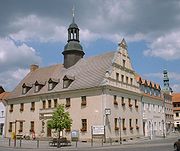
Main attractions are medieval Eisenhardt castle and the thermal bath SteinTherme. There is also a pittoresque historic town centre with the town hall and the market place in the middle.Places of interest in the incorporated villages include Glien Manor (Klein Glien) in Hagelberg and the windmill in Borne.