

Belly dance

Encyclopedia
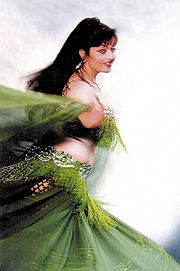
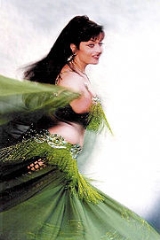
Belly dance or Bellydance is a "Western"-coined name for a traditional "Middle Eastern" dance, especially raqs sharqi . It is sometimes also called Middle Eastern dance or Arabic dance in the West, or by the Greco
Greek language
Greek is an independent branch of the Indo-European family of languages. Native to the southern Balkans, it has the longest documented history of any Indo-European language, spanning 34 centuries of written records. Its writing system has been the Greek alphabet for the majority of its history;...
-Turkish
Turkish language
Turkish is a language spoken as a native language by over 83 million people worldwide, making it the most commonly spoken of the Turkic languages. Its speakers are located predominantly in Turkey and Northern Cyprus with smaller groups in Iraq, Greece, Bulgaria, the Republic of Macedonia, Kosovo,...
term çiftetelli . The belly dance style is also quite popular in
India, where it has deep cultural roots.
The term "Belly dance" is a translation of the French "danse du ventre" which was applied to the dance in the Victorian era
Victorian era
The Victorian era of British history was the period of Queen Victoria's reign from 20 June 1837 until her death on 22 January 1901. It was a long period of peace, prosperity, refined sensibilities and national self-confidence...
. It is something of a misnomer as every part of the body is involved in the dance; the most featured body part usually is the hips. Belly dance takes many different forms depending on country and region, both in costume and dance style, and new styles have evolved in the West as its popularity has spread globally. Although contemporary forms of the dance have generally been performed by women, some of the dances, particularly the cane dance, have origins in male forms of performance.
- Raqs sharqi is the style more familiar to Westerners, performed in restaurants and cabarets around the world. It is more commonly performed by female dancers but is also sometimes danced by men. It is a soloSolo (dance)A solo dance is danced by an individual dancing alone, as opposed to couples dancing together but independently of others dancing at the same time, if any, and as opposed to groups of people dancing simultaneously in a coordinated manner. Solo dancers are usually the best dancers in a group or...
improvisational dance, although students often perform choreographed dances in a group.
- Raqs baladi, ' onMouseout='HidePop("33849")' href="/topics/Folk">folkFolkThe English word Folk is derived from a Germanic noun, *fulka meaning "people" or "army"...
" dance) is the folkloric style, danced socially by men and women of all ages in some Middle Eastern countries, usually at festive occasions such as weddings.
Origins and early history
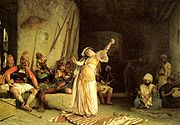
Belly dancing arose from various dancing styles which were performed in the Middle East
Middle East
The Middle East is a region that encompasses Western Asia and Northern Africa. It is often used as a synonym for Near East, in opposition to Far East...
and North Africa
North Africa
North Africa or Northern Africa is the northernmost region of the African continent, linked by the Sahara to Sub-Saharan Africa. Geopolitically, the United Nations definition of Northern Africa includes eight countries or territories; Algeria, Egypt, Libya, Morocco, South Sudan, Sudan, Tunisia, and...
. In Middle Eastern society two specific belly dance movements have been used in childbirth for generations. Another theory is that belly dance was originally danced by women for women in the Middle East
Middle East
The Middle East is a region that encompasses Western Asia and Northern Africa. It is often used as a synonym for Near East, in opposition to Far East...
, and North Africa
North Africa
North Africa or Northern Africa is the northernmost region of the African continent, linked by the Sahara to Sub-Saharan Africa. Geopolitically, the United Nations definition of Northern Africa includes eight countries or territories; Algeria, Egypt, Libya, Morocco, South Sudan, Sudan, Tunisia, and...
. The book "The dancing girl of Shamakha and other Asiatic tales" is cited, written by author Comte de Gobineau's. A final theory is that belly dance was always danced in the Middle East and North Africa as entertainment.
Belly dance was popularized in the West during the Romantic
Romanticism
Romanticism was an artistic, literary and intellectual movement that originated in the second half of the 18th century in Europe, and gained strength in reaction to the Industrial Revolution...
movement of the 18th and 19th centuries, when Orientalist
Orientalism
Orientalism is a term used for the imitation or depiction of aspects of Eastern cultures in the West by writers, designers and artists, as well as having other meanings...
artists depicted romanticized images of harem
Harem
Harem refers to the sphere of women in what is usually a polygynous household and their enclosed quarters which are forbidden to men...
life in the Ottoman Empire
Ottoman Empire
The Ottoman EmpireIt was usually referred to as the "Ottoman Empire", the "Turkish Empire", the "Ottoman Caliphate" or more commonly "Turkey" by its contemporaries...
. Around this time, dancers from Middle Eastern countries began to perform at various World's Fair
World's Fair
World's fair, World fair, Universal Exposition, and World Expo are various large public exhibitions held in different parts of the world. The first Expo was held in The Crystal Palace in Hyde Park, London, United Kingdom, in 1851, under the title "Great Exhibition of the Works of Industry of All...
s, often drawing crowds in numbers that rivaled those for the science and technology exhibits. It was during this period that the term "oriental" or "eastern" dancing is first used. Several dancers, including the French author Colette
Colette
Colette was the surname of the French novelist and performer Sidonie-Gabrielle Colette . She is best known for her novel Gigi, upon which Lerner and Loewe based the stage and film musical comedies of the same title.-Early life and marriage:Colette was born to retired military officer Jules-Joseph...
, engaged in "oriental" dancing, sometimes passing off their own interpretations as authentic.
Egyptian forms of belly dance, alongside the development of Egyptian music, were heavily influenced by the presence of European colonial forces, and increasing urbanisation in Egypt. This resulted in variations in the dance brought in by influences as diverse as marching bands, and visits of the Russian ballet
Russian ballet
Russian ballet is a form of ballet characteristic of or originating from Russia. In the early 19th century, the theaters were opened up to anyone who could afford a ticket. There was a seating section called a rayok, or 'paradise gallery', that consisted of simple wooden benches...
. All these factors contributed to the development of a variety of belly dances.
Costume
In the West, the costume most associated with belly dance is the bedlahBedlah
The bedlah is an Arabian costume normally worn by women. The word bedlah is Arabic for "suit".In the world of belly dance the term bedlah refers simply to the costume that a dancer wears...
(Arabic for "suit"). It owes its creation to the Victorian painters of "Orientalism
Orientalism
Orientalism is a term used for the imitation or depiction of aspects of Eastern cultures in the West by writers, designers and artists, as well as having other meanings...
" and the harem fantasy productions of vaudeville
Vaudeville
Vaudeville was a theatrical genre of variety entertainment in the United States and Canada from the early 1880s until the early 1930s. Each performance was made up of a series of separate, unrelated acts grouped together on a common bill...
, burlesque
Burlesque
Burlesque is a literary, dramatic or musical work intended to cause laughter by caricaturing the manner or spirit of serious works, or by ludicrous treatment of their subjects...
, and Hollywood during the turn of the 20th century, rather than to authentic West Asian ("Middle Eastern") dress. Maude Allan, an American dancer/artist, was famous for her Salome dance, and her costume was considered by many to set the standard of what Westerners would perceive as a bellydance costume.
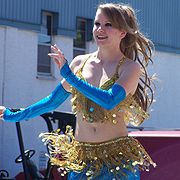
The bedlah style includes a fitted top or bra (usually with a fringe of beads or coins), a fitted hip belt (again with a fringe of beads or coins), and a skirt or harem pants. The bra and belt may be richly decorated with beads, sequins, braid and embroidery. The belt may be a separate piece, or sewn into a skirt.
Badia Masabni, a Cairo cabaret
Cabaret
Cabaret is a form, or place, of entertainment featuring comedy, song, dance, and theatre, distinguished mainly by the performance venue: a restaurant or nightclub with a stage for performances and the audience sitting at tables watching the performance, as introduced by a master of ceremonies or...
owner, is credited with bringing the costume to Egypt, because it was the image that Western tourists wanted.
The hip belt is a broad piece of fabric worn low on the hips. It may have straight edge, or may be curved or angled. The bra usually matches the belt and does not resemble lingerie. The classic harem pants are full and gathered at the ankle, but there are many variations. Sometimes pants and a sheer skirt are worn together. Skirts may be flowing creations made of multiple layers of one color sheer fabric chiffon.
Costume in Egypt
Since the 1950s, it has been illegal in Egypt for belly dancers to perform publicly with their midriff uncovered or to display excessive skin. It is therefore becoming more common to wear a long, figure-hugging lycra one-piece gown with strategically placed cut-outs filled in with sheer, flesh-colored.If a separate bra and skirt are worn, a belt is rarely used and any embellishment is embroidered directly on the tight, sleek lycra skirt. A sheer body stocking must be worn to cover the midsection. Egyptian dancers traditionally dance in bare feet, but these days often wear shoes and even high heels.
Costume in Lebanon
As there is no prohibition on showing the stomach in Lebanon, the bedleh style is more common. The skirts tend to be sheer and/or skimpier than Egyptian outfits, showing more of the dancer's body. The veil is more widely used and the veil matches the outfit. High heels are commonly worn.Costume in Turkey
Turkish dancers also wear bedleh style costumes. In the 80s and 90s a 'stripperesque' costume style developed, with skirts designed to display both legs up to the hip, and plunging bras. Such styles still exist in some venues but there are also many Turkish belly dancers who wear more moderate costumes. Even so, many Turkish belly dance costumes reflect the playful, flirty style of Turkish belly dance.Costume in America
"West Asian-style" American dancers often purchase their costumes from Egypt or Turkey, but hallmarks of the classical "American" style include a headband with fringe, sheer harem pantsHarem pants
Harem pants or harem trousers, also known as parachute pants, are women's baggy long pants tapered at the ankle, with side flaps on the hip that button at the waist area....
or skirt rather than tight lycra, and the use of coins and metalwork to decorate the bra.
For the folkloric and baladi dances, a full-length beledi dress or galabeyah is worn, with or without cutouts.
American Tribal style dancers often make their own costumes or arrange to have them custom-made, as personality and originality are an important part of the costuming. This style of costume tends to involve large pants covered with one or more skirts and belts. The top is usually a coin bra with pieces hanging from it, and dancers wear flowers, headbands, metal headdresses, and other folkoric-inspired pieces in their hair. They also often wear bindis and sport large tattoos that travel around the hip and belly area.
Belly dance props
Props are used, especially in American restaurant style, to spark or audience interest and add variety to the performance, although some traditionalists frown on their use. Some props in common usage are:- Finger cymbals (zills or sagats)
- Cane (in the Saiidi)
- Face Veil
- Sword
- Candelabra headdress (shamadan)
- Veil poi (mostly in Tribal belly danceTribal Fusion (dance form)Tribal Fusion Belly Dance is a modern form of belly dance which has evolved from American Tribal Style belly dancing, blending elements of ATS with any other style of dance...
) - Fire sticks (mostly in Tribal)
- Isis Wings
- Tambourine
- Fan (mostly in Tribal)
- Snakes (usually either pythons or boa constrictorBoa constrictorThe Boa constrictor is a large, heavy-bodied species of snake. It is a member of the family Boidae found in North, Central, and South America, as well as some islands in the Caribbean. A staple of private collections and public displays, its color pattern is highly variable yet distinctive...
s) - Fanveils
Steps and technique
Most of the movements in belly dancing involve isolating different parts of the body (hips, shoulders, chest, stomach etc.), which appear similar to the isolations used in jazz ballet, but are often driven differently. In much of bellydance there is a focus upon the core muscles of the body producing the movement rather than the external muscles of the body. Egyptian and Lebanese bellydance in particular emphasise the need for movemements to originate in the muscles of the back. Correct posture is as important in bellydance as it is in other fields of dance. In most belly dance styles, the focus is on the hip and pelvic area. Due to the diversity of styles and 'origins' of the dance, many of the moves are referred to by a wide variety of different terminologies. However, from an observer's point of view bellydance includes certain key elements.Important moves are:
- Shiver or Shimmy – a shimmering vibration of the hips. This vibration is usually layered onto other movements to create depth in performance. It may be created by moving the knees past each other at high speed, although some dancers use contractions of the glutes or thighs instead. It is also possible to perform this using the muscles of the lower back. The two terms may refer to performing this move in different directions, as it is possible to create this vibration moving the hips alternately up and down, side-to-side, or in a forward and back swinging motion. The same move can be performed using the shoulders and is sometimes called a shoulder shimmy.
- Hip hits – A staccatoStaccatoStaccato is a form of musical articulation. In modern notation it signifies a note of shortened duration and separated from the note that may follow by silence...
movement of the hips out from the body. This can also be performed using other body parts such as the shoulders or chest. The move is usually achieved by isolating the hip area and contracting the glute muscles to move the hips up or down. The dancer's weight can either be distributed across both legs or on one leg with the toes of the other foot pointed.
- Undulations – Fluid movements of the hips or of the chest in a circular or rotating fashion. There are a wide variety of movements of this kind, of which the most well known is probably the rotating movements of the chest forward, up, back and down to create the impression of riding a camel.
Different styles also incorporate kicks and arm movements as an integral part of the style.
Egyptian belly dance
In Egypt, three main forms of the traditional dance are associated with belly dance which are called by different terms. Broadly, these are folk dance, classical dance, and cabaret dance. The terms often used are: Sha'abi, Baladi/Beledi, and Sharqi.Baladi is a folk style of dance from the Arab tribes who settled in Upper Egypt. However the term has come to have distinct usage in reference to the folk dance which continues to be performed by the working classes of urbanised Egypt. Dance which more rigorously tries to uphold folk traditions from the countryside or from specific tribes will often be referred to as Ghawahzee. The Ghawahzee dancers have also been known to be at the heart of the conflict in Egypt over the propriety of publicly performed dance. The well-reputed Mazin sisters are widely held to be the last authentic performers of Ghawahzee dance. Khayreyya Mazin is curerntly the last of these dancers still teaching and performing as of 2009.
Sharqi is based on the baladi style but was further developed by Samia Gamal
Samia Gamal
Samia Gamal was an Egyptian belly dancer and film actress.Born in the small Egyptian town of Wana in 1924, Samia's family moved just months later to Cairo and settled near the Khan El-Khalili bazaar. It was many years later that Samia Gamal met Badia Masabni, the founder of modern Oriental dance....
, Tahiya Karioka
Tahiya Karioka
Tahiya Karioka also Tahiya Mohamed , was an Egyptian belly dancer and film actress. Born in the Egyptian town of Ismaileya in 1920 to Mohamed Kareem, Tahiya was discouraged from performing as a dancer by her family...
, Naima Akef
Naima Akef
Naima Akef was a famous Egyptian belly dancer during the Egyptian cinema's golden age and starred in many films of the time. Naima Akef was born in Tanta on the Nile Delta. Her parents were acrobats in the Akef Circus , which was one of the best known circuses at the time...
, and other dancers who rose to fame during the golden years of the Egyptian film industry. This has come to be considered the classical style of dance in Egypt. These dancers were famous not only for their role in Egyptian films, but also for their performances at the "Opera Casino" opened in 1925 by Badia Masabni. This venue was a popular place for influential musicians and choreographers from both the US and Europe who became involved in the performances and careers of the dancers, so many of the developments of the Golden Age which were pioneered here can be considered new developments in the dance. Later dancers who based their styles partially on the dances of these artists are Sohair Zaki, Fifi Abdou
Fifi Abdou
Fifi Abdou is an Egyptian belly dancer and actress. She has been described as "synonymous with belly dancing in the years she was performing." In her acting career, she is known as the woman-empowering type where, rarely in Egyptian culture and film, she beats up and overpowers men.-Early life...
, and Nagwa Fouad. All rose to fame between 1960 and 1980, and are still popular today. Some of these later dancers were the first to choreograph and perform dances using a full 'orchestra' and stage set-up, which had a huge influence upon what is considered the 'classical' style.
Though the basic movements of Raqs Sharqi are unchanged, the dance form continues to evolve.
Although Western dancers view Egypt as the Holy Grail of belly dance, belly dancers in Egypt are not well regarded. Egyptians do not consider it a respectable profession, and most belly dancers performing for tourists in Egypt today are foreigners.
Dancers are not allowed to perform certain movements or do any floor work.
State television in Egypt no longer broadcasts belly dancing. A plan to establish a state institute to train belly dancers in Egypt
Egypt
Egypt , officially the Arab Republic of Egypt, Arabic: , is a country mainly in North Africa, with the Sinai Peninsula forming a land bridge in Southwest Asia. Egypt is thus a transcontinental country, and a major power in Africa, the Mediterranean Basin, the Middle East and the Muslim world...
came under heavy fire as it "seriously challenges the Egyptian society's traditions and glaringly violates the constitution," said Farid Esmail, a member of parliament.
Greek and Turkish belly dance
Some mistakenly believe that TurkishTurkic peoples
The Turkic peoples are peoples residing in northern, central and western Asia, southern Siberia and northwestern China and parts of eastern Europe. They speak languages belonging to the Turkic language family. They share, to varying degrees, certain cultural traits and historical backgrounds...
oriental dancing is called Çiftetelli because this style of music has been incorporated into oriental dancing by Arabs and Greeks. In fact, Greek and Cypriot
Cyprus
Cyprus , officially the Republic of Cyprus , is a Eurasian island country, member of the European Union, in the Eastern Mediterranean, east of Greece, south of Turkey, west of Syria and north of Egypt. It is the third largest island in the Mediterranean Sea.The earliest known human activity on the...
belly dance is called Tsifteteli
Tsifteteli
The Tsifteteli , is a rhythm and dance of Anatolia and the Balkans with a rhythmic pattern of 2/4. The dance is probably of Turkish origin and in the Turkish language it means "double stringed", taken from the violin playing style that is practiced in this kind of music...
. However, Turkish Çiftetelli is actually a form of lively wedding music and is not connected with oriental dancing.
Turkish, Greek, and Cypriot belly dance today may have been influenced by Arabs before the Ottoman Empire
Ottoman Empire
The Ottoman EmpireIt was usually referred to as the "Ottoman Empire", the "Turkish Empire", the "Ottoman Caliphate" or more commonly "Turkey" by its contemporaries...
as much as by the Egyptian and Syrian/Lebanese forms.
Turkish law does not impose restrictions on dancers as they do in Egypt, where dancers must keep their midriffs covered and cannot perform floor work and certain pelvic movements. This has resulted in a marked difference in style - Egyptian bellydance is noted for its restraint and elegance, whereas Turkish bellydance is playful and uninhibited.
Many professional dancers and musicians in Turkey continue to be of Romani heritage, which is the great part of a varied fusion in this dance. (There is also a distinct Turkish Romani dance style which is different from Turkish Oriental.) Turkish dancers are known for their energetic, athletic (even gymnastic) style, and their adept use of finger cymbals, also known as zils. Connoisseurs of Turkish dance often say a dancer who cannot play the zills is not an accomplished dancer. Another distinguishing element of Turkish style is the use of the Karsilama
Karsilama
Karsilamas , is a Turkish folk dance spread all over Northwest Asia Minor and carried to Greece by Asia Minor refugees...
rhythm in a 9/8 time signature, counted as 12-34-56-789. Famous Turkish belly dancers include Tulay Karaca, Nesrin Topkapi and Birgul Berai and Didem
Belly dance in the USA

Sol Bloom
Sol Bloom was an entertainment and popular music entrepreneur who billed himself as "Sol Bloom, the Music Man" and served for many years in the United States House of Representatives.-Early life:...
, entertainment director of the 1893 World's Fair
World's Fair
World's fair, World fair, Universal Exposition, and World Expo are various large public exhibitions held in different parts of the world. The first Expo was held in The Crystal Palace in Hyde Park, London, United Kingdom, in 1851, under the title "Great Exhibition of the Works of Industry of All...
, the World Columbian Exposition in Chicago, although he consistently referred to the dance as "danse du ventre," of which "belly dance" is a literal translation. In his memoirs, Bloom states only that "when the public learned...danse du ventre...I had a gold mine."
Although there were dancers of this type at the 1876 Centennial in Philadelphia, it was not until the Chicago World's Fair that it gained national attention. There were authentic dancers from several Middle Eastern and North African countries, including Syria, Turkey and Algeria, but it was the dancers in the Egyptian Theater of The Street in the Cairo exhibit who gained the most notoriety. The fact that the dancers were uncorseted and gyrated their hips was shocking to Victorian sensibilities. There were no soloists, but it is claimed that a dancer nicknamed Little Egypt
Little Egypt (dancer)
Little Egypt was the stage name for three popular belly dancers. They had so many imitators, the name became synonymous with belly dancers generally.Farida Mazar Spyropoulos, Little Egypt was the stage name for three popular belly dancers. They had so many imitators, the name became synonymous with...
stole the show. Some claim the dancer was Farida Mazar Spyropoulos
Little Egypt (dancer)
Little Egypt was the stage name for three popular belly dancers. They had so many imitators, the name became synonymous with belly dancers generally.Farida Mazar Spyropoulos, Little Egypt was the stage name for three popular belly dancers. They had so many imitators, the name became synonymous with...
, but this fact is disputed.
The popularity of these dancers subsequently spawned dozens of imitators, many of whom claimed to be from the original troupe. Victorian society continued to be affronted by this "shocking" dance, and dancers were sometimes arrested and fined. The dance was nicknamed the "Hootchy-Kootchy" or "Hoochee-Coochie", or the shimmy and shake. A short film, "Fatima's Dance", was widely distributed in the nickelodeon (movie theater)s. It drew criticism for its "immodest" dancing, and was eventually censored. Belly dance drew men in droves to burlesque theaters, and to carnival and circus lots.
Thomas Edison
Thomas Edison
Thomas Alva Edison was an American inventor and businessman. He developed many devices that greatly influenced life around the world, including the phonograph, the motion picture camera, and a long-lasting, practical electric light bulb. In addition, he created the world’s first industrial...
made several film
Film
A film, also called a movie or motion picture, is a series of still or moving images. It is produced by recording photographic images with cameras, or by creating images using animation techniques or visual effects...
s of dancers in the 1890s. These included a Turkish dance, and Crissie Sheridan in 1897, and Princess Rajah from 1904, which features a dancer playing zills, doing "floor work", and balancing a chair in her teeth.
Ruth St. Denis
Ruth St. Denis
Ruth St. Denis was an early modern dance pioneer.-Biography:Ruth St. Denis founded Adelphi University's dance program in 1938 which was one of the first dance departments in an American university...
also used Middle Eastern-inspired dance in D.W. Griffith's silent film Intolerance
Intolerance (film)
Intolerance is a 1916 American silent film directed by D. W. Griffith and is considered one of the great masterpieces of the Silent Era. The three-and-a-half hour epic intercuts four parallel storylines each separated by several centuries: A contemporary melodrama of crime and redemption; a...
, her goal being to lift dance to a respectable art form at a time when dancers were considered to be women of loose morals. Hollywood began producing films such as The Sheik
The Sheik (film)
The Sheik is a 1921 silent film produced by Famous Players-Lasky, directed by George Melford and starring Rudolph Valentino, Agnes Ayres, and Adolphe Menjou...
, Cleopatra
Cleopatra (1917 film)
Cleopatra was directed by J. Gordon Edwards and starred Theda Bara in the title role. Fritz Leiber, Sr. played Julius Caesar and Thurston Hall played Mark Antony....
, and Salomé
Salomé (1923 film)
Salomé , a silent film directed by Charles Bryant and starring Alla Nazimova, is a film adaptation of the Oscar Wilde play of the same name...
, to capitalize on Western fantasies of the orient.
When immigrants from Arab States began to arrive in New York in the 1930s, dancers started to perform in nightclubs and restaurants. Some of today's most accomplished performers are their descendants, e.g. Anahid Sofian, Aisha Ali, and Artemis Mourat.
In the late 1960s and early '70s many dancers began teaching. Middle Eastern or Eastern bands took dancers with them on tour, which helped spark interest in the dance.
Although using traditional Turkish and Egyptian movements, American Cabaret or American Restaurant belly dancing has developed its own distinctive style, using props and encouraging audience interaction. Many modern practitioners make use of the music of Egyptian Sha'abi singers, including Ahmed Adaweya, Hakim
Hakim (Egyptian singer)
Hakim is an Egyptian folk-singer. In addition to the number of albums he has put out, on December 11, 2006 he was the first person from an Arab country to perform at a Nobel Peace Prize event.-Biography:...
, and Saad el Soghayar in their routines, which combines the percussion of modern Egyptian music with a traditional feeling for music and dance in the Raks Sha'abi (dance of the people) style.
In 1987, a uniquely American style, American Tribal Style Belly Dance
American Tribal Style Belly Dance
American Tribal Style Belly Dance or Tribal Style Belly Dance is a modern style of bellydance created by FatChanceBellyDance director, Carolena Nericcio. American Tribal Style Belly Dance is clearly defined and documented with the primary characteristic being that of group improvisation...
, (ATS), was created. Although a wholly modern style, its steps are based on a fusion of ancient dance techniques from North India
North India
North India, known natively as Uttar Bhārat or Shumālī Hindustān , is a loosely defined region in the northern part of India. The exact meaning of the term varies by usage...
, the Middle East, and Africa
Africa
Africa is the world's second largest and second most populous continent, after Asia. At about 30.2 million km² including adjacent islands, it covers 6% of the Earth's total surface area and 20.4% of the total land area...
.
Many forms of "Tribal Fusion"
Tribal Fusion (dance form)
Tribal Fusion Belly Dance is a modern form of belly dance which has evolved from American Tribal Style belly dancing, blending elements of ATS with any other style of dance...
belly dance have also developed, incorporating elements from many other dance and music styles including flamenco
Flamenco
Flamenco is a genre of music and dance which has its foundation in Andalusian music and dance and in whose evolution Andalusian Gypsies played an important part....
, ballet, burlesque
Burlesque
Burlesque is a literary, dramatic or musical work intended to cause laughter by caricaturing the manner or spirit of serious works, or by ludicrous treatment of their subjects...
, hula hoop
Hula hoop
A hula hoop is a toy hoop that is twirled around the waist, limbs or neck.Although the exact origins of hula hoops are unknown, children and adults around the world have played with hoops, twirling, rolling and throwing them throughout history...
and even hip hop
Hip hop
Hip hop is a form of musical expression and artistic culture that originated in African-American and Latino communities during the 1970s in New York City, specifically the Bronx. DJ Afrika Bambaataa outlined the four pillars of hip hop culture: MCing, DJing, breaking and graffiti writing...
. "Gothic Belly Dance"
Gothic bellydance
Gothic Bellydance is a recent and rapidly growing dance art movement, currently becoming very popular in both the amateur and professional dance communities of the United States and Europe. -History:...
is a style which incorporates elements from Goth subculture
Goth subculture
The goth subculture is a contemporary subculture found in many countries. It began in England during the early 1980s in the gothic rock scene, an offshoot of the post-punk genre. The goth subculture has survived much longer than others of the same era, and has continued to diversify...
. Tribal style dance is characterized by muscle isolation to create smooth, undulating movements; it also tends to feature small, somewhat mincing movements, unlike the more sweeping movements of the traditional dance. Like other forms of belly dance, Tribal dance is more accessible than many other dance styles to people with a wider range of body types, ages, and health problems.
Belly dance in Australia
The first wave of interest for belly dancing in Australia was during the late 1970s to 1980s with the influx of migrants and refugees escaping troubles in the Middle East, including drummer Jamal Zraika. These immigrants created a lively social scene including numerous Lebanese and Turkish restaurants, providing employment for belly dancers.Early dance pioneers included Amera Eid
Amera Eid
Amera Eid is an Australian bellydancer and owner of an Australian bellydance school, Amera’s Palace. Amera is of Egyptian and European background and was introduced to bellydancing at the age of twelve. She began her professional training with Rozeta Ahalyea in Sydney in 1983 and worked the Sydney...
and Terezka Drnzik
Terezka Drnzik
Terezka Drnzik is one of the matriarch figures in the Australian bellydancing community, having started the first dedicated bellydance studio in Sydney in 1989...
. Both of these teachers have pedigrees linked back to Rozeta Ahalyea
Rozeta Ahalyea
Rozeta Ahalyea was one of the earliest professional bellydancers in Australia with a performance career that spanned four decades. She trained Amera Eid and Terezka Drznik, who both became distinguished teachers and who themselves taught many of today's professional Australian belly dancers...
. Belly dance has now spread across the country, with vibrant belly dance communities in every capital city and many regional centres.
see also Academy of middle eastern dance ( AMED)
Belly dance in Canada
Belly dance in the UK and Ireland
Belly dance culture has been in evidence in the UK and Ireland since the early 1960s. A number of practising dancers credit many of the developments since the 1980s to Suraya Hilal, who performed throughout the Middle East and Europe during this time. Her influence was one which particularly drove home the distinction between belly dance as a cabaret act and the dance form as a theatrical performance and art form. Suraya has continued in attempts to develop the dance as a distinct classical form of performance, although this has less influence among UK dancers than it once did. She continues to influence bellydance in Europe through her school, the Hilal School of Dance Suraya Hilal.Today, many dancers in the have been greatly influenced by the US dance hybrids, and have gone on to create their own forms of urban and folk bellydance. There is also a thriving scene in cabaret bellydance/burlesque crossover performance.
There are a number of belly dance festivals popular in the UK. Two of the most well-known being the Annual Glastonbury Majma and Raqs Britannia.
Costumes for belly dance are freely available to purchase in the UK both online and in retail shops. The first retail shop dedicated only to belly dance costumes and accessories in the England was in Lutterworth, near Leicester, named Forbidden Fruits Bazaar, proprietor Karen Pilkington Puddephatt opened in 2005.
Belly dance in Asia
Asia now has belly dancing competitions, like the Asia Global Belly Dance Competition.Health and belly dancing
Belly dance is a non-impact, weight-bearing exercise and is thus suitable for all ages, and is a good exercise for the prevention of osteoporosis in older people. Many of the moves involve isolations, which improves flexibility of the torso. Belly dance moves are beneficial to the spine, as the full-body undulation moves both lengthen (decompress) and strengthen the entire column of both spinal and abdominal muscles in a gentle way.Dancing with the veil can help build strength in the upper-body, arm and shoulders. Playing the zills trains fingers to work independently and builds strength. The legs and long muscles of the back are strengthened by hip movements.
Paffrath also researched the effect of belly dance on women with menstruation problems. The subjects reported a more positive approach toward their menstruation, sexuality, and bodies.
Beginning in the late 1990's, Belly Dance hit the mainstream marketplace and with Belly Dance Fitness Videos/DVDs, by such artists as Veena and Neena, Rania Bossonis, and Dolphina. These videos are still popular items throughout the world, and have been credited with opening a new market of Belly Dance Fitness classes throughout the US and abroad.
Belly dancing in pop culture
Belly dancing has recently been repopularized by Latin AmericaLatin America
Latin America is a region of the Americas where Romance languages – particularly Spanish and Portuguese, and variably French – are primarily spoken. Latin America has an area of approximately 21,069,500 km² , almost 3.9% of the Earth's surface or 14.1% of its land surface area...
n superstar Shakira
Shakira
Shakira Isabel Mebarak Ripoll , known professionally as Shakira , is a Colombian singer who emerged in the music scene of Colombia and Latin America in the early 1990s...
. Although she is Colombia
Colombia
Colombia, officially the Republic of Colombia , is a unitary constitutional republic comprising thirty-two departments. The country is located in northwestern South America, bordered to the east by Venezuela and Brazil; to the south by Ecuador and Peru; to the north by the Caribbean Sea; to the...
n, her part-Lebanese
Lebanon
Lebanon , officially the Republic of LebanonRepublic of Lebanon is the most common term used by Lebanese government agencies. The term Lebanese Republic, a literal translation of the official Arabic and French names that is not used in today's world. Arabic is the most common language spoken among...
background has influenced her style.
The Brazilian novella
Novella
A novella is a written, fictional, prose narrative usually longer than a novelette but shorter than a novel. The Science Fiction and Fantasy Writers of America Nebula Awards for science fiction define the novella as having a word count between 17,500 and 40,000...
O Clone
O Clone
O Clone is a Brazilian TV Series/Telenovela that ran on the Rede Globo Network from October 1, 2001 to June 14, 2002, airing 221 episodes.-Plot:...
also known as El Clon
El Clon
El Clon is a Spanish-language telenovela produced by the U.S.-based television network Telemundo and Rede Globo. It is a remake of O Clone, a Brazilian telenovela that originally aired on Globo in 2001 and on Telemundo in 2002...
in Spanish-speaking countries
Hispanophone
Hispanophone or Hispanosphere denotes Spanish language speakers and the Spanish-speaking world. The word derives from the Latin political name of the Iberian Peninsula, Hispania, which comprised basically the territory of the modern states of Spain and Portugal.Hispanophones are estimated at...
and the United States, is set in Brazil and Morocco and featured belly dancing in many episodes. The lead character, Jade (Giovanna Antonelli
Giovanna Antonelli
Giovanna Antonelli Prado is a Brazilian actress, television presenter and producer.-Early life:Antonelli was born on March 18, 1976, in Rio de Janeiro. She is the daughter of Ilton Prada and dancer Suelly Antonelli. She also has one older brother, Leonard.Giovanna started her career when she was 14...
), used it to entice her lover Lucas (Murilo Benício
Murilo Benício
Murilo Benício Ribeiro is a Brazilian actor, best known for his film roles in Woman On Top with Penélope Cruz and Amores Possíveis which won the Jury Award for Latin American Cinema at the Sundance Film Festival, and his television roles in O Clone and América.- Career :Benicio's television roles...
) and to soothe and seduce her husband Said (Dalton Vigh).
Several James Bond films have featured belly dancers. In The Man With the Golden Gun
The Man with the Golden Gun (film)
The Man with the Golden Gun is the ninth spy film in the James Bond series and the second to star Roger Moore as the fictional MI6 agent James Bond...
, the belly dancer Saida wears a spent bullet in her navel, which Bond accidentally swallows while trying to retrieve it.
In the Beatles movie Help! there is a restaurant scene in which Paul McCartney enters with the other Beatles and attempts conversation with a belly dancer.
R&B singer Aaliyah
Aaliyah
Aaliyah Dana Haughton , who performed under the mononym Aaliyah , was an American R&B recording artist, actress and model. She was born in Brooklyn, New York, and was raised in Detroit, Michigan. At the age of 10, she appeared on the television show Star Search and performed in concert alongside...
used the belly roll as her signature move. Other singers and actresses who have performed belly dance moves include Britney Spears
Britney Spears
Britney Jean Spears is an American recording artist and entertainer. Born in McComb, Mississippi, and raised in Kentwood, Louisiana, Spears began performing as a child, landing acting roles in stage productions and television shows. She signed with Jive Records in 1997 and released her debut album...
, Christina Aguilera
Christina Aguilera
Christina María Aguilera is an American recording artist and actress. Aguilera first appeared on national television in 1990 as a contestant on the Star Search program, and went on to star in Disney Channel's television series The Mickey Mouse Club from 1993–1994...
, Yvonne De Carlo
Yvonne De Carlo
Yvonne De Carlo was a Canadian-born American actress of film and television. During her six-decade career, her most frequent appearances in film came in the 1940s and 1950s and included her best-known film roles, such as of Anna Marie in Salome Where She Danced ; Anna in Criss Cross ; Sephora the...
, Jessica Simpson
Jessica Simpson
Jessica Ann Simpson is an American recording artist, actress, television personality, and fashion designer whose rise to fame began in 1999. Since that time, Simpson has achieved many recording milestones, starred in several television shows, movies, and commercials, launched a line of hair and...
, Beyoncé
Beyoncé Knowles
Beyoncé Giselle Knowles , often known simply as Beyoncé, is an American singer, songwriter, record producer, and actress. Born and raised in Houston, Texas, she enrolled in various performing arts schools and was first exposed to singing and dancing competitions as a child...
, Ciara
Ciara
Ciara Princess Harris , known mononymously as Ciara, is an American singer-songwriter, dancer, actress and fashion model. Born in Austin, Texas, she traveled around the world during her childhood, only to land in Atlanta, Georgia where she met music producer, Jazze Pha...
, and Hilary Duff
Hilary Duff
Hilary Erhard Duff is an American actress, singer-songwriter, entrepreneur, and author. After working in local theater plays and television commercials in her childhood, she achieved fame playing the title role in the Disney Channel television series Lizzie McGuire. She also reprised her role in...
.
Probably the most famous belly dance troupe is the group formed by Miles Copeland, Bellydance Superstars
Bellydance Superstars
Bellydance Superstars is a professional American bellydance troupe formed in 2002 by producer and manager Miles Copeland. In its first six years of touring, it presented 700 shows in 22 countries....
tours internationally, furthering the popularity of bellydance around the world by performing over 700 shows in over 22 countries. Gravitating from small theatres and clubs the troupe now performs in much the same venues as Riverdance
Riverdance
Riverdance is a theatrical show consisting of traditional Irish stepdancing, notable for its rapid leg movements while body and arms are kept largely stationary. It originated as an interval performance during the 1994 Eurovision Song Contest, a moment that is still considered a significant...
and other mainstream dance shows. The shows have made stars of several of its dancers, including Rachel Brice
Rachel Brice
Rachel Brice is a contemporary performer in Tribal Fusion Style Belly Dance based in Portland, Oregon. She is the artistic director and choreographer for The Indigo Belly Dance Company and a frequent performer with the Bellydance Superstars....
, Jillina, Sonia, Petite Jamilla, and Kami Liddle.
Documentaries about belly dance include American Bellydancer
American Bellydancer
American Bellydancer is a 2005 documentary film directed by Jonathan Brandeis. It features Bellydancers including Ansuya, Rachel Galoob-Ortega, Suhaila Salimpour, Rachel Brice and Sonia....
, Belly, and Temptation of Bellydance.
Today bellydance itself has become an industry. It includes numerous weekly classes around the world. The most popular classes take place in Egypt at the Ahlan WaSahlan annual festival. There are also courses that can be taken via the Nile Group in Egypt. This group featured one of the World's Top Male Raqs Artists, Tito Seif.
The bellydance costume industry is also very large. There are many other suppliers and costumers found at the many festivals. Khan al Khalili is the world's most popular spot for bellydance wear/Raqswear and continues to attract millions of visitors every year.
See also
- Bellydance SuperstarsBellydance SuperstarsBellydance Superstars is a professional American bellydance troupe formed in 2002 by producer and manager Miles Copeland. In its first six years of touring, it presented 700 shows in 22 countries....
- Dance basic topics
- KöçekKöçekThe köçek phenomenon is one of the significant features of Ottoman Empire culture...
- List of dances
- TsifteteliTsifteteliThe Tsifteteli , is a rhythm and dance of Anatolia and the Balkans with a rhythmic pattern of 2/4. The dance is probably of Turkish origin and in the Turkish language it means "double stringed", taken from the violin playing style that is practiced in this kind of music...