


Belgian Air Force

Encyclopedia
The Air Component, formerly the Belgian Air Force, is the air arm
of the Belgian Armed Forces
. Originally founded in 1909, it is one of the world's first air forces, and was a pioneer in aerial combat during the First World War. Despite many obstacles, it performed commendably even in its first few years of existence.
The present commander is Major-General Claude Van de Voorde, appointed on 23 July 2009.
's interest in the military use of airplanes was a main impetus for its formation. Coincidently, in the civil aviation sector, Baron
Pierre de Caters
earned the first civil pilot's brevet that same year. Caters would promptly establish an aviation school. At approximately the same time, the War Ministry decided to follow the French military's example and have pilots earn a civil pilot's brevet before their military one.
As a result, in 1910, three Belgian lieutenants earned their Pilot's Brevets at that school, voluntarily paying their own fees. There were two artillery lieutenants; Baudoin de Montens d'Oosterwyck, who earned Brevet No. 19 on 30 September, and Alfred Sarteel, granted No. 23 on 10 November. The third lieutenant, Georges Nelis, was the new force's first aviation candidate, gaining Brevet No. 28 on 21 December. An airplane was personally purchased for him.
In Spring of 1911, the new air force established its military aviation school with five pilots, two mechanics, and a woodworker. It received its first airplane via a circuitous route; Baron Caters gave an airplane to King Albert, who in turn presented it to the school.
On 12 September 1912, pilot Lieutenant Nelis and observer Sous Lieutenant Stellingwerff were the first Europeans to fire a machine gun from an airplane; while Nelis brought the aircraft low, Stellingwerff put some bullets through a sheet staked out on the ground. They were disciplined for their efforts. Nelis then accompanied Capitaine Commandant Émile Mathieu to England during November 1913 to demonstrate aerial use of the Lewis machine gun at Hendon
and Aldershot
; as a result, the British adopted the Lewis, although the Belgians did not. Belgium entered World War I with planes tasked solely for reconnaissance missions.
s.
The new air force suffered serious setbacks on two stormy occasions, which is not too surprising considering that bad weather prevented flying about a third of the time; on both 13 September and 28 December, windy storms destroyed and damaged its aircraft. This was not the only obstacle to its success; the Belgian airmen had their recce reports sometimes discounted and disbelieved at war's opening. They also had to adjust to the dawning of hostilities in the third dimension. The neophyte aviators were belligerent toward enemy airmen almost from the opening guns. Sous Lieutenant Henri Crombez flew the first war patrol, in a Nieuport 10
on 26 August 1914. Adjutant Behaeghe was the first to engage an enemy, a few days later. On 26 September, the Belgian air crew of Sous Lieutenant de Petrowski and Sergeant Benselin mortally wounded a German pilot with a rifle bullet and forced his Taube to land at Sint-Agatha-Berchem
; if they had submitted a claim for this victory, its approval would have marked history's first air-to-air combat victory.
On 3 January 1915, two machine guns supplied by British aviation were fitted to two Belgian planes, making a dual effort against the foe possible; these were Belgium's first dedicated fighter planes. In February, 13 of the Belgian airmen flew 28 offensive patrols; their first dogfight was fought on the 26th, with 10 Albatroses versus three Belgian Farmans. On 26 March, Sous Lieutenant Boschmans sent a German two-seater into a steep dive when he seemed to hit the pilot; the German was not seen to either crash or land. This was the Belgian aviators' first victory claim.
In April, Lieutenant Fernand Jacquet
mounted a machine gun on his pusher
plane and sought out the enemy. On the 17th, he scored Belgium's first confirmed aerial victory, sending an Albatros reconnaissance plane down in flames over Roeselare
. Apparently at about the same time, Adjutant José Orta and Sous Lieutenant Louis de Burlet were the first to attack an enemy observation balloon
when they dropped three small bombs on a gasbag over Houthulst
. Luckily for them, they missed; success would probably have blown them out of the sky.
On 18 January 1916, the decision was made to form a dedicated fighter squadron. On 22 February 1916, Escadrille I became the 1ère Escadrille de Chasse. It consisted of newly-supplied Nieuport 10s and one obsolete Farman two-seater. In August, the new squadron would upgrade to Nieuport 11
s, and Escadrille V was turned into the 5ème Escadrille de Chasse. The new unit was the first to mount an offensive formation for the new air force; on 15 February 1917, they flew an offensive patrol of seven. By this time, the AMB had grown to 44 aircraft, including 21 fighters. At this point, individual airplanes bore personal markings affixed by their pilots, but no unit designations.
In the Summer of 1917, the AMB was allotted an active role in Allied aviation operations at the beginning of the Third Battle of Ypres. In March 1918, the AMB matured into a Groupe de Chasse
. At this time, the role of the Escadrilles de Chasse was finally focused on their operation strictly as fighter units. There was a general sorting out of pilots into fighter or reconnaissance roles. Not all fighter pilots went into the new fighter units; as of 1 May, 22 remained with recce units to fly escort missions. The King insisted that Jacquet be given the command of the Group. The newly organized fighter wing contained the two fighter escadrilles; however, 1ère Escadrille de Chasse became 9ème Escadrille de Chasse
, and 5ème Escadrille de Chasse became 10ème Escadrille de Chasse
. The 11ème Escadrille de Chasse
was founded on 28 May to join them. By the start of the Allies final offensive in September 1918, the AMB was incorporated in the Allied aviation effort, and could send 40-plus planes into the air at one time. In its short span of service, the Groupe fought over 700 aerial combats and was credited with 71 confirmed and 50 probable victories.
In June 1916 the nascent air force had received newer craft from the French in both single and double-seat versions of the Nieuport 10
. The Belgians would continue to upgrade their planes throughout the war, though through their dependence on French manufacturers they became the stepchildren of the Allied effort from 1916 onwards. The introduction dates of various types, compared to the date of their acquisition by the Belgians, tells the tale. The Franco-American Lafayette Escadrille
had Nieuport 16s as early as May 1916; the Belgians got them at the end of the year. The Nieuport 17
came into service with the French as early as June 1916, but the Belgians received so few that in June 1917 they were still operating all their earlier Nieuports. They then contracted for newer Nieuport 23s, which were basically up-engined Nieuport 17s. Spad VIIs had entered French service on 2 September 1916; the Belgians first received them almost an entire year later, with the first one on board on 22 August 1917. In September 1917, Belgium had the Hanriot HD.1
supplied to it the year after it was introduced. Spad XIIIs also came on line that month, but would not show up in Belgian inventory until the next year. Sopwith Camel
s first went into service in May 1917; the AMB received its first one on 29 November 1917.
The AMB did make one attempt to design and build its own airplane. However the Ponnier M1 was not a good enough design to see production, and the ten or so manufactured ended up with clipped wings as powered "Penguin" rollers for training rookie pilots.
Despite the many difficulties suffered during its foundation and first war, the AMB accomplished many things during World War I. One of its flying ace
pilots, Willy Coppens
, became the top ranking balloon buster
of World War I, as well as one of the war's top aces. Four other pilots from the tiny force also became aces with it: Andre de Meulemeester
,
Edmond Thieffry
,
Jan Olieslagers
,
and Fernand Jacquet
.
A sixth Belgian, Adolphe DuBois d'Aische
, became the war's oldest ace while in French service.
The fledgling air force was even entrusted with flying both King Albert
and Queen Elizabeth over the battle front at times.
. Some efforts were made to acquire aircraft from local production, as by Stampe et Vertongen and Renard
.
and R-32, the Fiat CR.42
, the Hawker Hurricane
, the Gloster Gladiator
, the Fairey Fox
, and the Fairey Battle
. These were massacred by the much superior German Luftwaffe in the German invasion of May 1940.
The following (possibly incomplete) table lists the inventory of the Belgian Air Force as in May 1940
Before the outbreak of the war Belgium also sought to equip its Aviation Militaire with foreign designs, ordering production licences in Poland
and France
and aircraft in the USA. However, the acquired licences could not be used until May 1940 and the aircraft produced in the USA were eventually delivered to France
and to the United Kingdom
. The following table summarizes Belgium's foreign orders:
After the surrender of Belgium on 28 May 1940, a very small Belgian Air Force in exile was created in Great Britain. This small force was active within the British Royal Air Force
, and its squadrons were equipped with versions of the Supermarine Spitfire
and Hawker Typhoon
.
 On 15 October 1946, the Belgian military aviation was turned into an autonomous force, independent of the Belgian Army.
During the Cold War, the Belgian Air Force operated the following aircraft:
; the 9th Training Wing in Sint-Truiden Air Base
; and the Elementary Flying School in Goetsenhoven
(1996).
In 2002, the Belgian government decided to emulate Canada
and impose a "single structure" on its armed forces in which the independent Belgian Air Force ceased to exist. The former Air Force became the Air Component (COMOPSAIR) of the Belgian Armed Forces. COMOPSAIR consists of the 2nd Tactical Wing
in Florennes Air Base
and the 10th Tactical Wing
in Kleine Brogel Air Base
, both flying F-16s in four squadrons. Out of the 160 F-16s originally bought by Belgium, only 105 were upgraded; with further reductions to 72 aircraft in 2005; and planned to 60 by 2015. The 1st Wing (Belgium)
at Beauvechain Air Base
is assigned for the training of pilots, using the piston-powered Aermacchi SF.260 for elementary training, and the Alpha Jet
for advanced training. Advanced combat training is done on F-16's at Kleine Brogel.
 COMOPSAIR still operates the Lockheed
C-130 Hercules
in the 15th Air Transport Wing
based at Melsbroek Air Base
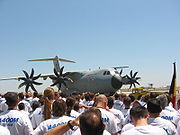
, planning to replace them by seven Airbus A400M
transport planes. VIPs are transported with Embraer 135/145
jets, Dassault 20/900
, and the Airbus A310
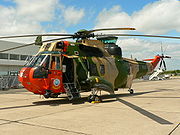
. The Sea King
helicopters and the Alouette III
SAR helicopters will be active for years. They will be replaced by NH-90s
(10: 4 NFH + 6 TTH).
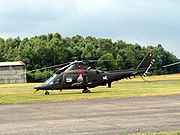
In 2004, as part of the unified structure, the Army Aviation units of the Wing Heli
were transferred to the COMOPSAIR. These contain the Agusta A109
attack helicopter, and the Alouette II training and recce helicopter.
In 2005, the Belgian Alpha Jet
s moved to Cazaux in France to continue the Initial Operational Training
, while the Advanced Jet Training is done on French Alpha Jet
s at Tours.
Within the framework of its commitments within the North Atlantic Treaty Organization, NATO, Belgium has assigned its 72 F-16s to NATO purposes. Two squadrons with a total of 16 aircraft have been designated for use by the Rapid Reaction Forces.
In February 2008, Defense Minister Pieter De Crem
announced that due to increasing problems and poor serviceability, the two A310s were to be replaced as soon as possible by two aircraft in the same class. An Airbus A330
was dry-leased to take their place.
On September 01, 2010, the Wing Heli
was disbanded and the Agusta A109
helicopters moved to Beauvechain Air Base
to become 1st Wing
. The SF260 squadrons became the Basic Flying Training School
.
On May 24, 2011, it was reported that the two retired Airbus A310
aircraft have been sold to the Brussels
-based company MAD Africa for the amount of 700,000 euros. The company then sold them on to the Dutch Van Vliet transport company, who in their turn will transfer the aircraft to an as yet unspecified Abu Dhabi
-based operator.
Diyarbakır
air base. During this operation, Belgian planes carried out several flights along the Iraqi border. After this operation the obsolete Mirage 5's were phased out.
On 15 July 1996, a C-130 with serial CH-06 carrying 37 members of the Dutch Army Fanfare Band and four crew crashed at Eindhoven
after a birdstrike while executing a go-around, resulting in the loss of power to three engines. 34 Dutch
soldiers were killed, and only 7 survived.
From October 1996, the Belgian Air Force cooperated with the Dutch Royal Air Force in the Deployable Air Task Force in patrolling former Yuguslavian airspace. F-16's of the 2nd and 10th Tactical Wings, operating from the Italian bases of Villafranca and Amendola, were assigned to missions insuring the control of a No-Fly Zone over Yugoslavia, and providing the air support necessary for UN and NATO troops. Between March 24 and June 10, 1999, 12 Belgian F-16s carried out 679 combat sorties - the first time since the second World War that Belgian aircraft took part in active war operations in enemy territory - against Serbia
during the Kosovo
crisis. The last Belgian F-16 detachment left Italy
in August 2001.
On 29 March 2004, four F-16's from Kleine Brogel were transferred under NATO's Baltic Air Policing
mission to the Šiauliai Air Base
in Lithuania
for three months, where they were employed in monitoring the Lithuania
n, Latvia
n, and Estonia
n skies.
In 2005, the Helicopter Wing (WHeli - HeliW) deployed 4 A-109 (including 1 Medevac) in Bosnia (Tuzla).
In July, four F-16's deployed to Afghanistan
to support the NATO International Security Assistance Force
.http://www2.hq.nato.int/isaf/update/Press_Releases/newsrelease/2005/Release_12July05_46.htm
At the same, the 80 UAV Sqn deployed its B-Hunter in Bosnia (Tuzla) for a four months period: 52 persons, 6 B-Hunter and 4 GCS. http://www.mil.be/aircomp/units/index.asp?LAN=fr&FILE=&ID=620&MENU=644&PAGE=1
On 9 September 2005, an F-16 crashed near Vlieland
, Netherlands
, killing its pilot.
In 2006, Belgian Hunter unmanned air vehicles deployed to the Democratic Republic of the Congo
as part of the EU EUFOR peacekeeping
mission.
At the same time, the Helicopter Wing (WHeli - HeliW) deployed 3 A-109 (including 1 Medevac) in Bosnia (Mostar), Operation codeword "Blue Bee". http://www.mil.be/def/news/index.asp?LAN=fr&ID=686
On 5 May 2006, a Belgian C-130 "Hercules" undergoing updating at the Sabena Technics was destroyed when the hangar that it was in burned to the ground. The Belgian Air Force announced its intention to acquire a secondhand C-130 to replace the one lost in the fire. A month later, the Air Component acquired a C-130E from the American operator Evergreen (serial N130EV, to become CH13).
On 1 December 2006 the Belgian Air Force deployed again under Baltic Air Policing
mission four F-16 MLU aircraft to Šiauliai Air Base in Lithuania, to defend the airspace of Estonia, Latvia, and Lithuania.
From August 2008, four F-16s will be deployed to Kandahar in Afghanistan in support of the Dutch land forces.
On 27 June 2008 an Agusta A109
helicopter crashed in Halleux. The pilot, co-pilot, a doctor and a nurse were injured.
On 27 July 2009 an F-16 fighter jet flying a practice mission over Germany accidentally dropped a non-explosive practice bomb into woods near the small town of Lastrup
. There were no casualties.
in March 2011, Belgium deployed 6 F-16 Fighters to Araxos in Greece, in support of operation: Odyssey Dawn, to support the NATO operations over Libya. the aircraft were already at the base as part of a joint exercise and were transferred to NATO command. as of June 2011, the aircraft have flown over 1000 hours over libya and attacked various military instalations and targets, without causing any collateral damage to the civilian population.
On 12 September 2011 a wikileaks document showed a diplomatic cable from the American ambassador and the Minister of Defence Pieter De Crem that Belgium is interested to buy off-the-shelf Lockheed F-35 Lightnings by 2020.

Air force
An air force, also known in some countries as an air army, is in the broadest sense, the national military organization that primarily conducts aerial warfare. More specifically, it is the branch of a nation's armed services that is responsible for aerial warfare as distinct from an army, navy or...
of the Belgian Armed Forces
Military of Belgium
The Belgian Army is the national military of Belgium. The Belgian Army was established after Belgium became independent in October 1830...
. Originally founded in 1909, it is one of the world's first air forces, and was a pioneer in aerial combat during the First World War. Despite many obstacles, it performed commendably even in its first few years of existence.
The present commander is Major-General Claude Van de Voorde, appointed on 23 July 2009.
Foundation and early years
The Belgian Air Force was founded in 1909 as a branch of the Belgian Army, carrying the name Compagnie des Ouvries et Aérostiers. King AlbertAlbert I of Belgium
Albert I reigned as King of the Belgians from 1909 until 1934.-Early life:Born Albert Léopold Clément Marie Meinrad in Brussels, he was the fifth child and second son of Prince Philippe, Count of Flanders, and his wife, Princess Marie of Hohenzollern-Sigmaringen...
's interest in the military use of airplanes was a main impetus for its formation. Coincidently, in the civil aviation sector, Baron
Baron
Baron is a title of nobility. The word baron comes from Old French baron, itself from Old High German and Latin baro meaning " man, warrior"; it merged with cognate Old English beorn meaning "nobleman"...
Pierre de Caters
Pierre de Caters
Baron Pierre de Caters was a Belgian adventurer, aviator and car and motorboat racer. He was the first Belgian to fly an aircraft in 1908....
earned the first civil pilot's brevet that same year. Caters would promptly establish an aviation school. At approximately the same time, the War Ministry decided to follow the French military's example and have pilots earn a civil pilot's brevet before their military one.
As a result, in 1910, three Belgian lieutenants earned their Pilot's Brevets at that school, voluntarily paying their own fees. There were two artillery lieutenants; Baudoin de Montens d'Oosterwyck, who earned Brevet No. 19 on 30 September, and Alfred Sarteel, granted No. 23 on 10 November. The third lieutenant, Georges Nelis, was the new force's first aviation candidate, gaining Brevet No. 28 on 21 December. An airplane was personally purchased for him.
In Spring of 1911, the new air force established its military aviation school with five pilots, two mechanics, and a woodworker. It received its first airplane via a circuitous route; Baron Caters gave an airplane to King Albert, who in turn presented it to the school.
On 12 September 1912, pilot Lieutenant Nelis and observer Sous Lieutenant Stellingwerff were the first Europeans to fire a machine gun from an airplane; while Nelis brought the aircraft low, Stellingwerff put some bullets through a sheet staked out on the ground. They were disciplined for their efforts. Nelis then accompanied Capitaine Commandant Émile Mathieu to England during November 1913 to demonstrate aerial use of the Lewis machine gun at Hendon
Hendon
Hendon is a London suburb situated northwest of Charing Cross.-History:Hendon was historically a civil parish in the county of Middlesex. The manor is described in Domesday , but the name, 'Hendun' meaning 'at the highest hill', is earlier...
and Aldershot
Aldershot
Aldershot is a town in the English county of Hampshire, located on heathland about southwest of London. The town is administered by Rushmoor Borough Council...
; as a result, the British adopted the Lewis, although the Belgians did not. Belgium entered World War I with planes tasked solely for reconnaissance missions.
World War I
By the date of Belgium's entry into the First World War on 4 August 1914, the military aviation branch, now called the Aviation Militaire Belge, consisted of four squadrons, each consisting of four 80 horsepower Henri Farman airplanes, although Escadrilles III and IV were still forming. A truck was assigned to each squadron, along with a fifth truck serving as a mobile workshop. Each squadron had a Commander, five pilots, and six observers, with all officers seconded from parent units. As a result, most of the new aviators were from the Engineers and Artillery components of the Belgian armed forces. As the war began, a fifth squadron was created, staffed with civilian pilots called to the colors and equipped with BleriotBlériot Aéronautique
Blériot Aéronautique was a French aircraft manufacturer founded by Louis Blériot. It also made a few cyclecars from 1921 to 1922.After Louis Blériot became famous for being the first to fly over the English Channel in 1909, he established an aircraft manufacturing company. This company really took...
s.
The new air force suffered serious setbacks on two stormy occasions, which is not too surprising considering that bad weather prevented flying about a third of the time; on both 13 September and 28 December, windy storms destroyed and damaged its aircraft. This was not the only obstacle to its success; the Belgian airmen had their recce reports sometimes discounted and disbelieved at war's opening. They also had to adjust to the dawning of hostilities in the third dimension. The neophyte aviators were belligerent toward enemy airmen almost from the opening guns. Sous Lieutenant Henri Crombez flew the first war patrol, in a Nieuport 10
Nieuport 10
|-See also:- External links :* *...
on 26 August 1914. Adjutant Behaeghe was the first to engage an enemy, a few days later. On 26 September, the Belgian air crew of Sous Lieutenant de Petrowski and Sergeant Benselin mortally wounded a German pilot with a rifle bullet and forced his Taube to land at Sint-Agatha-Berchem
Sint-Agatha-Berchem
Sint-Agatha-Berchem or Berchem-Sainte-Agathe is one of the nineteen municipalities located in the Brussels-Capital Region of Belgium.The municipality had a total population of 20,078 on 1 January 2006...
; if they had submitted a claim for this victory, its approval would have marked history's first air-to-air combat victory.
On 3 January 1915, two machine guns supplied by British aviation were fitted to two Belgian planes, making a dual effort against the foe possible; these were Belgium's first dedicated fighter planes. In February, 13 of the Belgian airmen flew 28 offensive patrols; their first dogfight was fought on the 26th, with 10 Albatroses versus three Belgian Farmans. On 26 March, Sous Lieutenant Boschmans sent a German two-seater into a steep dive when he seemed to hit the pilot; the German was not seen to either crash or land. This was the Belgian aviators' first victory claim.
In April, Lieutenant Fernand Jacquet
Fernand Jacquet
Captain-Commandant Fernand Maximillian Leon Jacquet was a World War I flying ace credited with seven aerial victories. He was the first Belgian pilot to score an aerial victory, on 17 April 1915, and became the first Belgian ace on 1 February 1917. He was also the first Belgian pilot to fly his...
mounted a machine gun on his pusher
Pusher configuration
In a craft with a pusher configuration the propeller are mounted behind their respective engine. According to Bill Gunston, a "pusher propeller" is one mounted behind engine so that drive shaft is in compression...
plane and sought out the enemy. On the 17th, he scored Belgium's first confirmed aerial victory, sending an Albatros reconnaissance plane down in flames over Roeselare
Roeselare
Roeselare is a Belgian city and municipality in the Flemish province of West Flanders. The municipality comprises the city of Roeselare proper and the towns of Beveren, Oekene and Rumbeke....
. Apparently at about the same time, Adjutant José Orta and Sous Lieutenant Louis de Burlet were the first to attack an enemy observation balloon
Observation balloon
Observation balloons are balloons that are employed as aerial platforms for intelligence gathering and artillery spotting. Their use began during the French Revolutionary Wars, reaching their zenith during World War I, and they continue in limited use today....
when they dropped three small bombs on a gasbag over Houthulst
Houthulst
Houthulst is a municipality located in the Belgian province of West Flanders. The municipality comprises the towns of Houthulst proper, Jonkershove, Klerken and Merkem. On January 1, 2006 Houthulst had a total population of 9,051...
. Luckily for them, they missed; success would probably have blown them out of the sky.
On 18 January 1916, the decision was made to form a dedicated fighter squadron. On 22 February 1916, Escadrille I became the 1ère Escadrille de Chasse. It consisted of newly-supplied Nieuport 10s and one obsolete Farman two-seater. In August, the new squadron would upgrade to Nieuport 11
Nieuport 11
|-See also:-References:NotesBibliography* Angelucci, Enzio, ed. The Rand McNally Encyclopedia of Military Aircraft. New York: The Military Press, 1983. ISBN 0-517-41021-4....
s, and Escadrille V was turned into the 5ème Escadrille de Chasse. The new unit was the first to mount an offensive formation for the new air force; on 15 February 1917, they flew an offensive patrol of seven. By this time, the AMB had grown to 44 aircraft, including 21 fighters. At this point, individual airplanes bore personal markings affixed by their pilots, but no unit designations.
In the Summer of 1917, the AMB was allotted an active role in Allied aviation operations at the beginning of the Third Battle of Ypres. In March 1918, the AMB matured into a Groupe de Chasse
Groupe de Chasse
The Groupe de Chasse was Belgium's first dedicated Fighter Wing. It was created in March 1918 at Les Moëres aerodrome near Veurne. On request of King Albert I, Capitaine Fernand Jacquet was appointed Commanding Officer, and the Groupe de Chasse also became known as the Groupe Jaquet...
. At this time, the role of the Escadrilles de Chasse was finally focused on their operation strictly as fighter units. There was a general sorting out of pilots into fighter or reconnaissance roles. Not all fighter pilots went into the new fighter units; as of 1 May, 22 remained with recce units to fly escort missions. The King insisted that Jacquet be given the command of the Group. The newly organized fighter wing contained the two fighter escadrilles; however, 1ère Escadrille de Chasse became 9ème Escadrille de Chasse
9 Squadron (Belgian Air Force)
9 Squadron is a training squadron of the Belgian Air Component, constituting the Basic Flying Training School together with 5 Squadron.-The squadron's origins:...
, and 5ème Escadrille de Chasse became 10ème Escadrille de Chasse
10me Escadrille de Chasse
The 5me Escadrille de Chasse was the second fighter squadron of the Belgian Air Component. The squadron was founded during World War I, reorganized into a dedicated fighter unit under its new designation of 10me Escadrille de Chasse in March 1918, and became part of a fighter wing before war's...
. The 11ème Escadrille de Chasse
11 Squadron (Belgian Air Force)
11 Squadron is a training squadron of the Belgian Air Component, deployed at Base Aérienne 120 at Cazaux in France, in the scope of the Advanced Jet Training School .-The squadron's origins:...
was founded on 28 May to join them. By the start of the Allies final offensive in September 1918, the AMB was incorporated in the Allied aviation effort, and could send 40-plus planes into the air at one time. In its short span of service, the Groupe fought over 700 aerial combats and was credited with 71 confirmed and 50 probable victories.
Aircraft procurement difficulties
In June 1916 the nascent air force had received newer craft from the French in both single and double-seat versions of the Nieuport 10
Nieuport 10
|-See also:- External links :* *...
. The Belgians would continue to upgrade their planes throughout the war, though through their dependence on French manufacturers they became the stepchildren of the Allied effort from 1916 onwards. The introduction dates of various types, compared to the date of their acquisition by the Belgians, tells the tale. The Franco-American Lafayette Escadrille
Lafayette Escadrille
The Lafayette Escadrille , was an escadrille of the French Air Service, the Aéronautique militaire, during World War I composed largely of American volunteer pilots flying fighters.-History:Dr. Edmund L...
had Nieuport 16s as early as May 1916; the Belgians got them at the end of the year. The Nieuport 17
Nieuport 17
|-Specifications :-See also:-Bibliography:* Bruce, Jack. "Those Classic Nieuports". Air Enthusiast Quarterly. Number Two, 1976. Bromley, UK:Pilot Press. pp. 137–153....
came into service with the French as early as June 1916, but the Belgians received so few that in June 1917 they were still operating all their earlier Nieuports. They then contracted for newer Nieuport 23s, which were basically up-engined Nieuport 17s. Spad VIIs had entered French service on 2 September 1916; the Belgians first received them almost an entire year later, with the first one on board on 22 August 1917. In September 1917, Belgium had the Hanriot HD.1
Hanriot HD.1
|-References:* Bruce, J.M. The Hanriot HD 1 Leatherhead: Profile Publications* Cheesman E.F. Fighter Aircraft of the 1914-1918 War Letchworth, Harletford Publications, 1960 pp. 82-83- External links :*...
supplied to it the year after it was introduced. Spad XIIIs also came on line that month, but would not show up in Belgian inventory until the next year. Sopwith Camel
Sopwith Camel
The Sopwith Camel was a British First World War single-seat biplane fighter introduced on the Western Front in 1917. Manufactured by Sopwith Aviation Company, it had a short-coupled fuselage, heavy, powerful rotary engine, and concentrated fire from twin synchronized machine guns. Though difficult...
s first went into service in May 1917; the AMB received its first one on 29 November 1917.
The AMB did make one attempt to design and build its own airplane. However the Ponnier M1 was not a good enough design to see production, and the ten or so manufactured ended up with clipped wings as powered "Penguin" rollers for training rookie pilots.
Operational summary
Despite the many difficulties suffered during its foundation and first war, the AMB accomplished many things during World War I. One of its flying ace
Flying ace
A flying ace or fighter ace is a military aviator credited with shooting down several enemy aircraft during aerial combat. The actual number of aerial victories required to officially qualify as an "ace" has varied, but is usually considered to be five or more...
pilots, Willy Coppens
Willy Coppens
Willy Omer Francois Jean Coppens was Belgium's leading fighter ace and the champion "balloon buster" of World War I.-Background and Early Military Service:...
, became the top ranking balloon buster
Balloon buster
Balloon busters were military pilots known for destroying enemy observation balloons. These pilots were noted for their fearlessness. Seventy-six fighter pilots in World War I were each credited with destroying five or more balloons, and thus were balloon aces....
of World War I, as well as one of the war's top aces. Four other pilots from the tiny force also became aces with it: Andre de Meulemeester
André de Meulemeester
Lieutenant Andre Emile Alfons de Meulemeester was a Belgian flying ace during World War I. He was credited with eleven confirmed and seventeen unconfirmed aerial victories.-World War I:...
,
Edmond Thieffry
Edmond Thieffry
Edmond Thieffry was a Belgian First World War air ace and aviation pioneer. He made, with Léopold Roger and Jef de Bruycker, the first successful flight between Belgium and Congo ....
,
Jan Olieslagers
Jan Olieslagers
Lieutenant Jan Olieslagers was a Belgian motorcycle and aviation pioneer who set world records with both types of machinery. He became a flying ace during World War I despite his indifference in claiming victories; he was credited with six confirmed victories, seventeen unconfirmed, and an unknown...
,
and Fernand Jacquet
Fernand Jacquet
Captain-Commandant Fernand Maximillian Leon Jacquet was a World War I flying ace credited with seven aerial victories. He was the first Belgian pilot to score an aerial victory, on 17 April 1915, and became the first Belgian ace on 1 February 1917. He was also the first Belgian pilot to fly his...
.
A sixth Belgian, Adolphe DuBois d'Aische
Adolphe DuBois d'Aische
Sergeant Adolphe Aloys Marie Hubert du Bois d'Aische was a Belgian World War I flying ace credited with six aerial victories. Serving in the French Air Service, he was the oldest ace in the war, scoring his fifth victories when he was 43 years of age.-See also:List of World War I aces from Belgium...
, became the war's oldest ace while in French service.
The fledgling air force was even entrusted with flying both King Albert
Albert I of Belgium
Albert I reigned as King of the Belgians from 1909 until 1934.-Early life:Born Albert Léopold Clément Marie Meinrad in Brussels, he was the fifth child and second son of Prince Philippe, Count of Flanders, and his wife, Princess Marie of Hohenzollern-Sigmaringen...
and Queen Elizabeth over the battle front at times.
Between the world wars
During the interbellum, the Belgian Air Force flew with Breguet 19Breguet 19
The Breguet 19 was a light bomber and reconnaissance plane, also used for long-distance flights, designed by the French Breguet company and produced from 1924.-Development:...
. Some efforts were made to acquire aircraft from local production, as by Stampe et Vertongen and Renard
Alfred Renard
-Biography:Alfred Renard was born in Anderlecht on 21 April 1895. Already as a youngster, inspired by kites he saw his father make, he illustrated his technical ability by installing electricity and telephone at an uncle's farm....
.
World War II
At the start of World War II, the Army Air Force had three active Air Force Regiments. Planes which were used by those regiments were the Renard R-31Renard R-31
-See also:-Bibliography:* Green, William. War Planes of the Second World War, Volume Seven: Bombers and Reconnaissance Aircraft. London: Macdonald & Co. Ltd., 1967. ISBN 0356-01477-0....
and R-32, the Fiat CR.42
Fiat CR.42
The Fiat CR.42 Falco was a single-seat sesquiplane fighter which served primarily in Italy's Regia Aeronautica before and during World War II. The aircraft was produced by the Turin firm, and entered service, in smaller numbers, with the air forces of Belgium, Sweden and Hungary...
, the Hawker Hurricane
Hawker Hurricane
The Hawker Hurricane is a British single-seat fighter aircraft that was designed and predominantly built by Hawker Aircraft Ltd for the Royal Air Force...
, the Gloster Gladiator
Gloster Gladiator
The Gloster Gladiator was a British-built biplane fighter. It was used by the Royal Air Force and the Royal Navy and was exported to a number of other air forces during the late 1930s. It was the RAF's last biplane fighter aircraft and was rendered obsolete by newer monoplane designs even as it...
, the Fairey Fox
Fairey Fox
The Fairey Fox was a British light bomber and fighter biplane of the 1920s and 1930s. It was originally produced in Britain for the RAF, but continued in production and use in Belgium long after it was retired in Britain.-Fox I:...
, and the Fairey Battle
Fairey Battle
The Fairey Battle was a British single-engine light bomber built by the Fairey Aviation Company in the late 1930s for the Royal Air Force. The Battle was powered by the same Rolls-Royce Merlin piston engine that gave contemporary British fighters high performance; however, the Battle was weighed...
. These were massacred by the much superior German Luftwaffe in the German invasion of May 1940.
The following (possibly incomplete) table lists the inventory of the Belgian Air Force as in May 1940
| Aircraft | Origin | Type | Year acquired | In service |
|---|---|---|---|---|
| Fairey Battle Fairey Battle The Fairey Battle was a British single-engine light bomber built by the Fairey Aviation Company in the late 1930s for the Royal Air Force. The Battle was powered by the same Rolls-Royce Merlin piston engine that gave contemporary British fighters high performance; however, the Battle was weighed... |
Light bomber | 1938 | 16 | |
| Fairey Fox Fairey Fox The Fairey Fox was a British light bomber and fighter biplane of the 1920s and 1930s. It was originally produced in Britain for the RAF, but continued in production and use in Belgium long after it was retired in Britain.-Fox I:... |
Light bomber and observation | 1933–1938 | 154 | |
| Fiat CR.42 Fiat CR.42 The Fiat CR.42 Falco was a single-seat sesquiplane fighter which served primarily in Italy's Regia Aeronautica before and during World War II. The aircraft was produced by the Turin firm, and entered service, in smaller numbers, with the air forces of Belgium, Sweden and Hungary... |
Fighter | 1940 | 27 | |
| Fokker F.VII Fokker F.VII The Fokker F.VII, also known as the Fokker Trimotor, was an airliner produced in the 1920s by the Dutch aircraft manufacturer Fokker, Fokker's American subsidiary Atlantic Aircraft Corporation, and other companies under licence.... |
Transport | 1935 | 9 | |
| Gloster Gladiator Gloster Gladiator The Gloster Gladiator was a British-built biplane fighter. It was used by the Royal Air Force and the Royal Navy and was exported to a number of other air forces during the late 1930s. It was the RAF's last biplane fighter aircraft and was rendered obsolete by newer monoplane designs even as it... |
Fighter | 1937 | 22 | |
| Hawker Hurricane Hawker Hurricane The Hawker Hurricane is a British single-seat fighter aircraft that was designed and predominantly built by Hawker Aircraft Ltd for the Royal Air Force... |
Fighter | 1939 | 20 | |
| Koolhoven FK.56 | Advanced trainer | 1940 | 12 | |
| LACAB GR.8 LACAB GR.8 -References:*"Plane Facts:The unaesthetic LACAB". Air International, January 1977, Volume 12 No. 1. Bromley,UK:Fine Scroll Publishing. p. 46.... |
Bomber prototype | 1936 | 1 | |
| Morane-Saulnier MS.230 Morane-Saulnier MS.230 -External links:* -Bibliography:* Donald, David. Encyclopedia of World Aircraft , p.664, "Morane-Saulnier MS.230 series".... |
Observation | 1932 | 23 | |
| Potez 33 | Light bomber and reconnaissance | 1930 | 10 | |
| Renard R.31 | Observation | 1935 | 33 | |
| Renard R.38 | Fighter prototype | 1940 | 1 | |
| SABCA S-47 / Caproni Ca.335 Caproni Ca.335 -References:*Green, William. War Planes of the Second World War: Volume Seven Bombers and Reconnaissance Aircraft. London:Macdonald, 1967.-External links:***... |
/ | Light bomber prototype | 1940 | 1 |
| Savoia-Marchetti SM.73 | Transport | 1940 | 8 | |
| Savoia-Marchetti SM.83 | Transport | 1940 | 3 | |
| Stampe-et-Vertongen SV-5 | Training | 1936 | 21 | |
| Stampe-et-Vertongen SV-22 | Training | 1933 | 10 | |
| Stampe-et-Vertongen SV-26 | Training | 1933 | 10 |
Before the outbreak of the war Belgium also sought to equip its Aviation Militaire with foreign designs, ordering production licences in Poland
Poland
Poland , officially the Republic of Poland , is a country in Central Europe bordered by Germany to the west; the Czech Republic and Slovakia to the south; Ukraine, Belarus and Lithuania to the east; and the Baltic Sea and Kaliningrad Oblast, a Russian exclave, to the north...
and France
France
The French Republic , The French Republic , The French Republic , (commonly known as France , is a unitary semi-presidential republic in Western Europe with several overseas territories and islands located on other continents and in the Indian, Pacific, and Atlantic oceans. Metropolitan France...
and aircraft in the USA. However, the acquired licences could not be used until May 1940 and the aircraft produced in the USA were eventually delivered to France
France
The French Republic , The French Republic , The French Republic , (commonly known as France , is a unitary semi-presidential republic in Western Europe with several overseas territories and islands located on other continents and in the Indian, Pacific, and Atlantic oceans. Metropolitan France...
and to the United Kingdom
United Kingdom
The United Kingdom of Great Britain and Northern IrelandIn the United Kingdom and Dependencies, other languages have been officially recognised as legitimate autochthonous languages under the European Charter for Regional or Minority Languages...
. The following table summarizes Belgium's foreign orders:
| Aircraft | Origin | Type | Year acquired | Number |
|---|---|---|---|---|
| Breguet 693 Breguet 693 The Breguet 690 and its derivatives were a series of light twin-engine ground-attack aircraft that were used by the French Air Force in World War II.... |
Light bomber and assault aircraft | 1940 | Licence to build 32 | |
| Brewster B-339 Brewster Buffalo The Brewster F2A Buffalo was an American fighter aircraft which saw limited service early in World War II. Though the Buffalo won a competition against the Grumman F4F Wildcat in 1939 to become the US Navy's first monoplane fighter aircraft, it turned out to be a big disappointment... |
Fighter | 1939 | 40 ordered, 1 delivered to Bordeaux Bordeaux Bordeaux is a port city on the Garonne River in the Gironde department in southwestern France.The Bordeaux-Arcachon-Libourne metropolitan area, has a population of 1,010,000 and constitutes the sixth-largest urban area in France. It is the capital of the Aquitaine region, as well as the prefecture... , 6 to Martinique Martinique Martinique is an island in the eastern Caribbean Sea, with a land area of . Like Guadeloupe, it is an overseas region of France, consisting of a single overseas department. To the northwest lies Dominica, to the south St Lucia, and to the southeast Barbados... , rest to RAF |
|
| Douglas DB-7 Douglas DB-7 The Douglas A-20/DB-7 Havoc was a family of American attack, light bomber and night fighter aircraft of World War II, that served with several Allied air forces, principally those of the Soviet Union, United Kingdom, and United States. The DB-7 was also used by the air forces of Australia, South... |
Medium bomber | 1939 | 16 ordered, transferred to RAF after surrender | |
| PZL.37 Łoś | Medium bomber | 1938 | Licence to build unknown number | |
| Grumman Martlet | Fighter | 1940 | an order for at least 10 aircraft was placed, never delivered and transferred to Royal Navy after surrender, aircraft was proposed with fixed wings for land based operations | |
| Caproni Ca.313 Caproni Ca.313 |-See also:-References:NotesBibliography*Alonzo, F.S, Il Caproni Ca.313 in Svezia, Storia militare magazine n.64 page 15.* Neulen, Hans Werner. In the Skies of Europe. Ramsbury, Marlborough, UK: The Crowood Press, 2000. ISBN 1-86126-799-1.... |
Light bomber and reconnaissance aircraft(designated Ca.312) | 1940 | 24 ordered, none delivered |
After the surrender of Belgium on 28 May 1940, a very small Belgian Air Force in exile was created in Great Britain. This small force was active within the British Royal Air Force
Royal Air Force
The Royal Air Force is the aerial warfare service branch of the British Armed Forces. Formed on 1 April 1918, it is the oldest independent air force in the world...
, and its squadrons were equipped with versions of the Supermarine Spitfire
Supermarine Spitfire
The Supermarine Spitfire is a British single-seat fighter aircraft that was used by the Royal Air Force and many other Allied countries throughout the Second World War. The Spitfire continued to be used as a front line fighter and in secondary roles into the 1950s...
and Hawker Typhoon
Hawker Typhoon
The Hawker Typhoon was a British single-seat fighter-bomber, produced by Hawker Aircraft. While the Typhoon was designed to be a medium-high altitude interceptor, and a direct replacement for the Hawker Hurricane, several design problems were encountered, and the Typhoon never completely satisfied...
.
The Cold War
During the Cold War, the Belgian Air Force operated the following aircraft:
| Aircraft | Origin | Description | Variants | Operated | Notes |
|---|---|---|---|---|---|
| Aero Commander 560F | Twin-engined light transport | 560F | 1 | 1961 to 1973 as royal transport | |
| Airspeed Consul Airspeed Consul -See also:-References:... |
Twin-engined light transport | 4 | Used from 1948 in Belgian Congo. | ||
| Airspeed Oxford Airspeed Oxford The Airspeed AS.10 Oxford was a twin-engine aircraft used for training British Commonwealth aircrews in navigation, radio-operating, bombing and gunnery during the Second World War.-Design and development:... |
Twin-engined light transport | 20 | Operated between 1947 and 1954. | ||
| Auster AOP6 | Single-engine light observation aircraft, | 22 | Operated between 1947 and 1955. | ||
| Avro Anson Avro Anson The Avro Anson is a British twin-engine, multi-role aircraft that served with the Royal Air Force, Fleet Air Arm and numerous other air forces prior to, during, and after the Second World War. Named for British Admiral George Anson, it was originally designed for maritime reconnaissance, but was... |
Twin-engined light transport | 15 | Operated between 1946 and 1954. | ||
| Avro-Canada CF-100 Canuck Avro CF-100 The Avro Canada CF-100 Canuck was a Canadian jet interceptor/fighter serving during the Cold War both in NATO bases in Europe and as part of NORAD. The CF-100 was the only Canadian-designed fighter to enter mass production, serving primarily with the RCAF/CAF and in small numbers in Belgium... |
Twin-jet interceptor | Mk 5 | 53 | Operated from 1957 into the mid 1960s. | |
| Boeing 727-200 | Three-engined jet airliner | 727-29C | 2 | Operated from 1975. | |
| Dassault Mirage 5 Dassault Mirage 5 The Dassault Mirage 5 is a supersonic attack aircraft designed in France by Dassault Aviation during the 1960s, and manufactured in France and a number of other countries. It was derived from Dassault's popular Mirage III fighter, and spawned several variants of its own.-Early development:The... |
Jet fighter-bomber and reconnaissance | 5BA 5BD 5BR |
63 16 27 |
Operated from 1970. 3 were built in France | |
| Dassault Falcon Dassault Falcon The Dassault Falcon is a family of business jets, manufactured by Dassault Aviation.Aircraft include:* Dassault Falcon 10 Scaled down Falcon 20... |
Twin-engined light jet transport | 20E | 2 | Operated from 1973. | |
| de Havilland Tiger Moth De Havilland Tiger Moth The de Havilland DH 82 Tiger Moth is a 1930s biplane designed by Geoffrey de Havilland and was operated by the Royal Air Force and others as a primary trainer. The Tiger Moth remained in service with the RAF until replaced by the de Havilland Chipmunk in 1952, when many of the surplus aircraft... |
Biplane trainer | 15 | Operated from 1946. | ||
| de Havilland Dominie De Havilland Dragon Rapide The de Havilland DH.89 Dragon Rapide was a British short-haul passenger airliner of the 1930s.-Design and development:Designed by the de Havilland company in late 1933 as a faster and more comfortable successor to the DH.84 Dragon, it was in effect a twin-engined, scaled-down version of the... |
Biplane transport | 7 | Operated from 1946. | ||
| de Havilland Mosquito De Havilland Mosquito The de Havilland DH.98 Mosquito was a British multi-role combat aircraft that served during the Second World War and the postwar era. It was known affectionately as the "Mossie" to its crews and was also nicknamed "The Wooden Wonder"... |
Twin-engined piston light fighter-bomber | TT3 NF30 |
7 24 |
Operated from 1947 as target tugs and night fighters. | |
| de Havilland Canada Chipmunk | Single-engined piston trainer | 2 | For evaluation from 1948. | ||
| Alpha Jet Dassault-Breguet/Dornier Alpha Jet The Dassault/Dornier Alpha Jet is a light attack jet and advanced trainer aircraft co-manufactured by Dornier of Germany and Dassault-Breguet of France.- Origins :... |
/ | Ground attack | Alpha Jet B | 33 | co designed and build by SABCA |
| Douglas C-47 Dakota C-47 Skytrain The Douglas C-47 Skytrain or Dakota is a military transport aircraft that was developed from the Douglas DC-3 airliner. It was used extensively by the Allies during World War II and remained in front line operations through the 1950s with a few remaining in operation to this day.-Design and... |
Passenger/troop transport | 41 | Operated in various roles between 1946 and 1976. | ||
| Douglas DC-4 Douglas DC-4 The Douglas DC-4 is a four-engined propeller-driven airliner developed by the Douglas Aircraft Company. It served during World War II, in the Berlin Airlift and into the 1960s in a military role... |
Four-engined piston airliner | 2 | Operated from 1950 to 1969. | ||
| Douglas DC-6 Douglas DC-6 The Douglas DC-6 is a piston-powered airliner and transport aircraft built by the Douglas Aircraft Company from 1946 to 1958. Originally intended as a military transport near the end of World War II, it was reworked after the war to compete with the Lockheed Constellation in the long-range... |
Four-engined piston airliner | 4 | Operated from 1954 to 1971. | ||
| Fairchild C-119 Flying Boxcar C-119 Flying Boxcar The Fairchild C-119 Flying Boxcar was an American military transport aircraft developed from the World War II-era Fairchild C-82 Packet, designed to carry cargo, personnel, litter patients, and mechanized equipment, and to drop cargo and troops by parachute... |
Twin-engined troop or cargo transport | C-119F C-119G |
46 | Operated from 1952 to 1973. | |
| Fouga Magister Fouga Magister The Fouga Magister is a 1950s French two-seat jet trainer. The related CM.175 Zéphyr was a carrier-capable version for the French Navy.... |
Jet trainer | CM.170R | 50 | Operated from 1960 | |
| SABCA F-16 F-16 Fighting Falcon The General Dynamics F-16 Fighting Falcon is a multirole jet fighter aircraft originally developed by General Dynamics for the United States Air Force . Designed as an air superiority day fighter, it evolved into a successful all-weather multirole aircraft. Over 4,400 aircraft have been built since... |
Fighter | F-16A F-16B |
136 24 |
Built under licence in Belgium and the Netherlands. | |
| Gloster Meteor Gloster Meteor The Gloster Meteor was the first British jet fighter and the Allies' first operational jet. It first flew in 1943 and commenced operations on 27 July 1944 with 616 Squadron of the Royal Air Force... |
Jet fighter | F4 T7 F8 NF11 |
48 43 260 24 |
Operated from 1949 some built in Belgium and the Netherlands | |
| Hawker Hurricane Hawker Hurricane The Hawker Hurricane is a British single-seat fighter aircraft that was designed and predominantly built by Hawker Aircraft Ltd for the Royal Air Force... |
Piston fighter | II | 3 | Operated from 1946 | |
| SABCA Hunter Hawker Hunter The Hawker Hunter is a subsonic British jet aircraft developed in the 1950s. The single-seat Hunter entered service as a manoeuvrable fighter aircraft, and later operated in fighter-bomber and reconnaissance roles in numerous conflicts. Two-seat variants remained in use for training and secondary... |
Jet fighter | F4 F6 |
148 144 |
Operated from 1956 all built in Belgium under licence | |
| Hawker Siddeley 748 Avro 748 The Hawker Siddeley HS 748 is a medium-sized turboprop airliner originally designed by the British firm Avro in the late 1950s as a replacement for the now-aged DC-3s then in widespread service as feederliners. Avro concentrated on performance, notably for STOL operations, and found a dedicated... |
Twin-engined transport | 2A | 3 | Operated from 1976 | |
| Lockheed T-33 T-33 Shooting Star The Lockheed T-33 Shooting Star is an American-built jet trainer aircraft. It was produced by Lockheed and made its first flight in 1948, piloted by Tony LeVier. The T-33 was developed from the Lockheed P-80/F-80 starting as TP-80C/TF-80C in development, then designated T-33A. It was used by the... |
Single engine jet | T-33A RT-33A |
38 1 |
Operated from 1952 | |
| SABCA F-104 Starfighter F-104 Starfighter The Lockheed F-104 Starfighter is a single-engine, high-performance, supersonic interceptor aircraft originally developed for the United States Air Force by Lockheed. One of the Century Series of aircraft, it served with the USAF from 1958 until 1969, and continued with Air National Guard units... |
Multi-role jet | F-104G TF-104G |
100 12 |
Operated from 1963, Belgian-built | |
| Miles Magister Miles Magister -See also:-References:NotesBibliography* Amos, Peter. Miles Aircraft = The early years. Tonbridge: Air-Britain, 2009. ISBN 978 0 85130 410 6... |
Single-engines trainer | 1 | Operated from 1946 to 1948 | ||
| Miles Martinet Miles Martinet |-See also:-Bibliography:* Amos, Peter. and Brown, Don Lambert. Miles Aircraft Since 1925, Volume 1. London: Putnam Aeronautical, 2000. ISBN 0-85177-787-0.... |
Single-engined target tug | 11 | Operated from 1947 to 1953 | ||
| North American Harvard T-6 Texan The North American Aviation T-6 Texan was a single-engine advanced trainer aircraft used to train pilots of the United States Army Air Forces, United States Navy, Royal Air Force and other air forces of the British Commonwealth during World War II and into the 1950s... |
Basic trainer | Various | 173 | Operated in Belgian Kongo | |
| Percival Proctor Percival Proctor The Percival Proctor was a British radio trainer and communications aircraft of the Second World War. The Proctor was a single-engine, low-wing monoplane with seating for three or four, depending on the model.-Design and development:... |
Single-engined liaison | IV | 6 | Operated from 1947 | |
| Percival Pembroke Percival Pembroke -See also:-Bibliography:* The Illustrated Encyclopedia of Aircraft London: Orbis Publishing, 1985.* Jackson, A.J. British Civil Aircraft since 1919 . London: Putnam, 1974. ISBN 0-370-10014-X.... |
Twin-engined light transport | C51 | 12 | Operated from 1954. | |
| Republic F-84 Thunderjet F-84 Thunderjet The Republic F-84 Thunderjet was an American turbojet fighter-bomber aircraft. Originating as a 1944 United States Army Air Forces proposal for a "day fighter", the F-84 flew in 1946... |
Single-engined fighter-bomber | F-84E F-84G |
213 | Operated from 1951 | |
| Republic F-84F Thunderstreak F-84F Thunderstreak The Republic F-84F Thunderstreak was an American-built swept-wing turbojet fighter-bomber. While an evolutionary development of the straight-wing F-84 Thunderjet, the F-84F was a new design. The RF-84F Thunderflash was a photo reconnaissance version.... |
Single-engined fighter-bomber | F-84F | 197 | Operated from 1955 | |
| Republic RF-84F Thunderflash F-84F Thunderstreak The Republic F-84F Thunderstreak was an American-built swept-wing turbojet fighter-bomber. While an evolutionary development of the straight-wing F-84 Thunderjet, the F-84F was a new design. The RF-84F Thunderflash was a photo reconnaissance version.... |
Single-engined reconnaissance | RF-84F | 34 | Operated from 1955 | |
| SIAI-Marchetti SF.260 | Single-engined trainer | SF.260MB | 36 | Operated from 1969 | |
| Stampe SV.4 Stampe SV.4 -Bibliography:* Pacco, John. "Stampe & Vertongen SV-4B" Belgisch Leger/Armee Belge: Het Militair Vliegwezen/l'Aeronautique Militaire 1930-1940. Aartselaar, Belgium, 2003, pp. 85-86. ISBN 90-801136-6-2.... |
Biplane trainer | SV-4B SV-4C |
20 45 |
Operated from 1948 | |
| Supermarine Spitfire Supermarine Spitfire The Supermarine Spitfire is a British single-seat fighter aircraft that was used by the Royal Air Force and many other Allied countries throughout the Second World War. The Spitfire continued to be used as a front line fighter and in secondary roles into the 1950s... |
Piston-engined fighter | IX and XVI | 181 | Operated from 1945 | |
| Swearingen Merlin Swearingen Merlin The Swearingen Merlin or the Fairchild Aerospace Merlin is a pressurised, twin turboprop business aircraft first produced by Swearingen Aircraft, and later by Fairchild at a plant in San Antonio, Texas.-Design and development:... |
Twin-engined light transport | Merlin 3A | 6 | Operated from 1976 | |
| Westland Sea King Westland Sea King The Westland WS-61 Sea King is a British licence-built version of the American Sikorsky S-61 helicopter of the same name, built by Westland Helicopters. The aircraft differs considerably from the American version, with Rolls-Royce Gnome engines , British made anti-submarine warfare systems and a... |
Rescue helicopter | Mk 48 | 5 | Operated from 1976 |
Post-Cold War reforms - COMOPSAIR
At the beginning of the 1990s, the end of the Cold War caused the Belgian government to restructure the Belgian Armed Forces in order to cope with the changed threats. The Belgian Air Force was hit hard and saw its strength more than halved with the disbanding of the 3rd Tactical Wing in Bierset (1994); the disbanding of the 1st Fighter Wing in BeauvechainBeauvechain
Beauvechain is a Walloon municipality located in the Belgian province of Walloon Brabant. On 1 January 2006 the municipality had 6,529 inhabitants. The total area is 38.58 km², giving a population density of 169 inhabitants per km²....
; the 9th Training Wing in Sint-Truiden Air Base
Sint-Truiden Air Base
Sint-Truiden Air Base is a Belgian Air Component base, located south of Sint-Truiden , approximately east of Brussels ....
; and the Elementary Flying School in Goetsenhoven
Goetsenhoven Military Airfield
Goetsenhoven Military Airfield is a Belgian Air Component base, located south of Tienen , approximately east-southeast of Brussels ....
(1996).
In 2002, the Belgian government decided to emulate Canada
Canada
Canada is a North American country consisting of ten provinces and three territories. Located in the northern part of the continent, it extends from the Atlantic Ocean in the east to the Pacific Ocean in the west, and northward into the Arctic Ocean...
and impose a "single structure" on its armed forces in which the independent Belgian Air Force ceased to exist. The former Air Force became the Air Component (COMOPSAIR) of the Belgian Armed Forces. COMOPSAIR consists of the 2nd Tactical Wing
2nd Tactical Wing
The 2nd Tactical Wing is a wing in the Air Component of the Belgian Armed Forces. It comprises the 1st Squadron and the 350th Squadron of the Air Component.-External links:*...
in Florennes Air Base
Florennes Air Base
Florennes Air Base is a Belgian Air Component military airfield located in Florennes, a municipality of Belgium. It is home to the 2nd Tactical Wing, operating F-16 Fighting Falcons. It also used to be the home to the Tactical Leadership Programme , a joint training program formed by 10 NATO members...
and the 10th Tactical Wing
10th Tactical Wing
The 10th Tactical Wing is a wing in the Air Component of the Belgian Armed Forces. It is based at the Kleine Brogel Air Base, in the municipality of Peer...
in Kleine Brogel Air Base
Kleine Brogel Air Base
Kleine Brogel Air Base is a Belgian Air Component military airfield located in Kleine Brogel, a municipality of Belgium. It is home to the 10th Tactical Wing, operating F-16 Fighting Falcons.It has been subject to much political controversy because of U.S...
, both flying F-16s in four squadrons. Out of the 160 F-16s originally bought by Belgium, only 105 were upgraded; with further reductions to 72 aircraft in 2005; and planned to 60 by 2015. The 1st Wing (Belgium)
1st Wing (Belgium)
The 1st Wing is a wing in the Air Component of the Belgian Armed Forces, located at Beauvechain Air Base.-Training Wing:The 1st Fighter Wing was disbanded in 1996, with 349 Squadron and the Operational Conversion Unit moving to Kleine Brogel Air Base. 350 Squadron moved to Florennes Air Base...
at Beauvechain Air Base
Beauvechain Air Base
Beauvechain Air Base is a Belgian Air Component military airfield in Belgium, located south of Beauvechain ; east-southeast of Brussels...
is assigned for the training of pilots, using the piston-powered Aermacchi SF.260 for elementary training, and the Alpha Jet
Alpha Jet
Alpha Jet has the following meanings:* Dassault/Dornier Alpha Jet, an advanced trainer aircraft* Freight trains on the Alphabet Route* αjet, Helios Airways name after rebranding...
for advanced training. Advanced combat training is done on F-16's at Kleine Brogel.
Lockheed Corporation
The Lockheed Corporation was an American aerospace company. Lockheed was founded in 1912 and later merged with Martin Marietta to form Lockheed Martin in 1995.-Origins:...
C-130 Hercules
C-130 Hercules
The Lockheed C-130 Hercules is a four-engine turboprop military transport aircraft designed and built originally by Lockheed, now Lockheed Martin. Capable of using unprepared runways for takeoffs and landings, the C-130 was originally designed as a troop, medical evacuation, and cargo transport...
in the 15th Air Transport Wing
15th Air Transport Wing
The 15th Air Transport Wing is a wing in the Air Component of the Belgian Armed Forces.The wing comprises two operational squadrons, the 21st Squadron and the 20th Squadron, and a Training & Conversion Unit. 21st Squadron is also known as the Liaison and Long-Haul Flight...
based at Melsbroek Air Base
Melsbroek Air Base
Melsbroek Air Base is a Belgian Air Component facility in Zaventem, Belgium. It is located on the northern side of the same site as Brussels Airport, with which it shares runways and ground and air control facilities....
, planning to replace them by seven Airbus A400M
Airbus A400M
The Airbus A400M, also known as the Atlas, is a multi-national four-engine turboprop military transport aircraft. It was designed by Airbus Military as a tactical airlifter with strategic capabilities. The aircraft's maiden flight, originally planned for 2008, took place on 11 December 2009 in...
transport planes. VIPs are transported with Embraer 135/145
Embraer ERJ 145 family
The Embraer ERJ 145 family is a series of regional jets produced by Embraer, a Brazilian aerospace company. Family members include the ERJ 135 , ERJ 140 , and ERJ 145 , as well as the Legacy business jet and the R-99 family of military aircraft. The ERJ 145 is the largest of the group...
jets, Dassault 20/900
Dassault Falcon
The Dassault Falcon is a family of business jets, manufactured by Dassault Aviation.Aircraft include:* Dassault Falcon 10 Scaled down Falcon 20...
, and the Airbus A310
Airbus A310
The Airbus A310 is a medium- to long-range twin-engine widebody jet airliner. Launched in July 1978, it was the second aircraft created by Airbus Industrie,a consortium of European aerospace companies, Airbus is now fully owned by EADS and since 2001 has been known as Airbus SAS. the consortium of...
. The Sea King
Westland Sea King
The Westland WS-61 Sea King is a British licence-built version of the American Sikorsky S-61 helicopter of the same name, built by Westland Helicopters. The aircraft differs considerably from the American version, with Rolls-Royce Gnome engines , British made anti-submarine warfare systems and a...
helicopters and the Alouette III
Aérospatiale Alouette III
The Aérospatiale Alouette III is a single-engine, light utility helicopter developed by Sud Aviation. It was manufactured by Aérospatiale of France, and under licence by Hindustan Aeronautics Limited in India as Hal Chetak and Industria Aeronautică Română in Romania.The Alouette III is the...
SAR helicopters will be active for years. They will be replaced by NH-90s
NHI NH90
The NHIndustries NH90 is a medium sized, twin-engine, multi-role military helicopter manufactured by NHIndustries. The first prototype had its maiden flight in December 1995...
(10: 4 NFH + 6 TTH).
In 2004, as part of the unified structure, the Army Aviation units of the Wing Heli
Wing Heli
The Wing Heli was a helicopter wing in the Air Component of the Belgian Armed Forces.-Mission:The mission of the Wing Heli is to intervene in order to provide aid to the nation, urgent humanitarian aid and armed support on the national territory, to evacuate Belgian nationals from areas of crisis...
were transferred to the COMOPSAIR. These contain the Agusta A109
Agusta A109
The AgustaWestland AW109 is a light-weight, twin-engine, eight-seat multi-purpose helicopter built by the Anglo-Italian manufacturer AgustaWestland...
attack helicopter, and the Alouette II training and recce helicopter.
In 2005, the Belgian Alpha Jet
Alpha Jet
Alpha Jet has the following meanings:* Dassault/Dornier Alpha Jet, an advanced trainer aircraft* Freight trains on the Alphabet Route* αjet, Helios Airways name after rebranding...
s moved to Cazaux in France to continue the Initial Operational Training
11 Squadron (Belgian Air Force)
11 Squadron is a training squadron of the Belgian Air Component, deployed at Base Aérienne 120 at Cazaux in France, in the scope of the Advanced Jet Training School .-The squadron's origins:...
, while the Advanced Jet Training is done on French Alpha Jet
Alpha Jet
Alpha Jet has the following meanings:* Dassault/Dornier Alpha Jet, an advanced trainer aircraft* Freight trains on the Alphabet Route* αjet, Helios Airways name after rebranding...
s at Tours.
Within the framework of its commitments within the North Atlantic Treaty Organization, NATO, Belgium has assigned its 72 F-16s to NATO purposes. Two squadrons with a total of 16 aircraft have been designated for use by the Rapid Reaction Forces.
In February 2008, Defense Minister Pieter De Crem
Pieter De Crem
Pieter Frans Norbert Jozef Raymond De Crem is a Belgian, Flemish politician and member of Christian Democratic and Flemish . He is the current Minister of Defense in the Belgian federal government. He has been a Member of the Belgian Chamber of Representatives since 1995. He headed the CD&V...
announced that due to increasing problems and poor serviceability, the two A310s were to be replaced as soon as possible by two aircraft in the same class. An Airbus A330
Airbus A330
The Airbus A330 is a wide-body twin-engine jet airliner made by Airbus, a division of EADS. Versions of the A330 have a range of and can accommodate up to 335 passengers in a two-class layout or carry of cargo....
was dry-leased to take their place.
On September 01, 2010, the Wing Heli
Wing Heli
The Wing Heli was a helicopter wing in the Air Component of the Belgian Armed Forces.-Mission:The mission of the Wing Heli is to intervene in order to provide aid to the nation, urgent humanitarian aid and armed support on the national territory, to evacuate Belgian nationals from areas of crisis...
was disbanded and the Agusta A109
Agusta A109
The AgustaWestland AW109 is a light-weight, twin-engine, eight-seat multi-purpose helicopter built by the Anglo-Italian manufacturer AgustaWestland...
helicopters moved to Beauvechain Air Base
Beauvechain Air Base
Beauvechain Air Base is a Belgian Air Component military airfield in Belgium, located south of Beauvechain ; east-southeast of Brussels...
to become 1st Wing
1st Wing (Belgium)
The 1st Wing is a wing in the Air Component of the Belgian Armed Forces, located at Beauvechain Air Base.-Training Wing:The 1st Fighter Wing was disbanded in 1996, with 349 Squadron and the Operational Conversion Unit moving to Kleine Brogel Air Base. 350 Squadron moved to Florennes Air Base...
. The SF260 squadrons became the Basic Flying Training School
Basic Flying Training School (Belgian Air Component)
The Basic Flying Training School is a unit of the Belgian Air Component located at Beauvechain Air Base. It consists of 5th Squadron and 9th Squadron. Both operate the SF 260 "M" & "D" models....
.
On May 24, 2011, it was reported that the two retired Airbus A310
Airbus A310
The Airbus A310 is a medium- to long-range twin-engine widebody jet airliner. Launched in July 1978, it was the second aircraft created by Airbus Industrie,a consortium of European aerospace companies, Airbus is now fully owned by EADS and since 2001 has been known as Airbus SAS. the consortium of...
aircraft have been sold to the Brussels
Brussels
Brussels , officially the Brussels Region or Brussels-Capital Region , is the capital of Belgium and the de facto capital of the European Union...
-based company MAD Africa for the amount of 700,000 euros. The company then sold them on to the Dutch Van Vliet transport company, who in their turn will transfer the aircraft to an as yet unspecified Abu Dhabi
Abu Dhabi
Abu Dhabi , literally Father of Gazelle, is the capital and the second largest city of the United Arab Emirates in terms of population and the largest of the seven member emirates of the United Arab Emirates. Abu Dhabi lies on a T-shaped island jutting into the Persian Gulf from the central western...
-based operator.
Recent operations
In January 1991, 18 Mirage 5 aircraft of the 3rd Tactical Wing were deployed to Turkey'sTurkey
Turkey , known officially as the Republic of Turkey , is a Eurasian country located in Western Asia and in East Thrace in Southeastern Europe...
Diyarbakır
Diyarbakır
Diyarbakır is one of the largest cities in southeastern Turkey...
air base. During this operation, Belgian planes carried out several flights along the Iraqi border. After this operation the obsolete Mirage 5's were phased out.
On 15 July 1996, a C-130 with serial CH-06 carrying 37 members of the Dutch Army Fanfare Band and four crew crashed at Eindhoven
Eindhoven Airport
-Facilities:Passenger facilities available include: Exchange office, Lost property office, Luggage lockers, Baby changing area and a Health centre. Wireless internet access is provided free of charge throughout the airport. A business lounge is available too. Major car rental companies have their...
after a birdstrike while executing a go-around, resulting in the loss of power to three engines. 34 Dutch
Netherlands
The Netherlands is a constituent country of the Kingdom of the Netherlands, located mainly in North-West Europe and with several islands in the Caribbean. Mainland Netherlands borders the North Sea to the north and west, Belgium to the south, and Germany to the east, and shares maritime borders...
soldiers were killed, and only 7 survived.
From October 1996, the Belgian Air Force cooperated with the Dutch Royal Air Force in the Deployable Air Task Force in patrolling former Yuguslavian airspace. F-16's of the 2nd and 10th Tactical Wings, operating from the Italian bases of Villafranca and Amendola, were assigned to missions insuring the control of a No-Fly Zone over Yugoslavia, and providing the air support necessary for UN and NATO troops. Between March 24 and June 10, 1999, 12 Belgian F-16s carried out 679 combat sorties - the first time since the second World War that Belgian aircraft took part in active war operations in enemy territory - against Serbia
Serbia
Serbia , officially the Republic of Serbia , is a landlocked country located at the crossroads of Central and Southeast Europe, covering the southern part of the Carpathian basin and the central part of the Balkans...
during the Kosovo
Kosovo
Kosovo is a region in southeastern Europe. Part of the Ottoman Empire for more than five centuries, later the Autonomous Province of Kosovo and Metohija within Serbia...
crisis. The last Belgian F-16 detachment left Italy
Italy
Italy , officially the Italian Republic languages]] under the European Charter for Regional or Minority Languages. In each of these, Italy's official name is as follows:;;;;;;;;), is a unitary parliamentary republic in South-Central Europe. To the north it borders France, Switzerland, Austria and...
in August 2001.
On 29 March 2004, four F-16's from Kleine Brogel were transferred under NATO's Baltic Air Policing
Baltic Air Policing
The Baltic air-policing mission is a NATO air defence Quick Reaction Alert in order to guard the airspace over the three Baltic states Estonia, Latvia and Lithuania.-Mission:...
mission to the Šiauliai Air Base
Šiauliai International Airport
Šiauliai International Airport is located 7 km southeast of the city of Šiauliai, in northern Lithuania. It covers an area of 471 hectares.- History :...
in Lithuania
Lithuania
Lithuania , officially the Republic of Lithuania is a country in Northern Europe, the biggest of the three Baltic states. It is situated along the southeastern shore of the Baltic Sea, whereby to the west lie Sweden and Denmark...
for three months, where they were employed in monitoring the Lithuania
Lithuania
Lithuania , officially the Republic of Lithuania is a country in Northern Europe, the biggest of the three Baltic states. It is situated along the southeastern shore of the Baltic Sea, whereby to the west lie Sweden and Denmark...
n, Latvia
Latvia
Latvia , officially the Republic of Latvia , is a country in the Baltic region of Northern Europe. It is bordered to the north by Estonia , to the south by Lithuania , to the east by the Russian Federation , to the southeast by Belarus and shares maritime borders to the west with Sweden...
n, and Estonia
Estonia
Estonia , officially the Republic of Estonia , is a state in the Baltic region of Northern Europe. It is bordered to the north by the Gulf of Finland, to the west by the Baltic Sea, to the south by Latvia , and to the east by Lake Peipsi and the Russian Federation . Across the Baltic Sea lies...
n skies.
In 2005, the Helicopter Wing (WHeli - HeliW) deployed 4 A-109 (including 1 Medevac) in Bosnia (Tuzla).
In July, four F-16's deployed to Afghanistan
Afghanistan
Afghanistan , officially the Islamic Republic of Afghanistan, is a landlocked country located in the centre of Asia, forming South Asia, Central Asia and the Middle East. With a population of about 29 million, it has an area of , making it the 42nd most populous and 41st largest nation in the world...
to support the NATO International Security Assistance Force
International Security Assistance Force
The International Security Assistance Force is a NATO-led security mission in Afghanistan established by the United Nations Security Council on 20 December 2001 by Resolution 1386 as envisaged by the Bonn Agreement...
.http://www2.hq.nato.int/isaf/update/Press_Releases/newsrelease/2005/Release_12July05_46.htm
At the same, the 80 UAV Sqn deployed its B-Hunter in Bosnia (Tuzla) for a four months period: 52 persons, 6 B-Hunter and 4 GCS. http://www.mil.be/aircomp/units/index.asp?LAN=fr&FILE=&ID=620&MENU=644&PAGE=1
On 9 September 2005, an F-16 crashed near Vlieland
Vlieland
Vlieland is a municipality in the northern Netherlands. The municipality of Vlieland has only one major town: Oost-Vlieland . It is the second-least densely populated municipality in the Netherlands ....
, Netherlands
Netherlands
The Netherlands is a constituent country of the Kingdom of the Netherlands, located mainly in North-West Europe and with several islands in the Caribbean. Mainland Netherlands borders the North Sea to the north and west, Belgium to the south, and Germany to the east, and shares maritime borders...
, killing its pilot.
In 2006, Belgian Hunter unmanned air vehicles deployed to the Democratic Republic of the Congo
Democratic Republic of the Congo
The Democratic Republic of the Congo is a state located in Central Africa. It is the second largest country in Africa by area and the eleventh largest in the world...
as part of the EU EUFOR peacekeeping
Peacekeeping
Peacekeeping is an activity that aims to create the conditions for lasting peace. It is distinguished from both peacebuilding and peacemaking....
mission.
At the same time, the Helicopter Wing (WHeli - HeliW) deployed 3 A-109 (including 1 Medevac) in Bosnia (Mostar), Operation codeword "Blue Bee". http://www.mil.be/def/news/index.asp?LAN=fr&ID=686
On 5 May 2006, a Belgian C-130 "Hercules" undergoing updating at the Sabena Technics was destroyed when the hangar that it was in burned to the ground. The Belgian Air Force announced its intention to acquire a secondhand C-130 to replace the one lost in the fire. A month later, the Air Component acquired a C-130E from the American operator Evergreen (serial N130EV, to become CH13).
On 1 December 2006 the Belgian Air Force deployed again under Baltic Air Policing
Baltic Air Policing
The Baltic air-policing mission is a NATO air defence Quick Reaction Alert in order to guard the airspace over the three Baltic states Estonia, Latvia and Lithuania.-Mission:...
mission four F-16 MLU aircraft to Šiauliai Air Base in Lithuania, to defend the airspace of Estonia, Latvia, and Lithuania.
From August 2008, four F-16s will be deployed to Kandahar in Afghanistan in support of the Dutch land forces.
On 27 June 2008 an Agusta A109
Agusta A109
The AgustaWestland AW109 is a light-weight, twin-engine, eight-seat multi-purpose helicopter built by the Anglo-Italian manufacturer AgustaWestland...
helicopter crashed in Halleux. The pilot, co-pilot, a doctor and a nurse were injured.
On 27 July 2009 an F-16 fighter jet flying a practice mission over Germany accidentally dropped a non-explosive practice bomb into woods near the small town of Lastrup
Lastrup
Lastrup is a municipality in the district of Cloppenburg, in Lower Saxony, Germany. It is situated approx. 15 km southwest of Cloppenburg....
. There were no casualties.
in March 2011, Belgium deployed 6 F-16 Fighters to Araxos in Greece, in support of operation: Odyssey Dawn, to support the NATO operations over Libya. the aircraft were already at the base as part of a joint exercise and were transferred to NATO command. as of June 2011, the aircraft have flown over 1000 hours over libya and attacked various military instalations and targets, without causing any collateral damage to the civilian population.
On 12 September 2011 a wikileaks document showed a diplomatic cable from the American ambassador and the Minister of Defence Pieter De Crem that Belgium is interested to buy off-the-shelf Lockheed F-35 Lightnings by 2020.
Strength