

Belaying

Encyclopedia
- This article is about belaying as it relates to climbing. For the nautical term describing the act of making a line fast to a fixed object, see cleatCleat (nautical)In nautical contexts, a cleat is a device for securing a rope. The traditional design is attached to a flat surface or a spar and features two “horns” extending parallel to the deck or the axis of the spar, resembling an anvil....
, belaying pinBelaying pinA belaying pin is a device used on traditional sailing vessels to secure lines of rigging. Their function on modern vessels has been replaced by cleats, but they are still used, particularly on square rigged ships....
, bollardBollardA bollard is a short vertical post. Originally it meant a post used on a ship or a quay, principally for mooring. The word now also describes a variety of structures to control or direct road traffic, such as posts arranged in a line to obstruct the passage of motor vehicles...
, or mooring.

Climbing
Climbing is the activity of using one's hands and feet to ascend a steep object. It is done both for recreation and professionally, as part of activities such as maintenance of a structure, or military operations.Climbing activities include:* Bouldering: Ascending boulders or small...
to exert friction
Friction
Friction is the force resisting the relative motion of solid surfaces, fluid layers, and/or material elements sliding against each other. There are several types of friction:...
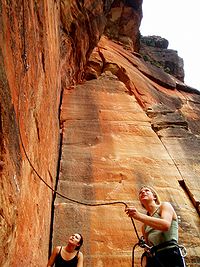
on a climbing rope so that a falling climber does not fall very far. A climbing partner typically applies the friction at the other end of the rope whenever the climber is not moving, removing the friction from the rope whenever the climber needs more rope in order to be able to continue climbing.
The term belay is also used to mean the place where the belayer is anchored; this would typically be a ledge, but may instead be a hanging belay, where the belayer is suspended from protection in the rock.
How belaying works
In a typical climbing situation, one end of the rope is fixed to the harness of the climber, using either a figure of eight loop, or a bowlineBowline
The bowline is an ancient and simple knot used to form a fixed loop at the end of a rope. It has the virtues of being both easy to tie and untie. The bowline is sometimes referred as King of the knots because of its importance...
or double bowline
Double bowline
A double bowline is a type of loop knot. Instead of the single turn of the regular bowline, the double bowline uses a round turn. This forms a more secure loop than a standard bowline...
knot. The rope then passes through climbing protection
Protection (climbing)
To make climbing as safe as possible, most climbers use protection, a term used to describe the equipment used to prevent injury to themselves and others.-Types of climbing:...
which is fixed into the rock. This may be bolts which are permanently fixed into the rock, or it may be traditional protection, which is placed by the climber and then later removed without altering the rock. The rope runs through the protection to a second person called the belayer. The belayer wears a harness to which a belay device
Belay device
Belay devices are mechanical pieces of climbing equipment used to control a rope during belaying. They are designed to improve belay safety for the climber by allowing the belayer to manage their duties with minimal physical effort. With the right belay device, a small, weak climber can easily...
is attached. The rope threads through the belay device, and by altering the position of the end of the rope, the belayer can vary the amount of friction which is applied to the rope. In one position the rope will run freely through the belay device and in another it can easily be held without moving because the amount of friction on the rope is so great. This is known as 'locking off' the rope.
If the climber climbs three feet higher than the last piece of protection in the rock, and then falls, their rope will allow them to fall the three feet to the protection, and another three feet below that. If they fall any further, rope will be pulled upwards through the protection from the belayer below. Because the belayer generally keeps the rope locked off, the climber's fall should be arrested and they are left suspended, but safe, somewhere below the protection.
A dynamic rope, which has some stretch in it, is used so that the climber is not brought to a sudden jarring stop which could cause severe injury.
As the climber continues his ascent, he clips his rope into higher and higher metal loops fixed into the rock, so that in the event of a fall he will not fall further than the "unclipped" length of rope will allow.
While the task of belaying is typically assigned to a companion who stays at the bottom, self-belaying is also possible as an advanced technical climbing technique.
The person climbing is said to be on belay when one of these belaying methods is being used. Belaying is a critical part of the climbing system. By using a correct belaying method, the belayer can hold the entire weight of the climber by using relatively little force, and can easily arrest even a long fall. By using a mixture of belaying angle and hand-grip on the rope, a climber can be lowered gently by the belayer to a safe point where climbing can be resumed.
Belayer responsibilities
The belayer should keep the rope locked off in the belay device whenever the climber is not moving. As the climber moves on the climb, the belayer must make sure that the climber has the right amount of rope by paying out or pulling in excess rope. If the climber falls, then they will free-fall the distance of the slack or unprotected rope before friction applied by the belayer will start to slow their descent. Too much slack on the rope will increase the distance which may be fallen, but too little slack on the rope may prevent the climber from being able to continue to move up the rock. It is extremely important for the belayer to concentrate on the climber's situation, as their role is crucial for the climber's safety.When belaying on overhanging bolted routes, particularly indoors belayers often stand well back from the rock so that they can watch the climber more easily. However, when belaying a lead climber who is using traditional protection, this can be very dangerous. The belayer should stand near to the bottom of the route in order to decrease the angle of the rope through the first piece of protection. This in turn will decrease the force pulling it up and out of the rock if the leader should fall. Standing too far away from the rock can result in protection unzipping, with the lowest piece being pulled away from the rock, followed by the next, until all of the protection may potentially be pulled out. Standing too far away from the bottom of the climb will also mean that if the leader falls, the belayer will experience a sudden pull inwards towards the rock and may be pulled off their feet or into the rock.
Communication
Communication is also extremely important in belaying.Climbers should wait for a verbal confirmation from the belayer that they are ready to begin. In the US, usually the climber will ask "On Belay?" or "Belay?" and wait for the belayer to reply "Belay On". Once ready, the climber then follows with a "Climb Ready" or "Climbing". This is usually acknowledged by the belayer saying "Climb On."
During the climb, the climber may ask the belayer for "Slack", "Tension", warn of a "Rock!" or that they are about to be "Falling!".
At the top of the climb, the climber may elect to climb back down, be lowered down, walk back down, or set up a new belay point for another pitch or set up a new line to rappel down from. Whatever they choose to do, it must be made clear to the belayer. When the climber is in a safe position independent of the belay they will call "Off belay".
At times, it may be impossible for climbing partners to hear one another, for example, in bad weather, by the sea, or near a busy road. Silent belay communication is possible via tugging the rope. Some people use walkie talkies in areas where communication is limited.
Anchoring
When belaying for a partner who is significantly heavier, it is advisable for the belayer to create an anchor point for him- or herself before allowing the climber to lead a route. This will not prevent a fall but will prevent the falling climber from counter-balancing the belayer during a fall and causing a "take off" where the belayer is launched into the air or towards the rock.To set up the anchor, the belayer should insert a relevant piece of protection (i.e. a nut or cam) into a crack below his or her body. The anchor will arrest any upward force produced during a fall, thus preventing the belayer from "taking off".
Unlike belays set up at the top of a climb, it is not usually necessary for belayers at the bottom to have more than one point of protection as long as the single piece is sturdy and safe - "bomb proof", as it were.
Belay methods
Climbers now almost exclusively use a belay deviceBelay device
Belay devices are mechanical pieces of climbing equipment used to control a rope during belaying. They are designed to improve belay safety for the climber by allowing the belayer to manage their duties with minimal physical effort. With the right belay device, a small, weak climber can easily...
to achieve controllable rope friction. Before the invention of these devices, climbers used other belay methods, which are still useful in emergencies.
Belay devices
A belay device is a piece of climbing equipment that improves belay safety for the climber by allowing the belayer to manage their duties with minimal physical effort. Belay devices are designed to allow a weak person to easily arrest a climber's fall with maximum control, while avoiding twisting, heating or severely bending the rope.Munter hitch / Italian Hitch
A munter hitch is a method of belaying which creates a friction brake by tying a special knot around an appropriate carabinerCarabiner
A carabiner or karabiner is a metal loop with a sprung or screwed gate that is used to quickly and reversibly connect components in safety-critical systems. The word comes from "Karabinerhaken", meaning "hook for a carbine" in German.-Use:...
. This type of belay, however, causes the rope to become twisted. It can also be used on double ropes. Simply tie the munter hitch with both ropes as if they were one.