

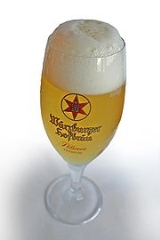
Beer head

Encyclopedia

Foam
-Definition:A foam is a substance that is formed by trapping gas in a liquid or solid in a divided form, i.e. by forming gas regions inside liquid regions, leading to different kinds of dispersed media...
on top of liquid beer
Beer
Beer is the world's most widely consumed andprobably oldest alcoholic beverage; it is the third most popular drink overall, after water and tea. It is produced by the brewing and fermentation of sugars, mainly derived from malted cereal grains, most commonly malted barley and malted wheat...
after it is poured in a glass. It is produced by bubbles of carbon dioxide
Carbon dioxide
Carbon dioxide is a naturally occurring chemical compound composed of two oxygen atoms covalently bonded to a single carbon atom...
rising to the surface.
The density and longevity of the head will be determined by the type of malt and adjunct
Adjuncts
Adjuncts are unmalted grains used in brewing beer which supplement the main mash ingredient , often with the intention of cutting costs, but sometimes to create an additional feature, such as better foam retention.- Definition :Ingredients which are standard for certain beers, such as wheat in a...
from which the beer was fermented
Fermentation (food)
Fermentation in food processing typically is the conversion of carbohydrates to alcohols and carbon dioxide or organic acids using yeasts, bacteria, or a combination thereof, under anaerobic conditions. Fermentation in simple terms is the chemical conversion of sugars into ethanol...
. Different mash schedules and cereal sources influence head retention.
In general, wheat tends to produce larger and longer lasting heads than barley.
Importance
Consumers tend to place a lot of importance on beer heads: too much of a head is undesirable because it detracts from the mass of the drink (similar to carbonated soda drinks), but on the other hand, a beer drink is viewed as incomplete unless it has a head, and the specific form of head expected for the type of beer. Some view beer heads as important because they give off the aroma of the beer. Another opinion is that it is important for the aesthetic look of the beer.Formation through carbon dioxide
The carbon dioxide may be produced naturally through the activity of brewers yeast, or artificially by dissolvingSolvation
Solvation, also sometimes called dissolution, is the process of attraction and association of molecules of a solvent with molecules or ions of a solute...
carbon dioxide under pressure into the liquid. The beer head is created by the carbon dioxide
Carbon dioxide
Carbon dioxide is a naturally occurring chemical compound composed of two oxygen atoms covalently bonded to a single carbon atom...
produced as a byproduct of the metabolism of brewer's yeast acting upon starches and sugars found in the wort
Wort
Wort may refer to:* Wort, the liquid created by the mashing of malted barley to use in brewing beer* Worting, Hampshire, a large district and suburb of the town of Basingstoke, in Hampshire, England....
.
Chemical composition
While the actual foam activity of beer depends on the presence of carbon dioxide, it is the surface-active materials like amphipathic polypeptides from malt that determine size, shape and length of the foam.Beer foam consists of polypeptides of five different classifications, divided by their relative hydrophobicity. As the hydrophobicity of the polypeptide groups increases, so does the stability of the foam.
Carbonation occurs when carbon dioxide is dissolved in water or an aqueous solution. This process is generally represented by the following reaction, where water and gaseous carbon dioxide react to form a dilute solution of carbonic acid.
Importance of the glass
Properties of the glass can also influence a beer head, with a roughened surface at the base of glass known as a widgetWidget (beer)
A widget is a device placed in a container of beer to manage the characteristics of the beer's head. The original widget was patented in Ireland by Guinness. The "floating widget" is found in cans of beer as a hollow plastic sphere, 3 cm in diameter with a small hole in one side...
, providing for nucleation
Nucleation
Nucleation is the extremely localized budding of a distinct thermodynamic phase. Some examples of phases that may form by way of nucleation in liquids are gaseous bubbles, crystals or glassy regions. Creation of liquid droplets in saturated vapor is also characterized by nucleation...
of carbon dioxide deep in the beverage rather than at the surface, resulting in a slower release of gas to the atmosphere.
While glass is completely nonporous, its surface can retain oil from the skin, aerosolized oil from nearby cooking, and traces of fat from food. When these oils come in contact with beer there is a significant reduction in the amount of head (foam) that is found on the beer, and the bubbles will tend to stick to the side of the glass rather than rising to the surface as normal.
For proper foam formation, it is also important to dry the glass thoroughly after washing. Any water in the glass can prevent excitement of the gas by covering designs set in the bottom of the glass, thus making the beer flat.
Conversely, some styles such as Belgian witbier benefit from being poured into a wet glass to control the often profusive head.
Formation of 'Nitrogen head'
The creamy head on beers such as GuinnessGuinness
Guinness is a popular Irish dry stout that originated in the brewery of Arthur Guinness at St. James's Gate, Dublin. Guinness is directly descended from the porter style that originated in London in the early 18th century and is one of the most successful beer brands worldwide, brewed in almost...
is created by a widget
Widget (beer)
A widget is a device placed in a container of beer to manage the characteristics of the beer's head. The original widget was patented in Ireland by Guinness. The "floating widget" is found in cans of beer as a hollow plastic sphere, 3 cm in diameter with a small hole in one side...
in cans or bottles using nitrogen
Nitrogen
Nitrogen is a chemical element that has the symbol N, atomic number of 7 and atomic mass 14.00674 u. Elemental nitrogen is a colorless, odorless, tasteless, and mostly inert diatomic gas at standard conditions, constituting 78.08% by volume of Earth's atmosphere...
, or by the process of drawing keg beer from a keg using nitrogen or mixed gas (carbon dioxide and nitrogen). The use of nitrogen, which was pioneered by Guinness, creates a firm head with small bubbles while reducing the excessively acidic taste often produced by using carbon dioxide alone.