
Home      Discussion      Topics      Dictionary      Almanac
Signup       Login
Bee-eater

Bee-eater

Overview
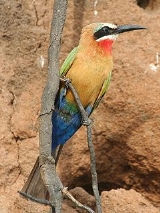
The bee-eaters are a group of near-passerine bird
Bird
Birds are feathered, winged, bipedal, endothermic , egg-laying, vertebrate animals. Around 10,000 living species and 188 families makes them the most speciose class of tetrapod vertebrates. They inhabit ecosystems across the globe, from the Arctic to the Antarctic. Extant birds range in size from...

s in the family
Family (biology)
In biological classification, family is* a taxonomic rank. Other well-known ranks are life, domain, kingdom, phylum, class, order, genus, and species, with family fitting between order and genus. As for the other well-known ranks, there is the option of an immediately lower rank, indicated by the...

 Meropidae. Most species are found in Africa and Asia but others occur in southern Europe, Australia, and New Guinea. They are characterised by richly coloured plumage, slender bodies, and usually elongated central tail feathers. All have long downturned bills
Beak
The beak, bill or rostrum is an external anatomical structure of birds which is used for eating and for grooming, manipulating objects, killing prey, fighting, probing for food, courtship and feeding young...

 and pointed wings, which give them a swallow-like appearance when seen from afar. There are 26 different species of bee-eaters.
Discussion
Ask a question about 'Bee-eater'
Start a new discussion about 'Bee-eater'
Answer questions from other users
Full Discussion Forum
 
Unanswered Questions
Encyclopedia
The bee-eaters are a group of near-passerine bird
Bird
Birds are feathered, winged, bipedal, endothermic , egg-laying, vertebrate animals. Around 10,000 living species and 188 families makes them the most speciose class of tetrapod vertebrates. They inhabit ecosystems across the globe, from the Arctic to the Antarctic. Extant birds range in size from...

s in the family
Family (biology)
In biological classification, family is* a taxonomic rank. Other well-known ranks are life, domain, kingdom, phylum, class, order, genus, and species, with family fitting between order and genus. As for the other well-known ranks, there is the option of an immediately lower rank, indicated by the...

 Meropidae. Most species are found in Africa and Asia but others occur in southern Europe, Australia, and New Guinea. They are characterised by richly coloured plumage, slender bodies, and usually elongated central tail feathers. All have long downturned bills
Beak
The beak, bill or rostrum is an external anatomical structure of birds which is used for eating and for grooming, manipulating objects, killing prey, fighting, probing for food, courtship and feeding young...

 and pointed wings, which give them a swallow-like appearance when seen from afar. There are 26 different species of bee-eaters.

As the name suggests, bee-eaters predominantly eat flying insect
Insect
Insects are a class of living creatures within the arthropods that have a chitinous exoskeleton, a three-part body , three pairs of jointed legs, compound eyes, and two antennae...

s, especially bees and wasps, which are caught in the air by sallies from an open perch. While they pursue any type of flying insect, honey bee
Honey bee
Honey bees are a subset of bees in the genus Apis, primarily distinguished by the production and storage of honey and the construction of perennial, colonial nests out of wax. Honey bees are the only extant members of the tribe Apini, all in the genus Apis...

s predominate in their diet. Hymenoptera
Hymenoptera
Hymenoptera is one of the largest orders of insects, comprising the sawflies, wasps, bees and ants. There are over 130,000 recognized species, with many more remaining to be described. The name refers to the heavy wings of the insects, and is derived from the Ancient Greek ὑμήν : membrane and...

 (ants, bees and wasps) comprise from 20% to 96% of all insects eaten, with honey bees comprising approximately one-third of the Hymenoptera.

Before eating its meal, a bee-eater removes the sting by repeatedly hitting and rubbing the insect on a hard surface. During this process, pressure is applied to the insect thereby extracting most of the venom. Notably, the birds only catch prey that are on the wing and ignore flying insects once they land.

Bee-eaters are gregarious. They form colonies
Bird colony
A bird colony is a large congregation of individuals of one or more species of bird that nest or roost in close proximity at a particular location. Many kinds of birds are known to congregate in groups of varying size; a congregation of nesting birds is called a breeding colony...

 by nesting in burrows tunnelled into the side of sandy banks, such as those that have collapsed on the edges of rivers. Their eggs are white and they generally produce 2-9 eggs per clutch (depending on species). As they live in colonies, large numbers of these holes are often seen together, white streaks from their accumulated droppings accentuating the entrances to the nests. Most of the species in the family are monogamous, and both parents care for the young, sometimes with the assistance of other birds in the colony.

Description


The bee-eaters are a fairly uniform group, morphologically. They share many features with related Coraciiformes
Coraciiformes
The Coraciiformes are a group of usually colorful near passerine birds including the kingfishers, the Hoopoe, the bee-eaters, the rollers, and the hornbills...

 such as the kingfisher
Kingfisher
Kingfishers are a group of small to medium sized brightly coloured birds in the order Coraciiformes. They have a cosmopolitan distribution, with most species being found in the Old World and Australia...

s and roller
Roller
The rollers are an Old World family, Coraciidae, of near passerine birds. The group gets its name from the aerial acrobatics some of these birds perform during courtship or territorial flights. Rollers resemble crows in size and build, and share the colourful appearance of kingfishers and...

s, being large-headed (but not as large-headed as their relatives) short-necked, brightly plumaged and short-legged. Their wings may be rounded or pointed, with wing shape closely correlated with foraging habitat and migratory
Bird migration
Bird migration is the regular seasonal journey undertaken by many species of birds. Bird movements include those made in response to changes in food availability, habitat or weather. Sometimes, journeys are not termed "true migration" because they are irregular or in only one direction...

 tendencies. Shorter, rounder wings are found on species that are sedentary and make shorter foraging flights in denser forests and reedbeds. Those with more elongated wings are more migratory. All the bee-eaters are highly aerial. They take off strongly from perches, fly directly without undulating, and are able to change directions quickly. Bee-eaters rarely hover, however.

The bill
Beak
The beak, bill or rostrum is an external anatomical structure of birds which is used for eating and for grooming, manipulating objects, killing prey, fighting, probing for food, courtship and feeding young...

s of bee-eaters are curved, long and end in a sharp point. The bill can bite strongly, particularly at the tip, and is used as a pair of forceps with which to snatch insects from the air and crush smaller ones. The short legs have weak feet, when moving on the ground its gait is barely more than a shuffle. The feet have sharp claws used for perching on vertical surfaces and also during nest excavation.

The plumage
Plumage
Plumage refers both to the layer of feathers that cover a bird and the pattern, colour, and arrangement of those feathers. The pattern and colours of plumage vary between species and subspecies and can also vary between different age classes, sexes, and season. Within species there can also be a...

 of the family is generally very bright and in most species dominated or at least partly green. The two carmine bee-eaters are mostly rosy coloured. Most of the Merops bee-eaters have a line through the eye and many have differently coloured throats and faces. The extent of the green in these varies from almost completely in the Green Bee-eater to barely any in the White-throated Bee-eater
White-throated Bee-eater
The White-throated Bee-eater, Merops albicollis is a near passerine bird in the bee-eater family Meropidae. It breeds in semi-desert along the southern edge of the Sahara, Africa...

. Three species, from equatorial Africa
Africa
Africa is the world's second largest and second most populous continent, after Asia. At about 30.2 million km² including adjacent islands, it covers 6% of the Earth's total surface area and 20.4% of the total land area...

, have no green at all in their plumage, the Black Bee-eater
Black Bee-eater
The Black Bee-eater is a species of bird in the Meropidae family.-Description:Black with scarlet chin and throat, streaked breast, pale blue eyebrow, belly, undertail-coverts and rump, rufous primaries.-Distribution:...

, the Blue-headed Bee-eater
Blue-headed Bee-eater
The blue-headed bee-eater is a species of bird in the Meropidae family.It is found in Cameroon, Central African Republic, Republic of the Congo, Democratic Republic of the Congo, Ivory Coast, Equatorial Guinea, Gabon, Ghana, Guinea, Kenya, Liberia, Nigeria, and Sierra Leone.The blue-headed...

 and the Rosy Bee-eater
Rosy Bee-eater
The Rosy Bee-eater is a species of bird in the Meropidae family.It is found in Angola, Benin, Burkina Faso, Republic of the Congo, Democratic Republic of the Congo, Ivory Coast, Equatorial Guinea, Gabon, Ghana, Nigeria, and Togo....

. Several species have long streamers in the tail, and in a few species these are ended with expanded spatulae.

There is little visible difference between the sexes
Sexual dimorphism
Sexual dimorphism is a phenotypic difference between males and females of the same species. Examples of such differences include differences in morphology, ornamentation, and behavior.-Examples:-Ornamentation / coloration:...

 in most of the family. In several species the iris
Iris (anatomy)
The iris is a thin, circular structure in the eye, responsible for controlling the diameter and size of the pupils and thus the amount of light reaching the retina. "Eye color" is the color of the iris, which can be green, blue, or brown. In some cases it can be hazel , grey, violet, or even pink...

 is red in the males and brown-red in the females, and in species with tail-streamers these may be slightly longer in males. Both the European and Red-bearded Bee-eaters have differences in the colour of their plumage, and the Rainbow Bee-eaters have differently shaped tail-streamers. There are however probably undocumented instances where bee-eaters are sexually dichromatic in the ultraviolet
Ultraviolet
Ultraviolet light is electromagnetic radiation with a wavelength shorter than that of visible light, but longer than X-rays, in the range 10 nm to 400 nm, and energies from 3 eV to 124 eV...

 end of the colour spectrum, which humans cannot see. A study of Blue-tailed Bee-eater
Blue-tailed Bee-eater
The Blue-tailed Bee-eater, Merops philippinus is a near passerine bird in the bee-eater family Meropidae. It breeds in southeastern Asia. It is strongly migratory, seen seasonally in much of peninsular India....

 found that males were more colourful when comparisons between males and females included a comparison of their plumage in the UV spectrum. Overall colour also was affected by body condition, suggesting that there was a signalling component to plumage colour.

Distribution, habitat and migration


The bee-eaters have an Old World
Old World
The Old World consists of those parts of the world known to classical antiquity and the European Middle Ages. It is used in the context of, and contrast with, the "New World" ....

 distribution, occurring from Europe
Europe
Europe is, by convention, one of the world's seven continents. Comprising the westernmost peninsula of Eurasia, Europe is generally 'divided' from Asia to its east by the watershed divides of the Ural and Caucasus Mountains, the Ural River, the Caspian and Black Seas, and the waterways connecting...

 to Australia
Australia
Australia , officially the Commonwealth of Australia, is a country in the Southern Hemisphere comprising the mainland of the Australian continent, the island of Tasmania, and numerous smaller islands in the Indian and Pacific Oceans. It is the world's sixth-largest country by total area...

. The centre of diversity of the family is Africa
Africa
Africa is the world's second largest and second most populous continent, after Asia. At about 30.2 million km² including adjacent islands, it covers 6% of the Earth's total surface area and 20.4% of the total land area...

, although a number of species also occur in Asia. A single species occurs in Europe, the European Bee-eater
European Bee-eater
The European Bee-eater, Merops apiaster, is a near passerine bird in the bee-eater family Meropidae. It breeds in southern Europe and in parts of north Africa and western Asia. It is strongly migratory, wintering in tropical Africa, India and Sri Lanka...

 and Australia, the Rainbow Bee-eater
Rainbow Bee-eater
The Rainbow Bee-eater, Merops ornatus, is a near passerine bird in the bee-eater family Meropidae. It is the only species of Meropidae found in Australia.-Description:...

; and there is one Madagascar species, the Olive Bee-eater (also found on mainland Africa). Of the three genera, Merops, which has the majority of the species in the family, occurs across the entirely of the family's distribution. Nyctyornis is restricted to Asia, ranging from India and southern China to the Indonesian islands of Sumatra
Sumatra
Sumatra is an island in western Indonesia, westernmost of the Sunda Islands. It is the largest island entirely in Indonesia , and the sixth largest island in the world at 473,481 km2 with a population of 50,365,538...

 and Borneo
Borneo
Borneo is the third largest island in the world and is located north of Java Island, Indonesia, at the geographic centre of Maritime Southeast Asia....

. The genus Meropogon, has a single species restricted to Sulawesi
Sulawesi
Sulawesi is one of the four larger Sunda Islands of Indonesia and is situated between Borneo and the Maluku Islands. In Indonesia, only Sumatra, Borneo, and Papua are larger in territory, and only Java and Sumatra have larger Indonesian populations.- Etymology :The Portuguese were the first to...

 in Indonesia.

Bee-eaters are fairly catholic in their habitat. Their requirements are a simply an elevated perch from which to watch for prey and a ground substrate in which to dig their breeding burrow. Because their prey is entirely caught on the wing they are not dependent on any vegetation type. A single species is found inside closed rainforest, the Blue-headed Bee-eater
Blue-headed Bee-eater
The blue-headed bee-eater is a species of bird in the Meropidae family.It is found in Cameroon, Central African Republic, Republic of the Congo, Democratic Republic of the Congo, Ivory Coast, Equatorial Guinea, Gabon, Ghana, Guinea, Kenya, Liberia, Nigeria, and Sierra Leone.The blue-headed...

, where it forages close to the ground in poor light in the gaps between large trees under the canopy. Six other species are also closely associated with rainforest, but do so in edge habitat in this environment; along rivers, in tree-fall gaps, off trees overhanging ravines or on emergent crowns above the main canopy.

A number of the bee-eaters are migratory
Bird migration
Bird migration is the regular seasonal journey undertaken by many species of birds. Bird movements include those made in response to changes in food availability, habitat or weather. Sometimes, journeys are not termed "true migration" because they are irregular or in only one direction...

. Species that breed in subtropical or temperate areas of Europe, Asia and Australia are all migrants. The European Bee-eater
European Bee-eater
The European Bee-eater, Merops apiaster, is a near passerine bird in the bee-eater family Meropidae. It breeds in southern Europe and in parts of north Africa and western Asia. It is strongly migratory, wintering in tropical Africa, India and Sri Lanka...

s that breed in southern Europe and Asia migrate to West
West Africa
West Africa or Western Africa is the westernmost region of the African continent. Geopolitically, the UN definition of Western Africa includes the following 16 countries and an area of approximately 5 million square km:-Flags of West Africa:...

 and Southern Africa
Southern Africa
Southern Africa is the southernmost region of the African continent, variably defined by geography or geopolitics. Within the region are numerous territories, including the Republic of South Africa ; nowadays, the simpler term South Africa is generally reserved for the country in English.-UN...

. Another population of the same species breeds in South Africa and Namibia; these birds move northwards after breeding. In Australia the Rainbow Bee-eater
Rainbow Bee-eater
The Rainbow Bee-eater, Merops ornatus, is a near passerine bird in the bee-eater family Meropidae. It is the only species of Meropidae found in Australia.-Description:...

 is migratory in the southern areas of its range, migrating to Indonesia and New Guinea, but occurs year round in northern Australia. Several species of bee-eater, such as the White-throated Bee-eater, are intra-African migrants. The most unusual migration is that of the Southern Carmine Bee-eater
Southern Carmine Bee-eater
The Southern Carmine Bee-eater occurs across sub-equatorial Africa, ranging from KwaZulu-Natal and Namibia to Gabon, eastern Democratic Republic of the Congo and Kenya....

, which has a three stage migration; after breeding in a band between Angola and Mozambique it moves south to Botswana, Namibia and South Africa before moving north to its main wintering grounds in northern Angola, Congo and Tanzania.

Behaviour


The bee-eaters are diurnal (active by day), although a few species may migrate during the night if the terrain on route is unsuitable for stopping or if they are crossing the sea. They are a highly social family. Pairs sitting together are often so close together that they touch (described as having an individual distance of zero). Groups may roost together in a row in such a fashion as well. Some species are highly gregarious in the non-breeding season, and many species are colonial
Bird colony
A bird colony is a large congregation of individuals of one or more species of bird that nest or roost in close proximity at a particular location. Many kinds of birds are known to congregate in groups of varying size; a congregation of nesting birds is called a breeding colony...

 in the breeding season as well.

The social structures of the Red-throated Bee-eater
Red-throated Bee-eater
The Red-throated Bee-eater is a species of bird in the Meropidae family.This species has a large range, and is found in Benin, Burkina Faso, Cameroon, Central African Republic, Chad, Democratic Republic of the Congo, Ivory Coast, Ethiopia, Gambia, Ghana, Guinea, Guinea-Bissau, Mali, Mauritania,...

 and the White-fronted Bee-eater
White-fronted Bee-eater
The White-fronted Bee-eater, Merops bullockoides, is a species of bee-eater widely distributed in sub-equatorial Africa.They have a distinctive white forehead, a square tail and a bright red patch on their throat...

s have been described as "the most complex of any bird species anywhere in the world". The birds exist in stable colonies located on nesting cliffs, and have a stable structure year round. These colonies are composed of clans of two or three pairs, their helpers
Helpers at the nest
Helpers at the nest is a term used in behavioural ecology and evolutionary biology to describe a social structure in which juveniles and sexually mature adolescents of either one or both sexes, remain in association with their parents and help them raise subsequent broods or litters, instead of...

, and offspring. Within the colony the males alternate between guarding their mate and attempting to make forced copulations other females. The females in turn attempt to lay eggs in their neighbour's nests. Within colonies some individuals also specialise in kleptoparasitism
Kleptoparasitism
Kleptoparasitism or cleptoparasitism is a form of feeding in which one animal takes prey or other food from another that has caught, collected, or otherwise prepared the food, including stored food...

, stealing prey collected by other colony members. The colony's daily routine is emerge from the nesting holes or roosting branches soon after dawn, preen and sun themselves for an hour, then disperse to feed. Feeding territories are broken down by clan, with the clan defending the territories from all others of the same species, including clans of the same colony. The clans return to the colony before dusk, and engage in more social behaviour before retiring for the night. Colonies are situated several hundred metres apart and have little to do with each other, although young individuals may disperse between colonies. As such these species can be thought to have four tiers of social kinship, the individual pair, the family unit, the clan and the colony as a whole.

Bee-eaters spend around 10% of their day on what are known as comfort activities. These include sunning themselves, dust bath
Dust bath
Dust bath is the act of an animal grooming and cleansing its skin or fur from parasites by rolling or moving around within dust or sand.-Overview:...

ing and water bathing. Sunning behaviour helps warm birds in the morning, reducing the need to use energy to raise the temperature. It also has a social aspect, as multiple birds adopt the same posture. Finally, it may help stimulate parasites in the feathers, making them easier to find and remove. Due to their hole-nesting bee-eaters accumulate a number of ectoparasites such as mites and flies. Together with sunning bouts of dust bath
Dust bath
Dust bath is the act of an animal grooming and cleansing its skin or fur from parasites by rolling or moving around within dust or sand.-Overview:...

ing (or water bathing where available), as well as rigorous preening, keep the feathers and skin in good health. Bathing with water involves making shallow dives into a water body and then returning to a perch to preen.

Diet and feeding


The bee-eaters are almost exclusively aerial hunters of insect prey. Prey is caught either while in continuous flight or more commonly from an exposed perch where the bee-eater watches for prey. Smaller, rounder-winged bee-eaters typically hunt from branches and twigs closer to the ground, whereas the larger species hunt from tree tops or telegraph wires. One unusual technique often used by carmine bee-eaters is to ride the back of bustards. Prey can be spotted from a distance; European Bee-eater
European Bee-eater
The European Bee-eater, Merops apiaster, is a near passerine bird in the bee-eater family Meropidae. It breeds in southern Europe and in parts of north Africa and western Asia. It is strongly migratory, wintering in tropical Africa, India and Sri Lanka...

s are able to spot a bee 60 m away, and Blue-cheeked Bee-eater
Blue-cheeked Bee-eater
The Blue-cheeked Bee-eater, Merops persicus, is a near passerine bird in the bee-eater family, Meropidae. It breeds in Northern Africa, and the Middle East from eastern Turkey to Kazakhstan and India. It is generally strongly migratory, wintering in tropical Africa, although some populations breed...

s have been observed flying out 100 m to catch large wasps. Prey is approached directly or from behind. Prey that lands on the ground or on plants is usually not pursued. Small prey may be eaten on the wing, but larger prey are returned to the perch to be beaten against the perch to kill them and break them up. Insects with poisonous stings are first smacked on the branch, then, with the eyes closed, rubbed to discharge the venom. This behaviour is innate, as demonstrated by a juvenile bird in captivity, which performed the task when first presented with wild bees. This bird was stung on the first five tries, but by ten bees, it was as adept at handling bees as adult birds.

Bee-eaters consume a wide range of insects; beyond a few distasteful butterflies they consume almost any insect from tiny Drosophila
Drosophila
Drosophila is a genus of small flies, belonging to the family Drosophilidae, whose members are often called "fruit flies" or more appropriately pomace flies, vinegar flies, or wine flies, a reference to the characteristic of many species to linger around overripe or rotting fruit...

 flies to large beetles and dragonflies. At some point bee-eaters have been recorded eating beetles, mayflies, stoneflies, cicadas, termites, crickets and grasshoppers, mantises, true flies and moths. For many species the dominant prey item are stinging members of the order Hymenoptera
Hymenoptera
Hymenoptera is one of the largest orders of insects, comprising the sawflies, wasps, bees and ants. There are over 130,000 recognized species, with many more remaining to be described. The name refers to the heavy wings of the insects, and is derived from the Ancient Greek ὑμήν : membrane and...

, namely wasp
Wasp
The term wasp is typically defined as any insect of the order Hymenoptera and suborder Apocrita that is neither a bee nor an ant. Almost every pest insect species has at least one wasp species that preys upon it or parasitizes it, making wasps critically important in natural control of their...

s and bee
Bee
Bees are flying insects closely related to wasps and ants, and are known for their role in pollination and for producing honey and beeswax. Bees are a monophyletic lineage within the superfamily Apoidea, presently classified by the unranked taxon name Anthophila...

s. In a survey of 20 studies the proportion of the diet made up by bees and wasps varied from 20% to 96%, with the average being 70%. Of these honeybees can comprise a large part of the diet - as much as 89% of the overall diet.

Breeding


Bee-eaters are seasonally monogamous
Monogamy
Monogamy /Gr. μονός+γάμος - one+marriage/ a form of marriage in which an individual has only one spouse at any one time. In current usage monogamy often refers to having one sexual partner irrespective of marriage or reproduction...

, and some species are monogamous over multiple seasons. Migratory species however are thought to form new pair bonds each breeding season. The courtship displays of the bee-eaters are rather unspectacular, with the exception of the "butterfly display" (where the wings of both sexes are held out while calling) of the White-throated Bee-eater
White-throated Bee-eater
The White-throated Bee-eater, Merops albicollis is a near passerine bird in the bee-eater family Meropidae. It breeds in semi-desert along the southern edge of the Sahara, Africa...

. Most members of the family engage in courtship feeding, where the male presents prey items to the female, and such feeding can account for much if not all of the energy females require for egg creation.

Like almost all Coraciiformes
Coraciiformes
The Coraciiformes are a group of usually colorful near passerine birds including the kingfishers, the Hoopoe, the bee-eaters, the rollers, and the hornbills...

 the bee-eaters are cavity nesters
Bird nest
A bird nest is the spot in which a bird lays and incubates its eggs and raises its young. Although the term popularly refers to a specific structure made by the bird itself—such as the grassy cup nest of the American Robin or Eurasian Blackbird, or the elaborately woven hanging nest of the...

. In the case of the bee-eaters the nests are burrows dug into the ground, either into the sides of earth cliffs or directly into level ground. Both types of nesting site are vulnerable, those on level ground are vulnerable to trampling and small predators, whereas those in cliffs, which are often the banks of rivers, are vulnerable to flash floods, which can wipe out dozens or hundreds of nests. Many species nest either on cliffs or on level ground but prefer cliffs, however the Böhm's Bee-eater always nests on level ground. The burrows are dug by both birds in the pair as well as any helpers that have joined the pair. The soil or sand is loosened with jabs of the sharp bill, then the feet are used to kick out the loose substrate. There may be several false starts where nests are dug partway before being abandoned; in solitary species this can give the impression of colonial living even when they are not. The process of nest building can take as long as twenty days to complete, during which the bill can be both blunted and shortened. Nests are generally used only for a single season and are rarely used twice by the bee-eaters, but abandoned bee-eater nests may be used by a host of birds, snakes and bats as shelter and breeding places.

Bee-eaters may nest as single pairs, loose colonies or dense colonies. Smaller species tend to nest solitarily, while medium sized species do so in the smaller colonies and larger and migratory species nest in large colonies that can number in the thousands. In some instances colonies may contain more than one species of bee-eater.

Species list in taxonomic order


The bee-eater family consists of two subfamilies - the bearded bee-eaters Nyctyornithinae, and Meropinae, the typical bee-eaters.

FAMILY: MEROPIDAE
  • Genus: Nyctyornis
    Nyctyornis
    Nyctyornis is a genus of the bee-eaters, near passerine birds in the family Meropidae. There are just two members of this group, which occur in tropical south and southeatern Asia.* Red-bearded Bee-eater, Nyctyornis amictus...

    • Red-bearded Bee-eater
      Red-bearded Bee-eater
      The Red-bearded Bee-eater Nyctyornis amictus is a large species of bee-eater found in the Indo-Malayan subregion of South-east Asia. This species is found in openings in patches of dense forest....

      , Nyctyornis amictus
    • Blue-bearded Bee-eater
      Blue-bearded Bee-eater
      The Blue-bearded Bee-eater Nyctyornis athertoni is a large species of bee-eater found in South Asia. This species is found in openings in patches of dense forest. It is found in the Malayan region and also extends into the Western Ghats in southwestern India. The blue feathers of its throat are...

      , Nyctyornis athertoni
  • Genus: Meropogon
    • Purple-bearded Bee-eater
      Purple-bearded Bee-eater
      The Purple-bearded Bee-eater or Celebes Bee-eater is a near passerine bird in the bee-eater family Meropidae. It is an endemic resident on the island of Sulawesi, Indonesia. This species is found in openings in patches of dense forest.The Purple-bearded Bee-eater is the only member of the genus...

      , Meropogon forsteni
  • Genus: Merops
    Merops (genus)
    Merops is a large genus of bee-eaters, a group of near passerine birds in the family Meropidae. The members of this Old World family are characterised by richly coloured plumage, slender bodies and usually elongated central tail feathers...

    • Little Bee-eater
      Little Bee-eater
      The little Bee-eater, Merops pusillus is a near passerine bird in the bee-eater family Meropidae. It is resident in much of sub-Saharan Africa. It should not be confused with the Little Green Bee-eater, Merops orientalis. Migration is limited to seasonal movements depending on rainfall...

      , Merops pusillus
    • Blue-cheeked Bee-eater
      Blue-cheeked Bee-eater
      The Blue-cheeked Bee-eater, Merops persicus, is a near passerine bird in the bee-eater family, Meropidae. It breeds in Northern Africa, and the Middle East from eastern Turkey to Kazakhstan and India. It is generally strongly migratory, wintering in tropical Africa, although some populations breed...

      , Merops persicus
    • Green Bee-eater, Merops orientalis
    • White-throated Bee-eater
      White-throated Bee-eater
      The White-throated Bee-eater, Merops albicollis is a near passerine bird in the bee-eater family Meropidae. It breeds in semi-desert along the southern edge of the Sahara, Africa...

      , Merops albicollis
    • Swallow-tailed Bee-eater
      Swallow-tailed Bee-eater
      The Swallow-tailed Bee-eater is a near passerine bird in the bee-eater family Meropidae. It breeds in savannah woodlands of sub-Saharan Africa. It is partially migratory, moving in response to rainfall patterns....

      , Merops hirundinaeus
    • Blue-tailed Bee-eater
      Blue-tailed Bee-eater
      The Blue-tailed Bee-eater, Merops philippinus is a near passerine bird in the bee-eater family Meropidae. It breeds in southeastern Asia. It is strongly migratory, seen seasonally in much of peninsular India....

      , Merops philippinus
    • Black Bee-eater
      Black Bee-eater
      The Black Bee-eater is a species of bird in the Meropidae family.-Description:Black with scarlet chin and throat, streaked breast, pale blue eyebrow, belly, undertail-coverts and rump, rufous primaries.-Distribution:...

      , Merops gularis
    • Blue-headed Bee-eater
      Blue-headed Bee-eater
      The blue-headed bee-eater is a species of bird in the Meropidae family.It is found in Cameroon, Central African Republic, Republic of the Congo, Democratic Republic of the Congo, Ivory Coast, Equatorial Guinea, Gabon, Ghana, Guinea, Kenya, Liberia, Nigeria, and Sierra Leone.The blue-headed...

      , Merops muelleri
    • Red-throated Bee-eater
      Red-throated Bee-eater
      The Red-throated Bee-eater is a species of bird in the Meropidae family.This species has a large range, and is found in Benin, Burkina Faso, Cameroon, Central African Republic, Chad, Democratic Republic of the Congo, Ivory Coast, Ethiopia, Gambia, Ghana, Guinea, Guinea-Bissau, Mali, Mauritania,...

      , Merops bulocki
    • White-fronted Bee-eater
      White-fronted Bee-eater
      The White-fronted Bee-eater, Merops bullockoides, is a species of bee-eater widely distributed in sub-equatorial Africa.They have a distinctive white forehead, a square tail and a bright red patch on their throat...

      , Merops bullockoides
    • Blue-breasted Bee-eater
      Blue-breasted Bee-eater
      The Blue-breasted Bee-eater is a species of bird in the Meropidae family.It is found in Angola, Burundi, Cameroon, Central African Republic, Republic of the Congo, Democratic Republic of the Congo, Equatorial Guinea, Eritrea, Ethiopia, Gabon, Kenya, Nigeria, Rwanda, Sudan, Tanzania, Uganda, and...

      , Merops variegatus
    • Cinnamon-chested Bee-eater
      Cinnamon-chested Bee-eater
      The cinnamon-chested bee-eater is a species of bird in the Meropidae family.It is found in Burundi, Democratic Republic of the Congo, Ethiopia, Kenya, Rwanda, Sudan, Tanzania, and Uganda....

      , Merops oreobates
    • Black-headed Bee-eater
      Black-headed Bee-eater
      The Black-headed Bee-eater is a species of bird in the Meropidae family.It is found in Angola, Central African Republic, Republic of the Congo, Democratic Republic of the Congo, Ivory Coast, Gabon, Ghana, Nigeria, and Sudan....

      , Merops breweri
    • Somali Bee-eater
      Somali Bee-eater
      The somali bee-eater is a species of bird in the Meropidae family.It is found in Ethiopia, Kenya, Saudi Arabia, Somalia and Tanzania....

      , Merops revoilii
    • Böhm's Bee-eater, Merops boehmi
    • Blue-throated Bee-eater
      Blue-throated Bee-eater
      The Blue-throated Bee-eater is a species of bird in the Meropidae family.It is found in Brunei, Cambodia, China, Hong Kong, Indonesia, Laos, Malaysia, the Philippines, Singapore, Taiwan, Thailand, and Vietnam....

      , Merops viridis
    • Olive Bee-eater, Merops superciliosus
    • Rainbow Bee-eater
      Rainbow Bee-eater
      The Rainbow Bee-eater, Merops ornatus, is a near passerine bird in the bee-eater family Meropidae. It is the only species of Meropidae found in Australia.-Description:...

      , Merops ornatus
    • European Bee-eater
      European Bee-eater
      The European Bee-eater, Merops apiaster, is a near passerine bird in the bee-eater family Meropidae. It breeds in southern Europe and in parts of north Africa and western Asia. It is strongly migratory, wintering in tropical Africa, India and Sri Lanka...

      , Merops apiaster
    • Chestnut-headed Bee-eater
      Chestnut-headed Bee-eater
      The Chestnut-headed Bee-eater, Merops leschenaulti is a near passerine bird in the bee-eater family Meropidae. It is a resident breeder in southern Asia from India east to southeast Asia and Indonesia....

      , Merops leschenaulti
    • Rosy Bee-eater
      Rosy Bee-eater
      The Rosy Bee-eater is a species of bird in the Meropidae family.It is found in Angola, Benin, Burkina Faso, Republic of the Congo, Democratic Republic of the Congo, Ivory Coast, Equatorial Guinea, Gabon, Ghana, Nigeria, and Togo....

      , Merops malimbicus
    • Northern Carmine Bee-eater
      Northern Carmine Bee-eater
      The Northern Carmine Bee-eater Merops nubicus is a near passerine bird in the bee-eater family Meropidae. Alternative common names include the Carmine Bee-eater or the Nubian Bee-eater.-Distribution:...

      , Merops nubicus
    • Southern Carmine Bee-eater
      Southern Carmine Bee-eater
      The Southern Carmine Bee-eater occurs across sub-equatorial Africa, ranging from KwaZulu-Natal and Namibia to Gabon, eastern Democratic Republic of the Congo and Kenya....

      , Merops nubicoides

External links