


Beam engine

Encyclopedia

Steam engine
A steam engine is a heat engine that performs mechanical work using steam as its working fluid.Steam engines are external combustion engines, where the working fluid is separate from the combustion products. Non-combustion heat sources such as solar power, nuclear power or geothermal energy may be...
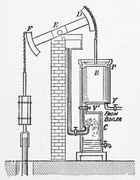
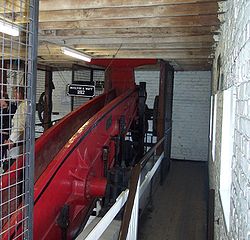
where a pivoted overhead beam is used to apply the force from a vertical piston
Piston
A piston is a component of reciprocating engines, reciprocating pumps, gas compressors and pneumatic cylinders, among other similar mechanisms. It is the moving component that is contained by a cylinder and is made gas-tight by piston rings. In an engine, its purpose is to transfer force from...
to a vertical connecting rod. This configuration, with the engine directly driving a pump, was first used by Thomas Newcomen
Thomas Newcomen
Thomas Newcomen was an ironmonger by trade and a Baptist lay preacher by calling. He was born in Dartmouth, Devon, England, near a part of the country noted for its tin mines. Flooding was a major problem, limiting the depth at which the mineral could be mined...
around 1705 to remove water from mines in Cornwall
Cornwall
Cornwall is a unitary authority and ceremonial county of England, within the United Kingdom. It is bordered to the north and west by the Celtic Sea, to the south by the English Channel, and to the east by the county of Devon, over the River Tamar. Cornwall has a population of , and covers an area of...
. The efficiency of the engines was improved by engineers including James Watt
James Watt
James Watt, FRS, FRSE was a Scottish inventor and mechanical engineer whose improvements to the Newcomen steam engine were fundamental to the changes brought by the Industrial Revolution in both his native Great Britain and the rest of the world.While working as an instrument maker at the...
who added a condenser, Jonathan Hornblower
Jonathan Hornblower
Jonathan Hornblower was a British pioneer of steam power, the son of Jonathan Hornblower and brother of Jabez Carter Hornblower, two fellow pioneers....
and Arthur Woolf
Arthur Woolf
Arthur Woolf was a Cornish engineer, most famous for inventing a high-pressure compound steam engine. As such he made an outstanding contribution to the development and perfection of the Cornish engine.Woolf left Cornwall in 1785 to work for Joseph Bramah's engineering works in London...
who compounded the cylinders, and William McNaught (Glasgow)
William McNaught (Glasgow)
William McNaught was a Scottish engineer, from Glasgow, who patented a compound steam engine in 1845. This was a technique of improving the efficiency of a standard simple Boulton & Watt beam engine. The engine was compounded by adding a high-pressure cylinder between the support column and the...
who devised a method of compounding an existing engine. Beam engines were first used to pump water out of mines or into canals, but could be used to pump water to supplement the flow for a waterwheel powering a mill.
The rotative beam engine is a later design of beam engine where the connecting rod drives a flywheel, by means of a crank
Crank (mechanism)
A crank is an arm attached at right angles to a rotating shaft by which reciprocating motion is imparted to or received from the shaft. It is used to change circular into reciprocating motion, or reciprocating into circular motion. The arm may be a bent portion of the shaft, or a separate arm...
(or, historically, by means of a sun and planet gear
Sun and planet gear
The sun and planet gear was a method of converting reciprocal motion to rotary motion and was utilised in a reciprocating steam engine....
). These beam engines could be used to directly power the line-shafting
Line shaft
A line shaft is a power transmission system used extensively during the Industrial Revolution. Prior to the widespread use of electric motors small enough to be connected directly to each piece of machinery, line shafting was used to distribute power from a large central power source to machinery...
in a mill
Cotton mill
A cotton mill is a factory that houses spinning and weaving machinery. Typically built between 1775 and 1930, mills spun cotton which was an important product during the Industrial Revolution....
. They also could be used to power steam ships.
History
The first beam engines were water-powered, and used to pump water from mines. A 'preserved' example may be seen at WanlockheadWanlockhead
Wanlockhead is a village in Dumfries and Galloway, Scotland nestling in the Lowther Hills one mile south of Leadhills at the head of the Mennock Pass, which forms part of the Southern Uplands...
, in Scotland
Scotland
Scotland is a country that is part of the United Kingdom. Occupying the northern third of the island of Great Britain, it shares a border with England to the south and is bounded by the North Sea to the east, the Atlantic Ocean to the north and west, and the North Channel and Irish Sea to the...
.
Beam engines were extensively used to power pump
Pump
A pump is a device used to move fluids, such as liquids, gases or slurries.A pump displaces a volume by physical or mechanical action. Pumps fall into three major groups: direct lift, displacement, and gravity pumps...
s on the English canal
Canal
Canals are man-made channels for water. There are two types of canal:#Waterways: navigable transportation canals used for carrying ships and boats shipping goods and conveying people, further subdivided into two kinds:...
system when it was expanded by means of locks early in the Industrial Revolution
Industrial Revolution
The Industrial Revolution was a period from the 18th to the 19th century where major changes in agriculture, manufacturing, mining, transportation, and technology had a profound effect on the social, economic and cultural conditions of the times...
, and also to drain water from mines
Mining
Mining is the extraction of valuable minerals or other geological materials from the earth, from an ore body, vein or seam. The term also includes the removal of soil. Materials recovered by mining include base metals, precious metals, iron, uranium, coal, diamonds, limestone, oil shale, rock...
in the same period, and as winding engine
Winding engine
A winding engine is a stationary engine used to control a cable, for example to power a mining hoist at a pit head. Electric hoist controllers have replaced proper winding engines in modern mining, but use electric motors that are also traditionally referred to as winding engines.Most proper...
s.
The first steam-powered beam engine was developed by Thomas Newcomen
Thomas Newcomen
Thomas Newcomen was an ironmonger by trade and a Baptist lay preacher by calling. He was born in Dartmouth, Devon, England, near a part of the country noted for its tin mines. Flooding was a major problem, limiting the depth at which the mineral could be mined...
. The Newcomen steam engine
Newcomen steam engine
The atmospheric engine invented by Thomas Newcomen in 1712, today referred to as a Newcomen steam engine , was the first practical device to harness the power of steam to produce mechanical work. Newcomen engines were used throughout Britain and Europe, principally to pump water out of mines,...
was adopted by many mines in Cornwall
Cornwall
Cornwall is a unitary authority and ceremonial county of England, within the United Kingdom. It is bordered to the north and west by the Celtic Sea, to the south by the English Channel, and to the east by the county of Devon, over the River Tamar. Cornwall has a population of , and covers an area of...
and elsewhere, but it was relatively inefficient and consumed a large quantity of fuel. James Watt
James Watt
James Watt, FRS, FRSE was a Scottish inventor and mechanical engineer whose improvements to the Newcomen steam engine were fundamental to the changes brought by the Industrial Revolution in both his native Great Britain and the rest of the world.While working as an instrument maker at the...
resolved the main inefficiencies of the Newcomen engine in his Watt steam engine
Watt steam engine
The Watt steam engine was the first type of steam engine to make use of steam at a pressure just above atmospheric to drive the piston helped by a partial vacuum...
, and these beam engines were used commercially in much larger numbers.
Watt held patents on key aspects of his engine's design, and it was not until these patents expired that others could develop modifications to improve it. The beam engine was considerably improved and enlarged in the tin- and copper-rich areas of south west England, which enabled the draining of the deep mines that existed there. Consequently the Cornish beam engines
Cornish engine
A Cornish engine is a type of steam engine developed in Cornwall, England, mainly for pumping water from a mine. It is a form of beam engine that uses steam at a higher pressure than the earlier engines designed by James Watt...
became world famous, as they remain the most massive beam engines ever constructed.
Rotative beam engines
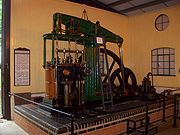
Piston rod
In a piston engine, a piston rod joins a piston to a connecting rod.Many internal combustion engines, and in particular all current automobile engines, do not have true piston rods, and the term piston rod is often used as a synonym for connecting rod in the context of these engines.All engines...
does not connect directly to the connecting rod
Connecting rod
In a reciprocating piston engine, the connecting rod or conrod connects the piston to the crank or crankshaft. Together with the crank, they form a simple mechanism that converts linear motion into rotating motion....
, but instead to a rocker or beam above both the piston and flywheel
Flywheel
A flywheel is a rotating mechanical device that is used to store rotational energy. Flywheels have a significant moment of inertia, and thus resist changes in rotational speed. The amount of energy stored in a flywheel is proportional to the square of its rotational speed...
. The beam is pivoted in the middle, with the cylinder on one side and the flywheel, which incorporates the crank
Crank (mechanism)
A crank is an arm attached at right angles to a rotating shaft by which reciprocating motion is imparted to or received from the shaft. It is used to change circular into reciprocating motion, or reciprocating into circular motion. The arm may be a bent portion of the shaft, or a separate arm...
, on the other. The connecting rod connects to the opposite end of the beam to the piston rod, and then to the flywheel.
Early Watt engines used Watt's patent sun and planet gear
Sun and planet gear
The sun and planet gear was a method of converting reciprocal motion to rotary motion and was utilised in a reciprocating steam engine....
, rather than a simple crank, as use of the latter was protected by a patent owned by someone else. Once the patent had expired, the simple crank was employed universally.
The first steam-powered ships used variants of the beam engine. These marine steam engine
Marine steam engine
A marine steam engine is a reciprocating steam engine that is used to power a ship or boat. Steam turbines and diesel engines largely replaced reciprocating steam engines in marine applications during the 20th century, so this article describes the more common types of marine steam engine in use...
s – known as side-lever, grasshopper, crosshead, or 'walking beam', among others – all varied from the original land-based machines by locating the beam or beams in different positions to take up less room on board ship.
Compounding
Compounding involves two or more cylinders; waste low-pressure steam from the first, high-pressure, cylinder is passed to the second cylinder where it expands further and provides more drive. This is the compound effect; the waste steam from this can produce further work if it is then passed into a condenser in the normal way. The first experiment with compounding was conducted by Jonathan HornblowerJonathan Hornblower
Jonathan Hornblower was a British pioneer of steam power, the son of Jonathan Hornblower and brother of Jabez Carter Hornblower, two fellow pioneers....
, who took out a patent in 1781. His first engine was installed at Tincroft Mine, Cornwall. It had two cylinders – one 21 inch (0.5334 m) diameter with 6 feet (1.8 m) stroke and one 27 inch (0.6858 m) diameter with 8 feet (2.4 m) stroke – placed alongside each other at one end of the beam. The early engines showed little performance gain: the steam pressure was too low, interconnecting pipes were of small diameter and the condenser ineffective.
At this time the laws of thermodynamics
Thermodynamics
Thermodynamics is a physical science that studies the effects on material bodies, and on radiation in regions of space, of transfer of heat and of work done on or by the bodies or radiation...
were not adequately understood, particularly the concept of absolute zero
Absolute zero
Absolute zero is the theoretical temperature at which entropy reaches its minimum value. The laws of thermodynamics state that absolute zero cannot be reached using only thermodynamic means....
. Engineers such as Arthur Woolf
Arthur Woolf
Arthur Woolf was a Cornish engineer, most famous for inventing a high-pressure compound steam engine. As such he made an outstanding contribution to the development and perfection of the Cornish engine.Woolf left Cornwall in 1785 to work for Joseph Bramah's engineering works in London...
were trying to tackle an engineering problem with an imperfect understanding of the physics. In particular, their valve gear
Valve gear
The valve gear of a steam engine is the mechanism that operates the inlet and exhaust valves to admit steam into the cylinder and allow exhaust steam to escape, respectively, at the correct points in the cycle...
was cutting-in at the wrong position in the stroke, not allowing for expansive working in the cylinder. Successful Woolf compound engines were produced in 1814, for the Wheal Abraham copper mine and the Wheal Vor
Wheal Vor
Wheal Vor was a metalliferous mine about two miles north west of Helston and one mile north of the village of Breage in the west of Cornwall, England, U.K. It is considered to be part of the Mount's Bay mining district. Until the mid–19th century the mine was notable for its willingness to try out...
tin mine.
Steam engine
A steam engine is a heat engine that performs mechanical work using steam as its working fluid.Steam engines are external combustion engines, where the working fluid is separate from the combustion products. Non-combustion heat sources such as solar power, nuclear power or geothermal energy may be...
where a pivoted overhead beam is used to apply the force from a vertical piston
Piston
A piston is a component of reciprocating engines, reciprocating pumps, gas compressors and pneumatic cylinders, among other similar mechanisms. It is the moving component that is contained by a cylinder and is made gas-tight by piston rings. In an engine, its purpose is to transfer force from...
to a vertical connecting rod. This configuration, with the engine directly driving a pump, was first used by Thomas Newcomen
Thomas Newcomen
Thomas Newcomen was an ironmonger by trade and a Baptist lay preacher by calling. He was born in Dartmouth, Devon, England, near a part of the country noted for its tin mines. Flooding was a major problem, limiting the depth at which the mineral could be mined...
around 1705 to remove water from mines in Cornwall
Cornwall
Cornwall is a unitary authority and ceremonial county of England, within the United Kingdom. It is bordered to the north and west by the Celtic Sea, to the south by the English Channel, and to the east by the county of Devon, over the River Tamar. Cornwall has a population of , and covers an area of...
. The efficiency of the engines was improved by engineers including James Watt
James Watt
James Watt, FRS, FRSE was a Scottish inventor and mechanical engineer whose improvements to the Newcomen steam engine were fundamental to the changes brought by the Industrial Revolution in both his native Great Britain and the rest of the world.While working as an instrument maker at the...
who added a condenser, Jonathan Hornblower
Jonathan Hornblower
Jonathan Hornblower was a British pioneer of steam power, the son of Jonathan Hornblower and brother of Jabez Carter Hornblower, two fellow pioneers....
and Arthur Woolf
Arthur Woolf
Arthur Woolf was a Cornish engineer, most famous for inventing a high-pressure compound steam engine. As such he made an outstanding contribution to the development and perfection of the Cornish engine.Woolf left Cornwall in 1785 to work for Joseph Bramah's engineering works in London...
who compounded the cylinders, and William McNaught (Glasgow)
William McNaught (Glasgow)
William McNaught was a Scottish engineer, from Glasgow, who patented a compound steam engine in 1845. This was a technique of improving the efficiency of a standard simple Boulton & Watt beam engine. The engine was compounded by adding a high-pressure cylinder between the support column and the...
who devised a method of compounding an existing engine. Beam engines were first used to pump water out of mines or into canals, but could be used to pump water to supplement the flow for a waterwheel powering a mill.
The rotative beam engine is a later design of beam engine where the connecting rod drives a flywheel, by means of a crank
Crank (mechanism)
A crank is an arm attached at right angles to a rotating shaft by which reciprocating motion is imparted to or received from the shaft. It is used to change circular into reciprocating motion, or reciprocating into circular motion. The arm may be a bent portion of the shaft, or a separate arm...
(or, historically, by means of a sun and planet gear
Sun and planet gear
The sun and planet gear was a method of converting reciprocal motion to rotary motion and was utilised in a reciprocating steam engine....
). These beam engines could be used to directly power the line-shafting
Line shaft
A line shaft is a power transmission system used extensively during the Industrial Revolution. Prior to the widespread use of electric motors small enough to be connected directly to each piece of machinery, line shafting was used to distribute power from a large central power source to machinery...
in a mill
Cotton mill
A cotton mill is a factory that houses spinning and weaving machinery. Typically built between 1775 and 1930, mills spun cotton which was an important product during the Industrial Revolution....
. They also could be used to power steam ships.
History
The first beam engines were water-powered, and used to pump water from mines. A 'preserved' example may be seen at WanlockheadWanlockhead
Wanlockhead is a village in Dumfries and Galloway, Scotland nestling in the Lowther Hills one mile south of Leadhills at the head of the Mennock Pass, which forms part of the Southern Uplands...
, in Scotland
Scotland
Scotland is a country that is part of the United Kingdom. Occupying the northern third of the island of Great Britain, it shares a border with England to the south and is bounded by the North Sea to the east, the Atlantic Ocean to the north and west, and the North Channel and Irish Sea to the...
.
Beam engines were extensively used to power pump
Pump
A pump is a device used to move fluids, such as liquids, gases or slurries.A pump displaces a volume by physical or mechanical action. Pumps fall into three major groups: direct lift, displacement, and gravity pumps...
s on the English canal
Canal
Canals are man-made channels for water. There are two types of canal:#Waterways: navigable transportation canals used for carrying ships and boats shipping goods and conveying people, further subdivided into two kinds:...
system when it was expanded by means of locks early in the Industrial Revolution
Industrial Revolution
The Industrial Revolution was a period from the 18th to the 19th century where major changes in agriculture, manufacturing, mining, transportation, and technology had a profound effect on the social, economic and cultural conditions of the times...
, and also to drain water from mines
Mining
Mining is the extraction of valuable minerals or other geological materials from the earth, from an ore body, vein or seam. The term also includes the removal of soil. Materials recovered by mining include base metals, precious metals, iron, uranium, coal, diamonds, limestone, oil shale, rock...
in the same period, and as winding engine
Winding engine
A winding engine is a stationary engine used to control a cable, for example to power a mining hoist at a pit head. Electric hoist controllers have replaced proper winding engines in modern mining, but use electric motors that are also traditionally referred to as winding engines.Most proper...
s.
The first steam-powered beam engine was developed by Thomas Newcomen
Thomas Newcomen
Thomas Newcomen was an ironmonger by trade and a Baptist lay preacher by calling. He was born in Dartmouth, Devon, England, near a part of the country noted for its tin mines. Flooding was a major problem, limiting the depth at which the mineral could be mined...
. The Newcomen steam engine
Newcomen steam engine
The atmospheric engine invented by Thomas Newcomen in 1712, today referred to as a Newcomen steam engine , was the first practical device to harness the power of steam to produce mechanical work. Newcomen engines were used throughout Britain and Europe, principally to pump water out of mines,...
was adopted by many mines in Cornwall
Cornwall
Cornwall is a unitary authority and ceremonial county of England, within the United Kingdom. It is bordered to the north and west by the Celtic Sea, to the south by the English Channel, and to the east by the county of Devon, over the River Tamar. Cornwall has a population of , and covers an area of...
and elsewhere, but it was relatively inefficient and consumed a large quantity of fuel. James Watt
James Watt
James Watt, FRS, FRSE was a Scottish inventor and mechanical engineer whose improvements to the Newcomen steam engine were fundamental to the changes brought by the Industrial Revolution in both his native Great Britain and the rest of the world.While working as an instrument maker at the...
resolved the main inefficiencies of the Newcomen engine in his Watt steam engine
Watt steam engine
The Watt steam engine was the first type of steam engine to make use of steam at a pressure just above atmospheric to drive the piston helped by a partial vacuum...
, and these beam engines were used commercially in much larger numbers.
Watt held patents on key aspects of his engine's design, and it was not until these patents expired that others could develop modifications to improve it. The beam engine was considerably improved and enlarged in the tin- and copper-rich areas of south west England, which enabled the draining of the deep mines that existed there. Consequently the Cornish beam engines
Cornish engine
A Cornish engine is a type of steam engine developed in Cornwall, England, mainly for pumping water from a mine. It is a form of beam engine that uses steam at a higher pressure than the earlier engines designed by James Watt...
became world famous, as they remain the most massive beam engines ever constructed.
Rotative beam engines
Piston rod
In a piston engine, a piston rod joins a piston to a connecting rod.Many internal combustion engines, and in particular all current automobile engines, do not have true piston rods, and the term piston rod is often used as a synonym for connecting rod in the context of these engines.All engines...
does not connect directly to the connecting rod
Connecting rod
In a reciprocating piston engine, the connecting rod or conrod connects the piston to the crank or crankshaft. Together with the crank, they form a simple mechanism that converts linear motion into rotating motion....
, but instead to a rocker or beam above both the piston and flywheel
Flywheel
A flywheel is a rotating mechanical device that is used to store rotational energy. Flywheels have a significant moment of inertia, and thus resist changes in rotational speed. The amount of energy stored in a flywheel is proportional to the square of its rotational speed...
. The beam is pivoted in the middle, with the cylinder on one side and the flywheel, which incorporates the crank
Crank (mechanism)
A crank is an arm attached at right angles to a rotating shaft by which reciprocating motion is imparted to or received from the shaft. It is used to change circular into reciprocating motion, or reciprocating into circular motion. The arm may be a bent portion of the shaft, or a separate arm...
, on the other. The connecting rod connects to the opposite end of the beam to the piston rod, and then to the flywheel.
Early Watt engines used Watt's patent sun and planet gear
Sun and planet gear
The sun and planet gear was a method of converting reciprocal motion to rotary motion and was utilised in a reciprocating steam engine....
, rather than a simple crank, as use of the latter was protected by a patent owned by someone else. Once the patent had expired, the simple crank was employed universally.
The first steam-powered ships used variants of the beam engine. These marine steam engine
Marine steam engine
A marine steam engine is a reciprocating steam engine that is used to power a ship or boat. Steam turbines and diesel engines largely replaced reciprocating steam engines in marine applications during the 20th century, so this article describes the more common types of marine steam engine in use...
s – known as side-lever, grasshopper, crosshead, or 'walking beam', among others – all varied from the original land-based machines by locating the beam or beams in different positions to take up less room on board ship.
Compounding
Compounding involves two or more cylinders; waste low-pressure steam from the first, high-pressure, cylinder is passed to the second cylinder where it expands further and provides more drive. This is the compound effect; the waste steam from this can produce further work if it is then passed into a condenser in the normal way. The first experiment with compounding was conducted by Jonathan HornblowerJonathan Hornblower
Jonathan Hornblower was a British pioneer of steam power, the son of Jonathan Hornblower and brother of Jabez Carter Hornblower, two fellow pioneers....
, who took out a patent in 1781. His first engine was installed at Tincroft Mine, Cornwall. It had two cylinders – one 21 inch (0.5334 m) diameter with 6 feet (1.8 m) stroke and one 27 inch (0.6858 m) diameter with 8 feet (2.4 m) stroke – placed alongside each other at one end of the beam. The early engines showed little performance gain: the steam pressure was too low, interconnecting pipes were of small diameter and the condenser ineffective.
At this time the laws of thermodynamics
Thermodynamics
Thermodynamics is a physical science that studies the effects on material bodies, and on radiation in regions of space, of transfer of heat and of work done on or by the bodies or radiation...
were not adequately understood, particularly the concept of absolute zero
Absolute zero
Absolute zero is the theoretical temperature at which entropy reaches its minimum value. The laws of thermodynamics state that absolute zero cannot be reached using only thermodynamic means....
. Engineers such as Arthur Woolf
Arthur Woolf
Arthur Woolf was a Cornish engineer, most famous for inventing a high-pressure compound steam engine. As such he made an outstanding contribution to the development and perfection of the Cornish engine.Woolf left Cornwall in 1785 to work for Joseph Bramah's engineering works in London...
were trying to tackle an engineering problem with an imperfect understanding of the physics. In particular, their valve gear
Valve gear
The valve gear of a steam engine is the mechanism that operates the inlet and exhaust valves to admit steam into the cylinder and allow exhaust steam to escape, respectively, at the correct points in the cycle...
was cutting-in at the wrong position in the stroke, not allowing for expansive working in the cylinder. Successful Woolf compound engines were produced in 1814, for the Wheal Abraham copper mine and the Wheal Vor
Wheal Vor
Wheal Vor was a metalliferous mine about two miles north west of Helston and one mile north of the village of Breage in the west of Cornwall, England, U.K. It is considered to be part of the Mount's Bay mining district. Until the mid–19th century the mine was notable for its willingness to try out...
tin mine.
Steam engine
A steam engine is a heat engine that performs mechanical work using steam as its working fluid.Steam engines are external combustion engines, where the working fluid is separate from the combustion products. Non-combustion heat sources such as solar power, nuclear power or geothermal energy may be...
where a pivoted overhead beam is used to apply the force from a vertical piston
Piston
A piston is a component of reciprocating engines, reciprocating pumps, gas compressors and pneumatic cylinders, among other similar mechanisms. It is the moving component that is contained by a cylinder and is made gas-tight by piston rings. In an engine, its purpose is to transfer force from...
to a vertical connecting rod. This configuration, with the engine directly driving a pump, was first used by Thomas Newcomen
Thomas Newcomen
Thomas Newcomen was an ironmonger by trade and a Baptist lay preacher by calling. He was born in Dartmouth, Devon, England, near a part of the country noted for its tin mines. Flooding was a major problem, limiting the depth at which the mineral could be mined...
around 1705 to remove water from mines in Cornwall
Cornwall
Cornwall is a unitary authority and ceremonial county of England, within the United Kingdom. It is bordered to the north and west by the Celtic Sea, to the south by the English Channel, and to the east by the county of Devon, over the River Tamar. Cornwall has a population of , and covers an area of...
. The efficiency of the engines was improved by engineers including James Watt
James Watt
James Watt, FRS, FRSE was a Scottish inventor and mechanical engineer whose improvements to the Newcomen steam engine were fundamental to the changes brought by the Industrial Revolution in both his native Great Britain and the rest of the world.While working as an instrument maker at the...
who added a condenser, Jonathan Hornblower
Jonathan Hornblower
Jonathan Hornblower was a British pioneer of steam power, the son of Jonathan Hornblower and brother of Jabez Carter Hornblower, two fellow pioneers....
and Arthur Woolf
Arthur Woolf
Arthur Woolf was a Cornish engineer, most famous for inventing a high-pressure compound steam engine. As such he made an outstanding contribution to the development and perfection of the Cornish engine.Woolf left Cornwall in 1785 to work for Joseph Bramah's engineering works in London...
who compounded the cylinders, and William McNaught (Glasgow)
William McNaught (Glasgow)
William McNaught was a Scottish engineer, from Glasgow, who patented a compound steam engine in 1845. This was a technique of improving the efficiency of a standard simple Boulton & Watt beam engine. The engine was compounded by adding a high-pressure cylinder between the support column and the...
who devised a method of compounding an existing engine. Beam engines were first used to pump water out of mines or into canals, but could be used to pump water to supplement the flow for a waterwheel powering a mill.
The rotative beam engine is a later design of beam engine where the connecting rod drives a flywheel, by means of a crank
Crank (mechanism)
A crank is an arm attached at right angles to a rotating shaft by which reciprocating motion is imparted to or received from the shaft. It is used to change circular into reciprocating motion, or reciprocating into circular motion. The arm may be a bent portion of the shaft, or a separate arm...
(or, historically, by means of a sun and planet gear
Sun and planet gear
The sun and planet gear was a method of converting reciprocal motion to rotary motion and was utilised in a reciprocating steam engine....
). These beam engines could be used to directly power the line-shafting
Line shaft
A line shaft is a power transmission system used extensively during the Industrial Revolution. Prior to the widespread use of electric motors small enough to be connected directly to each piece of machinery, line shafting was used to distribute power from a large central power source to machinery...
in a mill
Cotton mill
A cotton mill is a factory that houses spinning and weaving machinery. Typically built between 1775 and 1930, mills spun cotton which was an important product during the Industrial Revolution....
. They also could be used to power steam ships.
History
The first beam engines were water-powered, and used to pump water from mines. A 'preserved' example may be seen at WanlockheadWanlockhead
Wanlockhead is a village in Dumfries and Galloway, Scotland nestling in the Lowther Hills one mile south of Leadhills at the head of the Mennock Pass, which forms part of the Southern Uplands...
, in Scotland
Scotland
Scotland is a country that is part of the United Kingdom. Occupying the northern third of the island of Great Britain, it shares a border with England to the south and is bounded by the North Sea to the east, the Atlantic Ocean to the north and west, and the North Channel and Irish Sea to the...
.
Beam engines were extensively used to power pump
Pump
A pump is a device used to move fluids, such as liquids, gases or slurries.A pump displaces a volume by physical or mechanical action. Pumps fall into three major groups: direct lift, displacement, and gravity pumps...
s on the English canal
Canal
Canals are man-made channels for water. There are two types of canal:#Waterways: navigable transportation canals used for carrying ships and boats shipping goods and conveying people, further subdivided into two kinds:...
system when it was expanded by means of locks early in the Industrial Revolution
Industrial Revolution
The Industrial Revolution was a period from the 18th to the 19th century where major changes in agriculture, manufacturing, mining, transportation, and technology had a profound effect on the social, economic and cultural conditions of the times...
, and also to drain water from mines
Mining
Mining is the extraction of valuable minerals or other geological materials from the earth, from an ore body, vein or seam. The term also includes the removal of soil. Materials recovered by mining include base metals, precious metals, iron, uranium, coal, diamonds, limestone, oil shale, rock...
in the same period, and as winding engine
Winding engine
A winding engine is a stationary engine used to control a cable, for example to power a mining hoist at a pit head. Electric hoist controllers have replaced proper winding engines in modern mining, but use electric motors that are also traditionally referred to as winding engines.Most proper...
s.
The first steam-powered beam engine was developed by Thomas Newcomen
Thomas Newcomen
Thomas Newcomen was an ironmonger by trade and a Baptist lay preacher by calling. He was born in Dartmouth, Devon, England, near a part of the country noted for its tin mines. Flooding was a major problem, limiting the depth at which the mineral could be mined...
. The Newcomen steam engine
Newcomen steam engine
The atmospheric engine invented by Thomas Newcomen in 1712, today referred to as a Newcomen steam engine , was the first practical device to harness the power of steam to produce mechanical work. Newcomen engines were used throughout Britain and Europe, principally to pump water out of mines,...
was adopted by many mines in Cornwall
Cornwall
Cornwall is a unitary authority and ceremonial county of England, within the United Kingdom. It is bordered to the north and west by the Celtic Sea, to the south by the English Channel, and to the east by the county of Devon, over the River Tamar. Cornwall has a population of , and covers an area of...
and elsewhere, but it was relatively inefficient and consumed a large quantity of fuel. James Watt
James Watt
James Watt, FRS, FRSE was a Scottish inventor and mechanical engineer whose improvements to the Newcomen steam engine were fundamental to the changes brought by the Industrial Revolution in both his native Great Britain and the rest of the world.While working as an instrument maker at the...
resolved the main inefficiencies of the Newcomen engine in his Watt steam engine
Watt steam engine
The Watt steam engine was the first type of steam engine to make use of steam at a pressure just above atmospheric to drive the piston helped by a partial vacuum...
, and these beam engines were used commercially in much larger numbers.
Watt held patents on key aspects of his engine's design, and it was not until these patents expired that others could develop modifications to improve it. The beam engine was considerably improved and enlarged in the tin- and copper-rich areas of south west England, which enabled the draining of the deep mines that existed there. Consequently the Cornish beam engines
Cornish engine
A Cornish engine is a type of steam engine developed in Cornwall, England, mainly for pumping water from a mine. It is a form of beam engine that uses steam at a higher pressure than the earlier engines designed by James Watt...
became world famous, as they remain the most massive beam engines ever constructed.
Rotative beam engines
Piston rod
In a piston engine, a piston rod joins a piston to a connecting rod.Many internal combustion engines, and in particular all current automobile engines, do not have true piston rods, and the term piston rod is often used as a synonym for connecting rod in the context of these engines.All engines...
does not connect directly to the connecting rod
Connecting rod
In a reciprocating piston engine, the connecting rod or conrod connects the piston to the crank or crankshaft. Together with the crank, they form a simple mechanism that converts linear motion into rotating motion....
, but instead to a rocker or beam above both the piston and flywheel
Flywheel
A flywheel is a rotating mechanical device that is used to store rotational energy. Flywheels have a significant moment of inertia, and thus resist changes in rotational speed. The amount of energy stored in a flywheel is proportional to the square of its rotational speed...
. The beam is pivoted in the middle, with the cylinder on one side and the flywheel, which incorporates the crank
Crank (mechanism)
A crank is an arm attached at right angles to a rotating shaft by which reciprocating motion is imparted to or received from the shaft. It is used to change circular into reciprocating motion, or reciprocating into circular motion. The arm may be a bent portion of the shaft, or a separate arm...
, on the other. The connecting rod connects to the opposite end of the beam to the piston rod, and then to the flywheel.
Early Watt engines used Watt's patent sun and planet gear
Sun and planet gear
The sun and planet gear was a method of converting reciprocal motion to rotary motion and was utilised in a reciprocating steam engine....
, rather than a simple crank, as use of the latter was protected by a patent owned by someone else. Once the patent had expired, the simple crank was employed universally.
The first steam-powered ships used variants of the beam engine. These marine steam engine
Marine steam engine
A marine steam engine is a reciprocating steam engine that is used to power a ship or boat. Steam turbines and diesel engines largely replaced reciprocating steam engines in marine applications during the 20th century, so this article describes the more common types of marine steam engine in use...
s – known as side-lever, grasshopper, crosshead, or 'walking beam', among others – all varied from the original land-based machines by locating the beam or beams in different positions to take up less room on board ship.
Compounding
Compounding involves two or more cylinders; waste low-pressure steam from the first, high-pressure, cylinder is passed to the second cylinder where it expands further and provides more drive. This is the compound effect; the waste steam from this can produce further work if it is then passed into a condenser in the normal way. The first experiment with compounding was conducted by Jonathan HornblowerJonathan Hornblower
Jonathan Hornblower was a British pioneer of steam power, the son of Jonathan Hornblower and brother of Jabez Carter Hornblower, two fellow pioneers....
, who took out a patent in 1781. His first engine was installed at Tincroft Mine, Cornwall. It had two cylinders – one 21 inch (0.5334 m) diameter with 6 feet (1.8 m) stroke and one 27 inch (0.6858 m) diameter with 8 feet (2.4 m) stroke – placed alongside each other at one end of the beam. The early engines showed little performance gain: the steam pressure was too low, interconnecting pipes were of small diameter and the condenser ineffective.
At this time the laws of thermodynamics
Thermodynamics
Thermodynamics is a physical science that studies the effects on material bodies, and on radiation in regions of space, of transfer of heat and of work done on or by the bodies or radiation...
were not adequately understood, particularly the concept of absolute zero
Absolute zero
Absolute zero is the theoretical temperature at which entropy reaches its minimum value. The laws of thermodynamics state that absolute zero cannot be reached using only thermodynamic means....
. Engineers such as Arthur Woolf
Arthur Woolf
Arthur Woolf was a Cornish engineer, most famous for inventing a high-pressure compound steam engine. As such he made an outstanding contribution to the development and perfection of the Cornish engine.Woolf left Cornwall in 1785 to work for Joseph Bramah's engineering works in London...
were trying to tackle an engineering problem with an imperfect understanding of the physics. In particular, their valve gear
Valve gear
The valve gear of a steam engine is the mechanism that operates the inlet and exhaust valves to admit steam into the cylinder and allow exhaust steam to escape, respectively, at the correct points in the cycle...
was cutting-in at the wrong position in the stroke, not allowing for expansive working in the cylinder. Successful Woolf compound engines were produced in 1814, for the Wheal Abraham copper mine and the Wheal Vor
Wheal Vor
Wheal Vor was a metalliferous mine about two miles north west of Helston and one mile north of the village of Breage in the west of Cornwall, England, U.K. It is considered to be part of the Mount's Bay mining district. Until the mid–19th century the mine was notable for its willingness to try out...
tin mine.
McNaught engines
William McNaught of GlasgowWilliam McNaught (Glasgow)
William McNaught was a Scottish engineer, from Glasgow, who patented a compound steam engine in 1845. This was a technique of improving the efficiency of a standard simple Boulton & Watt beam engine. The engine was compounded by adding a high-pressure cylinder between the support column and the...
, not to be confused with William McNaught of Rochdale
William McNaught (Rochdale)
William McNaught was a steam engine engineer from Rochdale, Lancashire, England.McNaught was born in Manchester and apprenticed with a Mr Mills of Heywood, Bury...
(Petrie and McNaught), patented a compound beam engine in 1845. On a beam engine of the standard Boulton & Watt design he placed a high-pressure cylinder, on the opposite side of the beam to the existing single cylinder, where the water pump was normally fitted. This had two important effects: it massively reduced the pressure on the beam, and the connecting steam pipe, being long, acted as an expansive receiver – the element missing in the Woolf design. This modification could be made retrospectively, and engines so modified were said to be "McNaughted". The advantages of a compound engine were not significant at pressures under 60psi, but showed at over 100psi.
See also
- Cornish engineCornish engineA Cornish engine is a type of steam engine developed in Cornwall, England, mainly for pumping water from a mine. It is a form of beam engine that uses steam at a higher pressure than the earlier engines designed by James Watt...
- Gimson and CompanyGimson and CompanyGimson and Company were founded in 1840 by Josiah and Benjamin Gimson on Welford Road in Leicester. The company were listed as Engineers, Ironfounders, Boiler Makers & General Machinists. They later moved to Vulcan Works, Vulcan Street, Humberstone Road, Leicester.-Expansion:Between 1876 and 1878 a...
- Man engineMan engineA man engine is a mechanism of reciprocating ladders and stationary platforms installed in mines to assist the miners’ journeys to and from the working levels...
- Marine steam engineMarine steam engineA marine steam engine is a reciprocating steam engine that is used to power a ship or boat. Steam turbines and diesel engines largely replaced reciprocating steam engines in marine applications during the 20th century, so this article describes the more common types of marine steam engine in use...
- Mining in CornwallMining in CornwallMining in Cornwall and Devon began in the early Bronze Age approximately 2,150 BC and ended with the South Crofty tin mine in Cornwall closing in 1998...
- Prestongrange Industrial Heritage MuseumPrestongrange Industrial Heritage MuseumThe Prestongrange Industrial Heritage Museum is an industrial heritage museum at Prestongrange between Musselburgh and Prestonpans on the B1348 on the East Lothian coast, Scotland UK....
- Stationary engineStationary engineA stationary engine is an engine whose framework does not move. It is normally used not to propel a vehicle but to drive a piece of immobile equipment such as a pump or power tool. They may be powered by steam; or oil-burning or internal combustion engines....
- Steam engineSteam engineA steam engine is a heat engine that performs mechanical work using steam as its working fluid.Steam engines are external combustion engines, where the working fluid is separate from the combustion products. Non-combustion heat sources such as solar power, nuclear power or geothermal energy may be...
Preserved beam engines
- Bolton Steam MuseumBolton Steam MuseumBolton Steam Museum is a museum in Bolton, Greater Manchester, England, which houses a variety of preserved steam engines. It is owned and run by the Northern Mill Engine Society .-Overview:...
(Bolton, England) – includes several rotative beam engines originally used to drive mills - Crofton Pumping StationCrofton Pumping StationCrofton Pumping Station is a pumping station near the village of Great Bedwyn in the English county of Wiltshire: it supplies the summit pound of the Kennet and Avon Canal with water....
(Great Bedwyn, England) – two engines, including the oldest working 'Cornish' engine, in its original location, in the world (1812) - Crossness Pumping StationCrossness Pumping StationCrossness Pumping Station was a sewage pumping station designed by engineer Sir Joseph Bazalgette and architect Charles Henry Driver. It was constructed between 1859 and 1865 as part of his redevelopment of the London sewerage system...
(Abbey Wood, London, England) – set of four rotative beam engines: the largest surviving working examples - Museum De CruquiusMuseum De CruquiusThe Museum De Cruquius occupies the old Cruquius steam pumping station in Cruquius, The Netherlands. It derives its name from Nicolaas Kruik , a Dutch land-surveyor and one of many promotors of a plan to pump the Haarlemmermeer dry. Like many well-educated men of his time, he latinized his name...
(Cruquius, The Netherlands) – the eight-beamed engine at CruquiusCruquius (town)Cruquius is a town in the Dutch province of North Holland. It is a part of the municipality of Haarlemmermeer, and lies about 4 km northwest of Hoofddorp....
is thought to be the largest steam engine ever built - Dogdyke EngineDogdyke EngineThe Dogdyke Engine is a drainage engine near Tattershall, Lincolnshire, in England. of land around Tattershall was authorised for drainage in 1796, and came under the control of the Witham Third District commissioners in 1844...
(Tattershall, Lincolnshire) – drainage engine and scoop wheelScoop wheelright|thumb|Rim driven Scoop wheel of the [[Stretham Old Engine]], CambridgeshireA scoop wheel may be a pump or an excavator.-Scoop wheel pump:...
, steamed summer weekends. - Eastney Beam Engine HouseEastney beam engine houseEastney Beam Engine House is a Grade II -listed Victorian engine house in Portsmouth, Hampshire, England. Dating from 1887, it contains two 150hp James Watt & Co. beam engines. The pumps were built as part of a plan to improve Portsmouth's sewage system. The other element of the plan was large...
(Portsmouth, England) – contains two rotative beam engines for sewage-pumping, dating from 1887. - ElsecarElsecar Heritage CentreElsecar Heritage Centre is a Living History centre in Elsecar, South Yorkshire. It also comprises various shops, galleries, art studios and an exhibition hall. It runs craft workshops, special events, and a monthly antiques fair. The buildings were originally used for various industries including...
(Elsecar, South Yorkshire, England) – the only surviving Newcomen engine (in the world) to have remained in its original location (1795) - Kew Bridge Steam MuseumKew Bridge Steam MuseumKew Bridge Steam Museum houses a museum of water supply and a collection of water pumping steam engines. The museum is an Anchor Point of ERIH, The European Route of Industrial Heritage...
(Brentford, London, England) – four 'Cornish' engines (in original location) and several rotative engines (in museum), including the largest working 'Cornish' engine in the world - Levant Mine and Beam Engine (Trewellard, Pendeen, England) – a working beam engine on a National TrustNational Trust for Places of Historic Interest or Natural BeautyThe National Trust for Places of Historic Interest or Natural Beauty, usually known as the National Trust, is a conservation organisation in England, Wales and Northern Ireland...
property in West Cornwall, England - Markfield Beam EngineMarkfield Beam EngineThe Markfield Beam Engine is a 100 horsepower beam pumping engine, built in 1886 to transfer sewage from the Middlesex district of Tottenham into the London system for treatment at the Beckton works....
(Tottenham, London, England) – a compound, rotative engine - Pinchbeck EnginePinchbeck EngineThe Pinchbeck Engine is a drainage engine, a rotative beam engine built in 1833 to drain Pinchbeck Marsh, to the north of Spalding, Lincolnshire, in England...
(Spalding, Lincolnshire) – statically preserved 'A'-frame engine. - Ryhope Engines MuseumRyhope Engines MuseumThe Ryhope Engines Museum is a visitor attraction in the Ryhope suburb of Sunderland, Tyne and Wear.The Grade II* listed building is the most visited man-made landmark in Ryhope and is based at The Ryhope Pumping Station, operational for 100 years before closing in 1967.The volunteer-run museum...
(Ryhope, England) – twin rotative beam engines; built 1868 - Smethwick EngineSmethwick EngineThe Smethwick Engine is a steam engine made by Boulton and Watt; brought into service in May 1779.Originally, it was one of two engines used to pump water back up to the summit level of the BCN Old Main Line canal at Smethwick, not far from the Soho Foundry where it was made...
(Smethwick, Birmingham, England) – oldest working steam engine in the world (1779) - Stretham Old EngineStretham old engineStretham Old Engine is a steam-powered engine just south of Stretham in Cambridgeshire, England, that was used to pump water from flood-affected areas of The Fens back into the River Great Ouse. It is one of only three surviving drainage engines in East Anglia.During the seventeenth century, large...
(Stretham, Cambridgeshire) – Statically preserved engine and scoop wheel. - The Western Springs Water Works (Auckland, New Zealand) – 1877 double Woolf compound engine. In original location, restored in working order with Transport and Technology Museum built around it. The restoration of the Pumphouse and original Engineers cottage was awarded with the 2009 Award of Merit from UNESCO's Asia-Pacific Heritage Awards for Culture Heritage Conservation programme.
External links
- Animation of a Watt beam engine.
- The oldest surviving mine engine in CornwallCornwallCornwall is a unitary authority and ceremonial county of England, within the United Kingdom. It is bordered to the north and west by the Celtic Sea, to the south by the English Channel, and to the east by the county of Devon, over the River Tamar. Cornwall has a population of , and covers an area of...
. - Archive footage of the engines at AddingtonAddington, LondonAddington is a district of south London, England, located in the London Borough of Croydon. It is situated south south-east of Charing Cross.-History:...
Pumping Station in July 1973, a year prior to decommissioning.