
The
Beagle is a
breedDog breeds are groups of closely related and visibly similar domestic dogs, which are all of the subspecies Canis lupus familiaris, having characteristic traits that are selected and maintained by humans, bred from a known foundation stock....
of small to medium-sized
dogThe domestic dog is a domesticated form of the gray wolf, a member of the Canidae family of the order Carnivora. The term is used for both feral and pet varieties. The dog may have been the first animal to be domesticated, and has been the most widely kept working, hunting, and companion animal in...
. A member of the
Hound GroupHound Group is the name of a breed group of dogs, used by kennel clubs to classify a defined collection of dog breeds, and does not necessarily include all hound-type dogs...
, it is similar in appearance to the
FoxhoundA foxhound is a type of large hunting hound. Foxhounds hunt in packs and, like all scent hounds, have a strong sense of smell. They are used in hunts for foxes, hence the name. When out hunting they are followed usually on horseback and will travel several miles to catch their target. These dogs...
, but smaller, with shorter legs and longer, softer ears. Beagles are
scent houndScent hounds are a type of hound that primarily hunts by scent rather than sight. The Scenthound breeds are generally regarded as having some of the most sensitive noses among canines....
s, developed primarily for
trackingTracking in hunting and ecology is the science and art of observing animal tracks and other signs, with the goal of gaining understanding of the landscape and the animal being tracked...
hareHares and jackrabbits are leporids belonging to the genus Lepus. Hares less than one year old are called leverets. Four species commonly known as types of hare are classified outside of Lepus: the hispid hare , and three species known as red rock hares .Hares are very fast-moving...
,
rabbitRabbits are small mammals in the family Leporidae of the order Lagomorpha, found in several parts of the world...
, and other
gameGame is any animal hunted for food or not normally domesticated. Game animals are also hunted for sport.The type and range of animals hunted for food varies in different parts of the world. This will be influenced by climate, animal diversity, local taste and locally accepted view about what can or...
. They have a keen sense of smell and tracking instinct that sees them employed as
detection dogA detection dog or sniffer dog is a dog that is trained to and works at using its senses to detect substances such as explosives, illegal drugs, or blood. Hunting dogs that search for game and search dogs that search for missing humans are generally not considered detection dogs...
s for prohibited agricultural imports and foodstuffs in
quarantineQuarantine is compulsory isolation, typically to contain the spread of something considered dangerous, often but not always disease. The word comes from the Italian quarantena, meaning forty-day period....
around the world. Beagles are intelligent, and are popular as pets because of their size, even temper, and lack of
inherited health problemsThe health of dogs is a well studied area in veterinary medicine.Infectious diseases that affect dogs are important not only from a veterinary standpoint, but also because of the risk to public health; an example of this is rabies. Genetic disorders also affect dogs, often due to selective breeding...
. These characteristics also make them the dog of choice for
animal testingAnimal testing, also known as animal experimentation, animal research, and in vivo testing, is the use of non-human animals in experiments. Worldwide it is estimated that the number of vertebrate animals—from zebrafish to non-human primates—ranges from the tens of millions to more than 100 million...
.
Although beagle-type dogs have existed for over 2,000 years, the modern breed was developed in
Great BritainGreat Britain or Britain is an island situated to the northwest of Continental Europe. It is the ninth largest island in the world, and the largest European island, as well as the largest of the British Isles...
around the 1830s from several breeds, including the
Talbot HoundThe talbot was a white hunting dog which is now extinct because of its lack of purpose and need for constant care, but it has been credited with being an ancestor of the modern beagle and bloodhound...
, the
North Country BeagleThe North Country Beagle, Northern Hound or Northern Beagle was a breed of dog that existed in Britain probably until early in the 19th century...
, the
Southern HoundThe Southern Hound was a breed of dog that existed in Britain probably until sometime in the 19th century. The exact date of its extinction is not known; it is likely that it was gradually interbred with other breeds until the genuine Southern Hound bloodline ceased to exist.The origins of the...
, and possibly the
HarrierThe Harrier is a small to medium sized dog breed of the hound class,used for hunting hares by trailing them. It resembles an English Foxhound but is smaller, though not as small as a Beagle.-Appearance:...
.
Beagles have been depicted in popular culture since
ElizabethanThe Elizabethan era was the epoch in English history of Queen Elizabeth I's reign . Historians often depict it as the golden age in English history...
times in literature and paintings, and more recently in film, television and comic books.
SnoopySnoopy is an fictional character in the long-running comic strip Peanuts, by Charles M. Schulz. He is Charlie Brown's pet beagle. Snoopy began his life in the strip as a fairly conventional dog, but eventually evolved into perhaps the strip's most dynamic character—and among the most recognizable...
of the
comic stripA comic strip is a sequence of drawings arranged in interrelated panels to display brief humor or form a narrative, often serialized, with text in balloons and captions....
PeanutsPeanuts is a syndicated daily and Sunday American comic strip written and illustrated by Charles M. Schulz, which ran from October 2, 1950, to February 13, 2000, continuing in reruns afterward...
has been promoted as "the world's most famous beagle".
Early beagle-type dogs
Dogs of similar size and purpose to the modern Beagle can be traced in
Ancient GreeceAncient Greece is a civilization belonging to a period of Greek history that lasted from the Archaic period of the 8th to 6th centuries BC to the end of antiquity. Immediately following this period was the beginning of the Early Middle Ages and the Byzantine era. Included in Ancient Greece is the...
back to around the 5th century BC.
XenophonXenophon , son of Gryllus, of the deme Erchia of Athens, also known as Xenophon of Athens, was a Greek historian, soldier, mercenary, philosopher and a contemporary and admirer of Socrates...
, born around 433 BC, in his
Treatise on Hunting or
Cynegeticus refers to a
houndA hound is a type of dog that assists hunters by tracking or chasing the animal being hunted. It can be contrasted with the gun dog, which assists hunters by identifying the location of prey, and with the retriever, which recovers shot quarry...
that hunted hares by scent and was followed on foot. Small hounds are mentioned in the Forest Laws of
CanuteCnut the Great , also known as Canute, was a king of Denmark, England, Norway and parts of Sweden. Though after the death of his heirs within a decade of his own and the Norman conquest of England in 1066, his legacy was largely lost to history, historian Norman F...
which exempted them from the ordinance which commanded that all dogs capable of running down a
stagDeer are the ruminant mammals forming the family Cervidae. Species in the Cervidae family include white-tailed deer, elk, moose, red deer, reindeer, fallow deer, roe deer and chital. Male deer of all species and female reindeer grow and shed new antlers each year...
should have one foot mutilated. If genuine, these laws would confirm that beagle-type dogs were present in England before 1016, but it is likely the laws were written in the
Middle AgesThe Middle Ages is a periodization of European history from the 5th century to the 15th century. The Middle Ages follows the fall of the Western Roman Empire in 476 and precedes the Early Modern Era. It is the middle period of a three-period division of Western history: Classic, Medieval and Modern...
to give a sense of antiquity and tradition to Forest Law.
In the 11th century,
William the ConquerorWilliam I , also known as William the Conqueror , was the first Norman King of England from Christmas 1066 until his death. He was also Duke of Normandy from 3 July 1035 until his death, under the name William II...
brought the
Talbot houndThe talbot was a white hunting dog which is now extinct because of its lack of purpose and need for constant care, but it has been credited with being an ancestor of the modern beagle and bloodhound...
to Britain. The Talbot was a predominantly white, slow, deep-throated, scent hound derived from the St. Hubert Hound which had been developed in the 8th century. At some point the English Talbots were crossed with
GreyhoundThe Greyhound is a breed of sighthound that has been primarily bred for coursing game and racing, and the breed has also recently seen a resurgence in its popularity as a pedigree show dog and family pet. It is a gentle and intelligent breed...
s to give them an extra turn of speed. Long extinct, the Talbot strain probably gave rise to the Southern Hound which, in turn, is thought to be an ancestor of the modern day Beagle.
From medieval times,
beagle was used as a generic description for the smaller hounds, though these dogs differed considerably from the modern breed. Miniature breeds of beagle-type dogs were known from the times of
Edward IIEdward II , called Edward of Caernarfon, was King of England from 1307 until he was deposed by his wife Isabella in January 1327. He was the sixth Plantagenet king, in a line that began with the reign of Henry II...
and
Henry VIIHenry VII was King of England and Lord of Ireland from his seizing the crown on 22 August 1485 until his death on 21 April 1509, as the first monarch of the House of Tudor....
, who both had packs of Glove Beagles, so named since they were small enough to fit on a glove, and
Queen Elizabeth IElizabeth I was queen regnant of England and Ireland from 17 November 1558 until her death. Sometimes called The Virgin Queen, Gloriana, or Good Queen Bess, Elizabeth was the fifth and last monarch of the Tudor dynasty...
kept a breed known as a Pocket Beagle, which stood 8 to 9 in (20.3 to 22.9 cm) at the shoulder. Small enough to fit in a "pocket" or saddlebag, they rode along on the hunt. The larger hounds would run the prey to ground, then the hunters would release the small dogs to continue the chase through underbrush. Elizabeth I referred to the dogs as her
singing beagles and often entertained guests at her royal table by letting her Pocket Beagles cavort amid their plates and cups. 19th-century sources refer to these breeds interchangeably and it is possible that the two names refer to the same small variety. In George Jesse's
Researches into the History of the British Dog from 1866, the early 17th century poet and writer
Gervase MarkhamGervase Markham was an English poet and writer, best known for his work The English Huswife, Containing the Inward and Outward Virtues Which Ought to Be in a Complete Woman first published in London in 1615.-Life:Markham was the third son of Sir Robert Markham of Cotham, Nottinghamshire, and was...
is quoted referring to the Beagle as small enough to sit on a man's hand and to the:
Standards for the Pocket Beagle were drawn up as late as 1901; these genetic lines are now extinct, although modern breeders have attempted to recreate the variety.
Eighteenth century
By the 18th century two breeds had been developed for hunting hare and rabbit: the
Southern HoundThe Southern Hound was a breed of dog that existed in Britain probably until sometime in the 19th century. The exact date of its extinction is not known; it is likely that it was gradually interbred with other breeds until the genuine Southern Hound bloodline ceased to exist.The origins of the...
and the
North Country BeagleThe North Country Beagle, Northern Hound or Northern Beagle was a breed of dog that existed in Britain probably until early in the 19th century...
(or Northern Hound). The Southern Hound, a tall, heavy dog with a square head, and long, soft ears, was common from south of the
River TrentThe River Trent is one of the major rivers of England. Its source is in Staffordshire on the southern edge of Biddulph Moor. It flows through the Midlands until it joins the River Ouse at Trent Falls to form the Humber Estuary, which empties into the North Sea below Hull and Immingham.The Trent...
and probably closely related to the
Talbot HoundThe talbot was a white hunting dog which is now extinct because of its lack of purpose and need for constant care, but it has been credited with being an ancestor of the modern beagle and bloodhound...
. Though slow, it had stamina and an excellent scenting ability. The North Country Beagle, possibly a cross between an offshoot of the Talbot stock and a Greyhound, was bred chiefly in
YorkshireYorkshire is a historic county of northern England and the largest in the United Kingdom. Because of its great size in comparison to other English counties, functions have been increasingly undertaken over time by its subdivisions, which have also been subject to periodic reform...
and was common in the northern counties. It was smaller than the Southern Hound, less heavy-set and with a more pointed muzzle. It was faster than its southern counterpart but its scenting abilities were less well developed. As
fox huntingFox hunting is an activity involving the tracking, chase, and sometimes killing of a fox, traditionally a red fox, by trained foxhounds or other scent hounds, and a group of followers led by a master of foxhounds, who follow the hounds on foot or on horseback.Fox hunting originated in its current...
became increasingly popular, numbers of both types of hound diminished. The beagle-type dogs were crossed with larger breeds such as Stag Hounds to produce the modern
FoxhoundThe English Foxhound is one of the four foxhound breeds of dog. They are scent hounds, bred to hunt foxes by scent.-Appearance:The English Foxhound is about 21-25 inches tall to the withers, and weighs anywhere between 65-75 pounds, although some English Foxhounds bred for the show ring can be...
. The beagle-size varieties came close to extinction but some farmers in the South ensured the survival of the prototype breeds by maintaining small rabbit-hunting packs.
Development of the modern breed
Reverend Phillip Honeywood established a Beagle pack in
EssexEssex is a ceremonial and non-metropolitan county in the East region of England, and one of the home counties. It is located to the northeast of Greater London. It borders with Cambridgeshire and Suffolk to the north, Hertfordshire to the west, Kent to the South and London to the south west...
in the 1830s and it is believed that this pack formed the basis for the modern Beagle breed.
Although details of the pack's lineage are not recorded it is thought that North Country Beagles and Southern Hounds were strongly represented;
William YouattWilliam Youatt , was an English veterinary surgeon.Youatt was the son of a surgeon residing at Exeter. He was educated for the nonconformist ministry. In 1810 he left Devonshire, and undertook ministerial and scholastic duties in London...
suspected that
HarriersThe Harrier is a small to medium sized dog breed of the hound class,used for hunting hares by trailing them. It resembles an English Foxhound but is smaller, though not as small as a Beagle.-Appearance:...
formed a good majority of the Beagle's bloodline, but the origin of the Harrier is itself obscure. Honeywood's Beagles were small, standing at about 10 inches (25.4 cm) at the shoulder, and pure white according to John Mills (writing in
The Sportsman's Library in 1845). Prince Albert and
Lord WintertonEdward Turnour, 4th Earl Winterton was a first-class cricketer who played 25 times for Sussex CCC, without much success.-Notes:...
also had Beagle packs around this time, and royal favour no doubt led to some revival of interest in the breed, but Honeywood's pack was regarded as the finest of the three.
Although credited with the development of the modern breed, Honeywood concentrated on producing dogs for hunting and it was left to Thomas Johnson to refine the breeding to produce dogs that were both attractive and capable hunters. Two strains were developed: the rough- and smooth-coated varieties. The rough-coated Beagle survived until the beginning of the 20th century, and there were even records of one making an appearance at a dog show as late as 1969, but this variety is now extinct, having probably been absorbed into the standard Beagle bloodline.
In the 1840s, a standard Beagle type was beginning to develop: the distinction between the North Country Beagle and Southern Hound had been lost, but there was still a large variation in size, character, and reliability among the emerging packs. In 1856, "Stonehenge" (the pseudonym of John Henry Walsh, editor of
The FieldThe Field is the world's oldest country and field sports magazine, having been published continuously since 1853.The famous sportsman Robert Smith Surtees, the creator of Jorrocks, was the driving force behind the initial publication...
), writing in the
Manual of British Rural Sports was still dividing Beagles into four varieties: the medium Beagle; the dwarf or lapdog Beagle; the fox Beagle (a smaller, slower version of the Foxhound); and the rough-coated or terrier Beagle, which he classified as a cross between any of the other varieties and one of the Scottish
terrierA terrier is a dog of any one of many breeds or landraces of terrier type, which are typically small, wiry, very active and fearless dogs. Terrier breeds vary greatly in size from just a couple of pounds to over 70 pounds and are usually categorized by size or function...
breeds. Stonehenge also gives the start of a standard description:
By 1887 the threat of extinction was on the wane: there were 18 Beagle packs in England. The Beagle Club was formed in 1890 and the first standard drawn up at the same time. The following year the Association of Masters of Harriers and Beagles was formed. Both organisations aimed to further the best interests of the breed, and both were keen to produce a standard type of Beagle. By 1902 the number of packs had risen to 44.
Export
Beagles were in the United States by the 1840s at the latest, but the first dogs were imported strictly for hunting and were of variable quality. Since Honeywood had only started breeding in the 1830s, it is unlikely these dogs were representative of the modern breed and the description of them as looking like straight-legged
DachshundThe dachshund is a short-legged, long-bodied dog breed belonging to the hound family. The standard size dachshund was bred to scent, chase, and flush out badgers and other burrow-dwelling animals, while the miniature dachshund was developed to hunt smaller prey such as rabbits...
s with weak heads has little resemblance to the standard. Serious attempts at establishing a quality bloodline began in the early 1870s when General
Richard RowettRichard Rowett was a leading figure of nineteenth-century Illinois and American history. The English-born Rowett was a Civil War hero who entered service as captain of Company K of the Seventh Illinois Volunteer Infantry, which is considered the first unit from Illinois to answer President...
from
IllinoisIllinois is the fifth-most populous state of the United States of America, and is often noted for being a microcosm of the entire country. With Chicago in the northeast, small industrial cities and great agricultural productivity in central and northern Illinois, and natural resources like coal,...
imported some dogs from England and began breeding. Rowett's Beagles are believed to have formed the models for the first American standard, drawn up by Rowett, L. H. Twadell, and Norman Ellmore in 1887. The Beagle was accepted as a breed by the
American Kennel ClubThe American Kennel Club is a registry of purebred dog pedigrees in the United States. Beyond maintaining its pedigree registry, this kennel club also promotes and sanctions events for purebred dogs, including the Westminster Kennel Club Dog Show, an annual event which predates the official...
(AKC) in 1884. In the 20th century the breed has spread worldwide.
Popularity
On its formation, the Association of Masters of Harriers and Beagles took over the running of a regular show at
PeterboroughPeterborough is a cathedral city and unitary authority area in the East of England, with an estimated population of in June 2007. For ceremonial purposes it is in the county of Cambridgeshire. Situated north of London, the city stands on the River Nene which flows into the North Sea...
that had started in 1889, and the Beagle Club in the UK held its first show in 1896. The regular showing of the breed led to the development of a uniform type, and the Beagle continued to prove a success up until the outbreak of
World War IWorld War I , which was predominantly called the World War or the Great War from its occurrence until 1939, and the First World War or World War I thereafter, was a major war centred in Europe that began on 28 July 1914 and lasted until 11 November 1918...
when all shows were suspended. After the war, the breed was again struggling for survival in the UK: the last of the Pocket Beagles was probably lost during this time, and registrations fell to an all-time low. A few breeders (notably Reynalton Kennels) managed to revive interest in the dog and by
World War IIWorld War II, or the Second World War , was a global conflict lasting from 1939 to 1945, involving most of the world's nations—including all of the great powers—eventually forming two opposing military alliances: the Allies and the Axis...
, the breed was once again doing well. Registrations dropped again after the end of the war but almost immediately recovered.
As purebred dogs, Beagles have always been more popular in the United States and Canada than in their native country. The National Beagle Club of America was formed in 1888 and by 1901 a Beagle had won a Best in Show title. As in the UK, activity during World War I was minimal, but the breed showed a much stronger revival in the U.S. when hostilities ceased. In 1928 it won a number of prizes at the Westminster Kennel Club's show and by 1939 a Beagle – Champion Meadowlark Draughtsman – had captured the title of top-winning American-bred dog for the year. On 12 February 2008, a Beagle,
K-Run's Park Me In First (Uno)Ch. K-Run's Park Me In First, aka "Uno" is a 15" beagle from Belleville, Illinois, who won Best in Show in the 2008 Westminster Kennel Club dog show...
, won the Best In Show category at the Westminster Kennel Club show for the first time in the competition's history. In North America they have been consistently in the top-ten most-popular breeds for over 30 years. From 1953 to 1959 the Beagle was ranked No. 1 on the list of the
American Kennel ClubThe American Kennel Club is a registry of purebred dog pedigrees in the United States. Beyond maintaining its pedigree registry, this kennel club also promotes and sanctions events for purebred dogs, including the Westminster Kennel Club Dog Show, an annual event which predates the official...
's registered breeds; in 2005 and 2006 it ranked 5th out of the 155 breeds registered. In the UK they are not quite so popular, placing 28th and 30th in the rankings of registrations with the Kennel Club in 2005 and 2006 respectively.
Name
According to the
Oxford English DictionaryThe Oxford English Dictionary , published by the Oxford University Press, is the self-styled premier dictionary of the English language. Two fully bound print editions of the OED have been published under its current name, in 1928 and 1989. The first edition was published in twelve volumes , and...
, the first mention of the beagle by name in English literature dates from ca. 1475 in the
Esquire of Low Degree. The origin of the word "beagle" is uncertain, although it has been suggested that the word derives from the
FrenchFrench is a Romance language spoken as a first language in France, the Romandy region in Switzerland, Wallonia and Brussels in Belgium, Monaco, the regions of Quebec and Acadia in Canada, and by various communities elsewhere. Second-language speakers of French are distributed throughout many parts...
begueule (meaning "open throat" from
bayer "open wide" and
gueule "mouth") or from an
Old EnglishOld English or Anglo-Saxon is an early form of the English language that was spoken and written by the Anglo-Saxons and their descendants in parts of what are now England and southeastern Scotland between at least the mid-5th century and the mid-12th century...
, French, or the
GaelicThe Goidelic languages or Gaelic languages are one of the two branches of the Insular Celtic languages, the other consisting of the Brythonic languages. Goidelic languages historically formed a dialect continuum stretching from the south of Ireland through the Isle of Man to the north of Scotland...
word
beag, meaning "little." Other possibilities include the French
beugler (meaning "to bellow") and the
GermanGerman is a West Germanic language, related to and classified alongside English and Dutch. With an estimated 90 – 98 million native speakers, German is one of the world's major languages and is the most widely-spoken first language in the European Union....
begele (meaning "to scold").
It is not known why the black and tan
Kerry BeagleThe Kerry Beagle is one of the oldest Irish Hounds, believed to be descendant from the Old Southern Hound or Celtic Hounds, detailed pedigrees date back as far as 1794. Originally bred as a scent hound used to track game, larger hounds were then sent in to do the actually hunting...
, present in
IrelandIreland is an island to the northwest of continental Europe. It is the third-largest island in Europe and the twentieth-largest island on Earth...
since
CeltThe Celts were a diverse group of tribal societies in Iron Age and Roman-era Europe who spoke Celtic languages.The earliest archaeological culture commonly accepted as Celtic, or rather Proto-Celtic, was the central European Hallstatt culture , named for the rich grave finds in Hallstatt, Austria....
ic times, has the
beagle description, since at 22 to 24 in (55.9 to 61 cm) it is significantly taller than the modern day Beagle, and in earlier times was even larger. Some writers suggest that the Beagle's scenting ability may have come from cross-breeding earlier strains with the Kerry Beagle. Originally used for hunting stags, it is today used for hare and
drag huntingDrag hunting is a sport in which a group of dogs chase a scent that has been laid over a terrain before the hunt...
.
Appearance
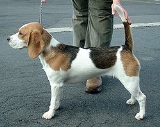
The general appearance of the Beagle resembles a
FoxhoundA foxhound is a type of large hunting hound. Foxhounds hunt in packs and, like all scent hounds, have a strong sense of smell. They are used in hunts for foxes, hence the name. When out hunting they are followed usually on horseback and will travel several miles to catch their target. These dogs...
in miniature, but the head is broader and the muzzle shorter, the expression completely different and the legs shorter in proportion to the body. They are generally between 13 and 16 in (33 and 40.6 cm) high at the
withersThe withers is the ridge between the shoulder blades of a four-legged animal. In many species it is the tallest point of the body, and in horses and dogs it is the standard place to measure the animal's height .-Horses:The withers in horses are formed by the dorsal spinal processes of roughly the...
and weigh between 18 and 35 lb (8.2 and 15.9 kg), with females being slightly smaller than males on average.
They have a smooth, somewhat domed
skullThe skull is a bony structure in the head of many animals that supports the structures of the face and forms a cavity for the brain.The skull is composed of two parts: the cranium and the mandible. A skull without a mandible is only a cranium. Animals that have skulls are called craniates...
with a medium-length, square-cut
muzzleThe snout, or muzzle, is the protruding portion of an animal's face, consisting of its nose, mouth, and jaw.-Terminology:The term "muzzle", used as a noun, can be ambiguous...
and a black (or occasionally liver), gumdrop nose. The jaw is strong and the teeth scissor together with the upper teeth fitting perfectly over the lower teeth and both sets aligned square to the jaw. The eyes are large, hazel or brown, with a mild hound-like pleading look. The large ears are long, soft and low-set, turning towards the cheeks slightly and rounded at the tips. Beagles have a strong, medium-length neck (which is long enough for them to easily bend to the ground to pick up a scent), with little folding in the skin but some evidence of a
dewlapA dewlap is a longitudinal flap of skin that hangs beneath the lower jaw or neck of many vertebrates. While the term is usually used in this specific context, it can also be used to include other structures occurring in the same body area with a similar aspect, such as those caused by a double...
; a broad chest narrowing to a tapered
abdomenIn vertebrates such as mammals the abdomen constitutes the part of the body between the thorax and pelvis. The region enclosed by the abdomen is termed the abdominal cavity...
and
waistThe waist is the part of the abdomen between the rib cage and hips. On proportionate people, the waist is the narrowest part of the torso....
and a short, slightly curved tail (known as the "stern") tipped with white. The white tip, known as the flag has been selectively bred for, as it allows the dog to be easily seen when its head is down following a scent. The tail does not curl over the back, but is held upright when the dog is active. The Beagle has a muscular body and a medium-length, smooth, hard coat. The front legs are straight and carried under the body while the rear legs are muscular and well bent at the
stiflesThe stifle joint is a complex joint in the hind limbs of quadruped mammals such as the sheep, horse or dog. It is the equivalent joint to the human knee...
.
Colouring
Beagles appear in a range of colours. Although the tricolour (white with large black areas and light brown shading) is the most common, Beagles can occur in any hound colour.
Tricoloured dogs occur in a number of shades, from the "Classic Tri" with a jet black saddle (also known as "Blackback"), to the "Dark Tri" (where faint brown markings are intermingled with more prominent black markings), to the "Faded Tri" (where faint black markings are intermingled with more prominent brown markings). Some tricoloured dogs have a broken pattern, sometimes referred to as
pied. These dogs have mostly white coats with patches of black and brown hair. Tricolour Beagles are almost always born black and white. The white areas are typically set by eight weeks, but the black areas may fade to brown as the puppy matures. (The brown may take between one and two years to fully develop.) Some Beagles gradually change colour during their lives, and may lose their black markings entirely.
Two-colour varieties always have a white base colour with areas of the second colour. Tan and white is the most common two-colour variety, but there is a wide range of other colours including lemon, a very light tan; red, a reddish, almost orange, brown; and liver, a darker brown, and black. Liver is not common and is not permitted in some standards; it tends to occur with yellow eyes. Ticked or mottled varieties may be either white or black with different coloured flecks (
ticking), such as the blue-mottled or bluetick Beagle, which has spots that appear to be a midnight-blue colour, similar to the colouring of the
Bluetick CoonhoundThe Bluetick Coonhound is a breed of dog. It is a type of coonhound and typically bred in the southern United States.- Appearance :The overall body style of the Bluetick Coonhound is muscular and speedy, not chunky or clumsily built. The head is carried well up and the tail carried over the back,...
. Some tricolour Beagles also have ticking of various colours in their white areas.
Sense of smell
Alongside the
BloodhoundThe Bloodhound is a large breed of dog which, while originally bred to hunt deer and wild boar, was later bred specifically to track human beings. It is a scenthound, tracking by smell, as opposed to a sighthound, which tracks using vision. It is famed for its ability to discern human odors even...
, the Beagle has one of the best developed senses of smell of any dog. In the 1950s, John Paul Scott and John Fuller began a 13 year study into canine behaviour. As part of this research, they tested the scenting abilities of various breeds by putting a mouse in a 1 acres (4,046.9 m²) field and timing how long it took the dogs to find it. The Beagles found it in less than a minute, while
Fox TerrierFox Terrier refers primarily to two different breeds of the terrier dog type: the Smooth Fox Terrier and the Wire Fox Terrier. Both of these breeds originated in the 19th century from a handful of dogs who are descended from earlier varieties of British terriers, and are related to other modern...
s took 15 minutes and
Scottish TerrierThe Scottish Terrier , popularly called the Scottie, is a breed of dog. Initially one of the highland breeds of Terrier that were grouped under the name of Skye Terrier, it is one of five breeds of terrier that originated in Scotland, the other four being the modern Skye, Cairn, Dandie Dinmont, and...
s failed to find it at all. Beagles are better at ground-scenting (following a trail on the ground) than they are at air-scenting, and for this reason they have been excluded from most
mountain rescueMountain rescue refers to search and rescue activities that occur in a mountainous environment, although the term is sometimes also used to apply to search and rescue in other wilderness environments. The difficult and remote nature of the terrain in which mountain rescue often occurs has resulted...
teams in favour of
collieThe collie is a distinctive type of herding dog, including many related landraces and formal breeds. It originates in Scotland and Northern England. It is a medium-sized, fairly lightly built dog with a pointed snout, and many types have a distinctive white pattern over the shoulders. Collies...
s, which use sight in addition to air-scenting and are more biddable. The long ears and large lips of the Beagle probably assist in trapping the scents close to the nose.
Breed varieties
The
American Kennel ClubThe American Kennel Club is a registry of purebred dog pedigrees in the United States. Beyond maintaining its pedigree registry, this kennel club also promotes and sanctions events for purebred dogs, including the Westminster Kennel Club Dog Show, an annual event which predates the official...
recognizes two separate varieties of Beagle: the 13-inch for hounds less than 13 inches (33 cm), and the 15-inch for those between 13 and 15 in (33 and 38.1 cm). The
Canadian Kennel ClubThe Canadian Kennel Club is the primary registry body for purebred dog pedigrees in Canada. Beyond maintaining the pedigree registry, the C.K.C...
recognizes a single type, with a height not exceeding 15 inches (38.1 cm). The Kennel Club (UK) and
FCIFédération Cynologique Internationale is an international federation of kennel clubs based in Thuin, Belgium. The English language translation, World Canine Organisation, is not often used.Its goals are described in Article 2 of their regulations:...
affiliated clubs recognize a single type, with a height of between 13 and 16 in (33 and 40.6 cm).
English and American varieties are sometimes mentioned. However, there is no official recognition from any Kennel Club for this distinction. Beagles fitting the American Kennel Club standard – which disallows animals over 15 inches (38.1 cm) – are smaller on average than those fitting the Kennel Club standard which allows heights up to 16 inches (40.6 cm).
Pocket Beagles are sometimes advertised for sale but the bloodline for this variety is extinct, and, although the UK Kennel Club originally specified a standard for the Pocket Beagle in 1901, the variety is not now recognised by any Kennel Club. Often, small Beagles are the result of poor breeding or dwarfism.
A strain known as Patch Hounds was developed by Willet Randall and his family from 1896 specifically for their rabbit hunting ability. They trace their bloodline back to Field Champion Patch, but do not necessarily have a patchwork marking.
Crossbreeds
In the 1850s, Stonehenge recommended a cross between a Beagle and a
Scottish TerrierThe Scottish Terrier , popularly called the Scottie, is a breed of dog. Initially one of the highland breeds of Terrier that were grouped under the name of Skye Terrier, it is one of five breeds of terrier that originated in Scotland, the other four being the modern Skye, Cairn, Dandie Dinmont, and...
as a retriever. He found the
crossbreedA crossbreed or crossbred usually refers to an animal with purebred parents of two different breeds, varieties, or populations. Crossbreeding refers to the process of breeding such an animal, often with the intention to create offspring that share the traits of both parent lineages, or producing...
to be a good worker, silent and obedient, but it had the drawback that it was small and could barely carry a hare.
More recently the trend has been for "designer dogs" and one of the most popular has been the Beagle/
PugThe pug is a "toy" breed of dog with a wrinkly, short-muzzled face, and curled tail. The breed has a fine, glossy coat that comes in a variety of colors, and a compact square body with well-developed muscle. They have been described as multum in parvo , referring to the pug's personality and...
cross known as a
PugglePuggle can refer to:*Puggle , a crossbreed between a Pug and a Beagle*A baby echidna*A member of the Awana organization in the two-to-three-year old age group-See also:*The Puggle Tales, a series of books by A. A. Barber of The Lost Forests...
. Less excitable than a Beagle and with a lower exercise requirement, these dogs are suited to city dwelling.
Temperament
The Beagle has an even temper and gentle disposition. Described in several breed standards as "merry", they are amiable and generally neither aggressive nor timid. They enjoy company, and although they may initially be standoffish with strangers, they are easily won over. They make poor guard dogs for this reason, although their tendency to bark or howl when confronted with the unfamiliar makes them good watch dogs. In a 1985 study conducted by Ben and Lynette Hart, the Beagle was given the highest excitability rating, along with the
Yorkshire TerrierThe Yorkshire Terrier is a small dog breed of terrier type, developed in the 19th century in the county of Yorkshire, England to catch rats in clothing mills. The defining features of the breed are its size, to , and its silky blue and tan coat...
,
Cairn TerrierThe Cairn Terrier is the oldest of the terrier breeds, originating in the Scottish Highlands and recognized as one of Scotland's earliest working dogs...
,
Miniature SchnauzerThe Miniature Schnauzer is a breed of small dog of the Schnauzer type that originated in Germany in the mid-to-late 19th century. Miniature Schnauzers developed from crosses between the Standard Schnauzer and one or more smaller breeds such as the Poodle and Affenpinscher.The breed remains one of...
,
West Highland White TerrierThe West Highland White Terrier, commonly known as the Westie, is a Scottish breed of dog with a distinctive white coat. The modern breed is descended from a number of breeding programes of white terriers in Scotland prior to the 20th century...
and
Fox TerrierFox Terrier refers primarily to two different breeds of the terrier dog type: the Smooth Fox Terrier and the Wire Fox Terrier. Both of these breeds originated in the 19th century from a handful of dogs who are descended from earlier varieties of British terriers, and are related to other modern...
.
Beagles are intelligent but, as a result of being bred for the long chase, are single-minded and determined, which can make them hard to train. They are generally obedient, but can be difficult to recall once they have picked up a scent, and are easily distracted by smells around them. They do not generally feature in obedience trials; while they are alert, respond well to food-reward training, and are eager to please, they are easily bored or distracted. They are ranked 72nd in
Stanley CorenStanley Coren is a psychology professor and neuropsychological researcher who has become best known to the general public for a series of books regarding the intelligence, mental abilities and history of dogs...
's
The Intelligence of DogsThe Intelligence of Dogs is a book on dog intelligence by Stanley Coren, a professor of psychology at the University of British Columbia in Vancouver. Published in 1994, the book explains Coren's theories about the differences in intelligence between different breeds of dogs...
, as Coren places them among the group with the lowest degree of working/obedience intelligence. Coren's scale, however, does not assess understanding, independence, or creativity.
Beagles are excellent with children and this is one of the reasons they have become popular family pets, but they are pack animals, and can be prone to
separation anxietySeparation anxiety in dogs is a condition where dogs, when left alone, exhibit distress and behavior problems. It is similar to separation anxiety disorder that people experience when they are away from someone they feel strongly emotionally attached to, i.e., a father or mother...
. Not all Beagles will howl, but most will bark when confronted with strange situations, and some will bay (also referred to as "speaking", "giving tongue", or "opening") when they catch the scent of potential quarry. They also generally get along well with other dogs. They are not demanding with regard to exercise; their inbred stamina means they do not easily tire when exercised, but they also do not need to be worked to exhaustion before they will rest, though regular exercise helps ward off the weight gain to which the breed is prone.
Health
The typical longevity of Beagles is 10–13 years, which is a common lifespan for dogs of their size.
Beagles may be prone to
epilepsyEpilepsy is a common chronic neurological disorder characterized by seizures. These seizures are transient signs and/or symptoms of abnormal, excessive or hypersynchronous neuronal activity in the brain.About 50 million people worldwide have epilepsy, and nearly two out of every three new cases...
, but this can be controlled with medication.
HypothyroidismHypothyroidism is a condition in which the thyroid gland does not make enough thyroid hormone.Iodine deficiency is the most common cause of hypothyroidism worldwide but it can be caused by other causes such as several conditions of the thyroid gland or, less commonly, the pituitary gland or...
and a number of types of
dwarfismDwarfism is short stature resulting from a medical condition. It is sometimes defined as an adult height of less than 4 feet 10 inches , although this definition is problematic because short stature in itself is not a disorder....
occur in Beagles. Two conditions in particular are unique to the breed: Funny Puppy, in which the puppy is slow to develop and eventually develops weak legs, a crooked back and although normally healthy, is prone to a range of illnesses; Hip dysplasia, common in Harriers and in some larger breeds, is rarely considered a problem in Beagles. Beagles are considered a chondrodystrophic breed, meaning that they are prone to types of disk diseases.
In rare cases, Beagles may develop
immune mediated polygenic arthritisAn immune mediated inflammation of the joints of an animal caused by a dysfunction of the immune system, which attacks various components of the joint. This leads to variable degrees of synovitis, and typically occurs in multiple joints . The condition is hereditary , and caused by defects at...
(where the immune system attacks the joints) even at a young age. The symptoms can sometimes be relieved by steroid treatments.
Their long floppy ears can mean that the inner ear does not receive a substantial air flow or that moist air becomes trapped, and this can lead to ear infections. Beagles may also be affected by a range of eye problems; two common ophthalmic conditions in Beagles are
glaucomaGlaucoma is an eye disorder in which the optic nerve suffers damage, permanently damaging vision in the affected eye and progressing to complete blindness if untreated. It is often, but not always, associated with increased pressure of the fluid in the eye...
and
corneal dystrophyCorneal dystrophy is a group of disorders, characterised by a noninflammatory, inherited, bilateral opacity of the transparent front part of the eye called the cornea.The distrophies could be subdivided based on specie affected:...
. "
Cherry eyeCherry eye is the term used to refer to canine nictitans gland prolapse, a common congenital eye defect in various dog breeds where the gland of the third eyelid known as the nictitating membrane prolapses and becomes visible. Commonly affected breeds include the Bulldog, Chihuahua, Cocker...
", a prolapse of the gland of the third eyelid, and distichiasis, a condition in which eyelashes grow into the eye causing irritation, sometimes exist; both these conditions can be corrected with surgery. They can suffer from several types of retinal atrophy. Failure of the nasolacrimal drainage system can cause dry eye or leakage of tears onto the face.
As field dogs they are prone to minor injuries such as cuts and sprains, and, if inactive, obesity is a common problem as they will eat whenever food is available and rely on their owners to regulate their weight. When working or running free they are also likely to pick up parasites such as
fleaFlea is the common name for insects of the order Siphonaptera which are wingless insects with mouthparts adapted for piercing skin and sucking blood...
s,
tickTicks are small arachnids in the order Ixodida, along with mites, constitute the subclass Acarina. Ticks are ectoparasites , living by hematophagy on the blood of mammals, birds, and sometimes reptiles and amphibians...
s,
harvest miteTrombicula is a genus of harvest mites in the Trombiculidae family. In their larval stage, they attach to various animals, including humans, and feed on skin, often causing itching...
s and tapeworms, and irritants such as grass seeds can become trapped in their eyes, soft ears or paws.
Beagles may exhibit a behaviour known as
reverse sneezingReverse sneezing or inspiratory paroxysmal respiration is a phenomenon observed in dogs, particularly in those with brachycephalic skulls. Its exact cause is unknown but may be due to nasal, pharyngeal, or sinus irritation , the dog's attempt to remove mucus, or from over-excitement due to present...
, in which they sound as if they are choking or gasping for breath, but are actually drawing air in through the mouth and nose. The exact cause of this behaviour is not known, but it is not harmful to the dog.
Hunting
Beagles were developed primarily for
huntingHunting is the practice of pursuing any living thing, usually wildlife, for food, recreation, or trade. In present-day use, the term refers to lawful hunting, as distinguished from poaching, which is the killing, trapping or capture of the hunted species contrary to applicable law...
hare, an activity known as
beaglingBeagling is the hunting of hares, rabbits, and occasionally foxes with beagles. A beagle pack is usually followed on foot. However, there is one pack of beagles in the U.S. which are distinguished as being the only hunting pack to hunt fox and be followed on horseback...
. They were seen as ideal hunting companions for the elderly who could follow on horseback without exerting themselves, for young hunters who could keep up with them on ponies, and for the poorer hunters who could not afford to maintain a stable of good hunting horses. Before the advent of the fashion for foxhunting in the 19th century, hunting was an all day event where the enjoyment was derived from the chase rather than the kill. In this setting the tiny Beagle was well matched to the hare, as unlike Harriers they would not quickly finish the hunt, but because of their excellent scent-tracking skills and stamina they were almost guaranteed to eventually catch the hare. The Beagle packs would run closely together ("so close that they might be covered with a sheet") which was useful in a long hunt, as it prevented stray dogs from obscuring the trail. In thick undergrowth they were also preferred to
spanielA spaniel is a type of gun dog. It is assumed spaniels originated from Spain as the word spaniel may be derived from Hispania or possibly from the French phrase "Chiens de l’Espagnol" . Spaniels were especially bred to flush game out of dense brush. By the late 17th century spaniels had become...
s when hunting
pheasantPheasants refer to some members of the Phasianinae subfamily of Phasianidae in the order Galliformes.Pheasants are characterised by strong sexual dimorphism, males being highly ornate with bright colours and adornments such as wattles and long tails. Males are usually larger than females and have...
.
With the fashion for faster hunts, the Beagle fell out of favour for chasing hare, but was still employed for rabbit hunting. In
Anecdotes of Dogs (1846),
Edward JesseEdward Jesse , English writer on natural history, was born at Hutton Cranswick, Yorkshire, where his father was vicar of the parish....
says:
In the United States they appear to have been employed chiefly for hunting rabbits from the earliest imports.
Hunting hare with Beagles became popular again in Britain in the mid-19th century and continued until it was made illegal in Scotland by the
Protection of Wild Mammals (Scotland) Act 2002The Protection of Wild Mammals Act was passed by the devolved Scottish parliament in February 2002, making Scotland the first part of the United Kingdom to ban traditional fox hunting and hare coursing.-Passage of the Act:...
and in England and Wales by the
Hunting Act 2004The Hunting Act 2004 is an Act of the Parliament of the United Kingdom. The effect of the Act is to outlaw hunting with dogs in England and Wales from 18 February 2005...
. Under this legislation Beagles may still pursue rabbits with the landowner's permission.
Drag huntingDrag hunting is a sport in which a group of dogs chase a scent that has been laid over a terrain before the hunt...
is popular where hunting is no longer permitted or for those owners who do not wish to participate in blood sports but still wish to exercise their dog's innate skills.
The traditional foot pack consists of up to 70 Beagles, marshalled by a Huntsman who directs the pack and who is assisted by a variable number of whippers-in whose job is to return straying hounds to the pack. The Master of the Hunt is in overall day-to-day charge of the pack, and may or may not take on the role of Huntsman on the day of the hunt. Beagles may also be employed individually or in a brace (a pair).
As hunting with Beagles was seen as ideal for young people, many of the British
public schoolsAn independent school is a school that is not financed through the taxation system by local or national government and is instead funded by private sources, predominantly in the form of tuition charges, gifts and long-term charitable endowments, and so is not subject to the conditions imposed by...
traditionally maintained Beagle packs. Protests were lodged against
Eton'sEton College, often referred to simply as Eton, is a British independent school for boys aged 13 to 18. It was founded in 1440 by King Henry VI as "The King's College of Our Lady of Eton besides Wyndsor"....
use of Beagles for hunting as early as 1902 but the pack is still in existence today, and a pack used by
Imperial CollegeThe College of St. Gregory and St. Martin at Wye, more commonly known as Wye College, was an educational institution in Kent, United Kingdom. It was founded in 1447 by John Kempe, the Archbishop of York, as a college for the training of priests. It is located in the small village of Wye, Kent, 60...
in Wye,
KentKent is a county in southeast England, and is one of the home counties. It borders East Sussex, Surrey and Greater London and has a defined boundary with Essex in the middle of the Thames Estuary. The ceremonial county boundaries of Kent include the shire county of Kent and the unitary borough of...
was stolen by the
Animal Liberation FrontThe Animal Liberation Front is an international, underground leaderless resistance that engages in illegal direct action in pursuit of animal liberation...
in 2001. School and university packs are still maintained by Eton,
MarlboroughMarlborough College is a British co-educational independent school for day and boarding pupils, located in Marlborough, Wiltshire.Founded in 1843 for the education of the sons of Church of England clergy, the school now accepts both boys and girls of all beliefs. Currently there are just over 800...
, Wye,
RadleyRadley College , founded in 1847, is a British independent school for boys on the edge of the English village of Radley, near to the market town of Abingdon in Oxfordshire, and has become a well-established boarding school...
, the
Royal Agricultural CollegeThe Royal Agricultural College is a higher education institution located in Cirencester, Gloucestershire, UK. Established in 1845, it was the first agricultural college in the English speaking world...
and
Christ Church, OxfordChrist Church or house of Christ, and thus sometimes known as The House), is one of the largest constituent colleges of the University of Oxford in England...
.
Beagles have been used for hunting a wide range of game including
Snowshoe HareThe Snowshoe Hare , also called the Varying Hare, or Snowshoe Rabbit, is a species of hare found in North America. It has the name "snowshoe" because of the large size of its hind feet and the marks its tail leaves. The animal's feet prevent it from sinking into the snow when it hops and walks...
,
Cottontail rabbitThe cottontail rabbits are among the 16 lagomorph species in the genus Sylvilagus, found in the Americas.In appearance, most cottontail rabbits closely resemble the wild European Rabbit...
s, game birds,
Roe DeerThe European Roe Deer , also known as the Western Roe Deer, chevreuil or just Roe Deer, is a Eurasian species of deer. It is relatively small, reddish and grey-brown, and well-adapted to cold environments. Roe Deer are widespread in Western Europe, from the Mediterranean to Scandinavia, and from...
,
Red DeerThe red deer is one of the largest deer species. Depending on taxonomy, the red deer inhabits most of Europe, the Caucasus Mountains region, Asia Minor, parts of western Asia, and central Asia. It also inhabits the Atlas Mountains region between Morocco and Tunisia in northwestern Africa, being...
,
BobcatThe bobcat is a North American mammal of the cat family Felidae, appearing during the Irvingtonian stage of around 1.8 million years ago . With twelve recognized subspecies, it ranges from southern Canada to northern Mexico, including most of the continental United States...
,
CoyoteThe coyote , also known as the American jackal or the prairie wolf, is a species of canine found throughout North and Central America, ranging from Panama in the south, north through Mexico, the United States and Canada...
, Wild Boar and
foxFox is a common name for many species of omnivorous mammals belonging to the Canidae family. Foxes are small to medium-sized canids , characterized by possessing a long narrow snout, and a bushy tail .Members of about 37 species are referred to as foxes, of which only 12 species actually belong to...
es, and have even been recorded as being used to hunt
StoatThe stoat , also known as the ermine or short-tailed weasel, is a species of Mustelid native to Eurasia and North America, distinguished from the least weasel by its larger size and longer tail with a prominent black tip...
. In most of these cases, the Beagle is employed as a gun dog, flushing game for hunter's guns.
Quarantine
Beagles are used as detection dogs in the
Beagle BrigadeBeagle Brigade is a team of beagles and their human handlers who, as part of the United States Department of Agriculture's Animal and Plant Health Inspection Service , inspect luggage at U.S. airports searching for agricultural products...
of the
United States Department of AgricultureThe United States Department of Agriculture is the United States federal executive department responsible for developing and executing U.S. federal government policy on farming, agriculture, and food...
. These dogs are used to detect food items in luggage being taken into the United States. After trialling several breeds, Beagles were chosen because they are relatively small and unintimidating for people who are uncomfortable around dogs, easy to care for, intelligent and work well for rewards. They are also used for this purpose in a number of other countries including by the
Ministry of Agriculture and ForestryThe Ministry of Agriculture and Forestry is the state sector organisation of New Zealand which deals with matters relating to agriculture, forestry and biosecurity...
in
New ZealandNew Zealand is an island country in the south-western Pacific Ocean comprising two main landmasses and numerous smaller islands. The country is situated some east of Australia across the Tasman Sea, and roughly south of the Pacific island nations of New Caledonia, Fiji, and Tonga...
, the
Australian Quarantine and Inspection ServiceThe Australian Quarantine and Inspection Service is the Australian government agency responsible for enforcing Australian quarantine laws...
, and in
CanadaCanada is a North American country consisting of ten provinces and three territories. Located in the northern part of the continent, it extends from the Atlantic Ocean in the east to the Pacific Ocean in the west, and northward into the Arctic Ocean...
,
JapanJapan is an island nation in East Asia. Located in the Pacific Ocean, it lies to the east of the Sea of Japan, China, North Korea, South Korea and Russia, stretching from the Sea of Okhotsk in the north to the East China Sea and Taiwan in the south...
and the
People's Republic of ChinaChina , officially the People's Republic of China , is the most populous country in the world, with over 1.3 billion citizens. Located in East Asia, the country covers approximately 9.6 million square kilometres...
. Larger breeds are generally used for detection of explosives as this often involves climbing over luggage and on large conveyor belts, work for which the smaller Beagle is not suited.
Testing
Beagles are the dog breed most often used in
animal testingAnimal testing, also known as animal experimentation, animal research, and in vivo testing, is the use of non-human animals in experiments. Worldwide it is estimated that the number of vertebrate animals—from zebrafish to non-human primates—ranges from the tens of millions to more than 100 million...
, due to their size and passive nature. Of the 8,018 dogs used in testing in the UK in 2004, 7,799 were Beagles (97.3%). In the UK, the
Animals (Scientific Procedures) Act 1986The Animals Act 1986 is an Act of the Parliament of the United Kingdom passed in 1986, which regulates the use of laboratory animals in the UK. The Act permits experiments to be carried out on animals, including procedures involving vivisection, if certain criteria are met...
gave special status to primates, equids, cats and dogs and in 2005 the Animal Procedures Committee (set up by the act) ruled that testing on mice was preferable, even though a greater number of individual animals were involved. In 2005 Beagles were involved in less than 0.3% of the total experiments on animals in the UK, but of the 7670 experiments performed on dogs 7406 involved Beagles (96.6%). Most dogs are bred specifically for the purpose, by companies such as
HarlanHarlan Sprague Dawley Inc. is one of the world's leading suppliers of animals and other services to laboratories for the purpose of animal testing...
. In the UK companies breeding animals for research must be licensed under the Animals (Scientific Procedures) Act.
Testing of cosmetic products on animals is banned in the member states of European Community, although France protested the ban and has made efforts to have it lifted. It is permitted in the United States but is not mandatory if safety can be ascertained by other methods, and the test species is not specified by the
Food and Drug AdministrationThe Food and Drug Administration is an agency of the United States Department of Health and Human Services, one of the United States federal executive departments...
(FDA). When testing toxicity of food additives, food contaminants, and some drugs and chemicals the FDA uses Beagles and
miniature pigA miniature pig is one of the breeds developed and used for medical research or developed for use as a pet. These smaller pigs were first used for medical research in Europe before being introduced to the United States as pets in the 1980s. Since then, the animals have been used in studies by...
s as surrogates for direct human testing.
Anti-
vivisectionAnimal testing, also known as animal experimentation, animal research, and in vivo testing, is the use of non-human animals in experiments. Worldwide it is estimated that the number of vertebrate animals—from zebrafish to non-human primates—ranges from the tens of millions to more than 100 million...
groups have reported on abuse of animals inside testing facilities. In 1997 footage secretly filmed by a freelance journalist inside
Huntingdon Life SciencesHuntingdon Life Sciences is a contract animal-testing company founded in 1952 in England, with facilities in Huntingdon, Cambridgeshire; Eye, Suffolk; New Jersey in the U.S., and Japan...
in the UK showed staff punching and screaming at Beagles. Consort Kennels, a UK-based breeder of Beagles for testing, closed down in 1997 after pressure from animal rights groups.
Medical research
In the United States where the breeds of dog used are not specified (although Beagles feature heavily in published research papers) the number of tests performed each year on dogs dropped by two-thirds, from 195,157 to 64,932, over the period from 1972 to 2004. In Japan the laws on animal experimentation do not require reporting on the types or number of animals used, and in France the proportion of inspectors to testing facilities means the regulatory environment is essentially one of trust.
Beagles are used in a range of research procedures: fundamental biological research, applied human medicine, applied veterinary medicine, and protection of man, animals or the environment.
Other roles
Although bred for hunting, Beagles are versatile and are nowadays employed for various other roles in detection, therapy, and as family pets.
Beagles are used as sniffer dogs for
termiteTermites are a group of eusocial insects that, until recently, were classified at the taxonomic rank of order Isoptera , but are now accepted as the epifamily Termitoidae, of the cockroach order Blattodea...
detection in Australia, and have been mentioned as possible candidates for drug and explosive detection. Because of their gentle nature and unimposing build, they are also frequently used in pet therapy, visiting the sick and elderly in hospital. In June 2006, a trained Beagle assistance dog was credited with saving the life of its owner after using his owner's mobile phone to dial an emergency number. In the aftermath of the
2010 Haiti earthquakeThe 2010 Haiti earthquake was a catastrophic magnitude 7.0 Mw earthquake, with an epicentre near the town of Léogâne, approximately west of Port-au-Prince, Haiti's capital. The earthquake occurred at 16:53 local time on Tuesday, 12 January 2010.By 24 January, at least 52 aftershocks...
, a Beagle
search and rescue dogThe use of dogs in search and rescue is a valuable component in wilderness tracking, natural disasters, mass casualty events, and in locating missing people. Dedicated handlers and well-trained dogs are required for the use of dogs to be effective in search efforts...
with a Colombian rescue squad was credited with locating the owner of the
Hôtel MontanaThe Hôtel Montana was a hotel in the Pétionville suburb of Port-au-Prince, Haiti. Built in 1946, the hotel was a popular four star tourist resort until the main building collapsed along with most buildings in the city during the 2010 Haiti earthquake...
, who was subsequently rescued after spending 100 hours buried in the rubble.
In popular culture
Beagles have been featured across a wide range of media. References to the dog appear before the 19th century in works by such writers as
William ShakespeareWilliam Shakespeare was an English poet and playwright, widely regarded as the greatest writer in the English language and the world's pre-eminent dramatist. He is often called England's national poet and the "Bard of Avon"...
,
John WebsterJohn Webster was an English Jacobean dramatist best known for his tragedies The White Devil and The Duchess of Malfi, which are often regarded as masterpieces of the early 17th-century English stage. He was a contemporary of William Shakespeare.- Biography :Webster's life is obscure, and the dates...
,
John DrydenJohn Dryden was an influential English poet, literary critic, translator, and playwright who dominated the literary life of Restoration England to such a point that the period came to be known in literary circles as the Age of Dryden.Walter Scott called him "Glorious John." He was made Poet...
,
Thomas TickellThomas Tickell was a minor English poet and man of letters.-Life:The son of a clergyman, he was born at Bridekirk near Cockermouth, Cumberland. He was educated at St Bees School 1695-1701, and in 1701 entered the Queen's College, Oxford, taking his M.A. degree in 1709...
,
Henry FieldingHenry Fielding was an English novelist and dramatist known for his rich earthy humour and satirical prowess, and as the author of the novel Tom Jones....
and
William CowperWilliam Cowper was an English poet and hymnodist. One of the most popular poets of his time, Cowper changed the direction of 18th century nature poetry by writing of everyday life and scenes of the English countryside. In many ways, he was one of the forerunners of Romantic poetry...
, and in
Alexander PopeAlexander Pope was an 18th-century English poet, best known for his satirical verse and for his translation of Homer. He is the third-most frequently quoted writer in The Oxford Dictionary of Quotations, after Shakespeare and Tennyson...
's translation of
HomerIn the Western classical tradition Homer , is the author of the Iliad and the Odyssey, and is revered as the greatest ancient Greek epic poet. These epics lie at the beginning of the Western canon of literature, and have had an enormous influence on the history of literature.When he lived is...
's
IliadThe Iliad is an epic poem in dactylic hexameters, traditionally attributed to Homer. Set during the Trojan War, the ten-year siege of the city of Troy by a coalition of Greek states, it tells of the battles and events during the weeks of a quarrel between King Agamemnon and the warrior Achilles...
. Beagles appeared in comic strips and animated cartoons from the 1950s with the
PeanutsPeanuts is a syndicated daily and Sunday American comic strip written and illustrated by Charles M. Schulz, which ran from October 2, 1950, to February 13, 2000, continuing in reruns afterward...
character
SnoopySnoopy is an fictional character in the long-running comic strip Peanuts, by Charles M. Schulz. He is Charlie Brown's pet beagle. Snoopy began his life in the strip as a fairly conventional dog, but eventually evolved into perhaps the strip's most dynamic character—and among the most recognizable...
(billed as "the world's most famous Beagle"),
Walt DisneyWalter Elias "Walt" Disney was an American film producer, director, screenwriter, voice actor, animator, entrepreneur, entertainer, international icon, and philanthropist, well-known for his influence in the field of entertainment during the 20th century. Along with his brother Roy O...
's
Beagle BoysThe Beagle Boys are a group of fictional characters from the Scrooge McDuck universe. Created by Carl Barks, they are a gang of criminals who constantly try to rob Scrooge McDuck. Their introduction and first appearance was in Terror of the Beagle Boys, in Walt Disney's Comics and Stories #134,...
and
Beegle BeagleBeegle Beagle is a fictional anthropomorphic beagle that appears in The Great Grape Ape Show as best friend to Grape Ape. Beegle would drive a yellow van which Grape Ape would sit on top of. Grape Ape would refer to him as "Beegly Beagly". The character also appeared in The New Tom and Jerry Show,...
, the constant companion of
Hanna-BarberaHanna-Barbera Productions, Inc. was an American animation studio that dominated North American television animation during the second half of the 20th century...
's
Grape ApeThe Great Grape Ape Show is a Saturday morning cartoon produced by Hanna-Barbera Productions that was broadcast on ABC from 1975 to 1978.-Summary:...
. They have appeared in numerous films, taking a central role in
Cats & DogsCats & Dogs is a 2001 American-Australian action-comedy film directed by Lawrence Guterman. The screenplay by John Requa and Glenn Ficarra centers on the relationships between cats and dogs. It was shot in Victoria and Vancouver. The film was released on July 4, 2001 by Warner Bros...
and
its sequelCats & Dogs: The Revenge of Kitty Galore is a 2010 family action comedy film directed by Brad Peyton. The film stars Chris O'Donnell and Jack McBrayer. The film also stars the voices of James Marsden, Nick Nolte, Christina Applegate, Katt Williams, Bette Midler, and Neil Patrick Harris...
, and the title roles in the adaptation of
Phyllis Reynolds NaylorPhyllis Reynolds Naylor is an American author best known for her children and young adult fiction books. Naylor is best known for her children's-novel trilogy Shiloh , Shiloh Season and Saving Shiloh, all made into movies...
's book
ShilohShiloh is a Newbery Medal-winning children's novel by Phyllis Reynolds Naylor published in 1991. The 65th book by Naylor, it is the first in a trilogy about a young boy and the title character, an abused dog...
. They have played supporting roles in films including
Auditionis a 1999 Japanese horror film directed by Takashi Miike and starring Ryo Ishibashi and Eihi Shiina. It is based on a Ryu Murakami novel of the same title. Over the years, the film has developed a cult following.-Plot:...
,
The Monster SquadThe Monster Squad is a comedy/horror film written by Shane Black and Fred Dekker and directed by Fred Dekker . It was released by Tri-Star Pictures on August 14, 1987. The film features the classic monsters , led by Count Dracula...
and
The Royal TenenbaumsThe Royal Tenenbaums is a 2001 American comedy-drama film directed by Wes Anderson and co-written with Owen Wilson. The film stars Gene Hackman and Anjelica Huston, with Danny Glover, Bill Murray, Gwyneth Paltrow, Ben Stiller, Luke Wilson, and Owen Wilson....
, and on television in
Star Trek: EnterpriseStar Trek: Enterprise is a science fiction television series. It follows the adventures of humanity's first warp 5 starship, the Enterprise, ten years before the United Federation of Planets shown in previous Star Trek series was formed.Enterprise premiered on September 26, 2001...
,
EastEndersEastEnders is a British television soap opera, first broadcast in the United Kingdom on BBC One on 19 February 1985 and continuing to today. EastEnders storylines examine the domestic and professional lives of the people who live and work in the fictional London Borough of Walford in the East End...
,
The Wonder YearsThe Wonder Years is an American television comedy-drama created by Carol Black and Neal Marlens. It ran for six seasons on ABC from 1988 through 1993. The pilot aired on January 31, 1988 after ABC's coverage of Super Bowl XXII....
, and
To the Manor BornTo the Manor Born is a British sitcom that first aired on BBC1 from 1979 to 1981. A special edition appeared in 2007. Starring Penelope Keith and Peter Bowles, the first 20 episodes and the 2007 special were written by Peter Spence, the creator, while the 1981 finale was written by Christopher...
among others. Former US President Lyndon Baines Johnson had several Beagles, and caused an outcry when he picked up one of them by its ears during an official greeting on the White House lawn. The ship on which
Charles DarwinCharles Robert Darwin FRS was an English naturalist. He established that all species of life have descended over time from common ancestry, and proposed the scientific theory that this branching pattern of evolution resulted from a process that he called natural selection.He published his theory...
made
the voyageThe second voyage of HMS Beagle, from 27 December 1831 to 2 October 1836, was the second survey expedition of HMS Beagle, under captain Robert FitzRoy who had taken over command of the ship on its first voyage after her previous captain committed suicide...
which provided much of the inspiration for
On the Origin of Species was named
HMS BeagleHMS Beagle was a Cherokee-class 10-gun brig-sloop of the Royal Navy. She was launched on 11 May 1820 from the Woolwich Dockyard on the River Thames, at a cost of £7,803. In July of that year she took part in a fleet review celebrating the coronation of King George IV of the United Kingdom in which...
after the breed, and, in turn, lent its name to the ill-fated British
MartianMars is the fourth planet from the Sun in the Solar System. The planet is named after the Roman god of war, Mars. It is often described as the "Red Planet", as the iron oxide prevalent on its surface gives it a reddish appearance...
lander
Beagle 2Beagle 2 was an unsuccessful British landing spacecraft that formed part of the European Space Agency's 2003 Mars Express mission. All contact with it was lost upon its separation from the Mars Express six days before its scheduled entry into the atmosphere...
.