

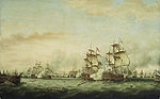
Battle of the Saintes

Encyclopedia
The Battle of the Saintes (known to the French as the Battle of Dominica) took place over 4 days, 9 April 1782 – 12 April 1782, during the American War of Independence, and was a victory of a British
fleet under Admiral Sir George Rodney over a French
fleet under the Comte de Grasse forcing the French and Spanish to abandon a planned invasion of Jamaica
.
The battle is named after the Saintes
(or Saints), a group of islands between Guadeloupe
and Dominica
in the West Indies. The French fleet defeated here by the Royal Navy was the same French fleet that had blockaded the British Army during the Siege of Yorktown
. The battle is sometimes credited with pioneering the tactic of "breaking the line"; this is however erroneous as Dano–Norwegian
admiral
Niels Juel
did this in the Battle of Køge Bay
more than a hundred years earlier.
with 35 ships of the line, including 2 50-gun ships and a large convoy of more than 100 cargo ships, to meet with a Spanish fleet consisting of 12 ships of the line and 15,000 troops for the purpose of capturing the British island of Jamaica
. He was pursued by Rodney with 36 ships of the line.
On 9 April 1782, De Grasse sent his convoy into Guadeloupe, escorted by his two fifty-gun ships (Fier and Experiment). There was an initial inconclusive clash during which the French got the better of the van division of the British fleet which had become separated from the centre and rear divisions. Two French ships of the line were damaged.
. As the French line passed down the British line, a sudden shift of wind let Rodney's flagship Formidable and several other ships, including the Duke and the Bedford, break through the French line, raking the ships as they did so. The resultant confusion in the French line and the severe damage to several of the French ships including De Grasse's flagship Ville de Paris
, of 104 guns, led eventually to De Grasse’s surrender and the retreat of many of his ships in disorder. This action split the French battle line into two. A general chase ensued. In all, four French ships were captured and one, César, blew up after she was taken.
The British lost 243 killed and 816 wounded, and two captains out of 36 were killed. The French loss in killed and wounded has never been stated, but of captains alone, six were killed out of 30. It is estimated that the French loss may have been as much as 2,000. More than 5,000 French soldiers and sailors were captured. The large number shows what a considerable force the French were willing to put ashore with the invasion of Jamaica. Of the Ville de Paris crew, over 400 had been killed and more than 700 were wounded. The César which blew up, killed over 400 French and 50 British sailors when her magazine exploded.
from the British. Rodney was created a peer
with £2,000 a year settled on the title in perpetuity for this victory. Hood was elevated to the peerage as well.
The battle has caused controversy ever since, for three reasons:
Kingdom of Great Britain
The former Kingdom of Great Britain, sometimes described as the 'United Kingdom of Great Britain', That the Two Kingdoms of Scotland and England, shall upon the 1st May next ensuing the date hereof, and forever after, be United into One Kingdom by the Name of GREAT BRITAIN. was a sovereign...
fleet under Admiral Sir George Rodney over a French
France
The French Republic , The French Republic , The French Republic , (commonly known as France , is a unitary semi-presidential republic in Western Europe with several overseas territories and islands located on other continents and in the Indian, Pacific, and Atlantic oceans. Metropolitan France...
fleet under the Comte de Grasse forcing the French and Spanish to abandon a planned invasion of Jamaica
Jamaica
Jamaica is an island nation of the Greater Antilles, in length, up to in width and 10,990 square kilometres in area. It is situated in the Caribbean Sea, about south of Cuba, and west of Hispaniola, the island harbouring the nation-states Haiti and the Dominican Republic...
.
The battle is named after the Saintes
Îles des Saintes
The Îles des Saintes , also called simply Les Saintes , is a small archipelago of French Antilles located in the South of Basse-Terre Island, on the West of Marie-Galante and in the North of Dominica in the arc of Lesser Antilles...
(or Saints), a group of islands between Guadeloupe
Guadeloupe
Guadeloupe is an archipelago located in the Leeward Islands, in the Lesser Antilles, with a land area of 1,628 square kilometres and a population of 400,000. It is the first overseas region of France, consisting of a single overseas department. As with the other overseas departments, Guadeloupe...
and Dominica
Dominica
Dominica , officially the Commonwealth of Dominica, is an island nation in the Lesser Antilles region of the Caribbean Sea, south-southeast of Guadeloupe and northwest of Martinique. Its size is and the highest point in the country is Morne Diablotins, which has an elevation of . The Commonwealth...
in the West Indies. The French fleet defeated here by the Royal Navy was the same French fleet that had blockaded the British Army during the Siege of Yorktown
Siege of Yorktown
The Siege of Yorktown, Battle of Yorktown, or Surrender of Yorktown in 1781 was a decisive victory by a combined assault of American forces led by General George Washington and French forces led by the Comte de Rochambeau over a British Army commanded by Lieutenant General Lord Cornwallis...
. The battle is sometimes credited with pioneering the tactic of "breaking the line"; this is however erroneous as Dano–Norwegian
Denmark–Norway
Denmark–Norway is the historiographical name for a former political entity consisting of the kingdoms of Denmark and Norway, including the originally Norwegian dependencies of Iceland, Greenland and the Faroe Islands...
admiral
Admiral
Admiral is the rank, or part of the name of the ranks, of the highest naval officers. It is usually considered a full admiral and above vice admiral and below admiral of the fleet . It is usually abbreviated to "Adm" or "ADM"...
Niels Juel
Niels Juel
Niels Juel was a Dano–Norwegian admiral. He was the brother of the diplomat Jens Juel.-Biography:Niels Juel was born the son of Erik Juel and Sophie Clausdatter Sehested, both were descendant of Danish nobility, who lived in Jutland where the father had a career as a local functionary and judge...
did this in the Battle of Køge Bay
Battle of Køge Bay
The Battle of Køge Bay was a naval battle between Denmark-Norway and Sweden that took place in the bay of Køge 1–2 July 1677, during the Scanian War, while Christian V was king of Denmark. It resulted in what may be Denmark's greatest naval victory....
more than a hundred years earlier.
Origins
On 7 April 1782, the Comte de Grasse set out from MartiniqueMartinique
Martinique is an island in the eastern Caribbean Sea, with a land area of . Like Guadeloupe, it is an overseas region of France, consisting of a single overseas department. To the northwest lies Dominica, to the south St Lucia, and to the southeast Barbados...
with 35 ships of the line, including 2 50-gun ships and a large convoy of more than 100 cargo ships, to meet with a Spanish fleet consisting of 12 ships of the line and 15,000 troops for the purpose of capturing the British island of Jamaica
Jamaica
Jamaica is an island nation of the Greater Antilles, in length, up to in width and 10,990 square kilometres in area. It is situated in the Caribbean Sea, about south of Cuba, and west of Hispaniola, the island harbouring the nation-states Haiti and the Dominican Republic...
. He was pursued by Rodney with 36 ships of the line.
On 9 April 1782, De Grasse sent his convoy into Guadeloupe, escorted by his two fifty-gun ships (Fier and Experiment). There was an initial inconclusive clash during which the French got the better of the van division of the British fleet which had become separated from the centre and rear divisions. Two French ships of the line were damaged.
Battle
On 12 April, De Grasse bore up with his fleet to protect a dismasted ship (Zélé, 74-guns) that was being chased by four British ships as he made for Guadeloupe. Rodney recalled his chasing ships and made the signal for line of battleLine of battle
In naval warfare, the line of battle is a tactic in which the ships of the fleet form a line end to end. A primitive form had been used by the Portuguese under Vasco Da Gama in 1502 near Malabar against a Muslim fleet.,Maarten Tromp used it in the Action of 18 September 1639 while its first use in...
. As the French line passed down the British line, a sudden shift of wind let Rodney's flagship Formidable and several other ships, including the Duke and the Bedford, break through the French line, raking the ships as they did so. The resultant confusion in the French line and the severe damage to several of the French ships including De Grasse's flagship Ville de Paris
French ship Ville de Paris (1764)
The Ville de Paris was a large three-decker French ship of the line that became famous as the flagship of the Comte de Grasse during the American Revolutionary War....
, of 104 guns, led eventually to De Grasse’s surrender and the retreat of many of his ships in disorder. This action split the French battle line into two. A general chase ensued. In all, four French ships were captured and one, César, blew up after she was taken.
The British lost 243 killed and 816 wounded, and two captains out of 36 were killed. The French loss in killed and wounded has never been stated, but of captains alone, six were killed out of 30. It is estimated that the French loss may have been as much as 2,000. More than 5,000 French soldiers and sailors were captured. The large number shows what a considerable force the French were willing to put ashore with the invasion of Jamaica. Of the Ville de Paris crew, over 400 had been killed and more than 700 were wounded. The César which blew up, killed over 400 French and 50 British sailors when her magazine exploded.
Aftermath
The battle frustrated French and Spanish hopes of capturing JamaicaJamaica
Jamaica is an island nation of the Greater Antilles, in length, up to in width and 10,990 square kilometres in area. It is situated in the Caribbean Sea, about south of Cuba, and west of Hispaniola, the island harbouring the nation-states Haiti and the Dominican Republic...
from the British. Rodney was created a peer
Peerage
The Peerage is a legal system of largely hereditary titles in the United Kingdom, which constitute the ranks of British nobility and is part of the British honours system...
with £2,000 a year settled on the title in perpetuity for this victory. Hood was elevated to the peerage as well.
The battle has caused controversy ever since, for three reasons:
- Rodney’s failure to follow up the victory by a pursuit was much criticised. Rear-Admiral Hood said that the 20 French ships would have been captured had the commander-in-chief maintained the chase. On 17 April, Hood was sent in pursuit of the enemy. He promptly captured two 64-gun ships of the line (JasonHMS Argonaut (1782)The 64-gun Jason was a ship of the line of the French Navy, launched in 1779.The Royal Navy captured Jason on 19 April 1782 at the Battle of the Mona Passage...
and Caton) and two smaller warships in the Battle of the Mona PassageBattle of the Mona PassageThe Battle of the Mona Passage was a naval engagement on 19 April 1782 between a British fleet under Rear-Admiral Sir Samuel Hood, and a small French fleet. It took place in the Mona Passage, a strait separating Hispaniola and Puerto Rico, shortly after the British victory at the Battle of the...
on 19 April. One hundred and twenty years later, the Navy Records SocietyNavy Records SocietyThe Navy Records Society was established in 1893 as a scholarly society to publish historical documents that illustrated the history of the Royal Navy. Professor Sir John Knox Laughton and Admiral Sir Cyprian Bridge were the key leaders who organized the Society, basing it on the model of earlier...
published the Dispatches and Letters Relating to the Blockading of Brest. In the introduction they include a small biography of Admiral William CornwallisWilliam CornwallisAdmiral the Honourable Sir William Cornwallis GCB was a Royal Navy officer who fought in the Napoleonic Wars. He was the brother of Charles Cornwallis, the 1st Marquess Cornwallis, governor-general of India...
who commanded the Canada at the Saintes. A poem purportedly written by him includes the lines:
Had a chief worthy Britain commanded our fleet,
Twenty-five good French ships had been laid at our feet.
- The battle is famous for the innovative tactic of "breaking the line", in which the British ships passed though a gap in the French line, engaging the enemy from leeward and throwing them into disorder. But there is considerable controversy about whether the tactic was intentional, and, if so, who was responsible for the idea (Rodney, his Captain-of-the-Fleet Sir Charles Douglas, or John Clerk of EldinJohn Clerk of EldinJohn Clerk of Eldin FRSE FSAScot was a Scottish merchant, naval author, artist, geologist and landowner. The 7th son of Sir John Clerk of Penicuik, Bt, Clerk of Eldin was a figure in the Scottish Enlightenment, best remembered for his influential writings on naval tactics in the Age of Sail.A...
), or even if this was the first case of such a tactic. - On the French side, de Grasse blamed his subordinates, VaudreuilLouis-Philippe de VaudreuilLouis-Philippe de Rigaud, Marquis de Vaudreuil was second in command of the French Navy during the American Revolutionary War.-Early life:...
and BougainvilleLouis Antoine de BougainvilleLouis-Antoine, Comte de Bougainville was a French admiral and explorer. A contemporary of James Cook, he took part in the French and Indian War and the unsuccessful French attempt to defend Canada from Britain...
, for his defeat.
Britain
| Admiral Sir George Rodney's fleet | ||||||||
|---|---|---|---|---|---|---|---|---|
| Van | ||||||||
| Ship | Rate Rating system of the Royal Navy The rating system of the Royal Navy and its predecessors was used by the British Royal Navy between the beginning of the 17th century and the middle of the 19th century to categorise sailing warships, initially classing them according to their assigned complement of men, and later according to the... |
Guns | Commander | Casualties | Notes | |||
| Killed | Wounded | Total | ||||||
| Third rate | 74 | Captain Thomas Burnett | ||||||
| Third rate | 74 | Captain William Bayne William Bayne (Royal Navy officer) William Bayne , was an officer of the Royal Navy. He saw service during the Seven Years' War and the American War of Independence, being killed in action in a brief engagement prior to the Battle of the Saintes.-Seven Years' War:... |
Bayne killed on 9 April | |||||
| Third rate | 74 | Captain George Bowen | ||||||
| Third rate | 64 | Captain Anthony Parrey | ||||||
| Third rate | 74 | Captain Samuel Granston Goodall Samuel Goodall Samuel Granston Goodall was an officer of the Royal Navy who saw service during the Seven Years' War, the American War of Independence and the French Revolutionary Wars in a career that spanned 50 years, rising to the rank of Admiral of the White.Goodall rose from obscure origins to the rank of... |
||||||
| Second rate | 98 | Rear-Admiral Sir Samuel Hood Samuel Hood, 1st Viscount Hood Samuel Hood, 1st Viscount Hood was a British Admiral known particularly for his service in the American War of Independence and French Revolutionary Wars... Captain John Knight John Knight (Royal Navy officer) Sir John Knight, KCB was a senior British Royal Navy officer during the late eighteenth and nineteenth centuries most noted for his activities as a post captain during the American and French Revolutionary Wars... |
Flagship of van | |||||
| Third rate | 74 | Captain Francis Reynolds Francis Reynolds-Moreton, 3rd Baron Ducie Francis Reynolds-Moreton, 3rd Baron Ducie was a British politician and naval officer.He served in the Royal Navy, being commissioned lieutenant with a date of seniority of 12 April 1762. By the outbreak of the American War of Independence he had been promoted Captain and was stationed in the West... |
||||||
| Third rate | 74 | Captain Sir James Wallace | ||||||
| Third rate | 64 | Captain Andrew Sutherland | ||||||
| Third rate | 74 | Captain John Nicholson Inglefield John Nicholson Inglefield John Nicholson Inglefield was an officer in the British Royal Navy.John Nicholson Inglefield was the son of a ship's carpenter, Isaac Inglefield, and his wife, a sister of the ship designer Thomas Slade,... |
No casualty returns made | |||||
| Third rate | 74 | Captain Robert Linzee Robert Linzee Robert Linzee was an officer of the Royal Navy who served during the American Revolutionary War, the French Revolutionary War, and the Napoleonic War.... |
||||||
| Third rate | 64 | Captain George Wilkinson | ||||||
| Centre | ||||||||
| Third rate | 74 | Commodore Edmund Affleck Edmund Affleck Sir Edmund Affleck, 1st Baronet was a naval officer of considerable repute. He entered the navy at an early age, and during reign of George II, served in the several capacities of lieutenant, master and commander, and post captain... Captain Thomas Graves |
||||||
| Third rate | 74 | Captain Nicholas Charrington | ||||||
| Third rate | 64 | Captain Thomas Dumaresq | ||||||
| Third rate | 74 | Captain William Cornwallis William Cornwallis Admiral the Honourable Sir William Cornwallis GCB was a Royal Navy officer who fought in the Napoleonic Wars. He was the brother of Charles Cornwallis, the 1st Marquess Cornwallis, governor-general of India... |
||||||
| Third rate | 64 | Captain Charles Inglis Charles Inglis (c. 1731–1791) Charles Inglis was an officer of the Royal Navy who saw service during the War of the Austrian Succession, the Seven Years' War, and the American War of Independence, rising to the rank of rear-admiral.... |
||||||
| Second rate | 90 | Captain Robert Fanshawe | ||||||
| Second rate | 98 | Admiral Sir George Rodney George Brydges Rodney, 1st Baron Rodney George Brydges Rodney, 1st Baron Rodney, KB was a British naval officer. He is best known for his commands in the American War of Independence, particularly his victory over the French at the Battle of the Saintes in 1782... Captain Sir Charles Douglas Sir Charles Douglas, 1st Baronet Rear Admiral Sir Charles Douglas, 1st Baronet of Carr was a descendant of the Earls of Morton and a distinguished British naval officer... 2nd Captain Charles Symons |
Flagship of centre | |||||
| Second rate | 90 | Captain Alan Gardner Alan Gardner, 1st Baron Gardner Admiral Alan Gardner, 1st Baron Gardner was a British Royal Navy officer and peer of the realm. He became one of the Georgian era's most dashing frigate captains and, ultimately, a respected senior admiral.-Naval career:... |
||||||
| Third rate | 64 | Captain Benjamin Caldwell Benjamin Caldwell Admiral Sir Benjamin Caldwell, GCB was a senior and highly experienced British Royal Navy officer of the eighteenth century whose many victories and achievements were overshadowed by his acrimonious departure from the Navy during the French Revolutionary Wars after highly publicised disputes with... |
||||||
| Third rate | 74 | Captain Lord Robert Manners Lord Robert Manners (Royal Navy officer) Captain Lord Robert Manners was an officer of the Royal Navy and nobleman, the second son of John Manners, Marquess of Granby and Lady Frances Seymour.... |
||||||
| Third rate | 64 | Captain Charles Buckner | ||||||
| Third rate | 74 | Captain Henry Savage | Captain Savage wounded | |||||
| Third rate | 64 | Captain Samuel Thompson | ||||||
| Rear | ||||||||
| Third rate | 74 | Captain James Saumarez James Saumarez, 1st Baron de Saumarez Admiral James Saumarez, 1st Baron de Saumarez , GCB was an admiral of the British Royal Navy, notable for his victory at the Battle of Algeciras.-Early life:... |
||||||
| Third rate | 74 | Captain Robert Barbor | ||||||
| Third rate | 64 | Captain William Blair | ||||||
| HMS Torbay HMS Neptune (1683) HMS Neptune was a 90-gun second rate ship of the line of the Royal Navy. She was built under the 1677 "Thirty Great Ships" Programme and launched in 1683 at Deptford Dockyard. She was first commissioned in 1690 under Captain Thomas Gardiner, as the flagship of Vice-Admiral George Rooke... |
Third rate | 74 | Captain John Lewis Gidoin | |||||
| Second rate | 98 | Captain James Williams | ||||||
| Third rate | 70 | Rear-Admiral Francis Samuel Drake Captain Charles Knatchbull |
Flagship of rear | |||||
| Third rate | 74 | Captain George Balfour | ||||||
| Third rate | 64 | Captain William Truscott | ||||||
| Third rate | 74 | Captain Charles Thompson Sir Charles Thompson, 1st Baronet Sir Charles Thompson, 1st baronet Thompson was a British naval officer. After long service in the Seven Years' War, American War of Independence and War of the First Coalition, he was Admiral John Jervis's second in command at the battle of Cape St Vincent... |
No casualty returns made | |||||
| Third rate | 74 | Captain Samuel Pitchford Cornish | ||||||
| Third rate | 74 | Captain Taylor Penny | ||||||
| Total recorded casualties: 239 killed, 762 wounded (casualties for two ships unknown) | ||||||||
| Source: The London Gazette London Gazette The London Gazette is one of the official journals of record of the British government, and the most important among such official journals in the United Kingdom, in which certain statutory notices are required to be published... , 12 December 1782. |
||||||||
France
| Admiral the Comte de Grasse's fleet | |||||||
|---|---|---|---|---|---|---|---|
| Ship | Guns | Commander | Fate | ||||
| Ardent HMS Ardent (1764) HMS Ardent was a 64-gun third-rate ship of the line of the Royal Navy. She was built by contract by Hugh Blaydes at Hull according to the plans of Sir Thomas Slade, and launched on 13 August 1764 as the first ship of the... |
64 | captured | |||||
| Auguste French ship Auguste (1778) The Auguste was a 80-gun ship of the line of the French Navy.In 1781 and 1782, she took part in the Naval operations in the American Revolutionary War, under Admiral de Grasse. She fought at the Battle of the Chesapeake under captain Bougainville.... |
80 | Louis Antoine de Bougainville Louis Antoine de Bougainville Louis-Antoine, Comte de Bougainville was a French admiral and explorer. A contemporary of James Cook, he took part in the French and Indian War and the unsuccessful French attempt to defend Canada from Britain... |
|||||
| Bourgogne French ship Bourgogne (1767) The Bourgogne was a 74-gun ship of the line of the French Navy.She was commissioned in 1772, and served in the squadron of the Mediterranean, with a refit in 1775, and another in 1778.... |
74 | ||||||
| Brave | 74 | ||||||
| César | 74 | captured, but burnt | |||||
| Citoyen | 74 | ||||||
| Conquérant French ship Conquérant (1747) The Conquérant was a Citoyen class 74-gun ship of the line of the French Navy.She took part in the Battle of the Nile, where she was armed with only 18- and 12-pounders, and crewed by a mere 400 men, under captain Dalbarade. Second ship in the vanguard of her line, Conquérant sustained fire from... |
74 | ||||||
| Couronne | 80 | Claude Mithon de Genouilly | |||||
| Dauphin Royal | 70 | ||||||
| Destin | 74 | ||||||
| Diadème French ship Diadème (1756) The Diadème was the lead ship of the Diadème class 74-gun ship of the line of the French Navy.On 17 March 1757, along with the 64-gun Éveillé, she captured HMS Greenwich, commanded by Captain Robert Roddam, off Saint-Domingue.... |
74 | ||||||
| Duc de Bourgogne French ship Duc de Bourgogne (1752) The Duc de Bourgogne was a 80-gun ship of the line of the French Navy.She was refitted twice, in and 1761 and 1779, having har hull copered.... |
80 | ||||||
| Éveillé | 64 | ||||||
| Glorieux HMS Glorieux The French ship Glorieux was a second rate 74 gun ship in the French Navy. Built by Clairin Deslauriers at Rochefort and launched on 10 August 1756, she was rebuilt in 1777.... |
74 | captured | |||||
| Hector | 74 | captured | |||||
| Hercule | 74 | ||||||
| Languedoc French ship Languedoc (1766) The Languedoc was a ship of the line of the French Navy and flagship of Admiral d'Estaing. She was offered to King Louis XV by the Languedoc, as part of a national effort to rebuild the navy after the Seven Years' War. She was designed by the naval architect Joseph Coulomb.In 1776, France decided... |
80 | ||||||
| Magnanime French ship Magnanime (1779) The Magnanime was a 74-gun of the French Navy, lead ship of her classShe took part in the American War of Independence in De Grasse's squadron, most notably in the Battle of the Saintes, where she trailed with Zélée, in the Battle of St. Lucia, and in the Battle of the Chesapeake.She was broken up... |
74 | ||||||
| Magnifique French ship Magnifique (1750) The Magnifique was the lead ship of the 3-ship Magnifique class 74-gun ship of the line of the French Navy.On 15 August 1782, the Magnifique crashed along the rocky shore of Lovells Island, in Boston Harbor, MA, USA... |
74 | ||||||
| Marseillais French ship Vengeur du Peuple The Vengeur du Peuple was a 74 gun ship of the line of the French Navy launched in 1762.Originally offered by the city of Marseille, and named the Marseillois , she saw action during the American War of Independence... |
74 | ||||||
| Neptune French ship Neptune (1778) The Neptune was a 74-gun ship of the line of the French Navy.Under Latouche Tréville, she captured a 30-gun British privateer named Hercules on 28 October 1778.In 1782, she was part of de Grasse's squadron... |
74 | ||||||
| Northumberland French ship Northumberland (1780) The Northumberland was a 74-gun Annibal class ship of the line of the French Navy.She took part in the Battle of the Saintes under captain Saint Cézaire, who was killed in the action. In 1782, she captured the 14-gun sloop HMS Allegiance.... |
74 | ||||||
| Palmier | 74 | ||||||
| Pluton French ship Pluton (1778) Pluton was a of Scipion class 74-gun French ship of the line built at Rochefort.She fought in a series of battles during the American War of Independence, including the battles of Martinique , Fort Royal , Chesapeake , St. Kitts, , and the Saintes .She was renamed Dugommier in 1797 and seems to... |
74 | ||||||
| Réfléchi | 64 | ||||||
| Richemond | frigate | Montemart | |||||
| Sceptre French ship Sceptre (1780) The Sceptre was a 74-gun ship of the line of the French Navy.In 1781 and 1782, she took part in the Naval operations in the American Revolutionary War, under Admiral de Grasse. She fought at the Battle of the Chesapeake and at the Battle of the Saintes... |
74 | ||||||
| Scipion French ship Scipion (1779) The Scipion was a French warship of the 18th century, lead ship of her class.Scipion took part in the American War of Independence, notably sailing at the rear of the French squadron at the Battle of the Chesapeake.... |
74 | ||||||
| Souverain French ship Souverain (1757) The Souverain was a 74-gun ship of the line of the French Navy, lead ship of her class.She took part in the Battle of the Chesapeake, in 1781. In 1792, she was renamed Peuple Souverain .... |
74 | ||||||
| Triomphant French ship Le Triomphant (1778) The Triomphant was an 80-gun ship of the line of the French Navy.Laid down in Toulon in March 1778 by the designer-builder Joseph-Marie-Blaise Coulomb, she was launched on 31 March 1779 and completed in June 1779. She took part in the Battle of Martinique with the Comte de Guichen's fleet in 1780... |
80 | Jean-François Du Cheyron Jean-François Du Cheyron Jean-François Du Cheyron, chevalier du Pavillon was a French naval tactician and Capitaine du vaisseau, hero of the American Revolutionary War. He is considered one of the principal creators of naval communications before the era of radio... |
|||||
| Ville de Paris French ship Ville de Paris (1764) The Ville de Paris was a large three-decker French ship of the line that became famous as the flagship of the Comte de Grasse during the American Revolutionary War.... |
104 | François Joseph Paul de Grasse François Joseph Paul de Grasse Lieutenant Général des Armées Navales François-Joseph Paul, marquis de Grasse Tilly, comte de Grasse was a French admiral. He is best known for his command of the French fleet at the Battle of the Chesapeake, which led directly to the British surrender at Yorktown... |
captured | ||||
See also
- France in the American Revolutionary WarFrance in the American Revolutionary WarFrance entered the American Revolutionary War in 1778, and assisted in the victory of the Americans seeking independence from Britain ....
- Naval operations in the American Revolutionary WarNaval operations in the American Revolutionary WarThe naval operations of the American Revolutionary War , divide themselves naturally into two periods...
Further reading
- Crossman, Mark World military leaders: a biographical dictionary Facts on File Inc (2006) ISBN 978-0816047321
- Fullom, S.W., Life of General Sir Howard Douglas, Bart. (1865)
- Mahan, A.T., Major Operations of the Navies in the War of Independence (1913)
- Mahan, A.T., Types of Naval Officers, Drawn from the History of the British Navy (1901)
- Mundy, Major-General, The Life and Correspondence of the Late Admiral Lord Rodney (1830)
- Playfair, John. “On the Naval Tactics of the Late John Clerk, Esq. of Eldin.” The Works of John Playfair, Vol. III (1822)
- “Rodney’s Battle of 12 April 1782: A Statement of Some Important Facts, Supported by Authentic Documents, Relating to the Operation of Breaking the Enemy’s Line, as Practiced for the First Time in the Celebrated Battle of 12 April 1782.” Quarterly Review, vol. XLII, no. LXXXIII, January & March, 1830
- Trew, Peter, Rodney and the Breaking of the Line (2006)