


Battle of the Bismarck Sea

Encyclopedia
South West Pacific Area
South West Pacific Area was the name given to the Allied supreme military command in the South West Pacific Theatre of World War II. It was one of four major Allied commands in the Pacific theatres of World War II, during 1942–45...
(SWPA) during World War II
World War II
World War II, or the Second World War , was a global conflict lasting from 1939 to 1945, involving most of the world's nations—including all of the great powers—eventually forming two opposing military alliances: the Allies and the Axis...
. During the course of the battle, aircraft of the U.S. 5th Air Force
Fifth Air Force
The Fifth Air Force is a numbered air force of the United States Air Force Pacific Air Forces . It is headquartered at Yokota Air Base, Japan....
and the Royal Australian Air Force
Royal Australian Air Force
The Royal Australian Air Force is the air force branch of the Australian Defence Force. The RAAF was formed in March 1921. It continues the traditions of the Australian Flying Corps , which was formed on 22 October 1912. The RAAF has taken part in many of the 20th century's major conflicts...
(RAAF) attacked a Japanese
Empire of Japan
The Empire of Japan is the name of the state of Japan that existed from the Meiji Restoration on 3 January 1868 to the enactment of the post-World War II Constitution of...
convoy
Convoy
A convoy is a group of vehicles, typically motor vehicles or ships, traveling together for mutual support and protection. Often, a convoy is organized with armed defensive support, though it may also be used in a non-military sense, for example when driving through remote areas.-Age of Sail:Naval...
that was carrying troops to Lae
Lae
Lae, the capital of Morobe Province, is the second-largest city in Papua New Guinea. It is located at the start of the Highlands Highway which is the main land transport corridor from the Highlands region to the coast...
, New Guinea
New Guinea
New Guinea is the world's second largest island, after Greenland, covering a land area of 786,000 km2. Located in the southwest Pacific Ocean, it lies geographically to the east of the Malay Archipelago, with which it is sometimes included as part of a greater Indo-Australian Archipelago...
. Most of the task force was destroyed, and Japanese troop losses were heavy.
In December 1942, the Japanese Imperial General Headquarters
Imperial General Headquarters
The as part of the Supreme War Council was established in 1893 to coordinate efforts between the Imperial Japanese Army and Imperial Japanese Navy during wartime...
decided to reinforce their position in the South West Pacific
South West Pacific theatre of World War II
The South West Pacific Theatre, technically the South West Pacific Area, between 1942 and 1945, was one of two designated area commands and war theatres enumerated by the Combined Chiefs of Staff of World War II in the Pacific region....
. A plan was devised to move some 6,900 troops from Rabaul
Rabaul
Rabaul is a township in East New Britain province, Papua New Guinea. The town was the provincial capital and most important settlement in the province until it was destroyed in 1994 by falling ash of a volcanic eruption. During the eruption, ash was sent thousands of metres into the air and the...
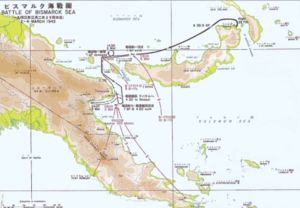
directly to Lae. The plan was understood to be risky, because Allied air power in the area was strong, but it was decided to proceed because otherwise the troops would have to march through inhospitable swamp, mountain and jungle terrain without roads. On 28 February 1943, the convoy—comprising eight destroyer
Destroyer
In naval terminology, a destroyer is a fast and maneuverable yet long-endurance warship intended to escort larger vessels in a fleet, convoy or battle group and defend them against smaller, powerful, short-range attackers. Destroyers, originally called torpedo-boat destroyers in 1892, evolved from...
s and eight troop transports with an escort of approximately 100 fighter
Fighter aircraft
A fighter aircraft is a military aircraft designed primarily for air-to-air combat with other aircraft, as opposed to a bomber, which is designed primarily to attack ground targets...
s—set out from Simpson Harbour
Simpson Harbour
Simpson Harbour is a sheltered harbour of Blanche Bay, on the Gazelle Peninsula in the extreme north of New Britain. The harbour is named after Captain Cortland Simpson who was surveying the bay while in command of in 1872. The former capital city of Rabaul is on its shores.The harbour is a huge...
in Rabaul.
The Allies had detected preparations for the convoy, and naval codebreakers in Melbourne
Melbourne
Melbourne is the capital and most populous city in the state of Victoria, and the second most populous city in Australia. The Melbourne City Centre is the hub of the greater metropolitan area and the Census statistical division—of which "Melbourne" is the common name. As of June 2009, the greater...
and Washington, D.C.
Washington, D.C.
Washington, D.C., formally the District of Columbia and commonly referred to as Washington, "the District", or simply D.C., is the capital of the United States. On July 16, 1790, the United States Congress approved the creation of a permanent national capital as permitted by the U.S. Constitution....
had decrypted and translated messages indicating the convoy's intended destination and date of arrival. The Allied Air Forces had developed a new techniques that they hoped would improve the chances of successful air attack on ships. They detected and shadowed the convoy, which came under sustained air attack on 2–3 March 1943. Follow-up attacks by PT Boats and aircraft were made on 4 March. All eight transports and four of the escorting destroyers were sunk. Out of 6,900 troops who were badly needed in New Guinea, only about 1,200 made it to Lae. Another 2,700 were saved by destroyers and submarines and returned to Rabaul. The Japanese would make no further attempts to reinforce Lae by ship.
Japanese plans
In December 1942, the Japanese Imperial General HeadquartersImperial General Headquarters
The as part of the Supreme War Council was established in 1893 to coordinate efforts between the Imperial Japanese Army and Imperial Japanese Navy during wartime...
decided to reinforce their position in the South West Pacific
South West Pacific theatre of World War II
The South West Pacific Theatre, technically the South West Pacific Area, between 1942 and 1945, was one of two designated area commands and war theatres enumerated by the Combined Chiefs of Staff of World War II in the Pacific region....
by transferring Lieutenant General
Lieutenant General
Lieutenant General is a military rank used in many countries. The rank traces its origins to the Middle Ages where the title of Lieutenant General was held by the second in command on the battlefield, who was normally subordinate to a Captain General....
Jusei Aoki's 20th Division from Korea to Guadalcanal
Guadalcanal
Guadalcanal is a tropical island in the South-Western Pacific. The largest island in the Solomons, it was discovered by the Spanish expedition of Alvaro de Mendaña in 1568...
and Lieutenant General Heisuke Abe
Heisuke Abe
was a senior officer in the Imperial Japanese Army during World War II. He was the Commandant of Cadets at the Komamoto Army Training School between 1934 and 1936, before being posted as the Commanding Officer Noncommissioned Officer Candidates Kwantung Army...
's 41st Division from China. Following the decision to evacuate Guadalcanal
Operation Ke
was the largely successful withdrawal of Japanese forces from Guadalcanal at the conclusion of the Guadalcanal Campaign of World War II. The operation took place between 14 January and 7 February 1943, and involved both army and navy forces under the overall direction of the Japanese Imperial...
, it was decided to send both divisions to Wewak
Wewak
Wewak is the capital of the East Sepik province of Papua New Guinea. It is located on the northern coast of the island of New Guinea. It is the largest town between Madang and Jayapura. It is the see city of the Roman Catholic Diocese of Wewak....
. Most of the 20th Division was landed there from naval high speed transport
High speed transport
High Speed Transports were converted destroyers and destroyer escorts used to support amphibious operations in World War II and afterward. They received the US Hull classification symbol APD; "AP" for transport and "D" for destroyer....
s on 19 January 1943. The bulk of the 41st Division followed on 12 February.
Lieutenant General Hitoshi Imamura
Hitoshi Imamura
-External links:...
's Eighth Area Army and Vice Admiral
Vice Admiral
Vice admiral is a senior naval rank of a three-star flag officer, which is equivalent to lieutenant general in the other uniformed services. A vice admiral is typically senior to a rear admiral and junior to an admiral...
Gunichi Mikawa
Gunichi Mikawa
was a Vice-Admiral in the Imperial Japanese Navy during World War II.Mikawa was the commander of a heavy cruiser force that carried out spectacular I.J.N. victory over the U.S. Navy and the Royal Australian Navy at the Battle of Savo Island in Ironbottom Sound on the night of August 1942. In...
's South East Area Fleet developed a plan to move the command post of the headquarters of the Japanese XVIII Army and the main body of the 51st Division from Rabaul
Rabaul
Rabaul is a township in East New Britain province, Papua New Guinea. The town was the provincial capital and most important settlement in the province until it was destroyed in 1994 by falling ash of a volcanic eruption. During the eruption, ash was sent thousands of metres into the air and the...
to Lae
Lae
Lae, the capital of Morobe Province, is the second-largest city in Papua New Guinea. It is located at the start of the Highlands Highway which is the main land transport corridor from the Highlands region to the coast...
on 3 March, followed by moving the remainder of the 20th Division to Madang on 10 March. The plan was understood to be risky, because Allied air power in the area was strong. In January, the Okabe Detachment had suffered heavy losses in the attempt
Battle of Wau
The Battle of Wau, 29–31 January 1943, was a battle in the New Guinea campaign of World War II. Forces of the Empire of Japan sailed from Rabaul and crossed the Solomon Sea and, despite Allied air attacks, successfully reached Lae, where they disembarked...
, with two ships lost and three damaged, although most of the cargo was delivered. This time, the XVIII Army staff gave the operation a 50–50 chance of success. War games
Military simulation
Military simulations, also known informally as war games, are simulations in which theories of warfare can be tested and refined without the need for actual hostilities. Many professional contemporary analysts object to the term wargames as this is generally taken to be referring to the civilian...
of the operation predicted losses of four of the 10 transports and between 30 and 40 aircraft. On the other hand, if the troops were landed at Madang, they would face a march of over 140 mi (225.3 km) over inhospitable swamp, mountain and jungle terrain without roads.
During the January operation, a course was followed that hugged the south coast of New Britain
New Britain
New Britain, or Niu Briten, is the largest island in the Bismarck Archipelago of Papua New Guinea. It is separated from the island of New Guinea by the Dampier and Vitiaz Straits and from New Ireland by St. George's Channel...
. This had made it easy to provide air cover, but being close to the airfields also made it possible for the Allied Air Forces to attack both the convoy and the airfields at the same time. This time, a route was chosen along the north coast, in the hope that the Allies would be deceived into thinking that the convoy's objective was Madang
Madang
Madang is the capital of Madang Province and is a town with a population of 27,420 on the north coast of Papua New Guinea. It was first settled by the Germans in the 19th century....
. Allied air attacks on the convoy at this point would have to fly over New Britain, allowing easy interdiction from Japanese air bases there, but the final leg of the voyage would be particularly dangerous, because the convoy would have to negotiate the restricted waters of the Vitiaz Strait
Vitiaz Strait
Vitiaz Strait is a strait between New Britain and the Huon Peninsula, northern New Guinea .The Vitiaz Strait was so named by Nicholai Nicholaievich Mikluho-Maklai to commemorate the Russian corvette Vitiaz in which he sailed from October 1870 by way of South America and the Pacific Islands reaching...
.
On 28 February, the convoy—comprising eight destroyer
Destroyer
In naval terminology, a destroyer is a fast and maneuverable yet long-endurance warship intended to escort larger vessels in a fleet, convoy or battle group and defend them against smaller, powerful, short-range attackers. Destroyers, originally called torpedo-boat destroyers in 1892, evolved from...
s and eight troop transports with an escort of approximately 100 fighter
Fighter aircraft
A fighter aircraft is a military aircraft designed primarily for air-to-air combat with other aircraft, as opposed to a bomber, which is designed primarily to attack ground targets...
s—assembled for the task and departed from Simpson Harbour
Simpson Harbour
Simpson Harbour is a sheltered harbour of Blanche Bay, on the Gazelle Peninsula in the extreme north of New Britain. The harbour is named after Captain Cortland Simpson who was surveying the bay while in command of in 1872. The former capital city of Rabaul is on its shores.The harbour is a huge...
in Rabaul. The destroyers carried 958 troops while the transports took 5,954. All the ships were combat loaded
Combat loading
Combat loading is a method of loading cargo into the ships that will carry it to the site of an amphibious landing. It gives primary consideration to the ease and sequence with which troops, equipment, and supplies can be unloaded ready for combat, rather than to the efficient use of cargo...
to expedite unloading at Lae. The commander of the Japanese 18th Army—Lieutenant General Hatazō Adachi
Hatazo Adachi
was a general in the Imperial Japanese Army during World War II.-Early career:Adachi was born into an impoverished samurai family in Ishikawa Prefecture in 1890...
—travelled on the destroyer , while that of the 51st Division—Lieutenant General Hidemitsu Nakano
Hidemitsu Nakano
was a senior officer in the Imperial Japanese Army. He was promoted as the Commanding Officer of the 51st Division in Manchuria on 16 November 1941. He was the commanding officer with the division in China, New Britain and New Guinea.-References:...
—was on board the destroyer . The escort commander—Rear Admiral Masatomi Kimura
Masatomi Kimura
-External links:*****- Notes :...
of the 3rd Destroyer Flotilla—flew his flag from the destroyer . The other five destroyers were , , , and . They escorted seven Army transports: Aiyo Maru (2,716 tons
Gross Register Tonnage
Gross register tonnage a ship's total internal volume expressed in "register tons", one of which equals to a volume of . It is calculated from the total permanently enclosed capacity of the vessel. The ship's net register tonnage is obtained by reducing the volume of non-revenue-earning spaces i.e...
; 7,686 m3), Kembu Maru (950 tons; 2,688 m3), Kyokusei Maru (5,493 tons; 15,545 m3), Oigawa Maru (6,494 tons; 18,378 m3), Shinai Maru (3,793 tons; 10,734 m3), Taimai Maru (2,883 tons; 8,159 m3) and Teiyo Maru (6,870 tons; 19,442 m3). Rounding out the force was the lone Navy transport Najima (8,125 tons; 22,994 m3). All the ships carried troops, equipment and ammunition, except for the Kembu Maru, which carried 1,000 drums of avgas
Avgas
Avgas is an aviation fuel used to power piston-engine aircraft. Avgas is distinguished from mogas , which is the everyday gasoline used in cars and some non-commercial light aircraft...
and 650 drums of other fuel.
Allied intelligence
The Allies soon began detecting signs of preparations for a new convoy. A Japanese floatplaneFloatplane
A floatplane is a type of seaplane, with slender pontoons mounted under the fuselage; only the floats of a floatplane normally come into contact with water, with the fuselage remaining above water...
of the type normally used for anti-submarine patrol
Anti-submarine warfare
Anti-submarine warfare is a branch of naval warfare that uses surface warships, aircraft, or other submarines to find, track and deter, damage or destroy enemy submarines....
s in advance of convoys was sighted on 7 February 1943. The Allied Air Forces South West Pacific Area commander—Lieutenant General
Lieutenant General (United States)
In the United States Army, the United States Air Force and the United States Marine Corps, lieutenant general is a three-star general officer rank, with the pay grade of O-9. Lieutenant general ranks above major general and below general...
George Kenney
George Kenney
George Churchill Kenney was a United States Army Air Forces general during World War II. He was commander of the Allied air forces in the Southwest Pacific Area from August 1942 until 1945.-Early life:...
—ordered an increase in reconnaissance
Aerial reconnaissance
Aerial reconnaissance is reconnaissance that is conducted using unmanned aerial vehicles or reconnaissance aircraft. Their roles are to collect imagery intelligence, signals intelligence and measurement and signature intelligence...
patrols over Rabaul. On 14 February, aerial photographs were taken that showed 79 vessels in port, including 45 merchant ships and six transports. It was clear that another convoy was being prepared, but its destination was not known. However, on 8 February, a coded message was intercepted which naval codebreakers in Melbourne
Melbourne
Melbourne is the capital and most populous city in the state of Victoria, and the second most populous city in Australia. The Melbourne City Centre is the hub of the greater metropolitan area and the Census statistical division—of which "Melbourne" is the common name. As of June 2009, the greater...
and Washington, D.C.
Washington, D.C.
Washington, D.C., formally the District of Columbia and commonly referred to as Washington, "the District", or simply D.C., is the capital of the United States. On July 16, 1790, the United States Congress approved the creation of a permanent national capital as permitted by the U.S. Constitution....
decrypted and translated over the next eight days. This revealed the Japanese intention to land convoys at Wewak, Madang and Lae. Subsequently, codebreakers decrypted a message from the Japanese 11th Air Fleet
Imperial Japanese Navy Air Service
The Imperial Japanese Navy Air Service was the air arm of the Imperial Japanese Navy during World War II, the organization was responsible for the operation of naval aircraft and the conduct of aerial warfare in the Pacific War.It was controlled by the Navy Staff of the Imperial Japanese Navy and...
to the effect that destroyers and six transports would reach Lae about 5 March. Another report indicated that they would reach Lae by 12 March. On 22 February, reconnaissance aircraft reported 59 merchant vessels in the harbour at Rabaul.
Kenney read this Ultra
Ultra
Ultra was the designation adopted by British military intelligence in June 1941 for wartime signals intelligence obtained by "breaking" high-level encrypted enemy radio and teleprinter communications at the Government Code and Cypher School at Bletchley Park. "Ultra" eventually became the standard...
intelligence in the office of the Supreme Allied Commander South West Pacific Area—General
General (United States)
In the United States Army, United States Air Force, and United States Marine Corps, general is a four-star general officer rank, with the pay grade of O-10. General ranks above lieutenant general and below General of the Army or General of the Air Force; the Marine Corps does not have an...
Douglas MacArthur
Douglas MacArthur
General of the Army Douglas MacArthur was an American general and field marshal of the Philippine Army. He was a Chief of Staff of the United States Army during the 1930s and played a prominent role in the Pacific theater during World War II. He received the Medal of Honor for his service in the...
—on 25 February. The prospect of an additional 6,900 Japanese troops in the Lae area greatly disturbed MacArthur, as they might seriously impact upon his plans to capture and develop the area
Operation Cartwheel
Operation Cartwheel was a major military strategy for the Allies in the Pacific theater of World War II. Cartwheel was a twin-axis of advance operation, aimed at militarily neutralizing the major Japanese base at Rabaul...
. Kenney wrote out orders for Brigadier General
Brigadier general (United States)
A brigadier general in the United States Army, Air Force, and Marine Corps, is a one-star general officer, with the pay grade of O-7. Brigadier general ranks above a colonel and below major general. Brigadier general is equivalent to the rank of rear admiral in the other uniformed...
Ennis Whitehead
Ennis Whitehead
Ennis Clement Whitehead was an early United States Army aviator and a United States Army Air Forces general during World War II. Whitehead joined the U. S. Army after the United States entered World War I in 1917...
, the commander of the Advance Echelon (ADVON) of the Fifth Air Force
Fifth Air Force
The Fifth Air Force is a numbered air force of the United States Air Force Pacific Air Forces . It is headquartered at Yokota Air Base, Japan....
in New Guinea, which were sent by courier. He informed Whitehead of the proposed convoy date, and warned him about the usual Japanese pre-convoy air attack. He also urged that flying hours be cut back so as to allow for a large strike on the convoy, and instructed him to move forward as many aircraft as possible so that they could be close to the nearby captured airfields around Dobodura
Dobodura
Dobodura armata is a species of beetle in the family Carabidae, the only species in the genus Dobodura....
, where they would not be subject to the vagaries of weather over the Owen Stanley Range
Owen Stanley Range
Owen Stanley Range is the south-eastern part of the central mountain-chain in Papua New Guinea. It was seen in 1849 by Captain Owen Stanley while surveying the south coast of Papua and named after him. Strictly, the eastern extremity of the range is Mount Victoria , which was climbed by Sir William...
. Kenney flew up to Port Moresby
Port Moresby
Port Moresby , or Pot Mosbi in Tok Pisin, is the capital and largest city of Papua New Guinea . It is located on the shores of the Gulf of Papua, on the southeastern coast of the island of New Guinea, which made it a prime objective for conquest by the Imperial Japanese forces during 1942–43...
on 26 February, where he met with Whitehead. The two generals inspected fighter and bomber units in the area, and agreed to attack the Japanese convoy in the Vitiaz Straits. Kenney returned to Brisbane
Brisbane
Brisbane is the capital and most populous city in the Australian state of Queensland and the third most populous city in Australia. Brisbane's metropolitan area has a population of over 2 million, and the South East Queensland urban conurbation, centred around Brisbane, encompasses a population of...
on 28 February.
Allied tactics
In the South West Pacific, "the air mission was to interdict Japan's sea supply lanes and enable the ground forces to conduct an island-hopping strategy." A conventional strategic bombing campaign was out of the question because industrial targets in Japan were well beyond the range of even the largest strategic bombers operating from bases in Australia and New Guinea. But the results of the effort against the January convoy were very disappointing. Some 416 sorties had been flown with only two ships sunk and three damaged. Clearly, a change of tactics was in order. Group CaptainGroup Captain
Group captain is a senior commissioned rank in the Royal Air Force and the air forces of many other Commonwealth countries. It ranks above wing commander and immediately below air commodore...
Bill Garing
Bill Garing
Air Commodore William "Bill" Henry Garing CBE, DFC, DSC was a senior officer in the Royal Australian Air Force....
, a Royal Australian Air Force
Royal Australian Air Force
The Royal Australian Air Force is the air force branch of the Australian Defence Force. The RAAF was formed in March 1921. It continues the traditions of the Australian Flying Corps , which was formed on 22 October 1912. The RAAF has taken part in many of the 20th century's major conflicts...
(RAAF) officer on Kenney's staff with considerable experience with air-sea operations, including a tour of duty in Europe, recommended that Japanese convoys be subjected to simultaneous attack from different altitudes and directions.
Major
Major
Major is a rank of commissioned officer, with corresponding ranks existing in almost every military in the world.When used unhyphenated, in conjunction with no other indicator of rank, the term refers to the rank just senior to that of an Army captain and just below the rank of lieutenant colonel. ...
Paul I. "Pappy" Gunn
Paul Gunn
Colonel Paul I. "Pappy" Gunn was a former U.S.naval aviator known most for his actions in the Second World War as an officer in the United States Army Air Forces...
and his men at the 81st Depot Repair Squadron in Townsville, Queensland
Townsville, Queensland
Townsville is a city on the north-eastern coast of Australia, in the state of Queensland. Adjacent to the central section of the Great Barrier Reef, it is in the dry tropics region of Queensland. Townsville is Australia's largest urban centre north of the Sunshine Coast, with a 2006 census...
, modified some United States Army Air Force (USAAF) Douglas A-20 Havoc light bombers by installing four 0.5 in (12.7 mm) machine gun
Machine gun
A machine gun is a fully automatic mounted or portable firearm, usually designed to fire rounds in quick succession from an ammunition belt or large-capacity magazine, typically at a rate of several hundred rounds per minute....
s in their noses. Two 450 gallons (1,703.4 l) fuel tanks were added to give the aircraft more range. This was successful, and an attempt was then made to create a longer range attack aircraft by doing the same thing to a North American B-25 Mitchell medium bomber
Medium bomber
A medium bomber is a bomber aircraft designed to operate with medium bombloads over medium distances; the name serves to distinguish them from the larger heavy bombers and smaller light bombers...
to operate as a "commerce destroyer". This proved to be somewhat more difficult. The resulting aircraft was obviously nose heavy despite adding lead ballast to the tail, and the vibrations caused by firing the machine guns were enough to make rivets pop out of the skin of the aircraft. The tail guns and belly turrets were removed, the latter being of little use if the aircraft was flying low.
The Mitchell crews developed a new technique called skip bombing
Skip bombing
Skip bombing was a low-level bombing technique developed by Italian pilot Giuseppe Cenni flying German Junkers Ju 87 Stuka aircraft during attacks on Allied ships off the coast of North Africa, between May and October of 1941...
. Flying only a few dozen feet above the sea toward their targets, they would release their bombs, which would then, ideally, ricochet
Ricochet
A ricochet is a rebound, bounce or skip off a surface, particularly in the case of a projectile. The possibility of ricochet is one of the reasons for the common firearms safety rule "Never shoot at a flat, hard surface."-Variables:...
across the surface of the water and explode at the side of the target ship, under it, or just over it. Another technique was mast height bombing, in which a bomber would approach the target at low altitude, 200 to 500 ft (61 to 152.4 ), at about 265 to 275 mph (118.5 to 122.9 ), and then drop down to mast height, 10 to 15 ft (3 to 4.6 ) about 600 yards (548.6 m) from the target. They would release their bombs at around 300 yards (274.3 m), aiming directly at the side of the ship. The Battle of the Bismarck sea would demonstrate that this was the more successful of the two tactics. However, they were not mutually exclusive. A bomber could drop two bombs, skipping the first and launching the second at mast height. Practice missions were carried out against the SS Pruth, a liner that had run aground in 1923.
The Fifth Air Force had two heavy bomber
Heavy bomber
A heavy bomber is a bomber aircraft of the largest size and load carrying capacity, and usually the longest range.In New START, the term "heavy bomber" is used for two types of bombers:*one with a range greater than 8,000 kilometers...
groups. The 43rd Bombardment Group was equipped with about 55 Boeing B-17 Flying Fortresses. Most of these had seen hard war service over the previous six months and the availability rate was low. The recently arrived 90th Bombardment Group was equipped with Consolidated B-24 Liberators but they too had maintenance problems. There were two medium groups, the 38th Bombardment Group
38th Bombardment Group
The 38th Bombardment Group is an inactive unit of the United States Air Force. It was most recently assigned as the operational component of the 38th Bombardment Wing, stationed at Laon-Couvron Air Base, France, where it was inactivated on 8 December 1957.During World War II the 38th Bomb Group...
, which was equipped with B-25 Mitchells, and the 22d Bombardment Group, which was equipped with Martin B-26 Marauder, but the former was missing two of its four squadrons that had been diverted to the South Pacific Area
South Pacific Area
The South Pacific Area was a multinational U.S.-led military command active during World War II. It was a part of the U.S. Pacific Ocean Areas under Admiral Chester Nimitz.Instructions to the senior U.S...
, and the latter had taken so many losses that it had been withdrawn to Australia to be rebuilt.
There was also a light group, the 3rd Attack Group, which was equipped with a mixture of A-20 Havocs and B25 Mitchells. The 3rd Attack Group was not just short of aircraft; it was critically short of aircrew as well. To make up the numbers the USAAF turned to the RAAF for help. Australian aircrew were assigned to most of the group's aircraft, serving in every role except aircraft commander. In addition to the RAAF aircrew with the USAAF squadrons, there were RAAF units in the Port Moresby area. No. 30 Squadron RAAF
No. 30 Squadron RAAF
No. 30 Squadron is a squadron of the Royal Australian Air Force . Raised in 1942 as a fighter unit, the Squadron saw action in the Second World War and later served in the target towing and surface-to-air missile roles. After a long period of disbandment lasting from the late 1960s, No...
, which had arrived in Port Moresby in September 1942, was equipped with the Australian-made Bristol Beaufighter
Bristol Beaufighter
The Bristol Type 156 Beaufighter, often referred to as simply the Beau, was a British long-range heavy fighter modification of the Bristol Aeroplane Company's earlier Beaufort torpedo bomber design...
. Both the aircraft and the squadron proved adept at low level attacks. Also in the Port Moresby area were two fighter groups, the 35th Fighter Group and the 49th Fighter Group, which were equipped with Bell P-400, Curtiss P-40 Warhawk and Lockheed P-38 Lightning fighters, but only the latter were suitable for long range escort missions.
Battle
The convoy, moving at 7 kn (8.5 mph; 13.7 km/h), was not detected for several days because of two tropical storms which struck the SolomonSolomon Sea
The Solomon Sea is a sea located within the Pacific Ocean. It lies between Papua New Guinea and the Solomon Islands. Many major battles were fought there during World War II.-Extent:...
and Bismarck Sea
Bismarck Sea
The Bismarck Sea lies in the southwestern Pacific Ocean to the north of the island of Papua New Guinea and to the south of the Bismarck Archipelago and Admiralty Islands. Like the Bismarck archipelago, it is named in honour of the German chancellor Otto von Bismarck...
s between 27 February and 1 March. However, at about 15:00 on 1 March, the crew of a patrolling B-24 Liberator heavy bomber spotted the convoy. Eight B-17 Flying Fortresses were sent to the location but failed to locate the convoy.
At dawn on 2 March, a force of six RAAF A-20 Bostons attacked Lae to reduce its ability to provide support. At about 10:00, another Liberator found the convoy. Eight B-17s took off to attack the convoy, followed an hour later by another 20. They found the convoy and attacked with 1000 lb (453.6 kg) bombs from 5000 ft (1,524 m). They claimed to have sunk up to three merchant ships. Kyokusei Maru had sunk and two other transports, Teiyo Maru and Nojima were damaged.
The destroyers Yukikaze and Asagumo plucked 950 survivors of Kyokusei Maru from the water. These two destroyers, being faster than the convoy since its speed was dictated by the slower transports, broke away from the group to disembark the survivors at Lae. The destroyers resumed their escort duties the next day. The convoy—without the troop transport and two destroyers—was attacked again on the evening of 2 March by 11 B-17s, with one transport sustaining minor damage. During the night, PBY Catalina flying boat
Flying boat
A flying boat is a fixed-winged seaplane with a hull, allowing it to land on water. It differs from a float plane as it uses a purpose-designed fuselage which can float, granting the aircraft buoyancy. Flying boats may be stabilized by under-wing floats or by wing-like projections from the fuselage...
s from No. 11 Squadron RAAF
No. 11 Squadron RAAF
No. 11 Squadron is a Royal Australian Air Force maritime patrol squadron based at RAAF Base Edinburgh. It was formed in 1939 and has seen active service in World War II, East Timor, the War on Terrorism and the 2003 Gulf War...
took over the task of shadowing the convoy.

Milne Bay
Milne Bay is a large bay in Milne Bay Province, southeastern Papua New Guinea. The bay is named after Sir Alexander Milne.The area was a site of the Battle of Milne Bay in 1942....
, and eight Bristol Beaufort
Bristol Beaufort
The Bristol Beaufort was a British twin-engined torpedo bomber designed by the Bristol Aeroplane Company, and developed from experience gained designing and building the earlier Blenheim light bomber....
torpedo bomber
Torpedo bomber
A torpedo bomber is a bomber aircraft designed primarily to attack ships with aerial torpedoes which could also carry out conventional bombings. Torpedo bombers existed almost exclusively prior to and during World War II when they were an important element in many famous battles, notably the...
s from No. 100 Squadron RAAF
No. 100 Squadron RAAF
No. 100 Squadron was a Royal Australian Air Force bomber and maritime patrol squadron of World War II. The Squadron was formed in 1942 and was disbanded in 1946.-Squadron history:...
took off from there. However, because of bad weather only two found the convoy, and neither scored any hits.The convoy now rounded the Huon Peninsula, which brought it into clearer conditions. A force of 90 Allied aircraft took off from Port Moresby
Port Moresby
Port Moresby , or Pot Mosbi in Tok Pisin, is the capital and largest city of Papua New Guinea . It is located on the shores of the Gulf of Papua, on the southeastern coast of the island of New Guinea, which made it a prime objective for conquest by the Imperial Japanese forces during 1942–43...
, and headed for Cape Ward Hunt, while 22 A-20 Bostons of No. 22 Squadron RAAF
No. 22 Squadron RAAF
No. 22 Squadron is a Royal Australian Air Force mixed regular and reserve squadron that provides support for the RAAF in the Sydney region. Formed in 1936, the squadron served in Papua New Guinea during the Second World War, and later followed the Pacific war as far as the Philippines...
attacked the Japanese fighter base at Lae, reducing the convoy's air cover. Attacks on the base continued throughout the day.
At 10:00, 13 B-17s reached the convoy and bombed from medium altitude, causing the ships to disperse, and prolonging the journey. They attracted a number of Mitsubishi A6M Zero fighters, which were engaged by the P-38 Lightning escorts. Three Lightnings were shot down. The fighter pilots claimed 15 Zeros destroyed, while the B-17 crews claimed five more. A B-17 broke up in the air, and its crew was forced to take to their parachutes. The Japanese pilot machine-gunned some of the B-17 crew members as they descended and attacked others in the water after they landed.
The 13 Beaufighters from No. 30 Squadron RAAF
No. 30 Squadron RAAF
No. 30 Squadron is a squadron of the Royal Australian Air Force . Raised in 1942 as a fighter unit, the Squadron saw action in the Second World War and later served in the target towing and surface-to-air missile roles. After a long period of disbandment lasting from the late 1960s, No...
approached at low level to give the impression they were Beauforts making another torpedo attack. If the ships turned to face them, the standard procedure in case of a torpedo attack, the Beaufighters maximised the damage they inflicted on the ships' anti-aircraft guns, bridges and crews in strafing runs with their four 20 mm (0.78740157480315 in) nose cannons and six wing-mounted 0.303 in (7.7 mm) machine guns. On board one of the Beaufighters was cameraman Damien Parer
Damien Parer
Damien Peter Parer was an Australian war photographer. He became famous for his war photography of the Second World War, and was killed by Japanese machinegun fire at Peleliu, Palau. He married Elizabeth Marie Cotter on 23 March 1944, and his son, producer Damien Parer, was born after his father...
, who shot dramatic footage of the battle. Immediately afterward, seven B-25s of the USAAF's 38th Bombardment Group
38th Bombardment Group
The 38th Bombardment Group is an inactive unit of the United States Air Force. It was most recently assigned as the operational component of the 38th Bombardment Wing, stationed at Laon-Couvron Air Base, France, where it was inactivated on 8 December 1957.During World War II the 38th Bomb Group...
's 71st Bombardment Squadron
71st Flying Training Squadron
The 71st Tactical Missile Squadron is an inactive United States Air Force unit. It was last assigned to the 485th Tactical Missile Wing, based at Florennes Air Base, Belgium. It was inactivated on 30 September 1989.-History:...
bombed from about 750 m (2,460.6 ft), while six from the 405th Bombardment Squadron
405th Tactical Missile Squadron
The 405th Tactical Missile Squadron is an inactive United States Air Force unit. It was last assigned to the 38th Tactical Missile Wing, based at Sembach Air Base, West Germany. It was inactivated on 25 September 1966.-History:...
attacked at mast height.
Shirayuki was the first ship to be hit, by a combination of strafing and bombing attacks. Almost all the men on the bridge became casualties, including Kimura, who was wounded. One bomb hit started a magazine explosion that caused the stern to break off, and the ship to sink. Her crew was transferred to Shikinami, and Shirayuki was scuttled. The destroyer Tokitsukaze was also hit and fatally damaged, and later sank. Its crew was taken off by Yukikaze. The destroyer Arashio was hit, and collided with the transport Nojima, disabling her. Both the destroyer and the transport were abandoned, and Nojima was later sunk by an air attack.
Fourteen B-25s returned that afternoon, reportedly claiming 17 hits or near misses. By this time, a third of the transports were sunk or sinking. As the Beaufighters and B-25s had expended their munitions, some USAAF A-20 Havocs of the 3rd Attack Group joined in. Another five hits were claimed by B-17s of the 43rd Bombardment Group from higher altitudes. During the afternoon, further attacks from USAAF B-25s and Bostons of No. 22 Squadron RAAF followed.
All seven of the transports were hit and most were burning or sinking about 100 km (54 nmi; 62.1 mi) south east of Finschhafen
Finschhafen
Finschhafen is a district on the northeast coast of the Morobe province of Papua New Guinea. It is named after the port of the same name.The port was discovered in 1884 by the German researcher Otto Finsch. In 1885 the German colony of German New Guinea created a town on the site and named it...
, along with the destroyers Shirayuki, Tokitsukaze and Arashio. Four of the destroyers—Shikinami, Yukikaze, Uranami and Asagumo—picked up as many survivors as possible and then retired to Rabaul, accompanied by the destroyer , which had come from Rabaul to assist. That night, a force of 10 U.S. Navy PT boat
PT boat
PT Boats were a variety of motor torpedo boat , a small, fast vessel used by the United States Navy in World War II to attack larger surface ships. The PT boat squadrons were nicknamed "the mosquito fleet". The Japanese called them "Devil Boats".The original pre–World War I torpedo boats were...
s—under the command of Lieutenant Commander
Lieutenant commander (United States)
Lieutenant commander is a mid-ranking officer rank in the United States Navy, the United States Coast Guard, the United States Public Health Service Commissioned Corps, and the National Oceanic and Atmospheric Administration Commissioned Corps, with the pay grade of O-4 and NATO rank code OF-3...
Barry Atkins—set out to attack the convoy. Two boats struck submerged debris and were forced to return. The other eight arrived off Lae in the early hours of 4 March. Atkins spotted a fire that turned out to be the transport Oigawa Maru. PT-143 and PT-150 fired torpedoes at it, sinking the crippled vessel. In the morning, a fifth destroyer——was sunk when a B-17 hit her with a 500 lb (226.8 kg) bomb while she was picking up survivors from Arashio.
Some 2,700 survivors were taken to Rabaul by the destroyers. On 4 March, another 1,000 or so survivors were adrift on rafts. On the evenings of 3–5 March, Allied patrol boat
Patrol boat
A patrol boat is a relatively small naval vessel generally designed for coastal defense duties.There have been many designs for patrol boats. They may be operated by a nation's navy, coast guard, or police force, and may be intended for marine and/or estuarine or river environments...
s and planes attacked Japanese rescue vessels, as well as the survivors from the sunken vessels on life rafts and swimming or floating in the sea. This was later justified on the grounds that rescued servicemen would have been rapidly landed at their military destination and promptly returned to active service. On 6 March, the Japanese submarines and picked up 170 of them. Two days later, I-26 found another 54 and put them ashore at Lae. Hundreds made their way to various islands. One band of 18 landed on Kiriwina
Kiriwina
Kiriwina is the largest of the Trobriand Islands, with an area of 290.5 km². It is part of the Milne Bay Province of Papua New Guinea. Most of the 12,000 people who live in the Trobriands live on Kiriwina. The Kilivila language, also known as Kiriwina, is spoken on the island...
, where it was captured by PT-114. Another made its way to Guadalcanal, only to be killed by an American patrol.
Aftermath
The battle was a disaster for the Japanese. Out of 6,900 troops who were badly needed in New Guinea, only about 1,200 made it to Lae. Another 2,700 were saved by destroyers and submarines and returned to Rabaul. About 2,890 Japanese soldiers and sailors were killed. The Allies lost 13 aircrew killed and eight wounded. Aircraft losses were one B-17 and three P-38s in combat, and one B-25 and one Beaufighter in accidents. Due to miscounting of the Japanese force, MacArthur issued a communiqué on 7 March claiming that 22 ships, which included 12 transports, three cruisers and seven destroyers, had been sunk along with 12,792 troops. Army Air Force Headquarters in Washington, D.C., looked into the matter in mid-1943 and concluded that there were only 16 ships involved. However, GHQ SWPA elected to stick to its original story. After the war, Kenney would repeat the claim.There was no doubt that the Japanese had suffered a major defeat. Imamura's chief of staff flew to Imperial General Headquarters to report on the disaster. It was decided that there would be no more attempts to land troops at Lae. The losses incurred in the Bismarck Sea caused grave concern for the security of Lae and Rabaul. This resulted in a change of strategy. On 25 March a joint Army-Navy Central Agreement on South West Area Operations gave operations in New Guinea priority over those in the Solomon Islands campaign
Solomon Islands campaign
The Solomon Islands campaign was a major campaign of the Pacific War of World War II. The campaign began with Japanese landings and occupation of several areas in the British Solomon Islands and Bougainville, in the Territory of New Guinea, during the first six months of 1942...
. The XVIII Army was allocated additional shipping, ordnance and anti-aircraft units, which were sent to Wewak or Hansa Bay.
The planned movement of the 20th Division to Madang was revised in the light of what had occurred in the Bismarck Sea. The operation was postponed for two days, and the destination was altered from Madang to Hansa Bay
Hansa Bay
Hansa Bay is a bay located on the north coast of Papua New Guinea, in Madang Province, between Madang and Wewak, north east of Bogia.- World War II history :...
further west. To reduce the Allied air threat, the Allied airfield at Wau was bombed on 9 March, and that at Dobodura on 11 March. Three Allied aircraft were destroyed on the ground, and one P-40 was lost in the air, but the Allied fighters claimed to have shot down nine Japanese planes. The transports reached Hansa Bay unscathed on 12 March, and the troops made their way down to Madang on foot or in barges. The 20th Division then became involved in a attempt to construct a road from Madang to Lae through the Ramu and Markham Valley
Markham Valley
Markham Valley is a geographical area in New Guinea. It is described as "Flatter than a pancake for miles and miles in all directions, until it runs into the mountains that surround it on three sides" and "Always hot, and usually bone dry." The Highlands Highway runs through the valley. The Markham...
s. Ordered back in January, it now received a increased urgency. The 20th Division would toil on the road for the next few months, but its efforts would ultimately be frustrated by New Guinea's weather and the rugged Finisterre Range
Finisterre Range
Finisterre Range is a mountain range in north-eastern Papua New Guinea, at . The unnamed highest point of the range , which is ranked 45th in the world by prominence, is usually quoted at 4,175 m, but SRTM data suggests that it is nearer to 4,120 m...
.
Some submarines were made available for supply runs to Lae, but they did not have the required capacity to support the troops there by themselves. An operation was carried out on 29 March in which four destroyers successfully delivered 800 troops to Finschhafen
Finschhafen
Finschhafen is a district on the northeast coast of the Morobe province of Papua New Guinea. It is named after the port of the same name.The port was discovered in 1884 by the German researcher Otto Finsch. In 1885 the German colony of German New Guinea created a town on the site and named it...
, but the growing threat from Allied aircraft led to the development of a routes along the coast of New Guinea from Madang to Finschhafen, and along both the north and south coasts New Britain to Finschhafen, and thence to Lae using Army landing craft. It was by this means that the 51st Division finally made the trip to Lae in May.
In April, Admiral
Admiral
Admiral is the rank, or part of the name of the ranks, of the highest naval officers. It is usually considered a full admiral and above vice admiral and below admiral of the fleet . It is usually abbreviated to "Adm" or "ADM"...
Isoroku Yamamoto
Isoroku Yamamoto
was a Japanese Naval Marshal General and the commander-in-chief of the Combined Fleet during World War II, a graduate of the Imperial Japanese Naval Academy and a student of Harvard University ....
used the additional air resources allocated to Rabaul in Operation I-Go
Operation I-Go
was an aerial counter-offensive launched by Imperial Japanese forces against Allied forces during the Solomon Islands and New Guinea Campaigns in the Pacific Theater of World War II from 1–16 April 1943...
, an air offensive designed to redress the situation by destroying Allied ships and aircraft in New Guinea and the Solomon Islands. The operation was indecisive, and Yamamoto would himself become a casualty of Allied intelligence and air power.
External links
- Bismarck Convoy Smashed! Incorporates film of the battle by Damien Parer.