
Home      Discussion      Topics      Dictionary      Almanac
Signup       Login
Battle of Tippecanoe

Battle of Tippecanoe

Overview
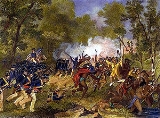
The Battle of Tippecanoe (icon ) was fought on November 7, 1811, between United States forces led by Governor William Henry Harrison
William Henry Harrison
William Henry Harrison was the ninth President of the United States , an American military officer and politician, and the first president to die in office. He was 68 years, 23 days old when elected, the oldest president elected until Ronald Reagan in 1980, and last President to be born before the...

 of the Indiana Territory
Indiana Territory
The Territory of Indiana was an organized incorporated territory of the United States that existed from July 4, 1800, until November 7, 1816, when the southern portion of the territory was admitted to the Union as the state of Indiana....

 and Native American
Native Americans in the United States
Native Americans in the United States are the indigenous peoples in North America within the boundaries of the present-day continental United States, parts of Alaska, and the island state of Hawaii. They are composed of numerous, distinct tribes, states, and ethnic groups, many of which survive as...

 warriors associated with the Shawnee
Shawnee
The Shawnee, Shaawanwaki, Shaawanooki and Shaawanowi lenaweeki, are an Algonquian-speaking people native to North America. Historically they inhabited the areas of Ohio, Virginia, West Virginia, Western Maryland, Kentucky, Indiana, and Pennsylvania...

 leader Tecumseh
Tecumseh
Tecumseh was a Native American leader of the Shawnee and a large tribal confederacy which opposed the United States during Tecumseh's War and the War of 1812...

. Tecumseh and his brother Tenskwatawa
Tenskwatawa
Tenskwatawa, was a Native American religious and political leader of the Shawnee tribe, known as The Prophet or the Shawnee Prophet. He was the brother of Tecumseh, leader of the Shawnee...

 ("The Prophet") were leaders of a confederacy of Native Americans from various tribes that opposed U.S. expansion into Native territory. As tensions and violence increased, Governor Harrison marched with an army of about 1,000 men to disperse the confederacy's headquarters at Prophetstown
Prophetstown State Park
Prophetstown State Park, named after Tenskwatawa , a religious leader and younger brother of Shawnee leader Tecumseh, is located near the town of Battle Ground, Indiana, about a mile east of the site of the Battle of Tippecanoe. Established in 2004, it is Indiana’s newest state park...

, near the confluence of the Tippecanoe
Tippecanoe River
The Tippecanoe River is a gentle, river in northern Indiana that flows from Big Lake in Noble County to the Wabash River near Battle Ground, about northeast of Lafayette. The name "Tippecanoe" comes from a Miami-Illinois word for buffalo fish, reconstructed as */kiteepihkwana/.The Tippecanoe...

 and Wabash
Wabash River
The Wabash River is a river in the Midwestern United States that flows southwest from northwest Ohio near Fort Recovery across northern Indiana to southern Illinois, where it forms the Illinois-Indiana border before draining into the Ohio River, of which it is the largest northern tributary...

 Rivers.
Discussion
Ask a question about 'Battle of Tippecanoe'
Start a new discussion about 'Battle of Tippecanoe'
Answer questions from other users
Full Discussion Forum
 
Unanswered Questions
Encyclopedia
The Battle of Tippecanoe (icon ) was fought on November 7, 1811, between United States forces led by Governor William Henry Harrison
William Henry Harrison
William Henry Harrison was the ninth President of the United States , an American military officer and politician, and the first president to die in office. He was 68 years, 23 days old when elected, the oldest president elected until Ronald Reagan in 1980, and last President to be born before the...

 of the Indiana Territory
Indiana Territory
The Territory of Indiana was an organized incorporated territory of the United States that existed from July 4, 1800, until November 7, 1816, when the southern portion of the territory was admitted to the Union as the state of Indiana....

 and Native American
Native Americans in the United States
Native Americans in the United States are the indigenous peoples in North America within the boundaries of the present-day continental United States, parts of Alaska, and the island state of Hawaii. They are composed of numerous, distinct tribes, states, and ethnic groups, many of which survive as...

 warriors associated with the Shawnee
Shawnee
The Shawnee, Shaawanwaki, Shaawanooki and Shaawanowi lenaweeki, are an Algonquian-speaking people native to North America. Historically they inhabited the areas of Ohio, Virginia, West Virginia, Western Maryland, Kentucky, Indiana, and Pennsylvania...

 leader Tecumseh
Tecumseh
Tecumseh was a Native American leader of the Shawnee and a large tribal confederacy which opposed the United States during Tecumseh's War and the War of 1812...

. Tecumseh and his brother Tenskwatawa
Tenskwatawa
Tenskwatawa, was a Native American religious and political leader of the Shawnee tribe, known as The Prophet or the Shawnee Prophet. He was the brother of Tecumseh, leader of the Shawnee...

 ("The Prophet") were leaders of a confederacy of Native Americans from various tribes that opposed U.S. expansion into Native territory. As tensions and violence increased, Governor Harrison marched with an army of about 1,000 men to disperse the confederacy's headquarters at Prophetstown
Prophetstown State Park
Prophetstown State Park, named after Tenskwatawa , a religious leader and younger brother of Shawnee leader Tecumseh, is located near the town of Battle Ground, Indiana, about a mile east of the site of the Battle of Tippecanoe. Established in 2004, it is Indiana’s newest state park...

, near the confluence of the Tippecanoe
Tippecanoe River
The Tippecanoe River is a gentle, river in northern Indiana that flows from Big Lake in Noble County to the Wabash River near Battle Ground, about northeast of Lafayette. The name "Tippecanoe" comes from a Miami-Illinois word for buffalo fish, reconstructed as */kiteepihkwana/.The Tippecanoe...

 and Wabash
Wabash River
The Wabash River is a river in the Midwestern United States that flows southwest from northwest Ohio near Fort Recovery across northern Indiana to southern Illinois, where it forms the Illinois-Indiana border before draining into the Ohio River, of which it is the largest northern tributary...

 Rivers.

Tecumseh, not yet ready to oppose the United States by force, was away recruiting allies when Harrison's army arrived. Tenskwatawa, a spiritual leader but not a military man, was in charge. Harrison camped near Prophetstown on November 6 and arranged to meet with Tenskwatawa the following day. Early the next morning, warriors from Prophetstown attacked Harrison's army. Although the outnumbered attackers took Harrison's army by surprise, Harrison and his men stood their ground for more than two hours. The Natives were ultimately repulsed when their ammunition ran low. After the battle, the Natives abandoned Prophetstown. Harrison's men burned the town and returned home.

Harrison, having accomplished his goal of destroying Prophetstown, proclaimed that he had won a decisive victory. He acquired the nickname "Tippecanoe", which was popularized in the song '"Tippecanoe and Tyler too
Tippecanoe and Tyler too
"Tippecanoe and Tyler too", originally published as "Tip and Ty", was a very popular and influential campaign song of the Whig Party's colorful Log Cabin Campaign in the 1840 United States presidential election...

" during the election of 1840
United States presidential election, 1840
The United States presidential election of 1840 saw President Martin Van Buren fight for re-election against an economic depression and a Whig Party unified for the first time behind war hero William Henry Harrison and his "log cabin campaign"...

, when Harrison was elected U.S, president
President of the United States
The President of the United States of America is the head of state and head of government of the United States. The president leads the executive branch of the federal government and is the commander-in-chief of the United States Armed Forces....

. But some of Harrison's contemporaries, as well as some subsequent historians, raised doubts about whether the expedition had been much of a success. Although the defeat was a setback for Tecumseh's confederacy, the Natives soon rebuilt Prophetstown, and frontier violence actually increased after the battle.

Public opinion in the United States blamed the violence on British
United Kingdom of Great Britain and Ireland
The United Kingdom of Great Britain and Ireland was the formal name of the United Kingdom during the period when what is now the Republic of Ireland formed a part of it....

 interference. This suspicion led to further deterioration of U.S. relations with Great Britain and served as a catalyst of the War of 1812
War of 1812
The War of 1812 was a military conflict fought between the forces of the United States of America and those of the British Empire. The Americans declared war in 1812 for several reasons, including trade restrictions because of Britain's ongoing war with France, impressment of American merchant...

, which began six months later. By the time the U.S. declared war on Great Britain, Tecumseh's confederacy was ready to launch its war against the United States and embrace an alliance with the British.

Background


After being appointed governor of the newly formed Indiana Territory
Indiana Territory
The Territory of Indiana was an organized incorporated territory of the United States that existed from July 4, 1800, until November 7, 1816, when the southern portion of the territory was admitted to the Union as the state of Indiana....

 in 1800, William Henry Harrison
William Henry Harrison
William Henry Harrison was the ninth President of the United States , an American military officer and politician, and the first president to die in office. He was 68 years, 23 days old when elected, the oldest president elected until Ronald Reagan in 1980, and last President to be born before the...

 sought to secure title to Native American lands to open more land for settlers; in particular, he hoped the Indiana Territory would attract enough settlers to qualify for statehood. Harrison negotiated numerous land cession treaties with American Indians, including the Treaty of Fort Wayne on September 30, 1809, in which Miami, Pottawatomie, Lenape
Lenape
The Lenape are an Algonquian group of Native Americans of the Northeastern Woodlands. They are also called Delaware Indians. As a result of the American Revolutionary War and later Indian removals from the eastern United States, today the main groups live in Canada, where they are enrolled in the...

, and other tribal leaders sold 3,000,000 acres (approximately 12,000 km²) to the United States.

Tenskwatawa
Tenskwatawa
Tenskwatawa, was a Native American religious and political leader of the Shawnee tribe, known as The Prophet or the Shawnee Prophet. He was the brother of Tecumseh, leader of the Shawnee...

, known as the Prophet, had been leading a religious movement among the northwestern tribes, calling for a return to the ancestral ways. His brother, Tecumseh
Tecumseh
Tecumseh was a Native American leader of the Shawnee and a large tribal confederacy which opposed the United States during Tecumseh's War and the War of 1812...

, was outraged by the Treaty of Fort Wayne, and thereafter emerged as a prominent leader. Tecumseh revived an idea advocated in previous years by the Shawnee
Shawnee
The Shawnee, Shaawanwaki, Shaawanooki and Shaawanowi lenaweeki, are an Algonquian-speaking people native to North America. Historically they inhabited the areas of Ohio, Virginia, West Virginia, Western Maryland, Kentucky, Indiana, and Pennsylvania...

 leader Blue Jacket
Blue Jacket
Blue Jacket or Weyapiersenwah was a war chief of the Shawnee people, known for his militant defense of Shawnee lands in the Ohio Country...

 and the Mohawk
Mohawk nation
Mohawk are the most easterly tribe of the Iroquois confederation. They call themselves Kanien'gehaga, people of the place of the flint...

 leader Joseph Brant
Joseph Brant
Thayendanegea or Joseph Brant was a Mohawk military and political leader, based in present-day New York, who was closely associated with Great Britain during and after the American Revolution. He was perhaps the most well-known American Indian of his generation...

, which stated that Native American land was owned in common by all tribes, and land could not be sold without agreement by all the tribes. Not yet ready to confront the United States directly, Tecumseh's primary adversaries were initially the Native American leaders who had signed the treaty. He began by intimidating them and threatening to kill anyone who carried out the terms of the treaty. Tecumseh began to travel widely, urging warriors to abandon the accommodationist chiefs and to join the resistance at Prophetstown. Tecumseh insisted that the Fort Wayne treaty was illegitimate. In an 1810 meeting with Harrison, he demanded that Harrison nullify the treaty and warned that settlers should not attempt to settle the lands sold in the treaty. Harrison rejected his demands and insisted that the tribes could have individual relations with the United States.

In the meeting Tecumseh warned Harrison that he would seek an alliance with the British
Great Britain
Great Britain or Britain is an island situated to the northwest of Continental Europe. It is the ninth largest island in the world, and the largest European island, as well as the largest of the British Isles...

 if hostilities broke out. Tensions between the United States and Britain had been high for several months as a result of British interference in U.S. commerce
Origins of the War of 1812
The War of 1812, between the United States of America and the British Empire , and Britain's Indian allies, lasted from 1812 to 1815. It was fought chiefly on the Atlantic Ocean and on the land, coasts and waterways of North America.There were several immediate stated causes for the U.S...

 with France. As early as 1810, British agents had sought to secure an alliance with Native Americans to assist in the defense of Canada
Canada
Canada is a North American country consisting of ten provinces and three territories. Located in the northern part of the continent, it extends from the Atlantic Ocean in the east to the Pacific Ocean in the west, and northward into the Arctic Ocean...

 should hostilities break out, but the Natives had been reluctant to accept their offer, fearing they had little to benefit from such an arrangement.

In August 1811, Tecumseh again met with Harrison at Vincennes
Vincennes, Indiana
Vincennes is a city in and the county seat of Knox County, Indiana, United States. It is located on the Wabash River in the southwestern part of the state. The population was 18,701 at the 2000 census...

, where Tecumseh assured Harrison that the Shawnee brothers meant to remain at peace with the United States. Tecumseh then traveled to the south on a mission to recruit allies among the "Five Civilized Tribes
Five Civilized Tribes
The Five Civilized Tribes were the five Native American nations—the Cherokee, Chickasaw, Choctaw, Creek, and Seminole—that were considered civilized by Anglo-European settlers during the colonial and early federal period because they adopted many of the colonists' customs and had generally good...

". Most of the southern nations rejected his appeals, but a faction of the Creeks
Creek people
The Muscogee , also known as the Creek or Creeks, are a Native American people traditionally from the southeastern United States. Mvskoke is their name in traditional spelling. The modern Muscogee live primarily in Oklahoma, Alabama, Georgia, and Florida...

, who came to be known as the Red Sticks
Red Sticks
Red Sticks is the English term for a traditionalist faction of Creek Indians who led a resistance movement which culminated in the outbreak of the Creek War in 1813....

, answered his call to arms, leading to the Creek War
Creek War
The Creek War , also known as the Red Stick War and the Creek Civil War, began as a civil war within the Creek nation...

, which also became a part of the War of 1812.
Harrison left the territory for business in Kentucky
Kentucky
The Commonwealth of Kentucky is a state located in the East Central United States of America. As classified by the United States Census Bureau, Kentucky is a Southern state, more specifically in the East South Central region. Kentucky is one of four U.S. states constituted as a commonwealth...

 shortly after the meeting with Tecumseh, leaving secretary John Gibson
John Gibson (Indiana)
John Gibson was a veteran of the French and Indian War, Lord Dunmore's War, the American Revolutionary War, Tecumseh's War, and the War of 1812. A delegate to the first Pennsylvania constitutional convention in 1790, and a merchant, he earned a reputation as a frontier leader and had good...

 as acting governor. Gibson, who had lived among the Miami tribe for many years, was quick to learn of Tecumseh's plans for war and immediately called out the territory's militia and sent emergency letters calling for the return of Harrison. By mid-September, most of the militia regiments had formed. By then, Harrison had returned, accompanied by a small force of army regulars, and had taken command of the militia. Harrison had already been in communication with his superiors in Washington, D.C.
Washington, D.C.
Washington, D.C., formally the District of Columbia and commonly referred to as Washington, "the District", or simply D.C., is the capital of the United States. On July 16, 1790, the United States Congress approved the creation of a permanent national capital as permitted by the U.S. Constitution....

, and he had been authorized to march against the confederacy in a show of force, hoping that they would accept peace.

Harrison gathered the scattered militia companies at Fort Knox near a settlement on Maria Creek, north of Vincennes; There he was joined by the sixty-man company called the Yellow Jackets
Yellow Jackets (Indiana)
The Yellow Jackets were a mounted militia company from Harrison County in the Indiana Territory. The company numbered sixty men and officers and saw action as part of the expeditionary force dispatched to put down the American Indian uprising during Tecumseh's War...

, so named for their bright yellow coats, from Corydon, Indiana
Corydon, Indiana
Corydon is a town in Harrison Township, Harrison County, Indiana, United States, founded in 1808, and is known as Indiana's First State Capital. After Vincennes, Corydon was the second capital of the Indiana Territory from May 1, 1813, until December 11, 1816. After statehood, the town was the...

, as well as the Indiana Rangers
Indiana Rangers
The Indiana Rangers were a mounted militia formed in 1807 and operated in the early part of the 19th century to defend settlers in Indiana Territory from attacks by Native Americans. The rangers were present at the Battle of Tippecanoe, and served as auxiliaries to the army during the War of 1812...

.The Indiana Rangers
Indiana Rangers
The Indiana Rangers were a mounted militia formed in 1807 and operated in the early part of the 19th century to defend settlers in Indiana Territory from attacks by Native Americans. The rangers were present at the Battle of Tippecanoe, and served as auxiliaries to the army during the War of 1812...

 had been formed in the early days of the territory to protect the settlers from raids by the Native Americans, but had seen little action in the previous five years.
From there the entire force of about 1000 men set out northward towards Prophetstown. The force consisted of about 250 army regulars from the 4th US Infantry Regiment, 100 Kentucky volunteers, and near 600 Indiana militia including two companies of the Indiana Rangers. The army reached the site of modern Terre Haute, Indiana
Terre Haute, Indiana
Terre Haute is a city and the county seat of Vigo County, Indiana, United States, near the state's western border with Illinois. As of the 2010 census, the city had a total population of 60,785 and its metropolitan area had a population of 170,943. The city is the county seat of Vigo County and...

, on October 3 where they camped and built Fort Harrison
Battle of Fort Harrison
The Siege of Fort Harrison was an engagement that lasted from 4 September–15 September 1812. The first American land victory during the War of 1812, it was won by an outnumbered United States force garrisoned inside the fort against a combined Native American force near modern Terre Haute,...

 while they waited for supplies to be delivered. A scouting party of Yellow Jackets was ambushed by Native Americans on October 10 causing several casualties and preventing the men from continuing to forage. Supplies quickly began to run low. By October 19, rations were cut and remained so until October 28 when fresh supplies arrived via the Wabash River
Wabash River
The Wabash River is a river in the Midwestern United States that flows southwest from northwest Ohio near Fort Recovery across northern Indiana to southern Illinois, where it forms the Illinois-Indiana border before draining into the Ohio River, of which it is the largest northern tributary...

 from Vincennes. With the army resupplied, Harrison resumed his advance to Prophetstown on October 29.

Battle


As Harrison's forces approached Prophetstown late on November 6, they were met by one of Tenskwatawa's followers waving a white flag. He carried a message from Tenskwatawa, requesting a ceasefire until the next day when the two sides could hold a peaceful meeting. Harrison agreed to a meeting, but was wary of Tenskwatawa's overture, believing that the negotiations would be futile. Harrison moved his army to a nearby hill near the confluence of the Wabash and Tippecanoe River
Tippecanoe River
The Tippecanoe River is a gentle, river in northern Indiana that flows from Big Lake in Noble County to the Wabash River near Battle Ground, about northeast of Lafayette. The name "Tippecanoe" comes from a Miami-Illinois word for buffalo fish, reconstructed as */kiteepihkwana/.The Tippecanoe...

s. There he camped his men in battle array, and kept sentinels
Sentry
Sentry may refer to:*Sentry, a guard at a gate or other point of passage − see General Orders for Sentries*Sentry , Autonomous underwater vehicle used to measure deep-ocean data...

 on duty during the night.


On the west side of the hill on which he encamped was a shallow creek (Burnett Creek), and on the east side a very steep embankment. Because of the nature of the position, Harrison did not order any temporary works to be created around the position as was ordinarily done by encamped armies. The Yellow Jacket company, with Captain Spier Spencer
Spier Spencer
Captain Spier Spencer was an Indiana militia officer who commanded a company of mounted riflemen known as the Yellow Jackets at the Battle of Tippecanoe. Spencer County, Indiana was named in his honor....

 in command, was posted on the southern end of the camp perimeter. The rest of the militia formed a rectangular formation along the edges of the bluff surrounding the camp. Colonel Davis Floyd
Davis Floyd
Davis Floyd was an Indiana Jeffersonian Republican politician who was convicted of aiding American Vice President Aaron Burr in the Burr conspiracy. Floyd was not convicted of treason however and returned to public life after several years working to redeem his reputation...

 commanded the militia units guarding the steep bluff on the eastern side of the formation. The regulars, commanded by Major Rodd, and the dragoons, commanded by Maj. Joseph Daviess and former congressman Capt. Benjamin Parke
Benjamin Parke
Benjamin Parke was a 19th-century American soldier and politician in the Indiana Territory and later state of Indiana.-Biography:...

, were kept behind the main line in reserve.

In an 1816 conversation with Lewis Cass
Lewis Cass
Lewis Cass was an American military officer and politician. During his long political career, Cass served as a governor of the Michigan Territory, an American ambassador, a U.S. Senator representing Michigan, and co-founder as well as first Masonic Grand Master of the Grand Lodge of Michigan...

, the Governor of Michigan
Governor of Michigan
The Governor of Michigan is the chief executive of the U.S. State of Michigan. The current Governor is Rick Snyder, a member of the Republican Party.-Gubernatorial elections and term of office:...

, Tenskwatawa denied that he ordered his warriors to attack Harrison, and blamed the Winnebago
Ho-Chunk
The Ho-Chunk, also known as Winnebago, are a tribe of Native Americans, native to what is now Wisconsin and Illinois. There are two federally recognized Ho-Chunk tribes, the Ho-Chunk Nation of Wisconsin and Winnebago Tribe of Nebraska....

s in his camp for launching the attack. Other accounts also point to the Winnebago as the responsible party for encouraging the attack and suggest that Tenskwatawa was unable to control his followers as panic set in. Tenskwatawa's followers were worried by the nearby army and feared an imminent attack. They had begun to fortify the town, but the defenses were not yet completed. During the evening, Tenskwatawa consulted with the spirits and decided that sending a party to murder Harrison in his tent was the best way to avoid a battle. He assured the warriors that he would cast spells that would prevent them from being harmed and confuse Harrison's army so they would not resist. The warriors then moved out and began to surround Harrison's army looking for a way to sneak into the camp. Ben, an African-American wagon driver traveling with Harrison's army, had deserted to the Shawnee during the expedition. He agreed to lead a small group of warriors through the line to Harrison's tent. During the late night hours, he was captured by the camp sentries, taken back to the camp and bound. He was later convicted of treason but pardoned by Harrison.

Although existing accounts are unclear about exactly how the battle began, Harrison's sentinels encountered advancing warriors in the pre-dawn hours of November 7. Around 4:30 a.m., the soldiers awoke to scattered gunshots and discovered themselves almost encircled by Tenskwatawa's forces. Contact was first made on the northern end of the perimeter, but the movement was probably intended as a diversion. Shortly after the first shots, fierce fighting broke out on the opposite end of the perimeter as the warriors charged Harrison's line on the southern corner. The attack took the army by surprise as the warriors shouted war calls and rushed the defenders. Spencer was among the first to be killed, being shot in each thigh. Governor Harrison later recorded his death in a dispatch to Washington saying,
"... Spencer was wounded in the head. He exhorted his men to fight valiantly. He was shot through both thighs and fell; still continuing to encourage them, he was raised up, and received [another] ball through his body, which put an immediate end to his existence." Spencer County, Indiana
Spencer County, Indiana
As of the census of 2000, there were 20,391 people, 7,569 households, and 5,752 families residing in the county. The population density was 51 people per square mile . There were 8,333 housing units at an average density of 21 per square mile...

 was later named in honor of Capt.Spier Spencer
Spier Spencer
Captain Spier Spencer was an Indiana militia officer who commanded a company of mounted riflemen known as the Yellow Jackets at the Battle of Tippecanoe. Spencer County, Indiana was named in his honor....

 for his sacrifice in the battle.


Lieutenants McMahan and Berry, the other two Yellow Jacket commanding officers, were also soon wounded and killed. Without leadership, the Yellow Jackets began to fall back from the main line, retreating with the sentinels. The warriors followed the retreating unit and entered the camp. The soldiers regrouped under the command of future United States Senator, ensign John Tipton
John Tipton
John Shields Tipton was an American politician.Tipton was born in what is now Sevier County, Tennessee. His father was killed by Native Americans. His great uncle, also named John, was a prominent man in the area...

, and with the help of two reserve companies under the command of Captain Rodd, repulsed the warriors and sealed the breach in the line.

The second charge by the Native Americans targeted both the north and south ends of the camp, with the far southern end again being the hardest hit. Over half of Harrison's casualties were suffered among the companies on the southern end, including Captain Spencer and five other men in his company, and seven other men in the adjoining company.Jacob Warrick
Jacob Warrick
Jacob Warrick was an Indiana militia leader.Jacob Warrick was born at Warrick's Station, in present-day Greenbrier County, West Virginia, the son of John Warrick, who fought at the Battle of Point Pleasant, in Lord Dunmore's War in 1774. Jacob Warrick moved on to Nicholas County, Kentucky.In 1795,...

, the captain of the adjoining company was also killed in the charge; Warrick County, Indiana
Warrick County, Indiana
As of the census of 2000, there were 52,383 people, 19,438 households, and 15,181 families residing in the county. The population density was 136 people per square mile . There were 20,546 housing units at an average density of 54 per square mile...

 was named in his honor.
With the regulars reinforcing that critical section of the line, and the surprise over, the men were able to hold their position as the attacks continued. On the northern end of the camp, Major Daviess led the dragoons on a counter charge that punched through the Native Americans' line before being repulsed. Most of Daviess's company retreated back to Harrison's main line, but Daviess himself was killed.Daviess County, Indiana
Daviess County, Indiana
Daviess County is a county located in the U.S. state of Indiana. As of 2010, the population was 31,648. The county seat is Washington. Daviess County switched to the Central Time Zone on April 2, 2006. It has returned to the Eastern Time Zone as of November 4, 2007.- History :Daviess County was...

 was later named in honor of Maj. Joseph Daviess's sacrifice at the battle.
Throughout the next hour Harrison's troops fought off several more charges. When the warriors began to run low on ammunition and the sun rose, revealing the small size of Tenskwatawa's army, the Indian forces finally began to slowly withdraw. A second charge by the dragoons forced the remaining Native Americans to flee.

The battle lasted about two hours and Harrison lost 62 men (37 killed in action and 25 mortally wounded); about 126 were less seriously hurt. The Yellow Jackets suffered the highest casualties of the battle, with 30% of their numbers killed or wounded. The number of Native American casualties is still the subject of debate, but it was certainly lower than that of the United States forces. Historians estimate that as many as 50 were killed and about 70–80 were wounded.

The warriors retreated to Prophetstown where, according to one chief's account, the warriors confronted Tenskwatawa and accused him of deceit because of the many deaths, which his spells were supposed to have prevented. He blamed his wife for desecrating his magic medicine and offered to cast a new spell and insisted that warriors launch a second attack, but they refused.

Fearing Tecumseh's imminent return with reinforcements, Harrison ordered his men to fortify the camp with works for the rest of the day. As the sentries moved back out, they discovered and scalped
Scalping
Scalping is the act of removing another person's scalp or a portion of their scalp, either from a dead body or from a living person. The initial purpose of scalping was to provide a trophy of battle or portable proof of a combatant's prowess in war...

 the bodies of 36 warriors. The following day, November 8, he sent a small group of men to inspect the town and found it was deserted except for one elderly woman too sick to flee; the rest of the defeated Natives had evacuated the village during the night. Harrison ordered his troops to spare the woman, but to burn down Prophetstown and destroy the Native Americans' cooking implements, without which the confederacy would be hard pressed to survive the winter. Everything of value was confiscated, including 5,000 bushels of corn and beans. Some of Harrison's soldiers dug up bodies from the graveyard in Prophetstown to scalp. Harrison's troops buried their own dead on the site of their camp. They built large fires over the mass grave in an attempt to conceal it from the Native Americans.It is implied that Harrison feared the Native Americans would dig up his dead soldiers to avenge the act of Harrison's men desecrating the Prophetstown graveyard. (See: Cave, p. 122 and Langguth, p. 169) However, after Harrison's troops departed the area, the Native Americans returned to the grave site, digging up many of the corpses and scattering the bodies in retaliation.

Aftermath


The day after the battle the wounded were loaded onto wagons and carried back to Fort Harrison for medical care. Most of the militia was released from duty on November 9 and returned home, but the regulars remained in the area a bit longer. In his initial report to Secretary William Eustis
William Eustis
William Eustis was an early American statesman.He was born in Cambridge, Massachusetts and studied at the Boston Latin School before he entered Harvard College, from which he graduated in 1772. He studied medicine under Dr. Joseph Warren and helped care for the wounded at the Battle of Bunker...

, Harrison informed him of a battle having occurred near the Tippecanoe River, giving the battle the river's name, and added that he feared an imminent reprisal. The first dispatch did not make clear which side had won the conflict, and the secretary interpreted it as a defeat. The follow-up dispatch made the United States victory clear, and the defeat of Tecumseh's confederacy became more certain when no second attack materialized. Eustis replied with a lengthy note demanding to know why Harrison had not taken adequate precautions in fortifying his camp. Harrison responded that he considered the position strong enough to not require fortification. This dispute was the catalyst of a disagreement between Harrison and the Department of War
United States Department of War
The United States Department of War, also called the War Department , was the United States Cabinet department originally responsible for the operation and maintenance of the United States Army...

 that later caused him to resign from the army in 1814.

At first, the newspapers carried little information about the battle, instead focusing on the highlights of the ongoing Napoleonic Wars
Napoleonic Wars
The Napoleonic Wars were a series of wars declared against Napoleon's French Empire by opposing coalitions that ran from 1803 to 1815. As a continuation of the wars sparked by the French Revolution of 1789, they revolutionised European armies and played out on an unprecedented scale, mainly due to...

. One Louisville
Louisville, Kentucky
Louisville is the largest city in the U.S. state of Kentucky, and the county seat of Jefferson County. Since 2003, the city's borders have been coterminous with those of the county because of a city-county merger. The city's population at the 2010 census was 741,096...

 newspaper even printed a copy of the original dispatch and called the battle a defeat for the United States. However, by December, most of the major papers in the United States began to carry stories about the battle. Public outrage quickly grew and many citizens blamed the British for inciting the tribes to violence and supplying them with firearms. Andrew Jackson
Andrew Jackson
Andrew Jackson was the seventh President of the United States . Based in frontier Tennessee, Jackson was a politician and army general who defeated the Creek Indians at the Battle of Horseshoe Bend , and the British at the Battle of New Orleans...

 was at the forefront of those calling for war, claiming that Tecumseh and his allies were "excited by secret British agents". Other western governors called for action, Willie Blount
Willie Blount
Willie Blount served as Governor of Tennessee from 1809 to 1815. He was the younger half-brother of William Blount, representative of North Carolina to the Continental Congress and governor of the Southwest Territory....

 of Tennessee
Tennessee
Tennessee is a U.S. state located in the Southeastern United States. It has a population of 6,346,105, making it the nation's 17th-largest state by population, and covers , making it the 36th-largest by total land area...

 called on the government to "purge the camps of Indians of every Englishmen to be found ..." Acting on popular sentiment, the War Hawks in Congress passed resolutions condemning the British for interfering in the United States' domestic affairs. Tippecanoe fueled the worsening tension with Great Britain, culminating in a declaration of war only a few months later.

Until recently historians have accepted the story that Tecumseh was furious with Tenskwatawa for losing the battle, and that Tecumseh had threatened to kill his brother for allowing the attack to take place. According to this story, the Prophet lost prestige after the battle and no longer served as a leader of the confederacy. In their subsequent meetings with Harrison, several Native leaders claimed that the Prophet's influence was destroyed; in some accounts it was said he was being persecuted. Historians Alfred Cave and Robert Owens have argued that the Natives were probably trying to mislead Harrison in an attempt to calm the situation and that Tenskwatawa actually continued to play an important role in the confederacy.

Harrison, having accomplished his goal of dispersing the Natives of Prophetstown, proclaimed that he had won a decisive victory. But some of Harrison's contemporaries, as well as some subsequent historians, raised doubts about whether the battle was as successful as Harrison claimed. "In none of the contemporary reports from Indian agents, traders, and public officials on the aftermath of Tippecanoe can we find confirmation of the claim that Harrison had won a decisive victory", wrote historian Alfred Cave. The defeat was a setback for Tecumseh's confederacy, but the Natives soon rebuilt Prophetstown, and frontier violence actually increased after the battle. "If anything," writes historian Adam Jortner, "the strike on Prophetstown made Tenskwatawa's movement stronger."

On December 16, 1811, the first of the New Madrid earthquakes shook the South and the Midwest
Midwestern United States
The Midwestern United States is one of the four U.S. geographic regions defined by the United States Census Bureau, providing an official definition of the American Midwest....

. Many Natives of the northwest took the earthquake as a sign that Tenskwatawa's predictions of doom were coming true, leading many to support Tecumseh, including many of his former detractors. Attacks against settlers by Native Americans quickly increased in the aftermath. Numerous settlers and isolated outposts in the Indiana and Illinois Territories
Illinois Territory
The Territory of Illinois was an organized incorporated territory of the United States that existed from March 1, 1809, until December 3, 1818, when the southern portion of the territory was admitted to the Union as the State of Illinois. The area was earlier known as "Illinois Country" while under...

 were targeted, leading to the deaths of many civilians. Prophetstown was partially rebuilt over the next year, though it was again destroyed by a second campaign in 1812. Tecumseh continued to play a major role in military operations on the frontier, and by the time the U.S. declared war on Great Britain in the War of 1812
War of 1812
The War of 1812 was a military conflict fought between the forces of the United States of America and those of the British Empire. The Americans declared war in 1812 for several reasons, including trade restrictions because of Britain's ongoing war with France, impressment of American merchant...

, Tecumseh's confederacy was ready to launch its own war against the United States, this time with British allies. Tecumseh's warriors made up nearly half of the British army that captured Detroit
Detroit, Michigan
Detroit is the major city among the primary cultural, financial, and transportation centers in the Metro Detroit area, a region of 5.2 million people. As the seat of Wayne County, the city of Detroit is the largest city in the U.S. state of Michigan and serves as a major port on the Detroit River...

 from the United States in the War of 1812. It was not until Tecumseh's death at the 1813 Battle of the Thames
Battle of the Thames
The Battle of the Thames, also known as the Battle of Moraviantown, was a decisive American victory in the War of 1812. It took place on October 5, 1813, near present-day Chatham, Ontario in Upper Canada...

 in Ontario
Ontario
Ontario is a province of Canada, located in east-central Canada. It is Canada's most populous province and second largest in total area. It is home to the nation's most populous city, Toronto, and the nation's capital, Ottawa....

 that his confederation ceased to threaten the interests of the United States.

When William Henry Harrison ran for President of the United States
President of the United States
The President of the United States of America is the head of state and head of government of the United States. The president leads the executive branch of the federal government and is the commander-in-chief of the United States Armed Forces....

 during the election of 1840
United States presidential election, 1840
The United States presidential election of 1840 saw President Martin Van Buren fight for re-election against an economic depression and a Whig Party unified for the first time behind war hero William Henry Harrison and his "log cabin campaign"...

, he used the slogan "Tippecanoe and Tyler Too
Tippecanoe and Tyler too
"Tippecanoe and Tyler too", originally published as "Tip and Ty", was a very popular and influential campaign song of the Whig Party's colorful Log Cabin Campaign in the 1840 United States presidential election...

" to remind people of his heroism during the battle.

Memorial


The participants in the battle received the Thanks of Congress
Thanks of Congress
The Thanks of Congress are a series of formal resolutions passed by the United States Congress originally to extend the government's formal thanks for significant victories or impressive actions by American military commanders and their troops. Although it began during the American Revolutionary...

. The resolution originally included William Henry Harrison by name, but his name was removed from the resolution before passage. Harrison considered this to be a insult, thinking Congress implied he was the one person in the campaign not worthy of accolades, and he expressed the opinion that it held him up to obloquy and disrespect. He was later awarded the Thanks of Congress
Thanks of Congress
The Thanks of Congress are a series of formal resolutions passed by the United States Congress originally to extend the government's formal thanks for significant victories or impressive actions by American military commanders and their troops. Although it began during the American Revolutionary...

 and a Congressional Gold Medal in 1818 for victory at the Battle of the Thames
Battle of the Thames
The Battle of the Thames, also known as the Battle of Moraviantown, was a decisive American victory in the War of 1812. It took place on October 5, 1813, near present-day Chatham, Ontario in Upper Canada...

.

William Henry Harrison returned to the battlefield in 1835 to give speeches during his first presidential campaign
United States presidential election, 1836
The United States presidential election of 1836 ushered Martin Van Buren into the White House. It is predominantly remembered for three reasons:...

. Part of his speech called for the creation of a memorial to preserve the battle site. John Tipton later purchased the land to preserve it. The mission school on the hill was purchased by the Methodist Church to be used as a seminary. Tipton left the battlefield to the seminary in his will and they maintained it for many years and built a larger facility at the location in 1862. The Battle and Harrison were memorialized by two Ohio towns being named Tippecanoe
Tippecanoe, Ohio
Tippecanoe is an unincorporated community in central Washington Township, Harrison County, Ohio, United States. Although it is unincorporated, it has a post office, with the ZIP code of 44699. It is located along State Route 800.-References:...

; one changed its name to Tipp City
Tipp City, Ohio
Tipp City is a city in Miami County, Ohio, United States. The population was 9,689 at the 2010 census. Formerly known as Tippecanoe, and then Tippecanoe City, this town was renamed to Tipp City in 1938 because another town in Ohio was likewise named Tippecanoe...

 in 1938.

In 1908, the Indiana General Assembly
Indiana General Assembly
The Indiana General Assembly is the state legislature, or legislative branch, of the state of Indiana. It is a bicameral legislature that consists of a lower house, the Indiana House of Representatives, and an upper house, the Indiana Senate...

 commissioned the creation of a 80 feet (24.4 m) high obelisk
Obelisk
An obelisk is a tall, four-sided, narrow tapering monument which ends in a pyramid-like shape at the top, and is said to resemble a petrified ray of the sun-disk. A pair of obelisks usually stood in front of a pylon...

 memorial. By the 1920s the site had become primarily a Methodist youth retreat. On October 9, 1960, the Tippecanoe Battlefield
Tippecanoe Battlefield Park
The Tippecanoe Battlefield Park preserves the location of the Battle of Tippecanoe fought on November 7, 1811.The site of the battle was deeded to the State of Indiana by John Tipton, a veteran of the fight, on November 7, 1836, the twenty-fifth anniversary of the battle...

 was named a National Historic Landmark
National Historic Landmark
A National Historic Landmark is a building, site, structure, object, or district, that is officially recognized by the United States government for its historical significance...

. In 1961, a large commemoration of the 150th anniversary of the battle was held and attended by an estimated 10,000 people. In the following years, the battle site became less trafficked and fell into disrepair. It was later taken over by the Tippecanoe County Historical Association which now maintains the battleground and the seminary building, which houses a museum about the battle. An amphitheater was added to the memorial in 1986. From 1989–90, the amphitheater was used for performances of The Battle of Tippecanoe Outdoor Drama
Battle of Tippecanoe Outdoor Drama
The Battle of Tippecanoe Outdoor Drama was a Summer outdoor historical drama held in Battle Ground, IN in the Summers of 1989 and 1990. The drama was held at a outdoor amphitheater specially constructed for the drama, renamed the Tippecanoe County Amphitheater after the drama folded in 1991...

.

See also


:Category:People from Indiana in the War of 1812
  • USS Tippecanoe
    USS Tippecanoe
    Several ships in the United States Navy have borne the name USS Tippecanoe or USNS Tippecanoe, after the Tippecanoe River, site of the Battle of Tippecanoe....

     name of several United States Navy ships
  • USNS Tippecanoe (T-AO-199)
    USNS Tippecanoe (T-AO-199)
    USNS Tippecanoe is a Henry J. Kaiser-class underway replenishment oiler operated by the Military Sealift Command to support ships of the United States Navy. She serves in the United States Pacific Fleet....


External links