
All Topics  
Battle of San Juan Hill


   Email Print
   Bookmark   Link


Battle of San Juan Hill


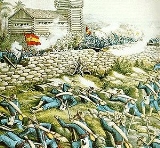
The Battle of San Juan Hill was the bloodiest and most famous battle of the Spanish-American WarSpanish-American War

The Spanish-American War took place in 1898 and resulted in the United States gaining control over the former colonies of Sp...
. The battle has become famous partly because it led directly to the major political rise of Theodore RooseveltTheodore Roosevelt

Theodore Roosevelt, Jr. , also known as T.R. and to the public as Teddy, was the 26th President of the United S...
.
BackgroundAt San Juan Hill, 750 Spanish soldiers were ordered to hold the heights against an American offensive on July 1, 1898. For reasons still not quite clear, Spanish General Arsenio Linares failed to reinforce this position, choosing to hold nearly 10,000 Spanish reserves in the city of Santiago. Spanish hilltop entrenchments, while typically well-constructed, had been poorly positioned, which would make even point-blank rifle volleying at the advancing Americans difficult.

General William Rufus ShafterWilliam Rufus Shafter

William Rufus Shafter was a Major General in the United States Army....
 commanded about 15,000 troops in three divisions.


Discussion
Ask a question about 'Battle of San Juan Hill'
Start a new discussion about 'Battle of San Juan Hill'
Answer questions from other users
Full Discussion Forum


Recent Posts


Encyclopedia


The Battle of San Juan Hill was the bloodiest and most famous battle of the Spanish-American WarSpanish-American War

The Spanish-American War took place in 1898 and resulted in the United States gaining control over the former colonies of Sp...
. The battle has become famous partly because it led directly to the major political rise of Theodore RooseveltTheodore Roosevelt

Theodore Roosevelt, Jr. , also known as T.R. and to the public as Teddy, was the 26th President of the United S...
.

Background

At San Juan Hill, 750 Spanish soldiers were ordered to hold the heights against an American offensive on July 1, 1898. For reasons still not quite clear, Spanish General Arsenio Linares failed to reinforce this position, choosing to hold nearly 10,000 Spanish reserves in the city of Santiago. Spanish hilltop entrenchments, while typically well-constructed, had been poorly positioned, which would make even point-blank rifle volleying at the advancing Americans difficult.

General William Rufus ShafterWilliam Rufus Shafter

William Rufus Shafter was a Major General in the United States Army....
 commanded about 15,000 troops in three divisions. Jacob F. Kent commanded the 1st Division, Henry W. Lawton commanded the 2nd Division, and Joseph WheelerJoseph Wheeler

Joseph Wheeler was an American military commander and politician....
 commanded the dismounted Cavalry Division but was suffering from fever and had to turn over command to General Samuel S. SumnerSamuel S. Sumner

Samuel Storrow Sumner was a United States Army general during the Spanish-American War, Boxer Rebellion, and Philippine-Amer...
. Shafter's plans to attack Santiago de CubaSantiago de Cuba

Santiago de Cuba is the capital city of Santiago de Cuba Province in eastern Cuba....
 called for Lawton's division to move north and reduce the Spanish stronghold at El Caney, which was to take about 2 hours then join with the rest of the troops for the attack on the San Juan Heights. The remaining two divisions would move directly against San Juan Hill with Sumner in the center and Kent to the south. Shafter was too ill to personally direct the operations and instead set up his headquarters at El PozoEl Pozo

El Pozo is a small town located about 20 minutes northeast of Culiacān, Sinaloa, Mexico....
 two miles (3 km) from San Juan Hill and communicated through mounted staff officers.

Order of battle

U.S.

V Corps - Major General William Rufus ShafterWilliam Rufus Shafter

William Rufus Shafter was a Major General in the United States Army....


Second-in-Command - Major General Joseph WheelerJoseph Wheeler Summary

Joseph Wheeler was an American military commander and politician....

  • 1st Division - Brigadier General Jacob Ford KentJacob Ford Kent Summary

    Jacob Ford Kent was a United States general during the Spanish-American War....
    • 1st Brigade - Brigadier General Hamilton S. HawkinsHamilton S. Hawkins

      Hamilton Smith Hawkins was a United States general during the Spanish-American War....
    • 2nd Brigade - Colonel E. P. Pearson
    • 3rd Brigade - Colonel Charles A. WikoffCharles A. Wikoff

      Charles A. Wikoff was a military colonel serving from American Civil War until he became the most senior ranking American A...
  • Cavalry Division (Dismounted) - Major General Joseph WheelerJoseph Wheeler

    Joseph Wheeler was an American military commander and politician....
    • 1st Brigade - Brigadier General Samuel S. SumnerSamuel S. Sumner

      Samuel Storrow Sumner was a United States Army general during the Spanish-American War, Boxer Rebellion, and Philippine-Amer...
    • 2nd Brigade - Brigadier General Leonard WoodLeonard Wood Overview

      Leonard Wood was a physician who served as the Chief of Staff of the United States Army and Governor General of the Philippi...


Spanish

IV Corps - General Arsenio Linares
  • 1st Provisional Battalion
  • 4th Battalion Talavera Peninsular Regiment
  • 1st Battalion San Fernando Regiment
  • 1st Battalion Asia Regiment
  • 1st Battalion Constitutional Regiment
  • 1st Battalion Cuba Regiment
  • 2nd Battalion Cuba Regiment
  • 1st Battalion Simancas Regiment
  • 1st and 2nd Guerilla Companies
  • 1st Cavalry Regiment

Battle

"Hell's Pocket"

Early on the morning of July 1 at the sound of Lawton's guns at El Caney, Sumner's dismounted cavalry followed by Kent's infantry began marching down the El Pozo Road toward the San Juan River. The road soon became crowded as infantry, cavalry and news correspondents bunched up waiting for Lawton's division to arrive from El Caney. Lieutenant Colonel Edward J. McClernand of Shafter's staff, rode to the front and set up a post on El Pozo Hill. At about 7 a.m. "Fighting Joe" WheelerJoseph Wheeler

Joseph Wheeler was an American military commander and politician....
 heard the sound of gunfire, arose from his sickbed and rode to the front. Upon arriving at El Pozo Hill, Wheeler became the senior front line officer and began discussing the course of action with McClernand. The advance then resumed with Colonel Henry K. Carrol's cavalry brigade in the lead followed by Brig. Gen. Leonard WoodLeonard Wood

Leonard Wood was a physician who served as the Chief of Staff of the United States Army and Governor General of the Philippi...
's brigade. The cavalry crossed the San Juan River and veered off to the right, while Hamilton S. HawkinsHamilton S. Hawkins

Hamilton Smith Hawkins was a United States general during the Spanish-American War....
 led his infantry brigade off to the left.

A company from the signal corps ascended in a hot air balloonHot air balloon

Hot air balloons are the oldest successful human flight technology, dating back to the Montgolfier brothers' invention in An...
 to reconnoiter the hills. The balloon made for a good target for the Spaniards, and it was eventually filled with enough holes that it dropped back to the ground, but not before its officers discovered another path leading up the slope. Hawkins' brigade had already passed by the new found route and Kent ordered forward the brigade under Colonel Charles A. WikoffFacts About Charles A. Wikoff

Charles A. Wikoff was a military colonel serving from American Civil War until he became the most senior ranking American A...
. It was 12 p.m. by the time Wikoff began heading down the trail, and a half an hour later he emerged from the woods and was struck by a bullet. He died as his staff officers carried him to the rear. Next in command was Lt. Col. William S. Worth who assumed command but within five minutes fell wounded. Lt. Col. Emerson Liscom assumed command and within another five minutes received a disabling wound. Lt. Col. Ezra P. Ewers, fourth in command of the brigade, assumed command.

Kent and Sumner lined up for the attack and waited for Lawton's division to arrive from El Caney. Lawton did not arrive as scheduled, and no orders came from either Shafter or Wheeler and the troops waited at the base of the hill plagued by Spanish gunfire in areas dubbed "Hell's Pocket" and "Bloody Ford".

Kettle Hill

Many of the officers grew impatient of waiting for orders. One such officer was Col. Theodore RooseveltTheodore Roosevelt Overview

Theodore Roosevelt, Jr. , also known as T.R. and to the public as Teddy, was the 26th President of the United S...
, commander of the volunteer "Rough RidersRough Riders

"The Rough Riders" was the name bestowed by the American press on the 1st U.S....
" regiment. Roosevelt's dismounted cavalry lay waiting in trenches at the base of the hill while suffering casualties. One of the casualties that occurred in the trenches was the death of Captain Bucky O'NeillBucky O'Neill

William Owen O'Neill , known as Buckey O'Neill, was a American soldier, sheriff, newspaper editor, miner, politician, ...
. In the absence of orders, Roosevelt took it upon himself to lead a bold charge. Facing the Rough Riders was a smaller hill which received the name Kettle Hill because the Americans found a large kettle near the base. Roosevelt formed his regiment and began to advance. The advance began to slow as troops dropped from heat exhaustion. Roosevelt feared that he could not keep up on foot in the tropical heat and instead stayed mounted. Soon officers from the rest of Wood's brigade along with Carrol's brigade began to advance, and the units became intermingled. One of the units involved was the 10th Cavalry "Buffalo Soldiers" along with one of its lieutenants, John J. "Black Jack" PershingJohn J. Pershing

John Joseph "Black Jack" Pershing, GCB was an officer in the United States Army....
. The attackers eventually cut their way through barbed wire near the top of the hill (forcing Roosevelt, the only man with a horse, to dismount before he reached the top) and drove the Spaniards out of their trenches on Kettle Hill.

A myth arose in which the regulars stopped to fire at a depression in the hill; Roosevelt ordered them to charge but they refused because no orders to do so came from the brigade commanders. So Roosevelt led his volunteers past the regulars to charge up the hill.

San Juan Hill

In the meantime Hamilton Hawkins' brigade was faring no better than Roosevelt had in his original position. A brigade staff officer named Jules G. Ord initiated an unusual discussion with his commander by asking, "General, if you will order a charge, I will lead it." Hawkins made no response. Ord again asked "If you do not wish to order a charge, General, I should like to volunteer. We can't stay here, can we?"

"I would not ask any man to volunteer," Hawkins stated. "If you do not forbid it, I will start it," returned Ord. Hawkins again remained silent. Ord finally asked "I only ask you not to refuse permission." Hawkins responded "I will not ask for volunteers, I will not give permission and I will not refuse it," he said. "God bless you and good luck!"

With that response Ord rushed to the front of the brigade. With Ord in the lead the brigade moved out of the trenches and advanced up the slope. General Hawkins apparently was not opposed to the attack since once the men began he joined in directing the two lead regiments. 150 yards from the hill the troops charged, cutting their way through the barbed wire.

Seeing the spontaneous advances of Roosevelt and Ord, Wheeler gave the order for Kent to advance with his whole division while he returned to the Cavalry Division. Kent sent forward Ewers' brigade to join Hawkins' men already approaching the hill. Kent's men discovered that the Spanish had placed their trenches in faulty positions and were actually covered from their fire while the attackers climbed the hill. Ord, still in the lead, was among the first to reach the crest. The Spanish fled, but as Ord jumped into the trench he was killed instantly and Hawkins was wounded shortly after.

After losing Kettle Hill, Linares's men still on San Juan Hill began to fire on the cavaliers' newly won position. While Kent's secured a blockhouseBlockhouse

In military science, a blockhouse is a small, isolated fort in the form of a single building....
 to the south after hand-to-hand fighting, Sumner also charged San Juan Hill. Roosevelt personally led the attack but paused after charging a few feet with only a handful of men following. He turned around and inquired why no one had followed. His men replied they had not heard the order and quickly joined the attack. Kent's remaining brigade under Colonel E. P. Pearson arrived after Hawkins and Ewers had already charged and moved further to the south and drove the Spanish off of a knollFacts About Knoll

* In geography, a knoll is a small natural hill ...
 on the Spanish right flank.

General Wood sent requests for Kent to send up infantry to strengthen his vulnerable position. General Wheeler reached the trenches and ordered breastworkBreastwork

Breastwork may mean:#A form of temporary fortification Breastwork....
s constructed. Roosevelt's men did in fact repulse a minor counterattack on the northern flank. The Americans' position on San Juan Hill was exposed to artillery fire from within Santiago, and Shafter feared the vulnerability of the line and ordered the troops to withdraw. Wheeler assured Shafter that the position could be held; still Shafter ordered the withdrawal. Before the men could withdraw Wheeler called aside Kent and Sumner and reassured them that the line could be held, and during the night they worked at strengthening the lines while reinforcements arrived.

Aftermath

The battle had been a hard one for the Americans, who suffered almost three times as many losses as the Spanish had. The Spaniards, meanwhile, had literally fought to the knife, losing a third of their force in casualties but yielding very few prisoners.

Lawton's division, which was supposed to join the fight early on July 1, did not arrive until noon on July 2, having encountering unexpectedly heavy resistance in the battle of El CaneyBattle of El Caney

The Battle of El Caney was fought on July 1, 1898, during the Spanish-American War....
. The Americans, along with the aid of Cuban insurgents, immediately began the investment of SantiagoSiege of Santiago

The Siege of Santiago also known as the Siege of Santiago de Cuba was the last major operation of the Spanish-American...
, which surrendered on July 17.

The battle of San Juan Hill launched Theodore Roosevelt into national fame along with his regiment of "Rough RidersRough Riders

"The Rough Riders" was the name bestowed by the American press on the 1st U.S....
". Roosevelt returned to the United States a national hero and was elected governor of New York state later in the year, then became Vice PresidentVice President of the United States

The Vice President of the United States is the second-highest executive official of the United States government....
 in the general election two years later. Roosevelt, along with 23 other participants were awarded the Medal of HonorMedal of Honor

The Medal of Honor is the highest military decoration awarded by the United States....
. Political rivalries prevented Roosevelt from receiving his award during his lifetime, but in 2001 President Bill ClintonBill Clinton

William Jefferson "Bill" Clinton was the 42nd President of the United States, serving from 1993 to 2001....
 presented the award to Tweed RooseveltTweed Roosevelt

Tweed Roosevelt is the great-grandson of President Theodore Roosevelt....
.

In popular culture

Movies

The battle was the climactic scene of the 1997 film Rough RidersRough Riders (film)

Rough Riders is a 1997 film about Theodore Roosevelt and the regiment he help raise to fight in Spanish-American War of ...
starring Tom BerengerTom Berenger

Tom Berenger is an American actor known mainly for his roles in action films....
 as Theodore Roosevelt, Sam ElliottSam Elliott

Sam Elliott is an American film and television actor, usually recognised by his tall, thin, rough-hewn physique, a thick han...
 as Bucky O'NeillFacts About Bucky O'Neill

William Owen O'Neill , known as Buckey O'Neill, was a American soldier, sheriff, newspaper editor, miner, politician, ...
, and Gary BuseyGary Busey

William Gary Busey is an Academy Award-nominated American film and stage actor....
 as General Wheeler.

Also See

  • Rough RidersRough Riders

    "The Rough Riders" was the name bestowed by the American press on the 1st U.S....
  • American Wars
  • Spanish WarsList of Spanish wars

    List of Spanish wars* 1568 - 1648 Eighty Years' War...
  • History of CubaHistory of Cuba

    Cuba, the largest of the Caribbean islands, was first inhabited by Amerindian peoples known as the Tano and Ciboney....


External links