

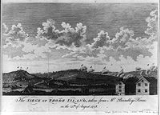
Battle of Rhode Island

Encyclopedia
The Battle of Rhode Island, also known as the Battle of Quaker Hill and the Siege of Newport, took place on August 29, 1778. Continental Army
and militia forces under the command of General John Sullivan
were withdrawing to the northern part of Aquidneck Island
after abandoning their siege of Newport, Rhode Island
, when the British
forces in Newport sortied, supported by recently arrived Royal Navy
ships, and attacked the retreating Americans. The battle ended inconclusively, but the Continental forces afterward withdrew to the mainland, leaving Aquidneck Island in British hands.
The battle took place in the aftermath of the first attempt at cooperation between French
and American forces following France's entry into the war as an American ally
. The operations against Newport were to have been made in conjunction with a French fleet and troops; these were frustrated in part by difficult relations between the commanders, and a storm that damaged both French and British fleets shortly before joint operations were to begin.
The battle was also notable for the participation of the 1st Rhode Island Regiment
, a locally recruited segregated regiment of African American
s. It was the only major military action to include a racially segregated unit on the American side in the war.
after the Battles of Saratoga in October 1777, France
decided to formally recognize the United States of America. It had previously supported the the independence effort of the Thirteen Colonies
in preceding years, but by early 1778 had made the decision to openly support the American cause. France formally recognized the United States in February 1778, and war was declared between France and Great Britain
in March.
with a fleet of 12 ships of the line and some French Army
troops to North America
in April 1778, with orders to blockade the British North American fleet in the Delaware River
. Although British leaders had early intelligence that d'Estaing was likely headed for North America, political and military differences within the government and navy delayed the British response, and permitted him to sail unopposed through the Straits of Gibraltar. It was not until early June that a fleet of 13 ships of the line under the command of Admiral John Byron
left European waters in pursuit. D'Estaing's crossing of the Atlantic took three months, but Byron (who was called "Foul-weather Jack" due to his repeated bad luck with the weather) was also delayed by bad weather and would not reach New York until mid August.
The British evacuated Philadelphia to New York City
before d'Estaing's arrival, and their North American fleet was no longer in the river when his fleet arrived at Delaware Bay in early July. D'Estaing decided to sail for New York, but its well-defended harbor presented a daunting challenge to the French fleet. Since d'Estaing's largest ships were believed (by the French and their American pilots) to be unable to cross the bar
into New York harbor, French and American leaders decided to deploy their forces against British-occupied Newport, Rhode Island
. While d'Estaing was outside the harbor, British General Sir Henry Clinton
and Admiral Lord Richard Howe
dispatched a fleet of transports carrying 2,000 troops to reinforce Newport via Long Island Sound
; these reached their destination on July 15, raising the size of Major General Robert Pigot's garrison to over 6,700 men.
, where Newport is located, American and British forces had been in a standoff since the British occupation began in late 1776. Major General Joseph Spencer
had been ordered by Major General George Washington
to launch an assault on Newport in 1777, but he had not done so, and was removed from command of the Rhode Island defenses. In March 1778 Congress approved the appointment of Major General John Sullivan
to Rhode Island. By early May, Sullivan had arrived in the state and produced a detailed report on the situation there. He also began logistical preparations for an attack on Newport, caching equipment and supplies on the eastern shore of Narragansett Bay and the Taunton River
. General Pigot was aware to Sullivan's preparations, and launched an expedition on May 25 that raided Bristol
and Warren
, destroying military supplies and plundering the towns. Sullivan's response was to make renewed appeals for assistance, which were reinforced by a Congressional declaration after a second raid on Freetown (present-day Fall River, Massachusetts
) on May 31.
General Washington wrote to Sullivan on July 17, ordering him to raise 5,000 troops for possible operations against Newport. Sullivan did not receive this letter until July 23, and it was followed the next day by the arrival of Colonel John Laurens
with word that Newport had been chosen as the allied target on the 22nd, and that he should raise as large a force as possible. Sullivan's force at that time amounted to 1,600 troops. Laurens had left Washington's camp on the 22nd, riding ahead of a column of Continental troops (the brigades of John Glover and Joseph Varnum) led by the marquis de Lafayette
.
News of the French involvement rallied support for the cause, and militia began streaming to Rhode Island from neighboring states. Half the entire Rhode Island militia
was called up and led by William West, and large numbers of militia from Massachusetts
and New Hampshire
along with Continental Artillery came to Rhode Island to join the effort; however, these forces took some time to muster, and the majority of them did not arrive until the first week of August. Washington on July 27 sent Major General Nathanael Greene
, a Rhode Island native and reliable officer, to further bolster Sullivan's leadership corps. Sullivan had been regularly criticized in Congress for his performance in earlier battles, and Washington urged him to take counsel from Greene and Lafayette. Greene, in writing to Sullivan on the matter, reinforced the need for a successful operation.
, sailed out after him once they discovered his destination to be Newport. D'Estaing arrived off Point Judith on July 29, and immediately met with Generals Greene and Lafayette to develop their plan of attack. Sullivan's proposal was that the Americans would cross over to Aquidneck Island's eastern shore from Tiverton, while French troops, which would use Conanicut Island
as a staging ground, would cross from the west, cutting off a detachment of British soldiers at Butts Hill on the northern part of the island. The next day, d'Estaing sent frigates into the Sakonnet River
(the channel to the east of Aquidneck) and into the main channel leading to Newport.
As allied intentions became clear, General Pigot decided to redeploy his forces in a defensive posture, withdrawing troops from Conanicut Island and from Butts Hill. He also decided to move nearly all livestock into the city, ordered the levelling of orchards and houses to provide a clear line of fire, and destroyed carriages and wagons. The arriving French ships drove several of his supporting ships aground, which were burned to prevent their capture. As the French worked their way up the channel toward Newport, Pigot ordered the remaining ships scuttled to hamper French access to Newport's harbor. On August 8, d'Estaing moved the bulk of his fleet into Newport Harbor. The next day he began disembarking some of his 4,000 troops onto nearby Conanicut Island. The same day, General Sullivan learned that Pigot had abandoned Butts Hill. Contrary to the agreement with d'Estaing, Sullivan then crossed troops over to seize that high ground, concerned that the British might reoccupy it in strength. This breach of agreement offended d'Estaing.
broke out. Raging for two days, the storm scattered both fleets, severely damaging the French flagship. It also frustrated plans by Sullivan to attack Newport without French support on August 11. While Sullivan awaited the return of the French fleet, he began siege operations, opening trenches to the northeast of the fortified British line north of Newport on August 14.
As the two fleets sought to regroup, individual ships encountered enemy ships, and there were several minor naval skirmishes; two French ships, already suffering storm damage, were badly mauled in these encounters. The French fleet regrouped off Delaware, and returned to Newport on August 20, while the British fleet regrouped at New York.
on the 22nd to repair his ships, prompting mass desertions on the part of the militia. Dismayed by this turn of events, Sullivan sent Lafayette to Boston to bring French troops to the prospective battlefield. This proved fruitless in the end. D'Estaing and Lafayette met fierce criticism in Boston, Lafayette remarking that "I am more upon a warlike footing in the American lines than when I came near the British lines at Newport."
By August 28, Sullivan changed his plans to reflect the relative strength of the opposing forces. Under the cloak of darkness, American troops were moved away from their siege positions to defensive positions in the north of the island around Butts Hill.
In the meantime, the British in New York had not been idle. Lord Howe, concerned about the French fleet and further reinforced by the arrival of ships from Byron's storm-tossed squadron, sailed out to catch d'Estaing before he reached Boston. General Clinton organized a force of 4,000 men under Major General Charles Grey
, and sailed with it on August 26 destined for Newport.
The Americans organized their forces in two sections:
The British followed suit and organized their attack in a corresponding way, sending Hessian General Friedrich Wilhelm von Lossberg up the west road and Major General Francis Smith
up the east road with two regiments each under orders to not make a general attack. As it turned out, this advance led to the main battle.
to dispatch the 54th Regiment and Brown’s Provincials to reinforce Smith. Thus reinforced, Smith returned to the attack, sending the 22nd and 43rd Regiments and the flank companies of the 38th and 54th Regiments against Livingston’s left flank. Livingston had also been reinforced with Col. Edward Wigglesworth’s regiment, sent by Sullivan, but was nevertheless driven back to Quaker Hill. Then, with a German regiment threatening to outflank Quaker Hill itself, Livingston and Wigglesworth abandoned the hill and retreated all the way to Glover’s lines. Smith made a probing attack but was repulsed by Glover’s troops. “Seeing the strength of the American position, Smith decided against launching a major assault”. This ended the fighting on the American left.
, who were positioned behind some stone walls south of the Redwood House. With the Hessian chasseurs, Huyne's Hessian regiment and Fanning's Provincial Regiment, Lossberg pushed Laurens' men back onto Turkey Hill. Despite Laurens being reinforced by a regiment sent by Sullivan, Lossberg stormed Turkey Hill and drove the defenders right back on Nathanael Greene's wing of the army before starting a cannonade of Greene's lines.
By 10 a.m., HMS Sphynx, HMS Vigilant and HMS Spitfire Galley had negotiated the passage between Rhode Island and Prudence Island and commenced a bombardment of Greene's troops on the American right flank. Lossberg now attacked Greene: German troops assailed Major Ward's Rhode Island Colored Regiment but were repulsed, bayoneting the American wounded as they fell back. Meanwhile, Greene’s artillery and the American battery at Bristol Neck concentrated their fire on the three British ships and drove them off.
At 2 p.m., Lossberg once again attacked Greene's positions without success. Greene counterattacked with Col. Israel Angell's 2nd Rhode Island Regiment, Brigadier General James Lovell's brigade of Massachusetts militia and Henry Brockholst Livingston's troops. Failing in a frontal attack, Greene sent his 1,500 men forward to try to turn Lossberg's right flank. Heavily outnumbered, Lossberg withdrew to the summit of Turkey Hill. By 3 p.m., Greene's wing was holding a stone wall three hundred paces from the foot of Turkey Hill. Towards evening, an attempt was made to cut off the Hessians on Lossberg's left flank but Huyne's Hessians and Fanning's Provincials drove off Greene's men. This ended the battle, although some artillery fire went on through the night. Out of 260 British casualties, 128 were German.
and Tiverton on the night of August 31, leaving Aquidneck Island under British control.
The relief force of Clinton and Grey arrived at Newport on September 1. Given that the threat was over, Clinton ordered Grey to instead raid several communities
on the Massachusetts coast. Admiral Byron, who succeeded Lord Howe in command of the North American fleet, was unsuccessful in his bid to catch up with d'Estaing, who held a strong position at the Nantasket Roads when Byron arrived. Byron was also unsuccessful in blockading d'Estaing: his fleet was scattered by a storm, after which d'Estaing slipped out of Boston, bound for the West Indies.
was declared a National Historic Landmark
in 1974 and is listed on the National Register of Historic Places
. It partially preserves the ground on which the battle was fought. The underwater site of and , two Royal Navy ships scuttled during the French fleet's advance on Newport, is also listed on the National Register of Historic Places, as is Fort Barton
, one of the American defenses in Tiverton, and the Conanicut Battery
, an earthworks on Conanicut Island built in 1775 and expanded by the British during their occupation of Newport. The site was abandoned by the British after the arrival of the French fleet. The Joseph Reynolds House
in Bristol, a National Historic Landmark and one of the oldest buildings in Rhode Island, was used by General Lafayette as his headquarters during the campaign.
Continental Army
The Continental Army was formed after the outbreak of the American Revolutionary War by the colonies that became the United States of America. Established by a resolution of the Continental Congress on June 14, 1775, it was created to coordinate the military efforts of the Thirteen Colonies in...
and militia forces under the command of General John Sullivan
John Sullivan
John Sullivan was the third son of Irish immigrants, a United States general in the Revolutionary War, a delegate in the Continental Congress and a United States federal judge....
were withdrawing to the northern part of Aquidneck Island
Aquidneck Island
Aquidneck Island, located in the state of Rhode Island, is the largest island in Narragansett Bay. The island's official name is Rhode Island, and the common use of name "Aquidneck Island" helps distinguish the island from the state. The total land area is 97.9 km²...
after abandoning their siege of Newport, Rhode Island
Newport, Rhode Island
Newport is a city on Aquidneck Island in Newport County, Rhode Island, United States, about south of Providence. Known as a New England summer resort and for the famous Newport Mansions, it is the home of Salve Regina University and Naval Station Newport which houses the United States Naval War...
, when the British
Kingdom of Great Britain
The former Kingdom of Great Britain, sometimes described as the 'United Kingdom of Great Britain', That the Two Kingdoms of Scotland and England, shall upon the 1st May next ensuing the date hereof, and forever after, be United into One Kingdom by the Name of GREAT BRITAIN. was a sovereign...
forces in Newport sortied, supported by recently arrived Royal Navy
Royal Navy
The Royal Navy is the naval warfare service branch of the British Armed Forces. Founded in the 16th century, it is the oldest service branch and is known as the Senior Service...
ships, and attacked the retreating Americans. The battle ended inconclusively, but the Continental forces afterward withdrew to the mainland, leaving Aquidneck Island in British hands.
The battle took place in the aftermath of the first attempt at cooperation between French
France
The French Republic , The French Republic , The French Republic , (commonly known as France , is a unitary semi-presidential republic in Western Europe with several overseas territories and islands located on other continents and in the Indian, Pacific, and Atlantic oceans. Metropolitan France...
and American forces following France's entry into the war as an American ally
Franco-American alliance
The Franco-American alliance refers to the 1778 alliance between Louis XVI's France and the United States, during the American Revolutionary War. Formalized in the 1778 Treaty of Alliance, it was a military pact in which France provided arms and money, and engaged in full-scale war with Britain. ...
. The operations against Newport were to have been made in conjunction with a French fleet and troops; these were frustrated in part by difficult relations between the commanders, and a storm that damaged both French and British fleets shortly before joint operations were to begin.
The battle was also notable for the participation of the 1st Rhode Island Regiment
1st Rhode Island Regiment
The 1st Rhode Island Regiment was a Continental Army regiment from Rhode Island during the American Revolutionary War . Like most regiments of the Continental Army, the unit went through several incarnations and name changes. It became well-known as the "Black Regiment" because, for a time, it had...
, a locally recruited segregated regiment of African American
African American
African Americans are citizens or residents of the United States who have at least partial ancestry from any of the native populations of Sub-Saharan Africa and are the direct descendants of enslaved Africans within the boundaries of the present United States...
s. It was the only major military action to include a racially segregated unit on the American side in the war.
Background
Following the surrender of the British ArmyBritish Army
The British Army is the land warfare branch of Her Majesty's Armed Forces in the United Kingdom. It came into being with the unification of the Kingdom of England and Scotland into the Kingdom of Great Britain in 1707. The new British Army incorporated Regiments that had already existed in England...
after the Battles of Saratoga in October 1777, France
France
The French Republic , The French Republic , The French Republic , (commonly known as France , is a unitary semi-presidential republic in Western Europe with several overseas territories and islands located on other continents and in the Indian, Pacific, and Atlantic oceans. Metropolitan France...
decided to formally recognize the United States of America. It had previously supported the the independence effort of the Thirteen Colonies
Thirteen Colonies
The Thirteen Colonies were English and later British colonies established on the Atlantic coast of North America between 1607 and 1733. They declared their independence in the American Revolution and formed the United States of America...
in preceding years, but by early 1778 had made the decision to openly support the American cause. France formally recognized the United States in February 1778, and war was declared between France and Great Britain
Kingdom of Great Britain
The former Kingdom of Great Britain, sometimes described as the 'United Kingdom of Great Britain', That the Two Kingdoms of Scotland and England, shall upon the 1st May next ensuing the date hereof, and forever after, be United into One Kingdom by the Name of GREAT BRITAIN. was a sovereign...
in March.
French movements
For its first major attempt at cooperation with the Americans, France sent Admiral the Comte d'EstaingCharles Hector, comte d'Estaing
Jean Baptiste Charles Henri Hector, comte d'Estaing was a French general, and admiral. He began his service as a soldier in the War of the Austrian Succession, briefly spending time as a prisoner of war of the British during the Seven Years' War...
with a fleet of 12 ships of the line and some French Army
French Army
The French Army, officially the Armée de Terre , is the land-based and largest component of the French Armed Forces.As of 2010, the army employs 123,100 regulars, 18,350 part-time reservists and 7,700 Legionnaires. All soldiers are professionals, following the suspension of conscription, voted in...
troops to North America
North America
North America is a continent wholly within the Northern Hemisphere and almost wholly within the Western Hemisphere. It is also considered a northern subcontinent of the Americas...
in April 1778, with orders to blockade the British North American fleet in the Delaware River
Delaware River
The Delaware River is a major river on the Atlantic coast of the United States.A Dutch expedition led by Henry Hudson in 1609 first mapped the river. The river was christened the South River in the New Netherland colony that followed, in contrast to the North River, as the Hudson River was then...
. Although British leaders had early intelligence that d'Estaing was likely headed for North America, political and military differences within the government and navy delayed the British response, and permitted him to sail unopposed through the Straits of Gibraltar. It was not until early June that a fleet of 13 ships of the line under the command of Admiral John Byron
John Byron
Vice Admiral The Hon. John Byron, RN was a Royal Navy officer. He was known as Foul-weather Jack because of his frequent bad luck with weather.-Early career:...
left European waters in pursuit. D'Estaing's crossing of the Atlantic took three months, but Byron (who was called "Foul-weather Jack" due to his repeated bad luck with the weather) was also delayed by bad weather and would not reach New York until mid August.
The British evacuated Philadelphia to New York City
New York City
New York is the most populous city in the United States and the center of the New York Metropolitan Area, one of the most populous metropolitan areas in the world. New York exerts a significant impact upon global commerce, finance, media, art, fashion, research, technology, education, and...
before d'Estaing's arrival, and their North American fleet was no longer in the river when his fleet arrived at Delaware Bay in early July. D'Estaing decided to sail for New York, but its well-defended harbor presented a daunting challenge to the French fleet. Since d'Estaing's largest ships were believed (by the French and their American pilots) to be unable to cross the bar
Bar (landform)
A shoal, sandbar , or gravelbar is a somewhat linear landform within or extending into a body of water, typically composed of sand, silt or small pebbles. A spit or sandspit is a type of shoal...
into New York harbor, French and American leaders decided to deploy their forces against British-occupied Newport, Rhode Island
Newport, Rhode Island
Newport is a city on Aquidneck Island in Newport County, Rhode Island, United States, about south of Providence. Known as a New England summer resort and for the famous Newport Mansions, it is the home of Salve Regina University and Naval Station Newport which houses the United States Naval War...
. While d'Estaing was outside the harbor, British General Sir Henry Clinton
Henry Clinton (American War of Independence)
General Sir Henry Clinton KB was a British army officer and politician, best known for his service as a general during the American War of Independence. First arriving in Boston in May 1775, from 1778 to 1782 he was the British Commander-in-Chief in North America...
and Admiral Lord Richard Howe
Richard Howe, 1st Earl Howe
Admiral of the Fleet Richard Howe, 1st Earl Howe KG was a British naval officer, notable in particular for his service during the American War of Independence and French Revolutionary Wars. He was the brother of William Howe and George Howe.Howe joined the navy at the age of thirteen and served...
dispatched a fleet of transports carrying 2,000 troops to reinforce Newport via Long Island Sound
Long Island Sound
Long Island Sound is an estuary of the Atlantic Ocean, located in the United States between Connecticut to the north and Long Island, New York to the south. The mouth of the Connecticut River at Old Saybrook, Connecticut, empties into the sound. On its western end the sound is bounded by the Bronx...
; these reached their destination on July 15, raising the size of Major General Robert Pigot's garrison to over 6,700 men.
American forces
On Aquidneck IslandAquidneck Island
Aquidneck Island, located in the state of Rhode Island, is the largest island in Narragansett Bay. The island's official name is Rhode Island, and the common use of name "Aquidneck Island" helps distinguish the island from the state. The total land area is 97.9 km²...
, where Newport is located, American and British forces had been in a standoff since the British occupation began in late 1776. Major General Joseph Spencer
Joseph Spencer
Joseph Spencer was an American lawyer, soldier, and statesman from Connecticut. During the Revolutionary War, he served both as a delegate to the Continental Congress and as a major general in the Continental Army....
had been ordered by Major General George Washington
George Washington
George Washington was the dominant military and political leader of the new United States of America from 1775 to 1799. He led the American victory over Great Britain in the American Revolutionary War as commander-in-chief of the Continental Army from 1775 to 1783, and presided over the writing of...
to launch an assault on Newport in 1777, but he had not done so, and was removed from command of the Rhode Island defenses. In March 1778 Congress approved the appointment of Major General John Sullivan
John Sullivan
John Sullivan was the third son of Irish immigrants, a United States general in the Revolutionary War, a delegate in the Continental Congress and a United States federal judge....
to Rhode Island. By early May, Sullivan had arrived in the state and produced a detailed report on the situation there. He also began logistical preparations for an attack on Newport, caching equipment and supplies on the eastern shore of Narragansett Bay and the Taunton River
Taunton River
The Taunton River , is a river in southeastern Massachusetts in the United States. It arises from the confluence of the Town River and Matfield River, in the town of Bridgewater...
. General Pigot was aware to Sullivan's preparations, and launched an expedition on May 25 that raided Bristol
Bristol, Rhode Island
Bristol is a town in and the historic county seat of Bristol County, Rhode Island, United States. The population was 22,954 at the 2010 census. Bristol, a deepwater seaport, is named after Bristol, England....
and Warren
Warren, Rhode Island
Warren is a town in Bristol County, Rhode Island, United States. The population was 10,611 at the 2010 census.-History:Warren was the site of the Indian village of Sowams on the peninsula called Pokanoket , and was first explored by Europeans in 1621, by Edward Winslow and Stephen Hopkins...
, destroying military supplies and plundering the towns. Sullivan's response was to make renewed appeals for assistance, which were reinforced by a Congressional declaration after a second raid on Freetown (present-day Fall River, Massachusetts
Fall River, Massachusetts
Fall River is a city in Bristol County, Massachusetts, in the United States. It is located about south of Boston, southeast of Providence, Rhode Island, and west of New Bedford and south of Taunton. The city's population was 88,857 during the 2010 census, making it the tenth largest city in...
) on May 31.
General Washington wrote to Sullivan on July 17, ordering him to raise 5,000 troops for possible operations against Newport. Sullivan did not receive this letter until July 23, and it was followed the next day by the arrival of Colonel John Laurens
John Laurens
John Laurens was an American soldier and statesman from South Carolina during the Revolutionary War. He gained approval by the Continental Congress in 1779 to recruit a regiment of 3000 slaves by promising them freedom in return for fighting...
with word that Newport had been chosen as the allied target on the 22nd, and that he should raise as large a force as possible. Sullivan's force at that time amounted to 1,600 troops. Laurens had left Washington's camp on the 22nd, riding ahead of a column of Continental troops (the brigades of John Glover and Joseph Varnum) led by the marquis de Lafayette
Gilbert du Motier, marquis de La Fayette
Marie-Joseph Paul Yves Roch Gilbert du Motier, Marquis de La Fayette , often known as simply Lafayette, was a French aristocrat and military officer born in Chavaniac, in the province of Auvergne in south central France...
.
News of the French involvement rallied support for the cause, and militia began streaming to Rhode Island from neighboring states. Half the entire Rhode Island militia
Militia
The term militia is commonly used today to refer to a military force composed of ordinary citizens to provide defense, emergency law enforcement, or paramilitary service, in times of emergency without being paid a regular salary or committed to a fixed term of service. It is a polyseme with...
was called up and led by William West, and large numbers of militia from Massachusetts
Massachusetts
The Commonwealth of Massachusetts is a state in the New England region of the northeastern United States of America. It is bordered by Rhode Island and Connecticut to the south, New York to the west, and Vermont and New Hampshire to the north; at its east lies the Atlantic Ocean. As of the 2010...
and New Hampshire
New Hampshire
New Hampshire is a state in the New England region of the northeastern United States of America. The state was named after the southern English county of Hampshire. It is bordered by Massachusetts to the south, Vermont to the west, Maine and the Atlantic Ocean to the east, and the Canadian...
along with Continental Artillery came to Rhode Island to join the effort; however, these forces took some time to muster, and the majority of them did not arrive until the first week of August. Washington on July 27 sent Major General Nathanael Greene
Nathanael Greene
Nathanael Greene was a major general of the Continental Army in the American Revolutionary War. When the war began, Greene was a militia private, the lowest rank possible; he emerged from the war with a reputation as George Washington's most gifted and dependable officer. Many places in the United...
, a Rhode Island native and reliable officer, to further bolster Sullivan's leadership corps. Sullivan had been regularly criticized in Congress for his performance in earlier battles, and Washington urged him to take counsel from Greene and Lafayette. Greene, in writing to Sullivan on the matter, reinforced the need for a successful operation.
French arrival at Newport
On July 22, when the British judged the tide high enough for the French ships to cross the bar, d'Estaing instead sailed from his position outside the New York harbor. He initially sailed south before turning northeast toward Newport. The British fleet in New York, eight ships of the line under the command of Lord Richard HoweRichard Howe, 1st Earl Howe
Admiral of the Fleet Richard Howe, 1st Earl Howe KG was a British naval officer, notable in particular for his service during the American War of Independence and French Revolutionary Wars. He was the brother of William Howe and George Howe.Howe joined the navy at the age of thirteen and served...
, sailed out after him once they discovered his destination to be Newport. D'Estaing arrived off Point Judith on July 29, and immediately met with Generals Greene and Lafayette to develop their plan of attack. Sullivan's proposal was that the Americans would cross over to Aquidneck Island's eastern shore from Tiverton, while French troops, which would use Conanicut Island
Conanicut Island
Conanicut Island is the second largest island in Narragansett Bay, in the state of Rhode Island. It is connected on the east to Newport, Rhode Island, on Aquidneck Island by the Claiborne Pell Bridge, commonly known as the Newport Bridge, and on the west to North Kingstown, Rhode Island, on the...
as a staging ground, would cross from the west, cutting off a detachment of British soldiers at Butts Hill on the northern part of the island. The next day, d'Estaing sent frigates into the Sakonnet River
Sakonnet River
The Sakonnet River is a tidal strait, in the U.S. state of Rhode Island. It flows approximately 23 km between Mount Hope Bay and Rhode Island Sound...
(the channel to the east of Aquidneck) and into the main channel leading to Newport.
As allied intentions became clear, General Pigot decided to redeploy his forces in a defensive posture, withdrawing troops from Conanicut Island and from Butts Hill. He also decided to move nearly all livestock into the city, ordered the levelling of orchards and houses to provide a clear line of fire, and destroyed carriages and wagons. The arriving French ships drove several of his supporting ships aground, which were burned to prevent their capture. As the French worked their way up the channel toward Newport, Pigot ordered the remaining ships scuttled to hamper French access to Newport's harbor. On August 8, d'Estaing moved the bulk of his fleet into Newport Harbor. The next day he began disembarking some of his 4,000 troops onto nearby Conanicut Island. The same day, General Sullivan learned that Pigot had abandoned Butts Hill. Contrary to the agreement with d'Estaing, Sullivan then crossed troops over to seize that high ground, concerned that the British might reoccupy it in strength. This breach of agreement offended d'Estaing.
Storm damage
Lord Howe's fleet was delayed departing New York by contrary winds, and he arrived off Point Judith on August 9. Since d'Estaing's fleet outnumbered Howe's, the French admiral, fearful that Howe would be further reinforced and eventually gain a numerical advantage, reboarded the French troops, and sailed out to do battle with Howe on August 10. As the two fleets prepared to battle and maneuvered for position, the weather deteriorated, and a major stormNor'easter
A nor'easter is a type of macro-scale storm along the East Coast of the United States and Atlantic Canada, so named because the storm travels to the northeast from the south and the winds come from the northeast, especially in the coastal areas of the Northeastern United States and Atlantic Canada...
broke out. Raging for two days, the storm scattered both fleets, severely damaging the French flagship. It also frustrated plans by Sullivan to attack Newport without French support on August 11. While Sullivan awaited the return of the French fleet, he began siege operations, opening trenches to the northeast of the fortified British line north of Newport on August 14.
As the two fleets sought to regroup, individual ships encountered enemy ships, and there were several minor naval skirmishes; two French ships, already suffering storm damage, were badly mauled in these encounters. The French fleet regrouped off Delaware, and returned to Newport on August 20, while the British fleet regrouped at New York.
French retreat to Boston
Despite pleas by Greene and Lafayette that he land troops, d'Estaing refused, citing orders to preserve his fleet. He instead sailed to BostonBoston
Boston is the capital of and largest city in Massachusetts, and is one of the oldest cities in the United States. The largest city in New England, Boston is regarded as the unofficial "Capital of New England" for its economic and cultural impact on the entire New England region. The city proper had...
on the 22nd to repair his ships, prompting mass desertions on the part of the militia. Dismayed by this turn of events, Sullivan sent Lafayette to Boston to bring French troops to the prospective battlefield. This proved fruitless in the end. D'Estaing and Lafayette met fierce criticism in Boston, Lafayette remarking that "I am more upon a warlike footing in the American lines than when I came near the British lines at Newport."
By August 28, Sullivan changed his plans to reflect the relative strength of the opposing forces. Under the cloak of darkness, American troops were moved away from their siege positions to defensive positions in the north of the island around Butts Hill.
In the meantime, the British in New York had not been idle. Lord Howe, concerned about the French fleet and further reinforced by the arrival of ships from Byron's storm-tossed squadron, sailed out to catch d'Estaing before he reached Boston. General Clinton organized a force of 4,000 men under Major General Charles Grey
Charles Grey, 1st Earl Grey
Charles Grey, 1st Earl Grey, KB PC was one of the most important British generals of the 18th century. He was the fourth son of Sir Henry Grey, 1st Baronet, of Howick in Northumberland. He served in the Seven Years' War, American War of Independence and French Revolutionary War...
, and sailed with it on August 26 destined for Newport.
Battle
The American generals decided to establish a defensive line across the entire island just south of a valley that cut across the island, hoping thereby to deny the British the high ground in the northern section.The Americans organized their forces in two sections:
- On the west, General Greene concentrated his forces in front of Turkey Hill, but sent the 1st Rhode Island to establish advance positions a half mile (1 km) south under the command of Brigadier General James VarnumJames Mitchell VarnumJames Mitchell Varnum was an American legislator, lawyer and a general in the Continental Army during the American Revolutionary War.-Early life:James Mitchell Varnum was born in Dracut, Massachusetts...
. - On the east, Brigadier General John Glover, who concentrated his forces behind a stone wall overlooking Quaker Hill.
The British followed suit and organized their attack in a corresponding way, sending Hessian General Friedrich Wilhelm von Lossberg up the west road and Major General Francis Smith
Francis Smith (British officer)
Major-General Francis Smith was the British commander during most of the Battle of Lexington and Concord, Massachusetts on April 19, 1775...
up the east road with two regiments each under orders to not make a general attack. As it turned out, this advance led to the main battle.
Smith's assault on the American left
Smith’s advance stalled when it came under fire from troops commanded by Lt. Col. Henry Brockholst Livingston, who were stationed at a windmill near Quaker Hill. Pigot sent word to the commander of the British reserve, Major General Richard PrescottRichard Prescott
Richard Prescott was a British officer, born in England.He was appointed a major of the 33rd Regiment of Foot, on 20 December 1756, transferred to the 72nd Regiment of Foot on 9 May 1758, and on 14 December 1761, lieutenant-colonel of the 17th Regiment of Foot, before in May 1762, transferring to...
to dispatch the 54th Regiment and Brown’s Provincials to reinforce Smith. Thus reinforced, Smith returned to the attack, sending the 22nd and 43rd Regiments and the flank companies of the 38th and 54th Regiments against Livingston’s left flank. Livingston had also been reinforced with Col. Edward Wigglesworth’s regiment, sent by Sullivan, but was nevertheless driven back to Quaker Hill. Then, with a German regiment threatening to outflank Quaker Hill itself, Livingston and Wigglesworth abandoned the hill and retreated all the way to Glover’s lines. Smith made a probing attack but was repulsed by Glover’s troops. “Seeing the strength of the American position, Smith decided against launching a major assault”. This ended the fighting on the American left.
Lossberg's assault on the American right
By 7:30 a.m., Lossberg had advanced against the American Light Corps under Col. John LaurensJohn Laurens
John Laurens was an American soldier and statesman from South Carolina during the Revolutionary War. He gained approval by the Continental Congress in 1779 to recruit a regiment of 3000 slaves by promising them freedom in return for fighting...
, who were positioned behind some stone walls south of the Redwood House. With the Hessian chasseurs, Huyne's Hessian regiment and Fanning's Provincial Regiment, Lossberg pushed Laurens' men back onto Turkey Hill. Despite Laurens being reinforced by a regiment sent by Sullivan, Lossberg stormed Turkey Hill and drove the defenders right back on Nathanael Greene's wing of the army before starting a cannonade of Greene's lines.
By 10 a.m., HMS Sphynx, HMS Vigilant and HMS Spitfire Galley had negotiated the passage between Rhode Island and Prudence Island and commenced a bombardment of Greene's troops on the American right flank. Lossberg now attacked Greene: German troops assailed Major Ward's Rhode Island Colored Regiment but were repulsed, bayoneting the American wounded as they fell back. Meanwhile, Greene’s artillery and the American battery at Bristol Neck concentrated their fire on the three British ships and drove them off.
At 2 p.m., Lossberg once again attacked Greene's positions without success. Greene counterattacked with Col. Israel Angell's 2nd Rhode Island Regiment, Brigadier General James Lovell's brigade of Massachusetts militia and Henry Brockholst Livingston's troops. Failing in a frontal attack, Greene sent his 1,500 men forward to try to turn Lossberg's right flank. Heavily outnumbered, Lossberg withdrew to the summit of Turkey Hill. By 3 p.m., Greene's wing was holding a stone wall three hundred paces from the foot of Turkey Hill. Towards evening, an attempt was made to cut off the Hessians on Lossberg's left flank but Huyne's Hessians and Fanning's Provincials drove off Greene's men. This ended the battle, although some artillery fire went on through the night. Out of 260 British casualties, 128 were German.
Aftermath
Both sides claimed to have won the battle: the British because they had captured ground from the Americans and the Americans because they had subsequently won some of it back. However, the strategic advantage belonged to the British because the Continental forces withdrew to BristolBristol, Rhode Island
Bristol is a town in and the historic county seat of Bristol County, Rhode Island, United States. The population was 22,954 at the 2010 census. Bristol, a deepwater seaport, is named after Bristol, England....
and Tiverton on the night of August 31, leaving Aquidneck Island under British control.
The relief force of Clinton and Grey arrived at Newport on September 1. Given that the threat was over, Clinton ordered Grey to instead raid several communities
Grey's raid
In September 1778, British Major General Charles Grey raided the Massachusetts communities of New Bedford and Martha's Vineyard. Troops under his command destroyed storehouses, shipping, and supplies in New Bedford, where they met with light resistance from the local militia...
on the Massachusetts coast. Admiral Byron, who succeeded Lord Howe in command of the North American fleet, was unsuccessful in his bid to catch up with d'Estaing, who held a strong position at the Nantasket Roads when Byron arrived. Byron was also unsuccessful in blockading d'Estaing: his fleet was scattered by a storm, after which d'Estaing slipped out of Boston, bound for the West Indies.
Legacy
The Battle of Rhode Island SiteBattle of Rhode Island Site
Battle of Rhode Island Site, also known as Site of Battle of Rhode Island or Battle of Rhode Island Historic District, is the partially preserved location of the Battle of Rhode Island in 1778. It took place in the town of Portsmouth, on the island of Rhode Island, in the state of Rhode Island...
was declared a National Historic Landmark
National Historic Landmark
A National Historic Landmark is a building, site, structure, object, or district, that is officially recognized by the United States government for its historical significance...
in 1974 and is listed on the National Register of Historic Places
National Register of Historic Places
The National Register of Historic Places is the United States government's official list of districts, sites, buildings, structures, and objects deemed worthy of preservation...
. It partially preserves the ground on which the battle was fought. The underwater site of and , two Royal Navy ships scuttled during the French fleet's advance on Newport, is also listed on the National Register of Historic Places, as is Fort Barton
Fort Barton Site
The Fort Barton Site is an historic American Revolution fort in Tiverton, Rhode Island.The fort was used as a launching position for American forces during the Battle of Rhode Island. The site was named after Lt. Col...
, one of the American defenses in Tiverton, and the Conanicut Battery
Conanicut Battery
Conanicut Battery is a colonial and 20th century military battery in Jamestown, Rhode Island, west of Beaver Tail Road.During the American revolution, the British occupied and rebuilt the colonial battery in 1776. During the early 20th century the U.S. military built large underground defensive...
, an earthworks on Conanicut Island built in 1775 and expanded by the British during their occupation of Newport. The site was abandoned by the British after the arrival of the French fleet. The Joseph Reynolds House
Joseph Reynolds House
The Joseph Reynolds House is a National Historic Landmark in Bristol, Rhode Island built in 1700. It is located on Hope Street . According to the National Park Service, it is "[t]he oldest known 3-story upright structure in Rhode Island, and perhaps the earliest wooden structure of its form extant...
in Bristol, a National Historic Landmark and one of the oldest buildings in Rhode Island, was used by General Lafayette as his headquarters during the campaign.
British forces
- 22nd Regiment of FootCheshire RegimentThe Cheshire Regiment was an infantry regiment of the British Army, part of the Prince of Wales' Division.The regiment was created in 1881 as part of the Childers reforms by the linking of the 22nd Regiment of Foot and the militia and rifle volunteers of Cheshire...
- 38th Regiment of Foot38th Regiment of FootThe 38th Regiment of Foot was an infantry regiment of the British Army.-History:It was formed in 1705 and amalgamated into the South Staffordshire Regiment in 1881....
- 43rd Regiment of Foot
- 54th Regiment of Foot
- Hessian Regiment Landgrave
- Hessian Regiment Huyne
- Hessian Regiment Ditforth
- Hessian Regiment Bunau
- 1st Anspach Regiment
- 2nd Anspach Regiment
- King's American RegimentKing's American RegimentThe King's American Regiment was a British provincial regiment which was raised and served in the American Revolutionary War.It was raised in New York in December, 1776 by Colonel Edmund Fanning as the Associated Refugees. It served in the attacks on Fort Clinton and Fort Montgomery...
(Loyalist regiment, Edmund FanningEdmund Fanning (colonial administrator)Edmund Fanning first gained fame for his role in the War of the Regulation, but later had a distinguished career as a colonial governor and British general.right| Sketch of Edmund Fanning...
) - Prince of Wales' American Regiment (Loyalist regiment, Montfort BrowneMontfort BrowneMontfort Browne was a British Army officer and Tory, and a major landowner and developer of British West Florida in the 1760s and 1770s. He commanded the Prince of Wales' American Regiment, a Loyalist regiment, in the American Revolutionary War...
) - Loyal New Englanders (Loyalist regiment, George Wightman)
- Hessian Chasseurs
- British, Hessian, and ship-based artillery
- Royal MarinesRoyal MarinesThe Corps of Her Majesty's Royal Marines, commonly just referred to as the Royal Marines , are the marine corps and amphibious infantry of the United Kingdom and, along with the Royal Navy and Royal Fleet Auxiliary, form the Naval Service...
Continental forces
- 1st Rhode Island Regiment1st Rhode Island RegimentThe 1st Rhode Island Regiment was a Continental Army regiment from Rhode Island during the American Revolutionary War . Like most regiments of the Continental Army, the unit went through several incarnations and name changes. It became well-known as the "Black Regiment" because, for a time, it had...
(an African AmericanAfrican AmericanAfrican Americans are citizens or residents of the United States who have at least partial ancestry from any of the native populations of Sub-Saharan Africa and are the direct descendants of enslaved Africans within the boundaries of the present United States...
unit) - 2nd Rhode Island Regiment2nd Rhode Island RegimentThe 2nd Rhode Island Regiment also known as Hitchcock's Regiment was authorized on 6 May 1775 under Colonel Daniel Hitchcock in the Rhode Island Army of Observation and was organized on 8 May 1775 as eight companies of volunteers from Providence County of the colony of Rhode Island...
- 4th Massachusetts Regiment4th Massachusetts RegimentThe 4th Massachusetts Regiment also known as 3rd Continental Regiment was raised on April 23, 1775 under Colonel Ebenezer Learned outside of Boston, Massachusetts. The regiment would see action at the Battle of Bunker Hill, New York Campaign, Battle of Trenton, Battle of Princeton, Battle of...
- 13th Massachusetts Regiment13th Massachusetts RegimentThe 13th Massachusetts Regiment was first raised on July 11, 1776 as the 6th Continental Regiment under Colonel Edward Wigglesworth and was manned with troops raised primarily from Essex, York, and Cumberland Counties. It was first known as Wigglesworth's State Regiment. An additional battalion was...
- Webb's Additional Continental Regiment9th Connecticut RegimentThe 9th Connecticut Regiment was a regiment of the Continental Army during the American Revolutionary War. It was first called Webb's Additional Continental Regiment before being added to the Connecticut Line in 1780...
- Jackson's Additional Continental Regiment16th Massachusetts RegimentThe 16th Massachusetts Regiment also known as Henry Jackson's Additional Continental Regiment was raised on January 12, 1777 under Colonel Jackson at Boston, Massachusetts. The regiment would see action at the Battle of Monmouth and the Battle of Rhode Island...
- Sherburne's Additional Continental Regiment
- 1st Canadian Regiment1st Canadian RegimentThe 1st Canadian Regiment, was raised by James Livingston to support Colonial efforts in the American Revolutionary War during the invasion of Quebec...
- Eight militia regiments from Rhode Island
- One militia regiment from Connecticut
- Langdon's Company of Light Horse VolunteersLangdon's Company of Light Horse VolunteersLangdon's Company of Light Horse Volunteers was formed on July 21, 1777 at Portsmouth, New Hampshire for Gen. John Stark's Brigade gathering at Charlestown, New Hampshire during the Saratoga Campaign. The company was formed by picked volunteers from other New Hampshire militia units. The company...
- Peabody's New Hampshire State RegimentPeabody's New Hampshire State RegimentPeabody's New Hampshire State Regiment was raised on January 1, 1778 under Col. Stephen Peabody at Hampstead, New Hampshire for service with Gen. John Sullivan in Rhode Island. The term of enlistment was one year. The regiment marched to Newport, Rhode Island and took part in the Battle of Rhode...
- Hale's Regiment of MilitiaHale's Regiment of MilitiaHale's Regiment of Militia also known as the 15th New Hampshire Militia Regiment was at Fort Ticonderoga during the spring and summer of 1776 reinforcing the Continental Army garrison. The regiment was again called up on July 21, 1777 at Rindge, New Hampshire for Gen. John Stark's Brigade gathering...
- Nichols' Regiment of MilitiaNichols' Regiment of MilitiaNichols' Regiment of Militia also known as the 5th New Hampshire Militia Regiment was called up on July 21, 1777 at Winchester, New Hampshire for Gen. John Stark's Brigade gathering at Charlestown, New Hampshire during the Saratoga Campaign...
- Evans' Regiment of MilitiaEvans' Regiment of MilitiaEvans' Regiment of Militia also known as the 4th New Hampshire Militia Regiment was called up at Exeter, New Hampshire on September 8, 1777 as reinforcements for the Continental Army during the Saratoga Campaign. The regiment marched quickly to join the gathering forces of General Horatio Gates as...
- Four artillery regiments