

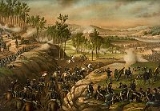
Battle of Resaca

Encyclopedia
The Battle of Resaca was part of the Atlanta Campaign
of the American Civil War
. The battle was waged in both Gordon
and Whitfield
counties, Georgia
, from May 13 - 15, 1864. It ended inconclusively with the Confederate Army retreating. The engagement was fought between the Military Division of the Mississippi
(led by Major General
William T. Sherman
) on the side of the Union
and the Army of Tennessee
(General Joseph E. Johnston
) for the Confederates
.
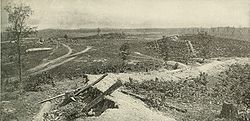 In early May 1864, the Confederate government granted Johnston's request for reinforcements to his camps around Dalton, Georgia
. As the brigade of Brigadier General James Cantey started to move through the city on May 7, 1864, cavalry scouts alerted Johnston that a large number of Union troops were moving towards Rome, Georgia
, on roads that led through Resaca. During the remainder of May 7 and the day of May 8 Cantey's brigade had time to entrench and set up defenses.
On May 9, the Army of the Tennessee
under the command of James B. McPherson
moved out of Snake Creek Gap and immediately ran into a Confederate cavalry brigade ordered to scout the area the day before under the command of Colonel Warren Grigsby. After a fierce battle, Brigadier General Thomas W. Sweeny formed a defensive line and drove the Confederates back to Resaca, several miles to the east.
Sherman's plan, as written in his memoirs, was to hold the railroad and telegraph lines south of Dalton, so as Johnston would either evacuate his position at Dalton or detach a section of his army to fight Sherman on a ground that had more of an advantage to Sherman. He devoted the Army of the Tennessee for this, while the Army of the Cumberland
and the Army of the Ohio
, commanded by George H. Thomas and John M. Schofield, respectively, would feign attacks in the Confederates's front.
As McPherson's two Corps left the woods, they skirmished with Confederate cavalry for a while until the cavalry was able to withdraw to a line of fortifications on the outer edge of the city, where they were reinforced by the 37th Mississippi, a regiment in James Cantey's brigade.
In the evening, Sherman sent his only cavalry, the 9th Illinois Mounted Infantry, northeast to scout out the best route to the Western & Atlantic Railroad. Meanwhile, skirmishers in Major General Grenville Dodge's
XVI Corps
moved to attack a line of fortifications along Camp Creek, held by Confederate cavalry, the remainders of Cantey's brigade, two twelve pound Napoleonic era batteries and a fresh brigade under Confederate brigadier general Daniel H. Reynolds, which was the lead of the column of 20,000 men sent out from Atlanta by John Bell Hood.
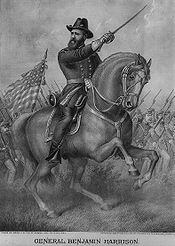
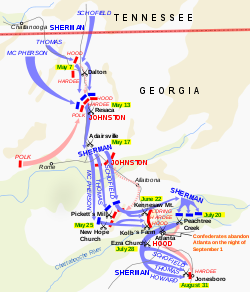 Johnston had withdrawn his forces from Rocky Face Ridge
to the hills around Resaca
. On May 13, the Union troops tested the Rebel lines to pinpoint their whereabouts. The next day full scale fighting occurred, and the Union troops were generally repulsed except on the Rebel right flank where Sherman did not fully exploit his advantage. On May 15, the battle continued with no advantage to either side until Sherman sent a force across the Oostanaula River
, at Lay's Ferry, using newly delivered Cumberland pontoon bridges
and advanced towards Johnston's railroad supply line. Unable to halt this Union turning movement, Johnston was forced to retire, leading to the Battle of Adairsville on May 17.
Atlanta Campaign
The Atlanta Campaign was a series of battles fought in the Western Theater of the American Civil War throughout northwest Georgia and the area around Atlanta during the summer of 1864. Union Maj. Gen. William T. Sherman invaded Georgia from the vicinity of Chattanooga, Tennessee, beginning in May...
of the American Civil War
American Civil War
The American Civil War was a civil war fought in the United States of America. In response to the election of Abraham Lincoln as President of the United States, 11 southern slave states declared their secession from the United States and formed the Confederate States of America ; the other 25...
. The battle was waged in both Gordon
Gordon County, Georgia
Gordon County is a county located in the U.S. state of Georgia. As of 2000, the population was 44,104. The 2007 Census Estimate shows a population of 52,044. The county seat is Calhoun.- History :...
and Whitfield
Whitfield County, Georgia
Whitfield County is a county located in the U.S. state of Georgia. It was created on December 30, 1851. The 2010 Census shows a population of 102,599. The county seat is Dalton.It is part of the Dalton, Georgia, Metropolitan Statistical Area.-Civil War:...
counties, Georgia
Georgia (U.S. state)
Georgia is a state located in the southeastern United States. It was established in 1732, the last of the original Thirteen Colonies. The state is named after King George II of Great Britain. Georgia was the fourth state to ratify the United States Constitution, on January 2, 1788...
, from May 13 - 15, 1864. It ended inconclusively with the Confederate Army retreating. The engagement was fought between the Military Division of the Mississippi
Military Division of the Mississippi
The Military Division of the Mississippi was an administrative division of the United States Army during the American Civil War that controlled all military operations in the Western Theater.-History:...
(led by Major General
Major general (United States)
In the United States Army, United States Marine Corps, and United States Air Force, major general is a two-star general-officer rank, with the pay grade of O-8. Major general ranks above brigadier general and below lieutenant general...
William T. Sherman
William Tecumseh Sherman
William Tecumseh Sherman was an American soldier, businessman, educator and author. He served as a General in the Union Army during the American Civil War , for which he received recognition for his outstanding command of military strategy as well as criticism for the harshness of the "scorched...
) on the side of the Union
Union Army
The Union Army was the land force that fought for the Union during the American Civil War. It was also known as the Federal Army, the U.S. Army, the Northern Army and the National Army...
and the Army of Tennessee
Army of Tennessee
The Army of Tennessee was the principal Confederate army operating between the Appalachian Mountains and the Mississippi River during the American Civil War. It was formed in late 1862 and fought until the end of the war in 1865, participating in most of the significant battles in the Western Theater...
(General Joseph E. Johnston
Joseph E. Johnston
Joseph Eggleston Johnston was a career U.S. Army officer, serving with distinction in the Mexican-American War and Seminole Wars, and was also one of the most senior general officers in the Confederate States Army during the American Civil War...
) for the Confederates
Confederate States of America
The Confederate States of America was a government set up from 1861 to 1865 by 11 Southern slave states of the United States of America that had declared their secession from the U.S...
.
Background
Dalton, Georgia
Dalton is a city in Whitfield County, Georgia, United States. It is the county seat of Whitfield County and the principal city of the Dalton, Georgia Metropolitan Statistical Area, which encompasses all of both Murray and Whitfield counties. As of the 2010 census, the city had a population of 33,128...
. As the brigade of Brigadier General James Cantey started to move through the city on May 7, 1864, cavalry scouts alerted Johnston that a large number of Union troops were moving towards Rome, Georgia
Rome, Georgia
Located in the foothills of the Appalachian Mountains, Rome is the largest city and the county seat of Floyd County, Georgia, United States. It is the principal city of the Rome, Georgia Metropolitan Statistical Area which encompasses all of Floyd County...
, on roads that led through Resaca. During the remainder of May 7 and the day of May 8 Cantey's brigade had time to entrench and set up defenses.
On May 9, the Army of the Tennessee
Army of the Tennessee
The Army of the Tennessee was a Union army in the Western Theater of the American Civil War, named for the Tennessee River. It should not be confused with the similarly named Army of Tennessee, a Confederate army named after the State of Tennessee....
under the command of James B. McPherson
James B. McPherson
James Birdseye McPherson was a career United States Army officer who served as a General in the Union Army during the American Civil War...
moved out of Snake Creek Gap and immediately ran into a Confederate cavalry brigade ordered to scout the area the day before under the command of Colonel Warren Grigsby. After a fierce battle, Brigadier General Thomas W. Sweeny formed a defensive line and drove the Confederates back to Resaca, several miles to the east.
Sherman's plan, as written in his memoirs, was to hold the railroad and telegraph lines south of Dalton, so as Johnston would either evacuate his position at Dalton or detach a section of his army to fight Sherman on a ground that had more of an advantage to Sherman. He devoted the Army of the Tennessee for this, while the Army of the Cumberland
Army of the Cumberland
The Army of the Cumberland was one of the principal Union armies in the Western Theater during the American Civil War. It was originally known as the Army of the Ohio.-History:...
and the Army of the Ohio
Army of the Ohio
The Army of the Ohio was the name of two Union armies in the American Civil War. The first army became the Army of the Cumberland and the second army was created in 1863.-History:...
, commanded by George H. Thomas and John M. Schofield, respectively, would feign attacks in the Confederates's front.
As McPherson's two Corps left the woods, they skirmished with Confederate cavalry for a while until the cavalry was able to withdraw to a line of fortifications on the outer edge of the city, where they were reinforced by the 37th Mississippi, a regiment in James Cantey's brigade.
In the evening, Sherman sent his only cavalry, the 9th Illinois Mounted Infantry, northeast to scout out the best route to the Western & Atlantic Railroad. Meanwhile, skirmishers in Major General Grenville Dodge's
Grenville M. Dodge
Grenville Mellen Dodge was a Union army officer on the frontier and during the Civil War, a U.S. Congressman, businessman, and railroad executive who helped construct the Transcontinental Railroad....
XVI Corps
XVI Corps
XVI Corps can refer to:*XVI Corps , active in the First and Second World Wars*XVI Corps *XVI Corps *XVI Corps , a field corps of the Indian Army...
moved to attack a line of fortifications along Camp Creek, held by Confederate cavalry, the remainders of Cantey's brigade, two twelve pound Napoleonic era batteries and a fresh brigade under Confederate brigadier general Daniel H. Reynolds, which was the lead of the column of 20,000 men sent out from Atlanta by John Bell Hood.
Battle
Battle of Rocky Face Ridge
The Battle of Rocky Face Ridge was fought May 7–13, 1864, in Whitfield County, Georgia, during the Atlanta Campaign of the American Civil War. The Union army was led by Maj. Gen. William Tecumseh Sherman and the Confederate army by Gen. Joseph E. Johnston...
to the hills around Resaca
Resaca, Georgia
Resaca is a city in Gordon County, Georgia, and Whitfield County, Georgia along the Oostanaula River. The population was 815 at the 2000 census.-Geography:Resaca is located at ....
. On May 13, the Union troops tested the Rebel lines to pinpoint their whereabouts. The next day full scale fighting occurred, and the Union troops were generally repulsed except on the Rebel right flank where Sherman did not fully exploit his advantage. On May 15, the battle continued with no advantage to either side until Sherman sent a force across the Oostanaula River
Oostanaula River
The Oostanaula River is a principal tributary of the Coosa River, about long, in northwestern Georgia in the United States. Via the Coosa and Alabama rivers, it is part of the watershed of the Mobile River, which flows to the Gulf of Mexico. Its name is said to come from a Cherokee Indian term...
, at Lay's Ferry, using newly delivered Cumberland pontoon bridges
Cumberland Pontoons
Cumberland pontoons were a novel design of pontoon bridges developed during the American Civil War to facilitate the movement of Union forces across the rivers of the Mid-South as the Federal forces advanced southward through Tennessee and Georgia....
and advanced towards Johnston's railroad supply line. Unable to halt this Union turning movement, Johnston was forced to retire, leading to the Battle of Adairsville on May 17.