

Battle of Posada

Encyclopedia
The Battle of Posada was fought between Basarab I of Wallachia
and Charles I Robert
of Hungary
.
The small Wallachian army led by Basarab, formed of cavalry
, foot archer
s, as well as local peasants, managed to ambush and defeat the 30,000-strong Hungarian army, in a mountainous region near the border between Oltenia
and Severin
.
The battle resulted in a major Wallachian victory and disaster for Charles Robert, becoming a turning point in the politics of Hungary, which had to abandon its hopes of extending the kingdom to the Black Sea
. For Wallachia, the victory meant an increase in morale and the further independent evolution of the state.
 Some historians claim that the Cumans
aided the Wallachians in the battle. In 1324, Wallachia was a vassal of Hungary, and Robert referred to Basarab as "our Transalpine Voivode".
The war started with encouragement from the Voivode of Transylvania
and a certain Dionisie, who later bore the title Ban of Severin
. In 1330, Robert captured the long disputed Wallachian citadel of Severin
and handed it to the Transylvanian Voivode.
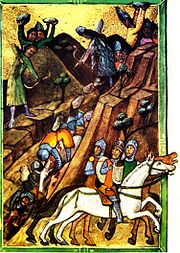
Basarab sent envoys who asked for the hostilities to cease, and in return offered to pay 7,000 marks in silver, submit the fortress of Severin to Robert, and send his own son as hostage. According to the Viennese Illuminated Chronicle, a contemporary account, Robert would have said about Basarab: "He is the shepherd of my sheep, and I will take him out of his mountains, dragging him by his beard. Another account writes that Robert said that he will drag the Voivode from his cottage, as would any driver his oxen or shepherd his sheep."
The King's councillors begged him to accept the offer or give a milder reply, but he refused and led his 30,000-strong army deeper into Wallachia "without proper supplies or adequate reconnaissance". Basarab was unable to stand a battle in the open field against a large army, owing to the poor state of his troops, and he decided to retreat somewhere into the mountains of Transylvanian Alps.
Robert entered Curtea de Argeş
, the main city of the Wallachian state. He realised that Basarab had fled into the mountains and decided to give chase. After many days of difficult marching in the Carpathian Mountains
, with his troops beginning to starve, the king and Basarab agreed to an armistice, with the condition that the latter would provide guides who knew the way out of the mountains and would lead the army back to the Hungarian plain by the shortest route.
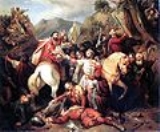
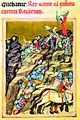
The guides, however, were ordered to lead the Hungarians into an ambush. When the army entered a ravine, the Wallachians started to attack them from all sides, shooting arrows and pelting them with trees and stones.
 The location of the battle is still debated among historians. One theory gives the location of the battle at Loviştea, in some mountain gorges, in the valley of Olt
, Transylvania
. However, Romanian historian Neagu Djuvara
denies this and states that the location of the battle would be somewhere at the border between Oltenia
and Severin regions.
The Wallachian army, led by Basarab himself, probably numbered less than 10,000 men and consisted of cavalry, pedestrian archers and some locally recruited peasants. When Robert saw his best knights being killed, without being able to fight back, while the escape routes were blocked by the Wallachian cavalry, he gave his royal robes and insignia to one of his captains – "who dies under a hail of arrows and stones" – and with a few loyal subjects made a difficult escape to Visegrád
"clad in dirty civilian clothes."
Robert later recounted in detail, in a charter of December 13, 1335, how one "Nicholas", son of a "Radoslav", saved his life by defending him from the swords of five Wallachian warriors, giving him enough time to escape. Most of the Hungarian army – which included many nobles – was destroyed; among the casualties were the Voivode of Transylvania and the priest who accompanied the King.
Because of its large financial power, the Kingdom of Hungary quickly rebuilt its army and found itself in conflict with the Holy Roman Empire
in 1337. However, the Hungarian King maintained a de-jure suzeranity
over Wallachia until the diplomatic disputes had been solved.
Wallachia
Wallachia or Walachia is a historical and geographical region of Romania. It is situated north of the Danube and south of the Southern Carpathians...
and Charles I Robert
Charles I of Hungary
Charles I , also known as Charles Robert , was the first King of Hungary and Croatia of the House of Anjou. He was also descended from the old Hungarian Árpád dynasty. His claim to the throne of Hungary was contested by several pretenders...
of Hungary
Hungary
Hungary , officially the Republic of Hungary , is a landlocked country in Central Europe. It is situated in the Carpathian Basin and is bordered by Slovakia to the north, Ukraine and Romania to the east, Serbia and Croatia to the south, Slovenia to the southwest and Austria to the west. The...
.
The small Wallachian army led by Basarab, formed of cavalry
Cavalry
Cavalry or horsemen were soldiers or warriors who fought mounted on horseback. Cavalry were historically the third oldest and the most mobile of the combat arms...
, foot archer
Archery
Archery is the art, practice, or skill of propelling arrows with the use of a bow, from Latin arcus. Archery has historically been used for hunting and combat; in modern times, however, its main use is that of a recreational activity...
s, as well as local peasants, managed to ambush and defeat the 30,000-strong Hungarian army, in a mountainous region near the border between Oltenia
Oltenia
Oltenia is a historical province and geographical region of Romania, in western Wallachia. It is situated between the Danube, the Southern Carpathians and the Olt river ....
and Severin
Caras-Severin County
Caraș-Severin is a county of Romania, in the historical region of Banat and few villages in Transylvania, with the county seat at Reșița.-Demographics:The county is part of the Danube-Kris-Mureș-Tisza euroregion....
.
The battle resulted in a major Wallachian victory and disaster for Charles Robert, becoming a turning point in the politics of Hungary, which had to abandon its hopes of extending the kingdom to the Black Sea
Black Sea
The Black Sea is bounded by Europe, Anatolia and the Caucasus and is ultimately connected to the Atlantic Ocean via the Mediterranean and the Aegean seas and various straits. The Bosphorus strait connects it to the Sea of Marmara, and the strait of the Dardanelles connects that sea to the Aegean...
. For Wallachia, the victory meant an increase in morale and the further independent evolution of the state.
Background
Cumans
The Cumans were Turkic nomadic people comprising the western branch of the Cuman-Kipchak confederation. After Mongol invasion , they decided to seek asylum in Hungary, and subsequently to Bulgaria...
aided the Wallachians in the battle. In 1324, Wallachia was a vassal of Hungary, and Robert referred to Basarab as "our Transalpine Voivode".
The war started with encouragement from the Voivode of Transylvania
Transylvania
Transylvania is a historical region in the central part of Romania. Bounded on the east and south by the Carpathian mountain range, historical Transylvania extended in the west to the Apuseni Mountains; however, the term sometimes encompasses not only Transylvania proper, but also the historical...
and a certain Dionisie, who later bore the title Ban of Severin
Severin
Severin, Séverin or Severinus may refer to:* Severin -Places:* Caraş-Severin County, a county in Romania* Severin County, a defunct county in Romania that was merged into the present Caraş-Severin County...
. In 1330, Robert captured the long disputed Wallachian citadel of Severin
Drobeta-Turnu Severin
Drobeta-Turnu Severin is a city in Mehedinţi County, Oltenia, Romania, on the left bank of the Danube, below the Iron Gates.The city administers three villages: Dudaşu Schelei, Gura Văii, and Schela Cladovei...
and handed it to the Transylvanian Voivode.
Basarab sent envoys who asked for the hostilities to cease, and in return offered to pay 7,000 marks in silver, submit the fortress of Severin to Robert, and send his own son as hostage. According to the Viennese Illuminated Chronicle, a contemporary account, Robert would have said about Basarab: "He is the shepherd of my sheep, and I will take him out of his mountains, dragging him by his beard. Another account writes that Robert said that he will drag the Voivode from his cottage, as would any driver his oxen or shepherd his sheep."
The King's councillors begged him to accept the offer or give a milder reply, but he refused and led his 30,000-strong army deeper into Wallachia "without proper supplies or adequate reconnaissance". Basarab was unable to stand a battle in the open field against a large army, owing to the poor state of his troops, and he decided to retreat somewhere into the mountains of Transylvanian Alps.
Robert entered Curtea de Argeş
Curtea de Arges
Curtea de Argeș is a city in Romania on the right bank of the Argeş River, where it flows through a valley of the lower Carpathians , on the railway from Pitești to the Turnu Roşu Pass. It is part of Argeș County. The city administers one village, Noapteș...
, the main city of the Wallachian state. He realised that Basarab had fled into the mountains and decided to give chase. After many days of difficult marching in the Carpathian Mountains
Carpathian Mountains
The Carpathian Mountains or Carpathians are a range of mountains forming an arc roughly long across Central and Eastern Europe, making them the second-longest mountain range in Europe...
, with his troops beginning to starve, the king and Basarab agreed to an armistice, with the condition that the latter would provide guides who knew the way out of the mountains and would lead the army back to the Hungarian plain by the shortest route.
The guides, however, were ordered to lead the Hungarians into an ambush. When the army entered a ravine, the Wallachians started to attack them from all sides, shooting arrows and pelting them with trees and stones.
Battle
Olt
Olt may refer to:* Olt Online Taxes, a tax website for USA Taxpayers* Olt County, a county of Romania* Olt Defile, a defile that has been cut into the Transyvanian Alps in south-central Romania by the Olt River* Olt River, a river in Romnia...
, Transylvania
Transylvania
Transylvania is a historical region in the central part of Romania. Bounded on the east and south by the Carpathian mountain range, historical Transylvania extended in the west to the Apuseni Mountains; however, the term sometimes encompasses not only Transylvania proper, but also the historical...
. However, Romanian historian Neagu Djuvara
Neagu Djuvara
Neagu Djuvara is a Romanian historian, essayist, philosopher, journalist, novelist, and diplomat.-Early life:A native of Bucharest, he descended from an aristocratic Aromanian family...
denies this and states that the location of the battle would be somewhere at the border between Oltenia
Oltenia
Oltenia is a historical province and geographical region of Romania, in western Wallachia. It is situated between the Danube, the Southern Carpathians and the Olt river ....
and Severin regions.
The Wallachian army, led by Basarab himself, probably numbered less than 10,000 men and consisted of cavalry, pedestrian archers and some locally recruited peasants. When Robert saw his best knights being killed, without being able to fight back, while the escape routes were blocked by the Wallachian cavalry, he gave his royal robes and insignia to one of his captains – "who dies under a hail of arrows and stones" – and with a few loyal subjects made a difficult escape to Visegrád
Visegrád
Visegrád is a small castle town in Pest County, Hungary.Situated north of Budapest on the right bank of the Danube in the Danube Bend, Visegrád has a population 1,654 as of 2001...
"clad in dirty civilian clothes."
Robert later recounted in detail, in a charter of December 13, 1335, how one "Nicholas", son of a "Radoslav", saved his life by defending him from the swords of five Wallachian warriors, giving him enough time to escape. Most of the Hungarian army – which included many nobles – was destroyed; among the casualties were the Voivode of Transylvania and the priest who accompanied the King.
Aftermath
The victory represented the survival of the Wallachian state, as well as the beginning of a period of tense relationship between Basarab and the Kingdom of Hungary, which lasted until 1344 when Basarab sent his son Alexandru in order to re-establish a relationship between the two states.Because of its large financial power, the Kingdom of Hungary quickly rebuilt its army and found itself in conflict with the Holy Roman Empire
Holy Roman Empire
The Holy Roman Empire was a realm that existed from 962 to 1806 in Central Europe.It was ruled by the Holy Roman Emperor. Its character changed during the Middle Ages and the Early Modern period, when the power of the emperor gradually weakened in favour of the princes...
in 1337. However, the Hungarian King maintained a de-jure suzeranity
Feudalism
Feudalism was a set of legal and military customs in medieval Europe that flourished between the 9th and 15th centuries, which, broadly defined, was a system for ordering society around relationships derived from the holding of land in exchange for service or labour.Although derived from the...
over Wallachia until the diplomatic disputes had been solved.