
All Topics  
Battle of Perryville


   Email Print
   Bookmark   Link


Battle of Perryville


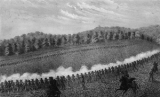
The Battle of Perryville, also known as the Battle of Chaplin Hills, was fought on October 8, 1862, in the Chaplin Hills west of Perryville, KentuckyPerryville, Kentucky

Perryville is a city in Boyle County, Kentucky, United States....
, as the culmination of the Confederate Heartland OffensiveConfederate Heartland Offensive

The Confederate Heartland Offensive or Kentucky Campaign was a series of maneuvers and battles in East Tennessee and K...
 (Kentucky Campaign) during the American Civil WarAmerican Civil War

The American Civil War was a sectional conflict in the United States of America between the federal government and 11 Sout...
. ConfederateConfederate States Army

The Confederate States Army was formed in February 1861 to defend the Confederate States of America, which had itself been f...
 Gen. Braxton BraggBraxton Bragg

Braxton Bragg was a career U.S. Army officer and a general in the Confederate States Army, a principal commander in the West...
's Army of MississippiArmy of Mississippi

There were three organizations known as the Army of Mississippi in the Confederate States Army during the American Civil War...
  won a tactical victory against primarily a single corps of Maj. Gen.Major General

Major General or Major-General is a military rank used in many countries....
 Don Carlos BuellDon Carlos Buell

Don Carlos Buell was a career U.S....
's UnionUnion Army

The Union Army refers to the United States Army during the American Civil War....
 Army of the OhioArmy of the Ohio

The Army of the Ohio was the name of two Union armies in the American Civil War....
. The battle is considered a strategic Union victory, sometimes called the Battle for Kentucky, because Bragg withdrew to TennesseeTennessee

Tennessee is a U.S. state located in the Southern United States....
 soon thereafter, leaving the critical border state of Kentucky in Union hands for the remainder of the war.

On October 7, Buell's army, in pursuit of Bragg, converged on the small crossroads town of Perryville in three columns. Union forces first skirmished with Confederate cavalry on the Springfield Pike before the fighting became more general, on Peters Hill, as the Confederate infantry arrived, both sides desperate to get access to fresh water.


Discussion
Ask a question about 'Battle of Perryville'
Start a new discussion about 'Battle of Perryville'
Answer questions from other users
Full Discussion Forum


Timeline

1862   American Civil War: Battle of Perryville - Union forces under General Don Carlos Buell halt the Confederate invasion of Kentucky by defeating troops led by General Braxton Bragg at Perryville, Kentucky.


Encyclopedia


The Battle of Perryville, also known as the Battle of Chaplin Hills, was fought on October 8, 1862, in the Chaplin Hills west of Perryville, KentuckyPerryville, Kentucky

Perryville is a city in Boyle County, Kentucky, United States....
, as the culmination of the Confederate Heartland OffensiveConfederate Heartland Offensive

The Confederate Heartland Offensive or Kentucky Campaign was a series of maneuvers and battles in East Tennessee and K...
 (Kentucky Campaign) during the American Civil WarAmerican Civil War

The American Civil War was a sectional conflict in the United States of America between the federal government and 11 Sout...
. ConfederateConfederate States Army

The Confederate States Army was formed in February 1861 to defend the Confederate States of America, which had itself been f...
 Gen. Braxton BraggBraxton Bragg

Braxton Bragg was a career U.S. Army officer and a general in the Confederate States Army, a principal commander in the West...
's Army of MississippiArmy of Mississippi

There were three organizations known as the Army of Mississippi in the Confederate States Army during the American Civil War...
  won a tactical victory against primarily a single corps of Maj. Gen.Major General

Major General or Major-General is a military rank used in many countries....
 Don Carlos BuellDon Carlos Buell

Don Carlos Buell was a career U.S....
's UnionUnion Army

The Union Army refers to the United States Army during the American Civil War....
 Army of the OhioArmy of the Ohio

The Army of the Ohio was the name of two Union armies in the American Civil War....
. The battle is considered a strategic Union victory, sometimes called the Battle for Kentucky, because Bragg withdrew to TennesseeTennessee

Tennessee is a U.S. state located in the Southern United States....
 soon thereafter, leaving the critical border state of Kentucky in Union hands for the remainder of the war.

On October 7, Buell's army, in pursuit of Bragg, converged on the small crossroads town of Perryville in three columns. Union forces first skirmished with Confederate cavalry on the Springfield Pike before the fighting became more general, on Peters Hill, as the Confederate infantry arrived, both sides desperate to get access to fresh water. The next day, at dawn, fighting began again around Peters Hill as a Union division advanced up the pike, halting just before the Confederate line. After noon, a Confederate division struck the Union left flank—the I CorpsI Corps (ACW)

I Corps was the designation of three different corps-sized units in the Union Army during the American Civil War....
 of Maj. Gen. Alexander M. McCookAlexander McDowell McCook

Alexander McDowell McCook was a career U.S....
—and forced it to fall back. When more Confederate divisions joined the fray, the Union line made a stubborn stand, counterattacked, but finally fell back with some troops routed.

Buell, a couple of miles behind the action, was not aware that a battle was taking place and did not send any reserves to the front until late in the afternoon. The Union troops on the left flank, reinforced by two brigades, stabilized their line, and the Confederate attack sputtered to a halt. Later, three Confederate regiments assaulted the Union division on the Springfield Pike but were repulsed and fell back into Perryville. Union troops pursued, and skirmishing occurred in the streets in the evening before dark. By that time, Union reinforcements were threatening the Confederate left flank. Bragg, short of men and supplies, withdrew during the night, and continued the Confederate retrograde by way of Cumberland GapCumberland Gap Overview

The Cumberland Gap is a pass across the Cumberland Mountains region of the Appalachian Mountains....
 into East TennesseeEast Tennessee

style="float:right; margin: 0 0 1em 1em;">...
.

Considering the casualties for the engaged strengths of the armies, the Battle of Perryville was one of the bloodiest battles of the Civil War, and the largest battle fought in the state of Kentucky.

Kentucky Campaign of 1862

Situated between the Southern statesSouthern United States

The Southern United States or the South constitutes a distinctive region covering a large portion of the United States...
 of TennesseeFacts About Tennessee

Tennessee is a U.S. state located in the Southern United States....
 and VirginiaVirginia

The Commonwealth of Virginia is one of the original thirteen colonies of the United States that revolted against British ru...
 and the Northern statesNorthern United States

The Northern United States or simply The North, is a region in the United States of America....
 of IllinoisIllinois Summary

Illinois is the 21st U.S. state and is located in the Midwest region of the United States of America....
, IndianaIndiana Overview

Indiana, meaning the "Land of the Indians," is a state in the Great Lakes region of the Midwestern United States....
, and OhioOhio

Ohio is a Midwestern state of the United States....
, the border state of Kentucky was coveted by both sides of the conflict because of its central location and its control of key rivers, such as the OhioOhio River

The Ohio River is a principal tributary of the Mississippi River....
. In September 1861, Kentucky-born PresidentPresident of the United States

The President of the United States of America is the head of state of the United States....
 Abraham LincolnAbraham Lincoln

Abraham Lincoln , sometimes called Abe Lincoln and nicknamed Honest Abe, the Rail Splitter, and the Gre...
 wrote in a private letter, "I think to lose Kentucky is nearly to lose the whole game."

Opposing viewpoints within the state vied for control during the early part of the war, and the state legislature declared official neutrality between the combatants. This neutrality was first violated on September 3, 1861, when Confederate Maj. Gen. Leonidas PolkLeonidas Polk

Leonidas Polk was a Confederate general who was once a planter in Maury County, Tennessee, and a third cousin of President J...
 occupied ColumbusColumbus, Kentucky

Columbus is a city in Hickman County, Kentucky, United States....
, considered key to controlling the Lower MississippiMississippi River

The Mississippi River, derived from the old Ojibwe word misi-ziibi meaning 'great river' , is the longest river in the U...
, and two days later Union Brig. Gen.Brigadier General

Brigadier General is the lowest rank of general officer in some countries, usually ranking just above Colonel and just below...
 Ulysses S. GrantUlysses S. Grant

Ulysses S. Grant was an American soldier and politician who was elected the 18th President of the United States ....
 seized PaducahPaducah, Kentucky

Paducah is a city in McCracken County, Kentucky at the confluence of the Tennessee River and the Ohio River....
. Henceforth, neither adversary respected the proclaimed neutrality of the state. While the state never secededSecession Overview

Secession is the act of withdrawing from an organization, union, or political entity....
 from the Union, a temporary Confederate capital was set up in Bowling GreenBowling Green, Kentucky Overview

Bowling Green is the fourth-most populous city in the U.S....
 in November 1861. This prompted recognition of Kentucky by the Confederate States and the addition of a star representing Kentucky to the Confederate flagFlags of the Confederate States of America

The following flags were used by the Confederate States of America....
.

The initiative to invade Kentucky came primarily from Confederate Maj. Gen. Edmund Kirby SmithEdmund Kirby Smith

Edmund Kirby Smith was a career U.S....
, commander of the Department of East Tennessee. He believed the campaign would allow them to obtain supplies, enlist recruits, divert Union troops from Tennessee, and claim Kentucky for the Confederacy. Some of his enthusiasm for generating enlistments in Kentucky was prompted by a successful cavalry raid carried out in July 1862 by Col.Colonel (United States) Overview

Please see "Colonel" for other countries which use this rank...
 John Hunt MorganFacts About John Hunt Morgan

John Hunt Morgan was a Confederate general and cavalry officer in the American Civil War....
, who ventured deeply into the rear areas of Buell's department and caused considerable consternation in his command and in Washington, D.C.Washington, D.C.

Washington, D.C. is the capital city of the United States of America....
 Morgan had been cheered and supported during his raid and he added 300 Kentuckians to his 900 man force during the raid. He confidently promised Kirby Smith, "The whole country can be secured, and 25,000 or 30,000 men will join you at once."

Bragg considered various options, including an attempt to retake Corinth, MississippiCorinth, Mississippi

Corinth is a city in Alcorn County, Mississippi, United States....
, or to advance against Buell's army through Middle TennesseeMiddle Tennessee

le Tennessee is known for its rolling hills and fertile stream valleys, as well as for its major city, Nashville, which is the sta...
. He eventually heeded Kirby Smith's calls for reinforcement and decided to relocate his Army of Mississippi to join with him. He moved 30,000 infantrymen in a tortuous railroad journey from Tupelo, MississippiFacts About Tupelo, Mississippi

Tupelo, birthplace of Elvis Presley...
, through MobileMobile, Alabama

Mobile is a city located in Mobile County, Alabama, US, along Mobile Bay....
 and MontgomeryMontgomery, Alabama

Montgomery is the capital of the U.S....
 to ChattanoogaChattanooga, Tennessee

Chattanooga is the fourth-largest city in Tennessee, and the seat of Hamilton County, in the United States of America....
. Supply wagons, cavalry, and artillery moved overland under their own power through Rome, GeorgiaRome, Georgia

Rome is the largest city in and the county seat of Floyd County, Georgia, United States....
. Although Bragg was the senior general in the theater, Confederate PresidentPresident of the Confederate States of America

The President of the Confederate States of America was the Head of State of the short-lived republic of the Confederate Stat...
 Jefferson DavisJefferson Davis

Jefferson Davis was an American statesman and advocate for slavery and, until he became president, for States' Rights....
 had established Kirby Smith's Department of East Tennessee as an independent command, reporting directly to RichmondRichmond, Virginia

Richmond is the capital of the Commonwealth of Virginia, in the United States of America....
, a decision that would cause Bragg difficulty during the campaign.

Kirby Smith and Bragg met together in Chattanooga on July 31, 1862, and devised a plan for the campaign: The newly created Army of Kentucky, including two of Bragg's brigadeBrigade

Brigade is a term from military science which refers to military echelon under a division, above a regiment where that exist...
s and approximately 21,000 men, would march north under Kirby Smith's command into Kentucky to dispose of the Union defenders of Cumberland Gap. (Bragg's army was too exhausted from its long journey to begin immediate offensive operations.) Kirby Smith would return to join with Bragg and the combined force would attempt to maneuver into Buell's rear and force a battle to protect his supply lines. Any attempt by Ulysses S. Grant to reinforce Buell from northern Mississippi would be handled by the two small armies of Maj. Gens. Sterling PriceSterling Price

Sterling "Old Pap" Price was an antebellum politician from the U.S....
 and Earl Van DornEarl Van Dorn

Earl Van Dorn was a career U.S. Army officer and a Confederate major general during the American Civil War....
. Once the armies were combined, Bragg's seniority would apply and Kirby Smith would be under his direct command. Assuming that Buell's army could be destroyed, Bragg and Kirby Smith would march north into Kentucky, a movement they assumed would be welcomed by the local populace. Any remaining Federal force would be defeated in a grand battle in Kentucky, establishing the Confederate frontier at the Ohio River.

The campaign plan was bold but risky, requiring perfect coordination between multiple armies that would initially have no unity of command. Bragg almost immediately began to have second thoughts, despite pressure from President Davis to take Kentucky. Kirby Smith quickly abandoned the agreement, foreseeing that a solo adventure in Kentucky would bring him personal glory. He deceived Bragg as to his intentions and requested two additional brigades, ostensibly for his expedition to Cumberland Gap. On August 9, Kirby Smith informed Bragg that he was breaking the agreement and intended to bypass Cumberland Gap, leaving a small holding force to neutralize the Union garrison, and to move north. Unable to command Kirby Smith to honor the agreement, Bragg focused his attention on a movement to LexingtonLexington, Kentucky

Lexington, Kentucky, United States, known as the "Horse Capital of the World," is located in the heart of the Bluegrass regi...
 instead of NashvilleNashville, Tennessee

Nashville is the capital of the U.S....
, cautioning Kirby Smith not to forget that Buell could pursue him and defeat his smaller army in detail before Bragg's army could join up with them.

Kirby Smith marched north with 21,000 men from Knoxville on August 13; Bragg departed from Chattanooga on August 27, just before Kirby Smith reached Lexington. The beginning of the campaign coincided with Gen. Robert E. LeeRobert E. Lee

Robert Edward Lee was a career U.S....
's offensive in the Northern Virginia CampaignNorthern Virginia Campaign

The Northern Virginia Campaign, also known as the Second Bull Run Campaign or Second Manassas Campaign, was a se...
 (Second Manassas Campaign) and with Price's and Van Dorn's operations against Grant. Although not centrally directed, it was the largest simultaneous Confederate offensive of the war.

Meanwhile, Buell was forced to abandon his slow advance toward Chattanooga. Receiving word of the Confederate movements, he decided to concentrate his army around Nashville. The news that Smith and Bragg were both in Kentucky convinced him of the need to get his army between the Confederates and the Union cities of LouisvilleLouisville, Kentucky

Louisville is Kentucky's largest city....
 and CincinnatiCincinnati, Ohio

Cincinnati is a southwestern Ohio city in the United States that lies on the Ohio River and is the county seat of Hamilton C...
. On September 7, Buell's Army of the Ohio left Nashville and began racing Bragg to Louisville.

On the way, Bragg was distracted from his objective by the capture of a Union fort at MunfordvilleBattle of Munfordville

The Battle of Munfordville was a September 1862 engagement in Kentucky during the American Civil War....
. Now, he had to decide again whether to continue toward a fight with Buell (over Louisville) or rejoin Smith, who had gained control of the center of the state by capturing RichmondBattle of Richmond

The Battle of Richmond, Kentucky, the arguably most complete Confederate victory in the American Civil War, took place on wh...
 and Lexington, and threatened to move on Cincinnati. He chose to rejoin Smith. This allowed Buell to reach Louisville where the Union general gathered, reorganized, and reinforced his army with thousands of new recruits. He dispatched 20,000 men under Brig. Gen. Joshua W. SillJoshua W. Sill

Joshua Woodrow Sill was an officer in the United States Army, before and during the American Civil War. ...
 toward FrankfortFacts About Frankfort, Kentucky

Frankfort is the capital of Kentucky, a state of the United States of America....
, hoping to distract Kirby Smith and prevent the two Confederate armies from joining against him. Meanwhile, Bragg left his army and met Kirby Smith in Frankfort, where he was able to attend the inaugurationFacts About Inauguration

An inauguration is a ceremony of formal investiture whereby an individual assumes an office or position of authority or powe...
 of Confederate Governor Richard HawesRichard Hawes Summary

Richard Hawes was a United States Representative from Kentucky and Confederate Governor of Kentucky....
 on October 4. The inauguration ceremony was disrupted by the sound of cannon fire from Sills's approaching division and the inaugural ball scheduled for that evening was canceled.

Opposing forces

Union


Image:Don Carlos Buell.jpg|
Image:George Henry Thomas - Brady-Handy.jpg|
Image:Alexander McDowell McCook.jpg|
Image:CCGilbert.jpg|

On October 1, Buell's Army of the Ohio left Louisville with Maj. Gen. George H. ThomasGeorge Henry Thomas

George Henry Thomas, the "Rock of Chickamauga", was a career U.S....
 as his second in command. (Two days earlier, Buell had received orders from Washington relieving him of command, to be replaced by Thomas. Thomas demurred, refusing to accept command while the campaign was underway, leaving Buell in place.) The 55,000 troops—many of whom Thomas described as "as yet undisciplined, unprovided with suitable artillery, and in every way unfit for active operations against a disciplined foe"—advanced toward Bragg's veteran army in BardstownBardstown, Kentucky

Bardstown is a city in Nelson County, Kentucky, United States....
 on three separate roads.

The I CorpsI Corps (ACW)

I Corps was the designation of three different corps-sized units in the Union Army during the American Civil War....
, commanded by Maj. Gen. Alexander M. McCookAlexander McDowell McCook

Alexander McDowell McCook was a career U.S....
, marched on the left, along the Mackville Road. His 13,000 men consisted of the 3rd Division, under Brig. Gen. Lovell H. Rousseau, and the 10th Division, under Brig. Gen. James S. JacksonJames S. Jackson

James Streshly Jackson was a U.S....
.

The II CorpsII Corps (ACW) Overview

There were five corps in the Union Army designated as II Corps during the American Civil War....
, commanded by Maj. Gen. Thomas L. Crittenden, marched on the right, along the Lebanon Road. His 20,000 men were in three divisions: the 4th, commanded by Brig. Gen. William Sooy SmithWilliam Sooy Smith

William Sooy Smith was a West Point graduate and career United States Army officer who rose through the ranks to become a B...
; the 5th, Brig. Gen. Horatio P. Van CleveHoratio P. Van Cleve

Horatio Phillips Van Cleve was a Union general in the American Civil War....
; and the 6th, Brig. Gen. Thomas J. WoodThomas J. Wood

Thomas John Wood was a Union General during the American Civil War....
.

The III CorpsIII Corps (ACW)

There were four formations in the Union Army designated as III Corps during the American Civil War....
, commanded by Maj. Gen. Charles Champion GilbertCharles Champion Gilbert

Charles Champion Gilbert was a U.S....
, took the center, along the Springfield Pike. Just a few weeks earlier, Gilbert had been a captain, but was elevated to acting major general and corps command following the death by murder of the previous commander, Maj. Gen. William "Bull" Nelson. Gilbert's 22,000 men were also in three divisions: the 1st, under Brig. Gen. Albin F. Schoepf; 9th, Brig. Gen. Robert B. Mitchell; and the 11th, Brig. Gen. Philip H. Sheridan.

Confederate


Image:Braxton Bragg.png|
Image:Leonidas Polk.jpg|
Image:William J. Hardee.jpg|

Bragg's Army of Mississippi consisted of about 16,800 men in two wings. The Right Wing, commanded by Maj. Gen. Leonidas PolkLeonidas Polk

Leonidas Polk was a Confederate general who was once a planter in Maury County, Tennessee, and a third cousin of President J...
, consisted of a single division under Maj. Gen. Benjamin F. CheathamBenjamin F. Cheatham Overview

Benjamin Franklin Cheatham, known also as Frank, was a Tennessee farmer, California gold miner, and a general in the C...
. The Left Wing, commanded by Maj. Gen. William J. HardeeWilliam J. Hardee

William Joseph Hardee was a career U.S....
, consisted of the divisions of Brig. Gen. J. Patton AndersonJames Patton Anderson

James Patton Anderson was a 19th century American politician, most notably as congressman of Tennessee, Mississippi state le...
 and Maj. Gen. Simon B. BucknerSimon Bolivar Buckner, Sr.

Simon Bolivar Buckner was a career U.S....
.

Prelude to battle

When he departed for Frankfort on September 28, Bragg left his army under Polk's command. On October 3, the approach of the large Union force caused the Confederates to withdraw eastward and Bardstown was occupied on October 4. Hardee's wing stopped at Perryville and requested reinforcements from Bragg. Although Bragg wished to concentrate his army at VersaillesVersailles, Kentucky

Versailles is a city in Woodford County, Kentucky, United States....
, the quickly approaching Federal III Corps forced the concentration at Perryville and HarrodsburgHarrodsburg, Kentucky

...
.

Hardee had selected Perryville for a few reasons. The village of approximately 300 residents had an excellent road network with connections to nearby towns in six directions, allowing for strategic flexibility. It was located to prevent the Federals from reaching the Confederate supply depot in BryantsvilleBryantsville, Kentucky

Bryantsville is an unincorporated community in Garrard County, Kentucky, United States....
. And finally, it was a potential source of water. The area had been afflicted by a drought for months. The heat was oppressive for both men and horses, and the few sources of drinking water provided by the rivers and creeks west of town—most reduced to isolated stagnant puddles—were desperately sought after.

On October 7, Buell reached the Perryville area as Union cavalry clashed with Wheeler's rearguard throughout the day. Accompanying III Corps, Buell learned that the Confederates had halted at Perryville and were deploying their infantry. He therefore planned an attack. The enemy force was his principal objective, but the availability of water also made control of the town and surrounding area desirable. Buell issued orders for all corps to move at 3 a.m. the next day and attack at 10 a.m. However, movements of the I and II Corps were delayed, deviating several miles from their line of march in search of water. Buell decided to delay his attack until October 9 to complete his army's deployment and ordered each corps commander to avoid a general engagement on October 8. Buell was unable to oversee the deployment of his arriving corps. Thrown from his horse, he suffered injuries that prevented him from riding. He established his headquarters at the Dorsey house, about 3 miles due west of town.

Hardee established a line of defense across the three roads leading into Perryville from the north and west. Until reinforcements could arrive, he was limited to three of the four brigades of Buckner's division. Brig. Gen. Sterling A. M. Wood was placed at the north of town. Brig. Gen. Bushrod JohnsonBushrod Johnson

Bushrod Rust Johnson was a teacher, university chancellor, and Confederate general in the American Civil War....
 was to Wood's right, east of the Chaplin RiverChaplin River

The Chaplin River is a tributary of the Beech Fork of the Salt River, Kentucky....
 near the Harrodsburg Pike. Brig. Gen. St. John R. Liddell'sSt. John Richardson Liddell

St. John Richardson Liddell was a prominent Louisiana planter who served as a general in the Confederate States Army during...
 ArkansasArkansas

Arkansas is a Southern state in the United States. ...
 Brigade formed on the crest of Bottom Hill, just east of Bull Run Creek, a tributary of Doctor's Creek, with one regiment, the 7th Arkansas, sent forward to Peters Hill on the other side of the creek. On the evening of October 7 the final Confederate forces began to arrive. The first of Patton Anderson's four brigades reached the area around 3 p.m. Brig. Gen. Patrick CleburnePatrick Cleburne

Patrick Ronayne Cleburne was a major general in the Confederate States Army during the American Civil War, killed at the Bat...
's brigade, the remainder of Buckner's division, followed. Around midnight, three brigades of Frank Cheatham's division arrived, moving quickly and enthusiastically, having left their baggage train behind; his fourth brigade, under Brig. Gen. Preston Smith, received orders to return to Harrodsburg.

Battle

Morning actions

The first shots of the battle were fired early on the morning of October 8. Finding that there were algae-covered pools of water in the otherwise dry bed of Doctor's Creek, troops from the 10th Indiana Infantry advanced to take advantage of them. They encountered the forward men of the 7th Arkansas and some shots were exchanged. At 2 a.m., Buell and Gilbert, the III Corps commander, ordered newly promoted Brig. Gen. Phil Sheridan to seize Peters Hill; Sheridan started off with the brigade of Col. Daniel McCookDaniel McCook

Daniel McCook was an attorney and an officer in the Union army during the American Civil War....
 (the younger brother of the I Corps commander). Sheridan seized the hill, driving the Arkansans back to the main line of their brigade, but continued to push across the creek. Liddell's brigade could not check the momentum of Sheridan's thirsty soldiers and Buckner, Lidell's division commander, was ordered by Polk not to reinforce him, but to pull his brigade back. Polk was concerned about starting a general engagement to the west of the Chaplin River, fearing he was outnumbered. Meanwhile, on the Union side, a nervous Gilbert ordered Sheridan to return to Peters Hill.

For the preceding few days, Braxton Bragg had been deceived by the diversion launched by Sills against Frankfort, assuming that it was the major thrust of Buell's army. He wanted Polk to attack and defeat what he considered to be a minor force at Perryville and then immediately return so that the entire army could be joined with Kirby Smith's. Polk sent a dispatch to Bragg early that morning that he intended to attack vigorously, but he quickly changed his mind and settled on a defensive posture. Bragg, angered that he was not hearing the sounds of battle, rode from Harrodsburg to Perryville to take charge, arriving about 10 a.m. and establishing his headquarters at the Crawford house on the Harrodsburg Pike.

Bragg was appalled at the condition of Polk's battle line, which contained gaps and was not properly anchored on the flanks. As he rode in, he observed some of McCook's I Corps troops north of town, but he assumed that the primary threat continued to be on the Springfield Pike, where the action against the III Corps had taken place early that morning. (He had no knowledge of Crittenden's II Corps approaching on the Lebanon Pike.) He gave orders to realign his army into a north-south line and prepare to attack en echelon. Cheatham's division marched north from town and prepared to open the attack on the Union left—which Bragg assumed to be on the Mackville Road—beginning a large "left wheel" movement. Two brigades from Patton Anderson's division would then strike the Union center and Buckner's division would follow up on the left. Another of Anderson's brigades, commanded by Col. Samuel Powell, would attack farther to the south along the Springfield Pike. The large clouds of dust raised by Cheatham's division marching at the double quick north prompted some of McCook's men to believe the Confederates were starting to retreat, which increased the surprise of the Rebel attack later in the day.

By the afternoon of October 8, most of Buell's army had arrived. They were positioned with McCook's I Corps on the left from the Benton Road to the Mackville Road; Gilbert's III Corps in the center, on the Springfield Pike; Crittenden's II Corps on the right, along the Lebanon Pike. The vast majority of action during the battle would be against McCook's corps. Because of an unusual acoustic shadowAcoustic Shadow

An acoustic shadow is an area through which sound waves fail to propagate, due to topographical obstructions or disruption o...
, few sounds from the battle reached Buell's headquarters only 2 miles away; he did not exert effective control over the battle and committed no reserves until late in the day.

Attack from the Confederate right

Cheatham's artillery bombardment began at 12:30 p.m., but he did not immediately order his infantry forward. Union troops continue to file in line, extending their flank to the north, beyond the intended avenue of attack. Bragg moved Cheatham's division into Walker's Bend, assuming the redirected attack would now strike the Union's open flank. Unfortunately for the Confederates, their cavalry reconnaissance withdrew before McCook placed an artillery battery under Lt. Charles Parsons and the brigade of Brig. Gen. William R. TerrillWilliam R. Terrill

William Rufus Terrill was a United States soldier and general who was killed in action at the battle of Perryville in 1862....
 onto the Open Knob, a prominent hill on the northern end of the battlefield.

The brigade of Brig. Gen. Daniel S. DonelsonDaniel Smith Donelson Overview

Daniel Smith Donelson was a Confederate general during the American Civil War....
 was the first to cross the Chaplin River, climb the bluffs on the west bank, and began its attack around 2 p.m. Two of the brigade's regiments had been detached, leaving only three for the attack. Cheatham shouted, "Give 'em hell, boys!" One of the enduring legends of the Civil War is that Gen. Polk, who was also an EpiscopalEpiscopal Church in the United States of America

The Protestant Episcopal Church in the United States of America, or as it is also known, The Episcopal Church, is the ...
 bishopBishop

A bishop is an ordained member of the Christian clergy who, in certain Christian churches, holds a position of authority....
, was nearby and seconded the cheer: "Give it to 'em boys; give 'em what General Cheatham says!" The brigade found that instead of striking the open flank it had expected, it was performing a frontal assault on the center of the Union position. The 16th Tennessee Infantry, under Col. John H. Savage, raced ahead of the other two regiments, attempting to reach the artillery battery of Capt. Samuel J. Harris. (Savage held Donelson in disdain, considering him a drunkard with limited military ability, and often paid little attention to orders from his commander. He considered Donelson's order to attack Harris's battery to be a death sentence against him.) As it moved west into a depression, it came under crossfire from the 33rd Ohio Infantry and the eight guns of Parsons's artillery on Open Knob, 200 yards to the north. Cheatham ordered the brigade of Brig. Gen. George E. Maney forward to deal with Parsons on the Open Knob, but Donelson's brigade could not withstand the fire and withdrew to its starting point at 2:30 p.m. with about 20% casualties; Savage's regiment lost 219 of its 370 men.

Parsons's eight guns on the Open Knob were manned by inexperienced soldiers, some of whom were infantry recruits from the 105th Ohio. Terrill's 33rd Brigade was posted to defend the guns. Maney's brigade was able to approach the Knob undetected through the woods, as the Union troops' attention was focused on Donelson's attack. Eventually they redirected their guns and a fierce firefight ensued. Brig. Gen. Jackson, the 10th Division commander, was killed in the action, and command fell to Terrill, who immediately made a poor command decision. Obsessed with the safety of his artillery, he ordered the 123rd Illinois to mount a bayonet charge down the hill. The 770 raw Union troops suffered heavy casualties at the hands of the 1,800 veteran Confederates. As reinforcements arrived from the 80th Illinois and a detachment of infantry commanded by Col. Theophilus T. Garrard, the two sides were briefly stalemated. Maney's artillery, commanded by Lt. William Turner, pounded the inexperienced defenders, and Maney ordered a charge up the steep slope, which swept the Union men from the hill and captured most of Parsons's guns; the tenacious Parsons had to be dragged away from the scene by his retreating soldiers.

Maney's attack continued to the west, down the reverse slope of the Open Knob, through a cornfield, and across the Benton Road, after which was another steep ridge, occupied by the 2,200 men in the Union 28th Brigade of Col. John C. StarkweatherJohn Converse Starkweather

John Converse Starkweather was a general in the Union Army during the American Civil War....
 (Rousseau's division), and twelve guns. Those guns made the Open Knob an untenable position. Starkweather had placed his 21st Wisconsin in the cornfield about the time that Maney was attacking Parsons's position. The inexperienced men of the 21st—some of whom had never fired their weapons before, the regiment having been formed less than a month earlier—could see little through the 10- to 12-foot high cornstalks of the cornfield. They were surprised as the remnants of Terrill's brigade retreated through their position. As Terrill himself retreated, he shouted, "The Rebels are advancing in terrible force!" Terrill convinced the regimental adjutant to order yet another bayonet charge; 200 men advanced and were quickly smashed by the oncoming Confederates. While the Union men had to hold their fire to prevent shooting their retreating comrades, artillery fire from Starkweather's batteries caused numerous friendly fireFriendly fire

Friendly fire is a term originally adopted by the United States military in reference to an attack on friendly forces by...
 casualties. The 21st managed to fire a volley into the Confederate ranks, but it was answered by a 1,400-musket volley that decimated the Union regiment and the survivors fled toward the Benton Road.

To fill a gap in the Confederate line where Donelson's brigade had fought, Cheatham deployed the Tennessee brigade of Brig. Gen. Alexander P. StewartAlexander P. Stewart

Alexander Peter Stewart was a U.S....
 and they joined Maney's brigade in the advance against Starkweather. The 1st Tennessee attacked the northern end of the hill while the remainder of Maney's brigade assaulted directly up the slope. Starkweather's position was a strong one, however, and the Confederates were initially repulsed by strong infantry and artillery fire. A second charge and vicious hand-to-hand fighting brought the Confederates to the crest, among the batteries. Meanwhile, Brig. Gen. Terrill returned to the fight, leading his troops up the reverse slope of the hill. He was mortally wounded by an artillery shell exploding overhead and died at 2 a.m. the following day. Starkweather was able to salvage six of his twelve guns and move them 100 yards west to the next ridge.

Once again the Federals had a strong defensive position, with good artillery support and a stone wall at the top of a steep slope. Maney's and Stewart's men attempted three assaults, all unsuccessful, and withdrew to the vicinity of the Open Knob at around 5:30 p.m. The assault by Maney's brigade over three hours was the bloodiest of the battle, and arguably its most crucial action. Historian Kenneth W. Noe describes Maney's final repulse as the " high-water mark of the Confederacy in the western theater, no less important than the Angle at GettysburgBattle of Gettysburg

The Battle of Gettysburg , fought in and around the town of Gettysburg, Pennsylvania, as part of the Gettysburg Campaign, wa...
."

Attack from the Confederate center

The en echelon attack continued with Anderson's division in the center. At about 2:45 p.m., the same time that Maney's first attack was being repulsed on the Open Knob, the brigade of Col. Thomas M. Jones began its attack across a valley commanded by a large sinkhole. Jones had no orders to attack from Anderson or Hardee, but moved forward on his own initiative when he heard the sound of firing to his right. As they entered the valley, his men were cut down by musketry and fire from twelve artillery pieces on the next ridge, where the Union 9th Brigade (Rousseau's division) under Col. Leonard A. Harris was posted. Confederate artillery attached to Jones's brigade, Capt. Charles Lumsden's Alabama Light Artillery, returned fire, but due to an optical illusion that made two successive ridges looked the same, were unable to fix on the appropriate range and their fire had no effect on the Federal line. At 3:30 p.m., the Confederate brigade of Brig. Gen. John C. BrownJohn C. Brown

John Calvin Brown was a Confederate general during the American Civil War and the governor of Tennessee from 1871 to 1875....
 moved up to take the place of Jones's retreating men. By this time, most of the Union artillery had to withdraw to replenish their ammunition, so Brown's men did not suffer the same fate as Jones's. Nevertheless, they made no headway against the infantry units in place until successes on the Confederate left put pressure on the Union position.

Attack from the Confederate left

Almost all of McCook's I Corps units were posted at the beginning of the battle on land owned by "SquireSquire

In feudal times a squire was a man-at-arms in the service of a knight, often as his apprentice. ...
" Henry P. Bottom. The corps' right flank, Col. William H. LytleWilliam Haines Lytle

William Haines Lytle was a politician in Ohio, renowned poet, and military officer in the United States Army during both the...
's 17th Brigade, was posted on a ridge on which Squire Bottom's house and barn were situated, overlooking a bend in the Chaplin River and a hill and farm owned by R. F. Chatham on the other side. The Confederate attack against this area began with Brig. Gen. Bushrod R. Johnson's brigade descending Chatham House Hill at about 2:45 p.m., crossing the almost-dry riverbed, and attacking the 3rd Ohio Infantry, commanded by Col. John Beatty. The attack was disorganized; last-minute changes of orders from Buckner were not distributed to all of the participating units and friendly fire from Confederate artillery broke their lines while still on Chatham House Hill. When the infantry attack eventually moved up the hill, fighting from stone wall to stone wall, Confederate artillery bombarded the 3rd Ohio and set afire Squire Bottom's log barn. Some of the Union wounded soldiers had sought refuge in the barn and many were burned to death.

The Ohioans withdrew and were replaced in their position by the 15th Kentucky. As Johnson's men ran low on ammunition, Brig. Gen. Patrick R. Cleburne's brigade entered the battle at about 3:40 p.m. Cleburne's horse, Dixie, was killed by an artillery shell, which also wounded Cleburne in the ankle, but he kept his troops moving forward. As they advanced up the slope, they were subjected to Confederate artillery fire; Cleburne later surmised that the friendly fire was caused by his man wearing blue uniform trousers, which had been captured from Union soldiers at Richmond. On Cleburne's left, Brig. Gen. Daniel W. Adams's brigade joined the attack against the 15th Kentucky, which had been reinforced by three companies of the 3rd Ohio. The Union troops retreated to the west toward the Russell House, McCook's headquarters. Lytle was wounded in the head as he attempted to rally his men. He was left on the field for dead, and was captured.

While Lytle's brigade was being beaten back, the left flank of Phil Sheridan's division was only a few hundred yards to the south on Peters Hill. One of the lingering controversies of the battle has been why he did not choose to join the fight. Earlier in the day he had been ordered by Gilbert not to bring on a general engagement. At around 2 p.m., the sound of artillery fire reached army headquarters where Buell was having dinner with Gilbert; the two generals assumed that it was Union artillery practicing and sent word to Sheridan not to waste gunpowder. Sheridan did project some artillery fire into the Confederate assault, but when Gilbert finally arrived from the rear, he feared that Sheridan would be attacked and ordered him back to his entrenchments.

Sheridan's division did participate toward the end of the battle. The Confederate brigade of Col. Samuel Powell (Anderson's division) was ordered to advance in conjunction with Adams's brigade, on Cleburne's left. The two brigades were widely separated, however, with Powell's on Edwards House Hill, immediately west of Perryville. At about 4 p.m., Powell received orders from Bragg to advance west on the Springfield Pike to silence the battery of Capt. Henry Hescock, which was firing into the left flank of Bragg's assault. Bragg assumed this was an isolated battery, not the entire III Corps. Three regiments of Powell's brigade encountered Sheridan's division, and although Sheridan was initially concerned by the Confederates' aggressive attack and sent for reinforcements, the three regiments were quickly repulsed.

Sheridan, who would be characterized in later battles as very aggressive, hesitated to pursue the smaller force, and also refused a request by Daniel McCook to move north in support of his brother's corps. However, his earlier request for reinforcements bore fruit and the 31st Brigade of Col. William P. Carlin (Mitchell's division) moved up on Sheridan's right. Carlin's men moved aggressively in pursuit of Powell, chasing them as fast as they could run toward Perryville. As they reached the cemetery on the western outskirts of town, fierce artillery dueling commenced. Carlin pressed forward and was joined by the 21st Brigade of Col. George B. Wagner (Wood's division, II Corps). They were poised to capture the town and the critical crossroads that dominated Braxton Bragg's avenue of withdrawal, but an order from Gilbert to Mitchell curtailed the advance, despite Mitchell's furious protestations.

Dixville Crossroads

Bragg's attack had been a large pincer movement, forcing both flanks of McCook's corps back into a concentrated mass. This mass occurred at the Dixville Crossroads, where the Benton Road crossed the Mackville Road. If this intersection could be seized, the Confederates could conceivably get around the right wing of McCook's corps, effectively cutting them off from the rest of the army. The southern jaw of the pincer began to slow at the temporary line established at the Russell House. Harris's and Lytle's brigades defended until Cleburne's and Adams's attack ground to a halt. The northern jaw had been stopped by Starkweather's defense. The remaining attacks came from north of the Mackville Road, by two fresh brigades from Buckner's division: Brig. Gen. St. John R. LiddellSt. John Richardson Liddell

St. John Richardson Liddell was a prominent Louisiana planter who served as a general in the Confederate States Army during...
's and Brig. Gen. Sterling A. M. Wood's.

The initial target of the assault was Col. George Webster's 34th Brigade of Jackson's division. Webster was mortally wounded during the fighting. His death marked the final senior loss for the 10th Division—the division commander, Jackson, and the other brigade commander, Terrill, had also been mortally wounded. (The previous evening, Jackson, Terrill, and Webster had been idly discussing the possibility of all of them being killed in battle and they dismissed the thought as being mathematically negligible.) Webster's infantry and Capt. Harris's artillery battery posted on a hill near the Benton Road shot Wood's attackers to pieces and they were forced to fall back. They regrouped at the base of the hill and renewed their assault. Harris's battery ran low on ammunition and had to withdraw, and the Confederate attack pushed Webster's men back toward the crossroads. Col. Michael Gooding's 13th Brigade (Mitchell's division) arrived on the field from Gilbert's corps and took up the fight. Wood's men withdrew and were replaced by Liddell's.

The arrival of reinforcements was a result of McCook's belated attempts to secure aid for his beleaguered corps. At 2:30 p.m. he sent an aide to Sheridan on Peters Hill, requesting that he secure I Corps' right flank. McCook dispatched a second staff officer at 3 p.m. to obtain assistance from the nearest III Corps unit. The officer encountered Brig. Gen. Albin F. Schoepf, commanding the 1st Division, the III Corps' reserve. Unwilling to act on his own authority, Schoepf referred the staff officer to Gilbert, who in turn referred him to Buell's headquarters more than 2 miles away. The arrival of McCook's staff officer at about 4 p.m. surprised the army commander, who had heard little battle noise and found it difficult to believe that a major Confederate attack had been under way for some time. Nevertheless, Buell ordered two brigades from Schoepf's division to support I Corps. This relatively minor commitment indicated Buell's unwillingness to accept the reported dire situation at face value.

Liddell's men fired at an unknown unit less than 100 yards east of the crossroads. Calls were heard, "You are firing upon friends; for God's sake stop!" Leonidas Polk, the wing commander, decided to ride forward to see who had been the victims of the supposedly friendly fire. Polk found that he had ridden by mistake into the lines of the 22nd Indiana and was forced to bluff his way out by riding down the Union line, pretending to be a Union officer, and shouting at the Federal troops to cease fire. When he had escaped, he shouted to Liddell and the Confederates fired, hundreds of muskets in a single volley, which killed Col. Squire Keith and caused casualties of 65% in the 22nd Indiana, the highest percentage of any regiment engaged at Perryville. Although Liddell wanted to pursue the assault, Polk had been unnerved by his personal contact with the enemy and halted the attack, blaming the falling darkness. The Union units moved their supplies and equipment through the endangered intersection and consolidated their lines on a chain of hills 200 yards northwest. McCook's corps had been badly damaged during the day, but was not destroyed.

Aftermath

Union casualties totaled 4,276 (894 killed, 2,911 wounded, 471 captured or missing). Confederate casualties were 3,401 (532 killed, 2,641 wounded, 228 captured or missing).

Braxton Bragg had arguably won a tactical victory, having fought aggressively and pushed his opponent back for over a mile. But his precarious strategic situation became clear to him as he found out about the III Corps advance on the Springfield Pike and he when learned late in the day of the II Corps' presence on the Lebanon Pike. At 9 p.m. he met with his subordinates at the Crawford House and gave orders to begin a withdrawal after midnight, leaving a picket line in place while his army joined up with Kirby Smith's. As the army marched toward HarrodsburgHarrodsburg, Kentucky

...
, they were forced to leave 900 wounded men behind.

Bragg united his forces with Smith's at Harrodsburg, and the Union and Confederate armies, now of comparable size, skirmished with one another over the next week or so, but neither attacked. Bragg soon realized that the new recruits he sought from Kentucky were not forthcoming and that he lacked the logistical support he needed to remain in the state, so he made his way southeast to Knoxville, TennesseeFacts About Knoxville, Tennessee

Knoxville is the third-largest city in the state of Tennessee behind Memphis and Nashville and is the county seat location o...
, through the Cumberland GapCumberland Gap Summary

The Cumberland Gap is a pass across the Cumberland Mountains region of the Appalachian Mountains....
. He was quickly called to the Confederate capital, Richmond, VirginiaRichmond, Virginia

Richmond is the capital of the Commonwealth of Virginia, in the United States of America....
, to explain to Jefferson DavisJefferson Davis

Jefferson Davis was an American statesman and advocate for slavery and, until he became president, for States' Rights....
 the charges brought by his officers about how he had conducted his campaign, demanding that he be replaced as head of the army. Although Davis decided to leave the general in command, Bragg's relationship with his subordinates would be severely damaged. Upon rejoining the army, he ordered a movement to Murfreesboro, TennesseeMurfreesboro, Tennessee

Murfreesboro is a city in Rutherford County, Tennessee, United States....
.

Buell conducted a half-hearted pursuit of Bragg and returned to Nashville, rather than pushing on to East Tennessee as the Lincoln administration had wished. Pent-up dissatisfaction with Buell's performance resulted in a reorganization of the Western departments. On October 24, a new Department of the Cumberland was formed under Maj. Gen. William S. Rosecrans and Buell's Army of the Ohio was assigned to it, redesignated the XIV CorpsXIV Corps (ACW)

XIV Corps was a corps of the Union Army during the American Civil War....
. (After the Battle of Stones RiverBattle of Stones River Summary

The Battle of Stones River or Second Battle of Murfreesboro, was fought from December 31, 1862, to January 2, 1863, in...
 at Murfreesboro in late December, another strategic defeat for Braxton Bragg, it would receive its more familiar name, the Army of the CumberlandArmy of the Cumberland

The Army of the Cumberland was one of the principal Union armies in the Western Theater during the American Civil War, forme...
.) Buell was ordered to appear before a commission investigating his conduct during the campaign. He remained in military limbo for a year and a half, his career essentially ruined. He resigned from the service in May 1864.

Following the Battle of Perryville, the Union maintained control of Kentucky for the rest of the war. Historian James M. McPhersonJames M. McPherson

James M. McPherson is an American Civil War historian, and is the George Henry Davis '86 Professor Emeritus of United States...
 considers Perryville to be part of a great turning pointTurning point of the American Civil War

There is widespread disagreement over the turning point of the American Civil War....
 of the war, "when battles at AntietamBattle of Antietam

The Battle of Antietam, fought on September 17, 1862, near Sharpsburg, Maryland and Antietam Creek, as part of the Maryland ...
 and Perryville threw back Confederate invasions, forestalled European mediation and recognition of the Confederacy, perhaps prevented a Democratic victory in the northern elections of 1862 that might have inhibited the government's ability to carry on the war, and set the stage for the Emancipation ProclamationEmancipation Proclamation

The Emancipation Proclamation was a presidential order on January 1 1863 declaring the freedom of all slaves in those areas...
 which enlarged the scope and purpose of the conflict."

Portions of the battlefield of Perryville are preserved by the state of Kentucky as Perryville Battlefield State Historic SitePerryville Battlefield State Historic Site Overview

Perryville Battlefield State Historic Site is a 600-acre park in Perryville, Kentucky, in Boyle County....
.

External links