

Battle of North Cape

Encyclopedia
The Battle of the North Cape was a Second World War
naval battle which occurred on 26 December 1943, as part of the Arctic Campaign. The German
battlecruiser
, on an operation to attack Arctic Convoys of war materiel from the Western Allies
to the USSR, was brought to battle and sunk by superior Royal Navy forces—the battleship plus several cruisers and destroyers—off Norway
's North Cape
.
The battle was the last battle between big gun capital ships in the war between Britain and Germany. The British victory confirmed the massive strategic advantage held by the British, at least in terms of surface units.
was an attempt by the German Kriegsmarine
to intercept the expected Arctic convoy
s. In late December 1943, these would be the Russia
-bound convoy JW 55B
and the Home-bound convoy RA 55A
.
On 22 December 1943, a Luftwaffe
aircraft sighted JW 55B and commenced shadowing. Three days later, on 25 December, Scharnhorst (Captain Fritz Hintze) with the Narvik-class destroyer
s , , , , and left Norway's Alta Fjord
under the overall command of Konteradmiral Erich Bey
.
JW 55B consisted of 19 cargo vessels, accompanied by a close escort of two destroyers and three other vessels, and an ocean escort of eight Home Fleet destroyers led by the destroyer .
Also in the area was convoy RA 55A, returning to the United Kingdom
from Russia. RA 55A consisted of 22 cargo ships, accompanied by a close escort of two destroyers and four other vessels, and an ocean escort of six Home Fleet destroyers led by the destroyer .
Escorting the convoys to Russia was the responsibility of the Home Fleet and its Commander-in-Chief, Admiral
Sir Bruce Fraser
. Fraser wished to neutralise Scharnhorst, a major threat to the convoys, and planned a confrontation over Christmas 1943 in which convoy JW 55B would be used to draw the enemy out. The previous convoy, JW 55A, had arrived safely at Murmansk with its normal escorts and additional protection from Force 1 commanded by Vice Admiral
Robert Burnett
in his flagship with the cruisers and .
Fraser expected and hoped that Scharnhorst would attempt to attack JW 55B. At a conference of the captains of the ships in his force Fraser described his plan to intercept Scharnhorst at a position between the convoy and the enemy's Norwegian base before approaching the enemy within 12000 yd (10,972.8 m) in the Arctic night, illuminating with star-shell, and opening fire using fire-control radar.
Convoy JW 55B had left Loch Ewe
on December 20, and by December 23 it was clear from intelligence reports that it had been sighted and was being shadowed by enemy aircraft. Fraser then put to sea with Force 2 consisting of his flagship the battleship
, the cruiser and S-class destroyer
s , , , and HNoMS Stord of the Royal Norwegian Navy
. Fraser was anxious not to discourage Scharnhorst from leaving its base, so did not approach before it was necessary to do so.
As JW 55B and its escorts approached the area of greatest danger on the same day, the 23rd, travelling slowly eastward 250 mi (217.2 nmi; 402.3 km) off the coast of North Norway, Burnett and Force 1 set out westward from Murmansk
while Fraser with Force 2 approached at moderate speed from the west. Scharnhorst sailed from its base at Altenfjord on the evening of 25 December and set course for the convoy's reported position as a south-westerly gale developed .
reconnaissance to aid him, Rear Admiral Bey was unable to locate the convoy. Thinking he had overshot the enemy, he detached his destroyers and sent them southward to increase the search area. Admiral Fraser, preparing for a German attack, had diverted the returning empty convoy RA 55A northward, out of the area in which it was expected, and ordered JW 55B to reverse course, to allow him to close. He later ordered four of the destroyers with RA 55A; , , and , to detach and join him.
The now unescorted Scharnhorst encountered Burnett's Force 1 shortly after 09:00. At a distance of nearly 13000 yd (11,887.2 m), the British cruisers opened fire and Scharnhorst responded with her own salvoes. While no hits were scored on the cruisers, the German battlecruiser was struck twice, with one shell destroying the radar
controls and leaving Scharnhorst virtually blind in a mounting snowstorm. Without radar, gunners aboard the battlecruiser were forced to aim at the enemy's muzzle flashes. This was made more difficult because two of the British cruisers were using a new flashless propellant, leaving Norfolk the relatively easier target. Bey, believing he had engaged a battleship, turned south in an attempt to distance himself from the pursuers and perhaps draw them away from the convoy.
Once he had shaken off his pursuers, Bey turned northeast in an attempt to circle round them. Burnett, instead of giving chase in sea conditions that were limiting his cruisers' speed to 24 kn (29.2 mph; 47 km/h), positioned Force 1 so as to protect the convoy. It was a decision that he had some personal doubts about and which was criticised in some quarters but supported by Fraser, but to Burnett's relief, shortly after noon Scharnhorst approached the cruisers once more. As fire was again exchanged, Scharnhorst scored hits on Norfolk, disabling a turret and her radar
. Following this exchange, Bey decided to return to port , while he ordered the destroyers to attack the convoy at a position reported by a U-Boat
. The reported position was out of date and the destroyers missed the convoy.
Scharnhorst ran south for several hours. Burnett pursued, but both Sheffield and Norfolk suffered engine problems and dropped back, leaving Belfast dangerously exposed for a while. The lack of working radar aboard Scharnhorst prevented the Germans from taking advantage of the situation, allowing Belfast to reacquire the German ship on her radar set.
Meanwhile, an actual battleship, Duke of York — with her four destroyers already pressing ahead to try to get into torpedo launching positions — had been informed of Belfasts contact and soon they themselves picked up Scharnhorst on radar at 16:15 and were manoeuvring to bring a full broadside to bear.
At 16:48, Belfast fired starshells to illuminate Scharnhorst. Scharnhorst, unprepared with her turrets trained fore and aft, was clearly visible from Duke of York. Duke of York opened fire at a range of 11920 yd (10,899.6 m) and scored a hit on the first salvo. Scharnhorsts foremost turret ("Anton") was disabled after a while, and another salvo destroyed the ship's aeroplane hangar. Bey turned north, but was engaged by the cruisers Norfolk and Belfast, and turned east at a high speed of 31 kn (37.8 mph; 60.8 km/h).
Bey was able to put some more distance between Scharnhorst and the British ships to increase his prospects of success. Scharnhorst also put two 11 in (279.4 mm) shells through Duke of Yorks masts severing a vital radar cable, but these hits could not have been known to Bey, and his ship's fortunes took a dramatic turn for the worse at 18:20 when a shell fired by Duke of York, at extreme range, pierced her armour belt
and destroyed the No. 1 boiler room. Scharnhorsts speed dropped to only 10 kn (12.2 mph; 19.6 km/h), though immediate repair work allowed it to regain to 22 kn (26.8 mph; 43.1 km/h). She was now vulnerable to the attacks of the destroyers. Five minutes later, Bey sent his final radio message to the German naval command: "We will fight on until the last shell is fired."
At 18:50, Scharnhorst turned to starboard to engage the destroyers Savage and Saumarez, but this allowed Scorpion and the Norwegian destroyer Stord to attack, scoring one hit on the starboard side. As Scharnhorst continued to turn to avoid the torpedoes, Savage and Saumarez scored three hits on her port side. Saumarez was hit several times by Scharnhorsts secondary armament and suffered eleven killed and eleven wounded.
Due to the torpedo
hits, Scharnhorsts speed again fell to 10 kn (12.2 mph; 19.6 km/h), allowing Duke of York to rapidly close the range. With Scharnhorst illuminated by starshells "hanging over her like a chandelier", Duke of York and Jamaica resumed fire, at a range of only 10400 yd (9,509.8 m). At 19:15, Belfast joined in from the north. The British vessels subjected the German ship to a deluge of shells, and the cruisers Jamaica and Belfast fired their remaining torpedoes at the slowing target. Scharnhorsts end came when the British destroyers Opportune, Virago, Musketeer and Matchless fired a further 19 torpedoes at her. Wracked with hits and unable to flee, Scharnhorst finally capsized and sank at 19:45 on 26 December, her propellers still turning, at an estimated position of 72°16′N 28°41′E. She was later identified and filmed at 72°31′N 28°15′E. Of her total complement of 1,968, only 36 were pulled from the frigid waters, 30 by Scorpion and six by Matchless. Neither Rear Admiral Bey nor Captain Hintze were among those rescued, although both were reported seen in the water after the ship sank, nor were any other officers. Scorpion tried to rescue Bey but he foundered . Fraser ordered the force to proceed to Murmansk, making a signal to the Admiralty: "Scharnhorst sunk", to which the reply came: "Grand well done".
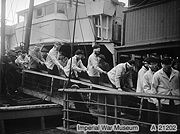 Later in the evening of 26 December, Admiral Fraser briefed his officers on board Duke of York: "Gentlemen, the battle against Scharnhorst has ended in victory for us. I hope that if any of you are ever called upon to lead a ship into action against an opponent many times superior, you will command your ship as gallantly as Scharnhorst was commanded today" .
The loss of Scharnhorst demonstrated the vital importance of radar in modern naval warfare. While the battlecruiser should have been able to outgun all of her opponents (save the battleship Duke of York), the early loss of radar-assisted fire control combined with the problem of inclement weather left her at a significant disadvantage. Scharnhorst was straddled by 31 of the 52 radar-fire-controlled salvos fired by Duke of York. In the aftermath of the battle, the Kriegsmarine commander, Großadmiral Karl Dönitz
remarked, "Surface ships are no longer able to fight without effective radar equipment."
Stord and Scorpion fired their torpedoes from an easterly direction. Stord fired her eight torpedoes as she was about 1500 yd (1,371.6 m) from Scharnhorst, while also firing with her guns. After the battle Admiral Fraser sent the following message to the Admiralty
: "... Please convey to the C-in-C Norwegian Navy. Stord played a very daring role in the fight and I am very proud of her...". In an interview in The Evening News on 5 February 1944 the commanding officer of HMS Duke of York (Captain Guy Russell) said: "... the Norwegian destroyer Stord carried out the most daring attack of the whole action...".
World War II
World War II, or the Second World War , was a global conflict lasting from 1939 to 1945, involving most of the world's nations—including all of the great powers—eventually forming two opposing military alliances: the Allies and the Axis...
naval battle which occurred on 26 December 1943, as part of the Arctic Campaign. The German
Nazi Germany
Nazi Germany , also known as the Third Reich , but officially called German Reich from 1933 to 1943 and Greater German Reich from 26 June 1943 onward, is the name commonly used to refer to the state of Germany from 1933 to 1945, when it was a totalitarian dictatorship ruled by...
battlecruiser
Battlecruiser
Battlecruisers were large capital ships built in the first half of the 20th century. They were developed in the first decade of the century as the successor to the armoured cruiser, but their evolution was more closely linked to that of the dreadnought battleship...
, on an operation to attack Arctic Convoys of war materiel from the Western Allies
Western Allies
The Western Allies were a political and geographic grouping among the Allied Powers of the Second World War. It generally includes the United Kingdom and British Commonwealth, the United States, France and various other European and Latin American countries, but excludes China, the Soviet Union,...
to the USSR, was brought to battle and sunk by superior Royal Navy forces—the battleship plus several cruisers and destroyers—off Norway
Norway
Norway , officially the Kingdom of Norway, is a Nordic unitary constitutional monarchy whose territory comprises the western portion of the Scandinavian Peninsula, Jan Mayen, and the Arctic archipelago of Svalbard and Bouvet Island. Norway has a total area of and a population of about 4.9 million...
's North Cape
North Cape, Norway
North Cape is a cape on the island of Magerøya in Northern Norway, in the municipality of Nordkapp. Its 307 m high, steep cliff is often referred to as the northernmost point of Europe, located at , 2102.3 km from the North Pole. However, the neighbouring point Knivskjellodden is actually...
.
The battle was the last battle between big gun capital ships in the war between Britain and Germany. The British victory confirmed the massive strategic advantage held by the British, at least in terms of surface units.
Background
Operation OstfrontOperation Ostfront
Operation Ostfront was the sortie into the Arctic Ocean by the German warship Scharnhorst during World War II. This operation culminated in the sinking of Scharnhorst.-Background:...
was an attempt by the German Kriegsmarine
Kriegsmarine
The Kriegsmarine was the name of the German Navy during the Nazi regime . It superseded the Kaiserliche Marine of World War I and the post-war Reichsmarine. The Kriegsmarine was one of three official branches of the Wehrmacht, the unified armed forces of Nazi Germany.The Kriegsmarine grew rapidly...
to intercept the expected Arctic convoy
Arctic convoys of World War II
The Arctic convoys of World War II travelled from the United Kingdom and North America to the northern ports of the Soviet Union—Arkhangelsk and Murmansk. There were 78 convoys between August 1941 and May 1945...
s. In late December 1943, these would be the Russia
Soviet Union
The Soviet Union , officially the Union of Soviet Socialist Republics , was a constitutionally socialist state that existed in Eurasia between 1922 and 1991....
-bound convoy JW 55B
Convoy JW 55B
Convoy JW 55B was an Arctic convoy sent from Great Britain by the Western Allies to aid the Soviet Union during World War II. It sailed in late December 1943, reaching the Soviet northern ports at the end of the month...
and the Home-bound convoy RA 55A
Convoy RA 55A
Convoy RA 55A was an Arctic convoy during World War II.It was one of a series of convoys run to return Allied ships from Soviet northern ports to ports in Britain.It sailed in late December 1943, reaching British ports at the end of the month...
.
On 22 December 1943, a Luftwaffe
Luftwaffe
Luftwaffe is a generic German term for an air force. It is also the official name for two of the four historic German air forces, the Wehrmacht air arm founded in 1935 and disbanded in 1946; and the current Bundeswehr air arm founded in 1956....
aircraft sighted JW 55B and commenced shadowing. Three days later, on 25 December, Scharnhorst (Captain Fritz Hintze) with the Narvik-class destroyer
Narvik class destroyer
The Zerstörer 1936A-class destroyers, or Narvik-class destroyers as they were known to the Allies, were a class of German destroyers of the Second World War...
s , , , , and left Norway's Alta Fjord
Alta, Norway
-Birdlife:For those interested in bird watching, the river outlet, known locally as Altaosen is well worth a visit. This tidal area is used as a stopover for many wetland species.-Transportation:...
under the overall command of Konteradmiral Erich Bey
Erich Bey
Erich Bey was a German naval officer who most notably served as a commander of the Kriegsmarine's destroyer forces and commanded the battleship Scharnhorst in the Battle of North Cape on 26 December 1943, during which the German ship was sunk. He was killed during that action. Bey was also a...
.
JW 55B consisted of 19 cargo vessels, accompanied by a close escort of two destroyers and three other vessels, and an ocean escort of eight Home Fleet destroyers led by the destroyer .
Also in the area was convoy RA 55A, returning to the United Kingdom
United Kingdom
The United Kingdom of Great Britain and Northern IrelandIn the United Kingdom and Dependencies, other languages have been officially recognised as legitimate autochthonous languages under the European Charter for Regional or Minority Languages...
from Russia. RA 55A consisted of 22 cargo ships, accompanied by a close escort of two destroyers and four other vessels, and an ocean escort of six Home Fleet destroyers led by the destroyer .
Escorting the convoys to Russia was the responsibility of the Home Fleet and its Commander-in-Chief, Admiral
Admiral
Admiral is the rank, or part of the name of the ranks, of the highest naval officers. It is usually considered a full admiral and above vice admiral and below admiral of the fleet . It is usually abbreviated to "Adm" or "ADM"...
Sir Bruce Fraser
Bruce Fraser, 1st Baron Fraser of North Cape
Admiral of the Fleet Bruce Austin Fraser, 1st Baron Fraser of North Cape GCB, KBE was a senior British admiral during World War II.-Early naval career:Fraser joined the Royal Navy as a Cadet on 15 January 1904...
. Fraser wished to neutralise Scharnhorst, a major threat to the convoys, and planned a confrontation over Christmas 1943 in which convoy JW 55B would be used to draw the enemy out. The previous convoy, JW 55A, had arrived safely at Murmansk with its normal escorts and additional protection from Force 1 commanded by Vice Admiral
Vice Admiral
Vice admiral is a senior naval rank of a three-star flag officer, which is equivalent to lieutenant general in the other uniformed services. A vice admiral is typically senior to a rear admiral and junior to an admiral...
Robert Burnett
Robert Burnett
Admiral Sir Robert Lindsay Burnett, GBE, KCB, CStJ, DSO was an officer in the Royal Navy.-Naval career:Educated at Bedford School, Burnett joined the Royal Navy in 1902. He served on the China Station from 1904 and then with the Atlantic and Mediterranean Fleets from 1908...
in his flagship with the cruisers and .
Fraser expected and hoped that Scharnhorst would attempt to attack JW 55B. At a conference of the captains of the ships in his force Fraser described his plan to intercept Scharnhorst at a position between the convoy and the enemy's Norwegian base before approaching the enemy within 12000 yd (10,972.8 m) in the Arctic night, illuminating with star-shell, and opening fire using fire-control radar.
Convoy JW 55B had left Loch Ewe
Loch Ewe
Loch Ewe is a sea loch in the region of in the Northwest Highlands of Scotland. The shores are inhabited by a traditionally Gàidhlig speaking people living in or sustained by crofting villages, the most notable of which, situated on the north-eastern shore, is the Aultbea settlement...
on December 20, and by December 23 it was clear from intelligence reports that it had been sighted and was being shadowed by enemy aircraft. Fraser then put to sea with Force 2 consisting of his flagship the battleship
Battleship
A battleship is a large armored warship with a main battery consisting of heavy caliber guns. Battleships were larger, better armed and armored than cruisers and destroyers. As the largest armed ships in a fleet, battleships were used to attain command of the sea and represented the apex of a...
, the cruiser and S-class destroyer
S and T class destroyer
The S and T class was a class of sixteen destroyers of the Royal Navy launched in 1942–1943. They were built as two flotillas, known as the 5th and 6th Emergency Flotilla respectively and they served as fleet and convoy escorts in World War II.-Design features:The S class, introduced the CP ...
s , , , and HNoMS Stord of the Royal Norwegian Navy
Royal Norwegian Navy
The Royal Norwegian Navy is the branch of the Norwegian Defence Force responsible for naval operations. , the RNoN consists of approximately 3,700 personnel and 70 vessels, including 5 heavy frigates, 6 submarines, 14 patrol boats, 4 minesweepers, 4 minehunters, 1 mine detection vessel, 4 support...
. Fraser was anxious not to discourage Scharnhorst from leaving its base, so did not approach before it was necessary to do so.
As JW 55B and its escorts approached the area of greatest danger on the same day, the 23rd, travelling slowly eastward 250 mi (217.2 nmi; 402.3 km) off the coast of North Norway, Burnett and Force 1 set out westward from Murmansk
Murmansk
Murmansk is a city and the administrative center of Murmansk Oblast, Russia. It serves as a seaport and is located in the extreme northwest part of Russia, on the Kola Bay, from the Barents Sea on the northern shore of the Kola Peninsula, not far from Russia's borders with Norway and Finland...
while Fraser with Force 2 approached at moderate speed from the west. Scharnhorst sailed from its base at Altenfjord on the evening of 25 December and set course for the convoy's reported position as a south-westerly gale developed .
Battle
The following day, in poor weather and heavy seas and with only minimal LuftwaffeLuftwaffe
Luftwaffe is a generic German term for an air force. It is also the official name for two of the four historic German air forces, the Wehrmacht air arm founded in 1935 and disbanded in 1946; and the current Bundeswehr air arm founded in 1956....
reconnaissance to aid him, Rear Admiral Bey was unable to locate the convoy. Thinking he had overshot the enemy, he detached his destroyers and sent them southward to increase the search area. Admiral Fraser, preparing for a German attack, had diverted the returning empty convoy RA 55A northward, out of the area in which it was expected, and ordered JW 55B to reverse course, to allow him to close. He later ordered four of the destroyers with RA 55A; , , and , to detach and join him.
The now unescorted Scharnhorst encountered Burnett's Force 1 shortly after 09:00. At a distance of nearly 13000 yd (11,887.2 m), the British cruisers opened fire and Scharnhorst responded with her own salvoes. While no hits were scored on the cruisers, the German battlecruiser was struck twice, with one shell destroying the radar
Radar
Radar is an object-detection system which uses radio waves to determine the range, altitude, direction, or speed of objects. It can be used to detect aircraft, ships, spacecraft, guided missiles, motor vehicles, weather formations, and terrain. The radar dish or antenna transmits pulses of radio...
controls and leaving Scharnhorst virtually blind in a mounting snowstorm. Without radar, gunners aboard the battlecruiser were forced to aim at the enemy's muzzle flashes. This was made more difficult because two of the British cruisers were using a new flashless propellant, leaving Norfolk the relatively easier target. Bey, believing he had engaged a battleship, turned south in an attempt to distance himself from the pursuers and perhaps draw them away from the convoy.
Once he had shaken off his pursuers, Bey turned northeast in an attempt to circle round them. Burnett, instead of giving chase in sea conditions that were limiting his cruisers' speed to 24 kn (29.2 mph; 47 km/h), positioned Force 1 so as to protect the convoy. It was a decision that he had some personal doubts about and which was criticised in some quarters but supported by Fraser, but to Burnett's relief, shortly after noon Scharnhorst approached the cruisers once more. As fire was again exchanged, Scharnhorst scored hits on Norfolk, disabling a turret and her radar
Radar
Radar is an object-detection system which uses radio waves to determine the range, altitude, direction, or speed of objects. It can be used to detect aircraft, ships, spacecraft, guided missiles, motor vehicles, weather formations, and terrain. The radar dish or antenna transmits pulses of radio...
. Following this exchange, Bey decided to return to port , while he ordered the destroyers to attack the convoy at a position reported by a U-Boat
U-boat
U-boat is the anglicized version of the German word U-Boot , itself an abbreviation of Unterseeboot , and refers to military submarines operated by Germany, particularly in World War I and World War II...
. The reported position was out of date and the destroyers missed the convoy.
Scharnhorst ran south for several hours. Burnett pursued, but both Sheffield and Norfolk suffered engine problems and dropped back, leaving Belfast dangerously exposed for a while. The lack of working radar aboard Scharnhorst prevented the Germans from taking advantage of the situation, allowing Belfast to reacquire the German ship on her radar set.
Meanwhile, an actual battleship, Duke of York — with her four destroyers already pressing ahead to try to get into torpedo launching positions — had been informed of Belfasts contact and soon they themselves picked up Scharnhorst on radar at 16:15 and were manoeuvring to bring a full broadside to bear.
At 16:48, Belfast fired starshells to illuminate Scharnhorst. Scharnhorst, unprepared with her turrets trained fore and aft, was clearly visible from Duke of York. Duke of York opened fire at a range of 11920 yd (10,899.6 m) and scored a hit on the first salvo. Scharnhorsts foremost turret ("Anton") was disabled after a while, and another salvo destroyed the ship's aeroplane hangar. Bey turned north, but was engaged by the cruisers Norfolk and Belfast, and turned east at a high speed of 31 kn (37.8 mph; 60.8 km/h).
Bey was able to put some more distance between Scharnhorst and the British ships to increase his prospects of success. Scharnhorst also put two 11 in (279.4 mm) shells through Duke of Yorks masts severing a vital radar cable, but these hits could not have been known to Bey, and his ship's fortunes took a dramatic turn for the worse at 18:20 when a shell fired by Duke of York, at extreme range, pierced her armour belt
Belt armor
Belt armor is a layer of heavy metal armor plated on to or within outer hulls of warships, typically on battleships, battlecruisers and cruisers, and on aircraft carriers converted from those types of ships....
and destroyed the No. 1 boiler room. Scharnhorsts speed dropped to only 10 kn (12.2 mph; 19.6 km/h), though immediate repair work allowed it to regain to 22 kn (26.8 mph; 43.1 km/h). She was now vulnerable to the attacks of the destroyers. Five minutes later, Bey sent his final radio message to the German naval command: "We will fight on until the last shell is fired."
At 18:50, Scharnhorst turned to starboard to engage the destroyers Savage and Saumarez, but this allowed Scorpion and the Norwegian destroyer Stord to attack, scoring one hit on the starboard side. As Scharnhorst continued to turn to avoid the torpedoes, Savage and Saumarez scored three hits on her port side. Saumarez was hit several times by Scharnhorsts secondary armament and suffered eleven killed and eleven wounded.
Due to the torpedo
Torpedo
The modern torpedo is a self-propelled missile weapon with an explosive warhead, launched above or below the water surface, propelled underwater towards a target, and designed to detonate either on contact with it or in proximity to it.The term torpedo was originally employed for...
hits, Scharnhorsts speed again fell to 10 kn (12.2 mph; 19.6 km/h), allowing Duke of York to rapidly close the range. With Scharnhorst illuminated by starshells "hanging over her like a chandelier", Duke of York and Jamaica resumed fire, at a range of only 10400 yd (9,509.8 m). At 19:15, Belfast joined in from the north. The British vessels subjected the German ship to a deluge of shells, and the cruisers Jamaica and Belfast fired their remaining torpedoes at the slowing target. Scharnhorsts end came when the British destroyers Opportune, Virago, Musketeer and Matchless fired a further 19 torpedoes at her. Wracked with hits and unable to flee, Scharnhorst finally capsized and sank at 19:45 on 26 December, her propellers still turning, at an estimated position of 72°16′N 28°41′E. She was later identified and filmed at 72°31′N 28°15′E. Of her total complement of 1,968, only 36 were pulled from the frigid waters, 30 by Scorpion and six by Matchless. Neither Rear Admiral Bey nor Captain Hintze were among those rescued, although both were reported seen in the water after the ship sank, nor were any other officers. Scorpion tried to rescue Bey but he foundered . Fraser ordered the force to proceed to Murmansk, making a signal to the Admiralty: "Scharnhorst sunk", to which the reply came: "Grand well done".
Aftermath
The loss of Scharnhorst demonstrated the vital importance of radar in modern naval warfare. While the battlecruiser should have been able to outgun all of her opponents (save the battleship Duke of York), the early loss of radar-assisted fire control combined with the problem of inclement weather left her at a significant disadvantage. Scharnhorst was straddled by 31 of the 52 radar-fire-controlled salvos fired by Duke of York. In the aftermath of the battle, the Kriegsmarine commander, Großadmiral Karl Dönitz
Karl Dönitz
Karl Dönitz was a German naval commander during World War II. He started his career in the German Navy during World War I. In 1918, while he was in command of , the submarine was sunk by British forces and Dönitz was taken prisoner...
remarked, "Surface ships are no longer able to fight without effective radar equipment."
Stord and Scorpion fired their torpedoes from an easterly direction. Stord fired her eight torpedoes as she was about 1500 yd (1,371.6 m) from Scharnhorst, while also firing with her guns. After the battle Admiral Fraser sent the following message to the Admiralty
Admiralty
The Admiralty was formerly the authority in the Kingdom of England, and later in the United Kingdom, responsible for the command of the Royal Navy...
: "... Please convey to the C-in-C Norwegian Navy. Stord played a very daring role in the fight and I am very proud of her...". In an interview in The Evening News on 5 February 1944 the commanding officer of HMS Duke of York (Captain Guy Russell) said: "... the Norwegian destroyer Stord carried out the most daring attack of the whole action...".