

.gif)
Battle of Megiddo (1918)

Encyclopedia
The Battle of Megiddo
took place between 19 September and 1 October 1918, in what was then the northern part of Ottoman
Palestine
and parts of present-day Syria
and Jordan
. It is less commonly known in English as the Battle of Armageddon
and in Turkish as the Nablus Hezimeti ("Rout of Nablus"), the Nablus Yarması ("Breakthrough at Nablus") or the Battle of the Nablus Plain. The battle, and its subsequent exploitation, were the final engagements in the Sinai and Palestine Campaign
of the First World War.
The Allied
Egyptian Expeditionary Force
, composed mainly of British
, Indian
, Australia
n and New Zealand
troops, with a small French
and Armenian
contingent, launched an offensive against the Ottoman Yildirim Army Group
(which contained a German
contingent) following several months of preparation. After the Ottoman forces were distracted by attacks against their lines of communication by irregular forces of the Arab Revolt
, part of their front was overrun by British and Indian infantry after a short but heavy artillery bombardment. Indian and Australian mounted divisions rode through the breach in the Ottoman lines and captured communication centres deep in the Ottoman rear areas, while British and Australian aircraft paralysed the Ottoman headquarters and prevented Ottoman troops rallying or escaping encirclement. Once the main Ottoman armies were destroyed, Allied mounted troops and Arab insurgents advanced to Damascus
, effectively ending the campaign.
General Edmund Allenby, the British commander of the Egyptian Expeditionary Force, took the name of this battle as his title when he was ennobled after the war, becoming the First Viscount
Allenby of Megiddo. His operations during the Battle of Megiddo succeeded at very little cost, in contrast to many offensives during the First World War, and were widely praised in several military writings. Allenby relied on deception and surprise rather than brute force, and made significant use of both cavalry and aircraft, a historically rare combination. He also incorporated the irregular forces of the Arab Revolt into his operations, despite divergent political goals.
at the end of 1917 and Jericho
in February 1918, Allenby's forces were greatly weakened when many of his infantry units (two complete divisions, 24 infantry battalions from other divisions and nine regiments of dismounted Yeomanry
) were sent to reinforce the British armies on the Western Front
after the Germans launched their Spring Offensive
on 21 March. Allenby's tank force was also shipped off to France, and would not return before the Armistice on the Western Front
came into effect. In spite of this, Allenby tried to maintain the pressure on the Ottoman armies by twice sending mounted formations across the Jordan to capture Amman
and Es Salt
and to cut the Hejaz Railway. Both attacks were defeated, although Allenby retained a small bridgehead across the Jordan north of the Dead Sea
.
At the same time (effectively from 8 March), the Ottoman command changed. The highest level Ottoman headquarters in Palestine was the Yıldırım Army Group
. (Yıldırım translates roughly as "thunderbolt", and the name was taken from the nickname of Sultan Bayezid I
.) The Army Group had originally been formed for the purpose of recapturing Baghdad
which had been captured
by British forces on 11 March 1917, but had been diverted to Palestine where the British threatened the front. The Army Group's first commander was the German General Erich von Falkenhayn
, who wished to continue a policy of "yielding defence", being prepared to give ground while inflicting casualties and delay, rather than hold positions at all costs. He was also prepared to fall back to shorten his lines of communication and reduce the need for static garrisons. However, he was unpopular among Ottoman officers, mainly because he relied almost exclusively on German rather than Turkish staff officers, and was blamed for the defeats at Gaza
and Jerusalem. He was replaced by another German General, Otto Liman von Sanders
, who had commanded the successful Ottoman defence during the Gallipoli Campaign. Von Sanders reasoned that continued retreat in Palestine would demoralise the Ottoman troops, ruin their draught animals, encourage the Arab Revolt
to spread further north into the Ottoman rear areas and also lead to all the Ottoman forces to the south in the Hejaz
being finally isolated. His forces halted their retreat and dug in to resist further advances by the weakened British, even regaining some ground near the Jordan as Allenby's two raids on Amman were repulsed.
units. Two British Indian Army
divisions, the 3rd (Lahore) Division
and the 7th (Meerut) Division
, were transferred from the Mesopotamian Campaign
to replace two British divisions which had been sent to the Western Front. Four of Allenby's other depleted infantry divisions were rebuilt with newly-raised units from India, with three Indian battalions to every British battalion. The remaining infantry division, the 54th (East Anglian) Division
, retained all its British units but Allenby was informed by the War Office that this division was required to supply reinforcements for the Western Front and could not be allowed to incur heavy casualties. A brigade-sized detachment of French North African and Armenian troops was attached to the division.
For several months, the RAF had enjoyed superiority in the air and did not need reinforcements, but at Allenby's request more planes and men were supplied.
As this reorganisation proceeded, most of what action there was took place east of the Jordan where the Arab Northern Army
(part of the Arab Revolt
) was operating under the overall leadership of the Emir Feisal
. Its regular soldiers, commanded by Jaafar Pasha, maintained a blockade of the Ottoman garrison at Ma'an
after a failed attack (the Battle of Al-Samna) earlier in the year. Most of these regulars were former Arab conscripts into the Ottoman Army who had deserted or had changed sides after having been taken prisoner
. Meanwhile, irregulars forayed from Aqaba
against the Hejaz Railway, often accompanied and inspired by Lawrence of Arabia
and other British liaison officers. West of the Jordan, the Ottomans and Germans themselves mounted a brief attack at Abu Tellul
near the river, but were defeated by Australian Light Horse units with heavy casualties to a German Jäger
unit.
coast, where the terrain was suitable for large-scale cavalry manoeuvres and where British troops had seized crossings over a stream, the Nahr al-Auja, which was almost the only natural defensive position on this part of the front, during the last phases of the fighting in 1917 and early 1918. Once the breakthrough had been achieved, Allenby intended that the mounted troops of the Desert Mounted Corps
would pass through the resulting gap in the Ottoman front lines, reach the passes through the Carmel Range
before Ottoman troops could forestall them, and seize the communication centres of Al-Afuleh
and Beisan. These two communication centres were within the 60 miles (96.6 km) radius of a strategic cavalry "bound", the distance mounted units could cover before being forced to halt for rest and to obtain water and fodder for the horses. If they were captured, the lines of communication for all Ottoman troops west of the Jordan would be cut.
To make this breakthrough and exploitation easier, Allenby made laborious efforts to deceive the Turks as to his intentions, as he had done at the Battle of Beersheba. To fix the Turks' attention on the wrong end of the front, the detached Anzac Mounted Division
in the Jordan Valley
simulated the activity of the entire mounted corps. Troops marched openly down to the valley by day, and were secretly taken back by lorry at night to repeat the process the next day. Vehicles or mules dragged harrows along tracks to raise dust clouds, simulating other troop movements. Dummy camps and horse lines were constructed and a hotel in Jerusalem was ostentatiously commandeered for an Expeditionary Force headquarters. Meanwhile, a British battalion of the Imperial Camel Corps
joined Arab irregulars in a raid east of the Jordan. They first captured and destroyed the railway station at Mudawara, finally cutting the Hejaz Railway, and then mounted a reconnaissance near Amman, scattering corned beef tins and documents as proof of their presence. Lawrence sent agents to openly buy up huge quantities of forage in the same area. As a final touch, British newspapers and messages were filled with reports of a race meeting to take place in Gaza
on 19 September, the day on which the attack was to be launched.
West of the Jordan, the Allied forces enjoyed undisputed air supremacy by this time. The squadrons of the Royal Air Force
and the Australian Flying Corps outnumbered and outclassed the Ottoman and German aircraft detachments in Palestine. During the weeks before the September attack, enemy aerial activity dropped markedly; although during one week in June hostile aeroplanes crossed the British front lines 100 times, mainly on the tip–and–run principle at altitudes of 16000 –, by the last week in August this number had dropped to 18 and during the three following weeks of September it was reduced to just four enemy aircraft. During the 18 days before the start of the battle, only two or three German aircraft were seen flying. Ottoman and German reconnaissance aircraft could not even take off without being engaged by British or Australian fighters, and could therefore not see through Allenby's deceptions, nor spot the true Allied concentration which was concealed in orange groves and plantations. By chance, the Royal Engineers
had established a bridging school on the Nahr-al-Auja much earlier in the year, so the sudden appearance of several bridges across it on the eve of the assault did not alert the Ottoman front-line observers.
and Nuri as-Said
began destroying railway lines around the vital rail centre of Deraa. Lawrence's initial forces (a Camel Corps unit from Feisal's Army, an Egyptian Camel Corps unit, some Gurkha
machine gunners, British and Australian armoured cars and French mountain artillery) were soon joined by up to 3,000 Rualla and Howeitat
tribesmen, under noted fighting chiefs such as Auda abu Tayi and Nuri es-Shaalan. Although Lawrence was ordered by Allenby only to disrupt communications around Deraa for a week and Lawrence himself had not intended a major uprising to take place in the area immediately, to avoid Ottoman reprisals, a growing number of local communities spontaneously took up arms against the Turks.
As the Ottomans reacted, sending the garrison of Al-Afuleh to reinforce Deraa, the units of Chetwode's Corps made attacks in the hills above the Jordan, intending to further divert the Turks' attention to this flank, although this did not fool the Ottomans. At the last minute, an Indian deserter warned the Turks about the impending main attack. The commander of Ottoman XXII Corps wished to withdraw to forestall the attack but his superiors Jevad Pasha
, commanding the Ottoman Eighth Army
, and Liman (who feared that the deserter was himself an attempted intelligence bluff) forbade him to do so.
At 1:00am on 19 September, the RAF Palestine Brigade's single Handley Page O/400
heavy bomber dropped sixteen 112 pounds (50.8 kg) bombs on the Ottoman Headquarters and telephone exchange in Al-Afuleh. This cut the communications between Liman's headquarters and those of the Ottoman Seventh
and Eighth Armies for the following vital two days, dislocating the Ottoman command. Other aircraft bombed Seventh Army's headquarters at Nablus
and Eighth Army's headquarters at Tulkarm
, disrupting both formations.
At 4:30am, Allenby's main attack opened. A barrage by 385 guns (the field artillery of five divisions, five 60-pounder guns, thirteen siege batteries of medium howitzers and seven batteries of the Royal Horse Artillery
, with 60 trench mortars and two destroyers off the coast) fell on the Ottoman 7th and 20th Infantry Division's front-line positions. As the barrage ceased at 4:50am, the British and Indian infantry advanced and quickly broke through the Turkish lines. Within hours, the three mounted divisions of the Desert Mounted Corps were moving north along the coast, with no Ottoman reserves available to check them. By the end of the day, the remnants of the Ottoman Eighth Army were in disorderly retreat under air attack into the hills to the east, covered by a few hastily-organised rearguards. Jevad Pasha himself had fled, and Mustafa Kemal Pasha was unable to re-establish control over Eighth Army's troops.
The RAF prevented any of the German aircraft based at Jenin
from taking off and interfering with the British land operations. Two S.E.5s
, armed with bombs, circled over the German airfield all day on 19 September. When they spotted any movement on the ground, they bombed the airfield. Each pair of aircraft were relieved every two hours and before departing each pair machine-gunned the German hangars.
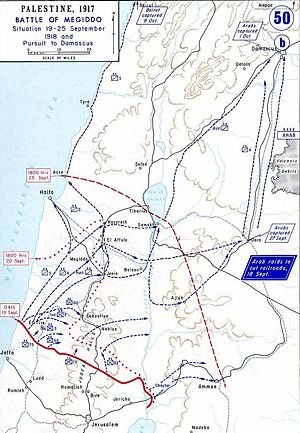 During the early hours of 20 September 1918, the Desert Mounted Corps secured the defile
s of the Carmel Range. The 4th Mounted Division passed through these to capture Al-Afuleh and Beisan, complete with the bulk of two Depot Regiments. A brigade of the 5th Mounted Division attacked Nazareth
, where Liman von Sanders's HQ was situated, although Liman himself escaped. The Imperial Service Cavalry Brigade, also part of the 5th Mounted Division, captured the vital port of Haifa
the next day. A brigade of the Australian Mounted Division occupied Jenin, threatening the rear of the Ottoman Seventh Army
.
Once nothing stood between Allenby's forces and Mustafa Kemal's Seventh Army in Nablus, Kemal decided that he lacked sufficient men to fight the British forces. With the railway blocked, the Seventh Army's only escape route lay to the east, along the Nablus-Beisan road that led down the Wadi Fara into the Jordan valley.
On the night of 20–21 September the Seventh Army began to evacuate Nablus. By this time the Seventh Army was the last formed Ottoman army west of the Jordan and although there was a chance that Chetwode's XX Corps might cut off their retreat, its units had been delayed by Ottoman rearguards and had made poor progress in their advance. On 21 September, the Seventh Army was spotted by aircraft in a defile west of the river. The RAF proceeded to bomb the retreating Turks and destroyed their entire column. Waves of bombing and strafing aircraft passed over the column every three minutes and although the operation had been intended to last for five hours, the Seventh Army was routed in 60 minutes. All transport, artillery and heavy equipment was abandoned or destroyed, many Turks were killed and the survivors were scattered and leaderless. The wreckage of the destroyed column stretched over 6 miles (9.7 km) and Lawrence would later write that "the RAF lost four killed. The Turks lost a corps."
. Many of the surviving refugees who crossed the Jordan were attacked and captured by Arabs as they approached or tried to bypass Deraa.
Several German and Turkish aircraft had continued to operate from Deraa, harassing the Arab irregulars and insurgents still attacking railways and isolated Ottoman detachments about the town. At Lawrence's urging, British aircraft began operating from makeshift landing strips at Um el Surab nearby from 22 September. Three Bristol F.2 Fighter
s shot down several of the German aircraft. The Handley Page 0/400 ferried across petrol, ammunition and spares for the fighters and two Airco DH.9
s, and itself bombed the airfield at Deraa early on 23 September and nearby Mafraq
on the following night.
Liman had attempted to deploy a few rear-area detachments to hold the line of the Jordan and Yarmuk rivers around the Sea of Galilee. A charge by an Australian Light Horse brigade at last light on 26 September captured the town of Samakh
, breaking this line.
. Meanwhile, the 3rd Indian Division advanced north along the coast towards Beirut
and the 7th Indian Division advanced on Baalbek
in the Beqaa Valley
, where the rearmost Ottoman depots and reinforcement camps were situated.
The Ottoman Fourth Army
had begun to retreat from Amman in increasing disorder on 22 September 1918, ultimately dissolving into a rabble under attack by aircraft and Arabs. A British Corps-sized detachment under Major General Edward Chaytor
crossed the Jordan as the Turks fell back and abandoned the crossings. The Anzac Mounted Division captured Amman on 26 September. The Ottoman detachment from Ma'an found its line of retreat blocked south of Amman, and surrendered intact to the Anzac Mounted Division rather than risk slaughter by Arab irregulars.
The 4th Mounted Division moved to Deraa, which had already been abandoned to Arab forces, and then advanced north on Damascus in company with them. The retreating Turks committed several atrocities against hostile Arab villages; in return, the Arab forces took no prisoners. An entire Ottoman brigade (along with some German and Austrians) was massacred near the village of Tafas on 27 September, with the Ottoman commander Jemal Pasha narrowly escaping. The Arabs repeated the performance the next day, losing a few hundred casualties while wiping out nearly 5,000 Turks in these two battles.
The 5th Mounted Division and Australian Mounted Division advanced directly across the Golan Heights towards Damascus. They fought actions at Benat Yakup, Kuneitra, Sasa and Katana, before they reached and closed the north and northwest exits from Damascus on 29 September. On 30 September, the Australians intercepted the garrison of Damascus as they tried to retreat through the Barada gorge. Damascus fell the next day, with the Allies capturing 20,000 prisoners. Jemal Pasha fled, having failed to inspire last-ditch resistance. Overall, the campaign resulted in the surrender of 75,000 Ottoman soldiers.
on 26 October. They subsequently advanced to Mouslimmiye, where Mustafa Kemal (now in command of the Yıldırım Army Group) had rallied some troops under XXII Corps HQ. Kemal held his positions until 31 October, when hostilities ceased following the signing of the Armistice of Mudros
.
The successful action at Megiddo resulted in the Megiddo battle honour
being awarded to units of the Commonwealth forces participating in the battle. Two subsidiary battle honours, Sharon and Nablus were also awarded.
The Bahá'í Faith
in 1918 and today has its administrative and spiritual center in the environs of Haifa
. As a direct result of the events of the battle, the leader of the Bahá'í Faith at the time was rescued after death threats were made against him in case the Ottoman
side was to lose. In addition, because of `Abdu'l-Bahá
's preparations against famine caused by social chaos caused by war, and his generosity in sharing food stores built up, he was knighted by the British Empire, though it was a title he never used. In addition to the practical implications, the Bahá'ís believe the battle was one way the prophecies of the Battle of Armageddon were accomplished.
Megiddo (place)
Megiddo is a tell in modern Israel near Megiddo Kibbutz, known for its historical, geographical, and theological importance especially under its Greek name Armageddon. In ancient times Megiddo was an important city-state. Excavations have unearthed 26 layers of ruins, indicated a long period of...
took place between 19 September and 1 October 1918, in what was then the northern part of Ottoman
Ottoman Empire
The Ottoman EmpireIt was usually referred to as the "Ottoman Empire", the "Turkish Empire", the "Ottoman Caliphate" or more commonly "Turkey" by its contemporaries...
Palestine
Palestine
Palestine is a conventional name, among others, used to describe the geographic region between the Mediterranean Sea and the Jordan River, and various adjoining lands....
and parts of present-day Syria
Syria
Syria , officially the Syrian Arab Republic , is a country in Western Asia, bordering Lebanon and the Mediterranean Sea to the West, Turkey to the north, Iraq to the east, Jordan to the south, and Israel to the southwest....
and Jordan
Jordan
Jordan , officially the Hashemite Kingdom of Jordan , Al-Mamlaka al-Urduniyya al-Hashemiyya) is a kingdom on the East Bank of the River Jordan. The country borders Saudi Arabia to the east and south-east, Iraq to the north-east, Syria to the north and the West Bank and Israel to the west, sharing...
. It is less commonly known in English as the Battle of Armageddon
Armageddon
Armageddon is, according to the Bible, the site of a battle during the end times, variously interpreted as either a literal or symbolic location...
and in Turkish as the Nablus Hezimeti ("Rout of Nablus"), the Nablus Yarması ("Breakthrough at Nablus") or the Battle of the Nablus Plain. The battle, and its subsequent exploitation, were the final engagements in the Sinai and Palestine Campaign
Sinai and Palestine Campaign
The Sinai and Palestine Campaigns took place in the Middle Eastern Theatre of World War I. A series of battles were fought between British Empire, German Empire and Ottoman Empire forces from 26 January 1915 to 31 October 1918, when the Armistice of Mudros was signed between the Ottoman Empire and...
of the First World War.
The Allied
Allies of World War I
The Entente Powers were the countries at war with the Central Powers during World War I. The members of the Triple Entente were the United Kingdom, France, and the Russian Empire; Italy entered the war on their side in 1915...
Egyptian Expeditionary Force
Egyptian Expeditionary Force
The Egyptian Expeditionary Force was formed in March 1916 to command the British and British Empire military forces in Egypt during World War I. Originally known as the 'Force in Egypt' it had been commanded by General Maxwell who was recalled to England...
, composed mainly of British
United Kingdom
The United Kingdom of Great Britain and Northern IrelandIn the United Kingdom and Dependencies, other languages have been officially recognised as legitimate autochthonous languages under the European Charter for Regional or Minority Languages...
, Indian
British Raj
British Raj was the British rule in the Indian subcontinent between 1858 and 1947; The term can also refer to the period of dominion...
, Australia
Australia
Australia , officially the Commonwealth of Australia, is a country in the Southern Hemisphere comprising the mainland of the Australian continent, the island of Tasmania, and numerous smaller islands in the Indian and Pacific Oceans. It is the world's sixth-largest country by total area...
n and New Zealand
New Zealand
New Zealand is an island country in the south-western Pacific Ocean comprising two main landmasses and numerous smaller islands. The country is situated some east of Australia across the Tasman Sea, and roughly south of the Pacific island nations of New Caledonia, Fiji, and Tonga...
troops, with a small French
France
The French Republic , The French Republic , The French Republic , (commonly known as France , is a unitary semi-presidential republic in Western Europe with several overseas territories and islands located on other continents and in the Indian, Pacific, and Atlantic oceans. Metropolitan France...
and Armenian
French Armenian Legion
The Armenian Legion, established with the French-Armenian Agreement , was a foreign legion unit within French Army. The Armenian legion was established under the goals of the Armenian national liberation movement and was an armed unit besides the Armenian volunteer units and Armenian militia during...
contingent, launched an offensive against the Ottoman Yildirim Army Group
Yildirim Army Group
The Yildirim Army Group or Thunderbolt Army Group of the Ottoman Empire or Army Group F was one of the army groups of the Ottoman Army...
(which contained a German
German Empire
The German Empire refers to Germany during the "Second Reich" period from the unification of Germany and proclamation of Wilhelm I as German Emperor on 18 January 1871, to 1918, when it became a federal republic after defeat in World War I and the abdication of the Emperor, Wilhelm II.The German...
contingent) following several months of preparation. After the Ottoman forces were distracted by attacks against their lines of communication by irregular forces of the Arab Revolt
Arab Revolt
The Arab Revolt was initiated by the Sherif Hussein bin Ali with the aim of securing independence from the ruling Ottoman Turks and creating a single unified Arab state spanning from Aleppo in Syria to Aden in Yemen.- Background :...
, part of their front was overrun by British and Indian infantry after a short but heavy artillery bombardment. Indian and Australian mounted divisions rode through the breach in the Ottoman lines and captured communication centres deep in the Ottoman rear areas, while British and Australian aircraft paralysed the Ottoman headquarters and prevented Ottoman troops rallying or escaping encirclement. Once the main Ottoman armies were destroyed, Allied mounted troops and Arab insurgents advanced to Damascus
Damascus
Damascus , commonly known in Syria as Al Sham , and as the City of Jasmine , is the capital and the second largest city of Syria after Aleppo, both are part of the country's 14 governorates. In addition to being one of the oldest continuously inhabited cities in the world, Damascus is a major...
, effectively ending the campaign.
General Edmund Allenby, the British commander of the Egyptian Expeditionary Force, took the name of this battle as his title when he was ennobled after the war, becoming the First Viscount
Viscount
A viscount or viscountess is a member of the European nobility whose comital title ranks usually, as in the British peerage, above a baron, below an earl or a count .-Etymology:...
Allenby of Megiddo. His operations during the Battle of Megiddo succeeded at very little cost, in contrast to many offensives during the First World War, and were widely praised in several military writings. Allenby relied on deception and surprise rather than brute force, and made significant use of both cavalry and aircraft, a historically rare combination. He also incorporated the irregular forces of the Arab Revolt into his operations, despite divergent political goals.
Stalemate: Situation from the fall of Jerusalem to September 1918
After capturing JerusalemBattle of Jerusalem (1917)
The Battle of Jerusalem developed from 17 November with fighting continuing until 30 December 1917 during the Sinai and Palestine Campaign of World War I...
at the end of 1917 and Jericho
Capture of Jericho (1918)
The Capture of Jericho occurred between 19–21 February 1918 to the east of Jerusalem during the Sinai and Palestine Campaign of World War I. Fighting took place in an area bordered by the Bethlehem to Nablus road in the west and the Jordan River in the east and north of a line from Jerusalem to the...
in February 1918, Allenby's forces were greatly weakened when many of his infantry units (two complete divisions, 24 infantry battalions from other divisions and nine regiments of dismounted Yeomanry
Yeomanry
Yeomanry is a designation used by a number of units or sub-units of the British Territorial Army, descended from volunteer cavalry regiments. Today, Yeomanry units may serve in a variety of different military roles.-History:...
) were sent to reinforce the British armies on the Western Front
Western Front (World War I)
Following the outbreak of World War I in 1914, the German Army opened the Western Front by first invading Luxembourg and Belgium, then gaining military control of important industrial regions in France. The tide of the advance was dramatically turned with the Battle of the Marne...
after the Germans launched their Spring Offensive
Spring Offensive
The 1918 Spring Offensive or Kaiserschlacht , also known as the Ludendorff Offensive, was a series of German attacks along the Western Front during World War I, beginning on 21 March 1918, which marked the deepest advances by either side since 1914...
on 21 March. Allenby's tank force was also shipped off to France, and would not return before the Armistice on the Western Front
Armistice with Germany (Compiègne)
The armistice between the Allies and Germany was an agreement that ended the fighting in the First World War. It was signed in a railway carriage in Compiègne Forest on 11 November 1918 and marked a victory for the Allies and a complete defeat for Germany, although not technically a surrender...
came into effect. In spite of this, Allenby tried to maintain the pressure on the Ottoman armies by twice sending mounted formations across the Jordan to capture Amman
Amman
Amman is the capital of Jordan. It is the country's political, cultural and commercial centre and one of the oldest continuously inhabited cities in the world. The Greater Amman area has a population of 2,842,629 as of 2010. The population of Amman is expected to jump from 2.8 million to almost...
and Es Salt
Salt, Jordan
Salt is an ancient agricultural town and administrative centre in west-central Jordan. It is on the old main highway leading from Amman to Jerusalem. Situated in the Balqa highland, about 790–1100 metres above sea level, the town is built in the crook of three hills, close to the Jordan River...
and to cut the Hejaz Railway. Both attacks were defeated, although Allenby retained a small bridgehead across the Jordan north of the Dead Sea
Dead Sea
The Dead Sea , also called the Salt Sea, is a salt lake bordering Jordan to the east and Israel and the West Bank to the west. Its surface and shores are below sea level, the lowest elevation on the Earth's surface. The Dead Sea is deep, the deepest hypersaline lake in the world...
.
At the same time (effectively from 8 March), the Ottoman command changed. The highest level Ottoman headquarters in Palestine was the Yıldırım Army Group
Yildirim Army Group
The Yildirim Army Group or Thunderbolt Army Group of the Ottoman Empire or Army Group F was one of the army groups of the Ottoman Army...
. (Yıldırım translates roughly as "thunderbolt", and the name was taken from the nickname of Sultan Bayezid I
Bayezid I
Bayezid I was the Sultan of the Ottoman Empire, from 1389 to 1402. He was the son of Murad I and Valide Sultan Gülçiçek Hatun.-Biography:Bayezid was born in Edirne and spent his youth in Bursa, where he received a high-level education...
.) The Army Group had originally been formed for the purpose of recapturing Baghdad
Baghdad
Baghdad is the capital of Iraq, as well as the coterminous Baghdad Governorate. The population of Baghdad in 2011 is approximately 7,216,040...
which had been captured
Fall of Baghdad (1917)
The British Indian Army fought the Ottoman Empire in the First World War. On 11 March 1917, after a series of defeats, it captured Baghdad after a two-year campaign.-Arrival of General Sir Frederick Stanley Maude:...
by British forces on 11 March 1917, but had been diverted to Palestine where the British threatened the front. The Army Group's first commander was the German General Erich von Falkenhayn
Erich von Falkenhayn
Erich von Falkenhayn was a German soldier and Chief of the General Staff during World War I. He became a military writer after World War I.-Early life:...
, who wished to continue a policy of "yielding defence", being prepared to give ground while inflicting casualties and delay, rather than hold positions at all costs. He was also prepared to fall back to shorten his lines of communication and reduce the need for static garrisons. However, he was unpopular among Ottoman officers, mainly because he relied almost exclusively on German rather than Turkish staff officers, and was blamed for the defeats at Gaza
Third Battle of Gaza
The Third Battle of Gaza was fought in 1917 in southern Palestine during the First World War. The British Empire forces under the command of General Edmund Allenby successfully broke the Ottoman defensive Gaza-Beersheba line...
and Jerusalem. He was replaced by another German General, Otto Liman von Sanders
Otto Liman von Sanders
Generalleutnant Otto Liman von Sanders was a German general who served as adviser and military commander for the Ottoman Empire during World War I.-Biography:...
, who had commanded the successful Ottoman defence during the Gallipoli Campaign. Von Sanders reasoned that continued retreat in Palestine would demoralise the Ottoman troops, ruin their draught animals, encourage the Arab Revolt
Arab Revolt
The Arab Revolt was initiated by the Sherif Hussein bin Ali with the aim of securing independence from the ruling Ottoman Turks and creating a single unified Arab state spanning from Aleppo in Syria to Aden in Yemen.- Background :...
to spread further north into the Ottoman rear areas and also lead to all the Ottoman forces to the south in the Hejaz
Hejaz
al-Hejaz, also Hijaz is a region in the west of present-day Saudi Arabia. Defined primarily by its western border on the Red Sea, it extends from Haql on the Gulf of Aqaba to Jizan. Its main city is Jeddah, but it is probably better known for the Islamic holy cities of Mecca and Medina...
being finally isolated. His forces halted their retreat and dug in to resist further advances by the weakened British, even regaining some ground near the Jordan as Allenby's two raids on Amman were repulsed.
Allied reorganisation
Over the following summer, Allenby's forces were built back up to full strength. Two Indian mounted divisions (the 4th Cavalry Division and the 5th Cavalry Division) were transferred to Palestine from the Western Front where there was comparatively little use for mounted troops, and were reorganised to incorporate some of Allenby's British YeomanryYeomanry
Yeomanry is a designation used by a number of units or sub-units of the British Territorial Army, descended from volunteer cavalry regiments. Today, Yeomanry units may serve in a variety of different military roles.-History:...
units. Two British Indian Army
British Indian Army
The British Indian Army, officially simply the Indian Army, was the principal army of the British Raj in India before the partition of India in 1947...
divisions, the 3rd (Lahore) Division
3rd (Lahore) Division
The 3rd Division was an infantry division of the British Indian Army, first organised in 1852. It saw service during World War I as part of the Indian Corps in France before being moved to the Middle East where it fought against troops of the Ottoman Empire.-Pre-Mutiny:The Lahore Division first...
and the 7th (Meerut) Division
7th (Meerut) Division
The 7th Division was an infantry division of the British Indian Army that saw active service during World War I.-Pre-Mutiny:The Meerut Division first appeared in the Indian Army List in 1829, under the command of Sir Jasper Nicolls, KCB...
, were transferred from the Mesopotamian Campaign
Mesopotamian Campaign
The Mesopotamian campaign was a campaign in the Middle Eastern theatre of World War I fought between the Allies represented by the British Empire, mostly troops from the Indian Empire, and the Central Powers, mostly of the Ottoman Empire.- Background :...
to replace two British divisions which had been sent to the Western Front. Four of Allenby's other depleted infantry divisions were rebuilt with newly-raised units from India, with three Indian battalions to every British battalion. The remaining infantry division, the 54th (East Anglian) Division
British 54th (East Anglian) Division
The British 54th Division was a Territorial Army division. During the First World War the division fought at Gallipoli and in the Middle East. During the Second World War it was a home service division and did not see any combat....
, retained all its British units but Allenby was informed by the War Office that this division was required to supply reinforcements for the Western Front and could not be allowed to incur heavy casualties. A brigade-sized detachment of French North African and Armenian troops was attached to the division.
For several months, the RAF had enjoyed superiority in the air and did not need reinforcements, but at Allenby's request more planes and men were supplied.
As this reorganisation proceeded, most of what action there was took place east of the Jordan where the Arab Northern Army
Sharifian Army
The Sharifian Army was the military force behind the Arab Revolt which was a part of the Middle Eastern theatre of World War I. Sharif Husayn ibn 'Ali led the Sharifian Army in a rebellion against the Ottoman Empire with the ultimate goal of uniting the Arab people under and independent government...
(part of the Arab Revolt
Arab Revolt
The Arab Revolt was initiated by the Sherif Hussein bin Ali with the aim of securing independence from the ruling Ottoman Turks and creating a single unified Arab state spanning from Aleppo in Syria to Aden in Yemen.- Background :...
) was operating under the overall leadership of the Emir Feisal
Faisal I of Iraq
Faisal bin Hussein bin Ali al-Hashemi, was for a short time King of the Arab Kingdom of Syria or Greater Syria in 1920, and was King of the Kingdom of Iraq from 23 August 1921 to 1933...
. Its regular soldiers, commanded by Jaafar Pasha, maintained a blockade of the Ottoman garrison at Ma'an
Ma'an
Ma'an is a town in southern Jordan 218 km away from the capital Amman. It is the capital of Ma'an Governorate. Ma'an has a population of around 50,000. The city had a population of 22,989 in the 1992 census and is estimated as being about 50,000 as of 2007 according to the Ma'an Municipality...
after a failed attack (the Battle of Al-Samna) earlier in the year. Most of these regulars were former Arab conscripts into the Ottoman Army who had deserted or had changed sides after having been taken prisoner
Prisoner of war
A prisoner of war or enemy prisoner of war is a person, whether civilian or combatant, who is held in custody by an enemy power during or immediately after an armed conflict...
. Meanwhile, irregulars forayed from Aqaba
Aqaba
Aqaba is a coastal city in the far south of Jordan, the capital of Aqaba Governorate at the head of the Gulf of Aqaba. Aqaba is strategically important to Jordan as it is the country's only seaport. Aqaba is best known today as a diving and beach resort, but industrial activity remains important...
against the Hejaz Railway, often accompanied and inspired by Lawrence of Arabia
T. E. Lawrence
Lieutenant Colonel Thomas Edward Lawrence, CB, DSO , known professionally as T. E. Lawrence, was a British Army officer renowned especially for his liaison role during the Arab Revolt against Ottoman Turkish rule of 1916–18...
and other British liaison officers. West of the Jordan, the Ottomans and Germans themselves mounted a brief attack at Abu Tellul
Battle of Abu Tellul
The Battle of Abu Tellul was fought on 14 July 1918 during the Sinai and Palestine Campaign of World War I between German and Ottoman Empire forces which attacked the front line of the British Empire garrison protecting their occupation of the Jordan Valley...
near the river, but were defeated by Australian Light Horse units with heavy casualties to a German Jäger
Jäger (military)
Jäger is a term that was adopted in the Enlightenment era in German-speaking states and others influenced by German military practice to describe a kind of light infantry, and it has continued in that use since then....
unit.
Allied plans and preparations
Allenby intended to break through at the western end of his front, near the MediterraneanMediterranean Sea
The Mediterranean Sea is a sea connected to the Atlantic Ocean surrounded by the Mediterranean region and almost completely enclosed by land: on the north by Anatolia and Europe, on the south by North Africa, and on the east by the Levant...
coast, where the terrain was suitable for large-scale cavalry manoeuvres and where British troops had seized crossings over a stream, the Nahr al-Auja, which was almost the only natural defensive position on this part of the front, during the last phases of the fighting in 1917 and early 1918. Once the breakthrough had been achieved, Allenby intended that the mounted troops of the Desert Mounted Corps
Desert Mounted Corps
The Desert Mounted Corps was a World War I Allied army corps that operated in the Middle East during 1917 and 1918.Originally formed on 15 March 1916 as the Australian and New Zealand Mounted Division under the command of Major General Harry Chauvel The Desert Mounted Corps was a World War I...
would pass through the resulting gap in the Ottoman front lines, reach the passes through the Carmel Range
Mount Carmel
Mount Carmel ; , Kármēlos; , Kurmul or جبل مار إلياس Jabal Mar Elyas 'Mount Saint Elias') is a coastal mountain range in northern Israel stretching from the Mediterranean Sea towards the southeast. Archaeologists have discovered ancient wine and oil presses at various locations on Mt. Carmel...
before Ottoman troops could forestall them, and seize the communication centres of Al-Afuleh
Afula
Afula is a city in the North District of Israel, often known as the "Capital of the Valley", referring to the Jezreel Valley. The city had a population of 40,500 at the end of 2009.-History:...
and Beisan. These two communication centres were within the 60 miles (96.6 km) radius of a strategic cavalry "bound", the distance mounted units could cover before being forced to halt for rest and to obtain water and fodder for the horses. If they were captured, the lines of communication for all Ottoman troops west of the Jordan would be cut.
To make this breakthrough and exploitation easier, Allenby made laborious efforts to deceive the Turks as to his intentions, as he had done at the Battle of Beersheba. To fix the Turks' attention on the wrong end of the front, the detached Anzac Mounted Division
Anzac Mounted Division
The ANZAC Mounted Division was a mounted infantry and mounted rifles division formed in March 1916 in Egypt during World War I following the Battle of Gallipoli when the Australian and New Zealand regiments returned from fighting dismounted as infantry...
in the Jordan Valley
Jordan Valley (Middle East)
The Jordan Valley forms part of the larger Jordan Rift Valley. It is 120 kilometers long and 15 kilometers wide, where it runs from Lake Tiberias in the north to northern Dead Sea in the south. It runs for an additional 155 kilometer south of the Dead Sea to Aqaba, an area also known as Wadi...
simulated the activity of the entire mounted corps. Troops marched openly down to the valley by day, and were secretly taken back by lorry at night to repeat the process the next day. Vehicles or mules dragged harrows along tracks to raise dust clouds, simulating other troop movements. Dummy camps and horse lines were constructed and a hotel in Jerusalem was ostentatiously commandeered for an Expeditionary Force headquarters. Meanwhile, a British battalion of the Imperial Camel Corps
Imperial Camel Corps
The Imperial Camel Corps was a brigade-sized military formation which fought for the Allies in the Sinai and Palestine Campaign in World War I. Its personnel were infantry mounted on camels for movement across desert....
joined Arab irregulars in a raid east of the Jordan. They first captured and destroyed the railway station at Mudawara, finally cutting the Hejaz Railway, and then mounted a reconnaissance near Amman, scattering corned beef tins and documents as proof of their presence. Lawrence sent agents to openly buy up huge quantities of forage in the same area. As a final touch, British newspapers and messages were filled with reports of a race meeting to take place in Gaza
Gaza
Gaza , also referred to as Gaza City, is a Palestinian city in the Gaza Strip, with a population of about 450,000, making it the largest city in the Palestinian territories.Inhabited since at least the 15th century BC,...
on 19 September, the day on which the attack was to be launched.
West of the Jordan, the Allied forces enjoyed undisputed air supremacy by this time. The squadrons of the Royal Air Force
Royal Air Force
The Royal Air Force is the aerial warfare service branch of the British Armed Forces. Formed on 1 April 1918, it is the oldest independent air force in the world...
and the Australian Flying Corps outnumbered and outclassed the Ottoman and German aircraft detachments in Palestine. During the weeks before the September attack, enemy aerial activity dropped markedly; although during one week in June hostile aeroplanes crossed the British front lines 100 times, mainly on the tip–and–run principle at altitudes of 16000 –, by the last week in August this number had dropped to 18 and during the three following weeks of September it was reduced to just four enemy aircraft. During the 18 days before the start of the battle, only two or three German aircraft were seen flying. Ottoman and German reconnaissance aircraft could not even take off without being engaged by British or Australian fighters, and could therefore not see through Allenby's deceptions, nor spot the true Allied concentration which was concealed in orange groves and plantations. By chance, the Royal Engineers
Royal Engineers
The Corps of Royal Engineers, usually just called the Royal Engineers , and commonly known as the Sappers, is one of the corps of the British Army....
had established a bridging school on the Nahr-al-Auja much earlier in the year, so the sudden appearance of several bridges across it on the eve of the assault did not alert the Ottoman front-line observers.
Ottoman dispositions
Lacking intelligence on the Allied plans and dispositions, Liman was forced to dispose his forces evenly along the entire length of his front. Although the proportions of artillery and especially of machine guns (273 light and 696 heavy) were unusually high, almost the entire Ottoman fighting strength was in the front line. As tactical reserves, there were only two German regiments west of the Jordan, and an understrength Ottoman cavalry division near Amman. Further back there were only some "Depot Regiments", not organised as fighting units, and scattered garrisons and line of communication units. After four years of warfare, most of the Ottoman units were understrength and demoralised by desertions, sickness and shortage of supplies, but Liman nevertheless relied on the determination of the Turkish infantry and the strength of his front-line fortifications.Order of battle
On 17 September 1918, the opposing armies were deployed as follows:| Ottoman Order of Battle | Allied Allies of World War I The Entente Powers were the countries at war with the Central Powers during World War I. The members of the Triple Entente were the United Kingdom, France, and the Russian Empire; Italy entered the war on their side in 1915... Order of Battle |
|---|---|
Yildirim Army Group Yildirim Army Group The Yildirim Army Group or Thunderbolt Army Group of the Ottoman Empire or Army Group F was one of the army groups of the Ottoman Army... (Otto Liman von Sanders Otto Liman von Sanders Generalleutnant Otto Liman von Sanders was a German general who served as adviser and military commander for the Ottoman Empire during World War I.-Biography:... )
|
Egyptian Expeditionary Force Egyptian Expeditionary Force The Egyptian Expeditionary Force was formed in March 1916 to command the British and British Empire military forces in Egypt during World War I. Originally known as the 'Force in Egypt' it had been commanded by General Maxwell who was recalled to England... (Edmund Allenby)
|
| Arab Northern Army Sharifian Army The Sharifian Army was the military force behind the Arab Revolt which was a part of the Middle Eastern theatre of World War I. Sharif Husayn ibn 'Ali led the Sharifian Army in a rebellion against the Ottoman Empire with the ultimate goal of uniting the Arab people under and independent government... (Emir Feisal Faisal I of Iraq Faisal bin Hussein bin Ali al-Hashemi, was for a short time King of the Arab Kingdom of Syria or Greater Syria in 1920, and was King of the Kingdom of Iraq from 23 August 1921 to 1933... ) Jafar al-Askari Ja'far Pasha al-Askari served twice as prime minister of Iraq: from November 22, 1923, to August 3, 1924; and from November 21, 1926, to December 31, 1927.... ) — Ma'an T. E. Lawrence Lieutenant Colonel Thomas Edward Lawrence, CB, DSO , known professionally as T. E. Lawrence, was a British Army officer renowned especially for his liaison role during the Arab Revolt against Ottoman Turkish rule of 1916–18... ) Howeitat The Howeitat or Huwaytat are a large tribal confederation of historic Transjordan, an area in present-day Jordan and Saudi Arabia. The Howeitat have several branches, notably the Ibn Jazi, the Abu Tayi and the Sulaymanniyin, in addition to a number of associated tribes.The Howeitat are unusual in... tribesmen — (Nuri as-Said Nuri as-Said Nuri Pasha al-Said was an Iraqi politician during the British Mandate and during the Kingdom of Iraq. He served in various key cabinet positions, and served seven terms as Prime Minister of Iraq.... , Auda abu Tayi) |
Opening attack
On 17 September 1918, Arabs under T. E. LawrenceT. E. Lawrence
Lieutenant Colonel Thomas Edward Lawrence, CB, DSO , known professionally as T. E. Lawrence, was a British Army officer renowned especially for his liaison role during the Arab Revolt against Ottoman Turkish rule of 1916–18...
and Nuri as-Said
Nuri as-Said
Nuri Pasha al-Said was an Iraqi politician during the British Mandate and during the Kingdom of Iraq. He served in various key cabinet positions, and served seven terms as Prime Minister of Iraq....
began destroying railway lines around the vital rail centre of Deraa. Lawrence's initial forces (a Camel Corps unit from Feisal's Army, an Egyptian Camel Corps unit, some Gurkha
Gurkha
Gurkha are people from Nepal who take their name from the Gorkha District. Gurkhas are best known for their history in the Indian Army's Gorkha regiments, the British Army's Brigade of Gurkhas and the Nepalese Army. Gurkha units are closely associated with the kukri, a forward-curving Nepalese knife...
machine gunners, British and Australian armoured cars and French mountain artillery) were soon joined by up to 3,000 Rualla and Howeitat
Howeitat
The Howeitat or Huwaytat are a large tribal confederation of historic Transjordan, an area in present-day Jordan and Saudi Arabia. The Howeitat have several branches, notably the Ibn Jazi, the Abu Tayi and the Sulaymanniyin, in addition to a number of associated tribes.The Howeitat are unusual in...
tribesmen, under noted fighting chiefs such as Auda abu Tayi and Nuri es-Shaalan. Although Lawrence was ordered by Allenby only to disrupt communications around Deraa for a week and Lawrence himself had not intended a major uprising to take place in the area immediately, to avoid Ottoman reprisals, a growing number of local communities spontaneously took up arms against the Turks.
As the Ottomans reacted, sending the garrison of Al-Afuleh to reinforce Deraa, the units of Chetwode's Corps made attacks in the hills above the Jordan, intending to further divert the Turks' attention to this flank, although this did not fool the Ottomans. At the last minute, an Indian deserter warned the Turks about the impending main attack. The commander of Ottoman XXII Corps wished to withdraw to forestall the attack but his superiors Jevad Pasha
Cevat Çobanli
Cevat Çobanlı was a military commander of the Ottoman Army, War Minister of the Ottoman Empire and a general of Turkish Army.-Family and schools:...
, commanding the Ottoman Eighth Army
Eighth Army (Ottoman Empire)
The Eighth Army of the Ottoman Empire was one of the field armies of the Ottoman Army. It was formed during the World War I.- Order of Battle, January 1918 :In January 1918, the army was structured as follows:...
, and Liman (who feared that the deserter was himself an attempted intelligence bluff) forbade him to do so.
At 1:00am on 19 September, the RAF Palestine Brigade's single Handley Page O/400
Handley Page Type O
The Handley Page Type O was an early biplane bomber used by Britain during the First World War. At the time, it was the largest aircraft that had been built in the UK and one of the largest in the world...
heavy bomber dropped sixteen 112 pounds (50.8 kg) bombs on the Ottoman Headquarters and telephone exchange in Al-Afuleh. This cut the communications between Liman's headquarters and those of the Ottoman Seventh
Seventh Army (Ottoman Empire)
The Ottoman Seventh Army was a large military formation of Ottoman Empire in the late 19th and early 20th centuries. Although designated as an army, at least by 1918, it was only of corps strength....
and Eighth Armies for the following vital two days, dislocating the Ottoman command. Other aircraft bombed Seventh Army's headquarters at Nablus
Nablus
Nablus is a Palestinian city in the northern West Bank, approximately north of Jerusalem, with a population of 126,132. Located in a strategic position between Mount Ebal and Mount Gerizim, it is the capital of the Nablus Governorate and a Palestinian commercial and cultural center.Founded by the...
and Eighth Army's headquarters at Tulkarm
Tulkarm
Tulkarem or Tulkarm is a Palestinian city in the northern Samarian mountain range in the Tulkarm Governorate in the extreme northwestern West Bank adjacent to the Netanya and Haifa districts to the west, the Nablus and Jenin Districts to the east...
, disrupting both formations.
At 4:30am, Allenby's main attack opened. A barrage by 385 guns (the field artillery of five divisions, five 60-pounder guns, thirteen siege batteries of medium howitzers and seven batteries of the Royal Horse Artillery
Royal Horse Artillery
The regiments of the Royal Horse Artillery , dating from 1793, are part of the Royal Regiment of Artillery of the British Army...
, with 60 trench mortars and two destroyers off the coast) fell on the Ottoman 7th and 20th Infantry Division's front-line positions. As the barrage ceased at 4:50am, the British and Indian infantry advanced and quickly broke through the Turkish lines. Within hours, the three mounted divisions of the Desert Mounted Corps were moving north along the coast, with no Ottoman reserves available to check them. By the end of the day, the remnants of the Ottoman Eighth Army were in disorderly retreat under air attack into the hills to the east, covered by a few hastily-organised rearguards. Jevad Pasha himself had fled, and Mustafa Kemal Pasha was unable to re-establish control over Eighth Army's troops.
The RAF prevented any of the German aircraft based at Jenin
Jenin
Jenin is the largest town in the Northern West Bank, and the third largest city overall. It serves as the administrative center of the Jenin Governorate and is a major agricultural center for the surrounding towns. In 2007, the city had a population of 120,004 not including the adjacent refugee...
from taking off and interfering with the British land operations. Two S.E.5s
Royal Aircraft Factory S.E.5
The Royal Aircraft Factory S.E.5 was a British biplane fighter aircraft of the First World War. Although the first examples reached the Western Front before the Sopwith Camel and it had a much better overall performance, problems with its Hispano-Suiza engine, particularly the geared-output H-S...
, armed with bombs, circled over the German airfield all day on 19 September. When they spotted any movement on the ground, they bombed the airfield. Each pair of aircraft were relieved every two hours and before departing each pair machine-gunned the German hangars.
Destruction of the Ottoman Armies
Defile (geography)
Defile is a geographic term for a narrow pass or gorge between mountains or hills. It has its origins as a military description of a pass through which troops can march only in a narrow column or with a narrow front...
s of the Carmel Range. The 4th Mounted Division passed through these to capture Al-Afuleh and Beisan, complete with the bulk of two Depot Regiments. A brigade of the 5th Mounted Division attacked Nazareth
Nazareth
Nazareth is the largest city in the North District of Israel. Known as "the Arab capital of Israel," the population is made up predominantly of Palestinian Arab citizens of Israel...
, where Liman von Sanders's HQ was situated, although Liman himself escaped. The Imperial Service Cavalry Brigade, also part of the 5th Mounted Division, captured the vital port of Haifa
Haifa
Haifa is the largest city in northern Israel, and the third-largest city in the country, with a population of over 268,000. Another 300,000 people live in towns directly adjacent to the city including the cities of the Krayot, as well as, Tirat Carmel, Daliyat al-Karmel and Nesher...
the next day. A brigade of the Australian Mounted Division occupied Jenin, threatening the rear of the Ottoman Seventh Army
Seventh Army (Ottoman Empire)
The Ottoman Seventh Army was a large military formation of Ottoman Empire in the late 19th and early 20th centuries. Although designated as an army, at least by 1918, it was only of corps strength....
.
Once nothing stood between Allenby's forces and Mustafa Kemal's Seventh Army in Nablus, Kemal decided that he lacked sufficient men to fight the British forces. With the railway blocked, the Seventh Army's only escape route lay to the east, along the Nablus-Beisan road that led down the Wadi Fara into the Jordan valley.
On the night of 20–21 September the Seventh Army began to evacuate Nablus. By this time the Seventh Army was the last formed Ottoman army west of the Jordan and although there was a chance that Chetwode's XX Corps might cut off their retreat, its units had been delayed by Ottoman rearguards and had made poor progress in their advance. On 21 September, the Seventh Army was spotted by aircraft in a defile west of the river. The RAF proceeded to bomb the retreating Turks and destroyed their entire column. Waves of bombing and strafing aircraft passed over the column every three minutes and although the operation had been intended to last for five hours, the Seventh Army was routed in 60 minutes. All transport, artillery and heavy equipment was abandoned or destroyed, many Turks were killed and the survivors were scattered and leaderless. The wreckage of the destroyed column stretched over 6 miles (9.7 km) and Lawrence would later write that "the RAF lost four killed. The Turks lost a corps."
Later operations
Over the next four days, the 4th Mounted Division and Australian Mounted Division rounded up large numbers of demoralised and disorganised Ottoman troops in the Jezreel ValleyJezreel Valley
-Etymology:The Jezreel Valley takes its name from the ancient city of Jezreel which was located on a low hill overlooking the southern edge of the valley, though some scholars think that the name of the city originates from the name of the clan which founded it, and whose existence is mentioned in...
. Many of the surviving refugees who crossed the Jordan were attacked and captured by Arabs as they approached or tried to bypass Deraa.
Several German and Turkish aircraft had continued to operate from Deraa, harassing the Arab irregulars and insurgents still attacking railways and isolated Ottoman detachments about the town. At Lawrence's urging, British aircraft began operating from makeshift landing strips at Um el Surab nearby from 22 September. Three Bristol F.2 Fighter
Bristol F.2 Fighter
The Bristol F.2 Fighter was a British two-seat biplane fighter and reconnaissance aircraft of the First World War flown by the Royal Flying Corps. It is often simply called the Bristol Fighter or popularly the "Brisfit" or "Biff". Despite being a two-seater, the F.2B proved to be an agile aircraft...
s shot down several of the German aircraft. The Handley Page 0/400 ferried across petrol, ammunition and spares for the fighters and two Airco DH.9
Airco DH.9
The Airco DH.9 - also known after 1920 as the de Havilland DH.9 - was a British bomber used in the First World War...
s, and itself bombed the airfield at Deraa early on 23 September and nearby Mafraq
Mafraq
Mafraq is the capital city of Mafraq Governorate, Jordan, located 80 Km to the north from the Jordanian capital Amman in crossroad to Syria to the north and Iraq to the east. It has 58,954 inhabitants...
on the following night.
Liman had attempted to deploy a few rear-area detachments to hold the line of the Jordan and Yarmuk rivers around the Sea of Galilee. A charge by an Australian Light Horse brigade at last light on 26 September captured the town of Samakh
Samakh, Tiberias
Samakh was a Palestinian Arab village located at the southern end of the Lake Tiberias in Palestine . It had a population of 3,320 Arab Muslims and Arab Christians in 1945...
, breaking this line.
Allied Exploitation
Allenby now ordered his cavalry to cross the Jordan, to capture Amman, Deraa and DamascusDamascus
Damascus , commonly known in Syria as Al Sham , and as the City of Jasmine , is the capital and the second largest city of Syria after Aleppo, both are part of the country's 14 governorates. In addition to being one of the oldest continuously inhabited cities in the world, Damascus is a major...
. Meanwhile, the 3rd Indian Division advanced north along the coast towards Beirut
Beirut
Beirut is the capital and largest city of Lebanon, with a population ranging from 1 million to more than 2 million . Located on a peninsula at the midpoint of Lebanon's Mediterranean coastline, it serves as the country's largest and main seaport, and also forms the Beirut Metropolitan...
and the 7th Indian Division advanced on Baalbek
Baalbek
Baalbek is a town in the Beqaa Valley of Lebanon, altitude , situated east of the Litani River. It is famous for its exquisitely detailed yet monumentally scaled temple ruins of the Roman period, when Baalbek, then known as Heliopolis, was one of the largest sanctuaries in the Empire...
in the Beqaa Valley
Beqaa Valley
The Beqaa Valley is a fertile valley in east Lebanon. For the Romans, the Beqaa Valley was a major agricultural source, and today it remains Lebanon’s most important farming region...
, where the rearmost Ottoman depots and reinforcement camps were situated.
The Ottoman Fourth Army
Fourth Army (Ottoman Empire)
The Fourth Army of the Ottoman Empire was one of the field armies of the Ottoman Army. It was formed in the middle nineteenth century, during Ottoman military reforms.-Order of Battle, 1877:In 1877, it was stationed in Anatolia...
had begun to retreat from Amman in increasing disorder on 22 September 1918, ultimately dissolving into a rabble under attack by aircraft and Arabs. A British Corps-sized detachment under Major General Edward Chaytor
Edward Chaytor
Major General Sir Edward Walter Clervaux Chaytor KCMG, KCVO, CB was a farmer, and a military commander of New Zealand troops in the Boer War and World War I....
crossed the Jordan as the Turks fell back and abandoned the crossings. The Anzac Mounted Division captured Amman on 26 September. The Ottoman detachment from Ma'an found its line of retreat blocked south of Amman, and surrendered intact to the Anzac Mounted Division rather than risk slaughter by Arab irregulars.
The 4th Mounted Division moved to Deraa, which had already been abandoned to Arab forces, and then advanced north on Damascus in company with them. The retreating Turks committed several atrocities against hostile Arab villages; in return, the Arab forces took no prisoners. An entire Ottoman brigade (along with some German and Austrians) was massacred near the village of Tafas on 27 September, with the Ottoman commander Jemal Pasha narrowly escaping. The Arabs repeated the performance the next day, losing a few hundred casualties while wiping out nearly 5,000 Turks in these two battles.
The 5th Mounted Division and Australian Mounted Division advanced directly across the Golan Heights towards Damascus. They fought actions at Benat Yakup, Kuneitra, Sasa and Katana, before they reached and closed the north and northwest exits from Damascus on 29 September. On 30 September, the Australians intercepted the garrison of Damascus as they tried to retreat through the Barada gorge. Damascus fell the next day, with the Allies capturing 20,000 prisoners. Jemal Pasha fled, having failed to inspire last-ditch resistance. Overall, the campaign resulted in the surrender of 75,000 Ottoman soldiers.
Aftermath
After the fall of Damascus, the 5th Mounted Division and some detachments of the Arab Northern Army advanced north through Syria, capturing AleppoAleppo
Aleppo is the largest city in Syria and the capital of Aleppo Governorate, the most populous Syrian governorate. With an official population of 2,301,570 , expanding to over 2.5 million in the metropolitan area, it is also one of the largest cities in the Levant...
on 26 October. They subsequently advanced to Mouslimmiye, where Mustafa Kemal (now in command of the Yıldırım Army Group) had rallied some troops under XXII Corps HQ. Kemal held his positions until 31 October, when hostilities ceased following the signing of the Armistice of Mudros
Armistice of Mudros
The Armistice of Moudros , concluded on 30 October 1918, ended the hostilities in the Middle Eastern theatre between the Ottoman Empire and the Allies of World War I...
.
The successful action at Megiddo resulted in the Megiddo battle honour
Megiddo (battle honour)
Megiddo is a battle honour awarded to units of the British Army, Royal Air Force and British Empire forces which successfully participated in the Battle of Megiddo in 1918 during the Palestine Campaign of the First World War....
being awarded to units of the Commonwealth forces participating in the battle. Two subsidiary battle honours, Sharon and Nablus were also awarded.
The Bahá'í Faith
Bahá'í Faith
The Bahá'í Faith is a monotheistic religion founded by Bahá'u'lláh in 19th-century Persia, emphasizing the spiritual unity of all humankind. There are an estimated five to six million Bahá'ís around the world in more than 200 countries and territories....
in 1918 and today has its administrative and spiritual center in the environs of Haifa
Haifa
Haifa is the largest city in northern Israel, and the third-largest city in the country, with a population of over 268,000. Another 300,000 people live in towns directly adjacent to the city including the cities of the Krayot, as well as, Tirat Carmel, Daliyat al-Karmel and Nesher...
. As a direct result of the events of the battle, the leader of the Bahá'í Faith at the time was rescued after death threats were made against him in case the Ottoman
Ottoman Empire
The Ottoman EmpireIt was usually referred to as the "Ottoman Empire", the "Turkish Empire", the "Ottoman Caliphate" or more commonly "Turkey" by its contemporaries...
side was to lose. In addition, because of `Abdu'l-Bahá
`Abdu'l-Bahá
‘Abdu’l-Bahá , born ‘Abbás Effendí, was the eldest son of Bahá'u'lláh, the founder of the Bahá'í Faith. In 1892, `Abdu'l-Bahá was appointed in his father's will to be his successor and head of the Bahá'í Faith. `Abdu'l-Bahá was born in Tehran to an aristocratic family of the realm...
's preparations against famine caused by social chaos caused by war, and his generosity in sharing food stores built up, he was knighted by the British Empire, though it was a title he never used. In addition to the practical implications, the Bahá'ís believe the battle was one way the prophecies of the Battle of Armageddon were accomplished.
Further reading
- Stephen Lambden, "Catastrophe, Armageddon and Millennium: some aspects of the Bábí-Bahá’í exegesis of apocalyptic symbolism", Bahá'í Studies Review, Volume 9, 1999/2000.
- Cline, Eric H. (2000), The Battles of Armageddon: Megiddo and the Jezreel Valley from the Bronze Age to the Nuclear Age, University of Michigan Press, ISBN 0472097393