

Battle of Ligny

Encyclopedia
The Battle of Ligny was the last victory of the military career of Napoleon I
. In this battle, French troops of the Armée du Nord
under Napoleon's command, defeated a Prussia
n army under Field Marshal
Blücher
, near Ligny
in present-day Belgium
. The bulk of the Prussian army survived, however, and went on to play a pivotal role two days later at the Battle of Waterloo
. As in contrast to Blücher's forces Napoleon's army did not join the decisive engagement, the battle is a prime example of a tactical win and a strategic loss.
On 13 March 1815, six days before Napoleon reached Paris
, the powers at the Congress of Vienna
declared him an outlaw
; four days later, the United Kingdom
, Russia
, Austria
, and Prussia
bound themselves to put 150,000 men each into the field to end his rule. Napoleon knew that, once his attempts at dissuading one or more of the Seventh Coalition Allies from invading France had failed, his only chance of remaining in power was to attack before the Coalition could put together an overwhelming force. If he could destroy the existing Coalition forces south of Brussels before they were reinforced, he might be able to drive the British back to the sea and knock the Prussians out of the war.
The Duke of Wellington
expected Napoleon to try to envelop the Coalition armies, a manoeuvre that he had successfully used many times before, by moving through Mons
to the south-west of Brussels. The roads to Mons were paved, which would have enabled a rapid flank march. This would have cut Wellington's communications with his base at Ostend
, but would also have pushed his army closer to Blücher's. In fact, Napoleon planned instead to divide the two Coalition armies and defeat them separately, and he encouraged Wellington's misapprehension with false intelligence. Moving up to the frontier without alerting the Coalition, Napoleon divided his army into a left wing, commanded by Marshal Ney, a right wing commanded by Marshal Grouchy
, and a reserve, which he commanded personally (although all three elements remained close enough to support one another). Crossing the frontier at Thuin
near Charleroi
before dawn on 15 June, the French rapidly over-ran Coalition outposts and secured Napoleon's favoured "central position" – at the junction between the area where Wellington's allied army was dispersed to his north-west, and Blücher's Prussian army to the north-east.
Only very late on the night of 15 June was Wellington certain that the Charleroi attack was the main French thrust, and he duly ordered his army to deploy near Nivelles
and Quatre Bras
. Early on the morning of 16 June, at the Duchess of Richmond's ball
, on receiving a dispatch from the Prince of Orange
, he was shocked by the speed of Napoleon's advance, and hastily sent his army in the direction of Quatre Bras, where the Prince of Orange, with the brigade of Prince Bernhard of Saxe-Weimar, was holding a tenuous position against the French left, commanded by Marshal Ney. Ney's orders were to secure the crossroads of Quatre Bras, so that if necessary, he could later swing east and reinforce Napoleon.
As Napoleon considered the concentrated Prussian army the greater threat, he moved against them first. Lieutenant-General Zieten's I Corps rearguard action on 15 June held up the French advance, giving Blücher the opportunity to concentrate his forces in the Sombreffe position, which had been selected earlier for its good defensive attributes.
Napoleon's original plan for 16 June was based on the assumption that the Coalition forces, who had been caught napping, would not attempt a risky forward concentration; and he intended therefore to push an advanced guard as far as Gembloux
, for the purpose of feeling for and warding off Blücher. To assist this operation the reserve would move at first to Fleurus
to reinforce Grouchy, should he need assistance in driving back Blücher's troops; but, once in possession of Sombreffe, Napoleon would swing the reserve westwards and join Ney, who, it was supposed, would have in the meantime mastered Quatre Bras.
In pursuance of this object Ney, to whom III Cavalry Corps (Kellermann
) was now attached, was to mass at Quatre Bras and push an advanced guard 10 kilometres (6.2 mi) northward of that place, with a connecting division at Marbais to link him with Grouchy. The centre and left wing together would then make a night-march to Brussels. The Coalition forces would thus be irremediably sundered, and all that remained would be to destroy them in detail. Napoleon now awaited further information from his wing commanders at Charleroi, where he massed the VI Corps (Lobau), to save it, if possible, from a harassing countermarch, as it appeared likely that it would only be wanted for the march to Brussels. Ney spent the morning in massing his I and II corps, and in reconnoitring the enemy at Quatre Bras, who, as he was informed, had been reinforced. But up till noon he took no serious step to capture the cross-roads, which then lay at his mercy. Grouchy meantime reported from Fleurus that Prussians were coming up from Namur, but Napoleon does not appear to have attached much importance to this report. He was still at Charleroi when, between 09:00 and 10:00, further news reached him from the left that considerable hostile forces were visible at Quatre Bras. He at once wrote to Ney saying that these could only be some of Wellington's troops, and that Ney was to concentrate his force and crush what was in front of him, adding that he was to send all reports to Fleurus. Then, keeping Lobau provisionally at Charleroi, Napoleon hastened to Fleurus, arriving about 11:00.
 The French Armee du Nord (Army of the North) was commanded by veteran officers and headed by Napoleon himself, who had won dozens of battles. Directly under him were three Marshals, Grouchy, Ney, and Soult
, all generals of renown and bravery. The corps and division generals were well known for ability and with several campaigns behind them. The troops of the Army of the North were, for the most part, experienced veterans who had seen at least one battle. While the mix of veterans was higher than in either of the other armies, many of the troops had never worked with one another before nor under their officers. Trust in one another and in their officers was therefore in short supply. For all that we may count the veterans it was noted that there were many in the French formations that had never been under fire. In the words of Henri Houssaye, "Napoleon had never held in his hand an instrument so fearsome or fragile." In equipment and supply, the French were well set with both, although the Guard units had to suffer standard weapons, and the Army of the North had more cavalry than their opponents throughout the four days of battle that would follow and end at Waterloo.
By contrast, the Prussian Army was, at this point, in a sorry state. According to historian Peter Hofschröer
"The armed forces fielded by the Kingdom of Prussia in 1815 were in terms of quality of manpower, equipment, and coherence of organization probably the worst fielded by Prussia in the Revolutionary and Napoleonic Wars
. The Prussian cavalry was reorganizing and converting the Freecorps and Legions into regular cavalry formations. The artillery was lacking guns and needed equipment and, in fact, guns and equipment continued to arrive from Prussia even as the battles were raging. No less than one third of the Prussian Infantry consisted of Landwehr (militia) and, unlike the Landwehr of 1813/1814, these were untrained. Hofschröer says that "they could be counted to go forward in disorder and retreat in chaos". To further compound the Prussians' problems, the Saxon and Rhinelander contingents were recent additions to the Prussian Army and were reluctant at best; in fact, the Saxons rebelled and were sent home before the French advanced, and many of the Rhinelanders would desert and head home during the battle.
The post chain was a relay of towns, each set up as a fortified village. Each was commanded by a Prussian officer who made sure that the post kept enough horses, forage, and troops to move messages efficiently along. In addition these posts served as intelligence posts where surveillance would take place, stragglers would be collected up, and wandering civilians would be closely questioned. A post chain was set up all the way back to Blücher's command post so that the Headquarters was alerted from the first French deployment. General Steinmetz' 1st brigade of the I Corps had been very active in touring his outposts on 12 May, 17 May, 21 May, and 9 June. Out posting and intelligence collection were given proper weight.
Reports sent back to General Steinmetz indicated that an attack was seen as imminent as soon as 12 June.
During the period of 12 June through to 14 June reports were sent by the I Corps brigade commanders and General Zieten himself to General Blücher and General Wellington. In addition communications were made with the Dutch cavalry adjoining I Corps position to the west. It is notable that General Steinmetz ordered his brigade to assemble for defense on the night of 13 June and General Pirch II on the morning of the 14th, so thick was French deployments to their front. The first French attacks were to take place on 15 June.
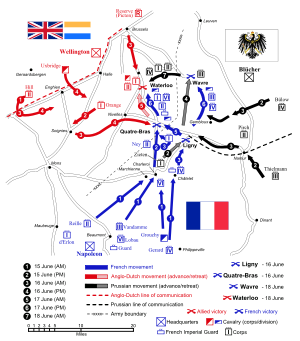
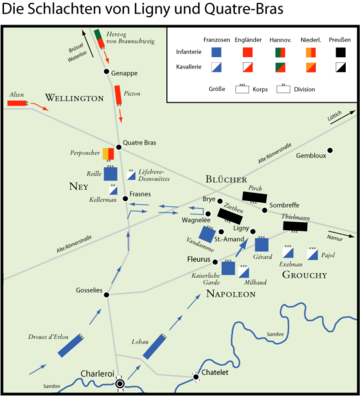 On 15 June Napoleon had crossed the Sambre
at Charleroi and had pushed a wedge between Wellington and Blücher. His army was divided into three parts: on the left wing one corps and two cavalry divisions stood under the command of Marshal Ney, on the right wing two cavalry corps under Marshal Grouchy and in the centre three corps (including the Imperial Guard) and Milhaud's IV Cavalry Corps (cuirassier
s) as a heavy cavalry reserve under the command of Napoleon. Napoleon's most important goal consisted of keeping the two opposing armies separated and striking each individually. For this purpose Ney would move against the Anglo-Allies on Quatre Bras and hold Wellington's forces there. At the same time the French III Corps under Vandamme
and IV Corps under Gérard
would attack the Prussians frontally on their line of defense between Wagnelée, Saint-Amand
and Ligny
, while Grouchy marched on Sombreffe
. Vandamme's corps was reinforced by Girard's
7th Infantry Division, detached from Reille's
II Corps, the bulk of which was at Quatre Bras. Napoleon wanted to advance in the centre of the Prussian position at Fleurus
and decide the battle with a final advance by the Old Guard
. The plan of separation of opposing armies and defeat in detail was an old and favoured stratagem of Napoleon's, dating back to his operations in Italy, and had been the deciding factor in his campaigns in Austria, and in his battles with the Fifth Coalition.
Blücher's troops consisted of the I Prussian Corps under Ziethen, the II Corps under Pirch I and the III Corps under Thielmann
. The I Corps was located in the foremost row and had support from the II Corps standing behind it – the task, the defence of the villages of Ligny, Brye, and Saint-Amand, while the III Corps formed the left wing and the routes of withdrawal while defending Gembloux
and Namur
. Blücher and Wellington had to avoid above all being separated. Still in the morning of the battle Wellington rode to a meeting with Blücher at the windmill of Brye (or Bussy) and promised Blücher the support of at least one Anglo-Allied corps.
After the break for discussion with Blücher, Wellington left for Quatre Bras. In reaction to the troop movements of the French, II and III Corps began sending reinforcements to I Corps under General Ziethen. The Prussian front lines were too long for the troops available and were depending on the arrival of the IV Corps under Bülow
advancing from Liège south west of the battlefield.
The Prussians now faced the French with 82,700 troops, with the French Army numbering around 60,800 available troops.
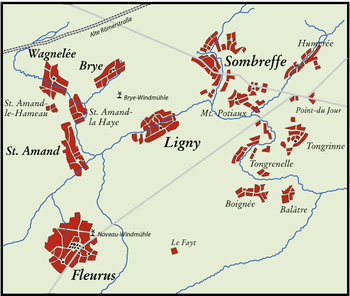 The battlefield of Ligny was on the watershed between the rivers Scheldt
and Meuse
. The Ligny stream rises to the west of Fleurus
and meanders in a north east direction through the small village of Ligny to the confluence at Sombreffe. The stream was only few meters wide, at its edges however swampy in parts, so that the bridges at Saint Amand and Ligny were strategically important. This dictated that villages of Ligny, and St Amand and Wagnelée – connected by the hamlets of Saint Amand-le-Hameau and Saint Amand-la-Haye – were the best defensive position because they were sturdily built and surrounded by trees. The remaining parts of the battlefield consisted of fields of grain as high as a man. The windmill of Brye on a hill north west from Ligny, was a suitable vantage point and Blücher made it his headquarters during the battle. Napoleon placed his headquarters in Fleurus, where he also had a good view of the battlefield from the windmill of Naveau.
, and thus knew that his left flank was secure. This delay also gave Gérard's IV Corps more time to deploy as it had only recently arrived in Fleurus from south west, and had an important role to play in the Napoleon's plan of attack on Ligny. Both delays meant that there was less time to win a decisive victory before night fell.
Napoleon began the attack with a cannonade by the Guards artillery positioned around Fleurus. Shortly afterwards Vandamme's III French Corps (Girard's 7th Infantry Division attached on its left) attacked the hamlet of Saint-Amand-la-Haye. Jagow's 3rd Prussian Brigade, defending Saint-Amand-la-Haye, could not withstand the pressure of Lefol's 8th Division and was forced to retreat. Shortly afterwards a counter attack by General Steinmetz with six battalions of the 1st Brigade recaptured the hamlet. A renewed attack by Vandamme's troops led to a bitter fight in which the Prussians lost approximately 2,500 men and possession of Saint-Amand-la-Haye.
With the loss of Saint-Amand-la-Haye, Blücher's right flank threatened to give way, so he ordered Pirch II's 2nd Prussian Brigade to retake Saint-Amand-la-Haye. Although Girard was mortally wounded (he died in Paris on 25 June of his wounds) the French held the hamlet, so Blücher ordered Tippelskirch to envelop the French with an attack by units of the II Corps on the left flank of the hamlet. French reinforcements, (Vandamme's III Corps,) deployed in front of Wagnelée prevented this happening, attacking Tippelskirch's brigades as they marched out of the grain fields to get into position for their attack. They were driven into the hamlet.
Blücher left his observation post in the windmill of Brye and intervened personally in the fight. Under his guidance the Prussian counter-attack on the French, very weak from the preceding actions, succeeded, and Saint-Amand-la-Haye was again in Prussian hands. Thus at 19:00 Saint-Amand, Saint-Amand-la-Haye and Wagnelée were still held by the Prussians.
12th Infantry Division succeeded in capturing the church in the village of Ligny. With this success however, came a price as the division now found itself under a violent bombardment from three sides. In a short time Pécheux's division lost 20 officers and 500 men and had to withdraw. Napoleon sent a battery of 12-pounders to support another attack and with the IV Corps artillery set numerous buildings in Ligny aflame. Another attack followed with vicious house to house fighting. Jagow's 3rd Prussian Brigade counter-attacked and recaptured Ligny again.
The Prussian second lieutenant, Gerhard Andreas von Garrelts, later gave an eye-witness account of the agonies of the Belgian civilian population, caught unexpectedly in the centre of battle:
with a written note to Marshal Ney at Quatre Bras ordering him to send d'Erlon's
I Corps to attack the rear of the right Prussian flank. Instead it seemed that the troops seen by Vandamme threatened the French left flank.
D'Erlon had gone on ahead of his corps (marching west towards Quatre Bras) to reconnoitre. Bédoyère, realising that time was of the essence, had on his own initiative ordered the I Corps to turn east towards Ligny. Its leading elements came into view at 17:00, that is to say, earlier than Napoleon expected. Marshal Ney, unaware of Napoleon's instructions, sent an order to d'Erlon to immediately turn around and march back towards Quatre Bras. D'Erlon, who had caught up with his troops, turned them around only a few kilometres away from Ligny. Crucially, the I Corps did not fight in either battle that day.
Blücher took advantage of the hesitation of the French by ordering an attack on the French left flank. From his observation post in the mill of Brye, Blücher could observe how his troops fared to the west of Saint Amand. Vandamme's III Corps received unexpected support from Duhesme's
Young Guard and the Prussians were thrown back to their original positions.
It was now that Blücher received a message that Wellington was heavily engaged fighting Ney's left wing of the French army and, therefore, could on no account send support to Ligny. So Blücher decided to counter-attack on the French left flank, in order to force a decision. First, he strengthened his tired forces in Ligny, and then he collected his last reserves and personally led an attack on Saint-Amand. The attack was initially successful and the Prussians managed to recapture Saint-Amand-le-Hameau, but the attack faltered and they were counter-attacked by chasseurs of the Imperial Guard west of Saint-Amand and started a disorderly retreat from Saint-Amand-le-Haye.
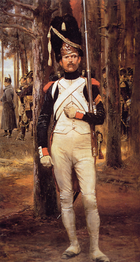 Taking advantage of the Prussians' retreat, Napoleon decided it was time to launch a decisive counterstrike. He could at least beat Blücher and render the Prussians unfit for any serious operation except retreat on 17 June, although he could no longer expect to destroy the Prussian army. Lobau's VI Corps, too, was now arriving and forming up on the heights east of Fleurus. The artillery of the Guard, therefore, came into action above Ligny to prepare Blücher's centre for assault. Some delay was occasioned by a thunderstorm; but, as this passed over, the guns opened and the Old Guard, supported by the reserve cavalry – the Grenadiers à Cheval de la Garde Impériale
– led by Guyot
, as well as Milhaud's IV Cavalry Corps proceeded to form up opposite Ligny. About 19:45 a crashing salvo of 60 guns gave the signal for a combined assault to be delivered by Gerard and the Guard, with Milhaud moving on their right flank. Blücher's worn-out soldiers could not withstand the tremendous impact of Napoleon's choicest troops, and the Prussian centre was pierced and broken. As a reaction to the Old Guard's attack, Blücher instructed Lieutenant-General Röder to counter-attack with the 2 brigades of the reserve cavalry of the I Prussian Corps.
(Blücher's Chief of staff), took over command from the absent Blücher.
, which left open lines of communication to the Rhine as well as the possibility of supporting Wellington if Napoleon was to turn on his army.
On the Prussian right, Lieutenant-General Zieten's I Corps retreated slowly with most of its artillery, leaving a rearguard close to Brye to slow the French pursuit. On the left, Lieutenant-General Thielemann's III Corps retreated unharmed, leaving a strong rearguard at Sombreffe
. The bulk of the rearguard held their positions until about midnight, before following the rest of the retreating army. In fact, Zieten's I Corps rearguard units only left the battlefield in the early morning of 17 June, as the exhausted French failed to press on. Pirch I's II Corps followed the I Corps off the battlefield and Thielemans III Corps moved last with the armies various parks in tow. The last of III Corps was moved in the morning completely ignored. Von Bulow's IV Corps moved south of Wavre and set up strong rear guard positions for the army to quickly reassemble. Blücher was already in communication with Wellington.
south of the village of Waterloo
and the Forest of Soignes. Napoleon, with the reserve and the right wing of the Army of the North, made a late start on 17 June and joined Ney
at Quatre Bras at 13:00 to attack Wellington's army, but found the position empty. The French pursued Wellington, but the result was only a brief cavalry skirmish in Genappe
just as torrential rain set in for the night.
The retreat of the Prussians was not interrupted, and was seemingly unnoticed, by the French. Crucially, they retreated not to the east, along their own lines of communication and away from Wellington, but northwards, parallel to Wellington's line of march and still within supporting distance, and remained throughout in communication with Wellington. On the Prussian right, Zieten's I Corps retreated slowly with most of its artillery, leaving a rearguard close to Brye to slow any French pursuit. On the left, Lieutenant-General Thielemann's III Corps retreated unmolested, leaving a strong rearguard at Sombreffe
. The bulk of the rearguard units held their positions until about midnight, before following the rest of the retreating army. In fact, Zieten's I Corps rearguard only left the battlefield in the early morning of 17 June, as the exhausted French had failed to press on. Pirch I's II Corps followed I Corps off the battlefield and Thieleman's III Corps moved last with the army's various supply parks in tow. The last of III Corps moved out in the morning and was completely ignored by the French. Von Bülow's
IV Corps, which had not been engaged at Ligny, moved south of Wavre and set up a strong position on which the other elements of the Prussian army could reassemble. Before leaving Ligny, Napoleon gave Grouchy 33,000 men and orders to follow up the retreating Prussians. A late start, uncertainty about the direction the Prussians had taken, and the vagueness of the orders given to Grouchy meant that he was too late to prevent the Prussian army reaching Wavre
, from where it could march to support Wellington.
By the end of 17 June, Wellington's army had arrived at its position at Waterloo, with the main body of Napoleon's army following. Blücher's army was gathering in and around Wavre, around eight miles (13 km)' march to the east.
It was at Waterloo on 18 June 1815 that the decisive battle of the campaign took place. The start of the battle was delayed for several hours as Napoleon waited until the ground had dried from the previous night’s rain. By late afternoon the French army had not succeeded in driving Wellington’s allied forces from the escarpment on which they stood. Once the Prussians arrived, attacking the French right flank in ever increasing numbers, Napoleon’s key strategy of keeping the Seventh Coalition armies divided had failed and his army was driven from the field in confusion, by a combined coalition general advance.
On the morning of 18 June 1815 Napoleon sent orders to Grouchy, commander of the right wing of the Army of the North, to harass the Prussians to stop them reforming. These orders arrived at around 06:00 and his corps began to move out at 08:00. By 12:00 cannon fire could be heard from the Battle of Waterloo. Grouchy’s corps commanders, especially Gérard, advised that they should "march to the sound of the guns". As this was contrary to Napoleon’s orders "you will be the sword against the Prussian’s back driving them through Wavre and join me here" Grouchy decided not to take the advice. It becomes apparent that neither Napoleon nor Marshal Grouchy understood that the Prussian army was neither routed nor disorganized but instead was organised and marching on Waterloo. Any thoughts of joining Napoleon were dashed when a second order repeating the same instructions arrived around 16:00.
Following Napoleon’s orders Grouchy attacked the Prussian III Corps under the command of General Johann von Thielmann
near village of Wavre
. Grouchy believed that he was engaging the rearguard of a still-retreating Prussian force. However only one Corps remained; the other three Prussian Corps (I, II and the still fresh IV) had regrouped after the Prussians defeat at Ligny and were marching toward Waterloo.
After the French defeat at Waterloo, the simultaneous battle of Wavre
, was concluded the next morning with a hollow French victory. Grouchy’s wing of the Army of the North withdrew in good order and other elements of the French army were able to reassemble around it. However, the army was not strong enough to resist the combined coalition forces, so it retreated toward Paris with the armies of Wellington and Blücher and other Coalition forces advancing on the same objective.
Napoleon announced his abdication on 24 June 1815. In the final skirmish of the Napoleonic Wars, Marshal Davout, Napoleon's minister of war, was defeated by Blücher at Issy on 3 July 1815. With this defeat, all hope of holding Paris faded as did any prospects that Napoleon could hold onto power in France. Napoleon tried to escape to North America but the Royal Navy
was blockading the French ports to forestall such a move. He finally surrendered to the captain of HMS
Bellerophon
on 15 July. There was a campaign against hold out French fortresses that ended with the capitulation of Longwy on 13 September 1815. The Treaty of Paris
was signed on 20 November 1815. Louis XVIII was restored to the throne of France, and Napoleon was exiled to Saint Helena
, where he died in 1821.
Napoleon I of France
Napoleon Bonaparte was a French military and political leader during the latter stages of the French Revolution.As Napoleon I, he was Emperor of the French from 1804 to 1815...
. In this battle, French troops of the Armée du Nord
L'Armée du Nord
The Army of the North or Armée du Nord is a name given to several historical units of the French Army. The first was one of the French Revolutionary Armies that fought with distinction against the First Coalition from 1792 to 1795...
under Napoleon's command, defeated a Prussia
Prussia
Prussia was a German kingdom and historic state originating out of the Duchy of Prussia and the Margraviate of Brandenburg. For centuries, the House of Hohenzollern ruled Prussia, successfully expanding its size by way of an unusually well-organized and effective army. Prussia shaped the history...
n army under Field Marshal
Field Marshal
Field Marshal is a military rank. Traditionally, it is the highest military rank in an army.-Etymology:The origin of the rank of field marshal dates to the early Middle Ages, originally meaning the keeper of the king's horses , from the time of the early Frankish kings.-Usage and hierarchical...
Blücher
Gebhard Leberecht von Blücher
Gebhard Leberecht von Blücher, Fürst von Wahlstatt , Graf , later elevated to Fürst von Wahlstatt, was a Prussian Generalfeldmarschall who led his army against Napoleon I at the Battle of the Nations at Leipzig in 1813 and at the Battle of Waterloo in 1815 with the Duke of Wellington.He is...
, near Ligny
Ligny
Ligny is a village in the municipality of Sombreffe . It is known as the site of the Battle of Ligny, when Napoleon defeated Blücher two days before the battle of Waterloo while Wellington and Marshal Ney were engaged at Quatre Bras...
in present-day Belgium
Belgium
Belgium , officially the Kingdom of Belgium, is a federal state in Western Europe. It is a founding member of the European Union and hosts the EU's headquarters, and those of several other major international organisations such as NATO.Belgium is also a member of, or affiliated to, many...
. The bulk of the Prussian army survived, however, and went on to play a pivotal role two days later at the Battle of Waterloo
Battle of Waterloo
The Battle of Waterloo was fought on Sunday 18 June 1815 near Waterloo in present-day Belgium, then part of the United Kingdom of the Netherlands...
. As in contrast to Blücher's forces Napoleon's army did not join the decisive engagement, the battle is a prime example of a tactical win and a strategic loss.
Prelude
On 13 March 1815, six days before Napoleon reached Paris
Paris
Paris is the capital and largest city in France, situated on the river Seine, in northern France, at the heart of the Île-de-France region...
, the powers at the Congress of Vienna
Congress of Vienna
The Congress of Vienna was a conference of ambassadors of European states chaired by Klemens Wenzel von Metternich, and held in Vienna from September, 1814 to June, 1815. The objective of the Congress was to settle the many issues arising from the French Revolutionary Wars, the Napoleonic Wars,...
declared him an outlaw
Outlaw
In historical legal systems, an outlaw is declared as outside the protection of the law. In pre-modern societies, this takes the burden of active prosecution of a criminal from the authorities. Instead, the criminal is withdrawn all legal protection, so that anyone is legally empowered to persecute...
; four days later, the United Kingdom
United Kingdom of Great Britain and Ireland
The United Kingdom of Great Britain and Ireland was the formal name of the United Kingdom during the period when what is now the Republic of Ireland formed a part of it....
, Russia
Russian Empire
The Russian Empire was a state that existed from 1721 until the Russian Revolution of 1917. It was the successor to the Tsardom of Russia and the predecessor of the Soviet Union...
, Austria
Austrian Empire
The Austrian Empire was a modern era successor empire, which was centered on what is today's Austria and which officially lasted from 1804 to 1867. It was followed by the Empire of Austria-Hungary, whose proclamation was a diplomatic move that elevated Hungary's status within the Austrian Empire...
, and Prussia
Kingdom of Prussia
The Kingdom of Prussia was a German kingdom from 1701 to 1918. Until the defeat of Germany in World War I, it comprised almost two-thirds of the area of the German Empire...
bound themselves to put 150,000 men each into the field to end his rule. Napoleon knew that, once his attempts at dissuading one or more of the Seventh Coalition Allies from invading France had failed, his only chance of remaining in power was to attack before the Coalition could put together an overwhelming force. If he could destroy the existing Coalition forces south of Brussels before they were reinforced, he might be able to drive the British back to the sea and knock the Prussians out of the war.
The Duke of Wellington
Arthur Wellesley, 1st Duke of Wellington
Field Marshal Arthur Wellesley, 1st Duke of Wellington, KG, GCB, GCH, PC, FRS , was an Irish-born British soldier and statesman, and one of the leading military and political figures of the 19th century...
expected Napoleon to try to envelop the Coalition armies, a manoeuvre that he had successfully used many times before, by moving through Mons
Mons
Mons is a Walloon city and municipality located in the Belgian province of Hainaut, of which it is the capital. The Mons municipality includes the old communes of Cuesmes, Flénu, Ghlin, Hyon, Nimy, Obourg, Baudour , Jemappes, Ciply, Harmignies, Harveng, Havré, Maisières, Mesvin, Nouvelles,...
to the south-west of Brussels. The roads to Mons were paved, which would have enabled a rapid flank march. This would have cut Wellington's communications with his base at Ostend
Ostend
Ostend is a Belgian city and municipality located in the Flemish province of West Flanders. It comprises the boroughs of Mariakerke , Stene and Zandvoorde, and the city of Ostend proper – the largest on the Belgian coast....
, but would also have pushed his army closer to Blücher's. In fact, Napoleon planned instead to divide the two Coalition armies and defeat them separately, and he encouraged Wellington's misapprehension with false intelligence. Moving up to the frontier without alerting the Coalition, Napoleon divided his army into a left wing, commanded by Marshal Ney, a right wing commanded by Marshal Grouchy
Emmanuel, marquis de Grouchy
Emmanuel de Grouchy, 2ème Marquis de Grouchy was a French general and marshal.-Biography:Grouchy was born in Paris, the son of François-Jacques de Grouchy, 1st Marquis de Grouchy and intellectual wife Gilberte Fréteau de Pény . His sister was Sophie de Condorcet, a noted femininist...
, and a reserve, which he commanded personally (although all three elements remained close enough to support one another). Crossing the frontier at Thuin
Thuin
Thuin is a Walloon municipality located in the Belgian province of Hainaut. The Thuin municipality includes the old communes of Leers-et-Fosteau, Biesme-sous-Thuin, Ragnies, Biercée, Gozée, Donstiennes, and Thuillies.-Origins:...
near Charleroi
Charleroi
Charleroi is a city and a municipality of Wallonia, located in the province of Hainaut, Belgium. , the total population of Charleroi was 201,593. The metropolitan area, including the outer commuter zone, covers an area of and had a total population of 522,522 as of 1 January 2008, ranking it as...
before dawn on 15 June, the French rapidly over-ran Coalition outposts and secured Napoleon's favoured "central position" – at the junction between the area where Wellington's allied army was dispersed to his north-west, and Blücher's Prussian army to the north-east.
Only very late on the night of 15 June was Wellington certain that the Charleroi attack was the main French thrust, and he duly ordered his army to deploy near Nivelles
Nivelles
Nivelles is a Walloon city and municipality located in the Belgian province of Walloon Brabant. The Nivelles municipality includes the old communes of Baulers, Bornival, Thines, and Monstreux....
and Quatre Bras
Quatre Bras
Quatre Bras is a common name given to a crossroad in French.More specifically it refers to the crossroad of the Charleroi-Brussels road and the Nivelles-Namur road South of Genappe in Wallonia, Belgium...
. Early on the morning of 16 June, at the Duchess of Richmond's ball
Duchess of Richmond's ball
The Duchess of Richmond's ball was held in Brussels on 15 June 1815, the night before the Battle of Quatre Bras. The Duchess's husband Charles Lennox, 4th Duke of Richmond was in command of a reserve force in Brussels, which was protecting that city in case Napoleon Bonaparte invaded.Elizabeth...
, on receiving a dispatch from the Prince of Orange
William II of the Netherlands
William II was King of the Netherlands, Grand Duke of Luxembourg, and Duke of Limburg from 7 October 1840 until his death in 1849.- Early life and education :...
, he was shocked by the speed of Napoleon's advance, and hastily sent his army in the direction of Quatre Bras, where the Prince of Orange, with the brigade of Prince Bernhard of Saxe-Weimar, was holding a tenuous position against the French left, commanded by Marshal Ney. Ney's orders were to secure the crossroads of Quatre Bras, so that if necessary, he could later swing east and reinforce Napoleon.
As Napoleon considered the concentrated Prussian army the greater threat, he moved against them first. Lieutenant-General Zieten's I Corps rearguard action on 15 June held up the French advance, giving Blücher the opportunity to concentrate his forces in the Sombreffe position, which had been selected earlier for its good defensive attributes.
Napoleon's original plan for 16 June was based on the assumption that the Coalition forces, who had been caught napping, would not attempt a risky forward concentration; and he intended therefore to push an advanced guard as far as Gembloux
Gembloux
Gembloux is a Walloon municipality located in the Belgian province of Namur, on the axis Brussels-NamurOn 1 January 2006 the municipality had 21,964 inhabitants...
, for the purpose of feeling for and warding off Blücher. To assist this operation the reserve would move at first to Fleurus
Fleurus
Fleurus is a Walloon municipality located in the Belgian province of Hainaut. On January 1, 2006 Fleurus had a total population of 22,221. The total area is which gives a population density of 375 inhabitants per km²...
to reinforce Grouchy, should he need assistance in driving back Blücher's troops; but, once in possession of Sombreffe, Napoleon would swing the reserve westwards and join Ney, who, it was supposed, would have in the meantime mastered Quatre Bras.
In pursuance of this object Ney, to whom III Cavalry Corps (Kellermann
François Étienne de Kellermann
Francois Étienne de Kellermann, 2nd Duc de Valmy was a French cavalry general noted for his daring and skillful exploits during the Napoleonic Wars...
) was now attached, was to mass at Quatre Bras and push an advanced guard 10 kilometres (6.2 mi) northward of that place, with a connecting division at Marbais to link him with Grouchy. The centre and left wing together would then make a night-march to Brussels. The Coalition forces would thus be irremediably sundered, and all that remained would be to destroy them in detail. Napoleon now awaited further information from his wing commanders at Charleroi, where he massed the VI Corps (Lobau), to save it, if possible, from a harassing countermarch, as it appeared likely that it would only be wanted for the march to Brussels. Ney spent the morning in massing his I and II corps, and in reconnoitring the enemy at Quatre Bras, who, as he was informed, had been reinforced. But up till noon he took no serious step to capture the cross-roads, which then lay at his mercy. Grouchy meantime reported from Fleurus that Prussians were coming up from Namur, but Napoleon does not appear to have attached much importance to this report. He was still at Charleroi when, between 09:00 and 10:00, further news reached him from the left that considerable hostile forces were visible at Quatre Bras. He at once wrote to Ney saying that these could only be some of Wellington's troops, and that Ney was to concentrate his force and crush what was in front of him, adding that he was to send all reports to Fleurus. Then, keeping Lobau provisionally at Charleroi, Napoleon hastened to Fleurus, arriving about 11:00.
Armies
Nicolas Jean de Dieu Soult
Nicolas Jean-de-Dieu Soult, 1st Duke of Dalmatia , the Hand of Iron, was a French general and statesman, named Marshal of the Empire in 1804. He was one of only six officers in French history to receive the distinction of Marshal General of France...
, all generals of renown and bravery. The corps and division generals were well known for ability and with several campaigns behind them. The troops of the Army of the North were, for the most part, experienced veterans who had seen at least one battle. While the mix of veterans was higher than in either of the other armies, many of the troops had never worked with one another before nor under their officers. Trust in one another and in their officers was therefore in short supply. For all that we may count the veterans it was noted that there were many in the French formations that had never been under fire. In the words of Henri Houssaye, "Napoleon had never held in his hand an instrument so fearsome or fragile." In equipment and supply, the French were well set with both, although the Guard units had to suffer standard weapons, and the Army of the North had more cavalry than their opponents throughout the four days of battle that would follow and end at Waterloo.
By contrast, the Prussian Army was, at this point, in a sorry state. According to historian Peter Hofschröer
Peter Hofschröer
Peter Hofschröer is a historian who specialises in the Napoleonic Wars. He is a graduate of King's College London and currently lives in Austria....
"The armed forces fielded by the Kingdom of Prussia in 1815 were in terms of quality of manpower, equipment, and coherence of organization probably the worst fielded by Prussia in the Revolutionary and Napoleonic Wars
Napoleonic Wars
The Napoleonic Wars were a series of wars declared against Napoleon's French Empire by opposing coalitions that ran from 1803 to 1815. As a continuation of the wars sparked by the French Revolution of 1789, they revolutionised European armies and played out on an unprecedented scale, mainly due to...
. The Prussian cavalry was reorganizing and converting the Freecorps and Legions into regular cavalry formations. The artillery was lacking guns and needed equipment and, in fact, guns and equipment continued to arrive from Prussia even as the battles were raging. No less than one third of the Prussian Infantry consisted of Landwehr (militia) and, unlike the Landwehr of 1813/1814, these were untrained. Hofschröer says that "they could be counted to go forward in disorder and retreat in chaos". To further compound the Prussians' problems, the Saxon and Rhinelander contingents were recent additions to the Prussian Army and were reluctant at best; in fact, the Saxons rebelled and were sent home before the French advanced, and many of the Rhinelanders would desert and head home during the battle.
Prussian preparations
The Prussians were not caught napping and set up a series of artillery/cavalry outposts whereby the cavalry patrolled the front and raced back to the artillery which would fire cannon in a prearranged signal. In this way the thinly stretched 1st and 2nd Brigades were promptly alerted and began rapid assembly General Zieten's I Corps would begin a difficult delaying/fighting/withdrawal giving time for the Prussian Army to assemble.The post chain was a relay of towns, each set up as a fortified village. Each was commanded by a Prussian officer who made sure that the post kept enough horses, forage, and troops to move messages efficiently along. In addition these posts served as intelligence posts where surveillance would take place, stragglers would be collected up, and wandering civilians would be closely questioned. A post chain was set up all the way back to Blücher's command post so that the Headquarters was alerted from the first French deployment. General Steinmetz' 1st brigade of the I Corps had been very active in touring his outposts on 12 May, 17 May, 21 May, and 9 June. Out posting and intelligence collection were given proper weight.
Reports sent back to General Steinmetz indicated that an attack was seen as imminent as soon as 12 June.
During the period of 12 June through to 14 June reports were sent by the I Corps brigade commanders and General Zieten himself to General Blücher and General Wellington. In addition communications were made with the Dutch cavalry adjoining I Corps position to the west. It is notable that General Steinmetz ordered his brigade to assemble for defense on the night of 13 June and General Pirch II on the morning of the 14th, so thick was French deployments to their front. The first French attacks were to take place on 15 June.
Converging towards battle
Sambre
The Sambre is a river in northern France and Wallonia, southern Belgium, left tributary of the Meuse River. The ancient Romans called the river Sabis.-Course:...
at Charleroi and had pushed a wedge between Wellington and Blücher. His army was divided into three parts: on the left wing one corps and two cavalry divisions stood under the command of Marshal Ney, on the right wing two cavalry corps under Marshal Grouchy and in the centre three corps (including the Imperial Guard) and Milhaud's IV Cavalry Corps (cuirassier
Cuirassier
Cuirassiers were mounted cavalry soldiers equipped with armour and firearms, first appearing in late 15th-century Europe. They were the successors of the medieval armoured knights...
s) as a heavy cavalry reserve under the command of Napoleon. Napoleon's most important goal consisted of keeping the two opposing armies separated and striking each individually. For this purpose Ney would move against the Anglo-Allies on Quatre Bras and hold Wellington's forces there. At the same time the French III Corps under Vandamme
Dominique Vandamme
General Dominique-Joseph René Vandamme, Count of Unseburg was a French military officer, who fought in the Napoleonic Wars....
and IV Corps under Gérard
Étienne Maurice Gérard
Étienne Maurice Gérard, comte Gérard was a French general and statesman. He served under a succession of French governments including the ancien regime monarchy, the Revolutionary governments, the Restorations, the July Monarchy, the First and Second Republics, and the First Empire , becoming...
would attack the Prussians frontally on their line of defense between Wagnelée, Saint-Amand
Saint-Amand (Fleurus)
Saint-Amand is a village that is part of the municipality of Fleurus, Belgium. Fleurus is located in the Arrondissement of Charleroi in Hainaut province. Saint-Amand's postal code is 6221. Saint-Amand was its own municipal entity before 1977 when it merged with Fleurus...
and Ligny
Ligny
Ligny is a village in the municipality of Sombreffe . It is known as the site of the Battle of Ligny, when Napoleon defeated Blücher two days before the battle of Waterloo while Wellington and Marshal Ney were engaged at Quatre Bras...
, while Grouchy marched on Sombreffe
Sombreffe
Sombreffe is a Walloon municipality located in the Belgian province of Namur. On 1 January 2006 the municipality had 7,615 inhabitants. The total area is 35.78 km², giving a population density of 213 inhabitants per km².- External links :*...
. Vandamme's corps was reinforced by Girard's
Jean-Baptiste Girard (soldier)
Jean-Baptiste Girard , was a French soldier, général and baron d'Empire, who fought in the French Revolutionary Wars and the Napoleonic Wars.-Biography:...
7th Infantry Division, detached from Reille's
Honoré Charles Reille
Honoré Charles Michel Joseph Reille was a Marshal of France, born in Antibes.Reille served in the early campaigns of the French Revolutionary Wars under Dumouriez and Masséna, whose daughter Victoire he married. In 1800, Reille was appointed commander of the Italian city of Florence...
II Corps, the bulk of which was at Quatre Bras. Napoleon wanted to advance in the centre of the Prussian position at Fleurus
Fleurus
Fleurus is a Walloon municipality located in the Belgian province of Hainaut. On January 1, 2006 Fleurus had a total population of 22,221. The total area is which gives a population density of 375 inhabitants per km²...
and decide the battle with a final advance by the Old Guard
Old Guard
The Old Guard were the elite veteran elements of theEmperor Napoleon's Imperial Guard. As such it was the most prestigious formation in Napoleon's Grande Armée....
. The plan of separation of opposing armies and defeat in detail was an old and favoured stratagem of Napoleon's, dating back to his operations in Italy, and had been the deciding factor in his campaigns in Austria, and in his battles with the Fifth Coalition.
Blücher's troops consisted of the I Prussian Corps under Ziethen, the II Corps under Pirch I and the III Corps under Thielmann
Johann von Thielmann
Johann Adolf Freiherr von Thielmann was a Saxon soldier who served with Saxony, Prussia and France during the Napoleonic Wars.-Biography:...
. The I Corps was located in the foremost row and had support from the II Corps standing behind it – the task, the defence of the villages of Ligny, Brye, and Saint-Amand, while the III Corps formed the left wing and the routes of withdrawal while defending Gembloux
Gembloux
Gembloux is a Walloon municipality located in the Belgian province of Namur, on the axis Brussels-NamurOn 1 January 2006 the municipality had 21,964 inhabitants...
and Namur
Namur (city)
Namur is a city and municipality in Wallonia, in southern Belgium. It is both the capital of the province of Namur and of Wallonia....
. Blücher and Wellington had to avoid above all being separated. Still in the morning of the battle Wellington rode to a meeting with Blücher at the windmill of Brye (or Bussy) and promised Blücher the support of at least one Anglo-Allied corps.
After the break for discussion with Blücher, Wellington left for Quatre Bras. In reaction to the troop movements of the French, II and III Corps began sending reinforcements to I Corps under General Ziethen. The Prussian front lines were too long for the troops available and were depending on the arrival of the IV Corps under Bülow
Friedrich Wilhelm Freiherr von Bülow
Friedrich Wilhelm Freiherr von Bülow, Graf von Dennewitz was a Prussian general of the Napoleonic Wars.-Early life:...
advancing from Liège south west of the battlefield.
The Prussians now faced the French with 82,700 troops, with the French Army numbering around 60,800 available troops.
Battlefield
Scheldt
The Scheldt is a 350 km long river in northern France, western Belgium and the southwestern part of the Netherlands...
and Meuse
Meuse River
The Maas or Meuse is a major European river, rising in France and flowing through Belgium and the Netherlands before draining into the North Sea...
. The Ligny stream rises to the west of Fleurus
Fleurus
Fleurus is a Walloon municipality located in the Belgian province of Hainaut. On January 1, 2006 Fleurus had a total population of 22,221. The total area is which gives a population density of 375 inhabitants per km²...
and meanders in a north east direction through the small village of Ligny to the confluence at Sombreffe. The stream was only few meters wide, at its edges however swampy in parts, so that the bridges at Saint Amand and Ligny were strategically important. This dictated that villages of Ligny, and St Amand and Wagnelée – connected by the hamlets of Saint Amand-le-Hameau and Saint Amand-la-Haye – were the best defensive position because they were sturdily built and surrounded by trees. The remaining parts of the battlefield consisted of fields of grain as high as a man. The windmill of Brye on a hill north west from Ligny, was a suitable vantage point and Blücher made it his headquarters during the battle. Napoleon placed his headquarters in Fleurus, where he also had a good view of the battlefield from the windmill of Naveau.
Saint-Amand
Napoleon delayed his attack until about 14:30 when he heard cannon fire coming from the direction of Quatre BrasQuatre Bras
Quatre Bras is a common name given to a crossroad in French.More specifically it refers to the crossroad of the Charleroi-Brussels road and the Nivelles-Namur road South of Genappe in Wallonia, Belgium...
, and thus knew that his left flank was secure. This delay also gave Gérard's IV Corps more time to deploy as it had only recently arrived in Fleurus from south west, and had an important role to play in the Napoleon's plan of attack on Ligny. Both delays meant that there was less time to win a decisive victory before night fell.
Napoleon began the attack with a cannonade by the Guards artillery positioned around Fleurus. Shortly afterwards Vandamme's III French Corps (Girard's 7th Infantry Division attached on its left) attacked the hamlet of Saint-Amand-la-Haye. Jagow's 3rd Prussian Brigade, defending Saint-Amand-la-Haye, could not withstand the pressure of Lefol's 8th Division and was forced to retreat. Shortly afterwards a counter attack by General Steinmetz with six battalions of the 1st Brigade recaptured the hamlet. A renewed attack by Vandamme's troops led to a bitter fight in which the Prussians lost approximately 2,500 men and possession of Saint-Amand-la-Haye.
With the loss of Saint-Amand-la-Haye, Blücher's right flank threatened to give way, so he ordered Pirch II's 2nd Prussian Brigade to retake Saint-Amand-la-Haye. Although Girard was mortally wounded (he died in Paris on 25 June of his wounds) the French held the hamlet, so Blücher ordered Tippelskirch to envelop the French with an attack by units of the II Corps on the left flank of the hamlet. French reinforcements, (Vandamme's III Corps,) deployed in front of Wagnelée prevented this happening, attacking Tippelskirch's brigades as they marched out of the grain fields to get into position for their attack. They were driven into the hamlet.
Blücher left his observation post in the windmill of Brye and intervened personally in the fight. Under his guidance the Prussian counter-attack on the French, very weak from the preceding actions, succeeded, and Saint-Amand-la-Haye was again in Prussian hands. Thus at 19:00 Saint-Amand, Saint-Amand-la-Haye and Wagnelée were still held by the Prussians.
Ligny
At 15:00 Gérard's IV French Corps opened the battle around Ligny. Under heavy Prussian artillery fire Pécheux'sMarc Nicolas Louis Pécheux
Marc Nicolas Louis Pécheux was a French general during the Napoleonic Wars....
12th Infantry Division succeeded in capturing the church in the village of Ligny. With this success however, came a price as the division now found itself under a violent bombardment from three sides. In a short time Pécheux's division lost 20 officers and 500 men and had to withdraw. Napoleon sent a battery of 12-pounders to support another attack and with the IV Corps artillery set numerous buildings in Ligny aflame. Another attack followed with vicious house to house fighting. Jagow's 3rd Prussian Brigade counter-attacked and recaptured Ligny again.
The Prussian second lieutenant, Gerhard Andreas von Garrelts, later gave an eye-witness account of the agonies of the Belgian civilian population, caught unexpectedly in the centre of battle:
Missed chance
At about 17:00 Field-Marshal Blücher employed the still-fresh II Corps under the command of General Pirch I and ordered him to deploy his corps into the area south of Brye. At about the same time Vandamme on the left French flank sighted a force of twenty to thirty thousand men advancing on Fleurus, which he incorrectly took to be enemy troops. Napoleon, who was preparing to launch a crucial attack at the centre of Blücher's line, was very surprised by this news, because at 15:30 he had sent Comte de la BédoyèreCharles de la Bédoyère
Charles Angélique François Huchet, Comte de la Bédoyère was a French General during the reign of Emperor Napoleon I who was executed in 1815....
with a written note to Marshal Ney at Quatre Bras ordering him to send d'Erlon's
Jean-Baptiste Drouet, Comte d'Erlon
Jean-Baptiste Drouet, comte d'Erlon was a marshal of France and a soldier in Napoleon's Army. D'Erlon notably commanded the I Corps of the Armée du Nord at the battle of Waterloo....
I Corps to attack the rear of the right Prussian flank. Instead it seemed that the troops seen by Vandamme threatened the French left flank.
D'Erlon had gone on ahead of his corps (marching west towards Quatre Bras) to reconnoitre. Bédoyère, realising that time was of the essence, had on his own initiative ordered the I Corps to turn east towards Ligny. Its leading elements came into view at 17:00, that is to say, earlier than Napoleon expected. Marshal Ney, unaware of Napoleon's instructions, sent an order to d'Erlon to immediately turn around and march back towards Quatre Bras. D'Erlon, who had caught up with his troops, turned them around only a few kilometres away from Ligny. Crucially, the I Corps did not fight in either battle that day.
Blücher took advantage of the hesitation of the French by ordering an attack on the French left flank. From his observation post in the mill of Brye, Blücher could observe how his troops fared to the west of Saint Amand. Vandamme's III Corps received unexpected support from Duhesme's
Guillaume Philibert Duhesme
Guillaume Philibert, 1st Count Duhesme was a French general during the Napoleonic Wars.-Revolution:...
Young Guard and the Prussians were thrown back to their original positions.
Prussian counter-attack
At 19:00 the situation on the battlefield was as follows: Grouchy's cavalry had captured Tongrenelle and advanced on Mont-Potiaux; in the centre, heavy fighting was taking place around Ligny; on the Prussian right flank there was a lull in the fighting between the Young Guard and the Prussians.It was now that Blücher received a message that Wellington was heavily engaged fighting Ney's left wing of the French army and, therefore, could on no account send support to Ligny. So Blücher decided to counter-attack on the French left flank, in order to force a decision. First, he strengthened his tired forces in Ligny, and then he collected his last reserves and personally led an attack on Saint-Amand. The attack was initially successful and the Prussians managed to recapture Saint-Amand-le-Hameau, but the attack faltered and they were counter-attacked by chasseurs of the Imperial Guard west of Saint-Amand and started a disorderly retreat from Saint-Amand-le-Haye.
Napoleon commits the Old Guard
Grenadiers à Cheval de la Garde Impériale
The Grenadiers à Cheval de la Garde Impériale constituted a heavy cavalry regiment in the Consular, then Imperial Guard during the French Consulate and First French Empire respectively...
– led by Guyot
Claude-Étienne Guyot
Claude-Étienne Guyot, count of the Empire, was a French general of the French Revolutionary Wars and Napoleonic Wars, noted for commanding cavalry.-Early career during the Revolutionary Wars:...
, as well as Milhaud's IV Cavalry Corps proceeded to form up opposite Ligny. About 19:45 a crashing salvo of 60 guns gave the signal for a combined assault to be delivered by Gerard and the Guard, with Milhaud moving on their right flank. Blücher's worn-out soldiers could not withstand the tremendous impact of Napoleon's choicest troops, and the Prussian centre was pierced and broken. As a reaction to the Old Guard's attack, Blücher instructed Lieutenant-General Röder to counter-attack with the 2 brigades of the reserve cavalry of the I Prussian Corps.
Blücher is incapacitated
While leading one of the charges in person, the 72-year-old Blücher's horse was shot and fell upon him. He was rescued by Major von Nostitz, and later by one of his aides, and borne in a semi-conscious condition from the field. While Blücher was being taken from the field the French cavalry beat off the Prussian cavalry counter-attack. Lieutenant-General August von GneisenauAugust von Gneisenau
August Wilhelm Antonius Graf Neidhardt von Gneisenau was a Prussian field marshal. He was a prominent figure in the reform of the Prussian military and the War of Liberation.-Early life:...
(Blücher's Chief of staff), took over command from the absent Blücher.
Prussian retreat
At 20:00 Major-General Kraft announced he would not be able to hold the village of Ligny much longer and half an hour later the Old Guard broke through, signalling that the Prussians had lost the battle. Gneisenau decided to retreat northward on TillyTilly
Tilly may refer to:People* James Tilly Matthews, the first fully documented case of paranoid schizophrenia* Charles Tilly, sociologist* Jacques Louis François Delaistre de Tilly, French general in the Napoleonic Wars* Jennifer Tilly, actress, poker player...
, which left open lines of communication to the Rhine as well as the possibility of supporting Wellington if Napoleon was to turn on his army.
On the Prussian right, Lieutenant-General Zieten's I Corps retreated slowly with most of its artillery, leaving a rearguard close to Brye to slow the French pursuit. On the left, Lieutenant-General Thielemann's III Corps retreated unharmed, leaving a strong rearguard at Sombreffe
Sombreffe
Sombreffe is a Walloon municipality located in the Belgian province of Namur. On 1 January 2006 the municipality had 7,615 inhabitants. The total area is 35.78 km², giving a population density of 213 inhabitants per km².- External links :*...
. The bulk of the rearguard held their positions until about midnight, before following the rest of the retreating army. In fact, Zieten's I Corps rearguard units only left the battlefield in the early morning of 17 June, as the exhausted French failed to press on. Pirch I's II Corps followed the I Corps off the battlefield and Thielemans III Corps moved last with the armies various parks in tow. The last of III Corps was moved in the morning completely ignored. Von Bulow's IV Corps moved south of Wavre and set up strong rear guard positions for the army to quickly reassemble. Blücher was already in communication with Wellington.
Aftermath
The Prussian defeat at Ligny made Wellington's Quatre Bras position untenable. Wellington spent 17 June falling back northwards, to a defensive position he had personally reconnoitred the previous year at Mont St Jean, a low ridgeRidge
A ridge is a geological feature consisting of a chain of mountains or hills that form a continuous elevated crest for some distance. Ridges are usually termed hills or mountains as well, depending on size. There are several main types of ridges:...
south of the village of Waterloo
Waterloo, Belgium
Waterloo is a Walloon municipality located in the province of Walloon Brabant, Belgium. On December 31, 2009, Waterloo had a total population of 29,573. The total area is 21.03 km² which gives a population density of 1,407 inhabitants per km²...
and the Forest of Soignes. Napoleon, with the reserve and the right wing of the Army of the North, made a late start on 17 June and joined Ney
Michel Ney
Michel Ney , 1st Duc d'Elchingen, 1st Prince de la Moskowa was a French soldier and military commander during the French Revolutionary Wars and the Napoleonic Wars. He was one of the original 18 Marshals of France created by Napoleon I...
at Quatre Bras at 13:00 to attack Wellington's army, but found the position empty. The French pursued Wellington, but the result was only a brief cavalry skirmish in Genappe
Genappe
Genappe is a Walloon municipality located in the Belgian province of Walloon Brabant. On 1 January 2006 Genappe had a total population of 14,136...
just as torrential rain set in for the night.
The retreat of the Prussians was not interrupted, and was seemingly unnoticed, by the French. Crucially, they retreated not to the east, along their own lines of communication and away from Wellington, but northwards, parallel to Wellington's line of march and still within supporting distance, and remained throughout in communication with Wellington. On the Prussian right, Zieten's I Corps retreated slowly with most of its artillery, leaving a rearguard close to Brye to slow any French pursuit. On the left, Lieutenant-General Thielemann's III Corps retreated unmolested, leaving a strong rearguard at Sombreffe
Sombreffe
Sombreffe is a Walloon municipality located in the Belgian province of Namur. On 1 January 2006 the municipality had 7,615 inhabitants. The total area is 35.78 km², giving a population density of 213 inhabitants per km².- External links :*...
. The bulk of the rearguard units held their positions until about midnight, before following the rest of the retreating army. In fact, Zieten's I Corps rearguard only left the battlefield in the early morning of 17 June, as the exhausted French had failed to press on. Pirch I's II Corps followed I Corps off the battlefield and Thieleman's III Corps moved last with the army's various supply parks in tow. The last of III Corps moved out in the morning and was completely ignored by the French. Von Bülow's
Friedrich Wilhelm Freiherr von Bülow
Friedrich Wilhelm Freiherr von Bülow, Graf von Dennewitz was a Prussian general of the Napoleonic Wars.-Early life:...
IV Corps, which had not been engaged at Ligny, moved south of Wavre and set up a strong position on which the other elements of the Prussian army could reassemble. Before leaving Ligny, Napoleon gave Grouchy 33,000 men and orders to follow up the retreating Prussians. A late start, uncertainty about the direction the Prussians had taken, and the vagueness of the orders given to Grouchy meant that he was too late to prevent the Prussian army reaching Wavre
Wavre
Wavre is a town and municipality located in the Belgian province of Walloon Brabant, of which it is the capital.Wavre is located in the Dyle valley. Most of its inhabitants speak French as mother tongue and are called "Wavriens" and "Wavriennes"...
, from where it could march to support Wellington.
By the end of 17 June, Wellington's army had arrived at its position at Waterloo, with the main body of Napoleon's army following. Blücher's army was gathering in and around Wavre, around eight miles (13 km)' march to the east.
It was at Waterloo on 18 June 1815 that the decisive battle of the campaign took place. The start of the battle was delayed for several hours as Napoleon waited until the ground had dried from the previous night’s rain. By late afternoon the French army had not succeeded in driving Wellington’s allied forces from the escarpment on which they stood. Once the Prussians arrived, attacking the French right flank in ever increasing numbers, Napoleon’s key strategy of keeping the Seventh Coalition armies divided had failed and his army was driven from the field in confusion, by a combined coalition general advance.
On the morning of 18 June 1815 Napoleon sent orders to Grouchy, commander of the right wing of the Army of the North, to harass the Prussians to stop them reforming. These orders arrived at around 06:00 and his corps began to move out at 08:00. By 12:00 cannon fire could be heard from the Battle of Waterloo. Grouchy’s corps commanders, especially Gérard, advised that they should "march to the sound of the guns". As this was contrary to Napoleon’s orders "you will be the sword against the Prussian’s back driving them through Wavre and join me here" Grouchy decided not to take the advice. It becomes apparent that neither Napoleon nor Marshal Grouchy understood that the Prussian army was neither routed nor disorganized but instead was organised and marching on Waterloo. Any thoughts of joining Napoleon were dashed when a second order repeating the same instructions arrived around 16:00.
Following Napoleon’s orders Grouchy attacked the Prussian III Corps under the command of General Johann von Thielmann
Johann von Thielmann
Johann Adolf Freiherr von Thielmann was a Saxon soldier who served with Saxony, Prussia and France during the Napoleonic Wars.-Biography:...
near village of Wavre
Wavre
Wavre is a town and municipality located in the Belgian province of Walloon Brabant, of which it is the capital.Wavre is located in the Dyle valley. Most of its inhabitants speak French as mother tongue and are called "Wavriens" and "Wavriennes"...
. Grouchy believed that he was engaging the rearguard of a still-retreating Prussian force. However only one Corps remained; the other three Prussian Corps (I, II and the still fresh IV) had regrouped after the Prussians defeat at Ligny and were marching toward Waterloo.
After the French defeat at Waterloo, the simultaneous battle of Wavre
Battle of Wavre
The Battle of Wavre was the final major military action of the Hundred Days campaign and the Napoleonic Wars. It was fought on 18-19 June 1815 between the Prussian rearguard under the command of General Johann von Thielmann and three corps of the French army under the command of Marshal Grouchy. A...
, was concluded the next morning with a hollow French victory. Grouchy’s wing of the Army of the North withdrew in good order and other elements of the French army were able to reassemble around it. However, the army was not strong enough to resist the combined coalition forces, so it retreated toward Paris with the armies of Wellington and Blücher and other Coalition forces advancing on the same objective.
Napoleon announced his abdication on 24 June 1815. In the final skirmish of the Napoleonic Wars, Marshal Davout, Napoleon's minister of war, was defeated by Blücher at Issy on 3 July 1815. With this defeat, all hope of holding Paris faded as did any prospects that Napoleon could hold onto power in France. Napoleon tried to escape to North America but the Royal Navy
Royal Navy
The Royal Navy is the naval warfare service branch of the British Armed Forces. Founded in the 16th century, it is the oldest service branch and is known as the Senior Service...
was blockading the French ports to forestall such a move. He finally surrendered to the captain of HMS
Her Majesty's Ship
Her or His Majesty's Ship is the ship prefix used for ships of the navy in some monarchies, either formally or informally.-HMS:* In the British Royal Navy, it refers to the king or queen of the United Kingdom as appropriate at the time...
Bellerophon
HMS Bellerophon (1786)
The first HMS Bellerophon of the Royal Navy was a 74-gun third-rate ship of the line launched on 6 October 1786 at Frindsbury on the River Medway, near Chatham. She was built at the shipyard of Edward Greaves to the specifications of the Arrogant, designed by Sir Thomas Slade in 1758, the lead ship...
on 15 July. There was a campaign against hold out French fortresses that ended with the capitulation of Longwy on 13 September 1815. The Treaty of Paris
Treaty of Paris (1815)
Treaty of Paris of 1815, was signed on 20 November 1815 following the defeat and second abdication of Napoleon Bonaparte. In February, Napoleon had escaped from his exile on Elba; he entered Paris on 20 March, beginning the Hundred Days of his restored rule. Four days after France's defeat in the...
was signed on 20 November 1815. Louis XVIII was restored to the throne of France, and Napoleon was exiled to Saint Helena
Saint Helena
Saint Helena , named after St Helena of Constantinople, is an island of volcanic origin in the South Atlantic Ocean. It is part of the British overseas territory of Saint Helena, Ascension and Tristan da Cunha which also includes Ascension Island and the islands of Tristan da Cunha...
, where he died in 1821.