

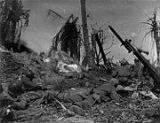
Battle of Kwajalein

Encyclopedia
The Battle of Kwajalein was a battle of the Pacific campaign
of World War II
, fought from 31 January-3 February 1944, on Kwajalein Atoll in the Marshall Islands
. Employing the hard-learned lessons of the battle of Tarawa
, the United States launched a successful twin assault on the main islands of Kwajalein in the south and Roi-Namur in the north. The Japanese defenders put up a stiff resistance though outnumbered and under-prepared. The determined defense of Roi-Namur left only 51 survivors of an original garrison of 3,500.
For the U.S., the battle represented both the next step in its island-hopping march to Japan and a significant moral victory because it was the first time the U.S. penetrated the "outer ring" of the Japanese Pacific sphere. For the Japanese, the battle represented the failure of the beach-line defense. Japanese defenses became prepared in depth, and the battles of Peleliu
, Guam
, and the Marianas proved far more costly to the U.S.
at 8°43′N 167°44′E. Kwajalein is the world's largest coral atoll as measured by area of enclosed water. Comprising 97 islets, it has a land area of 1,560 acres (6.33 km²) and surrounds one of the largest lagoons in the world, measuring 324 mi² (839 km²) in size.
The two most significant land masses are Kwajalein Island in the south, and the linked islands of Roi-Namur in the north. By the start of World War II, the Marshalls (South Pacific Mandate
) were already an integral part of the Japanese perimeter of defense. Its facilities were being utilized as outlying bases for submarines and surface warships, as well as for air staging for future advances being planned against Ellice
, the Fiji Islands, and Samoa
.
and Tarawa
in the Gilbert Islands
, the next step in the United States Navy
's campaign in the central Pacific
was the Marshall Island chain
. These islands had been German
colonies until World War I
, when they were assigned to Japan in the post-war settlement as the "Eastern Mandates". The islands had become a mystery since the Japanese closed them to the outside world. It was presumed the Japanese had built illegal fortifications throughout the islands, however the precise extent of any such fortifications was unknown. To the Japanese, regarding them as part of the "outer ring" of Japanese territory held prior to 1941, this assault would be the first on what the Japanese regarded as Japanese soil.
The strategic importance of the Marshalls had been identified as early as 1921 in Plan Orange
—the American interwar plan for a possible conflict with Japan. The Marshalls were a key step in the island-hopping march to mainland Japan.
After the loss of the Solomon Islands
and New Guinea
in 1943, the Japanese command decided that the Gilbert and Marshall Islands would be expendable. They preferred to fight a decisive battle closer to home. However, at the end of 1943, the Marshalls were reinforced to make their taking expensive for the Americans. By January 1944, the regional commander in Truk—Admiral Masashi Kobayashi
—had 28,000 troops to defend the Marshalls, but he had very few planes.
In addition, less than half of the troops stationed in the Marshalls were combat trained, the rest being support and labor troops with little or no combat training. It was not until after the Japanese position in the Solomons and New Guinea
began to deteriorate that Imperial Headquarters made plans to strengthen the Marshalls. In fact, by September 1943, the Japanese High Command had written off the Gilberts and Marshalls as lost, deciding that the areas should be used to fight a delaying action while a new defense perimeter was created from the Banda Sea
through the Caroline Island
and the Marianas Islands. Additionally, combat units were ordered to the Marshalls from the Philippines
, Manchukuo
, and the homeland, with additional air power to be flown in from both the homeland and nearby Truk.
The 6th Base Force, under command of Rear Admiral Monzo Akiyama, and headquartered on Kwajalein, was the principal defense force of the islands. Akiyama, however, had his men spread out over a very wide area, mostly concentrating on the defense of those atolls (Jaluit, Mille
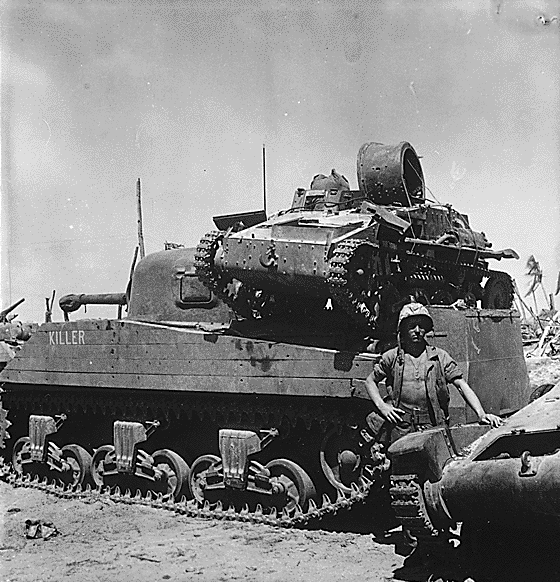
, Maloelap, and Wotje) that were never considered vulnerable to American attack. Those reinforcement troops 2nd Battalion/1st Amphibious Brigade under Captain (Naval) Aso, including nine Type 94/97 Tankettes and two companies of Type 2
Amphibious Tank (as SNLF
Kwajalein Tank Detachment), finally arrived and were quickly dispersed by Akiyama, mainly to the outlying atolls.
Kwajalein was to remain undermanned, underequipped, and unprepared for the assaults being arrayed against it. Overall Japanese strength on these islands numbered approximately 8,000 men, of which less than half were considered combat effective. On Kwajalein proper, the troops were made up mostly of labor forces, a good number of those being Koreans. On Roi-Namur
, the troops were mostly JNAF land personnel who had little ground combat training and who were underequipped for such a function.
The defense system on the islands was mostly in line, with little or no depth. Although some fortified areas existed, none were as extensive or well armed as those of Tarawa. In addition, there were several defenses that mostly concentrated on any assault coming from the ocean side; no coastal defense artillery had been placed on key islets guarding passages to the lagoon, and there was little or no use of mines. Despite shortfalls, efforts to strengthen ground defenses continued. Still, Akiyama's greatest defense remained his aerial offensive capability. He had well-manned air bases on Roi-Namur
, Maloelap, Wotje, Mille
and Eniwetok, detached Chitose
and 653rd Air Corps Mitsubishi A6M Zero fighters with the nearly complete Mitsubishi G3M
and G4M
bomber base in Kwajalein. In addition, he had some Nakajima A6M2-N and Mitsubishi F1M
floatplane
s detached in seaplane bases on Burton
, Jaluit, Wotje, Majuro
, Taongi, and Utirik.
During the month of November, however, both USAAF
land-based and U.S. Navy
carrier
-based bomber attacks, in conjunction with the American assault on the Gilberts, had destroyed 71 of Akiyama's fighters and bombers. Reinforcements flown in from the homeland and Truk replenished most of his losses, but he could expect little additional help in the future. The Japanese war industry was falling far short of needed production, affecting all branches of the armed services, including the Japanese Carrier Air Arm, which had long since retreated from the Central Pacific. In fact, the 32 planes flown from Truk were the last of the carrier aircraft left behind following that retreat. Akiyama was therefore not expected to defeat his adversary but rather to delay the Allied
forces advance while exacting the greatest possible toll upon them.
, Mille
, Maloelap
, and Jaluit
to the east and south. Indeed, the original American plan called for a cautious series of steppingstone attacks starting in the eastern Marshalls. The Japanese troop dispositions were revealed to the Americans by Ultra decryptions of Japanese communications, and Admiral Chester Nimitz
decided instead to bypass these outposts and attack the Kwajalein Atoll directly, knifing into the very heart of the Marshall Islands. The operation was given the code name Operation Flintlock
.
There were two main objectives: The linked islands of Roi-Namur
in the north, and Kwajalein Island at the south end of the atoll. The 4th Marine Division—under Major General Harry Schmidt
—was assigned to Roi-Namur, and the Army's 7th Infantry Division—under Major General Charles H. Corlett
—would make the assault on Kwajalein.
To ensure the success of the operation, sea and air superiority were necessary. Accordingly, on 29 January 1944, U.S. carrier planes attacked the Japanese airfield on Roi-Namur
, destroying 92 of the 110 Japanese planes in the Marshalls.
Staging through Baker Island
airfield, B-24 Liberator
s of the Seventh Air Force
quickly set their sights upon their targets. In the beginning, the most important were Mille
, the Japanese base closest to the Gilberts and Maloelap, the most powerful enemy bases threatening the upcoming operations. Mille was the subject of several attacks through the month of November, causing considerable damage to installations and high losses of aircraft for the Japanese. But Mille remained the only base within fighter reach of the Gilberts, and the defenders managed to keep the facilities there operational and reinforced with aircraft. Following the capture of Tarawa
and through 19 December, 106 B-24s dropped a total of 122 ST (110.7 t) of explosives on Mille's airbase. The largest of those raids came on 4 December when 34 B-24s pulverized the atoll in conjunction with carrier-based bombing raids of other parts of the Marshalls. On 18 December, renewed strikes were initiated against enemy targets on Mille with land-based Douglas A-24 Banshee dive bombers and Bell P-39 Airacobra fighters making their debut in the Marshall air offensive. Japanese losses for the day amounted to 10 fighters (four on the ground) and four damaged. Other aircraft types participating in the offensive included B-25 Mitchell
s and Curtiss P-40 Warhawks.
In addition, it was necessary to take another atoll in the eastern Marshalls—Majuro
. Majuro is 220 mi (191.2 nmi; 354.1 km) southeast of Kwajalein and could serve as an advanced air and naval base as well as safeguard supply lines to Kwajalein. Majuro was very lightly defended and only the V Amphibious Corps
Marine Reconnaissance Company and the 2nd Battalion
, 106th Infantry, 7th Infantry Division were employed in the capture of Majuro. The island was taken on 31 January 1944, without any U.S. casualties.
 The U.S. forces for the landings were Rear Admiral Richmond K. Turner
's 5th Amphibious Force, and Major General Holland M. Smith's V Amphibious Corps
, which comprised the 4th Marine Division
commanded by Maj. Gen. Harry Schmidt
, the 7th Infantry Division commanded by Maj.Gen. Charles H. Corlett
, plus the 22nd Marine, 106th Infantry, and the 111th Infantry
regiments. The 4th and 7th Divisions were assigned to the initial landings at Kwajalein, while the 2nd Battalion of the 106th was assigned to the simultaneous capture of Majuro Atoll. The rest of the 106th and the 22nd Marines were in reserve for Kwajalein, while awaiting the following assault on Eniwetok
, scheduled for three months later.
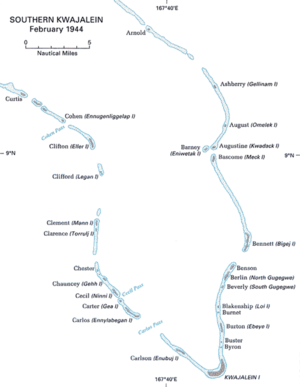
The 7th Infantry Division began by capturing the small islands labeled Carlos, Carter, Cecil, and Carlson on 31 January, which were used as artillery
bases for the next day's assault. Kwajalein Island is 2.5 mi (4 km) long but only 880 yd (804.7 m) wide. There was therefore no possibility of defence in depth and the Japanese planned to counter-attack the landing beaches. They had not realized until the battle of Tarawa that American amphibious vehicles could cross coral reefs and so land on the lagoon side of an atoll; accordingly the strongest defences on Kwajalein faced the ocean. The bombardment by battleship
s, B-24 bombers from Apamama, and artillery on Carlson was devastating. The U.S. Army history of the battle quotes a participant as saying that "the entire island looked as if it had been picked up 20,000 feet and then dropped." By the time the 7th Division landed on Kwajalein Island on 1 February, there was little resistance; by night the Americans estimated that only 1,500 of the original 5,000 defenders were still alive.
On the north side of the atoll, the 4th Marine Division followed the same plan, first capturing islets Ivan, Jacob, Albert, Allen, and Abraham on 31 January, and landing on Roi-Namur
on 1 February. The airfield on Roi (the eastern half) was captured quickly, and Namur (the western half) fell the next day. The worst setback came when a Marine demolition team threw a satchel charge
of high explosives into a Japanese bunker which turned out to be a torpedo
warhead magazine. The resulting explosion killed twenty Marines and wounded dozens more. Only 51 of the original 3,500 Japanese defenders of Roi-Namur survived to be captured.
 The relatively easy capture of Kwajalein demonstrated U.S. amphibious capabilities and showed that the changes to training and tactics after the bloody battle of Tarawa had been effective. It allowed Nimitz to speed up operations in the Marshalls and invade Eniwetok Atoll on 17 February 1944.
The Japanese learned from the battle that beachline defenses were too vulnerable to bombardment by ships and planes. In the campaign for the Mariana Islands, the defense in depth on Guam and Peleliu
was much harder to overcome than the thin line on Kwajalein.
Pacific War
The Pacific War, also sometimes called the Asia-Pacific War refers broadly to the parts of World War II that took place in the Pacific Ocean, its islands, and in East Asia, then called the Far East...
of World War II
World War II
World War II, or the Second World War , was a global conflict lasting from 1939 to 1945, involving most of the world's nations—including all of the great powers—eventually forming two opposing military alliances: the Allies and the Axis...
, fought from 31 January-3 February 1944, on Kwajalein Atoll in the Marshall Islands
Marshall Islands
The Republic of the Marshall Islands , , is a Micronesian nation of atolls and islands in the middle of the Pacific Ocean, just west of the International Date Line and just north of the Equator. As of July 2011 the population was 67,182...
. Employing the hard-learned lessons of the battle of Tarawa
Battle of Tarawa
The Battle of Tarawa, code named Operation Galvanic, was a battle in the Pacific Theater of World War II, largely fought from November 20 to November 23, 1943. It was the first American offensive in the critical central Pacific region....
, the United States launched a successful twin assault on the main islands of Kwajalein in the south and Roi-Namur in the north. The Japanese defenders put up a stiff resistance though outnumbered and under-prepared. The determined defense of Roi-Namur left only 51 survivors of an original garrison of 3,500.
For the U.S., the battle represented both the next step in its island-hopping march to Japan and a significant moral victory because it was the first time the U.S. penetrated the "outer ring" of the Japanese Pacific sphere. For the Japanese, the battle represented the failure of the beach-line defense. Japanese defenses became prepared in depth, and the battles of Peleliu
Peleliu
Peleliu is an island in the island nation of Palau. Peleliu forms, along with two small islands to its northeast, one of the sixteen states of Palau. It is located northeast of Angaur and southwest of Koror....
, Guam
Guam
Guam is an organized, unincorporated territory of the United States located in the western Pacific Ocean. It is one of five U.S. territories with an established civilian government. Guam is listed as one of 16 Non-Self-Governing Territories by the Special Committee on Decolonization of the United...
, and the Marianas proved far more costly to the U.S.
Geography
Kwajalein Atoll is in the heart of the Marshall Islands. It lies in the Ralik Chain, 2100 nmi (2,416.6 mi; 3,889.2 km) southwest of Honolulu, HawaiiHawaii
Hawaii is the newest of the 50 U.S. states , and is the only U.S. state made up entirely of islands. It is the northernmost island group in Polynesia, occupying most of an archipelago in the central Pacific Ocean, southwest of the continental United States, southeast of Japan, and northeast of...
at 8°43′N 167°44′E. Kwajalein is the world's largest coral atoll as measured by area of enclosed water. Comprising 97 islets, it has a land area of 1,560 acres (6.33 km²) and surrounds one of the largest lagoons in the world, measuring 324 mi² (839 km²) in size.
The two most significant land masses are Kwajalein Island in the south, and the linked islands of Roi-Namur in the north. By the start of World War II, the Marshalls (South Pacific Mandate
South Pacific Mandate
The was the Japanese League of Nations mandate consisting of several groups of islands in the Pacific Ocean which came under the administration of Japan after the defeat of the German Empire in World War I.-Early history:Under the terms of the Anglo-Japanese Alliance, after the start of World...
) were already an integral part of the Japanese perimeter of defense. Its facilities were being utilized as outlying bases for submarines and surface warships, as well as for air staging for future advances being planned against Ellice
Tuvalu
Tuvalu , formerly known as the Ellice Islands, is a Polynesian island nation located in the Pacific Ocean, midway between Hawaii and Australia. Its nearest neighbours are Kiribati, Nauru, Samoa and Fiji. It comprises four reef islands and five true atolls...
, the Fiji Islands, and Samoa
Samoa
Samoa , officially the Independent State of Samoa, formerly known as Western Samoa is a country encompassing the western part of the Samoan Islands in the South Pacific Ocean. It became independent from New Zealand in 1962. The two main islands of Samoa are Upolu and one of the biggest islands in...
.
Gilbert and Marshall Islands campaign
After the capture of MakinBattle of Makin
The Battle of Makin was a battle of the Pacific campaign of World War II, fought from 20 November to 24 November 1943, on Makin Atoll in the Gilbert Islands.-Japanese invasion and fortification:...
and Tarawa
Battle of Tarawa
The Battle of Tarawa, code named Operation Galvanic, was a battle in the Pacific Theater of World War II, largely fought from November 20 to November 23, 1943. It was the first American offensive in the critical central Pacific region....
in the Gilbert Islands
Gilbert Islands
The Gilbert Islands are a chain of sixteen atolls and coral islands in the Pacific Ocean. They are the main part of Republic of Kiribati and include Tarawa, the site of the country's capital and residence of almost half of the population.-Geography:The atolls and islands of the Gilbert Islands...
, the next step in the United States Navy
United States Navy
The United States Navy is the naval warfare service branch of the United States Armed Forces and one of the seven uniformed services of the United States. The U.S. Navy is the largest in the world; its battle fleet tonnage is greater than that of the next 13 largest navies combined. The U.S...
's campaign in the central Pacific
Pacific Ocean Areas
Pacific Ocean Areas was a major Allied military command in the Pacific Ocean theater of World War II. It was one of four major Allied commands during the Pacific War, and one of two United States commands in the Pacific Theater of Operations. Admiral Chester W. Nimitz of the U.S...
was the Marshall Island chain
Marshall Islands
The Republic of the Marshall Islands , , is a Micronesian nation of atolls and islands in the middle of the Pacific Ocean, just west of the International Date Line and just north of the Equator. As of July 2011 the population was 67,182...
. These islands had been German
Germany
Germany , officially the Federal Republic of Germany , is a federal parliamentary republic in Europe. The country consists of 16 states while the capital and largest city is Berlin. Germany covers an area of 357,021 km2 and has a largely temperate seasonal climate...
colonies until World War I
World War I
World War I , which was predominantly called the World War or the Great War from its occurrence until 1939, and the First World War or World War I thereafter, was a major war centred in Europe that began on 28 July 1914 and lasted until 11 November 1918...
, when they were assigned to Japan in the post-war settlement as the "Eastern Mandates". The islands had become a mystery since the Japanese closed them to the outside world. It was presumed the Japanese had built illegal fortifications throughout the islands, however the precise extent of any such fortifications was unknown. To the Japanese, regarding them as part of the "outer ring" of Japanese territory held prior to 1941, this assault would be the first on what the Japanese regarded as Japanese soil.
The strategic importance of the Marshalls had been identified as early as 1921 in Plan Orange
War Plan Orange
War Plan Orange refers to a series of United States Joint Army and Navy Board war plans for dealing with a possible war with Japan during the years between the First and Second World Wars....
—the American interwar plan for a possible conflict with Japan. The Marshalls were a key step in the island-hopping march to mainland Japan.
After the loss of the Solomon Islands
Solomon Islands
Solomon Islands is a sovereign state in Oceania, east of Papua New Guinea, consisting of nearly one thousand islands. It covers a land mass of . The capital, Honiara, is located on the island of Guadalcanal...
and New Guinea
New Guinea
New Guinea is the world's second largest island, after Greenland, covering a land area of 786,000 km2. Located in the southwest Pacific Ocean, it lies geographically to the east of the Malay Archipelago, with which it is sometimes included as part of a greater Indo-Australian Archipelago...
in 1943, the Japanese command decided that the Gilbert and Marshall Islands would be expendable. They preferred to fight a decisive battle closer to home. However, at the end of 1943, the Marshalls were reinforced to make their taking expensive for the Americans. By January 1944, the regional commander in Truk—Admiral Masashi Kobayashi
Masashi Kobayashi
Marasmi Kobayashi was a Japanese military commander. He graduated from the Imperial Japanese Naval Academy in 1906 and the Imperial Japanese Naval College in 1917, with a specialty in Navigation. He lived in the United States between 1925 to 1928, serving as assistant naval attaché...
—had 28,000 troops to defend the Marshalls, but he had very few planes.
Japanese planning and preparations
Actual defenses on the Marshalls, however, were never very substantial or heavily manned. After nearly 10 years of construction, fortifications on the Marshalls were considerably inferior when compared with Tarawa, which had been turned into a fortress in less than eighteen months.In addition, less than half of the troops stationed in the Marshalls were combat trained, the rest being support and labor troops with little or no combat training. It was not until after the Japanese position in the Solomons and New Guinea
New Guinea
New Guinea is the world's second largest island, after Greenland, covering a land area of 786,000 km2. Located in the southwest Pacific Ocean, it lies geographically to the east of the Malay Archipelago, with which it is sometimes included as part of a greater Indo-Australian Archipelago...
began to deteriorate that Imperial Headquarters made plans to strengthen the Marshalls. In fact, by September 1943, the Japanese High Command had written off the Gilberts and Marshalls as lost, deciding that the areas should be used to fight a delaying action while a new defense perimeter was created from the Banda Sea
Banda Sea
The Banda Sea is a sea in the Maluku Islands of Indonesia, technically part of the Pacific Ocean but separated from it by hundreds of islands, as well as the Halmahera and Ceram Seas...
through the Caroline Island
Caroline Island
Caroline Island or Caroline Atoll , is the easternmost of the uninhabited coral atolls which comprise the southern Line Islands in the central Pacific Ocean....
and the Marianas Islands. Additionally, combat units were ordered to the Marshalls from the Philippines
Philippines
The Philippines , officially known as the Republic of the Philippines , is a country in Southeast Asia in the western Pacific Ocean. To its north across the Luzon Strait lies Taiwan. West across the South China Sea sits Vietnam...
, Manchukuo
Manchukuo
Manchukuo or Manshū-koku was a puppet state in Manchuria and eastern Inner Mongolia, governed under a form of constitutional monarchy. The region was the historical homeland of the Manchus, who founded the Qing Empire in China...
, and the homeland, with additional air power to be flown in from both the homeland and nearby Truk.
The 6th Base Force, under command of Rear Admiral Monzo Akiyama, and headquartered on Kwajalein, was the principal defense force of the islands. Akiyama, however, had his men spread out over a very wide area, mostly concentrating on the defense of those atolls (Jaluit, Mille
Mili Atoll
Mili Atoll is a coral atoll of 92 islands in the Pacific Ocean, and forms a legislative district of the Ratak Chain of the Marshall Islands. It is located approximately southeast of Arno Its total land area is making it the second largest of the Marshall Islands after Kwajalein. It encloses a...
, Maloelap, and Wotje) that were never considered vulnerable to American attack. Those reinforcement troops 2nd Battalion/1st Amphibious Brigade under Captain (Naval) Aso, including nine Type 94/97 Tankettes and two companies of Type 2
Type 2 Ka-Mi
The was the Imperial Japanese Navy's first amphibious tank. The Type 2 Ka-Mi was based on the Imperial Japanese Army's Type 95 Ha-Go light tank with major modifications, and was a capable armoured fighting vehicle on both land and at sea...
Amphibious Tank (as SNLF
Japanese Special Naval Landing Forces
The Japanese Special Naval Landing Forces , were the marine troops of the Imperial Japanese Navy and were a part of the IJN Land Forces...
Kwajalein Tank Detachment), finally arrived and were quickly dispersed by Akiyama, mainly to the outlying atolls.
Kwajalein was to remain undermanned, underequipped, and unprepared for the assaults being arrayed against it. Overall Japanese strength on these islands numbered approximately 8,000 men, of which less than half were considered combat effective. On Kwajalein proper, the troops were made up mostly of labor forces, a good number of those being Koreans. On Roi-Namur
Roi-Namur
Roi-Namur is an island in the northern part of the Kwajalein atoll in the Marshall Islands.Occupied by Japanese forces prior to World War II, it was the target of the U.S. 4th Marine Division in the Battle of Kwajalein, in February 1944....
, the troops were mostly JNAF land personnel who had little ground combat training and who were underequipped for such a function.
The defense system on the islands was mostly in line, with little or no depth. Although some fortified areas existed, none were as extensive or well armed as those of Tarawa. In addition, there were several defenses that mostly concentrated on any assault coming from the ocean side; no coastal defense artillery had been placed on key islets guarding passages to the lagoon, and there was little or no use of mines. Despite shortfalls, efforts to strengthen ground defenses continued. Still, Akiyama's greatest defense remained his aerial offensive capability. He had well-manned air bases on Roi-Namur
Roi-Namur
Roi-Namur is an island in the northern part of the Kwajalein atoll in the Marshall Islands.Occupied by Japanese forces prior to World War II, it was the target of the U.S. 4th Marine Division in the Battle of Kwajalein, in February 1944....
, Maloelap, Wotje, Mille
Mili Atoll
Mili Atoll is a coral atoll of 92 islands in the Pacific Ocean, and forms a legislative district of the Ratak Chain of the Marshall Islands. It is located approximately southeast of Arno Its total land area is making it the second largest of the Marshall Islands after Kwajalein. It encloses a...
and Eniwetok, detached Chitose
Chitose Air Base
, is a Japan Air Self-Defense Force base located in Chitose, Hokkaidō, adjacent to New Chitose Airport. It is the JASDF's primary base in northern Japan and tasked with monitoring Japan's maritime borders with Russia. It was also Hokkaidō's primary civilian airport until the opening of New Chitose...
and 653rd Air Corps Mitsubishi A6M Zero fighters with the nearly complete Mitsubishi G3M
Mitsubishi G3M
The Mitsubishi G3M was a Japanese bomber used during World War II.-Design and development:...
and G4M
Mitsubishi G4M
The Mitsubishi G4M 一式陸上攻撃機, 一式陸攻 Isshiki rikujō kōgeki ki, Isshikirikkō was the main twin-engine, land-based bomber used by the Imperial Japanese Navy Air Service in World War II. The Allies gave the G4M the reporting name Betty...
bomber base in Kwajalein. In addition, he had some Nakajima A6M2-N and Mitsubishi F1M
Mitsubishi F1M
-See also:-Bibliography:* Francillon, R.J. Japanese Aircraft of the Pacific War. London:Putnam, 1970. ISBN 370 00033 1.* Green, William. War Planes of the Second World War, Volume Six: Floatplanes. London: Macdonald & Co., Ltd., 1962....
floatplane
Floatplane
A floatplane is a type of seaplane, with slender pontoons mounted under the fuselage; only the floats of a floatplane normally come into contact with water, with the fuselage remaining above water...
s detached in seaplane bases on Burton
Burton
- Canada :* Burton, British Columbia* Burton, New Brunswick* Burton, Ontario* Burtons, Nova Scotia* Burton, Durham Region, Ontario* Burton, Parry Sound District, Ontario* Burton, Prince Edward Island* Lac-Burton, Quebec* Burton Lake, Saskatchewan- England :...
, Jaluit, Wotje, Majuro
Majuro
Majuro , is a large coral atoll of 64 islands in the Pacific Ocean, and forms a legislative district of the Ratak Chain of the Marshall Islands. The atoll itself has a land area of and encloses a lagoon of...
, Taongi, and Utirik.
During the month of November, however, both USAAF
United States Army Air Forces
The United States Army Air Forces was the military aviation arm of the United States of America during and immediately after World War II, and the direct predecessor of the United States Air Force....
land-based and U.S. Navy
United States Navy
The United States Navy is the naval warfare service branch of the United States Armed Forces and one of the seven uniformed services of the United States. The U.S. Navy is the largest in the world; its battle fleet tonnage is greater than that of the next 13 largest navies combined. The U.S...
carrier
Aircraft carrier
An aircraft carrier is a warship designed with a primary mission of deploying and recovering aircraft, acting as a seagoing airbase. Aircraft carriers thus allow a naval force to project air power worldwide without having to depend on local bases for staging aircraft operations...
-based bomber attacks, in conjunction with the American assault on the Gilberts, had destroyed 71 of Akiyama's fighters and bombers. Reinforcements flown in from the homeland and Truk replenished most of his losses, but he could expect little additional help in the future. The Japanese war industry was falling far short of needed production, affecting all branches of the armed services, including the Japanese Carrier Air Arm, which had long since retreated from the Central Pacific. In fact, the 32 planes flown from Truk were the last of the carrier aircraft left behind following that retreat. Akiyama was therefore not expected to defeat his adversary but rather to delay the Allied
Allies of World War II
The Allies of World War II were the countries that opposed the Axis powers during the Second World War . Former Axis states contributing to the Allied victory are not considered Allied states...
forces advance while exacting the greatest possible toll upon them.
U.S. planning and preparation
Expecting the U.S. to attack the outermost islands in the group first, most of the defenders were stationed on WotjeWotje Atoll
Wotje Atoll is a coral atoll of 75 islands in the Pacific Ocean, and forms a legislative district of the Ratak Chain of the Marshall Islands. Wotje's land area of , is one the largest in the Marshall Islands, and encloses a lagoon of . The atoll is oriented east and west and is at its longest...
, Mille
Mili Atoll
Mili Atoll is a coral atoll of 92 islands in the Pacific Ocean, and forms a legislative district of the Ratak Chain of the Marshall Islands. It is located approximately southeast of Arno Its total land area is making it the second largest of the Marshall Islands after Kwajalein. It encloses a...
, Maloelap
Maloelap Atoll
The Maloelap Atoll is a coral atoll of 71 islands in the Pacific Ocean, and forms a legislative district of the Ratak Chain of the Marshall Islands. Its land area is only,. but that encloses a lagoon of . It is located north of the atoll of Aur...
, and Jaluit
Jaluit Atoll
Jaluit Atoll is a large coral atoll of 91 islands in the Pacific Ocean, and forms a legislative district of the Ralik Chain of the Marshall Islands. Its total land area is only , but it encloses a lagoon with an area of . Most of the land area is on largest islet of Jaluit . Jaluit is located...
to the east and south. Indeed, the original American plan called for a cautious series of steppingstone attacks starting in the eastern Marshalls. The Japanese troop dispositions were revealed to the Americans by Ultra decryptions of Japanese communications, and Admiral Chester Nimitz
Chester Nimitz
Fleet Admiral Chester William Nimitz, GCB, USN was a five-star admiral in the United States Navy. He held the dual command of Commander in Chief, United States Pacific Fleet , for U.S. naval forces and Commander in Chief, Pacific Ocean Areas , for U.S...
decided instead to bypass these outposts and attack the Kwajalein Atoll directly, knifing into the very heart of the Marshall Islands. The operation was given the code name Operation Flintlock
Operation Flintlock
Operation Flintlock was the campaign against the Marshall Islands in the Pacific campaign of World War II, from January to February 1944. The operation involved the invasions of Kwajalein and Eniwetok atolls....
.
There were two main objectives: The linked islands of Roi-Namur
Roi-Namur
Roi-Namur is an island in the northern part of the Kwajalein atoll in the Marshall Islands.Occupied by Japanese forces prior to World War II, it was the target of the U.S. 4th Marine Division in the Battle of Kwajalein, in February 1944....
in the north, and Kwajalein Island at the south end of the atoll. The 4th Marine Division—under Major General Harry Schmidt
Harry Schmidt (USMC)
General Harry Schmidt served as Commanding General of the Fourth Marine Division during the Marshall Islands campaign and the Battle of Saipan, and as Commanding General of the Fifth Amphibious Corps during the battles of Tinian and Iwo Jima, during World War II...
—was assigned to Roi-Namur, and the Army's 7th Infantry Division—under Major General Charles H. Corlett
Charles H. Corlett
Charles H. Corlett , nicknamed “Cowboy Pete,” was a major general in the U.S. Army who commanded troops in both the Pacific and European Theaters during World War II. He led the attack on Kiska in 1943 and commanded the 7th Infantry Division in the taking of Kwajalein in 1944...
—would make the assault on Kwajalein.
To ensure the success of the operation, sea and air superiority were necessary. Accordingly, on 29 January 1944, U.S. carrier planes attacked the Japanese airfield on Roi-Namur
Roi-Namur
Roi-Namur is an island in the northern part of the Kwajalein atoll in the Marshall Islands.Occupied by Japanese forces prior to World War II, it was the target of the U.S. 4th Marine Division in the Battle of Kwajalein, in February 1944....
, destroying 92 of the 110 Japanese planes in the Marshalls.
Staging through Baker Island
Baker Island
Baker Island is an uninhabited atoll located just north of the equator in the central Pacific Ocean about southwest of Honolulu. The island lies almost halfway between Hawaii and Australia, and is a possession of the United States. Its nearest neighbor is Howland Island, to the north.Located at...
airfield, B-24 Liberator
B-24 Liberator
The Consolidated B-24 Liberator was an American heavy bomber, designed by Consolidated Aircraft of San Diego, California. It was known within the company as the Model 32, and a small number of early models were sold under the name LB-30, for Land Bomber...
s of the Seventh Air Force
Seventh Air Force
The Seventh Air Force is a numbered air force of the United States Air Force Pacific Air Forces . It is headquartered at Osan Air Base, Republic of Korea....
quickly set their sights upon their targets. In the beginning, the most important were Mille
Mili Atoll
Mili Atoll is a coral atoll of 92 islands in the Pacific Ocean, and forms a legislative district of the Ratak Chain of the Marshall Islands. It is located approximately southeast of Arno Its total land area is making it the second largest of the Marshall Islands after Kwajalein. It encloses a...
, the Japanese base closest to the Gilberts and Maloelap, the most powerful enemy bases threatening the upcoming operations. Mille was the subject of several attacks through the month of November, causing considerable damage to installations and high losses of aircraft for the Japanese. But Mille remained the only base within fighter reach of the Gilberts, and the defenders managed to keep the facilities there operational and reinforced with aircraft. Following the capture of Tarawa
Battle of Tarawa
The Battle of Tarawa, code named Operation Galvanic, was a battle in the Pacific Theater of World War II, largely fought from November 20 to November 23, 1943. It was the first American offensive in the critical central Pacific region....
and through 19 December, 106 B-24s dropped a total of 122 ST (110.7 t) of explosives on Mille's airbase. The largest of those raids came on 4 December when 34 B-24s pulverized the atoll in conjunction with carrier-based bombing raids of other parts of the Marshalls. On 18 December, renewed strikes were initiated against enemy targets on Mille with land-based Douglas A-24 Banshee dive bombers and Bell P-39 Airacobra fighters making their debut in the Marshall air offensive. Japanese losses for the day amounted to 10 fighters (four on the ground) and four damaged. Other aircraft types participating in the offensive included B-25 Mitchell
B-25 Mitchell
The North American B-25 Mitchell was an American twin-engined medium bomber manufactured by North American Aviation. It was used by many Allied air forces, in every theater of World War II, as well as many other air forces after the war ended, and saw service across four decades.The B-25 was named...
s and Curtiss P-40 Warhawks.
In addition, it was necessary to take another atoll in the eastern Marshalls—Majuro
Majuro
Majuro , is a large coral atoll of 64 islands in the Pacific Ocean, and forms a legislative district of the Ratak Chain of the Marshall Islands. The atoll itself has a land area of and encloses a lagoon of...
. Majuro is 220 mi (191.2 nmi; 354.1 km) southeast of Kwajalein and could serve as an advanced air and naval base as well as safeguard supply lines to Kwajalein. Majuro was very lightly defended and only the V Amphibious Corps
V Amphibious Corps
The V Amphibious Corps was a formation of the United States Marine Corps and was composed of the 3rd, 4th and 5th Marine Divisions during World War II. They were the amphibious landing force for the United States Fifth Fleet and were notably involved in the battles for Tarawa and Saipan in 1944...
Marine Reconnaissance Company and the 2nd Battalion
Battalion
A battalion is a military unit of around 300–1,200 soldiers usually consisting of between two and seven companies and typically commanded by either a Lieutenant Colonel or a Colonel...
, 106th Infantry, 7th Infantry Division were employed in the capture of Majuro. The island was taken on 31 January 1944, without any U.S. casualties.
Battle
Richmond K. Turner
-Footnotes:...
's 5th Amphibious Force, and Major General Holland M. Smith's V Amphibious Corps
V Amphibious Corps
The V Amphibious Corps was a formation of the United States Marine Corps and was composed of the 3rd, 4th and 5th Marine Divisions during World War II. They were the amphibious landing force for the United States Fifth Fleet and were notably involved in the battles for Tarawa and Saipan in 1944...
, which comprised the 4th Marine Division
U.S. 4th Marine Division
The 4th Marine Division is a reserve division in the United States Marine Corps. It is the ground combat element of the Marine Forces Reserve and is headquartered in New Orleans, Louisiana and has units throughout the United States.-Mission:...
commanded by Maj. Gen. Harry Schmidt
Harry Schmidt (USMC)
General Harry Schmidt served as Commanding General of the Fourth Marine Division during the Marshall Islands campaign and the Battle of Saipan, and as Commanding General of the Fifth Amphibious Corps during the battles of Tinian and Iwo Jima, during World War II...
, the 7th Infantry Division commanded by Maj.Gen. Charles H. Corlett
Charles H. Corlett
Charles H. Corlett , nicknamed “Cowboy Pete,” was a major general in the U.S. Army who commanded troops in both the Pacific and European Theaters during World War II. He led the attack on Kiska in 1943 and commanded the 7th Infantry Division in the taking of Kwajalein in 1944...
, plus the 22nd Marine, 106th Infantry, and the 111th Infantry
111th Infantry Regiment (United States)
The 111th Infantry Regiment is represented in the U.S. Army by 1st Battalion, 111th Infantry assigned to the Pennsylvania Army National Guard's 56th Stryker Brigade Combat Team, 28th Infantry Division...
regiments. The 4th and 7th Divisions were assigned to the initial landings at Kwajalein, while the 2nd Battalion of the 106th was assigned to the simultaneous capture of Majuro Atoll. The rest of the 106th and the 22nd Marines were in reserve for Kwajalein, while awaiting the following assault on Eniwetok
Battle of Eniwetok
-External links:* *...
, scheduled for three months later.
The 7th Infantry Division began by capturing the small islands labeled Carlos, Carter, Cecil, and Carlson on 31 January, which were used as artillery
Artillery
Originally applied to any group of infantry primarily armed with projectile weapons, artillery has over time become limited in meaning to refer only to those engines of war that operate by projection of munitions far beyond the range of effect of personal weapons...
bases for the next day's assault. Kwajalein Island is 2.5 mi (4 km) long but only 880 yd (804.7 m) wide. There was therefore no possibility of defence in depth and the Japanese planned to counter-attack the landing beaches. They had not realized until the battle of Tarawa that American amphibious vehicles could cross coral reefs and so land on the lagoon side of an atoll; accordingly the strongest defences on Kwajalein faced the ocean. The bombardment by battleship
Battleship
A battleship is a large armored warship with a main battery consisting of heavy caliber guns. Battleships were larger, better armed and armored than cruisers and destroyers. As the largest armed ships in a fleet, battleships were used to attain command of the sea and represented the apex of a...
s, B-24 bombers from Apamama, and artillery on Carlson was devastating. The U.S. Army history of the battle quotes a participant as saying that "the entire island looked as if it had been picked up 20,000 feet and then dropped." By the time the 7th Division landed on Kwajalein Island on 1 February, there was little resistance; by night the Americans estimated that only 1,500 of the original 5,000 defenders were still alive.
On the north side of the atoll, the 4th Marine Division followed the same plan, first capturing islets Ivan, Jacob, Albert, Allen, and Abraham on 31 January, and landing on Roi-Namur
Roi-Namur
Roi-Namur is an island in the northern part of the Kwajalein atoll in the Marshall Islands.Occupied by Japanese forces prior to World War II, it was the target of the U.S. 4th Marine Division in the Battle of Kwajalein, in February 1944....
on 1 February. The airfield on Roi (the eastern half) was captured quickly, and Namur (the western half) fell the next day. The worst setback came when a Marine demolition team threw a satchel charge
Satchel charge
thumb|right|250px|Weapons used in [[Winter War]]. The original Finnish satchel charge at left.A satchel charge is a demolition device, primarily intended for combat, whose primary components are a charge of dynamite or a more potent explosive such as C-4 plastic explosive, a carrying device...
of high explosives into a Japanese bunker which turned out to be a torpedo
Torpedo
The modern torpedo is a self-propelled missile weapon with an explosive warhead, launched above or below the water surface, propelled underwater towards a target, and designed to detonate either on contact with it or in proximity to it.The term torpedo was originally employed for...
warhead magazine. The resulting explosion killed twenty Marines and wounded dozens more. Only 51 of the original 3,500 Japanese defenders of Roi-Namur survived to be captured.
Aftermath
The Japanese learned from the battle that beachline defenses were too vulnerable to bombardment by ships and planes. In the campaign for the Mariana Islands, the defense in depth on Guam and Peleliu
Battle of Peleliu
The Battle of Peleliu, codenamed Operation Stalemate II, was fought between the United States and the Empire of Japan in the Pacific Theater of World War II, from September–November 1944 on the island of Peleliu, present-day Palau. U.S...
was much harder to overcome than the thin line on Kwajalein.
Further reading
- Chapin, Captain John C., USMCR (Ret), Breaking the Outer Ring: Marine Landings in the Marshall Islands, Marines in World War II Commemorative Series, History and Museums Division, United States Marine Corps, 1994.