

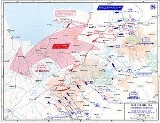
Battle of Gumbinnen

Encyclopedia
The Battle of Gumbinnen, initiated by forces of the German Empire
German Empire
The German Empire refers to Germany during the "Second Reich" period from the unification of Germany and proclamation of Wilhelm I as German Emperor on 18 January 1871, to 1918, when it became a federal republic after defeat in World War I and the abdication of the Emperor, Wilhelm II.The German...
on August 20, 1914, was the first major German offensive on the Eastern Front
Eastern Front (World War I)
The Eastern Front was a theatre of war during World War I in Central and, primarily, Eastern Europe. The term is in contrast to the Western Front. Despite the geographical separation, the events in the two theatres strongly influenced each other...
during the First World War
World War I
World War I , which was predominantly called the World War or the Great War from its occurrence until 1939, and the First World War or World War I thereafter, was a major war centred in Europe that began on 28 July 1914 and lasted until 11 November 1918...
. Because of the hastiness of the German attack, however, the Russian
Russian Empire
The Russian Empire was a state that existed from 1721 until the Russian Revolution of 1917. It was the successor to the Tsardom of Russia and the predecessor of the Soviet Union...
army emerged victorious.
Background
At the outbreak of the war, Maximilian von PrittwitzMaximilian von Prittwitz
Maximillion Von Prittwitz was a German General.-Family:Prittwitz came from an extremely old aristocratic Silesian family in Bernstadt...
's orders were very strict and clear: his German Eighth Army
German Eighth Army
The 8th Army was a World War I and World War II field army.-World War I:At the outbreak of World War I, the 8. Armee was stationed in East Prussia to defend against the expected Russian attack, Plan XIX. After the scrappy Battle of Gumbinnen, 8. Armee commander Generaloberst Maximilian von...
was to remain in its positions in East Prussia
East Prussia
East Prussia is the main part of the region of Prussia along the southeastern Baltic Coast from the 13th century to the end of World War II in May 1945. From 1772–1829 and 1878–1945, the Province of East Prussia was part of the German state of Prussia. The capital city was Königsberg.East Prussia...
, without attempting any offensive action, as all German efforts were to be concentrated on the Western Front
Western Front (World War I)
Following the outbreak of World War I in 1914, the German Army opened the Western Front by first invading Luxembourg and Belgium, then gaining military control of important industrial regions in France. The tide of the advance was dramatically turned with the Battle of the Marne...
against France
France
The French Republic , The French Republic , The French Republic , (commonly known as France , is a unitary semi-presidential republic in Western Europe with several overseas territories and islands located on other continents and in the Indian, Pacific, and Atlantic oceans. Metropolitan France...
, according to the Schlieffen Plan
Schlieffen Plan
The Schlieffen Plan was the German General Staff's early 20th century overall strategic plan for victory in a possible future war in which the German Empire might find itself fighting on two fronts: France to the west and Russia to the east...
. In addition, should the Russians
Russian Empire
The Russian Empire was a state that existed from 1721 until the Russian Revolution of 1917. It was the successor to the Tsardom of Russia and the predecessor of the Soviet Union...
increase their pressure, he was authorized to fall back as far as the Vistula
Vistula
The Vistula is the longest and the most important river in Poland, at 1,047 km in length. The watershed area of the Vistula is , of which lies within Poland ....
River, abandoning eastern Prussia.
The Eighth Army comprised four corps
Corps
A corps is either a large formation, or an administrative grouping of troops within an armed force with a common function such as Artillery or Signals representing an arm of service...
: I Corps (Hermann von François
Hermann von François
Hermann von François was a German General der Infanterie during World War I, and is best known for his key role in several German victories on the Eastern Front in 1914.-Early life and military career:...
), XVII Corps (August von Mackensen
August von Mackensen
Anton Ludwig August von Mackensen , born August Mackensen, was a German soldier and field marshal. He commanded with success during the First World War and became one of the German Empire's most prominent military leaders. After the Armistice, Mackensen was interned for a year...
), I Reserve Corps (Otto von Below
Otto von Below
Otto von Below was a Prussian general. He was born at and died at Danzig .Before World War I, Otto von Below became major-general in 1909 and lieutenant-general in 1912. On August 1, 1914 he took command of the I. Reserve Corps, which on the outbreak of the war was to be assigned to the Eight Army...
), and XX Corps (Friedrich von Scholtz
Friedrich von Scholtz
Friedrich von Scholtz was a German general, who served as commander of 20th Corps and the 8th Army of the German Empire on the Eastern Front in World War I and later as commander of Army Group "Sholtz" on the Macedonian Front.-Early life:Growing up in Ballenstedt his military career began in 1870...
), plus one cavalry
Cavalry
Cavalry or horsemen were soldiers or warriors who fought mounted on horseback. Cavalry were historically the third oldest and the most mobile of the combat arms...
division
Division (military)
A division is a large military unit or formation usually consisting of between 10,000 and 20,000 soldiers. In most armies, a division is composed of several regiments or brigades, and in turn several divisions typically make up a corps...
, facing the Russian First Army
Russian First Army
The Russian First Army was a World War I Russian field army that fought on the Eastern Front for two years.The First Army, commanded by General Paul Rennenkampf, invaded East Prussia at the outbreak of war in 1914 along with the Second Army commanded by General Alexander Samsonov. After declaring...
(Paul von Rennenkampf
Paul von Rennenkampf
Paul von Rennenkampf was a Russian general who served in the Imperial Russian Army for over 40 years, including during World War I.-Early career:...
) and Second Army (Alexander Samsonov
Alexander Samsonov
Aleksandr Vassilievich Samsonov was a career officer in the cavalry of the Imperial Russian Army and a general served during the Russo-Japanese War and World War I.-Biography:...
). The Russians enjoyed considerable numeric superiority, but were hampered by significant deficiencies in their services of supply
Services of Supply
The Services Of Supply or "SOS" branch of the Army of the USA was created on 28 February 1942 by Executive Order Number 9082 "Reorganizing the Army and the War Department" and War Department Circular No. 59, dated 2 March 1942. Services of Supply became one of the three autonomous components of the...
and field communications.
François was convinced that German training and equipment made up for their lack of numbers, and was pressing for offensive action. On the 17th he launched, on his own initiative and against orders, an attack against the Russian First Army at the Battle of Stallupönen
Battle of Stalluponen
The Battle of Stallupönen, fought between Russian and German armies on August 17, 1914, was the opening battle of World War I on the Eastern Front...
. By the time he withdrew to Gumbinnen
Gusev
Gusev is a town and the administrative center of Gusevsky District of Kaliningrad Oblast, Russia, located at the confluence of the Pissa and Krasnaya Rivers, near the border with Poland and Lithuania, east of Chernyakhovsk. Population: -History:...
after this battle, his corps had inflicted 5,000 casualties and managed to capture about 3,000 Russian prisoners.
German attack and retreat
Helmuth von Moltke the Younger
Helmuth Johann Ludwig von Moltke , also known as Moltke the Younger, was a nephew of Field Marshal Count Moltke and served as the Chief of the German General Staff from 1906 to 1914. The two are often differentiated as Moltke the Elder and Moltke the Younger...
, the German Chief of Staff, which specifically ruled out any offensive on the Eastern Front until France
France
The French Republic , The French Republic , The French Republic , (commonly known as France , is a unitary semi-presidential republic in Western Europe with several overseas territories and islands located on other continents and in the Indian, Pacific, and Atlantic oceans. Metropolitan France...
was defeated in the West
Western Front (World War I)
Following the outbreak of World War I in 1914, the German Army opened the Western Front by first invading Luxembourg and Belgium, then gaining military control of important industrial regions in France. The tide of the advance was dramatically turned with the Battle of the Marne...
.
On August 19, Russian cavalry came into contact with a German infantry
Infantry
Infantrymen are soldiers who are specifically trained for the role of fighting on foot to engage the enemy face to face and have historically borne the brunt of the casualties of combat in wars. As the oldest branch of combat arms, they are the backbone of armies...
regiment
Regiment
A regiment is a major tactical military unit, composed of variable numbers of batteries, squadrons or battalions, commanded by a colonel or lieutenant colonel...
outside Gumbinnen. Instead of withdrawing, the Russians dismounted and brought up their artillery
Artillery
Originally applied to any group of infantry primarily armed with projectile weapons, artillery has over time become limited in meaning to refer only to those engines of war that operate by projection of munitions far beyond the range of effect of personal weapons...
to continue the fight, driving the Germans back. However, they suffered 400 casualties and after expending most of their ammunition were forced to retreat themselves. This was the signal François had been awaiting, and he convinced Prittwitz to launch a counterattack the next day. With Prittwitz's approval, François started moving I Corps forward that night, reinforced by the 1st Cavalry Division.
At 4 a.m. on August 20, I Corps attacked the Russian 28th Division, which put up a spirited artillery defense. However, the Russians were always lacking in supplies, and they soon expended their artillery ammunition. This left them at the mercy of the German artillery, and they were forced to retreat 8 km in the early afternoon. The lines were stabilized when the Russian 29th Division arrived, and the battle turned into a stalemate.
To the south, Mackensen's XVII Corps and Below's I Reserve Corps were still moving up and were not ready for combat. Hearing of von François's actions further north, von Mackensen attacked Rennenkampf's III Corps at 8 AM, but von Below was not able to join in until noon. The Russians in this area were well aware of German intentions due to von François's attack, and had spent the time preparing for the assault by moving up their heavy artillery. At first the German advance went well, but faltered once they came under Russian artillery fire, and the Russians were able to turn their flanks and force them to retreat in disorder to the Insterburg-Angerburg lines, leaving 6,000 prisoners in Russian hands.
"The uncharacteristic sight of defeated German soldiers streaming mob-like to the rear really unnerved Prittwitz", who feared that his army could be trapped between Rennenkampf and Samsonov, although the former did not seem eager to pursue the retreating German troops. Prittwitz panicked and, with a decision out of proportion to the severity of the situation, ordered a general retreat to the Vistula, leaving East Prussia to the Russians.
von Moltke's reaction
Prittwitz's panic partially affected Moltke, who now feared that BerlinBerlin
Berlin is the capital city of Germany and is one of the 16 states of Germany. With a population of 3.45 million people, Berlin is Germany's largest city. It is the second most populous city proper and the seventh most populous urban area in the European Union...
itself could now be threatened by the advancing Russians. The Chief of Staff reacted by removing Prittwitz and his deputy Waldersee, replacing them with Paul von Hindenburg
Paul von Hindenburg
Paul Ludwig Hans Anton von Beneckendorff und von Hindenburg , known universally as Paul von Hindenburg was a Prussian-German field marshal, statesman, and politician, and served as the second President of Germany from 1925 to 1934....
and Erich Ludendorff
Erich Ludendorff
Erich Friedrich Wilhelm Ludendorff was a German general, victor of Liège and of the Battle of Tannenberg...
. He also transferred several divisions from the Western Front, which has been generally considered to have been an incorrect decision, as it weakened (some scholars say fatally) the German "marching wing" that was intended to rapidly move across Belgium
Belgium
Belgium , officially the Kingdom of Belgium, is a federal state in Western Europe. It is a founding member of the European Union and hosts the EU's headquarters, and those of several other major international organisations such as NATO.Belgium is also a member of, or affiliated to, many...
to outflank and destroy the French army.
One seemingly minor outcome of the battle would have lasting effects. After the battle, a note had been found on a dead Russian officer that outlined the greater part of the Russian plans for the campaign. As Hindenburg recalled:
- "It told us that Rennenkampf's Army was to pass the Masurian Lakes on the north and advance against the Insterburg-Angerburg line. It was to attack the German forces presumed to be behind the Angerapp while the Narew Army [Samsonov's] was to cross the Lotzen-Ortelsburg line to take the Germans in flank."
Armed with this intelligence, Hindenburg and Ludendorff halted the German retreat and decided to take the initiative. This would result in the Battle of Tannenberg
Battle of Tannenberg (1914)
The Battle of Tannenberg was an engagement between the Russian Empire and the German Empire in the first days of World War I. It was fought by the Russian First and Second Armies against the German Eighth Army between 23 August and 30 August 1914. The battle resulted in the almost complete...
, one of Germany's greatest victories.