


Battle of Glorieta Pass

Encyclopedia
The Battle of Glorieta Pass, fought from March 26 to 28, 1862 in northern New Mexico Territory
, was the decisive battle
of the New Mexico Campaign
during the American Civil War
. Dubbed the "Gettysburg
of the West" by some historians, it was intended as the killer blow by Confederate
forces to break the Union
possession of the West along the base of the Rocky Mountains
. It was fought at Glorieta Pass
in the Sangre de Cristo Mountains
in what is now New Mexico
, and was an important event in the history of the New Mexico Territory in the American Civil War
.
There was a skirmish on March 26 between advance forces from each army, with the main battle occurring on March 28. Although the Confederates were able to push the Union force back through the pass, they had to retreat when their supply train was destroyed and most of their horses and mules killed or driven off. Eventually, the Confederates had to withdraw entirely from the territory back into Confederate Arizona and then Texas
. Glorieta Pass thus represented the peak of the campaign.
in 1862, a claim that included the southern halves of modern Arizona
and New Mexico, after secession
moves by residents. The territory had its capital at Mesilla
, outside modern Las Cruces
. The strategic aim was to capture the gold and silver mines in California
and Colorado Territory
and the ports in southern California.
The commanders of the New Mexico Campaign were the Confederate Brigadier General Henry Hopkins Sibley
, and the Union Colonel
Edward Canby
. Sibley, whose mission was to capture Fort Craig
, outmaneuvered Canby at the Battle of Valverde
in February and drove Canby back to his fort, but failed to force Canby's surrender. Instead, Sibley bypassed the fort, and advanced up along the Rio Grande
Valley to seize Santa Fe
on March 10. Canby remained at Fort Craig to cut Sibley's logistical support from Texas and to await further reinforcements before resuming the offensive. Sibley set up his headquarters at the abandoned Union storehouse at Albuquerque
.
In March, Sibley sent a Confederate force of 200 to 300 Texans
under the command of Major
Charles L. Pyron
on an advance expedition over the Glorieta Pass
, a strategic location on the Santa Fe Trail
at the southern tip of the Sangre de Cristo Mountains
southeast of Santa Fe
. Control of the pass would allow the Confederates to advance onto the High Plains
and to make an assault on Fort Union
, the Union stronghold along the invasion route northward over Raton Pass
. Sibley also intended for six companies under the command of Colonel Tom Green to block the eastern end of Glorieta Pass, turning any Union defensive position in the Sangre de Cristos.

. During the battle on March 26, Pyron had his battalion of the 2nd Texas Mounted Rifles, four companies of the 5th Texas Mounted Rifles under Maj. John Shropshire, and two cannons. Scurry's force included nine companies of the 4th Texas Mounted Rifles under Maj. Henry Raguet, five companies of the 7th Texas Mounted Rifles under Maj. Powhatan Jordan, and three additional cannons.
The Union forces were led by Col. John P. Slough
of the 1st Colorado Infantry, with units under the command of Maj. John M. Chivington. In the action on March 26, Chivington had three infantry and one mounted companies of the 1st Colorado and a detachment of the 1st and 3rd U.S. Cavalry regiments. During the main battle on the 28th, Slough commanded in person nine companies of the 1st Colorado, a detachment from the 1st, 2nd, and 3rd U.S. Cavalry regiments, and two artillery batteries. Chivington commanded five companies of the 5th U.S. Infantry, one company from the 1st Colorado, James Hobart Ford
's Independent Company from the 2nd Colorado, and some New Mexico militia.
Prior to the battle, Union forces performed a forced march from Denver, over Raton Pass
, to Fort Union, and then to Glorietta Pass, covering the distance of 400 miles in 14 days. Combat commenced shortly after their arrival at the battlefield, leaving them little time to recuperate.
fire threw him back. He regrouped, split his force to the two sides of the pass, caught the Confederates in a crossfire, and soon forced them to retire. Pyron retired about a mile and a half (not quite two and a half kilometers) to a narrow section of the pass and formed a defensive line before Chivington’s men appeared. The Union forces flanked Pyron’s men again and punished them with enfilade
fire. Pyron ordered another retreat, but the withdrawal of the artillery caused the Confederates to become disorganized and start fighting in separate clusters of men. Chivington ordered a mounted Colorado company to make a frontal charge against the artillery; this charge succeeded in capturing several Confederates and scattering the rest. Not knowing if Confederate reinforcements were nearby, Chivington then retired and went into camp at Kozlowski’s Ranch to await Slough with the main body. His small victory was a morale booster for Slough's army.
No fighting occurred the next day as reinforcements arrived for both sides. Scurry's troops arrived at 3 A.M. on March 27, swelling the Confederate force to about 1,100 men and five cannons; as senior officer present, Scurry took command of the entire Confederate force. Thinking that Slough would attack again and expecting Green to arrive in the Union rear at any time, Scurry choose to remain in place for the day, digging rifle pits. Slough arrived early in the morning of March 28 with about 900 more men, bringing the Union strength to 1,300.
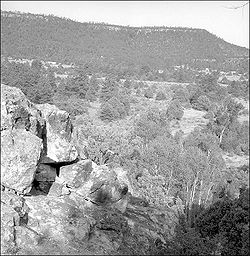 Both Scurry and Slough decided to attack on March 28 and set out early to do so. Expecting the Confederates to remain in Apache Canyon, Slough sent Maj. Chivington with two infantry battalions, under Lewis and Wynkoop, out in a circling movement with orders to go hide out at Glorieta Pass and hit the Texans in the flank once Slough's main force had engaged their front. Chivington did as ordered and his men waited above the Pass for Slough and the enemy to arrive. But instead of remaining at Apache Canyon as Slough had expected, Scurry advanced down the Canyon more rapidly than Slough had anticipated. Scurry expected the Union force was retreating back to Fort Union; he intended to attack them until Green arrived. One cannon and a small detail was left at Johnson's Ranch, the rest of the Confederate force, with more than a thousand men, marched eastwards along the Santa Fe trail.
When Slough found the Texans so far forward, he launched an attack, hitting the Texans around 11:00 a.m. about a half mile from Pigeon's Ranch. A provisional battalion of four companies from the 1st Colorado under Lt. Col. Samuel Tappan, supported by both batteries, deployed across the trail. The Confederates dismounted and deployed in a line across the canyon but the terrain caused some companies to become intermingled. Tappan was initially successful in holding his ground for a half hour, but the Confederates' numerical superiority enabled them to outflank the Union line by noon. Slough reformed his men a few hundred yards closer to Pigeon's Ranch, with four companies under Tappan and an artillery battery on a hill to the left, the other battery supported by two companies in the center across the road, and the other two companies on the ridge to the right.
Scurry then launched a three pronged attack on the Union line: Pyron and Raguet were ordered to attack the Union right, Shropshire the Union left, with the remainder of the Confederate force under himself attacking the Union center, supported by the artillery. The attack on the Union left was routed, with Shropshire killed, the attack in the center stalled, while the artillery was forced to withdraw after one cannon was disabled and a limber destroyed. The attack along the line then stalled, with the Confederates fighting by squads "with a desperation unequaled by any engagement of the war." At around 3:00 P.M., the Confederates managed to outflank the Union right, but Raguet was mortally wounded. From the ridge (known after the battle as "Sharpshooters Ridge"), the Confederates started to pick off the artillerymen and infantry below them, while Scurry started to press the Union center again. This made the Union position untenable, forcing Slough to order a retreat; Tappan organized the companies on the left flank into a rear guard. Slough then reformed his line a half mile east of Pigeon's Ranch, where both sides skirmished until dusk. Slough retreated back to Kozlowski's Ranch, leaving Scurry in possession of the field.
of the 2nd New Mexico Infantry, informed Chivington that his scouts had detected the Confederate supply train nearby at Johnson's Ranch. After watching them for an hour, Chivington's force descended the slope and attacked, routing or capturing the small baggage-guard with few casualties on either side. They then looted and set afire eighty supply wagons and spiked the cannon, and either killed or drove off five hundred horses and mules before returning to Kozlowski's Ranch. With no supplies with which to sustain his advance, Scurry had no choice but to retreat to Santa Fe, the first step on the long road back to San Antonio, Texas. The Federals thereby stopped further Confederate incursions into the Southwest. Glorieta Pass was the turning point of the war in the New Mexico Territory
.
One of Chaves' scouts was Anastasio Duran. Duran was stationed with the Union Army at Fort Union. He was a resident of Chaperito, New Mexico. Duran was considered a "Comanchero
" by U.S. Army officers; and was renowned for his hunting skills. He was intimately familiar with the terrain. Duran was the lead scout that led Union forces to attack Confederate forces behind Confederate lines at the Battle of Glorieta Pass.
Parts of the battlefield are preserved in Pecos National Historical Park
.
official, James L. Collins, with suggesting the roundabout attack on the supply train. The truth is that Chivington had been sent out in the hope of making a flank attack, and the discovery of the supply train was a lucky accident. But Chivington was accused of almost letting the opportunity slip. The New Mexico Territorial Legislature adopted a resolution on January 23, 1864, that did not mention Chivington but asked President Lincoln
to promote William H. Lewis and Asa B. Carey, both Regular Army officers, for "distinguished service" in the battle. On March 8, the Rio Abajo Press of Albuquerque editorialized against "Col. Chivington's strutting about in plumage stolen from Captain William H. Lewis". (It did not mention Carey.) The editorial claimed that "Some one of the party" suggested the attack, that Chivington agreed after "two hours persuasion", and that Lewis led the attack while Chivington was "viewing the scene from afar".
A rather more serious allegation made against Chivington was that if he had hurried to reinforce Slough as soon as he heard the gunfire coming from Pigeon's Ranch, his 400 men might have swung the battle in favor of the Federals – especially if he had led them against Scurry's flank, as ordered.
In the end, the dreams of a Confederate stronghold in the Southwest were impractical; New Mexico did not provide enough food or sustenance for any prolonged Confederate occupation. Furthermore, the approach of the Federal "California Column
" eastward through the New Mexico Territory during the summer of 1862 would have seriously jeopardized Confederate control of the region.
Of the roughly 10,500 actions of the U.S. Civil War, 384 (3.7%) were identified by the Commission as principal battles and rated according to their significance and threat of loss. The Battle of Glorieta Pass received the highest rating from the Commission, Priority I (Class A). Class A battlefields are principal strategic operations having a direct impact on the course of the war. With this rating the Commission placed Glorieta Pass on the same level with battles such as Gettysburg
and Antietam
. The Priority I rating identified Glorieta Pass as being not only one of the most important, but also one of the most highly endangered battlefields in the country. Only 10 other battlefields received the Priority I (Class A) rating. The Commission recommended that Congress focus its preservation efforts on Priority I, nationally significant battlefields.
Since 1993 portions of the Glorieta Pass Battlefield
have become a unit of the National Park Service. The Glorieta Pass unit (Pigeon’s Ranch) comprises roughly 20% of the total battlefield. The remaining 80% is in private ownership. Glorieta Pass Battlefield is managed by Pecos National Historical Park
and supported by the Glorieta Battlefield Coalition, a non-profit citizens' organization.
The Glorieta Pass Battlefield is also designated as a National Historic Landmark
– a site possessing exceptional value or quality in illustrating or interpreting the heritage of the United States. Fewer than 2,500 historic places in the nation bear this distinction.
The 1966 Sergio Leone
film The Good, the Bad and the Ugly
refers obliquely to the battle, setting one scene at Johnson's Ranch where the Confederates appear to be guarding their supply wagons around the time of the battle.
New Mexico Territory
thumb|right|240px|Proposed boundaries for State of New Mexico, 1850The Territory of New Mexico was an organized incorporated territory of the United States that existed from September 9, 1850, until January 6, 1912, when the final extent of the territory was admitted to the Union as the State of...
, was the decisive battle
Battle
Generally, a battle is a conceptual component in the hierarchy of combat in warfare between two or more armed forces, or combatants. In a battle, each combatant will seek to defeat the others, with defeat determined by the conditions of a military campaign...
of the New Mexico Campaign
New Mexico Campaign
The New Mexico Campaign was a military operation of the American Civil War from February to April 1862 in which Confederate Brigadier General Henry Hopkins Sibley invaded the northern New Mexico Territory in an attempt to gain control of the Southwest, including the gold fields of Colorado and the...
during the American Civil War
American Civil War
The American Civil War was a civil war fought in the United States of America. In response to the election of Abraham Lincoln as President of the United States, 11 southern slave states declared their secession from the United States and formed the Confederate States of America ; the other 25...
. Dubbed the "Gettysburg
Battle of Gettysburg
The Battle of Gettysburg , was fought July 1–3, 1863, in and around the town of Gettysburg, Pennsylvania. The battle with the largest number of casualties in the American Civil War, it is often described as the war's turning point. Union Maj. Gen. George Gordon Meade's Army of the Potomac...
of the West" by some historians, it was intended as the killer blow by Confederate
Confederate States of America
The Confederate States of America was a government set up from 1861 to 1865 by 11 Southern slave states of the United States of America that had declared their secession from the U.S...
forces to break the Union
Union (American Civil War)
During the American Civil War, the Union was a name used to refer to the federal government of the United States, which was supported by the twenty free states and five border slave states. It was opposed by 11 southern slave states that had declared a secession to join together to form the...
possession of the West along the base of the Rocky Mountains
Rocky Mountains
The Rocky Mountains are a major mountain range in western North America. The Rocky Mountains stretch more than from the northernmost part of British Columbia, in western Canada, to New Mexico, in the southwestern United States...
. It was fought at Glorieta Pass
Glorieta Pass
Glorieta Pass is a high mountain pass in the Sangre de Cristo Mountains of northern New Mexico. The pass is at a strategic location near at the southern end of the Sangre de Cristos in east central Santa Fe County southeast of the city of Santa Fe.Historically, the pass provided the most direct...
in the Sangre de Cristo Mountains
Sangre de Cristo Mountains
The Sangre de Cristo Mountains are the southernmost subrange of the Rocky Mountains. They are located in southern Colorado and northern New Mexico in the United States...
in what is now New Mexico
New Mexico
New Mexico is a state located in the southwest and western regions of the United States. New Mexico is also usually considered one of the Mountain States. With a population density of 16 per square mile, New Mexico is the sixth-most sparsely inhabited U.S...
, and was an important event in the history of the New Mexico Territory in the American Civil War
New Mexico Territory in the American Civil War
The New Mexico Territory, which included the areas which became the modern U.S. states of New Mexico and Arizona as well as the southern part of Nevada, played a role in the Trans-Mississippi Theater of the American Civil War. Both Confederate and Union governments claimed ownership and territorial...
.
There was a skirmish on March 26 between advance forces from each army, with the main battle occurring on March 28. Although the Confederates were able to push the Union force back through the pass, they had to retreat when their supply train was destroyed and most of their horses and mules killed or driven off. Eventually, the Confederates had to withdraw entirely from the territory back into Confederate Arizona and then Texas
Texas
Texas is the second largest U.S. state by both area and population, and the largest state by area in the contiguous United States.The name, based on the Caddo word "Tejas" meaning "friends" or "allies", was applied by the Spanish to the Caddo themselves and to the region of their settlement in...
. Glorieta Pass thus represented the peak of the campaign.
New Mexico Campaign
The Confederacy had organized the Confederate Arizona TerritoryArizona Territory (CSA)
The Territory of Arizona was a territory claimed by the Confederate States of America during the American Civil War, between 1861 and 1865. It consisted of the portion of the New Mexico Territory south of the 34th parallel north including parts of the modern states of New Mexico and Arizona. Its...
in 1862, a claim that included the southern halves of modern Arizona
Arizona
Arizona ; is a state located in the southwestern region of the United States. It is also part of the western United States and the mountain west. The capital and largest city is Phoenix...
and New Mexico, after secession
Secession in the United States
Secession in the United States can refer to secession of a state from the United States, secession of part of a state from that state to form a new state, or secession of an area from a city or county....
moves by residents. The territory had its capital at Mesilla
Mesilla, New Mexico
Mesilla is a town in Doña Ana County, New Mexico, United States. The population was 2,180 at the 2000 census...
, outside modern Las Cruces
Las Cruces, New Mexico
Las Cruces, also known as "The City of the Crosses", is the county seat of Doña Ana County, New Mexico, United States. The population was 97,618 in 2010 according to the 2010 Census, making it the second largest city in the state....
. The strategic aim was to capture the gold and silver mines in California
California
California is a state located on the West Coast of the United States. It is by far the most populous U.S. state, and the third-largest by land area...
and Colorado Territory
Colorado Territory
The Territory of Colorado was an organized incorporated territory of the United States that existed from February 28, 1861, until August 1, 1876, when it was admitted to the Union as the State of Colorado....
and the ports in southern California.
The commanders of the New Mexico Campaign were the Confederate Brigadier General Henry Hopkins Sibley
Henry Hopkins Sibley
Henry Hopkins Sibley was a brigadier general during the American Civil War, leading the Confederate States Army in the New Mexico Territory. His attempt to gain control of trails to California was defeated at the Battle of Glorieta Pass...
, and the Union Colonel
Colonel (United States)
In the United States Army, Air Force, and Marine Corps, colonel is a senior field grade military officer rank just above the rank of lieutenant colonel and just below the rank of brigadier general...
Edward Canby
Edward Canby
Edward Richard Sprigg Canby was a career United States Army officer and a Union general in the American Civil War, Reconstruction era, and the Indian Wars...
. Sibley, whose mission was to capture Fort Craig
Fort Craig
Fort Craig was a U.S. Army fort located along El Camino Real de Tierra Adentro, near Elephant Butte Lake State Park and the Rio Grande in Socorro County, New Mexico....
, outmaneuvered Canby at the Battle of Valverde
Battle of Valverde
The Battle of Valverde, or the Battle of Valverde Ford from February 20 to February 21, 1862, was fought near the town of Valverde at a ford of Valverde Creek in Confederate Arizona, in what is today the state of New Mexico. It was a major Confederate success in the New Mexico Campaign of the...
in February and drove Canby back to his fort, but failed to force Canby's surrender. Instead, Sibley bypassed the fort, and advanced up along the Rio Grande
Rio Grande
The Rio Grande is a river that flows from southwestern Colorado in the United States to the Gulf of Mexico. Along the way it forms part of the Mexico – United States border. Its length varies as its course changes...
Valley to seize Santa Fe
Santa Fe, New Mexico
Santa Fe is the capital of the U.S. state of New Mexico. It is the fourth-largest city in the state and is the seat of . Santa Fe had a population of 67,947 in the 2010 census...
on March 10. Canby remained at Fort Craig to cut Sibley's logistical support from Texas and to await further reinforcements before resuming the offensive. Sibley set up his headquarters at the abandoned Union storehouse at Albuquerque
Albuquerque, New Mexico
Albuquerque is the largest city in the state of New Mexico, United States. It is the county seat of Bernalillo County and is situated in the central part of the state, straddling the Rio Grande. The city population was 545,852 as of the 2010 Census and ranks as the 32nd-largest city in the U.S. As...
.
In March, Sibley sent a Confederate force of 200 to 300 Texans
Texas
Texas is the second largest U.S. state by both area and population, and the largest state by area in the contiguous United States.The name, based on the Caddo word "Tejas" meaning "friends" or "allies", was applied by the Spanish to the Caddo themselves and to the region of their settlement in...
under the command of Major
Major (United States)
In the United States Army, Air Force, and Marine Corps, major is a field grade military officer rank just above the rank of captain and just below the rank of lieutenant colonel...
Charles L. Pyron
Charles L. Pyron
Charles Lynn Pyron was a soldier in the U.S. Army in the Mexican-American War and a Confederate Army officer in the American Civil War...
on an advance expedition over the Glorieta Pass
Glorieta Pass
Glorieta Pass is a high mountain pass in the Sangre de Cristo Mountains of northern New Mexico. The pass is at a strategic location near at the southern end of the Sangre de Cristos in east central Santa Fe County southeast of the city of Santa Fe.Historically, the pass provided the most direct...
, a strategic location on the Santa Fe Trail
Santa Fe Trail
The Santa Fe Trail was a 19th-century transportation route through central North America that connected Missouri with Santa Fe, New Mexico. Pioneered in 1822 by William Becknell, it served as a vital commercial and military highway until the introduction of the railroad to Santa Fe in 1880...
at the southern tip of the Sangre de Cristo Mountains
Sangre de Cristo Mountains
The Sangre de Cristo Mountains are the southernmost subrange of the Rocky Mountains. They are located in southern Colorado and northern New Mexico in the United States...
southeast of Santa Fe
Santa Fe, New Mexico
Santa Fe is the capital of the U.S. state of New Mexico. It is the fourth-largest city in the state and is the seat of . Santa Fe had a population of 67,947 in the 2010 census...
. Control of the pass would allow the Confederates to advance onto the High Plains
High Plains (United States)
The High Plains are a subregion of the Great Plains mostly in the Western United States, but also partly in the Midwest states of Nebraska, Kansas, and South Dakota, generally encompassing the western part of the Great Plains before the region reaches the Rocky Mountains...
and to make an assault on Fort Union
Fort Union National Monument
Fort Union National Monument is a unit of the National Park Service located north of Watrous, Mora County, New Mexico, USA. The national monument was founded on June 28, 1954....
, the Union stronghold along the invasion route northward over Raton Pass
Raton Pass
Raton Pass is a mountain pass on the Santa Fe Trail along the Colorado-New Mexico border in the United States. Raton Pass is a federally designated National Historic Landmark...
. Sibley also intended for six companies under the command of Colonel Tom Green to block the eastern end of Glorieta Pass, turning any Union defensive position in the Sangre de Cristos.
Battle
Opposing forces
The Confederates were led by Charles L. Pyron and William Read ScurryWilliam Read Scurry
William Read Scurry was a general in the Confederate States Army in the American Civil War.-Biography:...
. During the battle on March 26, Pyron had his battalion of the 2nd Texas Mounted Rifles, four companies of the 5th Texas Mounted Rifles under Maj. John Shropshire, and two cannons. Scurry's force included nine companies of the 4th Texas Mounted Rifles under Maj. Henry Raguet, five companies of the 7th Texas Mounted Rifles under Maj. Powhatan Jordan, and three additional cannons.
The Union forces were led by Col. John P. Slough
John P. Slough
John Potts Slough was an American politician, lawyer, Union general during the American Civil War, and Chief Justice of New Mexico. He commanded the Union forces at the Battle of Glorieta Pass.-Early life and career:Slough was born in Cincinnati, Ohio...
of the 1st Colorado Infantry, with units under the command of Maj. John M. Chivington. In the action on March 26, Chivington had three infantry and one mounted companies of the 1st Colorado and a detachment of the 1st and 3rd U.S. Cavalry regiments. During the main battle on the 28th, Slough commanded in person nine companies of the 1st Colorado, a detachment from the 1st, 2nd, and 3rd U.S. Cavalry regiments, and two artillery batteries. Chivington commanded five companies of the 5th U.S. Infantry, one company from the 1st Colorado, James Hobart Ford
James Hobart Ford
James Hobart Ford was a Union general during the American Civil War, notable for his contributions in the Trans-Mississippi Theater of the war.-Early life:...
's Independent Company from the 2nd Colorado, and some New Mexico militia.
Prior to the battle, Union forces performed a forced march from Denver, over Raton Pass
Raton Pass
Raton Pass is a mountain pass on the Santa Fe Trail along the Colorado-New Mexico border in the United States. Raton Pass is a federally designated National Historic Landmark...
, to Fort Union, and then to Glorietta Pass, covering the distance of 400 miles in 14 days. Combat commenced shortly after their arrival at the battlefield, leaving them little time to recuperate.
Apache Canyon
Pyron's force of 300 camped at Apache Canyon, at one end of Glorieta Pass, leaving a picket post of fifty men at the summit of the pass. Chivington led 418 soldiers to the Pass and on the morning of March 26 moved out to attack. After noon, Chivington’s men captured the picket post and then found the main force behind them. Chivington advanced on them, but their artilleryField artillery in the American Civil War
Field artillery in the American Civil War refers to the important artillery weapons, equipment, and practices used by the Artillery branch to support the infantry and cavalry forces in the field. It does not include siege artillery, use of artillery in fixed fortifications, or coastal or naval...
fire threw him back. He regrouped, split his force to the two sides of the pass, caught the Confederates in a crossfire, and soon forced them to retire. Pyron retired about a mile and a half (not quite two and a half kilometers) to a narrow section of the pass and formed a defensive line before Chivington’s men appeared. The Union forces flanked Pyron’s men again and punished them with enfilade
Enfilade and defilade
Enfilade and defilade are concepts in military tactics used to describe a military formation's exposure to enemy fire. A formation or position is "in enfilade" if weapons fire can be directed along its longest axis. A unit or position is "in defilade" if it uses natural or artificial obstacles to...
fire. Pyron ordered another retreat, but the withdrawal of the artillery caused the Confederates to become disorganized and start fighting in separate clusters of men. Chivington ordered a mounted Colorado company to make a frontal charge against the artillery; this charge succeeded in capturing several Confederates and scattering the rest. Not knowing if Confederate reinforcements were nearby, Chivington then retired and went into camp at Kozlowski’s Ranch to await Slough with the main body. His small victory was a morale booster for Slough's army.
No fighting occurred the next day as reinforcements arrived for both sides. Scurry's troops arrived at 3 A.M. on March 27, swelling the Confederate force to about 1,100 men and five cannons; as senior officer present, Scurry took command of the entire Confederate force. Thinking that Slough would attack again and expecting Green to arrive in the Union rear at any time, Scurry choose to remain in place for the day, digging rifle pits. Slough arrived early in the morning of March 28 with about 900 more men, bringing the Union strength to 1,300.
Glorieta Pass
When Slough found the Texans so far forward, he launched an attack, hitting the Texans around 11:00 a.m. about a half mile from Pigeon's Ranch. A provisional battalion of four companies from the 1st Colorado under Lt. Col. Samuel Tappan, supported by both batteries, deployed across the trail. The Confederates dismounted and deployed in a line across the canyon but the terrain caused some companies to become intermingled. Tappan was initially successful in holding his ground for a half hour, but the Confederates' numerical superiority enabled them to outflank the Union line by noon. Slough reformed his men a few hundred yards closer to Pigeon's Ranch, with four companies under Tappan and an artillery battery on a hill to the left, the other battery supported by two companies in the center across the road, and the other two companies on the ridge to the right.
Scurry then launched a three pronged attack on the Union line: Pyron and Raguet were ordered to attack the Union right, Shropshire the Union left, with the remainder of the Confederate force under himself attacking the Union center, supported by the artillery. The attack on the Union left was routed, with Shropshire killed, the attack in the center stalled, while the artillery was forced to withdraw after one cannon was disabled and a limber destroyed. The attack along the line then stalled, with the Confederates fighting by squads "with a desperation unequaled by any engagement of the war." At around 3:00 P.M., the Confederates managed to outflank the Union right, but Raguet was mortally wounded. From the ridge (known after the battle as "Sharpshooters Ridge"), the Confederates started to pick off the artillerymen and infantry below them, while Scurry started to press the Union center again. This made the Union position untenable, forcing Slough to order a retreat; Tappan organized the companies on the left flank into a rear guard. Slough then reformed his line a half mile east of Pigeon's Ranch, where both sides skirmished until dusk. Slough retreated back to Kozlowski's Ranch, leaving Scurry in possession of the field.
Johnson's Ranch
Meanwhile, the leader of the New Mexican volunteers, Lt. Col. Manuel ChavesManuel Antonio Chaves
Manuel Antonio Chaves or Chávez , known as El Leoncito , was a soldier in the Mexican Army and then became a rancher who lived in New Mexico. His life was full of incident, and his courage and marksmanship became literally legendary in his own time...
of the 2nd New Mexico Infantry, informed Chivington that his scouts had detected the Confederate supply train nearby at Johnson's Ranch. After watching them for an hour, Chivington's force descended the slope and attacked, routing or capturing the small baggage-guard with few casualties on either side. They then looted and set afire eighty supply wagons and spiked the cannon, and either killed or drove off five hundred horses and mules before returning to Kozlowski's Ranch. With no supplies with which to sustain his advance, Scurry had no choice but to retreat to Santa Fe, the first step on the long road back to San Antonio, Texas. The Federals thereby stopped further Confederate incursions into the Southwest. Glorieta Pass was the turning point of the war in the New Mexico Territory
New Mexico Territory
thumb|right|240px|Proposed boundaries for State of New Mexico, 1850The Territory of New Mexico was an organized incorporated territory of the United States that existed from September 9, 1850, until January 6, 1912, when the final extent of the territory was admitted to the Union as the State of...
.
One of Chaves' scouts was Anastasio Duran. Duran was stationed with the Union Army at Fort Union. He was a resident of Chaperito, New Mexico. Duran was considered a "Comanchero
Comanchero
The Comancheros were primarily New Mexican hispanic traders in northern and central New Mexico who made their living by trading with the nomadic plains tribes, in northeastern New Mexico and west Texas. Comancheros were so named because the Comanches, in whose territory they traded, were considered...
" by U.S. Army officers; and was renowned for his hunting skills. He was intimately familiar with the terrain. Duran was the lead scout that led Union forces to attack Confederate forces behind Confederate lines at the Battle of Glorieta Pass.
Parts of the battlefield are preserved in Pecos National Historical Park
Pecos National Historical Park
Pecos National Historical Park is a National Historical Park in the U.S. state of New Mexico. It is located about east of Santa Fe, New Mexico. The site was originally designated Pecos National Monument on June 28, 1965. In 1990 new lands were added to the park and the official designation was...
.
Controversy
Many New Mexicans disputed the view that Chivington was the hero of Johnson's Ranch. Some Santa Feans credited a Bureau of Indian AffairsBureau of Indian Affairs
The Bureau of Indian Affairs is an agency of the federal government of the United States within the US Department of the Interior. It is responsible for the administration and management of of land held in trust by the United States for Native Americans in the United States, Native American...
official, James L. Collins, with suggesting the roundabout attack on the supply train. The truth is that Chivington had been sent out in the hope of making a flank attack, and the discovery of the supply train was a lucky accident. But Chivington was accused of almost letting the opportunity slip. The New Mexico Territorial Legislature adopted a resolution on January 23, 1864, that did not mention Chivington but asked President Lincoln
Abraham Lincoln
Abraham Lincoln was the 16th President of the United States, serving from March 1861 until his assassination in April 1865. He successfully led his country through a great constitutional, military and moral crisis – the American Civil War – preserving the Union, while ending slavery, and...
to promote William H. Lewis and Asa B. Carey, both Regular Army officers, for "distinguished service" in the battle. On March 8, the Rio Abajo Press of Albuquerque editorialized against "Col. Chivington's strutting about in plumage stolen from Captain William H. Lewis". (It did not mention Carey.) The editorial claimed that "Some one of the party" suggested the attack, that Chivington agreed after "two hours persuasion", and that Lewis led the attack while Chivington was "viewing the scene from afar".
A rather more serious allegation made against Chivington was that if he had hurried to reinforce Slough as soon as he heard the gunfire coming from Pigeon's Ranch, his 400 men might have swung the battle in favor of the Federals – especially if he had led them against Scurry's flank, as ordered.
Effects of the Federal victory
In the end, the Battle of Glorieta Pass proved remarkably important. First, despite the fact that the Confederates took the field, they were forced to retreat back to Santa Fe due to the destruction of their supplies and eventually abandon New Mexico Territory. Second, the battle at Glorieta foiled Sibley's plan to obtain his key objective: the capture of the major Federal base at Fort Union. The fall of Fort Union would have broken Federal resistance in New Mexico, and compelled Union forces to retire north of Raton Pass and back into Colorado Territory.In the end, the dreams of a Confederate stronghold in the Southwest were impractical; New Mexico did not provide enough food or sustenance for any prolonged Confederate occupation. Furthermore, the approach of the Federal "California Column
California Column
The California Column, a force of Union volunteers, marched from April to August 1862 over 900 miles from California, across the southern New Mexico Territory to the Rio Grande and then into western Texas during the American Civil War. At the time, this was the longest trek through desert terrain...
" eastward through the New Mexico Territory during the summer of 1862 would have seriously jeopardized Confederate control of the region.
Battlefield preservation
In 1993, the Congressionally appointed Civil War Sites Advisory Commission issued its "Report on the Nation’s Civil War Battlefields." The Commission was tasked with identifying the nation’s historically significant Civil War sites, determining their importance, and providing recommendations for their preservation to Congress.Of the roughly 10,500 actions of the U.S. Civil War, 384 (3.7%) were identified by the Commission as principal battles and rated according to their significance and threat of loss. The Battle of Glorieta Pass received the highest rating from the Commission, Priority I (Class A). Class A battlefields are principal strategic operations having a direct impact on the course of the war. With this rating the Commission placed Glorieta Pass on the same level with battles such as Gettysburg
Battle of Gettysburg
The Battle of Gettysburg , was fought July 1–3, 1863, in and around the town of Gettysburg, Pennsylvania. The battle with the largest number of casualties in the American Civil War, it is often described as the war's turning point. Union Maj. Gen. George Gordon Meade's Army of the Potomac...
and Antietam
Battle of Antietam
The Battle of Antietam , fought on September 17, 1862, near Sharpsburg, Maryland, and Antietam Creek, as part of the Maryland Campaign, was the first major battle in the American Civil War to take place on Northern soil. It was the bloodiest single-day battle in American history, with about 23,000...
. The Priority I rating identified Glorieta Pass as being not only one of the most important, but also one of the most highly endangered battlefields in the country. Only 10 other battlefields received the Priority I (Class A) rating. The Commission recommended that Congress focus its preservation efforts on Priority I, nationally significant battlefields.
Since 1993 portions of the Glorieta Pass Battlefield
Glorieta Pass Battlefield
Glorieta Pass Battlefield, also known as Glorieta Pass, was the site of a decisive American Civil War battle that ended Confederate ambitions to cut off the West from the Union...
have become a unit of the National Park Service. The Glorieta Pass unit (Pigeon’s Ranch) comprises roughly 20% of the total battlefield. The remaining 80% is in private ownership. Glorieta Pass Battlefield is managed by Pecos National Historical Park
Pecos National Historical Park
Pecos National Historical Park is a National Historical Park in the U.S. state of New Mexico. It is located about east of Santa Fe, New Mexico. The site was originally designated Pecos National Monument on June 28, 1965. In 1990 new lands were added to the park and the official designation was...
and supported by the Glorieta Battlefield Coalition, a non-profit citizens' organization.
The Glorieta Pass Battlefield is also designated as a National Historic Landmark
National Historic Landmark
A National Historic Landmark is a building, site, structure, object, or district, that is officially recognized by the United States government for its historical significance...
– a site possessing exceptional value or quality in illustrating or interpreting the heritage of the United States. Fewer than 2,500 historic places in the nation bear this distinction.
Depictions in popular culture
The battle is described in the historical novel Glorieta Pass by P. G. Nagle.The 1966 Sergio Leone
Sergio Leone
Sergio Leone was an Italian film director, producer and screenwriter most associated with the "Spaghetti Western" genre.Leone's film-making style includes juxtaposing extreme close-up shots with lengthy long shots...
film The Good, the Bad and the Ugly
The Good, the Bad and the Ugly
The Good, the Bad and the Ugly is a 1966 Italian epic spaghetti western film directed by Sergio Leone, starring Clint Eastwood, Lee Van Cleef, and Eli Wallach in the title roles. The screenplay was written by Age & Scarpelli, Luciano Vincenzoni and Leone, based on a story by Vincenzoni and Leone...
refers obliquely to the battle, setting one scene at Johnson's Ranch where the Confederates appear to be guarding their supply wagons around the time of the battle.
Further reading
- Alberts, Don. The Battle of Glorieta: Union Victory in the West. Texas A&M University Press, 1996. ISBN 0-89096-825-X.
- Edrington, Thomas. The Battle of Glorieta Pass: A Gettysburg in the West, March 26–28, 1862. University of New Mexico Press, 1998. ISBN 0-8263-1896-7.
- Nagle, P. G. Glorieta Pass [a novel]. New York: Forge, 1999. ISBN 0-312-86548-1.
- Scott, Robert. "Glory, Glory, Glorieta: The Gettysburg of the West." Johnson Books,1992. ISBN 1-55566-098-3.
- Simmons, Mark. "The Battle at Valley's Ranch: First account of the Gettysburg of the West, 1862." San Pedro Press, 1987. ISBN 0-943369-00-2.
- Whitford, William. "Battle of Glorieta Pass: The Colorado Volunteers in the Civil War." Rio Grande Press, 1990. ISBN 0-87380-171-7.