
The
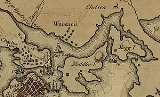
Battle of Chelsea Creek was the second military engagement of the
Boston campaignThe Boston campaign was the opening campaign of the American Revolutionary War. The campaign was primarily concerned with the formation of American colonial irregular militia units, and their transformation into a unified Continental Army...
of the
American Revolutionary WarThe American Revolutionary War , the American War of Independence, or simply the Revolutionary War, began as a war between the Kingdom of Great Britain and thirteen British colonies in North America, and ended in a global war between several European great powers.The war was the result of the...
. It is also known as the
Battle of Noddle's Island,
Battle of Hog Island and the
Battle of the Chelsea Estuary. This battle was fought on May 27 and 28, 1775, on
Chelsea CreekChelsea Creek, shown on federal maps as the Chelsea River, is a waterway that runs along the shore of Chelsea, Massachusetts and separates that community from the cities of Boston and Revere as well as feeding part of the current Belle Isle Marsh Reservation that separates Boston from Revere...
and on salt marshes, mudflats, and islands of
Boston HarborBoston Harbor is a natural harbor and estuary of Massachusetts Bay, and is located adjacent to the city of Boston, Massachusetts. It is home to the Port of Boston, a major shipping facility in the northeast.-History:...
, northeast of the Boston
peninsulaA peninsula is a piece of land that is bordered by water on three sides but connected to mainland. In many Germanic and Celtic languages and also in Baltic, Slavic and Hungarian, peninsulas are called "half-islands"....
. Most of these areas have since been united with the mainland by
land reclamationLand reclamation, usually known as reclamation, is the process to create new land from sea or riverbeds. The land reclaimed is known as reclamation ground or landfill.- Habitation :...
and are now part of
East BostonEast Boston is a neighborhood of Boston, Massachusetts, with approximately 40,000 residents. The community was created by connecting several islands using landfill and was annexed by Boston in 1836. East Boston is separated from the rest of the city by Boston Harbor and bordered by Winthrop,...
,
ChelseaChelsea is a city in Suffolk County, Massachusetts, United States directly across the Mystic River from the city of Boston. It is the smallest city in Massachusetts in land area, and the 26th most densely populated incorporated place in the country.-History:...
,
WinthropThe Town of Winthrop is a municipality in Suffolk County, Massachusetts, United States. The population of Winthrop was 17,497 at the 2010 U.S. Census. It is an oceanside suburban community in Greater Boston situated at the north entrance to Boston Harbor and is very close to Logan International...
, and
RevereRevere is a city in Suffolk County, Massachusetts, United States, and located approximately from downtown Boston. It is named after the American patriot Paul Revere. As of the 2010 census, the city population was 51,755.- History :...
.
The British colonists met their goal of strengthening the
siege of BostonThe Siege of Boston was the opening phase of the American Revolutionary War, in which New England militiamen—who later became part of the Continental Army—surrounded the town of Boston, Massachusetts, to prevent movement by the British Army garrisoned within...
by removing livestock and hay on those islands from the reach of the British regulars. The British
armed schooner DianaHMS Diana was the first British vessel captured and destroyed by colonial forces during the American Revolutionary War.The 120 ton schooner was afloat for little more than a year...
was also destroyed and its weaponry was appropriated by the Colonial side. This was the first naval capture of the war, and it was a significant boost to the morale of the Colonial forces.
Background
The Battle of Lexington and Concord on April 19, 1775 drew thousands of
militiaThe term militia is commonly used today to refer to a military force composed of ordinary citizens to provide defense, emergency law enforcement, or paramilitary service, in times of emergency without being paid a regular salary or committed to a fixed term of service. It is a polyseme with...
forces from throughout
New EnglandNew England is a region in the northeastern corner of the United States consisting of the six states of Maine, New Hampshire, Vermont, Massachusetts, Rhode Island, and Connecticut...
to the towns surrounding
BostonBoston is the capital of and largest city in Massachusetts, and is one of the oldest cities in the United States. The largest city in New England, Boston is regarded as the unofficial "Capital of New England" for its economic and cultural impact on the entire New England region. The city proper had...
. These men remained in the area and their numbers grew, placing the British forces in
Boston under siegeThe Siege of Boston was the opening phase of the American Revolutionary War, in which New England militiamen—who later became part of the Continental Army—surrounded the town of Boston, Massachusetts, to prevent movement by the British Army garrisoned within...
when they blocked all land access to the peninsula. The British were still able to sail in supplies from
Nova ScotiaNova Scotia is one of Canada's three Maritime provinces and is the most populous province in Atlantic Canada. The name of the province is Latin for "New Scotland," but "Nova Scotia" is the recognized, English-language name of the province. The provincial capital is Halifax. Nova Scotia is the...
,
ProvidenceProvidence is the capital and most populous city of Rhode Island and was one of the first cities established in the United States. Located in Providence County, it is the third largest city in the New England region...
, and other places because the harbor side of the city remained under British naval control. Colonial forces could do little to stop these shipments due to the naval supremacy of the British fleet and the complete absence of a
Continental NavyThe Continental Navy was the navy of the United States during the American Revolutionary War, and was formed in 1775. Through the efforts of the Continental Navy's patron, John Adams and vigorous Congressional support in the face of stiff opposition, the fleet cumulatively became relatively...
in the spring of 1775. However, there was one remaining local area that continued to supply the British forces in Boston after the war began.
Farmers to the east of the city in coastal areas and on the
Boston HarborBoston Harbor is a natural harbor and estuary of Massachusetts Bay, and is located adjacent to the city of Boston, Massachusetts. It is home to the Port of Boston, a major shipping facility in the northeast.-History:...
islands found themselves vulnerable once the siege began because they were exposed to British influence from the sea. If they continued to sell livestock to the regulars they would be viewed as
LoyalistLoyalists were American colonists who remained loyal to the Kingdom of Great Britain during the American Revolutionary War. At the time they were often called Tories, Royalists, or King's Men. They were opposed by the Patriots, those who supported the revolution...
s in the eyes of the
PatriotPatriots is a name often used to describe the colonists of the British Thirteen United Colonies who rebelled against British control during the American Revolution. It was their leading figures who, in July 1776, declared the United States of America an independent nation...
s, but if they refused to sell then the British would consider them rebels and raiding parties would simply take what they wanted. On May 14, the
MassachusettsThe Commonwealth of Massachusetts is a state in the New England region of the northeastern United States of America. It is bordered by Rhode Island and Connecticut to the south, New York to the west, and Vermont and New Hampshire to the north; at its east lies the Atlantic Ocean. As of the 2010...
Committee of SafetyMany Committees of Safety were established throughout Colonial America at the start of the American Revolution. These committees started to appear in the 1760s as means to discuss the concerns of the time, and often consisted of every male adult in the community...
under
Joseph WarrenDr. Joseph Warren was an American doctor who played a leading role in American Patriot organizations in Boston in early days of the American Revolution, eventually serving as president of the revolutionary Massachusetts Provincial Congress...
issued the following order:
A few days before the battle, Warren and
General Artemas WardArtemas Ward was an American major general in the American Revolutionary War and a Congressman from Massachusetts...
, commander of the besieging forces, inspected
Noddle's IslandNoddle's Island is one of Boston Harbor Islands off East Boston, Massachusetts. In the 1940s the strait separating Noddle's Island from East Boston was filled, thereby connecting the island to Logan International Airport on the mainland.-History:...
and Hog Island, which lay to the northeast of Boston, and east of Charlestown. They found no British troops there but plenty of livestock. The animals in other coastal areas had been moved inland by their owners. On May 21, the British had sailed troops to
Grape IslandGrape Island is an island in the Hingham Bay area of the Boston Harbor Islands National Recreation Area. The island is part of the territory of the town of Weymouth, Massachusetts. The island has a permanent size of , plus an intertidal zone of a further , and is composed of two drumlins, reaching...
in the outer harbor near
WeymouthThe Town of Weymouth is a city in Norfolk County, Massachusetts, United States. As of the 2010 census, Weymouth had a total population of 53,743. Despite its city status, it is formally known as the Town of Weymouth...
to get hay and livestock, and had been driven off by militia mustered from the nearby towns, which then removed the livestock and burned the hay on the island.
The British Navy around occupied Boston was under the command of
Vice-Admiral Samuel GravesAdmiral Samuel Graves RN was a British Admiral who is probably best known for his role early in the American War of Independence.-Military career:Graves joined the Royal Navy in 1732...
. The Royal Marines were under the command of
Major John PitcairnJohn Pitcairn was a British Marine who was stationed in Boston, Massachusetts at the start of the American Revolutionary War....
. The British forces as a whole were led by
Governor General Thomas GageThomas Gage was a British general, best known for his many years of service in North America, including his role as military commander in the early days of the American War of Independence....
. Graves had, in addition to hay and livestock, hired storage on Noddle's Island for a variety of important naval supplies, which he felt were important to preserve, owing to the "almost impossibility of replacing them at this Juncture."
Prelude to Battle
Vice-Admiral Graves, apparently acting on intelligence that the Colonials might make attempts on the islands, posted guard boats near Noddle's Island. These were longboats that included detachments of Marines. Sources disagree as to whether or not any regulars or marines were stationed
on Noddle's Island to protect the naval supplies.
The "regiment now at Medford" mentioned by the Committee of Safety was
Colonel John StarkJohn Stark was a New Hampshire native who served as a major general in the Continental Army during the American Revolution. He became widely known as the "Hero of Bennington" for his exemplary service at the Battle of Bennington in 1777.-Early life:John Stark was born in Londonderry, New...
's
1st New Hampshire RegimentThe 1st New Hampshire Regiment was an infantry unit that came into existence on 22 May 1775 at the beginning of the American Revolutionary War. John Stark was the regiment's first commander. The unit fought at Chelsea Creek and Bunker Hill in 1775. On 1 January 1776, while engaged in the Siege of...
of about 300 men stationed near
Winter HillWinter Hill is a neighborhood in Somerville, Massachusetts. The neighborhood gets its name from the 120-foot hill that occupies its landscape, the name of which dates back to the 18th century...
with its headquarters in Medford. Taking his instructions from General Ward, Stark and his regiment crossed the bridge over the
Mystic RiverThe Mystic River is a river in Massachusetts, in the United States. Its name derives from the Wampanoag word "muhs-uhtuq", which translates to "big river." In an Algonquian language, "Missi-Tuk" means "a great river whose waters are driven by waves", alluding to the natural tidal nature of the...
just after midnight on May 27. Their route took them far to the north of Chelsea Creek through Malden and parts of what are now the towns of
EverettEverett is a city in Middlesex County, Massachusetts, United States, near Boston. The population was 41,667 at the 2010 census.Everett is the last city in the United States with a bicameral legislature, which is composed of a seven-member Board of Aldermen and an 18-member Common Council...
and
RevereRevere is a city in Suffolk County, Massachusetts, United States, and located approximately from downtown Boston. It is named after the American patriot Paul Revere. As of the 2010 census, the city population was 51,755.- History :...
. Additional local men most likely joined them during their march. Hog Island was accessible at low tide from the east by fording Belle Isle Creek near the current location of
Belle Isle Marsh ReservationBelle Isle Marsh Reservation is a Massachusetts state park located in East Boston. The park is managed by the Department of Conservation and Recreation.-Description:...
. This crossing was effected without Graves' guard boats taking notice.
Stark began to move his force to Hog Island at about 10 am and directed most of his men to round up livestock there while he forded Crooked Creek to Noddle's Island with a group of thirty men. Stark's small contingent on Noddle's Island scattered into small groups, killed the animals they could find, and set fire to haystacks and barns.
Islands
The British first took notice when they spotted the smoke from the burning hay. Vice-Admiral Graves on his flagship,
HMS PrestonHMS Preston was a 50-gun fourth rate ship of the line of the Royal Navy, built at Deptford Dockyard to the draught specified in the 1745 Establishment, and launched on 7 February 1757....
saw smoke from the burning hay at about 2 pm, and signaled for the guard marines to land on Noddle's island, which they did, engaging Stark's scattered forces. Graves also ordered the
schooner DianaHMS Diana was the first British vessel captured and destroyed by colonial forces during the American Revolutionary War.The 120 ton schooner was afloat for little more than a year...
, under the command of his nephew Lieutenant Thomas Graves, to sail up Chelsea Creek to support the operation and cut off the colonists' escape. Eventually, a combined force of roughly 400 marines was landed, formed ranks and began to systematically drive Stark's men back to the east. The colonists fled without fighting until they reached Crooked Creek. There they dropped into marshy ditches and fired on their pursuers from strong defensive positions. A pitched battle followed, in which the colonists "Squat[t]ed down in a Ditch on the ma[r]sh" and engaged in "a hot fiar untill the Regulars retreated".
The Marines withdrew from their positions to the interior of Noddle's Island, and Stark's men left Crooked Creek to join the main body of his forces on Hog Island.
Diana and the other vessels continued northeast up Chelsea Creek in pursuit. By sunset, hundreds of cattle, sheep, and horses had been driven from Hog Island to the mainland. Also around sunset,
Diana turned about in an attempt to avoid being trapped in the shallows of the creek. However, Lieutenant Graves realized he would require assistance, and raised a signal. Vice-Admiral Graves ordered barges manned by marines into the creek to tow
Diana out, along with the
sloopA sloop is a sail boat with a fore-and-aft rig and a single mast farther forward than the mast of a cutter....
Britannia,
tenderA ship's tender, usually referred to as a tender, is a boat, or a larger ship used to service a ship, generally by transporting people and/or supplies to and from shore or another ship...
of
HMS SomersetHMS Somerset was a 70-gun third-rate ship of the line of the Royal Navy, built at Chatham Dockyard to the draught specified by the 1745 Establishment, and launched on 18 July 1748. She was the third vessel of the Royal Navy to bear the name. Somerset was involved in several notable battles of the...
(under the command of another of Graves nephews, Lieutenant John Graves) to assist and provide additional firepower.
It must be noted that sources disagree on the timing of the dispatching of the various vessels. A number of sources (Frothingham and
A Documentary History of Chelsea among them) claim that
Diana,
Britannia, and the barges were all dispatched together; Nelson and Ketchum, possibly on the basis of more recent research, claim the account as told above.
Mainland coast
Some of Stark's men were engaged in driving the livestock further up the coast. Others noticed that
Diana was in trouble, and called for reinforcements. General Putnam and as many as 1000 troops (including
Joseph WarrenDr. Joseph Warren was an American doctor who played a leading role in American Patriot organizations in Boston in early days of the American Revolution, eventually serving as president of the revolutionary Massachusetts Provincial Congress...
) came up on the shore near
Diana, a place at the mouth of Chelsea Creek, in the modern Chelsea neighborhood by the McArdle bridge to East Boston. Putnam waded out into the harbor up to his waist and offered quarter to the sailors of
Diana if they would surrender, but its cannon continued to fire, and attempts to tow her into deeper water continued. Colonial forces continued firing on the ship, supported by two field pieces positioned on the shore.
Britannia and field pieces the British had landed on Noddle's Island also joined the cannonade. At about 10 pm, the British rowers were forced to abandon the rescue of
Diana due to the heavy fire.
Diana drifted and ran aground again on the
Mystic RiverThe Mystic River is a river in Massachusetts, in the United States. Its name derives from the Wampanoag word "muhs-uhtuq", which translates to "big river." In an Algonquian language, "Missi-Tuk" means "a great river whose waters are driven by waves", alluding to the natural tidal nature of the...
side of the Chelsea coast, tipping onto one side. Lieutenant Graves abandoned
Diana and transferred his men to
Britannia, which was successfully towed to deeper water.
American forces boarded
Diana and rapidly removed everything of value, including guns, rigging, sails, clothing, and money. They laid hay under the stern to serve as kindling, and the vessel was set on fire at about 3 am to prevent it from falling back into British hands. The guns recovered were probably used in the American positions during the
Battle of Bunker HillThe Battle of Bunker Hill took place on June 17, 1775, mostly on and around Breed's Hill, during the Siege of Boston early in the American Revolutionary War...
.
Aftermath
This skirmish was apparently the first use of field pieces by the Colonists in the American Revolution. They suffered no fatalities, with only a small number of wounded, and their morale was greatly boosted by the successful capture and destruction of
Diana. The action was also a boost to Israel Putnam, whose appointment by the
Second Continental CongressThe Second Continental Congress was a convention of delegates from the Thirteen Colonies that started meeting on May 10, 1775, in Philadelphia, Pennsylvania, soon after warfare in the American Revolutionary War had begun. It succeeded the First Continental Congress, which met briefly during 1774,...
as a General in the
Continental ArmyThe Continental Army was formed after the outbreak of the American Revolutionary War by the colonies that became the United States of America. Established by a resolution of the Continental Congress on June 14, 1775, it was created to coordinate the military efforts of the Thirteen Colonies in...
was unanimously approved, in part due to reports of this skirmish.
General Gage was understated in his casualty report to London: "Two men were killed and a few wounded." Others, however, apparently exaggerated, reporting large casualties: "The regulars were said to have suffered very much, not to have had less than two hundred killed and wounded. The loss was probably greatly exaggerated; that, however, had a good effect on the provincials. The affair was a matter of no small triumph to them and they felt upon the occasion more courageous than ever." Gage ordered cannon mounted on Copp's Hill in Boston, and Vice-Admiral Graves moved the
Somerset, which had been stationed in the shallow waters between Boston and Charlestown, into deeper waters to the east of Boston, where it would have improved maneuverability if fired upon from land. He also belatedly sent a detachment of regulars to secure Noddle's Island; the Colonists had long before removed or destroyed anything of value on the island.
Geographic changes
In the years since the American Revolution, the geography of the Boston area has undergone significant expansion, and the islands named Hog and Noddle's are no longer islands. In the late 19th and early 20th century, the channel that separated Noddle's and Hog was filled in, and that between Hog Island and the mainland was filled in over the first half of the 20th century. In terms of modern geography, the
Orient HeightsOrient Heights is an historic section of East Boston. The neighborhood sits on a hill named "Orient Heights;" the hill measures 152 feet in elevation at its highest point...
neighborhood of East Boston is the present location of Hog Island, and much of the remainder of East Boston is what was then Noddle's Island.
While occasional attempts have been made to locate the remains of the
Diana in Chelsea Creek, which has been extensively dredged and industrialized in the years since the battle, no wrecks found in that body have been identified as hers. In 2009, the
National Park ServiceThe National Park Service is the U.S. federal agency that manages all national parks, many national monuments, and other conservation and historical properties with various title designations...
gave funds for an state-led effort to locate the wreck.
Further reading
- The above-cited Documentary History of Chelsea, in addition to the analysis and recounting of this action based on reliable accounts, contains in an appendix a variety of first-person accounts that vary considerably in their quality and reliability. This bound periodical contains an account of the action.