
Home      Discussion      Topics      Dictionary      Almanac
Signup       Login
Battle of Carillon

Battle of Carillon

Overview
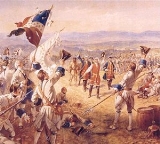
The Battle of Carillon, also known as the 1758 Battle of Ticonderoga, was fought on July 8, 1758, during the French and Indian War
French and Indian War
The French and Indian War is the common American name for the war between Great Britain and France in North America from 1754 to 1763. In 1756, the war erupted into the world-wide conflict known as the Seven Years' War and thus came to be regarded as the North American theater of that war...

 (which was part of the global Seven Years War). It was fought near Fort Carillon (now known as Fort Ticonderoga
Fort Ticonderoga
Fort Ticonderoga, formerly Fort Carillon, is a large 18th-century fort built by the Canadians and the French at a narrows near the south end of Lake Champlain in upstate New York in the United States...

) on the shore of Lake Champlain
Lake Champlain
Lake Champlain is a natural, freshwater lake in North America, located mainly within the borders of the United States but partially situated across the Canada—United States border in the Canadian province of Quebec.The New York portion of the Champlain Valley includes the eastern portions of...

 in the frontier
Frontier
A frontier is a political and geographical term referring to areas near or beyond a boundary. 'Frontier' was absorbed into English from French in the 15th century, with the meaning "borderland"--the region of a country that fronts on another country .The use of "frontier" to mean "a region at the...

 area between the British colony of New York
Province of New York
The Province of New York was an English and later British crown territory that originally included all of the present U.S. states of New York, New Jersey, Delaware and Vermont, along with inland portions of Connecticut, Massachusetts, and Maine, as well as eastern Pennsylvania...

 and the French colony of Canada
Canada, New France
Canada was the name of the French colony that once stretched along the St. Lawrence River; the other colonies of New France were Acadia, Louisiana and Newfoundland. Canada, the most developed colony of New France, was divided into three districts, each with its own government: Quebec,...

 (roughly the present-day Canadian provinces
Canada
Canada is a North American country consisting of ten provinces and three territories. Located in the northern part of the continent, it extends from the Atlantic Ocean in the east to the Pacific Ocean in the west, and northward into the Arctic Ocean...

 of Quebec
Quebec
Quebec or is a province in east-central Canada. It is the only Canadian province with a predominantly French-speaking population and the only one whose sole official language is French at the provincial level....

 and Ontario
Ontario
Ontario is a province of Canada, located in east-central Canada. It is Canada's most populous province and second largest in total area. It is home to the nation's most populous city, Toronto, and the nation's capital, Ottawa....

, and mid-western states of Ohio
Ohio
Ohio is a Midwestern state in the United States. The 34th largest state by area in the U.S.,it is the 7th‑most populous with over 11.5 million residents, containing several major American cities and seven metropolitan areas with populations of 500,000 or more.The state's capital is Columbus...

, Indiana
Indiana
Indiana is a US state, admitted to the United States as the 19th on December 11, 1816. It is located in the Midwestern United States and Great Lakes Region. With 6,483,802 residents, the state is ranked 15th in population and 16th in population density. Indiana is ranked 38th in land area and is...

, Illinois
Illinois
Illinois is the fifth-most populous state of the United States of America, and is often noted for being a microcosm of the entire country. With Chicago in the northeast, small industrial cities and great agricultural productivity in central and northern Illinois, and natural resources like coal,...

, Michigan
Michigan
Michigan is a U.S. state located in the Great Lakes Region of the United States of America. The name Michigan is the French form of the Ojibwa word mishigamaa, meaning "large water" or "large lake"....

 and Wisconsin
Wisconsin
Wisconsin is a U.S. state located in the north-central United States and is part of the Midwest. It is bordered by Minnesota to the west, Iowa to the southwest, Illinois to the south, Lake Michigan to the east, Michigan to the northeast, and Lake Superior to the north. Wisconsin's capital is...

).
Discussion
Ask a question about 'Battle of Carillon'
Start a new discussion about 'Battle of Carillon'
Answer questions from other users
Full Discussion Forum
 
Unanswered Questions
Encyclopedia
The Battle of Carillon, also known as the 1758 Battle of Ticonderoga, was fought on July 8, 1758, during the French and Indian War
French and Indian War
The French and Indian War is the common American name for the war between Great Britain and France in North America from 1754 to 1763. In 1756, the war erupted into the world-wide conflict known as the Seven Years' War and thus came to be regarded as the North American theater of that war...

 (which was part of the global Seven Years War). It was fought near Fort Carillon (now known as Fort Ticonderoga
Fort Ticonderoga
Fort Ticonderoga, formerly Fort Carillon, is a large 18th-century fort built by the Canadians and the French at a narrows near the south end of Lake Champlain in upstate New York in the United States...

) on the shore of Lake Champlain
Lake Champlain
Lake Champlain is a natural, freshwater lake in North America, located mainly within the borders of the United States but partially situated across the Canada—United States border in the Canadian province of Quebec.The New York portion of the Champlain Valley includes the eastern portions of...

 in the frontier
Frontier
A frontier is a political and geographical term referring to areas near or beyond a boundary. 'Frontier' was absorbed into English from French in the 15th century, with the meaning "borderland"--the region of a country that fronts on another country .The use of "frontier" to mean "a region at the...

 area between the British colony of New York
Province of New York
The Province of New York was an English and later British crown territory that originally included all of the present U.S. states of New York, New Jersey, Delaware and Vermont, along with inland portions of Connecticut, Massachusetts, and Maine, as well as eastern Pennsylvania...

 and the French colony of Canada
Canada, New France
Canada was the name of the French colony that once stretched along the St. Lawrence River; the other colonies of New France were Acadia, Louisiana and Newfoundland. Canada, the most developed colony of New France, was divided into three districts, each with its own government: Quebec,...

 (roughly the present-day Canadian provinces
Canada
Canada is a North American country consisting of ten provinces and three territories. Located in the northern part of the continent, it extends from the Atlantic Ocean in the east to the Pacific Ocean in the west, and northward into the Arctic Ocean...

 of Quebec
Quebec
Quebec or is a province in east-central Canada. It is the only Canadian province with a predominantly French-speaking population and the only one whose sole official language is French at the provincial level....

 and Ontario
Ontario
Ontario is a province of Canada, located in east-central Canada. It is Canada's most populous province and second largest in total area. It is home to the nation's most populous city, Toronto, and the nation's capital, Ottawa....

, and mid-western states of Ohio
Ohio
Ohio is a Midwestern state in the United States. The 34th largest state by area in the U.S.,it is the 7th‑most populous with over 11.5 million residents, containing several major American cities and seven metropolitan areas with populations of 500,000 or more.The state's capital is Columbus...

, Indiana
Indiana
Indiana is a US state, admitted to the United States as the 19th on December 11, 1816. It is located in the Midwestern United States and Great Lakes Region. With 6,483,802 residents, the state is ranked 15th in population and 16th in population density. Indiana is ranked 38th in land area and is...

, Illinois
Illinois
Illinois is the fifth-most populous state of the United States of America, and is often noted for being a microcosm of the entire country. With Chicago in the northeast, small industrial cities and great agricultural productivity in central and northern Illinois, and natural resources like coal,...

, Michigan
Michigan
Michigan is a U.S. state located in the Great Lakes Region of the United States of America. The name Michigan is the French form of the Ojibwa word mishigamaa, meaning "large water" or "large lake"....

 and Wisconsin
Wisconsin
Wisconsin is a U.S. state located in the north-central United States and is part of the Midwest. It is bordered by Minnesota to the west, Iowa to the southwest, Illinois to the south, Lake Michigan to the east, Michigan to the northeast, and Lake Superior to the north. Wisconsin's capital is...

).

In the battle, which took place primarily on a rise about three-quarters of a mile (one km) from the fort itself, a French
France
The French Republic , The French Republic , The French Republic , (commonly known as France , is a unitary semi-presidential republic in Western Europe with several overseas territories and islands located on other continents and in the Indian, Pacific, and Atlantic oceans. Metropolitan France...

 army of about 4,000 men under General Louis-Joseph de Montcalm
Louis-Joseph de Montcalm
Louis-Joseph de Montcalm-Gozon, Marquis de Saint-Veran was a French soldier best known as the commander of the forces in North America during the Seven Years' War .Montcalm was born near Nîmes in France to a noble family, and entered military service...

 and the Chevalier de Levis decisively defeated an overwhelmingly numerically superior force of British
Kingdom of Great Britain
The former Kingdom of Great Britain, sometimes described as the 'United Kingdom of Great Britain', That the Two Kingdoms of Scotland and England, shall upon the 1st May next ensuing the date hereof, and forever after, be United into One Kingdom by the Name of GREAT BRITAIN. was a sovereign...

 troops under General James Abercrombie
James Abercrombie (general)
General James Abercrombie or Abercromby was a British Army general and commander-in-chief of forces in North America during the French and Indian War, best known for the disastrous British losses in the 1758 Battle of Carillon.-Early life:Abercrombie was born in Glassaugh, Banffshire, Scotland to...

, which frontally assaulted an entrenched French position without using field artillery
Field artillery
Field artillery is a category of mobile artillery used to support armies in the field. These weapons are specialized for mobility, tactical proficiency, long range, short range and extremely long range target engagement....

. The battle was the bloodiest of the war, with over 3,000 casualties suffered, of which over 2,000 were British.

American historian Lawrence Henry Gipson wrote of Abercrombie's campaign that "no military campaign was ever launched on American soil that involved a greater number of errors of judgment on the part of those in positions of responsibility". Many military historians have cited the Battle of Carillon as a classic example of tactical military incompetence
Military incompetence
Military incompetence refers to incompetencies and failures of military organisations, whether through incompetent individuals or through a flawed institutional culture....

. Abercrombie, confident of a quick victory, ignored several viable military options, such as flanking
Flanking maneuver
In military tactics, a flanking maneuver, also called a flank attack, is an attack on the sides of an opposing force. If a flanking maneuver succeeds, the opposing force would be surrounded from two or more directions, which significantly reduces the maneuverability of the outflanked force and its...

 the French breastwork
Breastwork (fortification)
A breastwork is a fortification. The term is usually applied to temporary fortifications, often an earthwork thrown up to breast height to provide protection to defenders firing over it from a standing position...

s, waiting for his artillery, or laying siege to the fort. Instead, relying on a flawed report from a young military engineer
Military engineer
In military science, engineering refers to the practice of designing, building, maintaining and dismantling military works, including offensive, defensive and logistical structures, to shape the physical operating environment in war...

, and ignoring some of that engineer's recommendations, he decided in favor of a direct frontal assault
Frontal assault
The military tactic of frontal assault is a direct, hostile movement of forces toward the front of an enemy force . By targeting the enemy's front, the attackers are subjecting themselves to the maximum defensive power of the enemy...

 on the thoroughly entrenched French, without the benefit of artillery
Artillery
Originally applied to any group of infantry primarily armed with projectile weapons, artillery has over time become limited in meaning to refer only to those engines of war that operate by projection of munitions far beyond the range of effect of personal weapons...

. Montcalm, while concerned about the weak military position of the fort, conducted the defense with spirit. However, due in part to a lack of time, he committed strategic errors in preparing the area's defenses that a competent attacker could have exploited, and he made tactical errors that made the attacker's job easier.

The fort, abandoned by its garrison, was captured by the British the following year
Battle of Ticonderoga (1759)
The 1759 Battle of Ticonderoga was a minor confrontation at Fort Carillon on July 26 and 27, 1759, during the French and Indian War...

, and it has been known as Fort Ticonderoga (after its location) ever since. This battle gave the fort a reputation for impregnability that had an effect on future military operations in the area. Despite several large-scale military movements through the area, in both the French and Indian War and the American Revolutionary War
American Revolutionary War
The American Revolutionary War , the American War of Independence, or simply the Revolutionary War, began as a war between the Kingdom of Great Britain and thirteen British colonies in North America, and ended in a global war between several European great powers.The war was the result of the...

, this was the only major battle fought near the fort's location.

Geography


Fort Carillon
Fort Ticonderoga
Fort Ticonderoga, formerly Fort Carillon, is a large 18th-century fort built by the Canadians and the French at a narrows near the south end of Lake Champlain in upstate New York in the United States...

 is situated on a point of land between Lake Champlain
Lake Champlain
Lake Champlain is a natural, freshwater lake in North America, located mainly within the borders of the United States but partially situated across the Canada—United States border in the Canadian province of Quebec.The New York portion of the Champlain Valley includes the eastern portions of...

 and Lake George
Lake George (New York)
Lake George, nicknamed the Queen of American Lakes, is a long, narrow oligotrophic lake draining northwards into Lake Champlain and the St. Lawrence River Drainage basin located at the southeast base of the Adirondack Mountains in northern New York, U.S.A.. It lies within the upper region of the...

, at a natural point of conflict between French forces moving south from Canada
Canada, New France
Canada was the name of the French colony that once stretched along the St. Lawrence River; the other colonies of New France were Acadia, Louisiana and Newfoundland. Canada, the most developed colony of New France, was divided into three districts, each with its own government: Quebec,...

 and the St. Lawrence River Valley across the lake toward the Hudson Valley
Hudson Valley
The Hudson Valley comprises the valley of the Hudson River and its adjacent communities in New York State, United States, from northern Westchester County northward to the cities of Albany and Troy.-History:...

, and British forces moving up the Hudson from Albany
Albany, New York
Albany is the capital city of the U.S. state of New York, the seat of Albany County, and the central city of New York's Capital District. Roughly north of New York City, Albany sits on the west bank of the Hudson River, about south of its confluence with the Mohawk River...

. The fort was sited with Lake Champlain to the east, with Mount Independence
Mount Independence
Mount Independence is a high hill on the Vermont side of Lake Champlain, in the northeastern United States.It is a Vermont State Historic Site and was the site of Fort Independence, an American revolutionary war fortification built opposite Fort Ticonderoga...

 rising on the far side. Immediately to the south of the fort lay the mouth of the La Chute River
La Chute River
The La Chute River is a short, fast-moving river, near the Vermont-New York State border, now almost wholly contained within the municipality of Ticonderoga, New York, connecting the northern end and outlet of the long Lake George and the southern end of Lake Champlain through many falls and...

, which drains Lake George. The river was largely non-navigable, and there was a portage
Portage
Portage or portaging refers to the practice of carrying watercraft or cargo over land to avoid river obstacles, or between two bodies of water. A place where this carrying occurs is also called a portage; a person doing the carrying is called a porter.The English word portage is derived from the...

 trail from the northern end of Lake George to the location of a sawmill the French had built to assist in the fort's construction. The trail crossed the La Chute twice; once about 2 miles (3.2 km) from Lake George, and again at the sawmill, which was about 2 miles (3.2 km) from the fort.

To the north of the fort was a road going to Fort St. Frédéric
Fort St. Frédéric
Fort St. Frédéric was a French fort built on Lake Champlain at Crown Point to secure the region against British colonization and to allow the French to control the use of Lake Champlain....

. To the west was a low rise of land, beyond which lay Mount Hope, a rise that commanded part of the portage trail, but was too far from the fort to pose it any danger. The most serious geographic defect in the fort's location was Mount Defiance
Mount Defiance
Mount Defiance is an high hill on the New York side of Lake Champlain, in the northeastern United States. It is notable in that the hill militarily dominates both Fort Ticonderoga and Fort Independence, but it was deemed inaccessible so never fortified. Mount Defiance was previously known as...

 (known at the time of this battle as Rattlesnake Hill, and in the 1770s as Sugar Bush), which lay to the south of the fort, across the La Chute River. This 900 feet (274.3 m) hill, which was steep and densely forested, provided an excellent firing position for cannon aimed at the fort. Nicolas Sarrebource de Pontleroy, Montcalm's chief engineer, said of the fort's site, "Were I to be entrusted with the siege of it, I should require only six mortars and two cannon."

Background


Prior to 1758, the French and Indian War
French and Indian War
The French and Indian War is the common American name for the war between Great Britain and France in North America from 1754 to 1763. In 1756, the war erupted into the world-wide conflict known as the Seven Years' War and thus came to be regarded as the North American theater of that war...

 had gone very poorly for the British, whose military met few of its objectives. Following a string of French victories in 1757 in North America, coupled with military setbacks in Europe, William Pitt
William Pitt, 1st Earl of Chatham
William Pitt, 1st Earl of Chatham PC was a British Whig statesman who led Britain during the Seven Years' War...

 gained full control of the direction of British military efforts in the Seven Years' War
Seven Years' War
The Seven Years' War was a global military war between 1756 and 1763, involving most of the great powers of the time and affecting Europe, North America, Central America, the West African coast, India, and the Philippines...

. Embarking on a strategy that emphasized defense in Europe, where France was strong, and offense in North America, where France was weak, he resolved to attack New France
New France
New France was the area colonized by France in North America during a period beginning with the exploration of the Saint Lawrence River by Jacques Cartier in 1534 and ending with the cession of New France to Spain and Great Britain in 1763...

 (the colonial holdings of France in North America) in three strategic campaigns. Large-scale campaigns were planned to capture Fort Duquesne
Fort Duquesne
Fort Duquesne was a fort established by the French in 1754, at the junction of the Allegheny and Monongahela rivers in what is now downtown Pittsburgh in the state of Pennsylvania....

 on the Pennsylvania
Pennsylvania
The Commonwealth of Pennsylvania is a U.S. state that is located in the Northeastern and Mid-Atlantic regions of the United States. The state borders Delaware and Maryland to the south, West Virginia to the southwest, Ohio to the west, New York and Ontario, Canada, to the north, and New Jersey to...

 frontier and the fortress at Louisbourg (on Île-Royale, now known as Cape Breton Island
Cape Breton Island
Cape Breton Island is an island on the Atlantic coast of North America. It likely corresponds to the word Breton, the French demonym for Brittany....

). The third campaign, assigned to General James Abercrombie, was to launch an attack against Canada through the Champlain Valley. Pitt probably would have preferred to have George Howe
George Howe, 3rd Viscount Howe
George Augustus Howe, 3rd Viscount Howe was a career officer and a Brigadier General in the British Army. He was described by James Wolfe as "the best officer in the British Army"...

, a skilled tactician and a dynamic leader, lead this expedition, but seniority and political considerations led him to appoint the relatively undistinguished Abercrombie instead. Howe was appointed a brigadier general
Brigadier General
Brigadier general is a senior rank in the armed forces. It is the lowest ranking general officer in some countries, usually sitting between the ranks of colonel and major general. When appointed to a field command, a brigadier general is typically in command of a brigade consisting of around 4,000...

, and placed as Abercrombie's second in command.


The French, who had started construction on Fort Carillon in 1755, used it as a launching point for the successful siege of Fort William Henry in 1757. Despite that and other successes in North America in 1757, the situation did not look good for them in 1758. As early as March, Louis-Joseph de Montcalm
Louis-Joseph de Montcalm
Louis-Joseph de Montcalm-Gozon, Marquis de Saint-Veran was a French soldier best known as the commander of the forces in North America during the Seven Years' War .Montcalm was born near Nîmes in France to a noble family, and entered military service...

, the commanding general responsible of the French forces in North America, and the Marquis de Vaudreuil
Pierre François de Rigaud, Marquis de Vaudreuil-Cavagnal
Pierre François de Rigaud, Marquis de Vaudreuil-Cavagnal was a Canadian-born French colonial governor in North America...

, New France
New France
New France was the area colonized by France in North America during a period beginning with the exploration of the Saint Lawrence River by Jacques Cartier in 1534 and ending with the cession of New France to Spain and Great Britain in 1763...

's governor, were aware that the British were planning to send large numbers of troops against them, and that they would have relatively little support from King Louis XV of France
Louis XV of France
Louis XV was a Bourbon monarch who ruled as King of France and of Navarre from 1 September 1715 until his death. He succeeded his great-grandfather at the age of five, his first cousin Philippe II, Duke of Orléans, served as Regent of the kingdom until Louis's majority in 1723...

. The lack of support from France was in large part due to an unwillingness of the French military to risk the movement of significant military forces across the Atlantic Ocean
Atlantic Ocean
The Atlantic Ocean is the second-largest of the world's oceanic divisions. With a total area of about , it covers approximately 20% of the Earth's surface and about 26% of its water surface area...

, which was dominated by Britain's Royal Navy
Royal Navy
The Royal Navy is the naval warfare service branch of the British Armed Forces. Founded in the 16th century, it is the oldest service branch and is known as the Senior Service...

. This situation was further exacerbated by Canada's poor harvest in 1757, which resulted in food shortages as the winter progressed.

Montcalm and Vaudreuil, who did not get along with each other, differed on how to deal with the British threat. They had fewer than 5,000 regular troops, an estimated six thousand militia men, and a limited number of Indian allies, to bring against British forces reported to number 50,000. Vaudreuil, who had limited combat experience, wanted to divide the French forces, with about 5,000 each at Carillon and Louisbourg, and then send a picked force of about 3,500 men against the British in the Mohawk River
Mohawk River
The Mohawk River is a river in the U.S. state of New York. It is the largest tributary of the Hudson River. The Mohawk flows into the Hudson in the Capital District, a few miles north of the city of Albany. The river is named for the Mohawk Nation of the Iroquois Confederacy...

 on the northwestern frontiers of the Province of New York. Montcalm believed this to be folly, as the plan would enable the British to easily divert some of their forces to fend off the French attack. Vaudreuil prevailed, and in June 1758 Montcalm left Quebec
Quebec City
Quebec , also Québec, Quebec City or Québec City is the capital of the Canadian province of Quebec and is located within the Capitale-Nationale region. It is the second most populous city in Quebec after Montreal, which is about to the southwest...

 for Carillon.

British preparations


The British amassed their army, under the command of General James Abercrombie, near the remains of Fort William Henry
Fort William Henry
Fort William Henry was a British fort at the southern end of Lake George in the province of New York. It is best known as the site of notorious atrocities committed by Indians against the surrendered British and provincial troops following a successful French siege in 1757, an event which is the...

, which lay at the southern end of Lake George
Lake George (New York)
Lake George, nicknamed the Queen of American Lakes, is a long, narrow oligotrophic lake draining northwards into Lake Champlain and the St. Lawrence River Drainage basin located at the southeast base of the Adirondack Mountains in northern New York, U.S.A.. It lies within the upper region of the...

 but had been destroyed following its capture by the French the previous year. The army numbered fully 16,000 men, making it the largest single force ever deployed in North America
North America
North America is a continent wholly within the Northern Hemisphere and almost wholly within the Western Hemisphere. It is also considered a northern subcontinent of the Americas...

 at the time. Its complement of 6,000 regular troops included Lord John Murray's Highlanders of the 42nd Highland Regiment
42nd Regiment of Foot
The 42nd Regiment of Foot was an infantry regiment of the British Army. Originally the 43rd Highlanders they were renumbered the 42nd in 1748.- Early history :...

 (1st Battalion) the 27th
27th (Inniskilling) Regiment of Foot
The 27th Regiment of Foot was an Irish infantry regiment of the British Army, formed in 1689 and amalgamated into The Royal Inniskilling Fusiliers in 1881.- History :...

, 44th, 46th
46th (South Devonshire) Regiment of Foot
The 46th Regiment of Foot was an infantry regiment of the British Army, created in 1741 and amalgamated into the Duke of Cornwall's Light Infantry in 1881.-History:...

, and 55th regiments, and the 1st and 4th battalions of the 60th
King's Royal Rifle Corps
The King's Royal Rifle Corps was a British Army infantry regiment, originally raised in colonial North America as the Royal Americans, and recruited from American colonists. Later ranked as the 60th Regiment of Foot, the regiment served for more than 200 years throughout the British Empire...

, while the provinces providing militia support included Connecticut
Connecticut Colony
The Connecticut Colony or Colony of Connecticut was an English colony located in British America that became the U.S. state of Connecticut. Originally known as the River Colony, it was organized on March 3, 1636 as a haven for Puritan noblemen. After early struggles with the Dutch, the English...

, Massachusetts
Province of Massachusetts Bay
The Province of Massachusetts Bay was a crown colony in North America. It was chartered on October 7, 1691 by William and Mary, the joint monarchs of the kingdoms of England and Scotland...

, New York
Province of New York
The Province of New York was an English and later British crown territory that originally included all of the present U.S. states of New York, New Jersey, Delaware and Vermont, along with inland portions of Connecticut, Massachusetts, and Maine, as well as eastern Pennsylvania...

, New Jersey
Province of New Jersey
The Province of New Jersey was one of the Middle Colonies of Colonial America and became the U.S. state of New Jersey in 1776. The province had originally been settled by Europeans as part of New Netherland, but came under English rule after the surrender of Fort Amsterdam in 1664, becoming a...

, and Rhode Island
Colony of Rhode Island and Providence Plantations
The Colony of Rhode Island and Providence Plantations was one of the original English Thirteen Colonies established on the east coast of North America that, after the American Revolution, became the modern U.S...

. On July 5, 1758, these troops embarked on boats, which unloaded them at the north end of Lake George on July 6.

French defensive preparations


Colonel François-Charles de Bourlamaque
François-Charles de Bourlamaque
François-Charles de Bourlamaque was a French military leader and Governor of Guadeloupe from 1763. He began as military engineer, major-captain, infantry colonel, infantry comman­dant, commandant, general brigadier, major-general, commander of Saint-Louis, honorary order of Malta, and Governor of...

, in command of Fort Carillon prior to Montcalm's arrival, knew by June 23 that a major British offensive was about to begin. He had sent a messenger bearing a letter from Vaudreuil to Abercrombie (part of a conventional exchange of pleasantries between opposing commanders) on June 10, expecting him to return; the fact that the British held him was an indication that the messenger had probably learned too much just by being in the British camp. Bourlamaque increased scouting activities, and learned from captured British scouts the approximate size of the British force.


Montcalm arrived at Fort Carillon on June 30, and found there a significantly under-staffed garrison, with only 3,500 men, and food sufficient for only nine days. Bourlamaque's scouts reported that the British had 20,000 or more troops massing near the remains of Fort William Henry
Fort William Henry
Fort William Henry was a British fort at the southern end of Lake George in the province of New York. It is best known as the site of notorious atrocities committed by Indians against the surrendered British and provincial troops following a successful French siege in 1757, an event which is the...

. Given the large force facing him and the defects of the fort's site, Montcalm opted for a strategy of defending the likely approaches to the fort. He immediately detached Bourlamaque and three battalions to occupy and fortify the river crossing on the portage trail about two miles (3.2 km) from the northern end of Lake George
Lake George (New York)
Lake George, nicknamed the Queen of American Lakes, is a long, narrow oligotrophic lake draining northwards into Lake Champlain and the St. Lawrence River Drainage basin located at the southeast base of the Adirondack Mountains in northern New York, U.S.A.. It lies within the upper region of the...

, about 6 miles (9.7 km) from the fort. Montcalm himself took two battalions and occupied and fortified an advance camp at the sawmill, while remaining troops were put to work preparing additional defenses outside the fort. He also sent word back to Montreal of the situation, requesting that, if possible, the Chevalier de Lévis and his men, be sent as reinforcement; these were troops that Vaudreuil intended for duty at the western frontier forts. Lévis had not yet left Montreal, so Vaudreuil instead ordered him and 400 troops to Carillon. They departed Montreal on July 2.

When word reached Bourlamaque on July 5 that the British fleet was coming, he sent Captain Trépezet and about 350 men to observe the fleet, and, if possible, to prevent their landing. On learning the size of the British fleet, which was reportedly "large enough to cover the face of [Lake George]", Montcalm ordered Bourlamaque to retreat. Bourlamaque, who was satisfied with his defensive situation, resisted, not withdrawing until Montcalm repeated the orders three times. Montcalm, now aware of the scope of the movement, ordered all of the troops back to Carillon, and had both bridges on the portage trail destroyed. These withdrawals isolated Trépezet and his men from the main body, a situation made worse for Trépezet when his Indian guides, alarmed by the size of the British fleet, abandoned him.

Beginning on the evening of July 6, the French began to lay out entrenchments on the rise northwest of the fort, about 0.75 miles (1.2 km) away, that commanded the land routes to the fort. On July 7, they constructed a lengthy series of abatis
Abatis
Abatis, abattis, or abbattis is a term in field fortification for an obstacle formed of the branches of trees laid in a row, with the sharpened tops directed outwards, towards the enemy. The trees are usually interlaced or tied with wire...

 (felled trees with sharpened branches pointed outward) below these entrenchments. By the end of that day, they had also constructed a wooden breastwork
Breastwork (fortification)
A breastwork is a fortification. The term is usually applied to temporary fortifications, often an earthwork thrown up to breast height to provide protection to defenders firing over it from a standing position...

 above the trenches. These hastily erected defenses, while proof against small arms fire, would have been ineffective if the British had used cannon
Cannon
A cannon is any piece of artillery that uses gunpowder or other usually explosive-based propellents to launch a projectile. Cannon vary in caliber, range, mobility, rate of fire, angle of fire, and firepower; different forms of cannon combine and balance these attributes in varying degrees,...

s against them.

Bernetz Brook


The British army began an unopposed landing at the north end of Lake George on the morning of July 6. Abercrombie first landed an advance force to check the area where the forces were to disembark, and found it recently deserted; some supplies and equipment had been left behind by the French in their hasty departure. The bulk of the army landed, formed into columns, and attempted to march up the west side of the stream that connected Lake George to Lake Champlain, rather than along the portage trail, whose bridges Montcalm had destroyed. However, the wood was very thick, and the columns could not be maintained.

Near the area where Bernetz Brook enters the La Chute, Captain Trépezet and his troop, who were attempting to return to the French lines, encountered Phineas Lyman
Phineas Lyman
Phineas Lyman was a colonial American soldier known for his service in the provincial British army of the French and Indian War. He later led a group of New England veterans of the war to settle in the new colony of West Florida where he died shortly before the outbreak of the American...

's Connecticut regiment, sparking a skirmish in the woods. General Howe's column was near the action, so he led it in that direction. As they approached the battle scene, General Howe was hit and instantly killed by a musket ball. A column of Massachusetts provincials, also drawn to the battle, cut off the French patrol's rear. In desperate fighting, about 150 of Trepézet's men were killed, and another 150 were captured. Fifty men, including Trepézet, escaped by swimming across the La Chute. Trepézet died the next day of wounds suffered in the battle.

British casualties were light, only ten dead and six wounded. The British, frustrated by the difficult woods, demoralized by Howe's death, and exhausted from the overnight boat ride, camped in the woods, and returned to the landing point early the next morning.

Portage road


On July 7 Abercrombie sent Lieutenant Colonel John Bradstreet
John Bradstreet
Major General John Bradstreet was a British Army officer during the French and Indian War, King George's War, and Pontiac's Rebellion...

 and a sizable force down the portage path. On reaching the first crossing, where Bourlamaque had camped, they rebuilt the bridge there, and proceeded on to the sawmill crossing. The army then followed, and set up its camp there. Scouts and prisoners reported to Abercrombie that Montcalm had 6,000 men and was expecting the Chevalier de Lévis to arrive at any moment with 3,000 reinforcements. Abercrombie ordered his engineer, Lieutenant Matthew Clerk, and one of his aides, Captain James Abercrombie (it is uncertain if the Abercrombies were related or not) to reconnoiter the French defenses. After ascending Rattlesnake Hill (as Mount Defiance was then known), they reported that the French position appeared to be incomplete, and could be "easily forced, even without cannon". They were unaware that the French had disguised much of the works with shrubs and trees, and that they were in fact largely complete. Clerk's report included recommendations to fortify both the summit and the base of Rattlesnake Hill. Abercrombie decided that they had to attack the next morning, hopefully before Lévis and his supposed 3,000 arrived. Lévis arrived at the fort on the evening of July 7 with his troop of 400 regulars.

Abercrombie held a war council that evening. The options he presented to his staff were limited to asking if the next day's attack should be in three ranks or four; the council opted for three. Abercrombie's plan of attack omitted Clerk's recommendation to fortify the summit of Rattlesnake Hill; in addition to the frontal assault, 4 six-pound guns and a howitzer were to be floated down the La Chute River and mounted at the base of Rattlesnake Hill, with 20 bateaux of troops to support the effort.

Early on the morning of July 8, Clerk went out once again to the base of Rattlesnake Hill to observe the French defenses; his report indicated that he still felt the French lines could be taken by assault.

Battle lines form


Image:CarillonBattleSmall.png|right|thumb|240px|Schematic map depicting the battle lines (click for zoomable image)
desc none
default


The battle began on the morning of July 8 with Rogers' Rangers
Rogers' Rangers
Rogers' Rangers was an independent company of colonial militia, attached to the British Army during the Seven Years War . The unit was informally trained by Major Robert Rogers as a rapidly deployable light infantry force tasked with reconnaissance and conducting special operations against distant...

 and light infantry from Colonel Thomas Gage
Thomas Gage
Thomas Gage was a British general, best known for his many years of service in North America, including his role as military commander in the early days of the American War of Independence....

's 80th Regiment of Light-Armed Foot
80th Regiment of Light-Armed Foot
The 80th Regiment of Light-Armed Foot was the first light infantry regiment in the British Army.-History:The regiment was created in 1758 by Colonel Thomas Gage, and was known as Gage's Light Infantry or "leathercaps"...

 pushing the few remaining French scouts behind the entrenchments. They were followed by provincials from New York and Massachusetts, and then three columns of regulars, who made their way through the provincial formations to begin the attack. The 27th and 60th made up the right column, under the command of the 27th's Lt. Col. William Haviland
William Haviland
William Haviland was an Irish-born general in the British Army. He is best known for his service in North America during the Seven Years' War.-Life:William Haviland was born in Ireland in 1718...

, the 44th and 55th under Lt. Col. John Donaldson made the center, and the 42nd and 46th under the 42nd's Lt. Col. Francis Grant formed the left column. Each column was preceded by the regimental light infantry
Light infantry
Traditionally light infantry were soldiers whose job was to provide a skirmishing screen ahead of the main body of infantry, harassing and delaying the enemy advance. Light infantry was distinct from medium, heavy or line infantry. Heavy infantry were dedicated primarily to fighting in tight...

 companies. Held in reserve were provincial regiments from Connecticut and New Jersey.

Montcalm had organized the French forces into three brigades and a reserve. He commanded the Royal Roussillon
Régiment Royal Roussillon
The Régiment Royal Roussillon was a French Army regiment active during the late 17th century and 18th century. It is principally known for its role in the Seven Years' War, when it served in the North American theatre.-History:...

 and Berry
Régiment de Berry
The Régiment de Berry was a French Army regiment active in the 18th century. It is principally known for its role in the Seven Years' War, when it served in the North American theatre.-History:...

 battalions in the center of the entrenchments, while Lévis commanded the Béarn
Régiment de Béarn
The Régiment de Béarn was a French Army regiment active in the 18th century. It is principally known for its role in the Seven Years' War, when it served in the North American theatre.-History:...

, Guyenne
Régiment de Guyenne
The Régiment de Guyenne was a French Army infantry regiment in the 18th century. It is principally known for its role in the Seven Years' War, when it served in the North American theatre.-History:...

, and la Reine
Régiment de la Reine
The Régiment de la Reine was a French Army regiment active in the 18th century. It is principally known for its role in the Seven Years' War, when it served in the North American theatre.-History:...

 battalions on the right, and Bourlamaque led the La Sarre
Régiment La Sarre
The Régiment La Sarre was a French Army regiment active in the 18th century. It is principally known for its role in the Seven Years' War, when it served in the North American theatre.-History:...

 and Languedoc
Régiment de Languedoc
The Régiment de Languedoc was a French Army regiment active in the 18th century. It is principally known for its role in the Seven Years' War, when it served in the North American theatre.-History:...

 battalions on the left. Each battalion was given roughly 100 yards (91.4 m) of the entrenchment to defend. Redoubts with cannon protected the flanks of the entrenchments, although the one on the right had not been completed. The low ground between the left flank and the La Chute River was guarded by militia and marines, who had also constructed abatis to help protect their position. Reserve forces were either in the fort itself, or on the grounds between the fort and the entrenchments on Mount Hope. Portions of each battalion were also held in reserve, to assist in areas where they might be needed.

Battle


While Abercrombie had expected the battle to begin at 1 pm, by 12:30 elements of the New York regiments on the left began engaging the French defenders. The sounds of battle led Haviland to believe that the French line might have been penetrated, so he ordered his men forward, even though not all of the regulars were in place, and Abercrombie had not given an order to advance. The result, rather than an orderly, coordinated advance on the French position, was a piecemeal entry of the regulars into the battle. As companies of the regulars came forward, they arranged themselves into lines as instructed, and then began to advance. The right column, with a shorter distance to travel, attacked first, followed by the center, and then the left. The 42nd had initially been held in reserve, but after insisting on being allowed to participate, they joined the action.

The French position was such that they were able to lay down withering fire on the British forces as they advanced, and the abatis (a word that shares derivation with abattoir, or slaughterhouse) rapidly became a killing field. By about 2 pm, it was clear that the first wave of attack had failed. Montcalm was active on the battlefield, having removed his coat, and was moving among his men, giving encouragement and making sure all of their needs were being met. Abercrombie, who was reported by early historians like Francis Parkman
Francis Parkman
Francis Parkman was an American historian, best known as author of The Oregon Trail: Sketches of Prairie and Rocky-Mountain Life and his monumental seven-volume France and England in North America. These works are still valued as history and especially as literature, although the biases of his...

 and Thomas Mante to be at the sawmill (and thus well away from the action), was reported by his aide, James Abercrombie, to be near the rear of the lines by the La Chute River during much of the battle, and to have approached the front of the French lines at one point early in the battle. It is uncertain why, after the first wave of attack failed, Abercrombie persisted in ordering further attacks. Writing in his own defense, he later claimed that he was relying on Clerk's assessment that the works could be easily taken; this was clearly refuted by the failure of the first charge.

Around 2 pm, the British barges carrying artillery floated down the La Chute River, and, contrary to plan, came down a channel between an island in the La Chute and the shore. This brought them within range of the French left and some of the fort's guns. Fire from cannons on the fort's southwest bastion's sank two of the barges, spurring the remaining vessels to retreat.


Abercrombie ordered his reserves, the Connecticut and New Jersey provincials, into the battle around 2, but by 2:30 it was clear their attack also failed. Abercrombie then tried to recall the troops, but a significant number, notably the 42nd and 46th regiments on the British left, persisted in the attack. Around 5 pm the 42nd made a desperate advance that actually succeeded in reaching the base of the French wall; those that actually managed to scale the breastwork were bayonet
Bayonet
A bayonet is a knife, dagger, sword, or spike-shaped weapon designed to fit in, on, over or underneath the muzzle of a rifle, musket or similar weapon, effectively turning the gun into a spear...

ed. One British observer noted that "Our Forces Fell Exceeding Fast", while another wrote that they were "Cut Down Like Grass". The slaughter went on until nightfall, with a great many men retreating behind a breastwork that had been erected at the back of the battlefield.

Finally realizing the scope of the disaster, Abercrombie ordered the troops to muster and march down to the landing on Lake George. The retreat in the dark woods became somewhat panicked and disorganized, as rumors of French attacks swirled among the troops. By dawn the next morning, the army was rowing back up Lake George, reaching its base at the southern end around sunset. The humiliating nature of the retreat was immediately apparent to some of its participants; Lieutenant Colonel Artemas Ward
Artemas Ward
Artemas Ward was an American major general in the American Revolutionary War and a Congressman from Massachusetts...

 wrote that they "shamefully retreated".

Aftermath


Montcalm, wary of a British counterattack, and concerned about the fatigue of his troops after a long day of battle, had barrels of beer and wine brought forward to the lines. The troops spent the night alternating between sleeping and working on the defenses in anticipation of a renewed attack.

News of the battle was received in England shortly after news of the fall of Louisbourg, putting a damper on the celebrations marking that victory. The full scope of British victories in 1758 did not reach English shores until later in the year, when Pitt learned of the successes at Forts Duquesne and Frontenac, key steps in completing the conquest of New France. Had Carillon also fallen in 1758, the conquest might have been completed in 1758 or 1759; as it happened, Montreal (the last point of resistance) did not surrender until 1760, with campaigns launched from Fort Oswego
Fort Oswego
Fort Oswego was an important frontier post for British traders in the 18th century. A trading post was established in 1722 with a log palisade, and New York governor William Burnet ordered a fort built at the site in 1727. The log palisade fort established a British presence on the Great Lakes....

, Quebec, and Carillon, which was captured and renamed Ticonderoga in 1759
Battle of Ticonderoga (1759)
The 1759 Battle of Ticonderoga was a minor confrontation at Fort Carillon on July 26 and 27, 1759, during the French and Indian War...

 by forces under the command of Jeffrey Amherst, the victor at Louisbourg.

Abercrombie never led another military campaign. Although he was active at Lake George, he did little more than provide support for John Bradstreet's successful attack on Fort Frontenac
Battle of Fort Frontenac
The Battle of Fort Frontenac took place on August 26–28, 1758 during the Seven Years' War between France and Great Britain. The location of the battle was Fort Frontenac, a French fort and trading post which is located at the site of present-day Kingston, Ontario, at the eastern end of Lake...

, which was authorized in a war council on July 13. Bradstreet left with 3,000 men on July 23, and Abercrombie then refused to engage in further offensive acts, alleging a shortage of manpower. William Pitt
William Pitt, 1st Earl of Chatham
William Pitt, 1st Earl of Chatham PC was a British Whig statesman who led Britain during the Seven Years' War...

, the British Secretary of State
Secretary of State (United Kingdom)
In the United Kingdom, a Secretary of State is a Cabinet Minister in charge of a Government Department ....

 who had designed the British military strategy and received word of the defeat in August, wrote to Abercrombie on September 18 that the "King has judged proper that you should return to England." Abercrombie continued to be promoted, eventually reaching the rank of full General in 1772.

The fact that Indians allied to the British witnessed the debacle first hand complicated future relations with them. News of the defeat circulated widely in their communities, which had a significant effect on the ability of British agents to recruit Indians to their side for future operations.

Casualties


The battle was the bloodiest of the war, with over 3,000 casualties suffered. French casualties are normally considered to be comparatively light: 104 killed and 273 wounded in the main battle. Combined with the effective elimination of Trépezet's force on July 6, there were about 550 casualties, about 13 percent of the French force, a percentage similar to the losses of the British (who Chartrand calculates as having lost 11.5 to 15 percent).

General Abercrombie reported 547 killed, 1,356 wounded, and 77 missing. Lévis in one report claimed that the French recovered 800 British bodies, implying that Abercrombie may have underreported the actual death toll. Chartrand estimates the number of British killed (or died of their wounds) at about 1,000 for the main battle, with about 1,500 wounded. The skirmish on July 6 cost the British about 100 killed and wounded, and the loss of General Howe.


The 42nd Regiment, known as the Black Watch
42nd Regiment of Foot
The 42nd Regiment of Foot was an infantry regiment of the British Army. Originally the 43rd Highlanders they were renumbered the 42nd in 1748.- Early history :...

, paid dearly with the loss of many lives and many severely wounded. More than 300 men (including 8 officers) were killed, and a similar number were wounded, representing a significant fraction of the total casualties suffered by the British. King George III, later in July 1758, designated the 42nd a "Royal" regiment, due to its gallantry in earlier battles, and issued letters of service for adding a second battalion "as a testimony of his Majesty's satisfaction and approbation of the extraordinary courage, loyalty, and exemplary conduct of the Highland regiment." However, the king did not learn of the regiment's loss of almost half its strength in this battle until August.

A legend has long circulated concerning the death of the Black Watch's Major Duncan Campbell. In 1742, the ghost of Campbell's dead brother is said to have appeared to him in a dream with a promise to meet him again at "Ticonderoga", a place name that was unknown to him at the time. Campbell died of wounds sustained during the battle.

Analysis


The actions of both commanders have been extensively analyzed in this action. While Montcalm performed well during the battle, some strategic options escaped his notice, and some of his actions in preparing the defenses at Carillon are open to question. In contrast, almost everything Abercrombie did has been questioned. It is widely held among historians that he was an incompetent commander.

Montcalm


Both commanders were a product of the environment of European warfare, which generally took place in open fields with relatively easy mobility, and were thus uncomfortable with woodland warfare. Neither liked the irregular warfare practiced by the Indians and British counterparts like Rogers' Rangers
Rogers' Rangers
Rogers' Rangers was an independent company of colonial militia, attached to the British Army during the Seven Years War . The unit was informally trained by Major Robert Rogers as a rapidly deployable light infantry force tasked with reconnaissance and conducting special operations against distant...

, but saw them as a necessary evil, given the operating environment. Although the French depended on Indian support to increase their comparatively small numbers throughout the war, Indian forces were quite low in this battle, and Montcalm generally disliked them and their practices.

Montcalm in particular would have benefited from practicing a more irregular form of warfare. He apparently never inspected the landing area at the north end of Lake George, which was a location from which he could contest the British landing. Furthermore, the French could then have used the confined woodlands to blunt the numerical advantage of the British, and contested the entire portage road. The fact that fortifications were built along the portage road but then abandoned by the French is one indication of this failure of strategic thinking. Nester estimates that contesting the first crossing on the portage road would have gained Montcalm an additional day for defensive preparations.

Abercrombie


James Holden, writing in 1911, noted that American and British writers, both contemporary and historical, used words like "imbecile", "coward", "unready", and "old woman" to describe Abercrombie.

Before the battle


Criticisms of Abercrombie's strategy begin with his reliance on relatively poor intelligence. Reports reached him that the French strength at Carillon was 6,000, and that a further 3,000 were expected. Many of these reports were from French deserters or captives, and Abercrombie should have investigated them by sending out scouts or light infantry. Even if the reports were accurate, Abercrombie's army still significantly outnumbered that of Montcalm. The same sources must also have reported the shortage of provisions at the fort, a sign that a siege would have ended quickly.


Abercrombie's next strategic error was an apparent over-reliance on the analysis of Matthew Clerk. His lack of experienced engineers caused the state of French defenses to be repeatedly misread. What is clear is that Abercrombie, in his stated desire for haste, did not want to act on Clerk's recommendation to fortify Rattlesnake Hill, and then sought to blame Clerk, claiming he was merely acting on the engineer's advice. Clerk was one of the battle's casualties, so he was unavailable to defend himself against assignment of some of the blame. Captain Charles Lee
Charles Lee (general)
Charles Lee was a British soldier who later served as a General of the Continental Army during the American War of Independence. Lee served in the British army during the Seven Years War. After the war he sold his commission and served for a time in the Polish army of King Stanislaus II...

 of the 44th Foot wrote, on the prospect of using cannon on Rattlesnake Hill, "There was one hill in particular, which seem'd to offer itself as an ally to us, it immediately commanded the lines from hence two small cannon well planted must have drove the French in a very short time from their breast work [...] this was never thought of, which (one wou'd imagine) must have occur'd to any blockhead who was not absolutely so far sunk into Idiotism as to be oblig'd to wear a bib and bells."

The strategic decision not to bring cannons forward was probably one of Abercrombie's most significant errors. The use of cannon against the French works would have cleared paths through the abatis and breached the breastworks.

Abercrombie also had the option to avoid a pitched battle
Pitched battle
A pitched battle is a battle where both sides choose to fight at a chosen location and time and where either side has the option to disengage either before the battle starts, or shortly after the first armed exchanges....

, instead beginning siege
Siege
A siege is a military blockade of a city or fortress with the intent of conquering by attrition or assault. The term derives from sedere, Latin for "to sit". Generally speaking, siege warfare is a form of constant, low intensity conflict characterized by one party holding a strong, static...

 operations against the French position. His force was large enough that he could have fully invested
Investment (military)
Investment is the military tactic of surrounding an enemy fort with armed forces to prevent entry or escape.A circumvallation is a line of fortifications, built by the attackers around the besieged fortification facing towards the enemy fort...

 the French position and fended off any arriving reinforcements.

Tactics


Abercrombie made two notable errors of judgment during the battle. One was a failure to recognize after the first wave of attacks that his chosen method of attack was unlikely to work. Instead of ordering additional waves of troops to the slaughter, he should have retreated to a safe distance and considered alternative actions. The second failure was that he apparently never considered ordering a flanking maneuver against the French right. At a minimum this would have stretched the French defenses, allowing his attackers elsewhere to find weak points. In fact, the French twice in the battle sent companies of militia out of their works on the right to enfilade the British attackers.

After the battle


The disorganized nature of the British retreat demonstrated a loss of effective command. An experienced commander could easily have encamped at the Lake George landing, taken stock of the situation, and begun siege operations against the French. Abercrombie, to the surprise of some in his army, ordered a retreat all the way back to the south end of Lake George. Nester, unable to find other rational reasons for this, claims that the general must have panicked.

Legacy


While the fort itself was never endangered by the British assault, Ticonderoga became a byword for impregnability. Even though the fort was effectively handed to the British by a retreating French army in 1759
Battle of Ticonderoga (1759)
The 1759 Battle of Ticonderoga was a minor confrontation at Fort Carillon on July 26 and 27, 1759, during the French and Indian War...

, future defenders of the fort and their superior officers, who may not have been familiar with the site's shortcomings, fell under the spell of this idea. In 1777, when General John Burgoyne
John Burgoyne
General John Burgoyne was a British army officer, politician and dramatist. He first saw action during the Seven Years' War when he participated in several battles, mostly notably during the Portugal Campaign of 1762....

 advanced down Lake Champlain at the beginning of the Saratoga campaign
Saratoga campaign
The Saratoga Campaign was an attempt by Great Britain to gain military control of the strategically important Hudson River valley in 1777 during the American Revolutionary War...

, General George Washington
George Washington
George Washington was the dominant military and political leader of the new United States of America from 1775 to 1799. He led the American victory over Great Britain in the American Revolutionary War as commander-in-chief of the Continental Army from 1775 to 1783, and presided over the writing of...

, who had never seen the fort, thought highly of its defensive value. Anthony Wayne
Anthony Wayne
Anthony Wayne was a United States Army general and statesman. Wayne adopted a military career at the outset of the American Revolutionary War, where his military exploits and fiery personality quickly earned him a promotion to the rank of brigadier general and the sobriquet of Mad Anthony.-Early...

, who was at Fort Ticonderoga preparing its defenses before Burgoyne's arrival, wrote to Washington that the fort "can never be carried, without much loss of blood". Fort Ticonderoga was surrendered by the Americans without much of a fight in July 1777.
The modern Flag of Quebec
Flag of Quebec
The flag of Quebec, called the Fleurdelisé, was adopted for the province by the government of Quebec, during the administration of Maurice Duplessis. It was the first provincial flag officially adopted in Canada, first shown on January 21, 1948, at the Parliament Building of the National Assembly...

 is based upon a banner supposedly carried by the victorious French forces at Carillon. The banner, now known as the Flag of Carillon
Flag of Carillon
The flag of Carillon was flown by the troops of General Louis-Joseph de Montcalm during the Battle of Carillon, which was fought by the French and Canadian forces against those of the British in July 1758 at Fort Carillon....

, dates back to the 17th century, confirmed by textile expert Jean-Michel Tuchscherer: "The flag is without doubt an exceptional piece of document from the 17th century". As for the coat of arm under the madonna now erased, they were most probably that of Charles, Marquis of Beauharnois
Charles de la Boische, Marquis de Beauharnois
Charles de la Boische, Marquis de Beauharnois was a French Naval officer who served as Governor of New France from 1726 to 1746.Charles had two brothers who also impacted the history of New France...

 (1671–1749), Governor of New France from 1726 to 1747: Silver on one side with a saber, monted on three merlettes. Only the governor had the right to inscribe his personal crest on a banner with the arms of France, and only Beauharnois had the eagles to support his crest. The flag was probably fabricated around 1726, date of the arrival of Marquis de Beauharnois, and May 29, 1732, date were it was flown for the order of Saint Louis, with its motto: Bellicae virtutis praemium. However, historian Alistair Fraser is of the opinion that stories of the flag's presence on the battlefield appears to be a 19th-century fabrication, as there is no evidence that the large religious banner (2 by 3 meters, or 6 by 10 feet) on which the flag design was based was actually used as a standard
Ensign
An ensign is a national flag when used at sea, in vexillology, or a distinguishing token, emblem, or badge, such as a symbol of office in heraldry...

at the battle.

External links