


Battle of Buxar

Encyclopedia
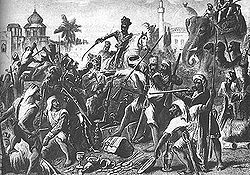
The Battle of Buxar was fought on 22 October 1764 between the forces under the command of the British East India Company
, and the combined armies of Mir Qasim
, the Nawab of Bengal
; Shuja-ud-Daula
Nawab of Awadh
; and Shah Alam II
, the Mughal Emperor. The battle fought at Buxar
, then within the territory of Bengal
, a town located on the bank of the Ganges river, was a decisive victory for the British East India Company
.
s and 918 Indian cavalry. The number of the native forces were estimated to be around 40,000. Lack of co-ordination among the three desperate allies, each with a different axe to grind, was responsible for their decisive debacle.
British losses are said to have been 1,847 killed and wounded, while the three Indian allies accounted for 2,000 dead; many more were wounded. The victors captured 133 pieces of artillery and over 1 million rupees of cash.
According to the British Durrani
and Rohilla
cavalry were present during the battle.
 The prime victim Shuja-ud-Daula
, signed the Treaty of Allahabad
that secured Diwani Rights for the Company to collect and manage the revenues of almost 100000000 acres (404,686 km²) of real estate which form parts of the modern states of West Bengal
, Orissa
, Bihar
, Jharkhand
, and Uttar Pradesh
, as well as areas in the neighboring country of Bangladesh
. He was also forced to pay a war indemnity of 5 million rupees. However, all his pre-war possessions were returned except for the districts of Karra and Allahabad
.
Shah Alam II became a pensioner with a monthly stipend of 450,000 rupees towards upkeep of horses, sepoy
s, peons, barkandazi
s (matchlock men) and household expenses. Mir Qasim
, who was not a general, was quietly replaced. He also received a small share of the total land revenue, initially fixed at 2 million rupees.
The Treaty of Allahabad heralded the establishment of the rule of the East India Company in one-eighth of India proper with a single stroke. The battles of Plassey and Buxar
secured a permanent foothold for the British East India Company in the rich province of Bengal, and secured its political ascendancy in the entire region later to be named India
.
Nawab
Shuja-ud-Daula
was restored to Oudh, with a subsidiary force and guarantee of defence, the emperor Shah Alam II
solaced with Allahabad
and a tribute and the frontier drawn at the boundary of Bihar
. In Bengal
itself he took a decisive step.
In return for restoring Shah Alam II
to Allahabad
he gave the imperial grant of the diwani or revenue authority in Bengal
and Bihar
to the Company. This had hitherto been enjoyed by the nawab
, so that now there was a double government, the nawab retaining judicial and police functions, the Company exercising the revenue power. The Company was acclimatized, as it were, into the Indian scene by becoming the Mughal revenue agent for Bengal and Bihar. There was as yet no thought of direct administration, and the revenue was collected by a Company-appointed deputy-nawab, Muhammad Reza Khan.
But this arrangement made the British East India Company
the virtual ruler of Bengal
since it already possessed decisive military power. All that was left to the nawab was the control of the judicial administration. But he was later forced to hand this over to the Company in 1793, thus the company's control was virtually complete.
In spite of all this the East India Company was again in the verge of bankruptcy
which stirred them to a fresh effort at reform. On the one hand Warren Hastings
was appointed with a mandate for reform, on the other an appeal was made to the State for a loan. The result was the beginnings of state control of the Company and the thirteen-year governorship of Warren Hastings
.
Hastings's first important work was that of an organizer. In the two and a half years before the Regulating Act came into force he put in order the whole Bengal
administration. The Indian deputies who had collected the revenue on behalf of the Company were deposed and their places taken by a Board of Revenue
in Calcutta and English collectors in the districts. This was the real beginning of British administration in India.
British East India Company
The East India Company was an early English joint-stock company that was formed initially for pursuing trade with the East Indies, but that ended up trading mainly with the Indian subcontinent and China...
, and the combined armies of Mir Qasim
Mir Qasim
Mir Qasim was Nawab of Bengal from 1760 to 1764. He was installed as Nawab by the British East India Company replacing Mir Jafar, his father-in-law, who had himself been installed by the British after his role in the Battle of Plassey...
, the Nawab of Bengal
Nawab of Bengal
The Nawabs of Bengal were the hereditary nazims or subadars of the subah of Bengal during the Mughal rule and the de-facto rulers of the province.-History:...
; Shuja-ud-Daula
Shuja-ud-Daula
Shuja-ud-Daula was the Subedar Nawab of Oudh from 5 October 1754 to 26 January 1775, and the son of Muhammad Nasir.Though a minor royal, he is best known for his key roles in two definitive battles in Indian history - the Third Battle of Panipat which ended Maratha domination of India, and the...
Nawab of Awadh
Nawab of Awadh
The Nawab of Awadh is the title of rulers who governed the state of Awadh in India in the 18th and 19th century. The Nawabs of Awadh originated form Persia-Establishment:...
; and Shah Alam II
Shah Alam II
Shah Alam II , also known as Ali Gauhar, was a Mughal emperor of India. A son of Alamgir II, he was exiled to Allahabad in December 1759 by Ghazi-ud-Din, who appointed Shah Jahan III as the emperor. Later, he was nominated as the emperor by Ahmad Shah.Shah Alam II was considered the only and...
, the Mughal Emperor. The battle fought at Buxar
Buxar
Buxar district is one of the thirty-eight districts of Bihar state, India. The district headquarters are located at Buxar.-Mythology:This place was also known as "Siddhashram", "Vedgarbhapuri", "Karush", "Tapovan", "Chaitrath", "VyaghraSar", "Buxar" in ancient history. The History of Buxar dates...
, then within the territory of Bengal
Bengal
Bengal is a historical and geographical region in the northeast region of the Indian Subcontinent at the apex of the Bay of Bengal. Today, it is mainly divided between the sovereign land of People's Republic of Bangladesh and the Indian state of West Bengal, although some regions of the previous...
, a town located on the bank of the Ganges river, was a decisive victory for the British East India Company
British East India Company
The East India Company was an early English joint-stock company that was formed initially for pursuing trade with the East Indies, but that ended up trading mainly with the Indian subcontinent and China...
.
The battle and booty calls
British troops engaged in the fighting numbered 7,072 comprising 857 British, 5,297 Indian sepoySepoy
A sepoy was formerly the designation given to an Indian soldier in the service of a European power. In the modern Indian Army, Pakistan Army and Bangladesh Army it remains in use for the rank of private soldier.-Etymology and Historical usage:...
s and 918 Indian cavalry. The number of the native forces were estimated to be around 40,000. Lack of co-ordination among the three desperate allies, each with a different axe to grind, was responsible for their decisive debacle.
British losses are said to have been 1,847 killed and wounded, while the three Indian allies accounted for 2,000 dead; many more were wounded. The victors captured 133 pieces of artillery and over 1 million rupees of cash.
According to the British Durrani
Durrani
Durrani or Abdali is the name of a chief Pashtun tribal confederation in Afghanistan and Pakistan. Originally known by their ancient name Abdali later as Durrani they have been called Durrani since the beginning of the Durrani Empire in 1747. The number of Durranis are estimated to be roughly 16%...
and Rohilla
Rohilla
The Rohilla are a community of Hindi-speaking Pashtun also known as Pathan, historically found in the state of Uttar Pradesh, in North India. Most are now also found in Pakistan where they are now part of the Mohajir community. At one time, they form one of the largest Pashtun diaspora community...
cavalry were present during the battle.
Treaty of Allahabad
Shuja-ud-Daula
Shuja-ud-Daula was the Subedar Nawab of Oudh from 5 October 1754 to 26 January 1775, and the son of Muhammad Nasir.Though a minor royal, he is best known for his key roles in two definitive battles in Indian history - the Third Battle of Panipat which ended Maratha domination of India, and the...
, signed the Treaty of Allahabad
Treaty of Allahabad
The Treaty of Allahabad was signed on August 16, 1765 between Mughal Emperor Shah Alam II and Lord Clive of the British East India Company after the Battle of Buxar . Based on the terms of the agreement, Shah Alam II granted Diwani rights or right to administer the territory and collect taxes to...
that secured Diwani Rights for the Company to collect and manage the revenues of almost 100000000 acres (404,686 km²) of real estate which form parts of the modern states of West Bengal
West Bengal
West Bengal is a state in the eastern region of India and is the nation's fourth-most populous. It is also the seventh-most populous sub-national entity in the world, with over 91 million inhabitants. A major agricultural producer, West Bengal is the sixth-largest contributor to India's GDP...
, Orissa
Orissa
Orissa , officially Odisha since Nov 2011, is a state of India, located on the east coast of India, by the Bay of Bengal. It is the modern name of the ancient nation of Kalinga, which was invaded by the Maurya Emperor Ashoka in 261 BC. The modern state of Orissa was established on 1 April...
, Bihar
Bihar
Bihar is a state in eastern India. It is the 12th largest state in terms of geographical size at and 3rd largest by population. Almost 58% of Biharis are below the age of 25, which is the highest proportion in India....
, Jharkhand
Jharkhand
Jharkhand is a state in eastern India. It was carved out of the southern part of Bihar on 15 November 2000. Jharkhand shares its border with the states of Bihar to the north, Uttar Pradesh and Chhattisgarh to the west, Orissa to the south, and West Bengal to the east...
, and Uttar Pradesh
Uttar Pradesh
Uttar Pradesh abbreviation U.P. , is a state located in the northern part of India. With a population of over 200 million people, it is India's most populous state, as well as the world's most populous sub-national entity...
, as well as areas in the neighboring country of Bangladesh
Bangladesh
Bangladesh , officially the People's Republic of Bangladesh is a sovereign state located in South Asia. It is bordered by India on all sides except for a small border with Burma to the far southeast and by the Bay of Bengal to the south...
. He was also forced to pay a war indemnity of 5 million rupees. However, all his pre-war possessions were returned except for the districts of Karra and Allahabad
Allahabad
Allahabad , or Settled by God in Persian, is a major city of India and is one of the main holy cities of Hinduism. It was renamed by the Mughals from the ancient name of Prayaga , and is by some accounts the second-oldest city in India. It is located in the north Indian state of Uttar Pradesh,...
.
Shah Alam II became a pensioner with a monthly stipend of 450,000 rupees towards upkeep of horses, sepoy
Sepoy
A sepoy was formerly the designation given to an Indian soldier in the service of a European power. In the modern Indian Army, Pakistan Army and Bangladesh Army it remains in use for the rank of private soldier.-Etymology and Historical usage:...
s, peons, barkandazi
Matchlock
The matchlock was the first mechanism, or "lock" invented to facilitate the firing of a hand-held firearm. This design removed the need to lower by hand a lit match into the weapon's flash pan and made it possible to have both hands free to keep a firm grip on the weapon at the moment of firing,...
s (matchlock men) and household expenses. Mir Qasim
Mir Qasim
Mir Qasim was Nawab of Bengal from 1760 to 1764. He was installed as Nawab by the British East India Company replacing Mir Jafar, his father-in-law, who had himself been installed by the British after his role in the Battle of Plassey...
, who was not a general, was quietly replaced. He also received a small share of the total land revenue, initially fixed at 2 million rupees.
The Treaty of Allahabad heralded the establishment of the rule of the East India Company in one-eighth of India proper with a single stroke. The battles of Plassey and Buxar
Buxar
Buxar district is one of the thirty-eight districts of Bihar state, India. The district headquarters are located at Buxar.-Mythology:This place was also known as "Siddhashram", "Vedgarbhapuri", "Karush", "Tapovan", "Chaitrath", "VyaghraSar", "Buxar" in ancient history. The History of Buxar dates...
secured a permanent foothold for the British East India Company in the rich province of Bengal, and secured its political ascendancy in the entire region later to be named India
India
India , officially the Republic of India , is a country in South Asia. It is the seventh-largest country by geographical area, the second-most populous country with over 1.2 billion people, and the most populous democracy in the world...
.
Nawab
Nawab
A Nawab or Nawaab is an honorific title given to Muslim rulers of princely states in South Asia. It is the Muslim equivalent of the term "maharaja" that was granted to Hindu rulers....
Shuja-ud-Daula
Shuja-ud-Daula
Shuja-ud-Daula was the Subedar Nawab of Oudh from 5 October 1754 to 26 January 1775, and the son of Muhammad Nasir.Though a minor royal, he is best known for his key roles in two definitive battles in Indian history - the Third Battle of Panipat which ended Maratha domination of India, and the...
was restored to Oudh, with a subsidiary force and guarantee of defence, the emperor Shah Alam II
Shah Alam II
Shah Alam II , also known as Ali Gauhar, was a Mughal emperor of India. A son of Alamgir II, he was exiled to Allahabad in December 1759 by Ghazi-ud-Din, who appointed Shah Jahan III as the emperor. Later, he was nominated as the emperor by Ahmad Shah.Shah Alam II was considered the only and...
solaced with Allahabad
Allahabad
Allahabad , or Settled by God in Persian, is a major city of India and is one of the main holy cities of Hinduism. It was renamed by the Mughals from the ancient name of Prayaga , and is by some accounts the second-oldest city in India. It is located in the north Indian state of Uttar Pradesh,...
and a tribute and the frontier drawn at the boundary of Bihar
Bihar
Bihar is a state in eastern India. It is the 12th largest state in terms of geographical size at and 3rd largest by population. Almost 58% of Biharis are below the age of 25, which is the highest proportion in India....
. In Bengal
Bengal
Bengal is a historical and geographical region in the northeast region of the Indian Subcontinent at the apex of the Bay of Bengal. Today, it is mainly divided between the sovereign land of People's Republic of Bangladesh and the Indian state of West Bengal, although some regions of the previous...
itself he took a decisive step.
In return for restoring Shah Alam II
Shah Alam II
Shah Alam II , also known as Ali Gauhar, was a Mughal emperor of India. A son of Alamgir II, he was exiled to Allahabad in December 1759 by Ghazi-ud-Din, who appointed Shah Jahan III as the emperor. Later, he was nominated as the emperor by Ahmad Shah.Shah Alam II was considered the only and...
to Allahabad
Allahabad
Allahabad , or Settled by God in Persian, is a major city of India and is one of the main holy cities of Hinduism. It was renamed by the Mughals from the ancient name of Prayaga , and is by some accounts the second-oldest city in India. It is located in the north Indian state of Uttar Pradesh,...
he gave the imperial grant of the diwani or revenue authority in Bengal
Bengal
Bengal is a historical and geographical region in the northeast region of the Indian Subcontinent at the apex of the Bay of Bengal. Today, it is mainly divided between the sovereign land of People's Republic of Bangladesh and the Indian state of West Bengal, although some regions of the previous...
and Bihar
Bihar
Bihar is a state in eastern India. It is the 12th largest state in terms of geographical size at and 3rd largest by population. Almost 58% of Biharis are below the age of 25, which is the highest proportion in India....
to the Company. This had hitherto been enjoyed by the nawab
Nawab
A Nawab or Nawaab is an honorific title given to Muslim rulers of princely states in South Asia. It is the Muslim equivalent of the term "maharaja" that was granted to Hindu rulers....
, so that now there was a double government, the nawab retaining judicial and police functions, the Company exercising the revenue power. The Company was acclimatized, as it were, into the Indian scene by becoming the Mughal revenue agent for Bengal and Bihar. There was as yet no thought of direct administration, and the revenue was collected by a Company-appointed deputy-nawab, Muhammad Reza Khan.
But this arrangement made the British East India Company
British East India Company
The East India Company was an early English joint-stock company that was formed initially for pursuing trade with the East Indies, but that ended up trading mainly with the Indian subcontinent and China...
the virtual ruler of Bengal
Bengal
Bengal is a historical and geographical region in the northeast region of the Indian Subcontinent at the apex of the Bay of Bengal. Today, it is mainly divided between the sovereign land of People's Republic of Bangladesh and the Indian state of West Bengal, although some regions of the previous...
since it already possessed decisive military power. All that was left to the nawab was the control of the judicial administration. But he was later forced to hand this over to the Company in 1793, thus the company's control was virtually complete.
In spite of all this the East India Company was again in the verge of bankruptcy
Bankruptcy
Bankruptcy is a legal status of an insolvent person or an organisation, that is, one that cannot repay the debts owed to creditors. In most jurisdictions bankruptcy is imposed by a court order, often initiated by the debtor....
which stirred them to a fresh effort at reform. On the one hand Warren Hastings
Warren Hastings
Warren Hastings PC was the first Governor-General of India, from 1773 to 1785. He was famously accused of corruption in an impeachment in 1787, but was acquitted in 1795. He was made a Privy Councillor in 1814.-Early life:...
was appointed with a mandate for reform, on the other an appeal was made to the State for a loan. The result was the beginnings of state control of the Company and the thirteen-year governorship of Warren Hastings
Warren Hastings
Warren Hastings PC was the first Governor-General of India, from 1773 to 1785. He was famously accused of corruption in an impeachment in 1787, but was acquitted in 1795. He was made a Privy Councillor in 1814.-Early life:...
.
Hastings's first important work was that of an organizer. In the two and a half years before the Regulating Act came into force he put in order the whole Bengal
Bengal
Bengal is a historical and geographical region in the northeast region of the Indian Subcontinent at the apex of the Bay of Bengal. Today, it is mainly divided between the sovereign land of People's Republic of Bangladesh and the Indian state of West Bengal, although some regions of the previous...
administration. The Indian deputies who had collected the revenue on behalf of the Company were deposed and their places taken by a Board of Revenue
Board of Revenue
The Board of Revenue was a Colonial British institution and part of the British Raj in India. It provided the crucial role of revenue management during the period when the British East India Company ruled.It was a creation of the East India Company in 1781.The Board of Revenue was formed to help...
in Calcutta and English collectors in the districts. This was the real beginning of British administration in India.