

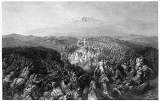
Battle of Ascalon

Encyclopedia
The Battle of Ascalon took place on August 12, 1099, and is often considered the last action of the First Crusade
.
rs had negotiated with the Fatimids of Egypt
during their march to Jerusalem, but no satisfactory compromise could be reached — the Fatimids were willing to give up control of Syria
but not Palestine
, but this was unacceptable to the crusaders, whose goal was the Church of the Holy Sepulchre
in Jerusalem. Jerusalem was captured from the Fatimids on July 15, 1099, after a long siege
, and immediately the crusaders learned that a Fatimid army was on its way to besiege them.
The crusaders acted quickly. Godfrey of Bouillon
was named Defender of the Holy Sepulchre on July 22, and Arnulf of Chocques
, named patriarch of Jerusalem
on August 1, discovered a relic
of the True Cross
on August 5. Fatimid ambassadors arrived to order the crusaders to leave Jerusalem, but they were ignored. On August 10 Godfrey led the remaining crusaders out of Jerusalem towards Ascalon
, a day's march away, while Peter the Hermit
led both the Catholic and Greek Orthodox
clergy in prayers and a procession from the Holy Sepulchre to the Temple
. Robert II of Flanders
and Arnulf accompanied Godfrey, but Raymond IV of Toulouse and Robert of Normandy stayed behind, either out of a quarrel with Godfrey or because they preferred to hear about the Egyptian army from their own scouts. When the Egyptian presence was confirmed, they marched out as well the next day. Near Ramla
, they met Tancred
and Godfrey's brother Eustace, who had left to capture Nablus
earlier in the month. At the head of the army, Arnulf carried the relic of the Cross, while Raymond of Aguilers
carried the relic of the Holy Lance
that had been discovered at Antioch
the previous year.
al-Afdal Shahanshah
, who commanded perhaps as many as 50,000 troops (other estimates range from 20–30,000 to the exaggerated 200,000 of the Gesta Francorum
). His army consisted of Seljuk Turks
, Arabs, Persians
, Armenia
ns, Kurds
, and Ethiopia
ns. He was intending to besiege the crusaders in Jerusalem, although he had brought no siege machinery with him; he did however have a fleet, also assembling in the port of Ascalon. The precise number of crusaders is unknown, but the number given by Raymond of Aguilers
is 1,200 knight
s and 9,000 infantry. The highest estimate is 20,000 men but this is surely impossible at this stage of the crusade. Al-Afdal camped in the plain of al-Majdal in a valley outside Ascalon, preparing to continue on to Jerusalem and besiege the crusaders there, apparently unaware that the crusaders had already left to meet him. On August 11 the crusaders found oxen
, sheep, camel
s, and goat
s, gathered there to feed the Fatimid camp, grazing outside the city. According to captives taken by Tancred in a skirmish near Ramla
, the animals were there to encourage the crusaders to disperse and pillage the land, making it easier for the Fatimids to attack. However, al-Afdal did not yet know the crusaders were in the area and was apparently not expecting them. In any case, these animals marched with them the next morning, making their army appear much larger than it actually was.
On the morning of the 12th, crusader scouts reported the location of the Fatimid camp and the army marched towards it. During the march the crusaders had been organized into nine divisions: Godfrey led the left wing, Raymond the right, and Tancred, Eustace, Robert of Normandy and Gaston IV of Béarn
made up the centre; they were further divided into two smaller divisions, and a division of foot-soldiers marched ahead of each. This arrangement was also used as the line of battle outside Ascalon, with the center of the army between the Jerusalem and Jaffa Gates, the right aligned with the Mediterranean
coast, and the left facing the Jaffa Gate.
According to most accounts (both crusader and Muslim), the Fatimids were caught unprepared and the battle was short, but Albert of Aix
states that the battle went on for some time with a fairly well prepared Egyptian army. The two main lines of battle fought each other with arrows until they were close enough to fight hand-to-hand with spear
s and other hand weapons. The Ethiopians attacked the centre of the crusader line, and the Fatimid vanguard was able to outflank the crusaders and surround their rearguard, until Godfrey arrived to rescue them. Despite his numerical superiority, al-Afdal's army was hardly as strong or dangerous as the Seljuk armies that the crusaders had encountered previously. The battle seems to have been over before the Fatimid heavy cavalry was prepared to join it. Al-Afdal and his panicked troops fled back to the safety of the heavily fortified city; Raymond chased some of them into the sea, others climbed trees and were killed with arrows, while others were crushed in the retreat back into the gates of Ascalon. Al-Afdal left behind his camp and its treasures, which were captured by Robert and Tancred. Crusader losses are unknown, but the Egyptians lost about 10–12,000 men.
having been fulfilled. There were perhaps only a few hundred knight
s left in Jerusalem by the end of the year, but they were gradually reinforced by new crusaders, inspired by the success of the original crusade.
Although the battle of Ascalon was a crusader victory the city itself remained under Fatimid control, and it was eventually re-garrisoned. It became the base of operations for invasions of the Kingdom of Jerusalem
every year afterwards, and numerous battles were fought there in the following years, until 1153 when it was finally captured by the crusaders in the Siege of Ascalon
.
First Crusade
The First Crusade was a military expedition by Western Christianity to regain the Holy Lands taken in the Muslim conquest of the Levant, ultimately resulting in the recapture of Jerusalem...
.
Background
The crusadeCrusades
The Crusades were a series of religious wars, blessed by the Pope and the Catholic Church with the main goal of restoring Christian access to the holy places in and near Jerusalem...
rs had negotiated with the Fatimids of Egypt
Egypt
Egypt , officially the Arab Republic of Egypt, Arabic: , is a country mainly in North Africa, with the Sinai Peninsula forming a land bridge in Southwest Asia. Egypt is thus a transcontinental country, and a major power in Africa, the Mediterranean Basin, the Middle East and the Muslim world...
during their march to Jerusalem, but no satisfactory compromise could be reached — the Fatimids were willing to give up control of Syria
Syria
Syria , officially the Syrian Arab Republic , is a country in Western Asia, bordering Lebanon and the Mediterranean Sea to the West, Turkey to the north, Iraq to the east, Jordan to the south, and Israel to the southwest....
but not Palestine
Palestine
Palestine is a conventional name, among others, used to describe the geographic region between the Mediterranean Sea and the Jordan River, and various adjoining lands....
, but this was unacceptable to the crusaders, whose goal was the Church of the Holy Sepulchre
Church of the Holy Sepulchre
The Church of the Holy Sepulchre, also called the Church of the Resurrection by Eastern Christians, is a church within the walled Old City of Jerusalem. It is a few steps away from the Muristan....
in Jerusalem. Jerusalem was captured from the Fatimids on July 15, 1099, after a long siege
Siege of Jerusalem (1099)
The Siege of Jerusalem took place from June 7 to July 15, 1099 during the First Crusade. The Crusaders stormed and captured the city from Fatimid Egypt.-Background:...
, and immediately the crusaders learned that a Fatimid army was on its way to besiege them.
The crusaders acted quickly. Godfrey of Bouillon
Godfrey of Bouillon
Godfrey of Bouillon was a medieval Frankish knight who was one of the leaders of the First Crusade from 1096 until his death. He was the Lord of Bouillon, from which he took his byname, from 1076 and the Duke of Lower Lorraine from 1087...
was named Defender of the Holy Sepulchre on July 22, and Arnulf of Chocques
Arnulf of Chocques
Arnulf Malecorne of Chocques was a leader among the clergy during the First Crusade, and was Latin Patriarch of Jerusalem in 1099 and from 1112 to 1118....
, named patriarch of Jerusalem
Latin Patriarch of Jerusalem
The Latin Patriarch of Jerusalem is the title possessed by the Latin Rite Catholic Archbishop of Jerusalem. The Archdiocese of Jerusalem has jurisdiction for all Latin Rite Catholics in Israel, the Palestinian Territories, Jordan and Cyprus...
on August 1, discovered a relic
Relic
In religion, a relic is a part of the body of a saint or a venerated person, or else another type of ancient religious object, carefully preserved for purposes of veneration or as a tangible memorial...
of the True Cross
True Cross
The True Cross is the name for physical remnants which, by a Christian tradition, are believed to be from the cross upon which Jesus was crucified.According to post-Nicene historians, Socrates Scholasticus and others, the Empress Helena The True Cross is the name for physical remnants which, by a...
on August 5. Fatimid ambassadors arrived to order the crusaders to leave Jerusalem, but they were ignored. On August 10 Godfrey led the remaining crusaders out of Jerusalem towards Ascalon
Ashkelon
Ashkelon is a coastal city in the South District of Israel on the Mediterranean coast, south of Tel Aviv, and north of the border with the Gaza Strip. The ancient seaport of Ashkelon dates back to the Neolithic Age...
, a day's march away, while Peter the Hermit
Peter the Hermit
Peter the Hermit was a priest of Amiens and a key figure during the First Crusade.-Before 1096:According to Anna Comnena, he had attempted to go on a pilgrimage to Jerusalem before 1096, but was prevented by the Seljuk Turks from reaching his goal and was tortured.Sources differ as to whether he...
led both the Catholic and Greek Orthodox
Eastern Orthodox Church
The Orthodox Church, officially called the Orthodox Catholic Church and commonly referred to as the Eastern Orthodox Church, is the second largest Christian denomination in the world, with an estimated 300 million adherents mainly in the countries of Belarus, Bulgaria, Cyprus, Georgia, Greece,...
clergy in prayers and a procession from the Holy Sepulchre to the Temple
Temple in Jerusalem
The Temple in Jerusalem or Holy Temple , refers to one of a series of structures which were historically located on the Temple Mount in the Old City of Jerusalem, the current site of the Dome of the Rock. Historically, these successive temples stood at this location and functioned as the centre of...
. Robert II of Flanders
Robert II, Count of Flanders
Robert II was Count of Flanders from 1093 to 1111. He became known as Robert of Jerusalem or Robert the Crusader after his exploits in the First Crusade.-History:...
and Arnulf accompanied Godfrey, but Raymond IV of Toulouse and Robert of Normandy stayed behind, either out of a quarrel with Godfrey or because they preferred to hear about the Egyptian army from their own scouts. When the Egyptian presence was confirmed, they marched out as well the next day. Near Ramla
Ramla
Ramla , is a city in central Israel. The city is predominantly Jewish with a significant Arab minority. Ramla was founded circa 705–715 AD by the Umayyad Caliph Suleiman ibn Abed al-Malik after the Arab conquest of the region...
, they met Tancred
Tancred, Prince of Galilee
Tancred was a Norman leader of the First Crusade who later became Prince of Galilee and regent of the Principality of Antioch...
and Godfrey's brother Eustace, who had left to capture Nablus
Nablus
Nablus is a Palestinian city in the northern West Bank, approximately north of Jerusalem, with a population of 126,132. Located in a strategic position between Mount Ebal and Mount Gerizim, it is the capital of the Nablus Governorate and a Palestinian commercial and cultural center.Founded by the...
earlier in the month. At the head of the army, Arnulf carried the relic of the Cross, while Raymond of Aguilers
Raymond of Aguilers
Raymond of Aguilers was a chronicler of the First Crusade . He followed the Provençal army of crusaders, guided by count Raymond IV of Toulouse, to Jerusalem....
carried the relic of the Holy Lance
Holy Lance
The Holy Lance is the name given to the lance that pierced Jesus' side as he hung on the cross in John's account of the Crucifixion.-Biblical references:The lance is mentioned only in the Gospel of John and not in any of the...
that had been discovered at Antioch
Antioch
Antioch on the Orontes was an ancient city on the eastern side of the Orontes River. It is near the modern city of Antakya, Turkey.Founded near the end of the 4th century BC by Seleucus I Nicator, one of Alexander the Great's generals, Antioch eventually rivaled Alexandria as the chief city of the...
the previous year.
The battle
The Fatimids were led by vizierVizier
A vizier or in Arabic script ; ; sometimes spelled vazir, vizir, vasir, wazir, vesir, or vezir) is a high-ranking political advisor or minister in a Muslim government....
al-Afdal Shahanshah
Al-Afdal Shahanshah
al-Malik al-Afdal ibn Badr al-Jamali Shahanshah was a vizier of the Fatimid caliphs of Egypt.- Ascent to power :He was born in Acre, the son of Badr al-Jamali, an Armenian who became Muslim. Badr was vizier for the Fatimids in Cairo from 1074 until his death in 1094, when al-Afdal succeeded him...
, who commanded perhaps as many as 50,000 troops (other estimates range from 20–30,000 to the exaggerated 200,000 of the Gesta Francorum
Gesta Francorum
The so-called Gesta Francorum or in full De Gesta Francorum et aliorum Hierosolimitanorum is a Latin chronicle of the First Crusade written in circa 1100-1101 by an anonymous author connected with Bohemund I of Antioch.It narrates the events of the First Crusade from the inception in November...
). His army consisted of Seljuk Turks
Seljuq dynasty
The Seljuq ; were a Turco-Persian Sunni Muslim dynasty that ruled parts of Central Asia and the Middle East from the 11th to 14th centuries...
, Arabs, Persians
Iran
Iran , officially the Islamic Republic of Iran , is a country in Southern and Western Asia. The name "Iran" has been in use natively since the Sassanian era and came into use internationally in 1935, before which the country was known to the Western world as Persia...
, Armenia
Armenia
Armenia , officially the Republic of Armenia , is a landlocked mountainous country in the Caucasus region of Eurasia...
ns, Kurds
Kurdish people
The Kurdish people, or Kurds , are an Iranian people native to the Middle East, mostly inhabiting a region known as Kurdistan, which includes adjacent parts of Iran, Iraq, Syria, and Turkey...
, and Ethiopia
Ethiopia
Ethiopia , officially known as the Federal Democratic Republic of Ethiopia, is a country located in the Horn of Africa. It is the second-most populous nation in Africa, with over 82 million inhabitants, and the tenth-largest by area, occupying 1,100,000 km2...
ns. He was intending to besiege the crusaders in Jerusalem, although he had brought no siege machinery with him; he did however have a fleet, also assembling in the port of Ascalon. The precise number of crusaders is unknown, but the number given by Raymond of Aguilers
Raymond of Aguilers
Raymond of Aguilers was a chronicler of the First Crusade . He followed the Provençal army of crusaders, guided by count Raymond IV of Toulouse, to Jerusalem....
is 1,200 knight
Knight
A knight was a member of a class of lower nobility in the High Middle Ages.By the Late Middle Ages, the rank had become associated with the ideals of chivalry, a code of conduct for the perfect courtly Christian warrior....
s and 9,000 infantry. The highest estimate is 20,000 men but this is surely impossible at this stage of the crusade. Al-Afdal camped in the plain of al-Majdal in a valley outside Ascalon, preparing to continue on to Jerusalem and besiege the crusaders there, apparently unaware that the crusaders had already left to meet him. On August 11 the crusaders found oxen
Ox
An ox , also known as a bullock in Australia, New Zealand and India, is a bovine trained as a draft animal. Oxen are commonly castrated adult male cattle; castration makes the animals more tractable...
, sheep, camel
Camel
A camel is an even-toed ungulate within the genus Camelus, bearing distinctive fatty deposits known as humps on its back. There are two species of camels: the dromedary or Arabian camel has a single hump, and the bactrian has two humps. Dromedaries are native to the dry desert areas of West Asia,...
s, and goat
Goat
The domestic goat is a subspecies of goat domesticated from the wild goat of southwest Asia and Eastern Europe. The goat is a member of the Bovidae family and is closely related to the sheep as both are in the goat-antelope subfamily Caprinae. There are over three hundred distinct breeds of...
s, gathered there to feed the Fatimid camp, grazing outside the city. According to captives taken by Tancred in a skirmish near Ramla
Ramla
Ramla , is a city in central Israel. The city is predominantly Jewish with a significant Arab minority. Ramla was founded circa 705–715 AD by the Umayyad Caliph Suleiman ibn Abed al-Malik after the Arab conquest of the region...
, the animals were there to encourage the crusaders to disperse and pillage the land, making it easier for the Fatimids to attack. However, al-Afdal did not yet know the crusaders were in the area and was apparently not expecting them. In any case, these animals marched with them the next morning, making their army appear much larger than it actually was.
On the morning of the 12th, crusader scouts reported the location of the Fatimid camp and the army marched towards it. During the march the crusaders had been organized into nine divisions: Godfrey led the left wing, Raymond the right, and Tancred, Eustace, Robert of Normandy and Gaston IV of Béarn
Gaston IV of Béarn
Gaston IV was viscount of Béarn from 1090 to 1131. He was called "le Croisé" due to his participation in the First Crusade....
made up the centre; they were further divided into two smaller divisions, and a division of foot-soldiers marched ahead of each. This arrangement was also used as the line of battle outside Ascalon, with the center of the army between the Jerusalem and Jaffa Gates, the right aligned with the Mediterranean
Mediterranean Sea
The Mediterranean Sea is a sea connected to the Atlantic Ocean surrounded by the Mediterranean region and almost completely enclosed by land: on the north by Anatolia and Europe, on the south by North Africa, and on the east by the Levant...
coast, and the left facing the Jaffa Gate.
According to most accounts (both crusader and Muslim), the Fatimids were caught unprepared and the battle was short, but Albert of Aix
Albert of Aix
Albert of Aix-la-Chapelle or Albert of Aachen , historian of the First Crusade, was born during the later part of the 11th century, and afterwards became canon and custos of the church of Aachen....
states that the battle went on for some time with a fairly well prepared Egyptian army. The two main lines of battle fought each other with arrows until they were close enough to fight hand-to-hand with spear
Spear
A spear is a pole weapon consisting of a shaft, usually of wood, with a pointed head.The head may be simply the sharpened end of the shaft itself, as is the case with bamboo spears, or it may be made of a more durable material fastened to the shaft, such as flint, obsidian, iron, steel or...
s and other hand weapons. The Ethiopians attacked the centre of the crusader line, and the Fatimid vanguard was able to outflank the crusaders and surround their rearguard, until Godfrey arrived to rescue them. Despite his numerical superiority, al-Afdal's army was hardly as strong or dangerous as the Seljuk armies that the crusaders had encountered previously. The battle seems to have been over before the Fatimid heavy cavalry was prepared to join it. Al-Afdal and his panicked troops fled back to the safety of the heavily fortified city; Raymond chased some of them into the sea, others climbed trees and were killed with arrows, while others were crushed in the retreat back into the gates of Ascalon. Al-Afdal left behind his camp and its treasures, which were captured by Robert and Tancred. Crusader losses are unknown, but the Egyptians lost about 10–12,000 men.
Aftermath
The crusaders spent the night in the abandoned camp, preparing for another attack, but in the morning they learned that the Fatimids were retreating to Egypt. Al-Afdal fled by ship. They took as much plunder as they could, including the Standard and al-Afdal's personal tent and burned the rest. They returned to Jerusalem on August 13, and after much celebration Godfrey and Raymond both claimed Ascalon. When the garrison learned of the dispute they refused to surrender. After the battle, almost all of the remaining crusaders returned to their homes in Europe, their vows of pilgrimagePilgrimage
A pilgrimage is a journey or search of great moral or spiritual significance. Typically, it is a journey to a shrine or other location of importance to a person's beliefs and faith...
having been fulfilled. There were perhaps only a few hundred knight
Knight
A knight was a member of a class of lower nobility in the High Middle Ages.By the Late Middle Ages, the rank had become associated with the ideals of chivalry, a code of conduct for the perfect courtly Christian warrior....
s left in Jerusalem by the end of the year, but they were gradually reinforced by new crusaders, inspired by the success of the original crusade.
Although the battle of Ascalon was a crusader victory the city itself remained under Fatimid control, and it was eventually re-garrisoned. It became the base of operations for invasions of the Kingdom of Jerusalem
Kingdom of Jerusalem
The Kingdom of Jerusalem was a Catholic kingdom established in the Levant in 1099 after the First Crusade. The kingdom lasted nearly two hundred years, from 1099 until 1291 when the last remaining possession, Acre, was destroyed by the Mamluks, but its history is divided into two distinct periods....
every year afterwards, and numerous battles were fought there in the following years, until 1153 when it was finally captured by the crusaders in the Siege of Ascalon
Siege of Ascalon
The Siege of Ascalon took place in 1153, resulting in the capture of that Egyptian fortress by the Crusader Kingdom of Jerusalem.-Background:...
.