
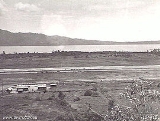
The
Battle of Ambon occurred on the island of
AmbonAmbon Island is part of the Maluku Islands of Indonesia. The island has an area of , and is mountainous, well watered, and fertile. Ambon Island consists of 2 territories: The main city and seaport is Ambon , which is also the capital of Maluku province and Maluku Tengah Ambon Island is part of the...
in the
Dutch East IndiesThe Dutch East Indies was a Dutch colony that became modern Indonesia following World War II. It was formed from the nationalised colonies of the Dutch East India Company, which came under the administration of the Netherlands government in 1800....
(Indonesia), on 30 January – 3 February 1942, during
World War IIWorld War II, or the Second World War , was a global conflict lasting from 1939 to 1945, involving most of the world's nations—including all of the great powers—eventually forming two opposing military alliances: the Allies and the Axis...
. A
JapaneseThe Empire of Japan is the name of the state of Japan that existed from the Meiji Restoration on 3 January 1868 to the enactment of the post-World War II Constitution of...
invasion was resisted by
DutchThe Netherlands is a constituent country of the Kingdom of the Netherlands, located mainly in North-West Europe and with several islands in the Caribbean. Mainland Netherlands borders the North Sea to the north and west, Belgium to the south, and Germany to the east, and shares maritime borders...
and Australian forces. The chaotic and sometimes bloody fighting was followed by a series of major
Japanese war crimesJapanese war crimes occurred during the period of Japanese imperialism, primarily during the Second Sino-Japanese War and World War II. Some of the incidents have also been described as an Asian Holocaust and Japanese war atrocities...
.
Background
During 1941, as the
AlliesThe Allies of World War II were the countries that opposed the Axis powers during the Second World War . Former Axis states contributing to the Allied victory are not considered Allied states...
perceived the possibility of
war with JapanThe Pacific War, also sometimes called the Asia-Pacific War refers broadly to the parts of World War II that took place in the Pacific Ocean, its islands, and in East Asia, then called the Far East...
, Ambon was seen to be a strategic location, because of its potential as a major air base. The Australian government and military commanders saw that it could be used in raids on northern Australia and decided to reinforce the Dutch forces on the island.
Geography
Ambon is located in the
MalukuThe Maluku Islands are an archipelago that is part of Indonesia, and part of the larger Maritime Southeast Asia region. Tectonically they are located on the Halmahera Plate within the Molucca Sea Collision Zone...
(Moluccas) islands, just south of the much larger island of
SeramSeram is an island in the Maluku province of Indonesia. It is located north of Ambon Island. The chief port/town is Masohi.- Geography and geology :...
(Ceram). Ambon has what might be described as a "figure eight" or "hourglass" shape, and consists of two peninsulas separated by a narrow
isthmusAn isthmus is a narrow strip of land connecting two larger land areas usually with waterforms on either side.Canals are often built through isthmuses where they may be particularly advantageous to create a shortcut for marine transportation...
, with long narrow bays on either side of the isthmus. The key airport at Laha is in the west of the Hitu Peninsula — northern part of the island — facing the Bay of Ambon. The town of Ambon is at the opposite side of the bay, on the southern part of the island, Laitimor Peninsula.
Allies
At the outbreak of war on 8 December, Ambon was garrisoned by the 2,800-strong
Molukken BrigadeA brigade is a major tactical military formation that is typically composed of two to five battalions, plus supporting elements depending on the era and nationality of a given army and could be perceived as an enlarged/reinforced regiment...
of the
Royal Netherlands East Indies ArmyThe Royal Netherlands East Indies Army was the military force maintained by the Netherlands in its colony of the Netherlands East Indies . The KNIL's air arm was the Royal Netherlands East Indies Army Air Force...
(KNIL) garrison, commanded by
Lieutenant ColonelLieutenant colonel is a rank of commissioned officer in the armies and most marine forces and some air forces of the world, typically ranking above a major and below a colonel. The rank of lieutenant colonel is often shortened to simply "colonel" in conversation and in unofficial correspondence...
Joseph Kapitz and consisting of
IndonesianIndonesia , officially the Republic of Indonesia , is a country in Southeast Asia and Oceania. Indonesia is an archipelago comprising approximately 13,000 islands. It has 33 provinces with over 238 million people, and is the world's fourth most populous country. Indonesia is a republic, with an...
colonial troops, under European officers. The garrison was poorly equipped and trained, partly as a result of the Netherlands having been defeated and occupied by
Nazi GermanyNazi Germany , also known as the Third Reich , but officially called German Reich from 1933 to 1943 and Greater German Reich from 26 June 1943 onward, is the name commonly used to refer to the state of Germany from 1933 to 1945, when it was a totalitarian dictatorship ruled by...
. The KNIL units were not equipped with radios and relied on landlines and written communications. They included 300 partly trained reservists.
The
Australian ArmyThe Australian Army is Australia's military land force. It is part of the Australian Defence Force along with the Royal Australian Navy and the Royal Australian Air Force. While the Chief of Defence commands the Australian Defence Force , the Army is commanded by the Chief of Army...
's 1,100-strong
Gull Force, commanded by Lt. Col. Leonard Roach, arrived on 17 December. The force consisted of the
Australian 8th DivisionThe 8th Division of the Australian Army was formed to serve in World War II, as part of the Second Australian Imperial Force, who were in turn, part of the Allies of World War II. The 8th Division was raised from regular army units and new, all-volunteer infantry brigades, from July 1940 onwards...
's 2/21st Infantry Battalion, as well as some divisional artillery and support units. Kapitz was appointed Allied commander on Ambon. Roach had visited the island before Gull Force's deployment and requested that more artillery and machine gun units be sent from Australia.
On 6 January, after Dutch and British territories to the north fell to Japan, Ambon came under attack from Japanese aircraft. Roach complained about the lack of response to his suggestions, and as a result he was replaced by Lt. Col. John Scott on 14 January.
Kapitz's headquarters was at
HalongHalong may refer to:* Ha Long, also known as Hong Gai, the capital city of Quang Ninh Province, Vietnam* Halong Bay, a UNESCO World Heritage site located in Quảng Ninh province, Vietnam...
, between Paso and the town of Ambon. It included four armoured cars, an anti-aircraft machine gun detachment and four 40 mm AA guns. In the belief that the terrain on the south coast of Laitimor was too inhospitable for landings and that any attack was likely to be in the east, around the Bay of Baguala, the KNIL forces were concentrated at Paso, near the isthmus, under Major H. H. L. Tieland. There were small KNIL detachments at likely landing places in the north of Hitu.
Two companies of the 2/21st Battalion and 300 Dutch troops were at Laha airfield, under the command of Major Mark Newbury. They were accompanied by Dutch artillery: four 75 mm field artillery pieces, four 37 mm anti-tank guns, four 75 mm AA guns, four 40 mm AA guns, a AA machine gun
platoonA platoon is a military unit typically composed of two to four sections or squads and containing 16 to 50 soldiers. Platoons are organized into a company, which typically consists of three, four or five platoons. A platoon is typically the smallest military unit led by a commissioned officer—the...
and a AA machine gun
batteryIn military organizations, an artillery battery is a unit of guns, mortars, rockets or missiles so grouped in order to facilitate better battlefield communication and command and control, as well as to provide dispersion for its constituent gunnery crews and their systems...
.
However, Lt Col. Scott, Gull Force HQ and the remainder of the Australian troops were concentrated in the western part of Laitimor Peninsula, in case of an attack from the Bay of Ambon. "A" Company of the 2/21st and one KNIL company were stationed at Eri, on the south west side of the bay. The 2/21st Battalion's
pioneerAn Assault Pioneer is an infantry soldier who is responsible for:* The construction of tools for infantry soldiers to cross natural and man-made obstacles as well as breaching of enemy fortifications;...
platoon was on the plateau around Mt Nona (the highest point on Laitimor), with a Dutch anti-aircraft machine gun detachment. Smaller Australian detachments were at: Latuhalat, near the south western tip of Laitimor and at Cape Batuanjut, just north of Eri. Gull Force HQ and a strategic reserve, "D" Company, were located on a line from the Nona plateau to Amahusu beach, between Eri and the town of Ambon.
The Allies had few aircraft to spare. The KNIL Air Service sent No. 2
FlightA flight is a military unit in an air force, naval air service, or army air corps. It usually comprises three to six aircraft, with their aircrews and ground staff; or, in the case of a non-flying ground flight, no aircraft and a roughly equivalent number of support personnel. In most usages,...
,
GroupA group is a military aviation unit, a component of military organization and a military formation. Usage of the terms group and wing differ from one country to another, as well as different branches of a defence force, in some cases...
IV (
2-Vl. G.IV) from Java to Laha. Of an original four
Brewster BuffaloThe Brewster F2A Buffalo was an American fighter aircraft which saw limited service early in World War II. Though the Buffalo won a competition against the Grumman F4F Wildcat in 1939 to become the US Navy's first monoplane fighter aircraft, it turned out to be a big disappointment...
s, two crashed on route to Ambon. The
Royal Australian Air ForceThe Royal Australian Air Force is the air force branch of the Australian Defence Force. The RAAF was formed in March 1921. It continues the traditions of the Australian Flying Corps , which was formed on 22 October 1912. The RAAF has taken part in many of the 20th century's major conflicts...
sent two flights, comprising 12
Lockheed HudsonThe Lockheed Hudson was an American-built light bomber and coastal reconnaissance aircraft built initially for the Royal Air Force shortly before the outbreak of the Second World War and primarily operated by the RAF thereafter...
Mk 2 light bombers, from
No. 13No. 13 Squadron is a Royal Australian Air Force squadron. The Squadron saw combat during World War II as a bomber and maritime patrol squadron and is currently active as a mixed regular and reserve RAAF unit located in Darwin, fulfilling both operational support and training duties.-History:No. 13...
and
No. 2 SquadronsNo. 2 Squadron is a Royal Australian Air Force squadron. From its formation in 1916, it has operated a variety of aircraft types including fighters, bombers, and Airborne Early Warning & Control.-World War I:No...
, were deployed to the area, under
Wing CommanderWing commander is a commissioned rank in the Royal Air Force and the air forces of many other Commonwealth countries...
Ernest Scott (who was not related to Lt Col. John Scott). One flight was based at Laha, and another was sent to Namlea on the neighbouring island of
BuruBuru is the third largest island within Maluku Islands of Malay Archipelago. It lies between the Banda Sea to the south and Seram Sea to the north, west of Ambon and Seram islands. The island belongs to Maluku province of Indonesia and includes the Buru and South Buru regencies...
.
The U. S. Navy’s Patrol Wing TEN, with PBY Catalinas, based at the Halong seaplane station from 23 December. Wing Headquarters moved to Java 9 January, but American PBYs mounted patrols from Halong through the 15 January air raid, and then abandoned the base as too exposed. Altogether five USN PBYs were destroyed there by air attack. The Wing’s seaplane tenders supported patrols, but left after 8 January. Tender-based patrols from WILLIAM B. PRESTON (AVD 7) and HERON (AVP 2) at anchorages further south continued until 5 February.
The Royal Netherlands Naval Air Service / Marineluchtvaartdienst flew patrols from Ambon/Halong; GVT 17 with Catalina flying boats continued from the start of war through 14 January, when they were ordered to Java.
U. S. Navy and RAAF aircraft made several very dangerous evacuation flights into Ambon/Laha in the last days of January.
Gouden Leeuw, a
Royal Netherlands NavyThe Koninklijke Marine is the navy of the Netherlands. In the mid-17th century the Dutch Navy was the most powerful navy in the world and it played an active role in the wars of the Dutch Republic and later those of the Batavian Republic and the Kingdom of the Netherlands...
minelayerMinelaying is the act of deploying explosive mines. Historically this has been carried out by ships, submarines and aircraft. Additionally, since World War I the term minelayer refers specifically to a naval ship used for deploying naval mines...
, left Ambon in early January, after
miningA naval mine is a self-contained explosive device placed in water to destroy surface ships or submarines. Unlike depth charges, mines are deposited and left to wait until they are triggered by the approach of, or contact with, an enemy vessel...
approaches to the island. By mid-January,
Heron was the only Allied combat ship at Ambon.
Japan
A
Imperial Japanese NavyThe Imperial Japanese Navy was the navy of the Empire of Japan from 1869 until 1947, when it was dissolved following Japan's constitutional renunciation of the use of force as a means of settling international disputes...
(IJN) task force for the invasion of Ambon, commanded by
Rear AdmiralRear admiral is a naval commissioned officer rank above that of a commodore and captain, and below that of a vice admiral. It is generally regarded as the lowest of the "admiral" ranks, which are also sometimes referred to as "flag officers" or "flag ranks"...
Ibō Takahashi- Books :...
, included the
aircraft carrierAn aircraft carrier is a warship designed with a primary mission of deploying and recovering aircraft, acting as a seagoing airbase. Aircraft carriers thus allow a naval force to project air power worldwide without having to depend on local bases for staging aircraft operations...
s
Hiryūwas a modified Sōryū-class aircraft carrier of the Imperial Japanese Navy. She was one of the carriers that began the Pacific War with the attack on Pearl Harbor...
and
Sōryūwas an aircraft carrier of the Imperial Japanese Navy. During the Second World War, she took part in the attack on Pearl Harbor, Wake Island, Port Darwin and raids in the Indian Ocean before being sunk at the Battle of Midway.-Design:...
, two
seaplane tenderA seaplane tender is a ship that provides facilities for operating seaplanes. These ships were the first aircraft carriers and appeared just before the First World War.-History:...
s, the
heavy cruiserThe heavy cruiser was a type of cruiser, a naval warship designed for long range, high speed and an armament of naval guns roughly 203mm calibre . The heavy cruiser can be seen as a lineage of ship design from 1915 until 1945, although the term 'heavy cruiser' only came into formal use in 1930...
s
Nachiwas the second of four Myōkō-class heavy cruisers built for the Imperial Japanese Navy — the other ships of the class being , and . She was named after a mountain in Wakayama Prefecture....
and
Haguro|-External reference links: -External links:**...
, the
light cruiser Jintsuwas a Sendai-class light cruiser in the Imperial Japanese Navy, named after the Jinzū River in the Gifu and Toyama prefectures of central Japan.-Background:...
, 15
destroyerIn naval terminology, a destroyer is a fast and maneuverable yet long-endurance warship intended to escort larger vessels in a fleet, convoy or battle group and defend them against smaller, powerful, short-range attackers. Destroyers, originally called torpedo-boat destroyers in 1892, evolved from...
s, five
minesweeperA minesweeper is a small naval warship designed to counter the threat posed by naval mines. Minesweepers generally detect then neutralize mines in advance of other naval operations.-History:...
s, four
submarine chaserA submarine chaser is a small and fast naval vessel specially intended for anti-submarine warfare. Although similar vessels were designed and used by many nations, this designation was most famously used by ships built by the United States of America...
s and two
patrol boatA patrol boat is a relatively small naval vessel generally designed for coastal defense duties.There have been many designs for patrol boats. They may be operated by a nation's navy, coast guard, or police force, and may be intended for marine and/or estuarine or river environments...
s.
The Japanese ground forces were made up of about 5,300 personnel: the Itō Detachment of the
Imperial Japanese Army-Foundation:During the Meiji Restoration, the military forces loyal to the Emperor were samurai drawn primarily from the loyalist feudal domains of Satsuma and Chōshū...
(IJA), under
Major GeneralMajor general or major-general is a military rank used in many countries. It is derived from the older rank of sergeant major general. A major general is a high-ranking officer, normally subordinate to the rank of lieutenant general and senior to the ranks of brigadier and brigadier general...
Takeo Itōwas a general in the Imperial Japanese Army during World War II.-Biography:Takeo Itō was born in the city of Fukuoka in the Fukuoka prefecture The commanding officer of the IJA 228th Infantry Regiment at the start of the Second Sino-Japanese War, he assumed command of 114th Infantry Regiment on...
, comprising the 38th Division HQ and the 228th Infantry Regiment, along with marines from the 1st Kure Special Naval Landing Force (part of the China Area Fleet), under
Rear AdmiralRear admiral is a naval commissioned officer rank above that of a commodore and captain, and below that of a vice admiral. It is generally regarded as the lowest of the "admiral" ranks, which are also sometimes referred to as "flag officers" or "flag ranks"...
Koichiro Hatakeyama.
30 January
From 6 January onwards, Ambon was attacked by Japanese aircraft.
Allied aircraft made some
sortieSortie is a term for deployment or dispatch of one military unit, be it an aircraft, ship, or troops from a strongpoint. The sortie, whether by one or more aircraft or vessels, usually has a specific mission....
s against the approaching Japanese fleet, with little success. On 13 January, the two Buffalos, piloted by
LtFirst lieutenant is a military rank and, in some forces, an appointment.The rank of lieutenant has different meanings in different military formations , but the majority of cases it is common for it to be sub-divided into a senior and junior rank...
Broers and
SgtSergeant is a rank used in some form by most militaries, police forces, and other uniformed organizations around the world. Its origins are the Latin serviens, "one who serves", through the French term Sergent....
Blans, attacked a flight of 10
Zero fighterThe Mitsubishi A6M Zero was a long-range fighter aircraft operated by the Imperial Japanese Navy Air Service from 1940 to 1945. The A6M was designated as the , and also designated as the Mitsubishi A6M Rei-sen and Mitsubishi Navy 12-shi Carrier Fighter. The A6M was usually referred to by the...
s. Broers' plane was hit and caught fire, but he continued to attack until it became uncontrollable, at which point he abandoned the Buffalo, using his parachute and landed in the sea. Blans was also shot down but also managed to use his parachute, landing in trees on Ambon. Both men were rescued. Broers suffered severe burns and Blans had 17 different wounds.
The naval aviation base at Halong was soon rendered unusable by Japanese air raids, and was abandoned by the Dutch and US navies in mid-January.
|-
|On 30 January, about 1,000 Japanese marines and IJA personnel landed at Hitu-lama on the north coast. Other elements of the 228th Regiment landed on the southern coast of the Laitimor Peninsula. Although the Japanese ground forces were numerically not much bigger than the Allies, the Japanese had overwhelming superiority in air support, naval and field
artilleryOriginally applied to any group of infantry primarily armed with projectile weapons, artillery has over time become limited in meaning to refer only to those engines of war that operate by projection of munitions far beyond the range of effect of personal weapons...
, and tanks. The remaining Allied aircraft were withdrawn that day, although RAAF ground staff remained. Within a day of the Japanese landings, the Dutch detachments in their vicinity were overrun and/or had withdrawn towards Paso. The destruction of bridges on Hitu was not carried out as ordered, hastening the Japanese advance.
There was a second wave of landings, at Hutumori in south eastern Laitimor, and at Batugong, near Paso. An Australian infantry
platoonA platoon is a military unit typically composed of two to four sections or squads and containing 16 to 50 soldiers. Platoons are organized into a company, which typically consists of three, four or five platoons. A platoon is typically the smallest military unit led by a commissioned officer—the...
was detached to reinforce its the pioneers on Nona plateau. The defences at Paso had been designed to repel attacks from the north and west, and now faced assault from the south. A KNIL platoon was detached from Paso to resist the attack on Batugong, causing a gap in the Dutch lines. The Japanese took advantage of this, and were assisted by the failure of a KNIL telephone line.
31 January
Batugong fell in the early hours of 31 January, enabling the Japanese to encircle the eastern flank of the Passo positions. Meanwhile, Kapitz ordered the Ambonese KNIL company at Eri to take up a position at Kudamati, which appeared prone to attack.
|
|}
At noon on 31 January, Kapitz moved his headquarters from Halong to Lateri, closer to Passo. Telephone communications between Kapitz and his subordinates, including Lt Col. Scott, ceased when the Japanese cut the lines. The Japanese force which had landed at Hitu-Lama then attacked the Passo defences from the north-east. Then, in the words of the Australian official historian:
- [a]t 6 p.m. a motor-cycle with sidecar
A sidecar is a one-wheeled device attached to the side of a motorcycle, scooter, or bicycle, producing a three-wheeled vehicle.-History:A sidecar appeared in a cartoon by George Moore in the January 7, 1903, issue of the British newspaper Motor Cycling. Three weeks later, a provisional patent was...
was seen on the road to the west of the Passo position showing white flags and travelling towards the Japanese. Firing on the Passo perimeter was suspended on the orders of the Dutch company commanders, and the troops were allowed to rest and eat.
It is not clear who authorised the surrender. There was no immediate response from the Japanese, and — in a meeting with company commanders — Kapitz and Tieland ordered the Dutch troops to recommence fighting. However, when Tieland and the company commanders returned to their positions, they found that their troops had been taken prisoner, and they were forced to surrender.
The first land attack on Laha occurred on the afternoon of 31 January. An Australian platoon north-east of the airfield was attacked by a stronger Japanese force, which it repelled.
Japanese forces were also approaching the town of Ambon from the south west. At about 4 p.m. on 31 January, the Japanese captured the town, including an Australian casualty clearing unit.
1 February
Several Japanese attacks were launched simultaneously on 1 February:
- Kapitz and his headquarters staff were taken prisoner in the early hours. Kapitz surrendered the remaining forces in the Paso area and sent a note to Lt. Col. Scott urging him to do the same. (The message did not reach Scott for two days.)
- an Australian transport unit and KNIL positions at Kudamati were attacked by infantry
- mountain gun
Mountain guns are artillery pieces designed for use in mountain warfare and areas where usual wheeled transport is not possible. They are similar to infantry support guns, and are generally capable of being broken down into smaller loads .Due to their ability to be broken down into smaller...
s in high ground were shelling a Dutch artillery battery on the coast at Benteng, which was forced to withdraw, putting further pressure on Kudamati.
- infantry attacked the eastern flank of Australian positions at Amahusu.
- on Nona plateau, a foothold was established in spite of fierce Australian opposition.
- Japanese aircraft and naval artillery attacks on the positions at Eri.
The Australian positions were also receiving large numbers of Dutch personnel fleeing from Paso. At 10:30 p.m., Scott ordered a withdrawal of the Allied forces at Amahusu and the south west, to Eri. The position at Kudamati was effectively encircled.
2–3 February
On 2 February (some sources say 1 February), the Japanese
minesweeperA minesweeper is a small naval warship designed to counter the threat posed by naval mines. Minesweepers generally detect then neutralize mines in advance of other naval operations.-History:...
W-9 struck a
mineA naval mine is a self-contained explosive device placed in water to destroy surface ships or submarines. Unlike depth charges, mines are deposited and left to wait until they are triggered by the approach of, or contact with, an enemy vessel...
laid by the Dutch minelayer
Gouden Leeuw in the Bay of Ambon and sank. Two other Japanese minesweepers were also damaged by mines.
After dawn on 2 February, the main Australian force on Nona plateau, commanded by Lieutenant Bill Jinkins, was in danger of encirclement. Jinkins ordered a withdrawal to Amahusu, where he became aware that the Dutch had surrendered. Unable to ascertain the disposition of Lt Col. Scott's force, Jinkins decided to meet senior Japanese officers
under truceA ceasefire is a temporary stoppage of a war in which each side agrees with the other to suspend aggressive actions. Ceasefires may be declared as part of a formal treaty, but they have also been called as part of an informal understanding between opposing forces...
at the town of Ambon. They allowed him to speak to Kapitz, who wrote another note advising the Australian commander to surrender. Jinkins set off to find Lt Col. Scott.
Meanwhile, the Japanese forces attacking Laha were reinforced and a concentrated assault on the Allies began, including naval artillery, dive bombers, fighter planes and probing attacks by infantry. A Japanese night attack in high grass near the beach, between two Allied positions, was beaten back by an Australian platoon. However, a massive Japanese offensive commenced at dawn on 2 February. By 10 a.m., only about 150 Australians and several KNIL personnel were still able to fight at Laha, and Newbury ordered them to surrender.
By the morning of 3 February, the Australians around Eri were struggling to cope with increasing air and naval attacks, wounded Australians, the influx of Dutch personnel, diminishing supplies and widespread fatigue. A Japanese flag had been seen flying on the other side of the bay, at Laha. By the time Jinkins reached Lt Col. Scott, the latter had himself met the Japanese and decided to surrender. The Allied position at Kudamati was surrendered separately at midday.
Laha massacre
Allied casualties in the battle were relatively light. However, at intervals for a fortnight after the surrender, IJN personnel chose more than 300 Australian and Dutch
prisoners of warA prisoner of war or enemy prisoner of war is a person, whether civilian or combatant, who is held in custody by an enemy power during or immediately after an armed conflict...
at random and
summarily executedA summary execution is a variety of execution in which a person is killed on the spot without trial or after a show trial. Summary executions have been practiced by the police, military, and paramilitary organizations and are associated with guerrilla warfare, counter-insurgency, terrorism, and...
them, at or near Laha airfield. In part this was revenge for the sinking of the Japanese minesweeper, as some surviving crew of the minesweeper took part. Those killed included W/Cdr Scott and Maj. Newbury. According to an
Australian War MemorialThe Australian War Memorial is Australia's national memorial to the members of all its armed forces and supporting organisations who have died or participated in the wars of the Commonwealth of Australia...
principal historian, Dr Peter Stanley, over the following three and a half years, the surviving POWs:
- ...suffered an ordeal and a death rate second only to the horrors of Sandakan
The Sandakan Death Marches were a series of forced marches in Borneo from Sandakan to Ranau which resulted in the deaths of more than 3,600 Indonesian civilian slave labourers and 2,400 Allied prisoners of war held captive by the Empire of Japan during the Pacific campaign of World War II at prison...
, first on Ambon and then after many were sent to the island of HainanHainan is the smallest province of the People's Republic of China . Although the province comprises some two hundred islands scattered among three archipelagos off the southern coast, of its land mass is Hainan Island , from which the province takes its name...
[China] late in 1942. Three-quarters of the Australians captured on Ambon died before the war's end. Of the 582 who remained on Ambon 405 died. They died of overwork, malnutrition, disease and one of the most brutal regimes among camps in which bashingsIn law, assault is a crime causing a victim to fear violence. The term is often confused with battery, which involves physical contact. The specific meaning of assault varies between countries, but can refer to an act that causes another to apprehend immediate and personal violence, or in the more...
were routine.
In 1946, incidents which followed the fall of Ambon became the subject of one of the largest ever war crimes trials: 93 Japanese personnel were tried by an Australian military tribunal at Ambon. R. Adm Hatakeyama was found to have ordered the Laha massacres, however he died before he could be tried.
CommanderCommander is a naval rank which is also sometimes used as a military title depending on the individual customs of a given military service. Commander is also used as a rank or title in some organizations outside of the armed forces, particularly in police and law enforcement.-Commander as a naval...
Kunito Hatakeyama, who was in direct command of the massacres, was sentenced to execution by hanging.
LieutenantA lieutenant is a junior commissioned officer in many nations' armed forces. Typically, the rank of lieutenant in naval usage, while still a junior officer rank, is senior to the army rank...
Kenichi Nakagawa was sentenced to 20 years imprisonment. Three other Japanese officers were executed for mistreatment of POWs and/or civilians on other occasions, during 1942–45. (The trials were the basis for the feature film
Blood Oath, released in 1990.)
General Itō was sentenced to death that same year for war crimes committed in other parts of the Pacific.
Other subsequent events
Approximately 30 Australian soldiers, including Jinkins, escaped from Ambon, in the space of several weeks after the surrender, often by rowing
prahuA proa, also seen as prau, perahu, and prahu, is a type of multihull sailing vessel.While the word perahu and proa are generic terms meaning boat their native language, proa in Western languages has come to describe a vessel consisting of two unequal length parallel hulls...
s (canoes) to Seram.
Another result of the capture of Ambon was the realisation of Australian fears of air attacks, when Japanese planes based at Ambon took part in major air raids on Darwin, Australia on 19 February.
External links