

Batmobile

Encyclopedia
The Batmobile is the automobile of DC Comics
superhero
Batman
. The car has evolved along with the character from comic books to television and films. Kept in the Batcave
, which it accesses through a hidden entrance, the Batmobile is a gadget-laden vehicle used by Batman in his crime
-fighting activities.
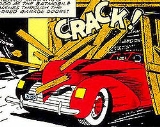
Batman first drove in Detective Comics #27 (May, 1939). A sedan, the vehicle was simply referred to as "his car". It soon began featuring an increasingly prominent bat motif, typically including distinctive wing-shaped tailfins. In the early stages of Batman's career, he modifies it with armor and technologically advanced automotive customization
and turns the Batmobile into a sleek street machine. The Batmobile has gone through numerous incarnations, and as state-of-the-art technology has continued to advance, the vehicle has had to change to stay a step ahead of real-life cutting edge advances.
#27, the first Batman story. Originally, the vehicle was a simple red convertible with nothing special in its functions. Although the Batplane
was introduced in Detective Comics No. 31, the name "Batmobile" was not applied to Batman and Robin
's automobile until Detective Comics No. 48 (February 1941). Other bat-vehicles soon followed, including the Batcycle
, Batboat
and Robin's Redbird
.
The car's design gradually evolved. It became a "specially built high-powered auto" by Detective Comics #30, and in Batman
#5, it began featuring an ever-larger bat hood ornament
and an ever-darker paint job. Eventually, the predominant designs included a large, dark-colored body and bat-like accessories, including large tailfins scalloped to resemble a bat's wings.
Batman No. 5 (Spring 1941) introduced a long, powerful, streamlined Batmobile with a tall scalloped fin and an intimidating bat head on the front. Three pages after it was introduced, it was forced off a cliff by the Joker
to crash in the ravine below. However, an identical Batmobile appeared in the next story in the same issue.
The live action television series
was so popular that its campy humor and its Batmobile (a superficially modified concept car
, the decade-old Lincoln Futura
, owned by George Barris
whose shop did the work) were quickly introduced into the Batman comic books. But the high camp and general silliness of the television show did not sit well with long-time Batman comic book fans. So, when the series was canceled in 1968, the comic books reacted by becoming darker and more serious, including having Batman abandon that Batmobile. Its replacement for a number of years was a much simpler model with a stylized bat's head silhouette decal on the hood being the only decoration of note. The 1960s TV style Batmobile still appears from time to time in the comic books, most recently in Detective Comics #850 and the issues of Batman Confidential
.
In mid-1985, a special variation of the Super Powers toyline Batmobile appeared in both Batman and Detective Comics
. This design had a full set of front and rear canopies, "Coke-bottle" sides, integrated fins, and generally rounder features, just like the toy. The only difference between this car and its toy counterpart is the nose, which was occasionally drawn to appear longer and more pointed.
In Batman: The Dark Knight Returns
, the Batmobile has been modified into a tank-like armored riot control
vehicle, complete with machine guns shooting rubber bullets, a large cannon mounted on the front, and large tank treads in place of tires. According to Batman's narration, the only thing that can penetrate its armor "isn't from this planet
." Batman also mentions that it was Dick Grayson
who came up with the name. The tank-like vehicle appears to take up two lanes of traffic on a normal road, evidenced when returning from Batman's initial fight with the leader of the Mutants, and thus is too big for normal land travel around Gotham
. In the scenes prior to Batman's last stand with the Joker, Batman uses a motorcycle to traverse the city, using the tank again after the attempted nuclear strike and fires in Gotham. This Batmobile reappeared in All Star Batman and Robin the Boy Wonder #4, which shows its construction by robots in the Batcave.
Beginning in the 1990s, the number of comics featuring Batman mushroomed with spin-off titles, limited series
, and graphic novel
s. At the same time, there was considerable experimentation with styles of illustration. With different illustration styles in so many different books, there was naturally a corresponding diversity of designs for the Batmobile. This has continued with designs for the Batmobile ranging from conservative and practical to highly stylized to outlandish.
During the Cataclysm
storyline, it is revealed that Batman has hidden a number of spare vehicles across the city just in case. A Humvee serves as a primary mean of transportation to cross the earthquake-ravaged city during the Aftershock storyline, as most of the Batmobiles are wrecked by the quake. These vehicles are not as sophisticated as the Batmobiles, but some of them are armored to withstand weaponry mounted on military automobiles.
In the Batman: Hush
storyline, a splash page by Jim Lee
shows all the previous Batmobiles (from comics, movies, and all TV series) in storage in the Batcave. In addition, some incarnations of the character, such as Batman: The Animated Series
, establish that Batman has a large ground vehicle fleet of various makes and models as well as utility vehicle
s to use when the Batmobile would be too conspicuous.
In Frank Miller's All Star Batman and Robin the Boy Wonder, the car can morph into a harrier jet and a submarine. Dick Grayson comments that the name Batmobile is "totally queer". However, in Batman: The Dark Knight Returns, which exists in the same continuity, Grayson was stated as the one who invented the name.
The metafictional Batmobile Owner's Manual, released in 2008, gives theoretical specifications of the car as if it were real. The book states that the Batmobile's five cylinder engine is more powerful than turbine jet engines, and capable of achieving up to 1700 hp.
In the new series Batman and Robin
, a new Batmobile is unveiled. This model is capable of flight, although is not as maneuverable as the Batwing
. It can fire 19 types of projectiles, one of which is a flame retardant non-toxic foam, and features a concussive sonic blast device. The new Batmobile was designed and constructed by Bruce Wayne; however, its construction was the source of great frustration to him, as mentioned by Alfred. In Batman and Robin
#1 it is revealed that Bruce's son, Damian Wayne
, solved the problem of its inability to fly.
, a black Cadillac
was used by Bruce Wayne and Dick Grayson
, as well as their secret identities Batman and Robin. Alfred
chauffeured the Dynamic Duo in both identities. Eventually a limousine replaced the Cadillac.
, the 1949 successor to the original serial, the duo drive around in a 1949 Mercury.
.jpg) The Batmobile built for and used in the 1966–1968 live action television show Batman
The Batmobile built for and used in the 1966–1968 live action television show Batman
and its film adaptation
was a customized vehicle that originated as a one-off Ford concept car
of the 1950s.
The TV Batmobile was based on the Lincoln Captain American 22123344635645 show time sting Show Car , originally created by William M. Schmidt and his design team at the Lincoln Styling Department; its rakish lines are said to have been inspired by the mako shark and the manta ray
. In 1954 the Futura prototype was built entirely by hand by the Ghia Body Works in Turin, Italy at a reported cost of US$250,000; it was unveiled in its original pearlescent Frost-Blue white paint finish on 8 January 1955 at the Chicago Auto Show
. In 1959, sporting a fresh red paint job, the Futura was featured in the film It Started with a Kiss, starring Debbie Reynolds
and Glenn Ford
.
In late 1965 20th Century Fox Television
and William Dozier
's Greenway Productions contracted renowned Hollywood car customizer Dean Jeffries
to design and build a "Batmobile" for their upcoming Batman TV series. He started customizing a 1959 Cadillac
, but when the studio wanted the program on the air in January 1966, and therefore filming sooner than he could provide the car, Jeffries was paid off, and the project went to George Barris
. Barris was trying to get Hollywood's attention with the Futura, but aside from "It Started With a Kiss" in 1959, the Futura had been languishing in his Hollywood shop for several years. With only three weeks to finish the Batmobile (although in recent years Jeffries says that his car was dropped because he was told it was needed in "a week and a half", he was quoted in 1988 as saying "three weeks" as well), Barris decided that, rather than building a car from scratch, it would be relatively easy to transform the distinctive Futura into the famous crime-fighting vehicle. Design work was conducted by Herb Grasse, working as an associate designer for Barris.
Barris hired Bill Cushenbery to do the metal modifications to the car and its conversion into the Batmobile was completed in just three weeks, at a reported cost of US$30,000. They used the primer-painted, white-striped car in October, 1965, for a network presentation reel. Shortly afterward, the car was painted gloss black with "fluorescent cerise" stripes. Barris retained ownership of the car and leased it back to 20th Century Fox and Greenway Productions for use in the series. The estimated 1966 value of the Barris Batmobile was about $125,000, but today it is estimated to be worth at least US$2 million.
In December 1965 Ford sold the Futura to Barris; despite its huge original production cost—the equivalent of approximately US$2 million in 2009 -- Barris was able to purchase the vehicle for the nominal sum of $1.00 and "other valuable consideration".
When filming for the series began, several problems arose due to the age of the car: it overheated, the battery went dead, and the expensive Mickey Thompson tires kept blowing. By mid season, the engine and transmission were replaced with those of a Ford Galaxie
. The most frequent visual influence of this car is that later Batmobiles usually have a rear rocket thruster that fires as the car makes a fast start.
powering the vehicle, which consumed fuel so fast that there was only enough fuel capacity to run it for the approximately fifteen seconds of the longest shot in which the viewer can see it operating.
This Batmobile's gadgets include a nose-mounted aluminum Cable Cutter Blade, Bat Ray Projector, Anti-Theft Device, Detect-a-scope, Batscope, Bat Eye Switch, Antenna Activator, Police Band Cut-In Switch, Automatic Tire Inflation Device, Remote Batcomputer—radio linked to the main Batcomputer in the Batcave, the Batphone, Emergency Bat Turn Lever, Anti-Fire Activator, Bat Smoke, Bat Photoscope, and many other Bat gadgets. If needed, the Batmobile is capable of a quick 180° "bat-turn" thanks to two rear-mounted ten-foot Deist parachutes. The main license plate seen throughout the series was 2F-3567. Some changes were made during the run of the series, including different license plates, removal of the Futura steering wheel and substitution with a 1958 Edsel steering wheel, and the addition of extra gadgets such as a net in the trunk, remote-controlled driving, a rear-facing camera under the turbine exhaust port, and the Bat Ram. Other devices included:
The #2 Barris-built Batmobile is owned by Dr. Anderson, New Jersey.
The #3 Barris-built Batmobile was sold by the Hart estate recently to an unknown buyer.
The #4 Barris-built Batmobile is owned by Mr. Jackson, California.
The so-called #5 Batmobile is owned by Scott Chinery's widow, New Jersey.
A replica Batmobile is displayed alongside two of the movie batmobiles at the Cars of the Stars Motor Museum
in Keswick, England.
was based on the Lincoln Futura design as seen on the live-action TV series starring Adam West. The main difference with the Super Friends version was that the lines of the car were modified substantially for use in animation. The most obvious change was to the nose of the car, where the hood received a "V" depression that echoed the lower fascia. This was also the first Batmobile (of any medium) to feature yellow bat emblems on the doors. This particular feature would be quickly adapted by the comics.
Beginning with the Challenge of the Super Friends
in 1978
, the Batmobile got revamped. This new version was developed to have a more aerodynamic hard-edged style. In addition, this Batmobile was smaller than its predecessor. It contained a sloped nose and flying buttress B-pillars. Features that were carried over from the original Super Friends Batmobile were the Bat-mask, low horizontal fins, twin bubble windshields, and blue coloring scheme.
In 1984
, Super Friends revamped its format (first as Super Friends: The Legendary Super Powers Show
and then as The Super Powers Team: Galactic Guardians
) to serve as a tie-in to Kenner
's Super Powers Collection
.
, including Batman: The Animated Series
, Superman: The Animated Series
, The New Batman Adventures
, Justice League
, and Justice League Unlimited
. The Batmobile in Batman: The Animated Series combined style elements from various eras to produce a long, low vehicle with square lines, long fins, and a blunt nose with a massive chrome grill that could have been from any time from the 1930s to the 1990s. This version of the Batmobile also vaguely resembled the Batmobile from the first two Tim Burton movies. Despite the obvious presence of the jet exhaust, the show frequently used sound effects from a reciprocating engine for the Batmobile's driving scenes. This, plus direct views of the engine (as seen in the episode "The Mechanic"), suggest that the car used a large piston engine for primary power and an auxiliary jet for high-speed acceleration. Among the features of the Batmobile of The Animated Series were: smoke and oil dispensers, wheel slasher hubs, a missile rack, tear gas dispensers, ejection seats, titanium alloy wheels and body panels, and reversible jet exhausts. It also had an armoured stationary mode to prevent people from tampering with the car when it was left unattended, though it was not as overt as the "shields" used in the 1989 movie Batmobile. The original Batmobile design had many design variants that are seen throughout other DCAU shows, the most notable examples being the Batmobile 'truck' seen in the Superman: The Animated Series episode "Stolen Memories" and an aging Bruce Wayne's limosine, seen in Batman Beyond, which is referred to by the producers as 'an upside-down Batmobile'.
In The New Batman Adventures, the Batmobile was redesigned, with its jet engine being most notably absent (save for one episode). This Batmobile design is re-used in Justice League and Justice League Unlimited, though appears somewhat more blue than black in paint color. In Batman Beyond
, there was a flying car
referred to as the Batmobile (in the show's future era, flying cars had become commonplace).
, the Batmobile resembled a sports coupe with multiple jet exhaust slits protruding from the back bumper. In the third season episode "RPM", this Batmobile was wrecked beyond repair, and Batman completed a prototype design that included a Wayne Industries 'EXP' power generator. This Batmobile was longer and had a lower profile with only one triangular jet exhaust coming from the rear of the car. At the end of the episode, Batman remarks that due to the Batmobile EXP's success, it is a "keeper". In the fourth season, the episode Artifacts explores Gotham City in the year 2027, complete with a new tank-like Batmobile reminiscent of Frank Miller
's design for the Batmobile in The Dark Knight Returns.
takes design elements from the Golden Age
Batmobiles and the Lincoln Futura. This Batmobile has the ability to transform into other vehicles. The tie in toyline's Batmobile shares this feature, transforming from car to jet. On at least one occasion, it has converted into a mecha similar to the Bat-Bots seen in Kingdom Come
.
In the episode "Game Over for Owlman", Batman is forced to use a back-up Batmobile which resembles a Studebaker
.
entitled "Reunion." Bugs Bunny
drove off in it after seeing the Bat-Signal
because, in that show, he is secretly Batman. This Batmobile slightly resembles the Golden Age version.
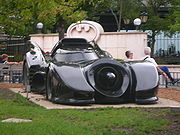 Tim Burton
's live-action films Batman
and Batman Returns
presented a different version of the Batmobile, which reflected that film's Art Deco
version of Gotham City, both of which were designed by Anton Furst. It was long, low and sleek, and was built on a Chevy Impala chassis.
For quick maneuvers, this Batmobile had side-mounted grappling hook launchers and a central "foot" capable of lifting the car and rotating it 180°.
was housed in the back. Two Browning machine guns were hidden behind flaps in each fender. Its Grappling hook
, once hooked on a structure, serves as an anchor to allow the batmobile to make an extremely sharp turn at high speed that its pursuers typically cannot duplicate. It had superhydraulics for course changes, and a batdisc ejector (side-mounted) that could fire precisely 15 Batdiscs
in the 1-second pulse. Other gadgets included chassis
-mounted shinbreakers, oil slick dispensers and smoke emitters. Inside, the two-seat cockpit featured aircraft-like instrumentation, a passenger's side monitor, self-diagnostics system, CD recorder, and voice-command recognition system. In Batman Returns it is shown to have a secondary mode referred to as the "Batmissile", where the wheels would retract inward and the sides of the vehicle would break off, converting the car into a thin bullet train-like form capable of squeezing through tight alleyways. Obviously, this secondary mode would require the car to be reassembled and significantly repaired.
The Batmobile's shields are made of ceramic fractal armor
panels. They explode outward when struck by projectiles, deflecting injurious force away from the car and its occupants. If Batman must leave the Batmobile for an extended period of time, he can, through a voice command spoken into a wrist device (specifically, the word "shields"), activate the Batmobile's shielding system. This prevents anyone from tampering with the vehicle while it is left unattended. Bulletproof and fireproof steel armor plates envelop the body and cockpit entirely. While this armor is in place, the vehicle cannot be driven. In Batman the shields were not fully functioning. In reality, a life-size model was built, and the shield activation sequence was created with stop motion
animation technology. In Batman Returns, the shields held the same characteristics. However, the design was slimmer and the special effects were provided by computer-generated imagery
. In shield mode, a small but powerful bomb can be deployed.
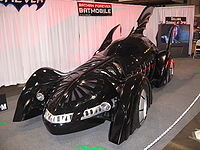 As the Batman films were handed over to director Joel Schumacher
from Tim Burton, the design for the Batmobile updated. Decorative lighting was added to the vehicle's rims, sides and front edge, and the wing-shaped fins reached further into the air. New abilities included a grappling hook allowing the Batmobile to drive up walls, as well as the speed to perform large jumps from surface to surface during chases across Gotham City
's elevated freeways and gigantic statues.
The Batman Forever Batmobile's ability to drive up walls was displayed as Batman eludes a dead-end provided by Two-Face
and his henchmen. Later in the film, Dick Grayson
takes the Batmobile for a joy ride without Batman's permission or awareness. Ultimately, it was destroyed when the Riddler
deposited a sack full of explosives in the cockpit. Batman Forever is also notable for the phrase uttered by Batman to Dr. Chase Meridian "It's the car, right? Chicks dig the car."
The design of the Batmobiles of the Schumacher films have garnered criticism for allegedly resembling giant phalli
.
was used to build the body of this particular Batmobile. The specifications for the Batmobile in this film are:
is taking the car out for a joyride through the city. The wheels were made to keep the bat emblems upright when the wheels are turning. The bat-emblem hubcaps was a counter-rotating gear that transferred into a stationary point. The two-seat cockpit featured a rear-view monitor, system diagnostics display, and custom gauge cluster. H. R. Giger
was chosen to design the Batmobile in the very early stages of production. He left due to creative differences. His designs are on his official website in illustrated and 3D Graphic Art form. There were two primary avoidance/defense features on the Batman Forever version. First, it had the ability to lock all four wheels perpendicular to its centerline, to allow for quick sideways movement. Second, for more dire circumstances, the Batmobile could reroute the jet exhaust to under its front end and launch grappling cables at overhead anchors. With the nose up and the lines in place, the car could climb sheer vertical surfaces like building walls as if it were driving on flat ground.
film Batman & Robin. It is prominently featured in one scene in which, as Batman and Robin are in pursuit, Mr. Freeze
shoots the underside of the car for several seconds with his freeze-gun, before the car crash-lands. However, in the next scene in the Batcave
, the Batmobile is sitting back on its pedestal appearing to be in perfect condition.
car, this Batmobile (which was designed by Harald Belker) featured light-up wheels and engine panels. The displays were much more involved with this car, however, with red, orange, yellow, and blue lights, as well as special pulsating lights in the counterrotating turbine intake. The nozzles were canted away from the centerline of the car slightly, so the final effect was that the six exhausts made a "V" pattern to keep the car pointed straight ahead. A bat mask was incorporated in the nose of the car, though the sculpted lines made it somewhat difficult to make out at first. The fins were unmistakable, though, and remain as the largest set ever built into a real-world Batmobile. On the Batman & Robin version the arsenal of weaponry and gadgets is controlled by an onboard voice-activated computer which surrounds the single-seat cockpit. From behind the wheel, the driver has access to a multifunctioning key command response system which delivers immediate weapon activation during attack and defensive procedures. The Batman & Robin Batmobile was equipped with dual-mount, subcarriage rocket launchers, front and rear grappling hooks, multipoint infrared and laser scan tracking units, anterior/posterior wheel-based axle bombs, catapult ejection seat, and disguised central carriage, which detaches to become an emergency road vehicle. The single-seat cockpit featured a two-way videoconferencing
screen, radar unit, and Redbird communication switch.
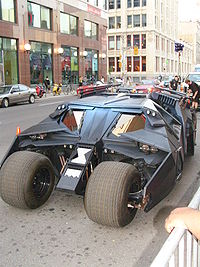 The Batmobile depicted in the Christopher Nolan
directed films Batman Begins
(2005) and The Dark Knight
(2008) owes more to the tank-like vehicle from Frank Miller
's Batman: The Dark Knight Returns
and has a much more 'workhorse' appearance than the sleek automobiles seen in previous incarnations. The vehicle does not have a front axle, a design that was influenced by the spinners featured in Ridley Scott
's Blade Runner
. The film's production designer
described the machine as a cross between a Lamborghini
and a tank
on the Batman Begins special features DVD. Bruce Wayne was seen driving a gray Lamborghini Murcielago
in both Batman Begins
and The Dark Knight
.
In the 2005 movie, Bruce Wayne modifies a prototype military vehicle called "the Tumbler" that was designed by Lucius Fox
as a bridging vehicle for the military. It includes features like weaponry, and the ability to boost into a rampless jump. In the Nolan films the vehicle is never referred to as the "Batmobile". Six vehicles were built for the production of the film. Two full-sized driving versions were used in exterior shots. One full-sized model with hydraulic enhancements was used in jump sequences. One full-sized, functional version carried propane tanks to fuel the rocket blast out of the rear nozzle. A radio-controlled, 1/3-scale electric model also performed stunts in the film (e.g., the roof-top chase sequence). These scenes were filmed over nine weeks, on a massive set built on a stage at Shepperton Studios
.
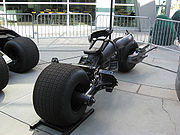 The Batmobile returns in The Dark Knight
, and appears twice in the movie: when Batman captures the Scarecrow
and the fake Batmen in the parking garage, and in the chase where it is damaged beyond repair by a chain 'tumbling' reaction, initiated by a rocket-propelled grenade fired by The Joker
; Batman ejects from the Batmobile in the Batpod (a motorcycle formed by the front wheels and struts of the Batmobile). Once ejected, Batman programs the Batmobile to self-destruct, the AI stating, "Goodbye" before the explosion. The Batmobile is also seen in the trailers in a deleted scene, exiting the improvised Batcave.
Production photos from filming of The Dark Knight Rises
(2012) in Pittsburgh showed a second Tumbler chassis after the first was destroyed in The Dark Knight. On the WPXI
morning news on July 21, 2011, video was shown of three tumbler variants being removed from a cargo plane. Each of these vehicles had the original color of the Tumbler as depicted during the test drive scenes in Batman Begins. Each of these three vehicles are reported to be used by the character Bane
and his gang.
dirt tires on the front.
s mounted in the nose of the car between the front wheels. In "Attack" mode, the driver's seat moves to the center of the car, and the driver is repositioned to lie face-down with his head in the center section between the front wheels. This serves two main purposes: first, it provides more substantial protection with the driver shielded by multiple layers of armor plating. Second, the prone position reduces the risk of injury a driver faces when making extreme driving maneuvers. Other devices included:
. One of the parts that Crowley used to create the vehicle was the nose cone of a P-38 Lightning
model to serve as the chassis for the car's jet engine. Six models of the Tumbler were built to 1:12 scale in the course of four months. Following the scale model creation, a crew of over 30 people, including Crowley and engineers Chris Culvert and Andy Smith, carved a full-size replica of the vehicle out of a large block of Styrofoam
, which was a process that lasted two months.
The Styrofoam model was used to create a steel "test frame", which had to stand up to several standards: have a speed of over 100 mph, go from 0 to 60 mi/h in 5 seconds, possess a steering
system to make sharp turns at city corners, and to withstand a self-propelled launch of up to 30 feet (9.1 m). On the very first jump test, the Tumbler's front end collapsed and had to be completely rebuilt. The basic configuration of the newly designed vehicle included a 5.7-liter Chevy V8 engine
, a truck axle for the rear axle, front racing tires by Hoosier, rear 4x4 mud tires by Interco., and the suspension
system of Baja racing trucks. The design and development process took nine months and cost several million dollars.
With the design process completed, four street-ready cars were constructed. Each vehicle possessed 65 carbon fiber
panels and cost $250,000 to build. Two of the four cars were specialized versions. One version was the flap version, which had hydraulics and flaps to detail the close-up shots where the vehicle propelled itself through the air. The other version was the jet version, in which an actual jet engine was mounted onto the vehicle, fueled by six propane
tanks. Due to the poor visibility inside the vehicle by the driver, monitors were connected to cameras on the vehicle body. The professional drivers for the Tumblers practiced driving the vehicles for six months before they drove on the streets of Chicago for the film's scenes.
The interior was an immobile studio set and not actually the interior of a street-capable version. The cockpit was over-sized to fit cameras for scenes filmed in the Tumbler interior. In addition, another version of the car was a miniature model
that was 1:5 scale of the full-sized one. This miniature model had an electric motor and was used to show it flying across ravines and between buildings. However, a full-size car was used for the waterfall sequence. The scale model scenes were filmed on a massive set built on a stage at Shepperton Studios
in England over the course of nine weeks. The full-sized vehicles were driven and filmed on the streets of Chicago. In The Dark Knight, the Batpod ejects from the Tumbler, with the Tumbler's front wheels as the Batpod's wheels; this was rendered using computer-generated imagery when attempts to achieve the separation through practical effects proved impossible.
, Red Bird & Jokermobile for their diecast toy lines.
produced the Batmobile for its World's Greatest Super Hero line in the 1970s. It could seat two 8 inch action figures.
's Super Powers Collection
toyline allowed two figures to sit in it, had a battering ram grille, and trapping claw in the back.
, the Batmobile was controlled during the time bonus stages after missions were completed.
used the Burnout 3: Takedown
engine for these levels. Batman has to ram enemy cars off the road which results in a "Take down" while picking up Nitro boosts along the way that float on the road in holographic bubbles. Xbox World
Australia called these sequences the highlight of the game. Cheatcc.com called them "by far the best Batmobile levels ever featured in a game".
(2009), the Batmobile appears with a design resembling Batman: The Animated Series. In the game, it's vandalized by Harley Quinn
and the Blackgate
prisoners. Batman later controls the Batmobile remotely using his utility belt
to take Bane
into the sea along with it.
DC Comics
DC Comics, Inc. is one of the largest and most successful companies operating in the market for American comic books and related media. It is the publishing unit of DC Entertainment a company of Warner Bros. Entertainment, which itself is owned by Time Warner...
superhero
Superhero
A superhero is a type of stock character, possessing "extraordinary or superhuman powers", dedicated to protecting the public. Since the debut of the prototypical superhero Superman in 1938, stories of superheroes — ranging from brief episodic adventures to continuing years-long sagas —...
Batman
Batman
Batman is a fictional character created by the artist Bob Kane and writer Bill Finger. A comic book superhero, Batman first appeared in Detective Comics #27 , and since then has appeared primarily in publications by DC Comics...
. The car has evolved along with the character from comic books to television and films. Kept in the Batcave
Batcave
The Batcave is the secret headquarters of fictional DC Comics superhero Batman, the alternate identity of playboy Bruce Wayne, consisting of a series of subterranean caves beneath his residence, Wayne Manor.-Publication history:...
, which it accesses through a hidden entrance, the Batmobile is a gadget-laden vehicle used by Batman in his crime
Crime
Crime is the breach of rules or laws for which some governing authority can ultimately prescribe a conviction...
-fighting activities.
Batman first drove in Detective Comics #27 (May, 1939). A sedan, the vehicle was simply referred to as "his car". It soon began featuring an increasingly prominent bat motif, typically including distinctive wing-shaped tailfins. In the early stages of Batman's career, he modifies it with armor and technologically advanced automotive customization
Custom car
A custom car is a passenger vehicle that has been modified in either of the following two ways. First, a custom car may be altered to improve its performance, often by altering or replacing the engine and transmission. Second, a custom car may be a personal "styling" statement, making the car look...
and turns the Batmobile into a sleek street machine. The Batmobile has gone through numerous incarnations, and as state-of-the-art technology has continued to advance, the vehicle has had to change to stay a step ahead of real-life cutting edge advances.
Publication history
The vehicle that became the Batmobile was introduced in Detective ComicsDetective Comics
Detective Comics is an American comic book series published monthly by DC Comics since 1937, best known for introducing the iconic superhero Batman in Detective Comics #27 . It is, along with Action Comics, the book that launched with the debut of Superman, one of the medium's signature series, and...
#27, the first Batman story. Originally, the vehicle was a simple red convertible with nothing special in its functions. Although the Batplane
Batplane
The Batplane, later known as the Batwing, is the fictional aircraft for the comic book superhero Batman. The vehicle was introduced in "Batman Versus The Vampire, I", published in Detective Comics #31 in 1939, a story which saw Batman travel to continental Europe...
was introduced in Detective Comics No. 31, the name "Batmobile" was not applied to Batman and Robin
Robin (comics)
Robin is the name of several fictional characters appearing in comic books published by DC Comics, originally created by Bob Kane, Bill Finger and Jerry Robinson, as a junior counterpart to DC Comics superhero Batman...
's automobile until Detective Comics No. 48 (February 1941). Other bat-vehicles soon followed, including the Batcycle
Batcycle
The Batcycle is the fictional personal motorcycle of comic book superhero Batman. In the comic book universe, Batman's personal Batcycle is a modified street-bike with a 786 cc liquid-cooled V-4 engine. It contains a computer-controlled carburetor and bulletproof wind-guard.-Batman :The Batcycle...
, Batboat
Batboat
The Batboat is the fictional personal watercraft of comic book superhero Batman.-Comics:In Sub-Level 6 of the Batcave, there's an aqua-dynamic hydrofoil/submersible on both the navigable Gotham River and the Atlantic Ocean's waters.-Background:Early in his career, while investigating arms dealers...
and Robin's Redbird
Redbird (comics)
-Automobile:The Redbird is a camouflaged sport coupé with all the armaments of the Batmobile. In addition to that, there are polarizing windows and exterior sliding bulletproof conversion panels, enabling it to be driven by an uncostumed Tim Drake as a "normal" car....
.
The car's design gradually evolved. It became a "specially built high-powered auto" by Detective Comics #30, and in Batman
Batman (comic book)
Batman is an ongoing comic book series featuring the DC Comics hero of the same name. The character first appeared in Detective Comics #27, published in May 1939. Batman proved to be so popular that a self-titled ongoing comic book series began publication in the spring of 1940...
#5, it began featuring an ever-larger bat hood ornament
Hood ornament
A hood/bonnet ornament, or radiator cap, or car mascot is a specially crafted model of something which symbolizes a car company like a badge, located on the front center portion of the hood...
and an ever-darker paint job. Eventually, the predominant designs included a large, dark-colored body and bat-like accessories, including large tailfins scalloped to resemble a bat's wings.
Batman No. 5 (Spring 1941) introduced a long, powerful, streamlined Batmobile with a tall scalloped fin and an intimidating bat head on the front. Three pages after it was introduced, it was forced off a cliff by the Joker
Joker (comics)
The Joker is a fictional character, a comic book supervillain published by DC Comics. He is the archenemy of Batman, having been directly responsible for numerous tragedies in Batman's life, including the paralysis of Barbara Gordon and the death of Jason Todd, the second Robin...
to crash in the ravine below. However, an identical Batmobile appeared in the next story in the same issue.
The live action television series
Batman (TV series)
Batman is an American television series, based on the DC comic book character of the same name. It stars Adam West as Batman and Burt Ward as Robin — two crime-fighting heroes who defend Gotham City. It aired on the American Broadcasting Company network for three seasons from January 12, 1966 to...
was so popular that its campy humor and its Batmobile (a superficially modified concept car
Concept car
A concept vehicle or show vehicle is a car made to showcase new styling and or new technology. They are often shown at motor shows to gauge customer reaction to new and radical designs which may or may not have a chance of being produced....
, the decade-old Lincoln Futura
Lincoln Futura
The Lincoln Futura was a concept car designed by the Lincoln division of Ford Motor Company. It was built by Ghia entirely by hand in Italy at a cost of $250,000 and displayed on the auto show circuit in 1955...
, owned by George Barris
George Barris (auto customizer)
George Barris is a designer of custom cars.-Early history:George and his brother Sam were born in Chicago in the 1920s. After the deaths of their parents, they moved to Roseville, California as children to live with relatives. Both were good students, interested in drama, music, and design...
whose shop did the work) were quickly introduced into the Batman comic books. But the high camp and general silliness of the television show did not sit well with long-time Batman comic book fans. So, when the series was canceled in 1968, the comic books reacted by becoming darker and more serious, including having Batman abandon that Batmobile. Its replacement for a number of years was a much simpler model with a stylized bat's head silhouette decal on the hood being the only decoration of note. The 1960s TV style Batmobile still appears from time to time in the comic books, most recently in Detective Comics #850 and the issues of Batman Confidential
Batman Confidential
Batman Confidential was an American monthly comic book series from DC Comics which debuted on December 6, 2006 and concluded on March 2, 2011....
.
In mid-1985, a special variation of the Super Powers toyline Batmobile appeared in both Batman and Detective Comics
Detective Comics
Detective Comics is an American comic book series published monthly by DC Comics since 1937, best known for introducing the iconic superhero Batman in Detective Comics #27 . It is, along with Action Comics, the book that launched with the debut of Superman, one of the medium's signature series, and...
. This design had a full set of front and rear canopies, "Coke-bottle" sides, integrated fins, and generally rounder features, just like the toy. The only difference between this car and its toy counterpart is the nose, which was occasionally drawn to appear longer and more pointed.
In Batman: The Dark Knight Returns
Batman: The Dark Knight Returns
Batman: The Dark Knight Returns is a four-issue comic book limited series written and drawn by Frank Miller, originally published by DC Comics under the title Batman: The Dark Knight in 1986. When the issues were released in a collected edition later that year, the story title for the first issue...
, the Batmobile has been modified into a tank-like armored riot control
Riot control
Riot control refers to the measures used by police, military, or other security forces to control, disperse, and arrest civilians who are involved in a riot, demonstration, or protest. Law enforcement officers or soldiers have long used non-lethal weapons such as batons and whips to disperse crowds...
vehicle, complete with machine guns shooting rubber bullets, a large cannon mounted on the front, and large tank treads in place of tires. According to Batman's narration, the only thing that can penetrate its armor "isn't from this planet
Superman
Superman is a fictional comic book superhero appearing in publications by DC Comics, widely considered to be an American cultural icon. Created by American writer Jerry Siegel and Canadian-born American artist Joe Shuster in 1932 while both were living in Cleveland, Ohio, and sold to Detective...
." Batman also mentions that it was Dick Grayson
Dick Grayson
Dick Grayson is a fictional superhero that appears in comic books published by DC Comics. Created by Bob Kane and Bill Finger and illustrator Jerry Robinson, he first appeared in Detective Comics #38 in April 1940....
who came up with the name. The tank-like vehicle appears to take up two lanes of traffic on a normal road, evidenced when returning from Batman's initial fight with the leader of the Mutants, and thus is too big for normal land travel around Gotham
Gotham City
Gotham City is a fictional U.S. city appearing in DC Comics, best known as the home of Batman. Batman's place of residence was first identified as Gotham City in Batman #4 . Gotham City is strongly inspired by Trenton, Ontario's history, location, atmosphere, and various architectural styles...
. In the scenes prior to Batman's last stand with the Joker, Batman uses a motorcycle to traverse the city, using the tank again after the attempted nuclear strike and fires in Gotham. This Batmobile reappeared in All Star Batman and Robin the Boy Wonder #4, which shows its construction by robots in the Batcave.
Beginning in the 1990s, the number of comics featuring Batman mushroomed with spin-off titles, limited series
Limited series
A limited series is a comic book series with a set number of installments. A limited series differs from an ongoing series in that the number of issues is determined before production and it differs from a one shot in that it is composed of multiple issues....
, and graphic novel
Graphic novel
A graphic novel is a narrative work in which the story is conveyed to the reader using sequential art in either an experimental design or in a traditional comics format...
s. At the same time, there was considerable experimentation with styles of illustration. With different illustration styles in so many different books, there was naturally a corresponding diversity of designs for the Batmobile. This has continued with designs for the Batmobile ranging from conservative and practical to highly stylized to outlandish.
During the Cataclysm
Batman: Cataclysm
"Cataclysm" is an 18 chapter DC Comics crossover story arc that ran through the various Batman family comics from March to May, 1998. The plot of the storyline centers around Gotham City being hit by a massive earthquake, the epicenter of the which is less than a mile from Wayne Manor...
storyline, it is revealed that Batman has hidden a number of spare vehicles across the city just in case. A Humvee serves as a primary mean of transportation to cross the earthquake-ravaged city during the Aftershock storyline, as most of the Batmobiles are wrecked by the quake. These vehicles are not as sophisticated as the Batmobiles, but some of them are armored to withstand weaponry mounted on military automobiles.
In the Batman: Hush
Batman: Hush
Hush is a 2002-2003 comic book story arc that ran through the Batman monthly series. It was written by Jeph Loeb, penciled by Jim Lee, inked by Scott Williams and colored by Alex Sinclair. The story depicts a mysterious stalker called Hush, who seems intent on sabotaging Batman from afar, and it...
storyline, a splash page by Jim Lee
Jim Lee
Jim Lee is a Korean-American comic book artist, writer, editor and publisher. He first broke into the industry in 1987 as an artist for Marvel Comics, illustrating titles such as Alpha Flight and Punisher War Journal, before gaining a great deal of popularity on The Uncanny X-Men...
shows all the previous Batmobiles (from comics, movies, and all TV series) in storage in the Batcave. In addition, some incarnations of the character, such as Batman: The Animated Series
Batman: The Animated Series
Batman: The Animated Series is an American animated series based on the DC Comics character Batman. The series featured an ensemble cast of many voice-actors including Kevin Conroy, Mark Hamill, Efrem Zimbalist, Jr., Arleen Sorkin, and Loren Lester. The series won four Emmy Awards and was nominated...
, establish that Batman has a large ground vehicle fleet of various makes and models as well as utility vehicle
Utility vehicle
Utility vehicle is used to describe a vehicle, generally motorized, that is designed for a specific task.-Sport utility vehicle:Vehicles similar to a station wagon but built on a light-truck chassis, usually with off-road capability....
s to use when the Batmobile would be too conspicuous.
In Frank Miller's All Star Batman and Robin the Boy Wonder, the car can morph into a harrier jet and a submarine. Dick Grayson comments that the name Batmobile is "totally queer". However, in Batman: The Dark Knight Returns, which exists in the same continuity, Grayson was stated as the one who invented the name.
The metafictional Batmobile Owner's Manual, released in 2008, gives theoretical specifications of the car as if it were real. The book states that the Batmobile's five cylinder engine is more powerful than turbine jet engines, and capable of achieving up to 1700 hp.
In the new series Batman and Robin
Batman and Robin (comic book)
Batman and Robin is an American comic book ongoing series, created by Grant Morrison and featuring Batman and Robin. The debut of the series followed the events of "Batman R.I.P.", Final Crisis, and "Battle for the Cowl" in which the original Batman, Bruce Wayne, apparently died at the hands of DC...
, a new Batmobile is unveiled. This model is capable of flight, although is not as maneuverable as the Batwing
Batplane
The Batplane, later known as the Batwing, is the fictional aircraft for the comic book superhero Batman. The vehicle was introduced in "Batman Versus The Vampire, I", published in Detective Comics #31 in 1939, a story which saw Batman travel to continental Europe...
. It can fire 19 types of projectiles, one of which is a flame retardant non-toxic foam, and features a concussive sonic blast device. The new Batmobile was designed and constructed by Bruce Wayne; however, its construction was the source of great frustration to him, as mentioned by Alfred. In Batman and Robin
Batman and Robin (comic book)
Batman and Robin is an American comic book ongoing series, created by Grant Morrison and featuring Batman and Robin. The debut of the series followed the events of "Batman R.I.P.", Final Crisis, and "Battle for the Cowl" in which the original Batman, Bruce Wayne, apparently died at the hands of DC...
#1 it is revealed that Bruce's son, Damian Wayne
Damian Wayne
Damian Wayne is a fictional character in the . Damian is the child of Bruce Wayne and Talia al Ghul, and thus the grandson of Batman villain Ra's al Ghul....
, solved the problem of its inability to fly.
Batman
In the 1943 serial film BatmanBatman (serial)
Batman is a 15-chapter serial, released in 1943 by Columbia Pictures. The serial starred Lewis Wilson as Batman and Douglas Croft as Robin. J. Carrol Naish played the villain, an original character named Dr. Daka. Rounding out the cast were Shirley Patterson as Linda Page , and William Austin as...
, a black Cadillac
Cadillac
Cadillac is an American luxury vehicle marque owned by General Motors . Cadillac vehicles are sold in over 50 countries and territories, but mostly in North America. Cadillac is currently the second oldest American automobile manufacturer behind fellow GM marque Buick and is among the oldest...
was used by Bruce Wayne and Dick Grayson
Dick Grayson
Dick Grayson is a fictional superhero that appears in comic books published by DC Comics. Created by Bob Kane and Bill Finger and illustrator Jerry Robinson, he first appeared in Detective Comics #38 in April 1940....
, as well as their secret identities Batman and Robin. Alfred
Alfred Pennyworth
Alfred Pennyworth is a fictional character that appears throughout the DC Comics franchise. The character first appears in Batman #16 , and was created by writer Bob Kane and artist Jerry Robinson. Alfred serves as Batman’s tireless butler, assistant, confidant, and surrogate father figure...
chauffeured the Dynamic Duo in both identities. Eventually a limousine replaced the Cadillac.
Batman and Robin
In Batman and RobinBatman and Robin (serial)
Batman and Robin is a 15-chapter serial released in 1949 by Columbia Pictures. Robert Lowery played Batman, while Johnny Duncan played Robin...
, the 1949 successor to the original serial, the duo drive around in a 1949 Mercury.
Live-action television
Batman (TV series)
Batman is an American television series, based on the DC comic book character of the same name. It stars Adam West as Batman and Burt Ward as Robin — two crime-fighting heroes who defend Gotham City. It aired on the American Broadcasting Company network for three seasons from January 12, 1966 to...
and its film adaptation
Batman (1966 film)
Batman, often promoted as Batman: The Movie, is a 1966 film based on the Batman television series, and the first full-length theatrical adaptation of the DC Comics character of the same name. Released by 20th Century Fox, the film starred Adam West as Batman and Burt Ward as Robin. The film was...
was a customized vehicle that originated as a one-off Ford concept car
Concept car
A concept vehicle or show vehicle is a car made to showcase new styling and or new technology. They are often shown at motor shows to gauge customer reaction to new and radical designs which may or may not have a chance of being produced....
of the 1950s.
The TV Batmobile was based on the Lincoln Captain American 22123344635645 show time sting Show Car , originally created by William M. Schmidt and his design team at the Lincoln Styling Department; its rakish lines are said to have been inspired by the mako shark and the manta ray
Manta ray
The manta ray is the largest species of the rays. The largest known specimen was more than across, with a weight of about . It ranges throughout waters of the world, typically around coral reefs...
. In 1954 the Futura prototype was built entirely by hand by the Ghia Body Works in Turin, Italy at a reported cost of US$250,000; it was unveiled in its original pearlescent Frost-Blue white paint finish on 8 January 1955 at the Chicago Auto Show
Chicago Auto Show
The Chicago Auto Show is held annually in February at Chicago's McCormick Placeconvention complex. It is among the largest auto shows in North America....
. In 1959, sporting a fresh red paint job, the Futura was featured in the film It Started with a Kiss, starring Debbie Reynolds
Debbie Reynolds
Debbie Reynolds is an American actress, singer, and dancer.She was initially signed at age 16 by Warner Bros., but her career got off to a slow start. When her contract was not renewed, Metro-Goldwyn-Mayer gave her a small, but significant part in the film Three Little Words , then signed her to...
and Glenn Ford
Glenn Ford
Glenn Ford was a Canadian-born American actor from Hollywood's Golden Era with a career that spanned seven decades...
.
In late 1965 20th Century Fox Television
20th Century Fox Television
20th Century Fox Television is the television production division of 20th Century Fox Film Corporation, and a production arm of the Fox Broadcasting Company...
and William Dozier
William Dozier
William Dozier was an American film and television producer and actor.He began in the film industry...
's Greenway Productions contracted renowned Hollywood car customizer Dean Jeffries
Dean Jeffries
Dean Jeffries is an American custom vehicle designer, fabricator, stuntman and stunt coordinator for motion pictures and television programs based in Los Angeles, California....
to design and build a "Batmobile" for their upcoming Batman TV series. He started customizing a 1959 Cadillac
Cadillac
Cadillac is an American luxury vehicle marque owned by General Motors . Cadillac vehicles are sold in over 50 countries and territories, but mostly in North America. Cadillac is currently the second oldest American automobile manufacturer behind fellow GM marque Buick and is among the oldest...
, but when the studio wanted the program on the air in January 1966, and therefore filming sooner than he could provide the car, Jeffries was paid off, and the project went to George Barris
George Barris (auto customizer)
George Barris is a designer of custom cars.-Early history:George and his brother Sam were born in Chicago in the 1920s. After the deaths of their parents, they moved to Roseville, California as children to live with relatives. Both were good students, interested in drama, music, and design...
. Barris was trying to get Hollywood's attention with the Futura, but aside from "It Started With a Kiss" in 1959, the Futura had been languishing in his Hollywood shop for several years. With only three weeks to finish the Batmobile (although in recent years Jeffries says that his car was dropped because he was told it was needed in "a week and a half", he was quoted in 1988 as saying "three weeks" as well), Barris decided that, rather than building a car from scratch, it would be relatively easy to transform the distinctive Futura into the famous crime-fighting vehicle. Design work was conducted by Herb Grasse, working as an associate designer for Barris.
Barris hired Bill Cushenbery to do the metal modifications to the car and its conversion into the Batmobile was completed in just three weeks, at a reported cost of US$30,000. They used the primer-painted, white-striped car in October, 1965, for a network presentation reel. Shortly afterward, the car was painted gloss black with "fluorescent cerise" stripes. Barris retained ownership of the car and leased it back to 20th Century Fox and Greenway Productions for use in the series. The estimated 1966 value of the Barris Batmobile was about $125,000, but today it is estimated to be worth at least US$2 million.
In December 1965 Ford sold the Futura to Barris; despite its huge original production cost—the equivalent of approximately US$2 million in 2009 -- Barris was able to purchase the vehicle for the nominal sum of $1.00 and "other valuable consideration".
When filming for the series began, several problems arose due to the age of the car: it overheated, the battery went dead, and the expensive Mickey Thompson tires kept blowing. By mid season, the engine and transmission were replaced with those of a Ford Galaxie
Ford Galaxie
The Ford Galaxie was a full-size car built in the United States by the Ford Motor Company for model years 1959 through 1974. The name was used for the top models in Ford’s full-size range from 1959 until 1961, in a marketing attempt to appeal to the excitement surrounding the Space Race...
. The most frequent visual influence of this car is that later Batmobiles usually have a rear rocket thruster that fires as the car makes a fast start.
Technical specifications
- Curb weight: 5500 lb
- Wheelbase: 126 in
- Length: 226 in
- Width: 90 in
- Height: 48 in
- Fins: 84 in
- Engine: 390 in³, V-8 (so-called "atomic turbine")
- Transmission: B&M Hydro Automatic (2nd transmission)
Features
Reputedly, every gadget seen on the Batmobile used in these films was fully functional, including the gas turbineGas turbine
A gas turbine, also called a combustion turbine, is a type of internal combustion engine. It has an upstream rotating compressor coupled to a downstream turbine, and a combustion chamber in-between....
powering the vehicle, which consumed fuel so fast that there was only enough fuel capacity to run it for the approximately fifteen seconds of the longest shot in which the viewer can see it operating.
This Batmobile's gadgets include a nose-mounted aluminum Cable Cutter Blade, Bat Ray Projector, Anti-Theft Device, Detect-a-scope, Batscope, Bat Eye Switch, Antenna Activator, Police Band Cut-In Switch, Automatic Tire Inflation Device, Remote Batcomputer—radio linked to the main Batcomputer in the Batcave, the Batphone, Emergency Bat Turn Lever, Anti-Fire Activator, Bat Smoke, Bat Photoscope, and many other Bat gadgets. If needed, the Batmobile is capable of a quick 180° "bat-turn" thanks to two rear-mounted ten-foot Deist parachutes. The main license plate seen throughout the series was 2F-3567. Some changes were made during the run of the series, including different license plates, removal of the Futura steering wheel and substitution with a 1958 Edsel steering wheel, and the addition of extra gadgets such as a net in the trunk, remote-controlled driving, a rear-facing camera under the turbine exhaust port, and the Bat Ram. Other devices included:
- Emergency Bat-turn Lever (releases the Batmobile's parachute that enables quick turns)
- Bat-ray (capable of many tasks, such as remotely opening quarry's vehicle doors)
- Automatic fire extinguisherFire extinguisherA fire extinguisher or extinguisher, flame entinguisher is an active fire protection device used to extinguish or control small fires, often in emergency situations...
- Mobile Batcomputer (in trunk)
- Bat Beam
- Emergency tire inflator
- Bat Smoke Screen
- Bat-tering Ram (also known as the Bat-ram, used for knocking down reinforced doors)
- Voice Control Batmobile Relay Unit
- Bat-photoscope (works in conjunction with the Microfilm Crime File in the BatcaveBatcaveThe Batcave is the secret headquarters of fictional DC Comics superhero Batman, the alternate identity of playboy Bruce Wayne, consisting of a series of subterranean caves beneath his residence, Wayne Manor.-Publication history:...
. Through this device a photo from the crime file can be reproduced remotely in the Batmobile.) - Batphone
- Police band cut-in switch
- Mobile tracking scope
- Remote Bat Computer Switch
Other appearances
- Barris built two fiberglass copies of the original Batmobile for exhibition on the car show circuit and a third for exhibition drag racingDrag racingDrag racing is a competition in which specially prepared automobiles or motorcycles compete two at a time to be the first to cross a set finish line, from a standing start, in a straight line, over a measured distance, most commonly a ¼-mile straight track....
. Eventually, the three copies (and the screen-used metal Futura Batmobile) were covered with a black velvet "fuzz" paint, presumably to hide stress cracks in the fiberglass bodies. Later, all three were restored to their gloss black paint job. The three replicas are all based on a 1965–1966 Ford Galaxie. Barris has retained ownership of the original television series car, which is currently on display at Barris Customs in North Hollywood, California. The three Barris copies all reside in private collections, including the exhibition drag racing version driven by wheelstanding driver Wild Bill ShrewsberryWild Bill Shrewsberry"Wild" Bill Shrewsberry is an American exhibition drag racing driver primarily active throughout the 1960s and 1970s. Originally from Mansfield, Ohio, Shrewsberry moved to Southern California in October 1962. Shrewsberry is best known as the driver of the drag racing replica of the Barris-built...
. This car was built with a dual-quad Holman MoodyHolman MoodyHolman Moody was an auto racing team, racecar manufacturer, and marine engine manufacturer. The team built virtually all of the factory Ford racecars of the 1950s, 1960s, and 1970s. It owned racecars that competed in NASCAR, drag racing, ocean boat racing, rallys, and sports car racing. The team...
Ford 427 V8 engine, Art Carr-prepared Ford C6 automatic transmission and 5.14 gears in the rear end. Quarter-mile times were in the mid-12 second range, primarily because Shrewsberry would launch the car in second gear and smoke the overinflated rear tires for show down most of the strip. The "rocket exhaust" was made functional via a tank filled with either gasoline or kerosene which was pumped out the exhaust port and ignited electrically.
The #2 Barris-built Batmobile is owned by Dr. Anderson, New Jersey.
The #3 Barris-built Batmobile was sold by the Hart estate recently to an unknown buyer.
The #4 Barris-built Batmobile is owned by Mr. Jackson, California.
The so-called #5 Batmobile is owned by Scott Chinery's widow, New Jersey.
Replicas
In October, 2010, DC Comics authorized Fiberglass Freaks in Logansport, Indiana, to build officially licensed 1966 Batmobile replicas. One of Fiberglass Freaks' 1966 Batmobile Replicas sold at an R & M auction for $216,000.A replica Batmobile is displayed alongside two of the movie batmobiles at the Cars of the Stars Motor Museum
Cars of the Stars Motor Museum
The Cars of the Stars Motor Museum was in the English town of Keswick, Cumbria, and owned a collection of celebrity television and film vehicles...
in Keswick, England.
- A replica Batmobile was sold at the Coys Spring Classic Cars Auction on February 27, 2007 at the Royal HorticulturalRoyal Horticultural SocietyThe Royal Horticultural Society was founded in 1804 in London, England as the Horticultural Society of London, and gained its present name in a Royal Charter granted in 1861 by Prince Albert...
Hall in London. Coys Auctions had said it expected the car to fetch more than £75,000 - the final and closing bid was £119,000, equivalent to $233,000 USD at the time. - In the movie Rock StarRock Star (2001 film)Rock Star is a 2001 American comedy-drama film directed by Stephen Herek and starring Mark Wahlberg and Jennifer Aniston. It tells the story of Chris "Izzy" Cole, a tribute band singer whose ascendance to the position of lead vocalist of his favorite band was inspired by the real-life story of Tim...
, Mark WahlbergMark WahlbergMark Robert Michael Wahlberg is an American actor, film and television producer, and former rapper. He was known as Marky Mark in his earlier years, and became famous for his 1991 debut as a musician with the band Marky Mark and the Funky Bunch. He was named No. 1 on VH1's 40 Hottest Hotties of...
's character is given to extravagant spending; one of his first purchases is the original Batmobile from the TV series. - An episode of The SimpsonsThe SimpsonsThe Simpsons is an American animated sitcom created by Matt Groening for the Fox Broadcasting Company. The series is a satirical parody of a middle class American lifestyle epitomized by its family of the same name, which consists of Homer, Marge, Bart, Lisa and Maggie...
guest-starred Adam WestAdam WestWilliam West Anderson , better known by the stage name Adam West, is an American actor best known for his lead role in the Batman TV series and the film of the same name...
with the Batmobile. Another episode featured the Batmobile in a museum of famous cars next to Herbie the Love Bug and a car from Mad MaxMad MaxMad Max is a 1979 Australian dystopian action film directed by George Miller and revised by Miller and Byron Kennedy over the original script by James McCausland. The film stars Mel Gibson, who was unknown at the time. Its narrative based around the traditional western genre, Mad Max tells a story...
. The latter episode featured a live Batman and Robin in the vehicle, who had both tried poorly to conceal the fact that they were not dummies. - On an episode of The Man ShowThe Man ShowThe Man Show is an American comedy television show on Comedy Central. It was created in 1999 by its two original co-hosts, Jimmy Kimmel and Adam Carolla, and their executive producer Daniel Kellison.-Format:...
, a guest won a ride in the Batmobile with Adam West in the "Wheel of Destiny" segment. - The Lincoln Futura version of the Batmobile is seen in the movie The BenchwarmersThe BenchwarmersThe Benchwarmers is a 2006 American sports-comedy film directed by Dennis Dugan. It stars Rob Schneider, Jon Heder, and David Spade. It is produced by Revolution Studios and Happy Madison Productions and distributed by Columbia Pictures.-Plot:...
, driven by Jon LovitzJon LovitzJonathan "Jon" Lovitz is an American comedian, actor, and singer. He is best known as a cast member of the NBC sketch comedy show Saturday Night Live from 1985 to 1990.-Early life:...
. - The Batmobile appears as an Easter Egg in the video game King's Quest II: Romancing the ThroneKing's Quest II: Romancing the ThroneKing's Quest II: Romancing the Throne is the second installment in the King's Quest series created by Sierra Entertainment...
, accompanied by a version of the 1966 TV theme. - In 20032003 in televisionThe year 2003 in television involved some significant events.Below is a list of television-related events in 2003.For the American TV schedule, see: 2003-04 United States network television schedule.-Events:-Debuts:-1940s:...
, Adam WestAdam WestWilliam West Anderson , better known by the stage name Adam West, is an American actor best known for his lead role in the Batman TV series and the film of the same name...
and Burt WardBurt WardBurt Ward is an American television actor and activist. He is best known for his portrayal of Robin in the television series Batman and its theatrical film spin-off.-Early life:...
reunited for a tongue-in-cheek telefilmTelevision movieA television film is a feature film that is a television program produced for and originally distributed by a television network, in contrast to...
titled Return to the Batcave: The Misadventures of Adam and BurtReturn to the Batcave: The Misadventures of Adam and BurtReturn to the Batcave: The Misadventures of Adam and Burt is a 2003 television movie reuniting the cast of the 1960s Batman TV show. It stars the original stars of the series Adam West and Burt Ward as themselves, with Jack Brewer and Jason Marsden portraying the young West/Batman and Ward/Robin...
which combined dramatized recreations of the filming of the original series (with younger actors standing in for the stars), with modern day footage of West and Ward searching for a stolen Batmobile. - In issue 9 of the comic series JusticeJustice (DC Comics)Justice was a twelve-issue American comic book limited series published bimonthly by DC Comics from August 2005 through June 2007, written by Alex Ross and Jim Krueger, with art also by Ross and Doug Braithwaite...
(February 2007), Batman dons a suit of armor visually influenced by the original Batmobile from the TV series. - Hobbyists have built a number of duplicates of the TV Batmobile, sharing sources for parts and assembly kits.
Super Friends
The Batmobile as seen in the early episodes of Super FriendsSuper Friends
Super Friends is an American animated television series about a team of superheroes, which ran from 1973 to 1986 on ABC as part of its Saturday morning cartoon lineup...
was based on the Lincoln Futura design as seen on the live-action TV series starring Adam West. The main difference with the Super Friends version was that the lines of the car were modified substantially for use in animation. The most obvious change was to the nose of the car, where the hood received a "V" depression that echoed the lower fascia. This was also the first Batmobile (of any medium) to feature yellow bat emblems on the doors. This particular feature would be quickly adapted by the comics.
Beginning with the Challenge of the Super Friends
Challenge of the Super Friends
Challenge of the Super Friends is an American animated television series about a team of superheroes which ran from September 9, 1978, to December 23, 1978, on ABC. The complete series was produced by Hanna-Barbera Productions for Warner Bros. Television and is based on the Justice League and...
in 1978
1978 in television
The year 1978 in television involved some significant events.Below is a list of television-related events in 1978.For the American TV schedule, see: 1978-79 American network television schedule.-Events:...
, the Batmobile got revamped. This new version was developed to have a more aerodynamic hard-edged style. In addition, this Batmobile was smaller than its predecessor. It contained a sloped nose and flying buttress B-pillars. Features that were carried over from the original Super Friends Batmobile were the Bat-mask, low horizontal fins, twin bubble windshields, and blue coloring scheme.
In 1984
1984 in television
This article is a list of television-related events in 1984.-Events:*January 9 – Wendy's "Fluffy Bun" ad first airs, which propels Clara Peller and her "Where's the beef?" catchphrase to national prominence....
, Super Friends revamped its format (first as Super Friends: The Legendary Super Powers Show
Super Friends: The Legendary Super Powers Show
Super Friends: The Legendary Super Powers Show is an American animated television series about a team of superheroes which ran from 1984 to 1985 on ABC...
and then as The Super Powers Team: Galactic Guardians
The Super Powers Team: Galactic Guardians
The Super Powers Team: Galactic Guardians is an American animated television series about a team of superheroes which ran from 1985 to 1986. It was produced by Hanna-Barbera and is based on the Justice League and associated comic book characters published by DC Comics.-Summary:In the fall of 1985,...
) to serve as a tie-in to Kenner
Kenner
Kenner Products was a toy company founded in 1947 by three brothers, Albert, Phillip, and Joseph L. Steiner, in Cincinnati, Ohio, United States, and was named after the street where the original corporate offices were located, which is just north of Cincinnati's Union Terminal.Kenner introduced its...
's Super Powers Collection
Super Powers Collection
The Super Powers Collection was a line of action figures based on DC Comics superheroes and supervillains that was created by Kenner Products in the 1980s.-History of the Line:...
.
DC Animated Universe
The Batmobile made appearances in the various series of the DC animated universeDC animated universe
The DC Animated Universe is a fan term that refers to a series of popular animated television series and related spin-offs produced by Warner Bros. Animation which share the same continuity. Most of these series are adapted from DC Comics properties...
, including Batman: The Animated Series
Batman: The Animated Series
Batman: The Animated Series is an American animated series based on the DC Comics character Batman. The series featured an ensemble cast of many voice-actors including Kevin Conroy, Mark Hamill, Efrem Zimbalist, Jr., Arleen Sorkin, and Loren Lester. The series won four Emmy Awards and was nominated...
, Superman: The Animated Series
Superman: The Animated Series
Superman: The Animated Series is an American animated television series starring DC Comics' flagship character, Superman. The series was produced by Warner Bros. Animation and aired on The WB from September 6, 1996 to February 12, 2000. Warner Bros...
, The New Batman Adventures
The New Batman Adventures
The New Batman Adventures is the successor to Batman: The Animated Series produced by Warner Bros. Animation. Although bearing different character designs and animation styles, both shows take place in the same continuity, with TNBA set two years after BTAS. The series aired on The WB from...
, Justice League
Justice League (TV series)
Justice League is an American animated television series about a team of superheroes which ran from 2001 to 2004 on Cartoon Network. The show was produced by Warner Bros. Animation. It is based on the Justice League of America and associated comic book characters published by DC Comics...
, and Justice League Unlimited
Justice League Unlimited
Justice League Unlimited is an American animated television series that was produced by Warner Bros. Animation and aired on Cartoon Network. Featuring a wide array of superheroes from the DC Comics universe, and specifically based on the Justice League superhero team, it is a direct sequel to the...
. The Batmobile in Batman: The Animated Series combined style elements from various eras to produce a long, low vehicle with square lines, long fins, and a blunt nose with a massive chrome grill that could have been from any time from the 1930s to the 1990s. This version of the Batmobile also vaguely resembled the Batmobile from the first two Tim Burton movies. Despite the obvious presence of the jet exhaust, the show frequently used sound effects from a reciprocating engine for the Batmobile's driving scenes. This, plus direct views of the engine (as seen in the episode "The Mechanic"), suggest that the car used a large piston engine for primary power and an auxiliary jet for high-speed acceleration. Among the features of the Batmobile of The Animated Series were: smoke and oil dispensers, wheel slasher hubs, a missile rack, tear gas dispensers, ejection seats, titanium alloy wheels and body panels, and reversible jet exhausts. It also had an armoured stationary mode to prevent people from tampering with the car when it was left unattended, though it was not as overt as the "shields" used in the 1989 movie Batmobile. The original Batmobile design had many design variants that are seen throughout other DCAU shows, the most notable examples being the Batmobile 'truck' seen in the Superman: The Animated Series episode "Stolen Memories" and an aging Bruce Wayne's limosine, seen in Batman Beyond, which is referred to by the producers as 'an upside-down Batmobile'.
In The New Batman Adventures, the Batmobile was redesigned, with its jet engine being most notably absent (save for one episode). This Batmobile design is re-used in Justice League and Justice League Unlimited, though appears somewhat more blue than black in paint color. In Batman Beyond
Batman Beyond
Batman Beyond is an American animated television series created by Warner Bros. Animation in collaboration with DC Comics as a continuation of the Batman legacy...
, there was a flying car
Flying car (fiction)
In fiction, a flying car is a car that can be flown in much the same way as a car may be driven. In some cases such flying cars can also be driven on roads....
referred to as the Batmobile (in the show's future era, flying cars had become commonplace).
The Batman
In the animated series The BatmanThe Batman (TV series)
The Batman is an American animated television series produced by Warner Bros. Animation based on the DC Comics superhero Batman. It ran from 2004 to 2008, on the Saturday morning television block Kids' WB...
, the Batmobile resembled a sports coupe with multiple jet exhaust slits protruding from the back bumper. In the third season episode "RPM", this Batmobile was wrecked beyond repair, and Batman completed a prototype design that included a Wayne Industries 'EXP' power generator. This Batmobile was longer and had a lower profile with only one triangular jet exhaust coming from the rear of the car. At the end of the episode, Batman remarks that due to the Batmobile EXP's success, it is a "keeper". In the fourth season, the episode Artifacts explores Gotham City in the year 2027, complete with a new tank-like Batmobile reminiscent of Frank Miller
Frank Miller (comics)
Frank Miller is an American comic book artist, writer and film director best known for his dark, film noir-style comic book stories and graphic novels Ronin, Daredevil: Born Again, Batman: The Dark Knight Returns, Sin City and 300...
's design for the Batmobile in The Dark Knight Returns.
Batman: Gotham Knight
In the straight-to-DVD animated shorts collection Gotham Knight, the Batmobile makes an appearance in the feature entitled "Field Test". While set in the same continuity as Christopher Nolan's films, it is visually a pastiche of the Batmobile as it has appeared in various films. Also, the Batmobile appears in the feature entitled "Working Through Pain"; wherein Alfred arrives to pick up Batman. The Batmobile appearing in this scene seems to be inspired by its appearance in the 1989 live-action film.Batman: The Brave and The Bold
The Batmobile in Batman: The Brave and the BoldBatman: The Brave and the Bold
Batman: The Brave and the Bold is an American animated television series based in part on the DC Comics series The Brave and the Bold which features two or more super heroes coming together to solve a crime or foil a super villain...
takes design elements from the Golden Age
Golden Age of Comic Books
The Golden Age of Comic Books was a period in the history of American comic books, generally thought of as lasting from the late 1930s until the late 1940s or early 1950s...
Batmobiles and the Lincoln Futura. This Batmobile has the ability to transform into other vehicles. The tie in toyline's Batmobile shares this feature, transforming from car to jet. On at least one occasion, it has converted into a mecha similar to the Bat-Bots seen in Kingdom Come
Kingdom Come (comics)
Kingdom Come is a four-issue comic book mini-series published in 1996 by DC Comics. It was written by Alex Ross and Mark Waid and painted in gouache by Ross, who also developed the concept from an original idea...
.
In the episode "Game Over for Owlman", Batman is forced to use a back-up Batmobile which resembles a Studebaker
Studebaker
Studebaker Corporation was a United States wagon and automobile manufacturer based in South Bend, Indiana. Founded in 1852 and incorporated in 1868 under the name of the Studebaker Brothers Manufacturing Company, the company was originally a producer of wagons for farmers, miners, and the...
.
Other Appearances
The Batmobile made a brief cameo at the end of an episode of the Looney Tunes ShowThe Looney Tunes Show
The Looney Tunes Show is a packaged show, created for Cartoon Network, and broadcast from 2002 to 2005. It was produced by Warner Bros. Animation. The show featured cartoon shorts from the original Looney Tunes and Merrie Melodies theatrical cartoon series produced from 1930 to 1969.-External links:...
entitled "Reunion." Bugs Bunny
Bugs Bunny
Bugs Bunny is a animated character created in 1938 at Leon Schlesinger Productions, later Warner Bros. Cartoons. Bugs is an anthropomorphic gray rabbit and is famous for his flippant, insouciant personality and his portrayal as a trickster. He has primarily appeared in animated cartoons, most...
drove off in it after seeing the Bat-Signal
Bat-Signal
The Bat-Signal is a distress signal device appearing in the various interpretations of the Batman mythos. It is a specially modified Klieg searchlight with a stylized symbol of a bat attached to the light so that it projects a large Bat emblem on the sky or buildings of Gotham City...
because, in that show, he is secretly Batman. This Batmobile slightly resembles the Golden Age version.
Batman and Batman Returns
Tim Burton
Timothy William "Tim" Burton is an American film director, film producer, writer and artist. He is famous for dark, quirky-themed movies such as Beetlejuice, Edward Scissorhands, The Nightmare Before Christmas, Ed Wood, Sleepy Hollow, Corpse Bride and Sweeney Todd: The Demon Barber of Fleet...
's live-action films Batman
Batman (1989 film)
Batman is a 1989 superhero film based on the DC Comics character of the same name, directed by Tim Burton. The film stars Michael Keaton in the title role, as well as Jack Nicholson, Kim Basinger, Robert Wuhl and Jack Palance...
and Batman Returns
Batman Returns
Batman Returns is a 1992 American superhero film directed by Tim Burton. Based on the DC Comics character Batman, it is the sequel to Burton's Batman , and features Michael Keaton reprising the title role, with Danny DeVito as the Penguin and Michelle Pfeiffer as Catwoman.Burton originally did not...
presented a different version of the Batmobile, which reflected that film's Art Deco
Art Deco
Art deco , or deco, is an eclectic artistic and design style that began in Paris in the 1920s and flourished internationally throughout the 1930s, into the World War II era. The style influenced all areas of design, including architecture and interior design, industrial design, fashion and...
version of Gotham City, both of which were designed by Anton Furst. It was long, low and sleek, and was built on a Chevy Impala chassis.
Technical specifications
- Length: 260.7 in
- Width: 94.4 in
- Height: 51.2 in
- Wheelbase: 141.0 in
- Wheels: Cast alloy, 15 × 6.5
- Tires: High aspect L60-15
- Acceleration: 0-60 in 3.7 seconds
- Maximum Speed: 330 mph with booster
- Engine: Jet Turbine
- Fuel: High octane; 97% special (gasoline paraffin mixture)
- TorqueTorqueTorque, moment or moment of force , is the tendency of a force to rotate an object about an axis, fulcrum, or pivot. Just as a force is a push or a pull, a torque can be thought of as a twist....
: 1750 lbf.ft at 98.7% ROS
For quick maneuvers, this Batmobile had side-mounted grappling hook launchers and a central "foot" capable of lifting the car and rotating it 180°.
Features
Spherical bombs could be deployed from its sides. An afterburnerAfterBurner
The AfterBurner is a lighting solution for the Game Boy Advance system that was created by Triton-Labs.Originally, portablemonopoly.net was a website created to petition Nintendo to put some kind of light in their Game Boy Advance system...
was housed in the back. Two Browning machine guns were hidden behind flaps in each fender. Its Grappling hook
Grappling hook
A grappling hook is an anchor with multiple hooks , attached to a rope; it is thrown, dropped, sunk, projected, or fastened directly by hand to where at least one hook may catch and hold. Generally, grappling hooks are used to temporarily secure one end of a rope. They may also be used to dredge...
, once hooked on a structure, serves as an anchor to allow the batmobile to make an extremely sharp turn at high speed that its pursuers typically cannot duplicate. It had superhydraulics for course changes, and a batdisc ejector (side-mounted) that could fire precisely 15 Batdiscs
Batarang
A batarang is a roughly bat-shaped throwing weapon used by the DC Comics superhero Batman. The name is a portmanteau of bat and boomerang, and was originally spelled baterang. Although they are named after boomerangs, batarangs have become more like shuriken in recent interpretations...
in the 1-second pulse. Other gadgets included chassis
Chassis
A chassis consists of an internal framework that supports a man-made object. It is analogous to an animal's skeleton. An example of a chassis is the underpart of a motor vehicle, consisting of the frame with the wheels and machinery.- Vehicles :In the case of vehicles, the term chassis means the...
-mounted shinbreakers, oil slick dispensers and smoke emitters. Inside, the two-seat cockpit featured aircraft-like instrumentation, a passenger's side monitor, self-diagnostics system, CD recorder, and voice-command recognition system. In Batman Returns it is shown to have a secondary mode referred to as the "Batmissile", where the wheels would retract inward and the sides of the vehicle would break off, converting the car into a thin bullet train-like form capable of squeezing through tight alleyways. Obviously, this secondary mode would require the car to be reassembled and significantly repaired.
The Batmobile's shields are made of ceramic fractal armor
Composite armour
Composite armour is a type of vehicle armour consisting of layers of different material such as metals, plastics, ceramics or air. Most composite armour are lighter than their all-metal equivalent, but instead occupy a larger volume for the same resistance to penetration...
panels. They explode outward when struck by projectiles, deflecting injurious force away from the car and its occupants. If Batman must leave the Batmobile for an extended period of time, he can, through a voice command spoken into a wrist device (specifically, the word "shields"), activate the Batmobile's shielding system. This prevents anyone from tampering with the vehicle while it is left unattended. Bulletproof and fireproof steel armor plates envelop the body and cockpit entirely. While this armor is in place, the vehicle cannot be driven. In Batman the shields were not fully functioning. In reality, a life-size model was built, and the shield activation sequence was created with stop motion
Stop motion
Stop motion is an animation technique to make a physically manipulated object appear to move on its own. The object is moved in small increments between individually photographed frames, creating the illusion of movement when the series of frames is played as a continuous sequence...
animation technology. In Batman Returns, the shields held the same characteristics. However, the design was slimmer and the special effects were provided by computer-generated imagery
Computer-generated imagery
Computer-generated imagery is the application of the field of computer graphics or, more specifically, 3D computer graphics to special effects in art, video games, films, television programs, commercials, simulators and simulation generally, and printed media...
. In shield mode, a small but powerful bomb can be deployed.
Other appearances
- The only actual turbine powered Batmobile in existence is a replica of the 1989 film car. It is powered by a military Boeing turboshaft engine driving the rear wheels through a 4 speed semi-automatic transmission and is street registered. This car was designed and constructed by Casey Putsch of Putsch Racing in 2011. Putsch Racing also created a V8 powered replica complete with retractable firing machine guns, automated canopy, internet, GPS, police/military scanner, etc.. That car was also street registered in the United States.
- Replicas of the Tim Burton-era Batmobiles are on display in front of several Batman: The RideBatman: The RideBatman: The Ride is a steel inverted roller coaster found in many Six Flags theme parks, as well as other parks around the world, including Six Flags Great America, Six Flags Great Adventure, Six Flags Magic Mountain, Six Flags Fiesta Texas , Six Flags Over Georgia, Six Flags St. Louis, Six Flags...
roller coasters and also in the street near Batman Adventure – The Ride 2Batman Adventure – The Ride 2Batman Adventure: The Ride 2 was a Batman-themed attraction at the Warner Bros. Movie World theme park on the Gold Coast, Australia. It also previously operated at Warner Bros. Movie World Germany . The ride opened first at the Australian park in 1993 followed it the opening in 1996 in Germany...
at Warner Bros. Movie WorldWarner Bros. Movie WorldWarner Bros. Movie World is a popular movie related theme park on the Gold Coast in Australia. It is owned and operated by Village Roadshow since the take over from Time Warner and is the only movie related park in Australia...
in Australia. - Historic auto attractionsHistoric auto attractionsHistoric Auto Attractions is an automobile, history and pop culture museum in Roscoe, Illinois, most known for its large collection of artifacts associated with the John F. Kennedy assassination...
in Roscoe, IllinoisRoscoe, IllinoisRoscoe is a village in Winnebago County, Illinois, a suburb of Rockford incorporated in 1965. The village is in a suburban area along the Rock River. It is part of the Rockford, Illinois Metropolitan Statistical Area. As of the 2010 census, the village population was 10,785, up from 6,244 at the...
displays a replica Batmobile from Batman Returns as well as the "Batmissile" in addition to a replica of the Batmobile from the 1960s television series. - A series of Onstar TV advertisementsBatman OnStar commercialsThe Batman OnStar commercials were a series of six television commercials featuring comic book superhero Batman, created by ad-agency Campbell-Ewald and aired from 2000 to the beginning of 2002. In 2000, OnStar, DC Comics and Warner Bros...
featured this particular Batmobile being equipped with the system. OnStarOnStarOnStar Corporation is a subsidiary of General Motors that provides subscription-based communications, in-vehicle security, hands free calling, turn-by-turn navigation, and remote diagnostics systems throughout the United States, Canada and China. A similar service is known as ChevyStar in Latin...
allowed Batman to call various Gotham characters, summon police, remotely unlock the vehicle's doors and find the nearest jet fuel station. - This version of the Batmobile was later seen in the Lois & Clark: The New Adventures of SupermanLois & Clark: The New Adventures of SupermanLois & Clark: The New Adventures of Superman was a live-action American television series based on the Superman comic books...
episode called "Don't Tug on Superman's Cape", an episode which shows that some collectors had apparently stolen the Batmobile. - In the movie Looney Tunes: Back in ActionLooney Tunes: Back in ActionLooney Tunes: Back in Action is a 2003 American live action/animated adventure comedy film directed by Joe Dante and starring Brendan Fraser, Jenna Elfman, Timothy Dalton, and Steve Martin. The film is essentially a feature-length Looney Tunes cartoon, with all the wackiness and surrealism typical...
, Daffy DuckDaffy DuckDaffy Duck is an animated cartoon character in the Warner Bros. Looney Tunes and Merrie Melodies series of cartoons, often running the gamut between being the best friend and sometimes arch-rival of Bugs Bunny...
drives the Tim BurtonTim BurtonTimothy William "Tim" Burton is an American film director, film producer, writer and artist. He is famous for dark, quirky-themed movies such as Beetlejuice, Edward Scissorhands, The Nightmare Before Christmas, Ed Wood, Sleepy Hollow, Corpse Bride and Sweeney Todd: The Demon Barber of Fleet...
version of the Batmobile into the water tower on the Warner Bros.Warner Bros.Warner Bros. Entertainment, Inc., also known as Warner Bros. Pictures or simply Warner Bros. , is an American producer of film and television entertainment.One of the major film studios, it is a subsidiary of Time Warner, with its headquarters in Burbank,...
studio lot, causing it to fall over and nearly crush Jenna ElfmanJenna ElfmanJennifer Mary "Jenna" Elfman is an American television and film actress. She is known for her role as Dharma on the ABC sitcom Dharma & Greg and as Billie on the short-lived CBS sitcom Accidentally on Purpose....
's character. - On the TV series AnimaniacsAnimaniacsSteven Spielberg Presents Animaniacs, usually referred to as simply Animaniacs, is an American animated series, distributed by Warner Bros. Television and produced by Amblin Entertainment and Warner Bros. Animation. The cartoon was the second animated series produced by the collaboration of Steven...
, the Tim Burton version of the Batmobile approaches the WB studios front gates, the guard at the door greets the driver by saying "Good afternoon Mr. KeatonMichael KeatonMichael John Douglas , better known by the stage name Michael Keaton, is an American actor known for his early comedic roles, most notably his performance as the title character of Tim Burton's Beetlejuice . Keaton is also famous for his dramatic portrayal of Bruce Wayne/Batman in Tim Burton's...
." - Yet another Animaniacs cartoon features a parodyParodyA parody , in current usage, is an imitative work created to mock, comment on, or trivialise an original work, its subject, author, style, or some other target, by means of humorous, satiric or ironic imitation...
of the poem 'Twas the Night Before Christmas. As the WB studios empty out for the Christmas break, the Tim Burton version of the Batmobile pulls up to the gate, and Ralph the Guard waves it through, saying, "Goodnight, Mr. Keaton, that's a lovely sedan." - In a third Animaniacs appearance, Dot Warner's interpretation of a PuckPuck (Shakespeare)Puck, also known as Robin Goodfellow, is a character in William Shakespeare's play A Midsummer Night's Dream that was based on the ancient figure in English mythology, also called Puck. Puck is a clever and mischievous elf and personifies the trickster or the wise knave...
soliloquy from A Midsummer Night's DreamA Midsummer Night's DreamA Midsummer Night's Dream is a play that was written by William Shakespeare. It is believed to have been written between 1590 and 1596. It portrays the events surrounding the marriage of the Duke of Athens, Theseus, and the Queen of the Amazons, Hippolyta...
renders the line, "And Robin shall make amends ere long" as "And the Boy Wonder will save us." The Tim Burton version of the Batmobile then drives up to the Warner siblings and opens its canopy; Robin pulls the trio into the car, which departs, saving them from an angry fairy. - In the "RPM" episode of the animated series The BatmanThe Batman (TV series)The Batman is an American animated television series produced by Warner Bros. Animation based on the DC Comics superhero Batman. It ran from 2004 to 2008, on the Saturday morning television block Kids' WB...
, one of Bruce Wayne's Batmobile prototypes is the Batmobile from the Tim Burton films. - In the segment Working Through Pain episode of the animated film Batman: Gotham KnightBatman: Gotham Knightis a 2008 direct-to-DVD animated superhero anthology film of six animated short films set in-between Batman Begins and The Dark Knight. It depicts Batman battling against the mob of Gotham City, as well as other villains...
, Alfred uses the 1989 Batmobile to pull the sewer gate to rescue an injured Bruce Wayne trapped underneath.
Batman Forever
Joel Schumacher
Joel T. Schumacher is an American film director, screenwriter and producer.-Early life:Schumacher was born in New York City, the son of Marian and Francis Schumacher. His mother was a Swedish Jew, and his father was a Baptist from Knoxville, Tennessee, who died when Joel was four years old...
from Tim Burton, the design for the Batmobile updated. Decorative lighting was added to the vehicle's rims, sides and front edge, and the wing-shaped fins reached further into the air. New abilities included a grappling hook allowing the Batmobile to drive up walls, as well as the speed to perform large jumps from surface to surface during chases across Gotham City
Gotham City
Gotham City is a fictional U.S. city appearing in DC Comics, best known as the home of Batman. Batman's place of residence was first identified as Gotham City in Batman #4 . Gotham City is strongly inspired by Trenton, Ontario's history, location, atmosphere, and various architectural styles...
's elevated freeways and gigantic statues.
The Batman Forever Batmobile's ability to drive up walls was displayed as Batman eludes a dead-end provided by Two-Face
Two-Face
Two-Face is a fictional comic book supervillain who appears in comic books published by DC Comics. and is an enemy of Batman. The character first appeared in Detective Comics #66 , and was created by Bob Kane and Bill Finger....
and his henchmen. Later in the film, Dick Grayson
Dick Grayson
Dick Grayson is a fictional superhero that appears in comic books published by DC Comics. Created by Bob Kane and Bill Finger and illustrator Jerry Robinson, he first appeared in Detective Comics #38 in April 1940....
takes the Batmobile for a joy ride without Batman's permission or awareness. Ultimately, it was destroyed when the Riddler
Riddler
The Riddler is a fictional character, a comic book character and supervillain published by DC Comics, and an enemy of Batman. Created by Bill Finger and Dick Sprang, the character first appeared in Detective Comics #140 ....
deposited a sack full of explosives in the cockpit. Batman Forever is also notable for the phrase uttered by Batman to Dr. Chase Meridian "It's the car, right? Chicks dig the car."
The design of the Batmobiles of the Schumacher films have garnered criticism for allegedly resembling giant phalli
Phallus
A phallus is an erect penis, a penis-shaped object such as a dildo, or a mimetic image of an erect penis. Any object that symbolically resembles a penis may also be referred to as a phallus; however, such objects are more often referred to as being phallic...
.
Technical specifications
The Batman Forever Batmobile had a Chevrolet 350 ZZ3 high-performance motor. The body is made from a vacuum-bagged high-temperature epoxy fiberglass laminate. The wheelbase is 118 in. (118 inches (3 m)), the average car wheelbase measures around 103 (USDOT Data 1980–2000) inches. In all, its size was 300 in long and 126 in high. Carbon fiberCarbon fiber
Carbon fiber, alternatively graphite fiber, carbon graphite or CF, is a material consisting of fibers about 5–10 μm in diameter and composed mostly of carbon atoms. The carbon atoms are bonded together in crystals that are more or less aligned parallel to the long axis of the fiber...
was used to build the body of this particular Batmobile. The specifications for the Batmobile in this film are:
- Length: 300 in (7.62 m)
- Width: 94.4 in
- Height: 126 in (3.20 m)
- Maximum Speed:330 mph with booster
- Engine: Off-road running engine
- Wheelbase: 118 in
- Tires: Pivotable
Features
The Batman Forever Batmobile sought to accentuate its intricate lines. To do this, the filmmakers equipped it with engine panels, wheels, and undercarriage that were indirectly lit so that they appeared to glow blue. The Batman Forever car also had a split cockpit canopy, separate fenders, and jet exhaust. The roof fin could be opened into a "V" shape for a more contemporary look, though the only time this was shown is during the scene when Dick GraysonDick Grayson
Dick Grayson is a fictional superhero that appears in comic books published by DC Comics. Created by Bob Kane and Bill Finger and illustrator Jerry Robinson, he first appeared in Detective Comics #38 in April 1940....
is taking the car out for a joyride through the city. The wheels were made to keep the bat emblems upright when the wheels are turning. The bat-emblem hubcaps was a counter-rotating gear that transferred into a stationary point. The two-seat cockpit featured a rear-view monitor, system diagnostics display, and custom gauge cluster. H. R. Giger
H. R. Giger
Hans Rudolf "Ruedi" Giger is a Swiss surrealist painter, sculptor, and set designer. He won an Academy Award for Best Achievement for Visual Effects for his design work on the film Alien.-Early life:...
was chosen to design the Batmobile in the very early stages of production. He left due to creative differences. His designs are on his official website in illustrated and 3D Graphic Art form. There were two primary avoidance/defense features on the Batman Forever version. First, it had the ability to lock all four wheels perpendicular to its centerline, to allow for quick sideways movement. Second, for more dire circumstances, the Batmobile could reroute the jet exhaust to under its front end and launch grappling cables at overhead anchors. With the nose up and the lines in place, the car could climb sheer vertical surfaces like building walls as if it were driving on flat ground.
Other appearances
- In episode 53 of the TV series The Drew Carey ShowThe Drew Carey ShowThe Drew Carey Show is an American sitcom that aired on ABC from 1995 to 2004. The show was set in Cleveland, Ohio, and revolved around the retail office and home life of "everyman" Drew Carey, a fictionalized version of the actor....
, Drew CareyDrew CareyDrew Allison Carey is an American actor, singer, comedian, photographer, sports executive, and game show host. After serving in the U.S. Marine Corps and making a name for himself in stand-up comedy, Carey eventually gained popularity starring on his own sitcom, The Drew Carey Show, and serving as...
won the Batman Forever Batmobile as a prize. Lewis and Oswald take it on a joyride dressed as Batman and Robin without Drew's permission. On a sidenote Oswald was played by Diedrich BaderDiedrich BaderKarl Diedrich Bader , better known as Diedrich Bader, is an American actor, voice artist and comedian. Many know him for his roles as Oswald Lee Harvey on The Drew Carey Show, Lawrence from the film Office Space, the Tae Kwon Do instructor Rex from Napoleon Dynamite, Tank "Shredder" Evans in Surf's...
who would later voice Batman in Batman: The Brave and the BoldBatman: The Brave and the BoldBatman: The Brave and the Bold is an American animated television series based in part on the DC Comics series The Brave and the Bold which features two or more super heroes coming together to solve a crime or foil a super villain...
. - In "Legends of the Dark Knight", an episode of The New Batman AdventuresThe New Batman AdventuresThe New Batman Adventures is the successor to Batman: The Animated Series produced by Warner Bros. Animation. Although bearing different character designs and animation styles, both shows take place in the same continuity, with TNBA set two years after BTAS. The series aired on The WB from...
, three teenagers discuss their ideas about what Batman is really like. They briefly meet an effeminate youth named Joel in front of a shoemaker's shop, whose idea of Batman consists mainly of a fascination with the tight rubber suits and a Batmobile that can drive up walls (as seen in Batman Forever). The other three children treat Joel's ideas with utter disdain. The scene was meant to be a mockery of Schumacher's interpretation of the character, which was hated by the producers. - In the 2011 remake of the comedy film ArthurArthur (2011 film)Arthur is a 2011 comedy film written by Peter Baynham and directed by Jason Winer. It is a remake of the 1981 film written and directed by Steve Gordon...
, Arthur (played by Russell BrandRussell BrandRussell Edward Brand is an English comedian, actor, columnist, singer, author and radio/television presenter.Brand achieved mainstream fame in the UK in 2004 for his role as host of Big Brother spin-off, Big Brother's Big Mouth. His first major film role was in the 2007 film St Trinians...
) drives the Batman Forever Batmobile.
Batman & Robin
A new Batmobile is seen in the 19971997 in film
-Events:* The original Star Wars trilogy's Special Editions are released.* Production begins on Star Wars Episode I: The Phantom Menace.* Titanic becomes the first film to gross US$1,000,000,000 at the box office making it the highest grossing film in history until Avatar broke the record in 2010.*...
film Batman & Robin. It is prominently featured in one scene in which, as Batman and Robin are in pursuit, Mr. Freeze
Mr. Freeze
Mr. Freeze, real name Dr. Victor Fries , is a DC Comics supervillain, an enemy of Batman. Created by Bob Kane, he first appeared in Batman #121 ....
shoots the underside of the car for several seconds with his freeze-gun, before the car crash-lands. However, in the next scene in the Batcave
Batcave
The Batcave is the secret headquarters of fictional DC Comics superhero Batman, the alternate identity of playboy Bruce Wayne, consisting of a series of subterranean caves beneath his residence, Wayne Manor.-Publication history:...
, the Batmobile is sitting back on its pedestal appearing to be in perfect condition.
Technical specifications
In Batman & Robin, the aerodynamic chassis design and "T" axis wheelbase provided the Batmobile counter-balance gyrometric stability, allowing for high velocity 90-degree turns at speeds greater than 70 mph without losing momentum. Initial plans had the Batmobile being able to transform into the "Bathammer" vehicle seen in this film,[A] but were abandoned. The specifications for the Batmobile in this film are as follows:- Length: 396 in (33 feet (10.1 m)) long. The six flame columns formed a V-shaped output of 71 in (1.80 m) length.
- Height: 59.05 in (1.5 m)
- Maximum Speed: 230 mph on open road, 350 mph with afterburner thrust; TFX road tested the Batmobile at 140 mph. 350 km/h and the additional jet propulsion brings the cars to 530 km/h.
- Engine: Chevy 350 ZZ3 (off-road racing motor). Instead of a single jet exhaust, this Batmobile had a "boattail" rear flanked by separate fenders, each with three smaller exhaust nozzles.
- Axle Base: 388 in
- Tires: It rode on custom 22" wheels with prototype, 55 in GoodYear tiresGoodyear Tire and Rubber CompanyThe Goodyear Tire & Rubber Company was founded in 1898 by Frank Seiberling. Goodyear manufactures tires for automobiles, commercial trucks, light trucks, SUVs, race cars, airplanes, farm equipment and heavy earth-mover machinery....
with Batsymbols in the treads.
Features
The second Schumacher era Batmobile featured neither a passenger seat nor a canopy. Like the Batman ForeverBatman Forever
Batman Forever is a 1995 American superhero film directed by Joel Schumacher and produced by Tim Burton. Based on the DC Comics character Batman, the film is a sequel to Batman Returns , with Val Kilmer replacing Michael Keaton as Batman...
car, this Batmobile (which was designed by Harald Belker) featured light-up wheels and engine panels. The displays were much more involved with this car, however, with red, orange, yellow, and blue lights, as well as special pulsating lights in the counterrotating turbine intake. The nozzles were canted away from the centerline of the car slightly, so the final effect was that the six exhausts made a "V" pattern to keep the car pointed straight ahead. A bat mask was incorporated in the nose of the car, though the sculpted lines made it somewhat difficult to make out at first. The fins were unmistakable, though, and remain as the largest set ever built into a real-world Batmobile. On the Batman & Robin version the arsenal of weaponry and gadgets is controlled by an onboard voice-activated computer which surrounds the single-seat cockpit. From behind the wheel, the driver has access to a multifunctioning key command response system which delivers immediate weapon activation during attack and defensive procedures. The Batman & Robin Batmobile was equipped with dual-mount, subcarriage rocket launchers, front and rear grappling hooks, multipoint infrared and laser scan tracking units, anterior/posterior wheel-based axle bombs, catapult ejection seat, and disguised central carriage, which detaches to become an emergency road vehicle. The single-seat cockpit featured a two-way videoconferencing
Videoconferencing
Videoconferencing is the conduct of a videoconference by a set of telecommunication technologies which allow two or more locations to interact via two-way video and audio transmissions simultaneously...
screen, radar unit, and Redbird communication switch.
The Nolan Trilogy
Christopher Nolan
Christopher Jonathan James Nolan is a British-American film director, screenwriter and producer.He received serious notice after his second feature Memento , which he wrote and directed based on a story idea by his brother, Jonathan Nolan. Jonathan went to co-write later scripts with him,...
directed films Batman Begins
Batman Begins
Batman Begins is a 2005 American superhero action film based on the fictional DC Comics character Batman, directed by Christopher Nolan. It stars Christian Bale as Batman, along with Michael Caine, Gary Oldman, Liam Neeson, Katie Holmes, Cillian Murphy, Morgan Freeman, Ken Watanabe, Tom Wilkinson,...
(2005) and The Dark Knight
The Dark Knight (film)
The Dark Knight is a 2008 superhero film directed, produced and co-written by Christopher Nolan. Based on the DC Comics character Batman, the film is part of Nolan's Batman film series and a sequel to 2005's Batman Begins...
(2008) owes more to the tank-like vehicle from Frank Miller
Frank Miller (comics)
Frank Miller is an American comic book artist, writer and film director best known for his dark, film noir-style comic book stories and graphic novels Ronin, Daredevil: Born Again, Batman: The Dark Knight Returns, Sin City and 300...
's Batman: The Dark Knight Returns
Batman: The Dark Knight Returns
Batman: The Dark Knight Returns is a four-issue comic book limited series written and drawn by Frank Miller, originally published by DC Comics under the title Batman: The Dark Knight in 1986. When the issues were released in a collected edition later that year, the story title for the first issue...
and has a much more 'workhorse' appearance than the sleek automobiles seen in previous incarnations. The vehicle does not have a front axle, a design that was influenced by the spinners featured in Ridley Scott
Ridley Scott
Sir Ridley Scott is an English film director and producer. His most famous films include The Duellists , Alien , Blade Runner , Legend , Thelma & Louise , G. I...
's Blade Runner
Blade Runner
Blade Runner is a 1982 American science fiction film directed by Ridley Scott and starring Harrison Ford, Rutger Hauer, and Sean Young. The screenplay, written by Hampton Fancher and David Peoples, is loosely based on the novel Do Androids Dream of Electric Sheep? by Philip K...
. The film's production designer
Production designer
In film and television, a production designer is the person responsible for the overall look of a filmed event such as films, TV programs, music videos or adverts. Production designers have one of the key creative roles in the creation of motion pictures and television. Working directly with the...
described the machine as a cross between a Lamborghini
Lamborghini
Automobili Lamborghini S.p.A., commonly referred to as Lamborghini , is an Italian car manufacturer. The company was founded by manufacturing magnate Ferruccio Lamborghini in 1963, with the objective of producing a refined grand touring car to compete with established offerings from marques like...
and a tank
Tank
A tank is a tracked, armoured fighting vehicle designed for front-line combat which combines operational mobility, tactical offensive, and defensive capabilities...
on the Batman Begins special features DVD. Bruce Wayne was seen driving a gray Lamborghini Murcielago
Lamborghini Murciélago
The Lamborghini Murciélago is a two-door, two-seat sports car produced by Italian automaker Lamborghini between 2001 and 2010. Successor to the Diablo and flagship of the automaker's lineup, the Murciélago was introduced as a coupé in 2001. The automaker's first new design in eleven years, the car...
in both Batman Begins
Batman Begins
Batman Begins is a 2005 American superhero action film based on the fictional DC Comics character Batman, directed by Christopher Nolan. It stars Christian Bale as Batman, along with Michael Caine, Gary Oldman, Liam Neeson, Katie Holmes, Cillian Murphy, Morgan Freeman, Ken Watanabe, Tom Wilkinson,...
and The Dark Knight
The Dark Knight (film)
The Dark Knight is a 2008 superhero film directed, produced and co-written by Christopher Nolan. Based on the DC Comics character Batman, the film is part of Nolan's Batman film series and a sequel to 2005's Batman Begins...
.
In the 2005 movie, Bruce Wayne modifies a prototype military vehicle called "the Tumbler" that was designed by Lucius Fox
Lucius Fox
Lucius Fox is a fictional character appearing in Batman comic books by DC Comics. He was created by Len Wein and John Calnan, and first appeared in Batman #307 . As a supporting character, he acts as Bruce Wayne's business manager who supposedly unknowingly runs the business interests that supply...
as a bridging vehicle for the military. It includes features like weaponry, and the ability to boost into a rampless jump. In the Nolan films the vehicle is never referred to as the "Batmobile". Six vehicles were built for the production of the film. Two full-sized driving versions were used in exterior shots. One full-sized model with hydraulic enhancements was used in jump sequences. One full-sized, functional version carried propane tanks to fuel the rocket blast out of the rear nozzle. A radio-controlled, 1/3-scale electric model also performed stunts in the film (e.g., the roof-top chase sequence). These scenes were filmed over nine weeks, on a massive set built on a stage at Shepperton Studios
Shepperton Studios
Shepperton Studios is a film studio in Shepperton, Surrey, England with a history dating back to 1931 since when many notable films have been made there...
.
The Dark Knight (film)
The Dark Knight is a 2008 superhero film directed, produced and co-written by Christopher Nolan. Based on the DC Comics character Batman, the film is part of Nolan's Batman film series and a sequel to 2005's Batman Begins...
, and appears twice in the movie: when Batman captures the Scarecrow
Scarecrow (comics)
The Scarecrow is a fictional character, a supervillain, that appears in comic books published by DC Comics. The character first appeared in World's Finest Comics #3 and was created by Bill Finger and Bob Kane...
and the fake Batmen in the parking garage, and in the chase where it is damaged beyond repair by a chain 'tumbling' reaction, initiated by a rocket-propelled grenade fired by The Joker
Joker (comics)
The Joker is a fictional character, a comic book supervillain published by DC Comics. He is the archenemy of Batman, having been directly responsible for numerous tragedies in Batman's life, including the paralysis of Barbara Gordon and the death of Jason Todd, the second Robin...
; Batman ejects from the Batmobile in the Batpod (a motorcycle formed by the front wheels and struts of the Batmobile). Once ejected, Batman programs the Batmobile to self-destruct, the AI stating, "Goodbye" before the explosion. The Batmobile is also seen in the trailers in a deleted scene, exiting the improvised Batcave.
Production photos from filming of The Dark Knight Rises
The Dark Knight Rises
The Dark Knight Rises is an upcoming epic superhero film. Based on the DC Comics character Batman, the film will be the third and final installment in Nolan's Batman film series, and is a sequel to Batman Begins and The Dark Knight...
(2012) in Pittsburgh showed a second Tumbler chassis after the first was destroyed in The Dark Knight. On the WPXI
WPXI
WPXI, channel 11, is the NBC-affiliated television station for Western Pennsylvania that is licensed to Pittsburgh. It broadcasts a high definition digital signal on UHF channel 48 from a transmitter located on the north side of Pittsburgh. Owned by Cox Enterprises, the station has studios in the...
morning news on July 21, 2011, video was shown of three tumbler variants being removed from a cargo plane. Each of these vehicles had the original color of the Tumbler as depicted during the test drive scenes in Batman Begins. Each of these three vehicles are reported to be used by the character Bane
Bane (comics)
Bane is a fictional character who appears in comic books published by DC Comics. The character first appeared in Batman: Vengeance of Bane #1 , and was created by Chuck Dixon, Doug Moench, and Graham Nolan. Bane has been one of Batman's more physically and intellectually powerful foes...
and his gang.
Technical specifications
- Length: 15 feet (4.6 m)
- Width: 9 inch
- Weight: 2.5 short tons (2.2 LT)
- Acceleration: 0-60 in 5.6 seconds.
- Engine: 5.7 liter GM V8 engine capable of 500 hp.
- Fuel: The "jet engine" on the back of the car was fed by propane tanks.
- Tires: 4 Interco "Super Swamper TSL" tires standing 44 inches (1,117.6 mm) tall 18.5 inches (469.9 mm) wide in the rear, and two 94.0/15.0-15 Hoosier Checkerboard
dirt tires on the front.
Features
The Batman Begins Batmobile has a pair of autocannonAutocannon
An autocannon or automatic cannon is a rapid-fire projectile weapon firing a shell as opposed to the bullet fired by a machine gun. Autocannons often have a larger caliber than a machine gun . Usually, autocannons are smaller than a field gun or other artillery, and are mechanically loaded for a...
s mounted in the nose of the car between the front wheels. In "Attack" mode, the driver's seat moves to the center of the car, and the driver is repositioned to lie face-down with his head in the center section between the front wheels. This serves two main purposes: first, it provides more substantial protection with the driver shielded by multiple layers of armor plating. Second, the prone position reduces the risk of injury a driver faces when making extreme driving maneuvers. Other devices included:
- Rear flaps to assist brakes
- Dual front autocannons
- Rocket launcherRocket launcherA rocket launcher is any device that launches a rocket-propelled projectile, although the term is often used in reference to mechanisms that are portable and capable of being operated by an individual....
- Landing hook to SprungSprung massIn a vehicle with a suspension, such as an automobile, motorcycle or a tank, sprung mass is the portion of the vehicle's total mass that is supported above the suspension, including in most applications approximately half of the weight of the suspension itself...
landing stabilization - Integrated fire-extinguishing system
- Integrated safety connection to gasoline control
- Jet engineJet engineA jet engine is a reaction engine that discharges a fast moving jet to generate thrust by jet propulsion and in accordance with Newton's laws of motion. This broad definition of jet engines includes turbojets, turbofans, rockets, ramjets, pulse jets...
on back of car for quick boosts/"rampless" jumps - Stealth mode, which turns off the car's lights and cuts off the main engine, the vehicle is powered by an electric motor making the car very hard to find in dark places
- Explosive caltrops are deployed from the rear of the vehicle. Batman uses this to immobilize a police vehicle following him.
- Front of car is heavily armored, so the car can ram as a practical offensive attack, and also protects the driver (Batman) while in the prone driving position/"Attack" mode
- Both front wheels can eject when the vehicle is damaged to form the Batpod, a motorcycle-like vehicle (the rest self-destructs).
Production process
Nathan Crowley, one of the production designers for Batman Begins, started the process of designing the Tumbler for the film by model bashingKitbashing
Kitbashing or model bashing is a practice whereby a new scale model is created by taking pieces out of commercial kits. These pieces may be added to a custom project or to another kit. For professional modelmakers, kitbashing is popular to create concept models for detailing movie special effects...
. One of the parts that Crowley used to create the vehicle was the nose cone of a P-38 Lightning
P-38 Lightning
The Lockheed P-38 Lightning was a World War II American fighter aircraft built by Lockheed. Developed to a United States Army Air Corps requirement, the P-38 had distinctive twin booms and a single, central nacelle containing the cockpit and armament...
model to serve as the chassis for the car's jet engine. Six models of the Tumbler were built to 1:12 scale in the course of four months. Following the scale model creation, a crew of over 30 people, including Crowley and engineers Chris Culvert and Andy Smith, carved a full-size replica of the vehicle out of a large block of Styrofoam
Styrofoam
Styrofoam is a trademark of The Dow Chemical Company for closed-cell currently made for thermal insulation and craft applications. In 1941, researchers in Dow's Chemical Physics Lab found a way to make foamed polystyrene...
, which was a process that lasted two months.
The Styrofoam model was used to create a steel "test frame", which had to stand up to several standards: have a speed of over 100 mph, go from 0 to 60 mi/h in 5 seconds, possess a steering
Steering
Steering is the term applied to the collection of components, linkages, etc. which will allow a vessel or vehicle to follow the desired course...
system to make sharp turns at city corners, and to withstand a self-propelled launch of up to 30 feet (9.1 m). On the very first jump test, the Tumbler's front end collapsed and had to be completely rebuilt. The basic configuration of the newly designed vehicle included a 5.7-liter Chevy V8 engine
V8 engine
A V8 engine is a V engine with eight cylinders mounted on the crankcase in two banks of four cylinders, in most cases set at a right angle to each other but sometimes at a narrower angle, with all eight pistons driving a common crankshaft....
, a truck axle for the rear axle, front racing tires by Hoosier, rear 4x4 mud tires by Interco., and the suspension
Suspension (vehicle)
Suspension is the term given to the system of springs, shock absorbers and linkages that connects a vehicle to its wheels. Suspension systems serve a dual purpose — contributing to the car's roadholding/handling and braking for good active safety and driving pleasure, and keeping vehicle occupants...
system of Baja racing trucks. The design and development process took nine months and cost several million dollars.
With the design process completed, four street-ready cars were constructed. Each vehicle possessed 65 carbon fiber
Carbon fiber
Carbon fiber, alternatively graphite fiber, carbon graphite or CF, is a material consisting of fibers about 5–10 μm in diameter and composed mostly of carbon atoms. The carbon atoms are bonded together in crystals that are more or less aligned parallel to the long axis of the fiber...
panels and cost $250,000 to build. Two of the four cars were specialized versions. One version was the flap version, which had hydraulics and flaps to detail the close-up shots where the vehicle propelled itself through the air. The other version was the jet version, in which an actual jet engine was mounted onto the vehicle, fueled by six propane
Propane
Propane is a three-carbon alkane with the molecular formula , normally a gas, but compressible to a transportable liquid. A by-product of natural gas processing and petroleum refining, it is commonly used as a fuel for engines, oxy-gas torches, barbecues, portable stoves, and residential central...
tanks. Due to the poor visibility inside the vehicle by the driver, monitors were connected to cameras on the vehicle body. The professional drivers for the Tumblers practiced driving the vehicles for six months before they drove on the streets of Chicago for the film's scenes.
The interior was an immobile studio set and not actually the interior of a street-capable version. The cockpit was over-sized to fit cameras for scenes filmed in the Tumbler interior. In addition, another version of the car was a miniature model
Radio-controlled car
Radio-controlled cars are self-powered model cars or trucks that can be controlled from a distance using a specialized transmitter...
that was 1:5 scale of the full-sized one. This miniature model had an electric motor and was used to show it flying across ravines and between buildings. However, a full-size car was used for the waterfall sequence. The scale model scenes were filmed on a massive set built on a stage at Shepperton Studios
Shepperton Studios
Shepperton Studios is a film studio in Shepperton, Surrey, England with a history dating back to 1931 since when many notable films have been made there...
in England over the course of nine weeks. The full-sized vehicles were driven and filmed on the streets of Chicago. In The Dark Knight, the Batpod ejects from the Tumbler, with the Tumbler's front wheels as the Batpod's wheels; this was rendered using computer-generated imagery when attempts to achieve the separation through practical effects proved impossible.
Corgi Toys
Corgi Toys of England has produced a wide range of Batmobiles ranging from the original sedan to the latest movie Batmobiles. They also have produced a BatboatBatboat
The Batboat is the fictional personal watercraft of comic book superhero Batman.-Comics:In Sub-Level 6 of the Batcave, there's an aqua-dynamic hydrofoil/submersible on both the navigable Gotham River and the Atlantic Ocean's waters.-Background:Early in his career, while investigating arms dealers...
, Red Bird & Jokermobile for their diecast toy lines.
World's Greatest Super Heroes
MegoMego Corporation
The Mego Corporation was a toy company that dominated the action figure toy market during most of the 1970s. The Mego Corporation was founded in the early 1950s by David Abrams and was mostly known prior to 1971 as a producer of dime store toys.-Golden age:...
produced the Batmobile for its World's Greatest Super Hero line in the 1970s. It could seat two 8 inch action figures.
Super Powers Collection
The Batmobile that was produced for KennerKenner
Kenner Products was a toy company founded in 1947 by three brothers, Albert, Phillip, and Joseph L. Steiner, in Cincinnati, Ohio, United States, and was named after the street where the original corporate offices were located, which is just north of Cincinnati's Union Terminal.Kenner introduced its...
's Super Powers Collection
Super Powers Collection
The Super Powers Collection was a line of action figures based on DC Comics superheroes and supervillains that was created by Kenner Products in the 1980s.-History of the Line:...
toyline allowed two figures to sit in it, had a battering ram grille, and trapping claw in the back.
Batman Returns
In the Sega CD adaptation of Batman ReturnsBatman Returns
Batman Returns is a 1992 American superhero film directed by Tim Burton. Based on the DC Comics character Batman, it is the sequel to Burton's Batman , and features Michael Keaton reprising the title role, with Danny DeVito as the Penguin and Michelle Pfeiffer as Catwoman.Burton originally did not...
, the Batmobile was controlled during the time bonus stages after missions were completed.
Batman Begins
There are two Batmobile levels in the video game adaptation of Batman Begins (2005). Electronic ArtsElectronic Arts
Electronic Arts, Inc. is a major American developer, marketer, publisher and distributor of video games. Founded and incorporated on May 28, 1982 by Trip Hawkins, the company was a pioneer of the early home computer games industry and was notable for promoting the designers and programmers...
used the Burnout 3: Takedown
Burnout 3: Takedown
Burnout 3: Takedown is the third game in the Burnout series of video games. Released on September 7, 2004, developed by Criterion Games and published by Electronic Arts , the game drew critical acclaim and a large fanbase.A GameCube version was planned but was scrapped during development...
engine for these levels. Batman has to ram enemy cars off the road which results in a "Take down" while picking up Nitro boosts along the way that float on the road in holographic bubbles. Xbox World
Xbox World 360
Xbox World 360 is a British Xbox and Xbox 360 magazine published by Future Publishing.- History :Xbox World 360 began life as Xbox World, with issue one released in early 2003, over a year after the Xbox's release...
Australia called these sequences the highlight of the game. Cheatcc.com called them "by far the best Batmobile levels ever featured in a game".
Batman: Arkham Asylum
In Batman: Arkham AsylumBatman: Arkham Asylum
Batman: Arkham Asylum is a 2009 action-adventure stealth video game based on DC Comics' Batman developed for PlayStation 3, Xbox 360, Mac OS X and Microsoft Windows. It was developed by Rocksteady Studios and published by Eidos Interactive in conjunction with Warner Bros. Interactive Entertainment...
(2009), the Batmobile appears with a design resembling Batman: The Animated Series. In the game, it's vandalized by Harley Quinn
Harley Quinn
Harley Quinn was first introduced as a villain on September 11, 1992, in the animated series Batman: The Animated Series, later adapted into DC Comics' Batman comic books. As suggested by her name , she is clad in the manner of a traditional harlequin jester...
and the Blackgate
Blackgate Penitentiary
Blackgate Penitentiary is a fictional prison depicted in the DC Universe, traditionally located on a small island in the Gotham Bay, Gotham City...
prisoners. Batman later controls the Batmobile remotely using his utility belt
Batman's utility belt
Batman's utility belt is one of the most characteristic portions of Batman's costume. Similar belts are used by the various Robins, Batgirls, and other members of the Batman family.-History:...
to take Bane
Bane (comics)
Bane is a fictional character who appears in comic books published by DC Comics. The character first appeared in Batman: Vengeance of Bane #1 , and was created by Chuck Dixon, Doug Moench, and Graham Nolan. Bane has been one of Batman's more physically and intellectually powerful foes...
into the sea along with it.
External links
- 1989 Batmobile Replica from Batman Movies
- The History of the Batmobile
- Batman: Yesterday, Today and Beyond
- 1966 Bat Fan
- Batmobile - Batman Wiki
- How the Batmobile Works
- Chicks Love the Car
- The Batmobile Biography, History
- Batmobile - DC Database
- Only Street Legal Batmobile for Rent
- 1989 Batmobile Kit
- List of Batmobile Replica Builders
- Batman-News
- The Evolution of the Batmobile
