

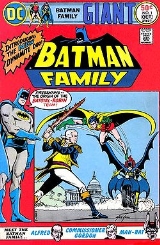
Batman Family

Encyclopedia
The Batman Family was a DC Comics
comic book
series which ran from 1975 to 1978, primarily featuring stories starring supporting characters in the Batman comics. The term is often used to refer to the extended cast of characters of comics books associated with Batman.
The Batman Family featured solo and team-up stories starring Batgirl
and Robin
in addition to reprints of Golden Age
stories. Many issues of Batman Family featured Batman supporting characters such as Alfred
, Vicki Vale
, the Elongated Man
, Man-Bat
, The Huntress, and Ace the Bat-Hound
.
DC published several other ... Family titles concurrent with Batman Family. These included Superman Family
(1974-82), Super-Team Family
(1975-1978) and Tarzan Family
(1975-76). As a rule, DC's ... Family titles contained mostly reprints, and featured a higher page count (and higher price) than DC's normal books. Its final issue, #20, ran with no advertisements.
, it was decided that DC Comics' long-running flagship title Detective Comics
was to be terminated with #480. However, the decision was overturned following strenuous arguments on behalf of saving the title within the DC office. Despite being the better selling title, Batman Family was instead merged with Detective, converting that book into a $1 68-page giant as of Detective #481 (Dec. 1978/Jan. 1979). This arrangement lasted 15 issues. With issue #496 (November 1980) Detective reverted to its traditional size and price — thus effectively canceling Batman Family for good. Detective Comics would continue to be published until the fall of 2011 at which point DC technically cancelled the title as part of The New 52
reboot scheme and launched a new Detective Comics series in its place.
. The first six issues were illustrated by Stefano Gaudiano and Rick Hoberg
. Steve Lieber
replaced Hoeberg on issues seven and eight.
DC Comics
DC Comics, Inc. is one of the largest and most successful companies operating in the market for American comic books and related media. It is the publishing unit of DC Entertainment a company of Warner Bros. Entertainment, which itself is owned by Time Warner...
comic book
Comic book
A comic book or comicbook is a magazine made up of comics, narrative artwork in the form of separate panels that represent individual scenes, often accompanied by dialog as well as including...
series which ran from 1975 to 1978, primarily featuring stories starring supporting characters in the Batman comics. The term is often used to refer to the extended cast of characters of comics books associated with Batman.
The Batman Family featured solo and team-up stories starring Batgirl
Barbara Gordon
Barbara Gordon is a fictional character appearing in comic books published by DC Comics and in related media, created by Gardner Fox and Carmine Infantino...
and Robin
Robin (comics)
Robin is the name of several fictional characters appearing in comic books published by DC Comics, originally created by Bob Kane, Bill Finger and Jerry Robinson, as a junior counterpart to DC Comics superhero Batman...
in addition to reprints of Golden Age
Golden Age of Comic Books
The Golden Age of Comic Books was a period in the history of American comic books, generally thought of as lasting from the late 1930s until the late 1940s or early 1950s...
stories. Many issues of Batman Family featured Batman supporting characters such as Alfred
Alfred Pennyworth
Alfred Pennyworth is a fictional character that appears throughout the DC Comics franchise. The character first appears in Batman #16 , and was created by writer Bob Kane and artist Jerry Robinson. Alfred serves as Batman’s tireless butler, assistant, confidant, and surrogate father figure...
, Vicki Vale
Vicki Vale
Victoria Vale is a fictional character that appears in comic books published by DC Comics. The character first appears in Batman #49 , and was created by Bob Kane and Bill Finger.-1940s-1960s:...
, the Elongated Man
Elongated Man
The Elongated Man is a fictional comic book superhero in the DC universe. He is a reserve member of the Justice League. His first appearance was in The Flash vol. 1, #112...
, Man-Bat
Man-Bat
Man-Bat is a fictional comic book character appearing in books published by DC Comics, usually as a supervillain and adversary of Batman, though occasionally depicted as a heroic character. He first appeared in Detective Comics #400 and was created by Frank Robbins and Neal Adams...
, The Huntress, and Ace the Bat-Hound
Ace the Bat-Hound
The comic book character Ace the Bat-Hound was the canine crime-fighting partner of Batman and Robin in DC Comics of the 1950s and 1960s. Ace debuted in Batman #92...
.
DC published several other ... Family titles concurrent with Batman Family. These included Superman Family
Superman Family
Superman Family was a DC Comics comic book series which ran from 1974 to 1982 featuring stories starring supporting characters in the Superman comics...
(1974-82), Super-Team Family
Super-Team Family
Super-Team Family is an comic book anthology series published by DC Comics in the 1970s that lasted for fifteen issues. The series published a mix of original and reprinted stories.- Publication history :...
(1975-1978) and Tarzan Family
Tarzan (comics)
Tarzan, a fictional character created by Edgar Rice Burroughs, first appeared in the 1912 novel Tarzan of the Apes, and then in 23 sequels. The character proved immensely popular and quickly made the jump to other media, including comics.-Comic strips:...
(1975-76). As a rule, DC's ... Family titles contained mostly reprints, and featured a higher page count (and higher price) than DC's normal books. Its final issue, #20, ran with no advertisements.
Merger with Detective Comics
In 1978, after the DC ImplosionDC Implosion
The DC Implosion is the popular label for the sudden cancellation of more than two dozen ongoing and planned series by the American comics publisher DC Comics in 1978.-History:...
, it was decided that DC Comics' long-running flagship title Detective Comics
Detective Comics
Detective Comics is an American comic book series published monthly by DC Comics since 1937, best known for introducing the iconic superhero Batman in Detective Comics #27 . It is, along with Action Comics, the book that launched with the debut of Superman, one of the medium's signature series, and...
was to be terminated with #480. However, the decision was overturned following strenuous arguments on behalf of saving the title within the DC office. Despite being the better selling title, Batman Family was instead merged with Detective, converting that book into a $1 68-page giant as of Detective #481 (Dec. 1978/Jan. 1979). This arrangement lasted 15 issues. With issue #496 (November 1980) Detective reverted to its traditional size and price — thus effectively canceling Batman Family for good. Detective Comics would continue to be published until the fall of 2011 at which point DC technically cancelled the title as part of The New 52
The New 52
The New 52 is a 2011 revamp and relaunch by DC Comics of its entire line of ongoing monthly superhero books, in which all of its existing titles were cancelled, and 52 new series debuted in September 2011 with new #1 issues. Among the series being renumbered are Action Comics and Detective Comics,...
reboot scheme and launched a new Detective Comics series in its place.
2002 Series
In 2002 DC published an eight-issue miniseries, Batman: Family, written by John Francis MooreJohn Francis Moore (comics)
John Francis Moore is comic book writer known for stints as writer on such Marvel comics series as X-Force, X-Factor, Doom 2099 and X-Men 2099...
. The first six issues were illustrated by Stefano Gaudiano and Rick Hoberg
Rick Hoberg
Rick Hoberg is an award-winning American comic book artist and animator.-Newspaper Strips:Hoberg began his career in the mid-1970s, working in newspaper strips, assisting Russ Manning on Tarzan and Star Wars , and Fred Kida on the daily Spider-Man strip .-Comic books:Between 1977 and 1979, Hoberg...
. Steve Lieber
Steve Lieber
Steve Lieber is a comic-book illustrator. His best known work includes runs on Detective Comics and Hawkman, the graphic novel Whiteout and its Eisner Award-winning sequel, Whiteout: Melt. He is also the co-author of The Complete Idiot's Guide to Creating a Graphic Novel.-Early life:Lieber was...
replaced Hoeberg on issues seven and eight.