
All Topics  
Basilar membrane


   Email Print
   Bookmark   Link


Basilar membrane


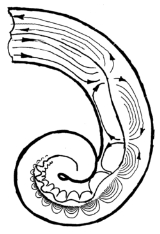
The basilar membrane within the cochlea
Cochlea

The cochlea is the auditory portion of the inner ear. Its core component is the Organ of Corti, the sensory organ of hearing , which is distributed along the partition separating fluid chambers in the coiled tapered tube of the cochlea....
 of the inner ear
Inner ear

The inner ear is the labyrinth , a system of passages comprising two main functional parts:* the organ of hearing, or cochlea* and the vestibular apparatus, the organ of balance that consists of three semicircular canals and the Vestibule of the ear....
 is a stiff structural element that separates two liquid-filled tubes that run along the coil of the cochlea, the scala media
Scala media

The cochlear duct is an endolymph filled cavity inside the cochlea, located in between the scala tympani and the scala vestibuli, separated by the basilar membrane and Reissner's membrane respectively....
 and the scala tympani
Scala tympani

Scala tympani is one of the perilymph-filled cavities in the cochlear labyrinth. It is separated from the scala media by the basilar membrane, and it extends from the round window to the helicotrema, where it continues as scala vestibuli....
 (see figure).

Endolymph/perilymph separation The fluids in these two tubes, the endolymph
Endolymph

Endolymph is the fluid contained in the membranous labyrinth of the inner ear.It is also called Scarpa's fluid, after Antonio Scarpa....
 and the perilymph
Perilymph

Perilymph is an extracellular fluid located within the cochlea in 2 of its 3 compartments; the scala tympani and scala vestibuli. The ionic composition of perilymph is comparable to that of Blood plasma and cerebrospinal fluid....
 are very different chemically, biochemically, and electrically. Therefore they are kept strictly separated.


Discussion
Ask a question about 'Basilar membrane'
Start a new discussion about 'Basilar membrane'
Answer questions from other users
Full Discussion Forum


Recent Posts


Encyclopedia


The basilar membrane within the cochlea
Cochlea

The cochlea is the auditory portion of the inner ear. Its core component is the Organ of Corti, the sensory organ of hearing , which is distributed along the partition separating fluid chambers in the coiled tapered tube of the cochlea....
 of the inner ear
Inner ear

The inner ear is the labyrinth , a system of passages comprising two main functional parts:* the organ of hearing, or cochlea* and the vestibular apparatus, the organ of balance that consists of three semicircular canals and the Vestibule of the ear....
 is a stiff structural element that separates two liquid-filled tubes that run along the coil of the cochlea, the scala media
Scala media

The cochlear duct is an endolymph filled cavity inside the cochlea, located in between the scala tympani and the scala vestibuli, separated by the basilar membrane and Reissner's membrane respectively....
 and the scala tympani
Scala tympani

Scala tympani is one of the perilymph-filled cavities in the cochlear labyrinth. It is separated from the scala media by the basilar membrane, and it extends from the round window to the helicotrema, where it continues as scala vestibuli....
 (see figure).

Function


Endolymph/perilymph separation

The fluids in these two tubes, the endolymph
Endolymph

Endolymph is the fluid contained in the membranous labyrinth of the inner ear.It is also called Scarpa's fluid, after Antonio Scarpa....
 and the perilymph
Perilymph

Perilymph is an extracellular fluid located within the cochlea in 2 of its 3 compartments; the scala tympani and scala vestibuli. The ionic composition of perilymph is comparable to that of Blood plasma and cerebrospinal fluid....
 are very different chemically, biochemically, and electrically. Therefore they are kept strictly separated. This separation is the main function of Reissner's membrane
Reissner's membrane

Reissner's membrane is a diaphragm inside the cochlea of the inner ear. It separates scala media from scala vestibuli. Together with the basilar membrane it creates a compartment in the cochlea filled with endolymph, which is important for the function of the organ of Corti....
 (between scala vestibuli
Scala vestibuli

Scala vestibuli is a perilymph filled cavity inside the cochlea of the inner ear.It is separated from the scala media by Reissner's membrane and extends from the oval window to the helicotrema where it joins scala tympani....
 and scala media), and is erroneously believed to be one of the functions of the basilar membrane in the hearing organ of all land vertebrates. However, the basilar membrane is in fact permeable to perilymph, thus the second border between endolymph and perilymph occurs at the reticular lamina.

A base for the sensory cells

The basilar membrane is also the base for the sensory cells of hearing, the hair cells or "Stereocilia" of which there are approximately 30,000 (see figure). This function gave the basilar membrane its name, and it is again present in all land vertebrates. Due to its location, the basilar membrane places the hair cells in a position where they are adjacent to both the endolymph and the perilymph, which is a precondition of hair cell function.

Frequency dispersion


A third, evolutionarily younger, function of the basilar membrane is strongly developed in the cochlea of most mammalian species and weakly developed in some bird species. It is the function of frequency dispersion
Dispersion

Dispersion can refer to:...
 of incoming sound waves. In brief, the membrane is tapered and it is stiffer at one end than at the other. The dispersion of fluid waves causes sound input of a certain frequency to vibrate some locations of the membrane more than other locations. As shown in experiments by Nobel Prize laureate Georg von Békésy
Georg von Békésy

Georg von B?k?sy was a Hungarian Biophysics born in Budapest.In 1961, he was awarded the Nobel Prize in Physiology or Medicine for his research on the function of the cochlea in the mammalian hearing organ....
, high frequencies lead to maximum vibrations at the basal end of the cochlear coil (narrow, stiff membrane), and low frequencies lead to maximum vibrations at the apical end of the cochlear coil (wide, more compliant membrane). This "place-frequency map" can be described quantitatively by the Greenwood function
Greenwood Function

The Greenwood function correlates the position of the hair cells in the inner ear to the frequencies that stimulate their corresponding auditory neurons....
 and its variants.

Anatomy


The basilar membrane is a pseudo-resonant structure that, like strings on an instrument, varies in width and stiffness. The "string" of the basilar membrane is not a set of parallel strings, as in a guitar, but a long structure that has different properties (width, stiffness, mass, damping, and the dimensions of the ducts that it couples to) at different points along its length. The motion of the basilar membrane is generally described as a traveling wave. The parameters of the membrane at a given point along its length determine its characteristic frequency (CF), the frequency at which it is most sensitive to sound vibrations. The Basilar membrane is widest (0.42–0.65 mm) and least taut at the apex of the cochlea, and narrowest (0.08–0.16 mm) and most taut at the base. High-frequency sounds localize near the base of the cochlea (near the round and oval windows), while low-frequency sounds localize near the apex.

Additional images


External links