


Baseball field

Encyclopedia
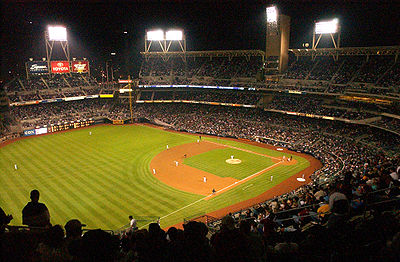
Playing field
A playing field is a field used for playing sports or games. They are generally outdoors, but many large structures exist to enclose playing fields from bad weather. Generally, playing fields are wide expanses of grass, dirt or sand without many obstructions...
upon which the game of baseball
Baseball
Baseball is a bat-and-ball sport played between two teams of nine players each. The aim is to score runs by hitting a thrown ball with a bat and touching a series of four bases arranged at the corners of a ninety-foot diamond...
is played. The terms "baseball field" and "ball field" are also often used as synonym
Synonym
Synonyms are different words with almost identical or similar meanings. Words that are synonyms are said to be synonymous, and the state of being a synonym is called synonymy. The word comes from Ancient Greek syn and onoma . The words car and automobile are synonyms...
s for ballpark.
Specifications
Home Plate
Home Plate is the fifth album by Bonnie Raitt, released in 1975 .-Track listing:#"What Do You Want the Boy to Do?" – 3:19#"Good Enough" – 2:56#"Run Like a Thief" – 3:02...
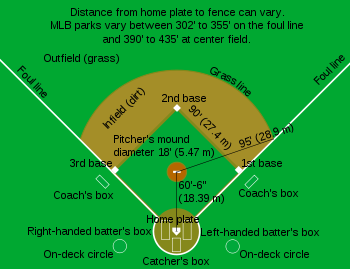
, which is a five-sided slab of whitened rubber, 17-inches square with two of the corners removed so that one edge is 17 inches long, two adjacent sides are 8½ inches and the remaining two sides are 12 inches and set at an angle to make a point. Adjacent to each of the two parallel 8½-inch sides is a batter's box. The point of home plate where the two 12-inch sides meet at right angles, is at one corner of a ninety-foot square. The other three corners of the square, in counterclockwise order from home plate, are called first base, second base, and third base
Third Base
is a 1978 Japanese film directed by Yōichi Higashi.-External links:...
. Three canvas bags fifteen inches (38 cm) square mark the three bases. These three bags along with home plate form the four bases at the corners of the infield.
All the bases, including home plate, lie entirely within fair territory. Thus, any batted ball that touches those bases must necessarily be in fair territory. While the first and third base bags are placed so that they lie inside the 90 foot square formed by the bases, the second base bag is placed so that its center (unlike first, third and home) coincides exactly with the "point" of the ninety-foot infield square. Thus, although the "points" of the bases are 90 feet apart, the physical distance between each successive pair of base markers is closer to 88 feet. This positioning of the second base bag creates an "offset" (of one-half of its bag width) from pure "alignment" with the first and third base bags - an anomaly which does not seem to have affected play over the years and generally goes unnoticed by players and fans.
The lines from home plate to first and third bases extend to the nearest fence, stand or other obstruction and are called the foul lines. The portion of the playing field between (and including) the foul lines is fair territory; the rest is foul territory. The area in the vicinity of the square formed by the bases is called the infield; fair territory outside the infield is known as the outfield. Most baseball fields are enclosed with a fence that marks the outer edge of the outfield. The fence is usually set at a distance ranging from 300 to 410 feet (90 to 125 m) from home plate. Most professional and college baseball fields have a right and left foul pole. These poles are at the intersection of the foul lines and the respective ends of the outfield fence and, unless otherwise specified within the ground rules, lie in fair territory. Thus, a batted ball that passes over the outfield wall in flight and touches the foul pole is a fair ball and the batter is awarded a home run. Another common feature of baseball fields is a warning track
Warning track
A warning track is the term for the part of the baseball field that is closest to the wall or fence and is typically made of dirt, instead of grass or artificial turf like most of the field. It runs parallel to the ballpark's wall and looks like a running track...
, a narrow dirt path that follows the outer edge of the outfield at the fence to serve to warn outfielders of their proximity to the wall.
First base
First base is the first of four bases that must be touched by a player on the batting team in order to score a run. Unlike when an offensive player reaches second or third base, it is permissible for a batter-runner to overrun first base without being in jeopardy of being put out. After contact is made with the base, the batter-runner may slow down and return to first base at his leisure, so long as he makes no move or attempt to advance to second base.The first baseman is the defensive player responsible for the area near first base. A professional first baseman is often tall. A tall first baseman presents a large target to which other fielders can throw, and his height gives him a larger range in reaching and catching errant throws. Players who are left-handed are preferable for first base because: first, it is easier for a left-handed fielder to catch a pick-off throw from the pitcher and tag the baserunner; and, second, his left foot (which he uses to maintain contact with first base after receiving a throw from another fielder) is closer to first base than his right foot. (A right-handed first baseman must, when setting himself up to receive a throw from an infielder, execute a half-pivot near the base; this is a move that a left-hander need not make.)
In the numbering system
Baseball scorekeeping
Baseball scorekeeping is the practice of recording the details of a baseball game as it unfolds. Professional baseball leagues hire official scorers to keep an official record of each game , but many fans keep score as well for their own enjoyment...
used to record defensive plays, the first baseman is assigned the number '3'.
Second base
Second base, or 2B, is the second of four stations on a baseball diamond which must be touched in succession by a base runner in order to score a run for that player's team. Second base is typically defended by the second baseman and the shortstopShortstop
Shortstop, abbreviated SS, is the baseball fielding position between second and third base. Shortstop is often regarded as the most dynamic defensive position in baseball, because there are more right-handed hitters in baseball than left-handed hitters, and most hitters have a tendency to pull the...
. Second base is also known as the keystone sack. A runner on second base is said to be in "scoring position," owing to the high likelihood of reaching home plate and scoring a run from second base on most base hits. Since second is the farthest base from home plate, it is the most common target of base stealing.
Ideally, the second baseman and shortstop possess quick hands and feet and the ability to release the ball rapidly and with accuracy. One will usually cover second base when the other attempts to field the ball. Both players must communicate well to be able to make a double play
Double play
In baseball, a double play for a team or a fielder is the act of making two outs during the same continuous playing action. In baseball slang, making a double play is referred to as "turning two"....
. Particular agility is required of the second baseman in double play situations, which usually forces the player to throw towards first while his momentum carries him in the opposite direction. In the numbering system used to record defensive plays, the second baseman is assigned the number 4, and the shortstop 6.
Third base
Third base is the third of four bases a baserunner must touch in a counterclockwise succession in order to score a run. Many batted balls that result in the batter being put out (such as a sacrifice flySacrifice fly
In baseball, a sacrifice fly is a batted ball that satisfies four criteria:* There are fewer than two outs when the ball is hit.* The ball is hit to the outfield....
) may nevertheless allow a runner to reach home plate and score a run from third base, provided that the third and final out is not recorded before he can do so. A runner on third base is therefore particularly valuable to the batting team when fewer than 2 outs have been recorded.
The third baseman, or 3B, is the defensive player whose responsibility is to defend the area nearest to third base. A third baseman ideally possesses quick reaction to batted balls and a strong arm to make the long throw to first base. In the numbering system used to record defensive plays, the third baseman is assigned the number 5.
Home plate
Home plate, formally designated home base in the rules, is the final base that a player must touch to score. Unlike the other bases, home plate is a five-sided slab of whitened rubber that is set at ground level. The use of rubber was developed by Robert KeatingBob Keating
Robert M. Keating , was a Major League Baseball pitcher for the Baltimore Orioles. He appeared in one game for the Orioles on August 27, 1887.. pitching a complete game, allowing 16 runs on 16 hits in the loss. An arm injury ended his career and he became an inventor, starting off by inventing...
, who pitched one game for the 1887 Baltimore Orioles. Previously, more dangerously, the plate was made of stone, iron or wood.
50 to 100 feet (15 to 30 meters) behind home plate is the backstop, which is a wall/fence that will stop wild pitch
Wild pitch
In baseball, a wild pitch is charged against a pitcher when his pitch is too high, too short, or too wide of home plate for the catcher to control with ordinary effort, thereby allowing a baserunner, perhaps even the batter-runner on strike three or ball four, to advance.A wild pitch usually...
es, passed ball
Passed ball
In baseball, a catcher is charged with a passed ball when he fails to hold or control a legally pitched ball that, with ordinary effort, should have been maintained under his control. When, as a result of this loss of control, the batter or a runner on base advances, the catcher is thereby charged...
s, and foul ball
Foul ball
In baseball, a foul ball is a batted ball that:* Settles on foul territory between home and first base or between home and third base, or* Bounds past first or third base on or over foul territory, or...
s. In enclosed stadiums, the backstop is often composed of a lower part, which is like any other part of the wall, and an upper netting to protect spectators seated behind it; in recreational baseball fields, there is usually a tall chain-link fence, including an angled top section, composing the entire backstop.
Additionally, the catcher covers home plate when a runner is attempting to score a run; he must tag the runner with the ball (or the glove with the ball inside) before the runner touches home plate, or in the event that the bases are loaded he may simply touch home plate while in possession of the ball to get the runner out. Professional catchers in the major leagues often have large body frames to maximally obstruct home plate from the runner's access. In the numbering system used to record defensive plays, the catcher is assigned the number 2.
Batter's box and catcher's box
Batting (baseball)
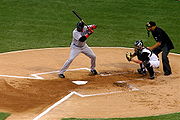
In baseball, batting is the act of facing the opposing pitcher and trying to produce offense for one's team. A batter or hitter is a person whose turn it is to face the pitcher...
stands when ready to receive a pitch
Pitch (baseball)
In baseball, a pitch is the act of throwing a baseball toward home plate to start a play. The term comes from the Knickerbocker Rules. Originally, the ball had to be literally "pitched" underhand, as with pitching horseshoes. Overhand throwing was not allowed until 1884.The biomechanics of...
from the pitcher
Pitcher
In baseball, the pitcher is the player who throwsthe baseball from the pitcher's mound toward the catcher to begin each play, with the goal of retiring a batter, who attempts to either make contact with the pitched ball or draw a walk. In the numbering system used to record defensive plays, the...
. It is usually drawn in chalk
Chalk
Chalk is a soft, white, porous sedimentary rock, a form of limestone composed of the mineral calcite. Calcite is calcium carbonate or CaCO3. It forms under reasonably deep marine conditions from the gradual accumulation of minute calcite plates shed from micro-organisms called coccolithophores....
on the dirt surrounding home plate
Home Plate
Home Plate is the fifth album by Bonnie Raitt, released in 1975 .-Track listing:#"What Do You Want the Boy to Do?" – 3:19#"Good Enough" – 2:56#"Run Like a Thief" – 3:02...
, and the insides of the boxes are watered down before each game.
The chalk lines delineating the 2 Foul Lines are rarely extended through the batter's boxes. However, those lines exist conceptually for the purpose of judging a batted ball fair or foul. In addition, inside edges of the Batter's Boxes are often not laid-in with chalk. Similarly, though not marked, those lines continue to exist for the purpose of the rules pertaining to the batter's box and the batter's position relative thereto.
There are two batter's boxes, one on each side of home plate. The batter's boxes are 4 feet wide and 6 feet long. The batter's boxes are centered lengthwise at the center of home plate with the inside line of each batter's box 6 inches from the near edge of home plate. A right-handed
Handedness
Handedness is a human attribute defined by unequal distribution of fine motor skills between the left and right hands. An individual who is more dexterous with the right hand is called right-handed and one who is more skilled with the left is said to be left-handed...
batter would stand in the batter's box on the left side of home plate from the perspective of the catcher
Catcher
Catcher is a position for a baseball or softball player. When a batter takes his turn to hit, the catcher crouches behind home plate, in front of the umpire, and receives the ball from the pitcher. This is a catcher's primary duty, but he is also called upon to master many other skills in order to...
and umpire. A left-handed batter would stand in the batter's box to their right. A batter may only occupy one batter's box at a time and may not legally leave the batter's box after the pitcher has come set or has started his windup. Should the batter wish to leave the batter's box once the pitcher has engaged the rubber, he must first ask the umpire
Umpire (baseball)
In baseball, the umpire is the person charged with officiating the game, including beginning and ending the game, enforcing the rules of the game and the grounds, making judgment calls on plays, and handling the disciplinary actions. The term is often shortened to the colloquial form ump...
for time-out. Time will not be granted if the pitcher has already started his pitching motion. For playing rules relating to the batter's box, see Rules 6.05 and 6.06 of the Official Baseball Rules.
The catcher
Catcher
Catcher is a position for a baseball or softball player. When a batter takes his turn to hit, the catcher crouches behind home plate, in front of the umpire, and receives the ball from the pitcher. This is a catcher's primary duty, but he is also called upon to master many other skills in order to...
is the defensive player who is positioned to receive pitches - generally positioned within the catcher's box. The catcher's box is 43 inches wide, centered on and extending 8 feet behind the point of home plate. Rule sets vary as to the catcher's responsibility to remain in the catcher's box. Under Official Baseball Rules, the only specified penalty relating to the catcher's box is that when a batter is being walked intentionally, it is a balk if the catcher steps outside the catcher's box before the pitcher releases the pitch.
Foul poles
Home run
In baseball, a home run is scored when the ball is hit in such a way that the batter is able to reach home safely in one play without any errors being committed by the defensive team in the process...
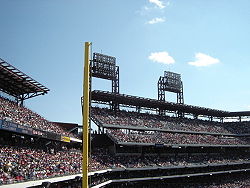
). The poles are a vertical extension of the foul lines. Both objects are used to determine whether a ball is foul or fair. The outer edge of the foul lines and foul poles define foul territory and both the lines and the poles themselves are actually within fair territory. Prior to 1920, the foul lines extended indefinitely: a batter was awarded a home run only if a fly ball over the fence landed in fair territory, or was fair "when last seen" by the umpire. Under the current rule, a batted ball that goes out of play in flight is judged fair or foul at the point it clears the fence. Thus, a fly ball hitting a foul pole above the top of the outfield fence is a home run, regardless of where the ball goes after striking this pole, and a fly ball clearing the fence on the fair side of the pole is a home run regardless of where it lands. Foul poles (shown at right) are typically much higher than the top of the outfield fence, and often have a narrow screen running along the fair side of the pole to further aid the umpire's judgment. It can still be a difficult call, especially in ballparks with no outfield stands behind the poles to provide perspective. Wrigley Field
Wrigley Field
Wrigley Field is a baseball stadium in Chicago, Illinois, United States that has served as the home ballpark of the Chicago Cubs since 1916. It was built in 1914 as Weeghman Park for the Chicago Federal League baseball team, the Chicago Whales...
is notorious for arguments over long, curving flies down a foul line (most notably in left field) that sail higher than the foul pole. At PETCO Park
PETCO Park
Petco Park is an open-air ballpark in downtown San Diego, California, USA. It opened in 2004, replacing Qualcomm Stadium as the home park of Major League Baseball's San Diego Padres. Before then, the Padres shared Qualcomm Stadium with the NFL's San Diego Chargers...
, there is no foul pole in left field, that function being served by a yellow metal strip on the corner of the Western Metal Supply Co. building.
Pitcher's mound

Pitcher
In baseball, the pitcher is the player who throwsthe baseball from the pitcher's mound toward the catcher to begin each play, with the goal of retiring a batter, who attempts to either make contact with the pitched ball or draw a walk. In the numbering system used to record defensive plays, the...
stands when throwing the pitch
Pitch (baseball)
In baseball, a pitch is the act of throwing a baseball toward home plate to start a play. The term comes from the Knickerbocker Rules. Originally, the ball had to be literally "pitched" underhand, as with pitching horseshoes. Overhand throwing was not allowed until 1884.The biomechanics of...
. Atop the mound is a white rubber slab, called the pitcher's plate. It measures 6 inches (15 cm) front-to-back and 2 feet (61 cm) across, the front of which is exactly 60 feet, 6 inches (18.4 m) from the rear point of home plate. This peculiar distance was set by the rulemakers in 1893, not due to a clerical or surveying error as popular myth has it, but intentionally (further details in History section).
In Major League Baseball
Major League Baseball
Major League Baseball is the highest level of professional baseball in the United States and Canada, consisting of teams that play in the National League and the American League...
, a regulation mound is 18 feet (5.5 m) in diameter, with the center 59 feet (18.0 m) from the rear point of home plate, on the line between home plate and second base. The front edge of the pitcher's plate or rubber is 18 inches (45.7 cm) behind the center of the mound, making the front edge's midpoint 60 feet 6 inches (18.4 m) from the rear point of home plate. Six inches (15.2 cm) in front of the pitcher's rubber the mound begins to slope downward. The top of the rubber is to be no higher than ten inches (25.4 cm) above home plate. From 1903 through 1968, this height limit was set at 15 inches, but was often slightly higher, sometimes as high as 20 inches (50.8 cm), especially for teams that emphasized pitching, such as the Los Angeles Dodgers
Los Angeles Dodgers
The Los Angeles Dodgers are a professional baseball team based in Los Angeles, California. The Dodgers are members of Major League Baseball's National League West Division. Established in 1883, the team originated in Brooklyn, New York, where it was known by a number of nicknames before becoming...
, who were reputed to have the highest mound in the majors.
A pitcher will push off the rubber with his foot in order to gain velocity toward home plate
Home Plate
Home Plate is the fifth album by Bonnie Raitt, released in 1975 .-Track listing:#"What Do You Want the Boy to Do?" – 3:19#"Good Enough" – 2:56#"Run Like a Thief" – 3:02...
when pitching. In addition, a higher mound generally favors the pitcher. With the height advantage, the pitcher gains more leverage and can put more downward velocity on the ball, making it more difficult for the batter to strike the ball squarely with the bat
Baseball bat
A baseball bat is a smooth wooden or metal club used in the game of baseball to hit the ball after the ball is thrown by the pitcher. It is no more than 2.75 inches in diameter at the thickest part and no more than 42 inches in length. It typically weighs no more than 33 ounces , but it...
. The lowering of the mound in 1969 was intended to "increase the batting" once again, as pitching had become increasingly dominant, reaching its peak the prior year; 1968 is known among baseball historians as "The Year of the Pitcher". This restrictive rule apparently did its job, contributing to the hitting surge of modern baseball.
A pitcher's mound is difficult for groundskeepers to maintain. Usually before every game it is watered down to keep the dust from spreading. On youth and amateur baseball fields, the mound may be much different from the rulebook definition due to erosion and repair attempts. Even in the major leagues, each mound gains its own character, as pitchers are allowed to kick away pieces of dirt in their way, thereby sculpting the mound a bit to their preference.
The pitcher may keep a rosin
Rosin
.Rosin, also called colophony or Greek pitch , is a solid form of resin obtained from pines and some other plants, mostly conifers, produced by heating fresh liquid resin to vaporize the volatile liquid terpene components. It is semi-transparent and varies in color from yellow to black...
bag on the rear of the mound to dry off his hands. Major league baseball teams are also permitted cleat
Cleat (shoe)
Cleats or studs are protrusions on the sole of a shoe, or on an external attachment to a shoe, that provide additional traction on a soft or slippery surface...
cleaners on the back of the mound. This may be a flat grate-style plate, or simply a hand tool such as a piece of wood used to remove mud and dirt from cleats. These items are allowed to remain on the backside of the mound at the discretion of the umpire
Umpire (baseball)
In baseball, the umpire is the person charged with officiating the game, including beginning and ending the game, enforcing the rules of the game and the grounds, making judgment calls on plays, and handling the disciplinary actions. The term is often shortened to the colloquial form ump...
, thus reducing the probability that they will affect a live play.
Baseline
A baseline is the direct route—a straight line— between two adjacent bases, though it is not drawn in chalk or paint on the field (though foul lines are drawn). The basepath is the region within three feet (0.9 m) of the baseline. Baserunners are not required to run in this objective basepath, however; a baserunner may run wherever he wants when no play is being attempted on him. At the moment the defense begins to attempt a tagTag out
In baseball, a tag out, sometimes just called a tag, is a play in which a baserunner is out because he is touched by the fielder's hand or glove holding a live ball while the runner is in jeopardy...
on him, his running baseline is established as a direct line from his current position to the base which he is trying for. A runner straying more than three feet away from his baseline in an attempt to avoid a tag may be called out.
Grass line
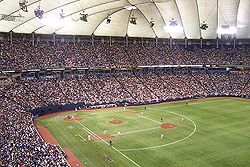
Umpire (baseball)
In baseball, the umpire is the person charged with officiating the game, including beginning and ending the game, enforcing the rules of the game and the grounds, making judgment calls on plays, and handling the disciplinary actions. The term is often shortened to the colloquial form ump...
and fans may better judge distance from the center of the diamond. Occasionally the ball may take a tricky bounce off the dirt area or the edge between the dirt and the grass. World Series
World Series
The World Series is the annual championship series of Major League Baseball, played between the American League and National League champions since 1903. The winner of the World Series championship is determined through a best-of-seven playoff and awarded the Commissioner's Trophy...
championships (including 1924, 1960 and 1986) have been decided or heavily influenced by erratic hops of ground balls. In artificial turf
Artificial turf
Artificial turf is a surface manufactured from synthetic fibers made to look like natural grass. It is most often used in arenas for sports that were originally or are normally played on grass. However, it is now being used on residential lawns and commercial applications as well...
stadiums (such as those with FieldTurf
FieldTurf
FieldTurf is a brand of artificial turf playing surface. It is manufactured and installed by the FieldTurf Tarkett division of Tarkett Inc., based in Calhoun, Georgia, USA. In the late 1990s, the artificial surface changed the industry with a design intended to replicate real grass...
in Major League Baseball), infield dirt is placed only around the bases and around the pitcher's and batting areas; thus the "grass line" is designated with a white line. The exception is at St. Petersburg
St. Petersburg, Florida
St. Petersburg is a city in Pinellas County, Florida, United States. It is known as a vacation destination for both American and foreign tourists. As of 2008, the population estimate by the U.S. Census Bureau is 245,314, making St...
's Tropicana Field
Tropicana Field
Tropicana Field is a domed stadium in St. Petersburg, Florida, which has been the home of Major League Baseball's Tampa Bay Rays since the team's inaugural season in 1998, when they were the Devil Rays. It has also served as the host stadium for the Beef 'O' Brady's Bowl, an NCAA-sanctioned college...
, where, in spite of artificial turf, standard dirt basepaths are used.
Outfield
The outfield is made from thick grass or artificial turf. It is where the outfielders play.The positions to play in the outfield are right, center, and left field (named in relation to the batter's position; thus left field is beyond third base and right field is beyond first base). Outfields vary in size and shape depending on the overall size and shape of the playing field.
Warning track
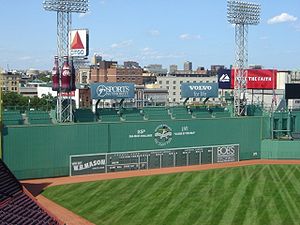
A warning track is also a common feature along the left and right sides of a field.
A warning track's width varies from field to field. It is generally designed to give about three steps of warning to the highest level players using the field. Typical widths run from about six feet for Little League fields to about 10–15 feet for college- or professional-level play.
The track can be composed of finely ground rock particles such as cinders, which is why announcer Bob Wolff
Bob Wolff
Robert "Bob" Wolff , in New York City, New York is an American sportscaster. He was the radio and TV voice of the Washington Senators from 1947 to 1960, continuing with the team when they relocated and became the Minnesota Twins in 1961. In 1962, he joined NBC-TV...
called it the "cinder path" rather than the "warning track".
The idea of a warning track originated in Yankee Stadium, where an actual running track was built for use in track and field events. When ballpark designers saw how the track helped fielders, it soon became a feature of every ballpark.
Despite the warning track's presence, it is common to see outfielders crash into the wall to make a catch, due either to a desire to field the play regardless of the outcome or because they fail to register the warning. For this reason, outfield walls are typically padded for extra safety, where feasible. Wrigley Field
Wrigley Field
Wrigley Field is a baseball stadium in Chicago, Illinois, United States that has served as the home ballpark of the Chicago Cubs since 1916. It was built in 1914 as Weeghman Park for the Chicago Federal League baseball team, the Chicago Whales...
's brick wall is covered only by ivy, which is not especially soft. There are pads on the walls of the tight left and right field corners in foul ground.
Warning-track power is a derogatory term for a batter who seems to have just enough power to hit the ball to the warning track for an out, but not enough to hit a home run. The term more generally refers to someone or something that is almost but not quite good enough for something.
Outfield wall
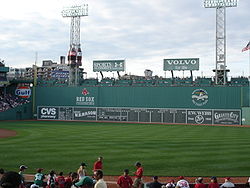
Dead ball
Dead ball is a phenomenon in many sports in which the ball is deemed temporarily not playable, and no movement may be made with it or the players from their respective positions of significance...
; if it passes over the wall in fair territory while in flight
In flight
In baseball, the rules state that a batted ball is considered in flight when it has not yet touched any object other than a fielder or his equipment....
, it is a home run. The official rules do not specify the shape, height, or composition of the wall, or a specific mandatory distance from home plate (though Major League Baseball mandates a minimum distance of 250 feet (76.2 m) and recommends a minimum distance of 320 feet (97.5 m) at the foul poles and 400 feet (121.9 m) at center field). As a result, baseball fields can vary greatly along those lines. The wall has numbers affixed or painted on it that denote the distance in feet from that point on the wall to home plate. In most modern major league ballparks, the wall is made of some hard material (e.g., concrete) with padding on the field side to protect players who may collide with the wall at high speed while trying to make a play. Chain link fencing
Chain link fencing
A chain-link fence is a type of woven fence usually made from galvanized or LLDPE-coated steel wire...
may also be incorporated into the wall in areas where the wall needs to be transparent, e.g., an outfield bullpen
Bullpen
In baseball, the bullpen is the area where relief pitchers warm-up before entering a game. Depending on the ballpark, it may be situated in foul territory along the baselines or just beyond the outfield fence. Also, a team's roster of relief pitchers is metonymically referred to as "the bullpen"...
, a spectator area behind the wall, or to protect a scoreboard
Scoreboard
A scoreboard is a large board for publicly displaying the score in a game or match. Most levels of sport from high school and above use at least one scoreboard for keeping score, measuring time, and displaying statistics. Scoreboards in the past used a mechanical clock and numeral cards to...
incorporated into the wall. Many ballparks feature a yellow line denoting the top of the wall to aid umpires in judging whether the ball passed over the wall.
Bullpen
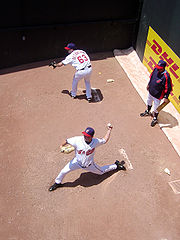
The bullpen (sometimes referred to as simply "the pen") is the area where pitchers warm-up before entering a game. Depending on the ballpark, it may be situated in foul territory along the baselines or just beyond the outfield fence. Relief pitchers usually wait in the bullpen when they have yet to play in a game, rather than in the dugoutDugout (baseball)
In baseball, the dugout is a team's bench area and is located in foul territory between home plate and either first or third base. There are two dugouts, one for the home team and one for the visiting team. In general, the dugout is occupied by all players not prescribed to be on the field at that...
with the rest of the team. The starting pitcher also makes his final pregame warmups in the bullpen. Managers can call coaches in the bullpen on an in-house telephone from the dugout to tell a certain pitcher to begin his warmup tosses.
"Bullpen" is also used metaphorically to describe a team's collection of relief pitchers.
On-deck circles
There are two on-deck circles in the field, one for each team, positioned in foul ground between home plate and the respective teams' benches. They are technically known as next-batter's boxes. The on-deck circle is where the next scheduled batter, or "on-deck" batter, warms up while waiting for the current batter to finish his turn. The on-deck circle is either an area composed of bare dirt; a plain circle painted onto artificial turf; or often, especially at the professional level, made from artificial material, with the team's logo painted onto it.Coach's boxes
The coach's boxes, located behind 1st and 3rd base, are where the 1st and 3rd base coach are supposed to stand, although coaches often stand closer to the field. This is permissible as long as the coach does not interfere with play. The coach's boxes are marked with chalk or paint. In the early days of baseball, the term "coacher's box" was used, as "coach" was taken to be a verb. As the term "coach" evolved into a noun, the name of the box also changed.History
The basic layout of the diamond has been little changed since the original Knickerbocker RulesKnickerbocker Rules
The Knickerbocker Rules are a set of baseball rules formalized by Alexander Cartwright in 1845. They are considered to be the basis for the rules of the modern game.-The rules:...
of the 1840s. The distance between bases was already established as 90 feet, which it remains to this day. Through trial and error, 90 feet had been settled upon as the optimal distance. 100 feet would have given too much advantage to the defense, and 80 feet too much to the offense. As athleticism has improved on both sides of the equation, 90 feet remains the appropriate balance between hitting and fielding, as it continues to provide frequent tests between the speed of a batter-runner and the throwing arm of a fielder. The first baseball field was created in 1845.
It is the pitching distance, and other aspects of the pitcher's mound, and of pitching itself, that were tinkered with from time to time over the many decades, in an effort to keep an appropriate balance between pitching and hitting.
In contrast to the distance between the bases, which seems natural enough, the very specific pitching distance of 60 feet 6 inches is one of those sports oddities that seems like a mistake unless one considers the history:
- The original Knickerbocker RulesKnickerbocker RulesThe Knickerbocker Rules are a set of baseball rules formalized by Alexander Cartwright in 1845. They are considered to be the basis for the rules of the modern game.-The rules:...
did not specify the pitching distance explicitly. - By the time major league baseball began in the 1870s, the pitcher was compelled to pitch from within a "box" whose front edge was 45 feet from the "point" of home plate. Although he had to release the ball before crossing the line, as with bowlers in cricketCricketCricket is a bat-and-ball game played between two teams of 11 players on an oval-shaped field, at the centre of which is a rectangular 22-yard long pitch. One team bats, trying to score as many runs as possible while the other team bowls and fields, trying to dismiss the batsmen and thus limit the...
, he also had to start his delivery from within the box; he could not run in from the field as bowlers do. Furthermore, the pitcher had to throw underhand. By the 1880s, pitchers had mastered the underhand delivery—in fact, in 1880, there were two perfect games within a week of each other. - In an attempt to "increase the batting", the front edge of the pitcher's box was moved back 5 feet in 1881, to 50 feet from home plate.
- The size of the box was altered over the following few years. Pitchers were allowed to throw overhand starting in 1884, and that tilted the balance of power again. In 1887, the box was set at 4 feet wide and 5½ feet deep, with the front edge still 50 feet from the plate. However, the pitcher was compelled to deliver the ball with his back foot at the 55½ foot line of the box, thus somewhat restricting his ability to "power" the ball with his overhand delivery. (Lansch, p. 96)
- In 1893, the box was replaced by the pitcher's plate, although "the box" is still used today as a slang term for the pitcher's location on the field. For example, a ground ball to the pitcher is one "hit back to the box", and a pitcher replaced for ineffectiveness has been "knocked out of the box". Exactly 5 feet was added to the point the pitcher had to toe, again "to increase the batting" (and hopefully to increase attendance, as fan interest had flagged somewhat), resulting in the seemingly peculiar pitching distance of 60½ feet. (Lansch, p. 230)
- Many sources suggest that the pitching distance evolved from 45 to 50 to 60½ feet. However, the first two were the "release point" and the third is the "pushoff point", so the 1893 increase was not quite as dramatic as is often implied; that is, the 1893 rule change added only 5 feet to the release point, not 10½ feet.
- Originally the pitcher threw from flat ground (as softball pitchers still do), but over time the raised mound was developed, somewhat returning the advantage back to the pitchers.
- Prior to the mid-20th century, it was common for baseball fields to include a dirt pathway between the pitcher's mound and home plate. This feature is sometimes known as the "keyhole" due to the shape that it makes together with the mound. The keyhole was once as wide as the pitcher's box and resembled the "pitch" area used in the game of cricket. Sometimes this path extended through the batting area and all the way to the backstop. Once the rounded pitcher's mound was developed, the path became more ornamental than practical, and was gradually thinned before being largely abandoned by the late 1940s. In recent years some ballparks, such as Comerica ParkComerica ParkComerica Park is an open-air ballpark located in downtown Detroit, Michigan. It serves as the home of the Detroit Tigers of Major League Baseball's American League, replacing historic Tiger Stadium in 2000....
and Chase FieldChase FieldChase Field is a baseball stadium located in downtown Phoenix, Arizona and is the home of the Arizona Diamondbacks of Major League Baseball. It opened in , just in time for the Diamondbacks' first game as an expansion team...
in the major leagues, have revived the feature for nostalgic reasons.
External links
- Baseball field Almanac
- PONY Baseball
- Baseball Field Dimensions
- Baseball Field Design, construction, and renovations Frazier's Field Repair
- Baseball field design, construction & renovation H&K Sports Fields
- Outfield fence size calculator Signature Fencing
- Differences among MLB fields